_2HiBQM *HbbB}+iBQM mbBM; 1MiBiv a2[m2M+2 E2`M2Hb
Deban jan Ghosh Smaranda Muresan
a+?QQH Q7 *QKKmMB+iBQM M/ AM7Q`KiBQM _mi;2`b lMBp2`bBiv- L2r C2`b2v y3389- la&/2#MDMX;?Qb?-bKm`2bM'!`mi;2`bX2/m
#bi`+i
h?Bb TT2` T`2b2Mib MQp2H ;T r2B;?i2/ bi`BM; F2`M2H `272``2/ iQ b M 2MiBiv b2[m2M+2 F2`M2H 7Q` i?2 ibF Q7 `2HiBQM 2ti`+iBQMX 1tT2`BK2Mib +HbbB7vBM; /Bz2`2Mi `2HiBQMb QM biM/`/ /ib2i b?Qr i?i i?2 2MiBiv b2[m2M+2 F2`M2Hb +?B2p2 6R b+Q`2b QM T` rBi? +m``2Mi bii2@Q7@i?2@`i i2+?MB[m2bX q2 HbQ T`2b2Mi bim/v Q7 ?Qr i?2Q`/2`Q7 +M/B/i2 2MiBiB2b BM~m2M+2b i?2`2HiBQM /B`2+iBQMHBivM/ ?Qr p`BQmb 7+iQ`b KB;?i +QMi`B#mi2 iQ i?2 ++m`+v Q7 `2bmHib 7Q` 2+? `2HiBQM /B`2+iBQMX
hAhG1 L. "ah_*h AL "2M;HB U
ޑޝݭޖޝ
Vގޝޓޝޞ⌠ފ ޙ⍈ޝޕ ޙ⎇ݻ⊽ ޞގ⎨ޝޗގ ݻޕމ ⋥ޓ ݻޝޤގ⊽ޖ
ݷݱ ݽޤޑޘމޝ ޏޤ⋱ ޙ⎇ݻ⊽ ޞގ⎨ޝޗޤގޕ ނގ⋤ ݷݻޞޅ ގފޠގ ގޝޓޝޞ⌠ފ ޙ⍈ޝޕ ޒޝޕޔޠ⌊ ޞ⎷ݭ ݻޝޤގ⊽ޖ
ݳޏ⎼ޝޏގ ݻޕޝ ޚޤޭޤށ ` ޏޕޟ⌔ޝޓޡޖݻ ޒޝޤޑ ގޝޓޝޞ⌠ފ ޙ⍈ޝ ݻޝޤގ⊽⋚ޙ ޑ⋤ޑޚޝޕ ݻޤޕ ޞޑޞޒ⍮ ޙ⎇ޤݻ⊽ޕ
ݳތޝޚޕމ⏦ޞޖ ⊻⋿މޟޑ⍔ ݻޕޝ ޚޤޭޤށ ޔޝޕ ސޖޝސޖ ݼޠޑݱ ޙޤ⍣ޝޘނގݻ ` ޞݻޒޝޤޑ ޞޑޞޒ⍮ ޞ⎼ޞފޓޝޏ
ݷޑݭ ޙ⍈ޝ⋸ޝދ⊽ޟޤތޕ ݯގޠޑޞފ⊽ފޝ ޙ⎇ݻ⊽ ݯޞޒޓޠݼ ޞޑހޝޤޕ ݯޑތޝގ ޕޝޤݼ ݰޓޕޝ ⊻ޙޞޅݹ ݷݱ ⋸ޑޤ⍫
ޏޞޕޤޑޗގ ݻޤޕޞށ `
E2vrQ`/b,
_2HiBQM 1ti`+iBQM- 1MiBiv a2[m2M+2 E2`M2H- aoJX1 Introduction
Information Extraction (IE) is the task of extracting structured information from unstructured text. Two major sub-tasks of IE are extracting entities such as[John Smith]Pers,[New York]Loc and[Google Inc]Or gand the relation between these entities, such asWork_Forrelation between
[John Smith]Persand[Google Inc.]Or g, andLive_Inrelation between[John Smith]Persand
[New York]Loc. Extracting relations between entities is still a significantly harder task than recognizing entities, and current state-of-the-art systems achieve inferior results. Consider the following examples of aLive_Inrelation from the corpus introduced by (Roth and Yih, 2004):
(1) [Actress Angie Dickinson]Pers, who was born in[Kulm,N.D.]Locdonated a coat she wore to the 1966[Academy Awards]Other
(2) [Modesto]Loc, native[George Lucas]Per’s film was released...
Our task is to extract theLive_Inrelation from the above sentences where the involved named entities are[Actress Angie Dickinson]Perand[Kulm, N.D.]Locin example (1) and[George Lucas]Perand[Modesto]Locin example (2). These two examples are illustrative of two key challenges: 1) a sentence can contain multiple entities (e.g.,[Academy awards]Otheris a named entity in sentence (1), but it is not part of theLive_Inrelation); and 2) each relation has a concept ofdirectionality. This is because the arguments in a relation often take different roles and need to be distinguished (Live_in([Actress Angie Dickinson]Pers,[Kulm,N.D.]Loc] vs.Live_in([Modesto]Loc,[George Lucas]Pers). Identifying the right directionality is key to the task of relation extraction. While few recent work on relation extraction has modeled the directionality of relations (Roth and Yih, 2004; Giuliano et al., 2007; Kate and Mooney, 2010; Zhang et al., 2008), these studies have only reported averaged results. A key contribution of this paper is an in-depth study of relation directionality, showing how various factors might contribute to the accuracy of results for each relation direction.
In this paper, we explore a novel approach of creating substring sequences from corpora annotated with entities for relation extraction. We use intra-sentential information between the entities to create string sequences, which we callentity sequences. In our approach, we assume that entity boundaries are known, but the types of entities are unknown. We treat the relation extraction problem as a supervised learning (classification) problem. A modified string kernel is applied overentity sequences. This kernel in turn is augmented with SVM to find the decision hyperplane that can separate one relation from the other. We show that semantic and syntactic features (WordNet hypernyms and dependency relations) help the classifier to achieve better results. We also present a preliminary set of experiments using a shortest path dependency kernel similar to the one introduced by Bunescu and Mooney (2005b), which improves our results for three out of the five relations under study. We use the dataset created by Roth and Yih (2004)1for two main reasons: 1) it represents a challenging dataset for our task since there are often more than two entities in a sentence, unlike SemEval 2010 dataset2and 2) it has been widely used in recent relation extraction research (Roth and Yih, 2004, 2007; Giuliano et al., 2007; Kate and Mooney, 2010) allowing us to compare our results with prior work. This dataset is referred to as the RY dataset.
In Section 2 we describe the method of creating entity sequences for the relation extraction task. Section 3 formally presents our proposed kernel. We discuss the kernel performance in Section
1http://cogcomp.cs.illinois.edu/Data/ER/ 2http:
4 including detailed experiments of relation directionality and comparison with state-of-the-art methods. In Section 5 we briefly review related work.
2 Entity Sequence Generation
Given a sentence S that contains a set of entitiese1, . . .ena relationRi jexists between a pair of entitieseiandej, whereeiis the first entity andejis the second entity. Togethereiandejare consideredcandidate entities. For example, given the sentence:
(3) a reasonable doubt that[Oswald]Perswas the lone gunman who killed[President Kennedy]Persand[Officer Tippit]Persand that there was no coverup by the[Warren Commission]Or g
There are twoKillrelations. The first one between[Oswald]ei (first entity) and[President Kennedy]ej(second entity) and the second one between[Oswald]ei(first entity) and[Officer Tippit]ej(second entity). In this paper, we introduce the concept of theentity sequenceand describe how it represents entities and relations in a sentence. An entity sequence depends upon the position and occurrence of entities in a sentences. We introduce three terms to represent the word sequences related to a relation: 1)pre-entity(the word sequence before the first entity of a relation), 2)intra-entities(the word sequence between the two entities) and 3)post-entity (the word sequence after the second entity). Thus, an entity sequence (ES) is defined as:
ES= [pre] +entit y1+ [intra] +entit y2+ [post] (1)
The pre/post entity word sequences have a maximum length of four words. Each entity sequence can contain a maximum of one relation between candidate entitiesentity1andentity2. If an entity sequence contains a relation, then the sequence is considered as apositiveexample for the given relation. Otherwise, it is anegativeexample. A single entity can take part in multiple relations. For example, in Figure 1,[Oswald]Persis part of twoKillrelations. In contrast, an entity in a given sentence might not take part in any relation (e.g.,[Warren
Entity Sequences Generated:
ES1=a reasonable doubt that[Oswald]eiwas the lone gunman who killed[President Kennedy]ejand
Officer Tippit and
ES2=a reasonable doubt that[Oswald]eiwas the lone gunman who killed President Kennedy and[Officer
Tippit]ekand that there was
ES3=a reasonable doubt that[Oswald]eiwas the lone gunman who killed President Kennedy and Officer
Tippit and that there was no coverup by the[Warren Commission]el
ES4=gunman who killed[President Kennedy]ejand[Officer Tippit]ekand that there was
ES5=gunman who killed[President Kennedy]ejand Officer Tippit and that there was no coverup by the [Warren Commission]el
ES6=killed President Kennedy and[Officer Tippit]ekand that there was no coverup by the[Warren
[image:4.420.70.335.200.290.2]Commission]el
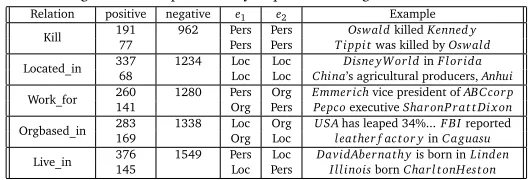
Figure 1: Example of entity sequences for a given sentence. Relation positive negative e1 e2 Example
Kill 19177 962 PersPers PersPers T ippitOswaldwas killed bykilledKenned yOswald
Located_in 33768 1234 LocLoc LocLoc China’s agricultural producers,Disne yWorldinF loridaAnhui
Work_for 260141 1280 PersOrg PersOrg EmmerichPepcoexecutivevice president ofSharonP rat t Di xonABCcor p
Orgbased_in 283169 1338 OrgLoc OrgLoc USAleather f actor yhas leaped 34%...inF BICaguasureported
Live_in 376145 1549 PersLoc PersLoc DavidAbernathyIllinoisbornCharl tonHestonis born inLinden
Table 1: Statistics of Entity Sequences in the RY dataset
order of the entities. In the case ofWork_Forrelation, thePersentity ise1and theOrgentity is e2. This ordering of entities is denoted ase1→e2. There are 260 examples of this ordering in Table 1. Conversely, there are 141 examples of typee2→e1whereOrgis the first entity and Persis the second entity. We have applied some heuristics forKillandLocated_Inbecause the candidate entities are of the same type. In the first example, onePersentity[Oswald]e1is acting upon anotherPersentity[President Kennedy]e2. According to our heuristic thus[Oswald]is denoted ase1and[President Kennedy]ise2. So the order of the entities ise1→e2. Similarly, in [Officer Tippit]ek, the Dallas policeman who was killed by[Oswald]eithe order of the entities is e2→e1. For theLocated_inrelation, when a location entity is inside another location entity we denote the contained entitye1and the container entity ase2. In the example[Disney World]ei in[Florida]ej, we have that[Disney World]ise1and[Florida]ise2. Similarly, in the example [China]ei’s major agricultural producers,[Anhui]ej,[China]becomese2and[Anhui]ise1.
3 Entity Sequence Kernel and SVM
classifier (e.g., a standard vector kernel) to classify entity sequences. Instead, gap weighted sequence kernels (Lodhi et al., 2002) are a perfect fit to handle instances where the order of the word sequences is essential. Thus, this kernel is a natural choice for our classification task. Given twoentity sequences sandt, an Entity Sequence Kernel Kescounts the number of subsequences of length n common to bothsandt. Formally, letFibe the feature space over the wordsin an ES. Similarly, we consider other disjoint feature spacesFj,Fk, ...,Fl(e.g., stem, POS tags, chunk tags) (Bunescu and Mooney, 2005a) where the set of all possible feature vectors F×=Fi×Fj×Fk×...×Fl. For any two feature vectorsx,y∈F×letsim(x,y)computes the number of similar (i.e., common) features betweenxandy. Given two entity sequencessand tover the finite setF×, let|s|denote the length ofs=s1...s|s|. Leti= (i1, ...,i|i|)be a sequence of|i|indices inswhere the length l(i) isi|i|−i1+1. Similarly,jis a sequence of|j|indices int. The kernel functionKes(s,t,λ)that calculates the number of weighted sparse subsequences of length n (say, n=2:bigram) common to bothsandt, is defined as:
Kes(s,t,λ) = �
i:|i|=n �
j:|j|=n n �
k=1
sim(sik,tjk)λ
l(i)+l(j) (2)
The recursive computation can be computed inO(kn|s||t|)time. The gap between the words is penalized with a suitable decay factorλ(0< λ <1). This decay factor in turn compensates for matches between lengthy word sequences. The design of the kernelKesis created by thepre, int ra, andpostpatterns, which have already been found useful in previous work of relation extraction (Giuliano et al., 2007; Bunescu and Mooney, 2005a). We define two separate kernels to effectively use the candidate entities and the word sequence before and after them. The relation kernel Krelmeasures the similarity betweensandtby adding up the evidences of various sub kernels over the word sequences (pre,postandint ra):Krel=Kprei+Kint+Kipost, where Kpreiconsists ofpre-entityandintra-entitysubstrings,Kintconsists ofintra-entitysubstring, andKipostconsists ofintra-entityandpost-entitysubstrings. Theentity kernel,Kentmeasures the similarity between the candidate entities(Kent =Ke1+Ke2)whereKe1is the kernel for the first entity, andKe2is the kernel for the second entity. The final entity sequence kernel is Kes=Krel+Kent.
Several features are used in computingsim(s,t)such as original word, stem, POS, chunk
infor-mation, dependency and WordNet hypernym features. Various preprocessing steps (sentence detection, POS tagging, chunking) are performed using the JTextPro3package. Rita.WordNet4 is used as the WordNet library to compute the similar hypernyms between words. Stanford Dependency Parser5is utilized to extract the dependency features. Often the entity sequences are just sequences of words which are non-grammatical as an utterance. Consequently, a parser will behave unexpectedly while parsing these sequences. Thus, we ran the Stanford Parser over the original sentences instead of the entity sequences. The grammatical relation with the governingtoken is used as a feature for the words. All the experiments are conducted using the LibSVM (Chang and Lin, 2001) package customized to augment the entity sequence kernel. The decay factorλwas set to 0.5 empirically. To reduce the data imbalance problem the cost factorWiwas set to be the ratio between the number of negative and positive examples. We have also performed an initial set of experiments using the shortest path dependency
3http://jtextpro.sourceforge.net/
4http://www.rednoise.org/rita/wordnet/documentation/ 5http:
Approach Direction Kill Located In Live In Prec. Rec. F1 Prec. Rec. F1 Prec. Rec. F1
BL e1→e2 65.5 73.5 69.3 74.1 67.6 70.7 59.5 61.7 60.6
BL e2→e1 87.1 70.1 77.6 68.0 32.4 43.9 80.5 40.9 54.2
BL+WN e1→e2 68.8 76.7 72.5 82.5 79.4 80.9 60.8 62.2 61.5
BL+WN e2→e1 92.6 64.6 76.6 71.0 29.7 41.7 84.5 41.2 55.4
BL+Dep+WN e1→e2 75.0 76.7 75.9 81.6 79.3 80.4 60.5 60.7 60.7
BL+Dep+WN e2→e1 94.6 66.7 78.1 73.3 29.6 42.2 85.9 41.3 55.8
Approach Direction OrgBased In Work For Prec. Rec. F1 Prec. Rec. F1
BL e1→e2 56.1 42.7 48.5 70.2 72.6 71.4
BL e2→e1 79.7 77.4 78.6 83.8 45.5 59.0
BL+WN e1→e2 69.9 60.5 64.9 67.3 72.4 69.8
BL+WN e2→e1 88.1 80.8 84.3 87.5 52.0 65.2
BL+Dep+WN e1→e2 54.2 44.8 49.1 69.5 75.9 72.6
[image:6.420.60.347.68.201.2]BL+Dep+WN e2→e1 83.0 80.8 81.9 87.8 54.1 67.0
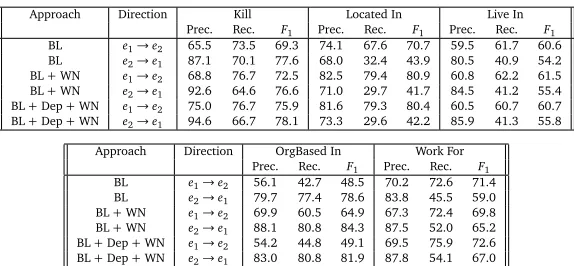
Table 2: Performance of entity sequence kernels (Kes) on both relation directions. kernel of Bunescu and Mooney (2005b) modified for our settings. We have modified the Entity Sequence Kernel to use only those words that occur on the shortest dependency path between the mentioned entities. Using the Stanford Dependency Parser we create the shortest path between two entities (eiandej) in the undirected version of the dependency graph. Thus an entity sequence - shortest path(ESSP)is defined asESSP=entit y1+ [sp] +entit y2, where
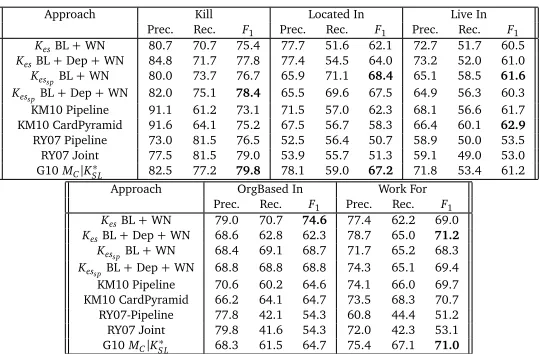
[sp]represents the words which appear on the shortest dependency path between entity1 and entity2. We define the shortest path entity sequence kernelKes_sp=Krel_sp+Kent, whereKrel_sp is based on the words present in[sp]. In Table 3, we notice that for three out of the five relations,Kes_spkernel outperforms the originalKeskernel.
4 Results and Discussion
Table 2 presents the results for each of the five relations, including directionality (e1→e2 vse2→e1). All scores are averaged over a 5-fold cross validation set. BLdenotes baseline features (word, stem, chunk, POS),Depis the dependency feature andWNis the WordNet hypernym similarity. For three relations (Kill,Work_ForandLive_In) thee1→e2relations have a higher recall but lower precision where thee2→e1have significantly higher precision for all the relations. For theKillrelation, there are 191 examples ofe1→e2direction and only 77 examples ofe2→e1(Table 1). This imbalance in number explains the general trend to express aKillrelation in text. The entity ordere1→e2(Oswald killed Kennedy) is more common than e2→e1(Kennedy was killed by Oswald).
Approach Kill Located In Live In Prec. Rec. F1 Prec. Rec. F1 Prec. Rec. F1
KesBL+WN 80.7 70.7 75.4 77.7 51.6 62.1 72.7 51.7 60.5 KesBL+Dep+WN 84.8 71.7 77.8 77.4 54.5 64.0 73.2 52.0 61.0 KesspBL+WN 80.0 73.7 76.7 65.9 71.1 68.4 65.1 58.5 61.6 KesspBL+Dep+WN 82.0 75.1 78.4 65.5 69.6 67.5 64.9 56.3 60.3 KM10 Pipeline 91.1 61.2 73.1 71.5 57.0 62.3 68.1 56.6 61.7 KM10 CardPyramid 91.6 64.1 75.2 67.5 56.7 58.3 66.4 60.1 62.9 RY07 Pipeline 73.0 81.5 76.5 52.5 56.4 50.7 58.9 50.0 53.5 RY07 Joint 77.5 81.5 79.0 53.9 55.7 51.3 59.1 49.0 53.0 G10MC|KS L∗ 82.5 77.2 79.8 78.1 59.0 67.2 71.8 53.4 61.2
Approach OrgBased In Work For
Prec. Rec. F1 Prec. Rec. F1
[image:7.420.83.353.68.245.2]KesBL+WN 79.0 70.7 74.6 77.4 62.2 69.0 KesBL+Dep+WN 68.6 62.8 62.3 78.7 65.0 71.2 KesspBL+WN 68.4 69.1 68.7 71.7 65.2 68.3 KesspBL+Dep+WN 68.8 68.8 68.8 74.3 65.1 69.4 KM10 Pipeline 70.6 60.2 64.6 74.1 66.0 69.7 KM10 CardPyramid 66.2 64.1 64.7 73.5 68.3 70.7 RY07-Pipeline 77.8 42.1 54.3 60.8 44.4 51.2 RY07 Joint 79.8 41.6 54.3 72.0 42.3 53.1 G10MC|KS L∗ 68.3 61.5 64.7 75.4 67.1 71.0
Table 3: Comparison with existing state-of-the-art systems (Average F1)
positives, which explains the higher precision. But since there are a small number of training examples (for a 5-fold cross validation, each fold has an average of 60 training instance), the recall is low. In the case ofOrgBased_InandLocated_Inwe observe two outcomes. First, for e1→e2the precision is little higher than the recall, unlike the other three relations. Even if we add features in the sequence kernel the concept of fuzzy matching is not helping to improve the recall for these two relations. We notice that a lot of of positive examples for these two relations are connected either by a single word or by punctuation. Consider the following examples, a) [Havana]ei[Radio Rebelda Network]ejin spanish GMT..., and b)[George Lucas]ei, a[Modesto]ej. Even if we add POS, Chunk, Dep features besides the word features, it will not help the classifier to improve the recall as there is not much useful information available. A single letter token likeais like a stop-word and does not help in classification. Thus, the recall does not change for these cases. Second, we notice that the dependency feature is not contributing much to these two relations. Stanford Parser does not recognize punctuation as relation markers. To test our hypothesis we observe that for these two relations (containing shorter sequences) the original gap sequence word kernel performs close to the baseline kernel (around 58% F1 for Located_Inand around 62.1% forOrgBased_In). However, forOrgBased_Inwe achieve a very high precision at the same time. WordNet hypernym help to match non-obvious terms like (FederationandNation), (CitizenandNational). In the case ofe2→e1forLocated_In, entities are mostly linked via the "possession" type of dependency relation. However, a lot of negative examples are linked like that; so by adding the dependency feature fore2→e1, we observe that the precision slightly decreases.
For Roth and Yih (2007), we report the results they obtain using their most sophisticated model which they call “E↔R" (RY07 in Table 3). For Kate and Mooney (2010) we show both the results of their card-pyramid method that performs joint modeling of entities and relations, and their pipeline approach (KM10 in Table 3). For (Giuliano et al., 2007) (G10 in Table 3) we use the results of theirMC|KS L∗ model which is the closest to ours (it uses entity boundaries but no entity types during training). Our method performs the best for three out of the five relations (OrgBased_In,Work_For,Located_In). For the other two relations our average F1 is very close to the best results, being 3rd forKill, 2nd forLive_In.
5 Related Work
Recently there has been a lot of research on relation extraction using kernel methods. In this section we review mainly two lines of work closely related to ours.
In Section 4 we have introduced several state-of-the-art approaches to relation extraction which have used the RY corpus. Roth and Yih (2007) have adopted an integer linear programming framework for joint extraction of entity and relations. Kate and Mooney (2010) have imple-mented a card-pyramid parsing technique where each candidate sentence is represented as a binary directed graph. The entities are placed on the leaf nodes and relations are on the higher levels in the graph. Giuliano et al. (2007) et al. have studied the relation extraction problem using a pipeline architecture, similar in nature to our approach but using linear kernel with only basic features. They ran an independent NER to recognize the entities in the sentences and used these new recognized entities as possible entity mentions for the relation extraction. However, we have not conducted any NER experiments to recognize entities and thus have used the available correct boundaries of entities in our research. Both Kate and Mooney (2010) and Giuliano et al. (2007) have mentioned the directionality issue of the relations but they only presented the micro-average F1 scores.
In terms of methodology, the closest approaches to ours are the ones using sequence kernels for relation extraction. Inspired by the string kernel of Lodhi et al. (2002), Bunescu and Mooney (2005a) created subsequence patterns between entities to extract top-level relations from the ACE dataset. In our work we use entity sequence kernes, and only consider the entity boundaries as given, and not entity types as in (Bunescu and Mooney, 2005a). Bunescu and Mooney (2005b) present a shortest path (between the entities) dependency tree kernel and evaluate it on the ACE 2002 dataset. However, as pointed out by (Giuliano et al., 2007) due to the varied datasets (e.g. ACE, SemEval) employed for these research it is a hard task to compare one against another. The generic trend is usually similar — sequence kernels have more flexibility and thus gap sequence kernels find similar subsequences and often results in a higher recall (Wang, 2008).
6 Conclusion
References
Bunescu, R. and Mooney, R. J. (2005a). Subsequence kernels for relation extraction. Proceed-ings of the 19th Conference on Neural Information Processing Systems (NIPS).
Bunescu, R. C. and Mooney, R. J. (2005b). A shortest path dependency kernel for relation ex-traction. Vancouver, BC. Proceedings of the Joint Conference on Human Language Technology
/Empirical Methods in Natural Language Processing (HLT/EMNLP).
Chang, C.-C. and Lin, C.-J. (2001). Libsvm: a library for support vector machines.
Giuliano, C., Lavelli, A., and Romano, L. (2007). Relation extraction and the influence of automatic named-entity recognition. ACM Transactions on Speech and Language Processing (TSLP), 5(2).
Kate, R. J. and Mooney, R. J. (2010). Joint entity and relation extraction using card-pyramid parsing. Number 203-212, Uppsala, Sweden. Proceedings of the Fourteenth Conference on Computational Natural Language Learning (CoNLL-2010).
Lodhi, H., Saunders, C., Taylor, J. S., Christianini, N., and Watkins, C. (2002). Text classification using string kernels.Journal of Machine Learning Research, 2:419–444.
Roth, D. and Yih, W. (2004). A linear programming formulation for global inference in natural language tasks.Proc. of the Annual Conference on Computational Natural Language Learning (CoNLL), pages 1–8.
Roth, D. and Yih, W. (2007). Global inference for entity and relation identification via a linear programming formulation.Introduction to Statistical Relational Learning.
Wang, M. (2008). A re-examination of dependency path kernel for relation extraction. In Proceedings of IJCNLP.