CVBed
: Structuring CVs using Word Embeddings
Shweta GargDelhi Technological University New Delhi, India
shweta [email protected]
Sudhanshu S Singh and Abhijit Mishra and Kuntal Dey IBM Research, New Delhi and Bangalore, India {sudsing3, abhijimi, kuntadey}@in.ibm.com
Abstract
Automatic analysis of curriculum vi-tae (CVs) of applicants is of tremen-dous importance in recruitment scenar-ios. The semi-structuredness of CVs, however, makes CV processing a chal-lenging task. We propose a solution to-wards transforming CVs to follow a uni-fied structure, thereby, paving ways for smoother CV analysis. The problem of restructuring is posed as a section rela-beling problem, where each section of a given CV gets reassigned to a prede-fined label. Our relabeling method re-lies onsemantic relatednesscomputed be-tween section header, content and labels, based onphrase-embeddingslearned from a large pool of CVs. We follow differ-ent heuristics to measure semantic relat-edness. Our best heuristic achieves an F-score of93.17% on a test dataset with gold-standard labels obtained using man-ual annotation.
1 Introduction
Automatic processing of curriculum vitae (CVs) is important in multiple real-life scenarios. This in-cludes analyzing, organizing and deriving action-able business intelligence from CVs. For corpo-rates, such processing is interesting in scenarios such as hiring applicants as employees, promot-ing and transitionpromot-ing employees to new rolesetc. For individuals, it is possible to add value by de-signing CV improvement and organization tools, enabling them to create more effective CVs spe-cific to their career objectives as well as main-tain the CVs easily over time. Hence, it is im-portant to transform CVs to follow a unified struc-ture, thereby, paving ways for smoother and more
effective manual/automated CV analysis.
The semi-structuredness of CVs, with the di-versity that different CVs exhibit, however, makes CV processing a challenging task. For example, a first CV could have sectionspersonal details, edu-cation, technical skills, project experience, man-agerial skills, others and a second CV, equiva-lent to the first one, could have sections about me, career objective, work experience, academic background, proficiency, professional interests, in that order. Note that, some sections are equiva-lent (e.g., personal details and about me) in the two CVs, some sections are simply absent in some CVs (e.g., any equivalent ofothersthat is present in the first CV, is missing in the second CV) and some sections in one CV is a composition of mul-tiple sections in another CV (e.g., proficiency in the second CV is a combination oftechnical skills andmanagerial skillsof the first). In real-life, the variations are high, and the solutions available to-day are far from perfect. Clearly, the problem at hand requires attention.
Multiple industrial solutions, such as Text Ker-nel1, Burning Glass2and Sovren3, have attempted to solve the problem at hand, and are offered as commercial products. Several researchers have also investigated the problem. Yu et al. (2005) proposed a hybrid (multipass) information extrac-tion model to assign labels to block of CVs. Subsequent works, such as Chuang et al. (2009) and Maheshwari et al. (2010), also used multi-pass approaches, and feature-based machine learn-ing techniques. Kopparapu (2010) suggested a knowledge-based approach, using section-specific keywords and n-grams. Tosik et al.(2015) found word embeddings to be more effective compared to word types and other features for CRF
mod-1https://www.textkernel.com 2http://burning-glass.com 3https://www.sovren.com
els. Singh et al. (2010) and Marjit et al. (2012), amongst others, also proposed different solutions.
We use a phrase-embedding based approach to identify and label sections, as well as investigate the usefulness of traditional language resources such as WordNet (Miller, 1995) and ConceptNet (Liu and Singh,2004). Empirically, our approach significantly outperforms other approaches.
2 Central Idea
As discussed earlier, CVs generally do not follow any predefined structure, and hence it would be hard to propose a deterministic (rule-based) solu-tion for parsing and categorizing the secsolu-tions of CV. This necessitates the application of statisti-cal classification to map each section of the CV to section-labels chosen from an exhaustive list of predefined labels. Now, applying supervised classification for this task would require a large amount of manually labeled training data which is extremely time consuming. Our approach, on the other hand, is based on unsupervised learning where each label is chosen based on thesemantic relatednessbetween the label and the section con-tent (in terms of section-header and section-body). For example, a section titled “Academic qualifica-tions” could be semantically closer to a predefined label “Education” than “Skills”; the section would thus be categorized under “Education”. We pro-pose two schemes for obtaining the semantic re-latedness between section headers, bodies and the predefined labels (discussed in Section3.2).
2.1 Scheme 1: Exhaustive Comparison
In the first scheme, we perform an exhaustive sim-ilarity comparison of all the words that appear in the given section of the test CV, with the label set. In this scheme, for each section extracted from the CVs, content words from the section headers and bodies are extracted and combined. Alexical sim-ilarity measure is computed, between each label in the label-set and each word extracted from the section. The average lexical similarity score for each label, with all the words in the section, is then computed. The label with the highest average sim-ilarity score is selected as the winner label. The in-tuition behind this scheme is that, labels that share maximum lexical similarity with section have the maximum semantic relatedness with the section, hence, most appropriate.
Formally, let L = {l1, l2, ..., ln} be the set
of available labels. Let W = {w1, w2, ..., wm}
be the set of words present in a given section. Letσ(wi, lj) represent the semantic similarity of
wordwi with the labellj. The average similarity
λ(lj, W) of label lj with the set of wordsW is
For computing semantic similarity σ, we use WordNet (Miller, 1995) pathsimilarity (Leacock and Chodorow, 1998) and Wu-Palmer similarity (Wu and Palmer,1994) and ConceptNet (Liu and Singh, 2004; Havasi et al., 2007) based similar-ity (Spagnola and Lagoze, 2011). The systems variants for these three similarity measures are, henceforth, referred to as PATH, WUP, CONCEPT. As expected, WordNet and ConceptNet offer lim-ited coverage, resulting in many of the similarity scores as0. We therefore propose another variant (referred to as EMBEDDING) where lexical simi-larity is the cosine simisimi-larity between the dings of the two input words. The word embed-dings are learned using the training data consist-ing of 1179 CVs (detailed in Section 3.1) using the skip-gram approach (Mikolov et al.,2013a,b), implemented with the help ofgensimpackage in python (ˇReh˚uˇrek and Sojka, 2010). The embed-ding dimension, min count, and window size were empirically set to 100, 5 and 4 respectively, and the vocabulary size turned out to be7970.
2.2 Scheme 2: MultiEmbedding
In the second scheme, we employ MULTIEM -BEDDING, arepresentative word-cluster similarity
based approach. Here, instead of directly com-paring the words appearing in the test data, we do the following. First, content words from sec-tion header and body are extracted and combined to form the set of wordsW = {w1, w2, ..., wm},
as discussed earlier. Their embeddings (W) =
{(w1), (w2), ..., (wm)}are then extracted. The
embeddings are averaged, to find the average em-bedding of the section, as:
E(W) =
m
P
i=1(wi)
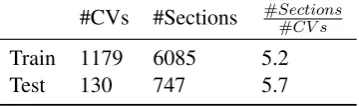
#CVs #Sections #Sections#CV s Train 1179 6085 5.2
Test 130 747 5.7
Table 1: Dataset statistics
We then extract the top M words, W0, from
the training-data vocabulary, based on the co-sine similarity between the averaged embedding E(W0) and the vocabulary words W.
Intu-itively, these words act as the representative clus-ter of words, semantically most similar to the section content. The embeddings of these top M words in the vocabulary are then obtained as (W0) = {(w
10), (w20), ..., (wm0)} and
aver-aged in a manner similar to Equation3, to obtain E(W’). Then, for each labellj ∈L, the cosine
sim-ilarity ofljand the averaged embeddingE(W0)is
calculated. The winner label is the one that shows up the maximum cosine similarity.
2.3 Split Section Approach
One of the main drawbacks of the schemes pro-posed is that they do not treat section headers and body-content separately. In practice, how-ever, section headers can sometimes play a cru-cial role in determining the category that the sec-tion should belong to. This motivated us to pro-pose other set of variants, in which section header and body-content are treated as two separate enti-ties. The steps in the schemes proposed are car-ried independently on header and body-content. After lexical similarity with labels for both body and header are computed separately, the win-ner label is selected through voting. This idea lead to 5 more model variants such as SPLIT -PATH, SPLITWUP, SPLITCONCEPT, SPLITEM -BEDDING, SPLITMULTIEMBEDDING.
We also implemented other variants such as: (a) averaging embeddings of words in the test data and then comparing the cosine similarity between the averaged resultant embedding with label em-beddings (b) getting the topM words using Word-Net and ConceptWord-Net similarities. But these meth-ods did not perform well, hence, results are not reported for these methods.
3 Experimental Setup
3.1 Dataset Creation and Preprocessing
Since, there is no publicly available standard CV dataset, we randomly pulled out 1309 number of CVs by requesting the recruitment division of a multinational organization (anonymized in this version). Since CVs can come up with dif-ferent file formats (such as pdf, html etc.), we converted every CV to docx format using the abiword application4, thereby preserving meta information about sections. Thedocxfiles are then processed using the docx package in
pythonto separate out section headers and bod-ies for each CV. Textual noise in the form of non-Unicode characters and escape characters are then removed. Table 1 presents a detailed statistics about the number of CVs and number sections thus obtained.
3.2 Defining Labels
Our task intends to eventually help in analysis of CV by categorizing them, making it necessary for us to define a label-set that ensures decent cov-erage while maintaining a proper level of gran-ularity. If the labels are too coarse or too fine, it will considerably increase the effort of analyz-ing the CVs and our task will be ineffective. We, thus, carefully chose 30 labels from the Text Kernel5 platform, which provides a consider-able coverage while balancing the granularity. The labels are shared in the supplementary material. In future, we plan to include important multi-word labels in our label set.
3.3 Test Data Annotation
To evaluate our methods against ground truth, we employed two software professionals (with ac-ceptable working proficiency in English) to an-notate the sections in the test data. The inter-annotator agreement between the inter-annotators turns out to be 669out of the 747sections (89.56%), with78non-agreements. We manually inspect all the cases of non-agreement, and find that these are very similar. Some examples of such confu-sion pairs areskillsvs. interests, trainingvs. in-ternship, etc. In order to resolve, in a label pre-processing step, we randomly choose one of the non-agreeing two labels and assign the chosen la-bel to the test instances, before we perform ground
truth validation. The labels provided by the anno-tators are compared with the output generated by our system, to obtain precision, recall, accuracy and F-score measures.
4 Results and Insights
We present the results and insights obtained from the experiments in this section.
4.1 Results
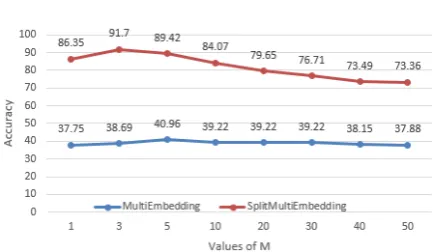
Figure 1: Variation of accuracy with M, the num-ber of representative words chosen
From Table 2, we observe that the SPLITEM -BEDDING method, which is the embodiment of Scheme 1 (given in Section2.1) whereσ(wi, lj),
the semantic similarity of wordwi with the label
lj, is computed using embedding, yields the
high-est precision across all the methods. However, SPLITMULTIEMBEDDING, a variant of Scheme 2 (given in Section 2.2) where the embeddings of section header and body are independently com-puted, and a weighted combination of the embed-dings is used to retrieve the representative words of the section to compare with the embeddings of the labels, delivers the highest recall and F-score values, as well as, the highest overall ac-curacy. Thus, the SPLITMULTIEMBEDDING ap-proach with M = 3 empirically turns out to be the most effective approach. Overall,4of the ap-proaches deliver strong performances (F-score >
80%): SPLITMULTIEMBEDDING, SPLITEMBED -DING, SPLITPATHand SPLITWUP.
Figure 1 shows the impact of varying M, on the system accuracy, for the MULTIEMBEDDING and SPLITMULTIEMBEDDING approaches. It is evident from the figure that for SPLITMULTIEM -BEDDING, the most effective value is M = 3, while for SPLITEMBEDDINGthe value isM = 5. Beyond these values of M, too many words get chosen, which in turn confuses the system.
4.2 Error Analysis
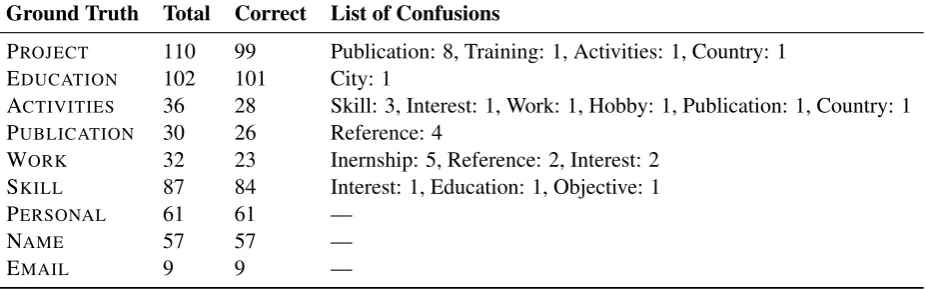
We investigate the errors that our system makes, by comparing the section headers we obtain, with ground truth. Table3 captures a random sample of the classifications made by our system. Note that, CVs that contain Personal sections (includ-ing name, email and other details inside the sec-tion), have always been classified with 100% accu-racy. This also applies for CVs that have separate section headers for identification, such as Name, Emailetc. On the other hand, for sections that are intuitively more complex, show some (meaning-ful) confusions across classes. For example, one would naturally assume Activities to have seman-tic overlaps with Skill, and similarly Work with Internship, and Project with Publications, among others. A few confusions are more intriguing, such as Project with Country (1 instance), and Edu-cation with City (1 instance). These confusions are rare although existent, showing the effective-ness of our system in general though there are per-haps some corner cases that can potentially be im-proved in the future.
5 Discussion
One aspect to note is that the approaches where the CV section header and body content are split, and the embeddings are subsequently combined in a weighted manner, outperform the approaches where the section header and body are given equal weightage. This conforms to the intuition that sec-tion headers bear a higher significance, compared to words that tend to appear in section bodies.
Further, we observe that the word embed-ding based approaches consistently and signifi-cantly outperform the WordNet and ConceptNet based approaches. While WordNet and Concept-Net are valuable lexical resources on their own, but clearly a predefined knowledge representation proves to be inadequate to capture the intricacies that CVs tend to present in real life. This high-lights (a) the inherent challenge in dealing with the semi-structured and heterogeneous data that CVs present to computational systems, as well as (b) the importance of learning the lexical characteris-tics from the core application domain.
6 Conclusion
Approach Precision Recall F-Score Accuracy
PATH 79.224 50.870 61.96 50.870
SPLITPATH 92.367 83.936 87.95 83.936
WUP 48.838 30.656 37.67 30.656
SPLITWUP 92.223 83.936 87.88 83.936
CONCEPT 58.241 43.507 49.81 43.507
SPLITCONCEPT 77.054 72.155 74.52 72.155
EMBEDDING 79.277 30.522 44.07 30.522
SPLITEMBEDDING 95.029 86.613 90.63 86.613
MULTIEMBEDDING(M = 3) 77.183 38.688 51.54 38.688 SPLITMULTIEMBEDDING(M = 3) 94.687 91.700 93.17 91.700
Table 2: Results for relabeling task for multiple approaches, numbers are shown in %
Ground Truth Total Correct List of Confusions
PROJECT 110 99 Publication: 8, Training: 1, Activities: 1, Country: 1
EDUCATION 102 101 City: 1
ACTIVITIES 36 28 Skill: 3, Interest: 1, Work: 1, Hobby: 1, Publication: 1, Country: 1
PUBLICATION 30 26 Reference: 4
WORK 32 23 Inernship: 5, Reference: 2, Interest: 2 SKILL 87 84 Interest: 1, Education: 1, Objective: 1
PERSONAL 61 61 —
NAME 57 57 —
EMAIL 9 9 —
Table 3: Confusion matrix, showing some randomly chosen ground truth classes from actual CV section headers, and our system predictions in the form of<incorrect class: incorrect classification count of our system for that class>
section of given CVs, learning phrase embeddings from a pool of training CVs, and exploring several heuristics to compute the semantic relatedness be-tween section headers, section contents and avail-able labels. Our best heuristic achieves an F-score of93.17%on a test dataset, with gold-standard la-bels obtained using manual annotation. Our sys-tem is useful in practical scenarios such as appli-cant management for recruitments, employee ca-reer management, and automated CV creation and maintenance for individuals.
References
Zhang Chuang, Wu Ming, Li Chun Guang, Xiao Bo, and Lin Zhi-qing. 2009. Resume parser: Semi-structured chinese document analysis. InComputer Science and Information Engineering, 2009 WRI World Congress on. IEEE, volume 5, pages 12–16. Catherine Havasi, Robert Speer, and Jason Alonso.
2007. Conceptnet 3: a flexible, multilingual seman-tic network for common sense knowledge. InRecent
advances in natural language processing. John Ben-jamins Philadelphia, PA, pages 27–29.
Sunil Kumar Kopparapu. 2010. Automatic extraction of usable information from unstructured resumes to aid search. InProgress in Informatics and Comput-ing (PIC), 2010 IEEE International Conference on. IEEE, volume 1, pages 99–103.
Claudia Leacock and Martin Chodorow. 1998. Com-bining local context and wordnet similarity for word sense identification. WordNet: An electronic lexical database49(2):265–283.
Hugo Liu and Push Singh. 2004. Conceptneta practi-cal commonsense reasoning tool-kit. BT technology journal22(4):211–226.
Sumit Maheshwari, Abhishek Sainani, and P Reddy. 2010. An approach to extract special skills to improve the performance of resume selection. Databases in Networked Information Systemspages 256–273.
International Journal of Web & Semantic Technol-ogy3(2):51.
Tomas Mikolov, Kai Chen, Greg Corrado, and Jef-frey Dean. 2013a. Efficient estimation of word representations in vector space. arXiv preprint arXiv:1301.3781.
Tomas Mikolov, Ilya Sutskever, Kai Chen, Greg S Cor-rado, and Jeff Dean. 2013b. Distributed representa-tions of words and phrases and their compositional-ity. InAdvances in neural information processing systems. pages 3111–3119.
George A Miller. 1995. Wordnet: a lexical database for english. Communications of the ACM 38(11):39– 41.
Radim ˇReh˚uˇrek and Petr Sojka. 2010. Software Frame-work for Topic Modelling with Large Corpora. In Proceedings of the LREC 2010 Workshop on New Challenges for NLP Frameworks. ELRA, Valletta, Malta, pages 45–50. http://is.muni.cz/
publication/884893/en.
Amit Singh, Catherine Rose, Karthik Visweswariah, Vijil Chenthamarakshan, and Nandakishore Kamb-hatla. 2010. Prospect: a system for screening can-didates for recruitment. InProceedings of the 19th ACM international conference on Information and knowledge management. ACM, pages 659–668. Steve Spagnola and Carl Lagoze. 2011. Edge
de-pendent pathway scoring for calculating semantic similarity in conceptnet. In Proceedings of the Ninth International Conference on Computational Semantics. Association for Computational Linguis-tics, pages 385–389.
Melanie Tosik, Carsten Lygteskov Hansen, Gerard Goossen, and Mihai Rotaru. 2015. Word embed-dings vs word types for sequence labeling: the curi-ous case of cv parsing. InVS@ HLT-NAACL. pages 123–128.
Zhibiao Wu and Martha Palmer. 1994. Verbs semantics and lexical selection. InProceedings of the 32nd an-nual meeting on Association for Computational Lin-guistics. Association for Computational Linguistics, pages 133–138.