A Study of Concrete Using Copper Slag as a
Partial Replacement of Fine Aggregate
B. Janakiramaiah1, Dr. B. Ramesh Babu2,G. Raghu Yadav3
M.Tech, Dept. of Civil Engineering, ALITS College, Affiliated to JNTUA, AP, India1
Principal, ALITS College, Affiliated to JNTUA, AP, India2
Dept. of Civil Engineering, ALITS College, Affiliated to JNTUA, AP, India3
ABSTRACT: The paper was focused on the characteristics of copper slag and its effects on the engineering properties of cement, mortars and concrete. Wu et al investigated the mechanical properties of copper slag and reinforced concrete under dynamic compression. The results showed that the dynamic compressive strength of copper slag reinforced concrete generally improved with the increase in amounts of copper slag used as a sand replacement up to 20%, compared with the control concrete, beyond which the strength was reduced. also investigated the mechanical properties of high strength concrete incorporating copper slag as a fine aggregate. The results indicated that the strength of concrete, with less than40% copper slag replacement, was higher than or equal to that of the control specimen. The microscopic view demonstrated that there were limited differences between the control concrete and the concrete with less than 40%copper slag content.
Based on above investigations, this research study was conducted to investigate the performance of concrete made with copper slag as a partial replacement for fine aggregate. Three test groups were constituted with replacement: 0%, 10%, 30%, and 50% of copper slag withstand in each series.
I. INTRODUCTION
The utilization of industrial waste or secondary materials has encouraged the production of cement and concrete in construction field. Newby-products and waste materials are being generated by various industries. Dumping or disposal waste materials causes environmental and health problems. Therefore, recycling of waste materials is a great potential in concrete industry.
For many years, by-products such as fly ash, silica fume and slag were considered as waste materials. Concrete prepared with such materials showed improvement in workability and durability compared to normal concrete and has been used in the construction of power, chemical plants and under-water structures. Over recent decades, intensive research studies have been carried out to explore all possible reuse methods. Construction waste, blast furnace, steel slag, coal fly ash and bottom ash have been accepted in many places as alternative aggregates in embankment, roads, pavements, foundation and building construction, raw material in the Manufacture of ordinary Portland cement pointed out by Teik thye luin et al.
Copper slag is an industrial by-product material produced from the process of manufacturing copper. For every ton of copper production, about2.2 tons of copper slag is generated. It has been estimated that approximately 24.6 million tons of slag are generated from the world copper industry (Gorai et al). Although copper slag is widely used in the sandblasting industry and in the manufacturing of abrasive tools, the remainder is disposed of without any further reuse or reclamation. Copper slag possesses mechanical and chemical characteristics that qualify the material to be used in concrete as a partial replacement for Portland cement or as a substitute for aggregates. For example, copper slag has a number of favorable mechanical properties for aggregate use such as excellent soundness characteristics, good abrasion resistance and good stability reported by (Gorai et al). Copper slag also exhibits pozzolanic properties since it contains low CaO. Under activation with NaOH, it can exhibit cementations property and can be used as partial or full replacement for Portland cement.
slag in the concrete industry as a replacement for cement can have the benefit of reducing the costs of disposal and help in protecting the environment. Despite the fact that several studies have been reported on the effect of copper slag replacement on the properties of Concrete, further investigations are necessary in order to obtain a comprehensive understanding that would provide an engineering base to allow the use of copper slag in concrete.
II. RELATED WORK
Al-Jabri et al (2009) has investigated the performance of high strength concrete (HSC) made with copper slag as a fine aggregate at constant workability and studied the effect of super plasticizer addition on the properties of HSC made with copper slag. Two series of concrete mixtures were prepared with different proportions of copper slag. The first series consisted of six concrete mixtures prepared with different proportions of copper slag at constant workability. The water content was adjusted in each mixture in order to achieve the same workability as that of the control mixture. Twelve concrete mixtures were prepared in the second series. Only the first mixture was prepared using super plasticizer whereas the other eleven mixtures were prepared without using super plasticizer and with different proportions of copper slag used as sand replacement.
Wei wu et al (2010) investigated the mechanical properties of high strength concrete incorporating copper slag as fine aggregate. The workability and strength characteristics were assessed through a series of tests on six different mixing proportions at 20% incremental copper slag by weight replacement of sand from 0% to 100%. A high range water reducing admixture was incorporated to achieve adequate workability. Micro silica with a specific gravity of 2.0 was used to supplement the cementations contenting the mix for high strength requirement. The following conclusions wiredrawn from this study. The results indicated that the strength of concrete with less than 40% copper slag replacement was higher than or equal tithe control specimen.
The microscopic view also suggest that the microstructure of concrete with more than 40% copper slag contains more voids, micro cracks, and capillary channels that accelerate the damage of concrete during loading.
The surface water absorption decreases constantly until 40%of copper slag substitution.
Cajun Shi et al (2008) reviewed the characteristics of copper slag and its effects on the engineering properties of cement, mortars and concrete and they concluded that the utilization of copper slag in cement and concrete provides additional environmental as well as technical benefits for all related industries, particularly in areas where a considerable amount of copper slag is produced. When it is used as a cement replacement or an aggregate replacement, the cement, mortar and concrete containing different forms of copper slag have good performance in comparison with ordinary Portland cement having normal and even higher strength.
III. PROCEDURE
A. CEMENT
An OPC 43 Grade cement was used in this investigation. The quantity required for this work was assessed and the entire quantity was purchased and stored properly in casting yard. The following tests were conducted in accordance with IS codes.
1. Specific gravity (Le – Hotelier flask) (IS: 1727-1967) 2. Standard consistency (IS: 4031 – 1988 Part 4) 3. Initial setting time (IS: 4031 – 1988 Part 5) 4. Final setting time (IS: 4031 – 1988 Part 5)
i. SPECIFIC GRAVITY (LE – CHATELIER FLASK) (IS: 1727-1967) PROCEDURE
Specific gravity of pozzolanic shall be determined on the material as received, unless otherwise specified.
Fill the flask with kerosene or naphtha to a point on the stem between the zero and the 1 ml mark and replace the stopper. Then immerse the flask in a constant temperature water bath, maintained at about room temperature for sufficient interval to avoid greater than ± 0.2ºC in the temperature of the liquid in the flask. Take the reading of the liquid in the flask.
expel any bubble in the pozzolanic, the level of the liquid will be in its final position at some point of the upper series of graduations. The reading shall be taken after the flasks immersed in the eater bath.
Note 1 – A rubber pad on the table may be used when filling or rolling the flask.
Note 2 ̶ The flask may be held in a vertical position in the water bath by means of a burette clamp.
Calculation: The difference between the first and final readings represents the volume of liquid displaced by the weight of cement used in the test. Specific gravity shall be calculated as follows:
Specific gravity =
ii. STANDARD CONSISTENCY (IS: 4031 – 1988 PART 4) PROCEDURE
The standard consistency of a cement paste is defined as that consistency which will permit the Vicat plunger G shown in IS : 5513-l 976*to penetrate to a point 5 to 7 mm from the bottom of the Vicat mould when the cement paste is tested as described in 5.2 to 5.4.
Prepare a paste of weighed quantity of Cement with a weighed quantity of potable or distilled water, taking care that the time of gauging is not less than 3 minutes, nor more than 5 min, and the gauging shall be completed before any sign of setting occurs. The gauging time shall be counted from the time of adding water to the dry cement until commencing to fill the mould. Fill the Vicat mould E with this paste, the mould resting upon a non-porous plate. After completely filling the mould, smoothen the surface of the paste, making it level with the top of the mould. The mould may be slightly shaken to expel the air.
Clean appliances shall be used for In filling the mould, the operator’s hand on the blade of the gauging trowel shall alone be used. Place the test block in the mould, together with the non-porous resting plate, under the rod bearing the plunger; lower the plunger gently to touch the surface of the test block, and quickly release, allowing it to sink into the paste. This operation shah be carried out immediately after filling the mould. Prepare trial pastes with varying percentages of water and test as described above until the amount of water necessary for making up the standard consistency as defined in 5.1 is found.
iii. Initial setting time (IS: 4031 – 1988 Part 5) Determination of Initial Setting Time
Place the test block confined in the mould and resting on the non-porous plate, under the rod bearing the needle ( C ); lower the needle gently until it comes in contact with the surface of the test block and quickly release, allowing it to penetrate into the test block. In. the beginning, the needle will completely pierce the test block. Repeat this procedure until the needle, when brought in contact with the test block and released as described above, fails to pierce the block beyond5.0 ± 0.5 mm measured from the bottom of the mould. The period elapsing between the time when water is added to the cement and the time at which the needle fails to pierce the test block to a point 5.0 ± 0.5 mm measured from the bottom of the mould shall be the initial setting time.
iv. FINAL SETTING TIME (IS: 4031 – 1988 PART 5) Determination of Final Setting Time
TABLE 1 Test on cement
1 Specific Gravity 3.10
2 Standard consistency 31.5%
3 Initial setting time 57 min
4 Final setting time 4 hour
5 Soundness test (Le- Hotelier's test) 0.95mm
IV. RESULTS
A. FINE AGGREGATE
The fine aggregate used in this investigation was clean river sand and the following tests were carried out on sand as per IS: 2386- 1968 (III).
1. Sieve analysis and fineness modulus 2. Water absorption test on fine aggregate 3. Specific gravity of sand
4. Voids in sand
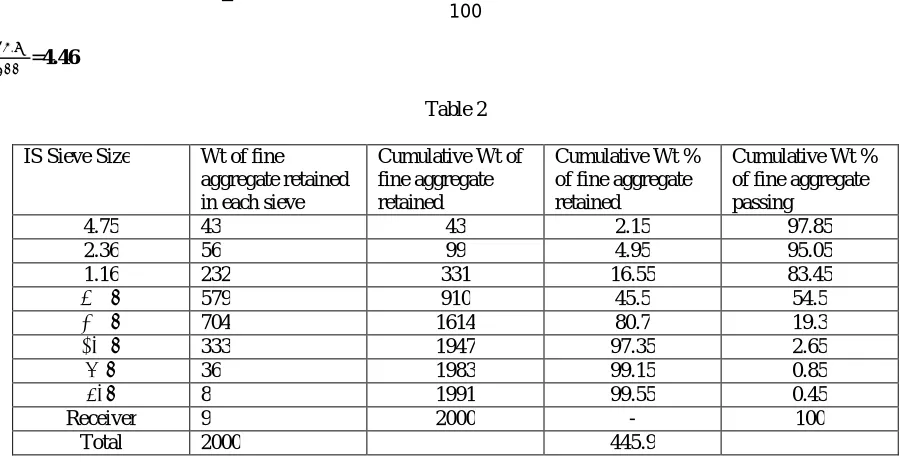
a. SIEVE ANALYSIS AND FINENESS MODULUS Sample Taken = 2000 g
Finenessmodulusof ine aggregate
= CumulativeWt%of ine aggregateineachsieve
100
= . =4.46
Table 2
IS Sieve Size Wt of fine aggregate retained in each sieve
Cumulative Wt of fine aggregate retained
Cumulative Wt % of fine aggregate retained
Cumulative Wt % of fine aggregate passing
4.75 43 43 2.15 97.85
2.36 56 99 4.95 95.05
1.16 232 331 16.55 83.45
600μ 579 910 45.5 54.5
300μ 704 1614 80.7 19.3
150μ 333 1947 97.35 2.65
90μ 36 1983 99.15 0.85
75μ 8 1991 99.55 0.45
Receiver 9 2000 - 100
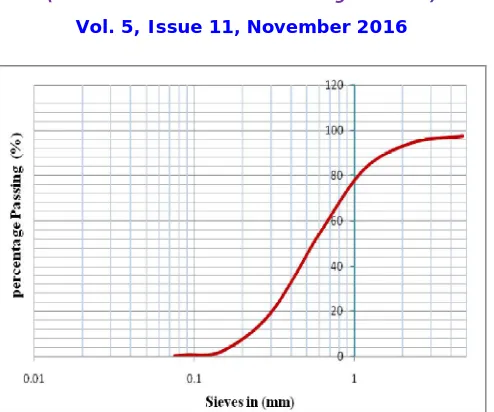
Fig 1 Finesse modulus graph on fine aggregate
TABLE 3 Test on fine aggregate
1 Sieve analysis and fineness modulus 4.46
2 Water absorption test on fine aggregate 1.5%
3 Specific gravity of sand 2.632
4 Voids in sand 38.46%
B. COURSE AGGREGATE
In the present investigation, locally available crushed blue granite stone aggregate of size 20 mm and down, was used and the various tests, carried out on the aggregates, are given below.
1. Sieve analysis for course aggregate 2. Water absorption test on course aggregate 3. Specific gravity of course aggregate 4. Aggregate impact test
SIEVE ANALYSIS FOR COURSE AGGREGATE
Table 4 IS Sieve Size Wt of course
aggregate retained in each sieve
Cumulative Wt of course aggregate retained
Cumulative Wt % of course aggregate retained
Cumulative Wt % of course aggregate passing
20 169 169 16.9 83.1
16 450 619 61.9 38.1
12.5 312 931 93.1 6.9
10 54 985 98.5 1.5
6.3 4 989 98.9 1.1
4.75 6 995 99.5 0.5
Receiver 5 1000 - -
Total 1000 g
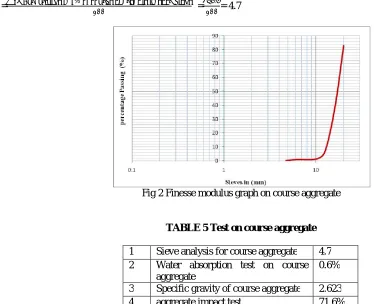
= % = .= 4.7
Fig 2 Finesse modulus graph on course aggregate
TABLE 5 Test on course aggregate
C. COPPER SLAG
Copper slag is a by-product material produced from the process of manufacturing copper. As the copper settles down in the smelter, it has a higher density, impurities stay in the top layer and then are transported to a water basin with a low temperature for solidification.
SIEVE ANALYSIS REPORT OF COPPER SLAG
Table 6
S.No Sieve Size mm
Weight Retained gm
Total Weight Retained gm
Total Weight Passing gm
% Passing
% Retained
1 4.75 0 0 500 100 0
2 2.36 29 29 471 94.2 5.8
3 1.18 106 135 365 73 27
4 0.6 154 289 211 42.2 57.8
5 0.3 5 294 206 41.2 58.8
6 0.15 197 491 9 1.8 98.2
7 ≤0.075 9 500 0 0 100
1 Sieve analysis for course aggregate 4.7 2 Water absorption test on course
aggregate
0.6%
Fineness modulus of copper slag = 3.476
Fig 3 Finesse modulus graph on copper slag
PHYSICAL PROPERTIES OF COPPER SLAG
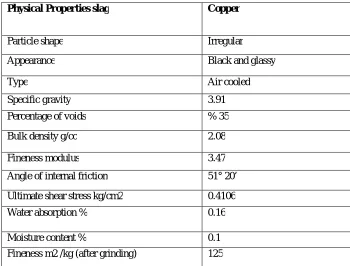
Copper slag is black glassy and granular in nature and has a similar particle size range like sand. The specific gravity of Indian slag lies between3.4 and 4.1. The bulk density of copper slag varies between 1.9 to 2.15 kg/m3which is almost similar to the bulk density of conventional fine aggregate.
TABLE 7 Physical Properties of copper slag
Physical Properties slag Copper
Particle shape Irregular
Appearance Black and glassy
Type Air cooled
Specific gravity 3.91
Percentage of voids % 35
Bulk density g/cc 2.08
Fineness modulus 3.47
Angle of internal friction 51° 20’
Ultimate shear stress kg/cm2 0.4106
Water absorption % 0.16
Moisture content % 0.1
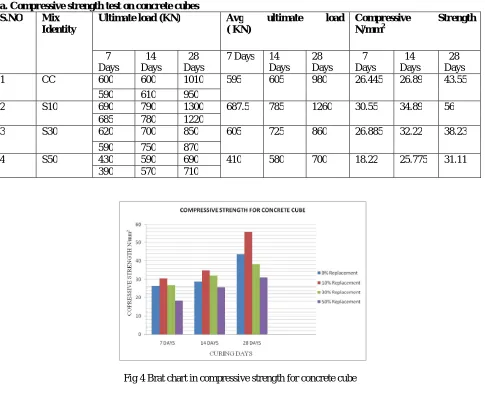
a. Compressive strength test on concrete cubes
S.NO Mix
Identity
Ultimate load (KN) Avg ultimate load
( KN)
Compressive Strength
N/mm2
7 Days
14 Days
28 Days
7 Days 14 Days
28 Days
7 Days
14 Days
28 Days
1 CC 600 600 1010 595 605 980 26.445 26.89 43.55
590 610 950
2 S10 690 790 1300 687.5 785 1260 30.55 34.89 56
685 780 1220
3 S30 620 700 850 605 725 860 26.885 32.22 38.23
590 750 870
4 S50 430 590 690 410 580 700 18.22 25.775 31.11
390 570 710
Fig 4 Brat chart in compressive strength for concrete cube
TABLE 9 Split Tensile Strength Test on Concrete Cylinders
S.NO Mix Identity Ultimate load (KN) Yavg ultimate load (KN)
Spilt tensile Strength N/mm2
7 DAYS
28 DAYS
7 DAYS
28 DAYS
7 DAYS 28 DAYS
1 CC 110 200 115 205 1.625 2.9
120 210
2 S10 130 220 140 235 1.98 3.326
150 250
3 S30 120 210 125 220 1.765 3.11
130 230
4 S50 110 190 105 195 1.485 2.755
Fig 5 Bar chart for Spilt tensile test in cylinder
V. CONCLUSION
Based on the investigations, the following conclusions were drawn. The utilization of copper slag in concrete provides additional environmental as well as technical benefits for all related industries. Partial replacement of copper slag in fine aggregate and cement reduces the cost of making concrete. Replacement of copper slag (100% replacement with sand)increases the self weight of concrete specimens to the maximum of 15-18%. The results of compressive, split tensile strength test have indicated that the strength of concrete increases with respect to the percentage of copper slag added by the weight of fine aggregate up to 10% (S10). Further additions of copper slag caused reduction in strength due to an increase of free water content in the mix. Utilization of copper slag as Portland cement replacement in concrete and as a cement raw material has the dual benefit of eliminating the costs of disposal and lowering the cost of the concrete. It was observed that, the copper slag replacement for sand is more effective than cement. Accelerated corrosion test reveals that the corrosion rate From these results, it can be concluded that copper slag is a good backfill material than sand and it can be used as backfill in retaining walls.
REFERENCES
[1] Alnuaimi AS,(2012), “Effects of Copper Slag as aReplacement for Fine Aggregate on the Behavior andUltimate Strength of Reinforced Concrete SlenderColumns”, TJER,Vol. 9, No. 2, pp 90-102.
[2] Ariño Antonio M. ,BarzinMobasher,( 1999), “Effect ofGround Copper Slag on Strength and ToughnessofCementitious Mixes”, ACI Materials Journal, Vol. 96, No.1, pp 68-74.
[3] Barnett Stephanie J., Marios N. Soutsos, John H. Bungey,Steve G. Millard,( 2007), “Fast-Track Construction withSlag Cement Con crete: Adiabatic Strength Developmentand Strength Prediction”, ACI Materials Journal, V. 104,No. 4, pp 388-396.concrete and dry lean concrete with copper slag as fine
[4] Brindha D. And S. Nagan, (2011), “DDurability Studies onCopper Slag Admixed Concrete”, Asian Journal of CivilEngineering (Building and Housing), Vol. 12, No. 5, pp563-578.