Development of Alternative Energy System for
Wearable Electronic Device
S. M. Dhavale1, N. M. Kulkarni2, A. D. Shaligram3
Research Scholar, Department of Electronic Science, Fergusson College, Pune, India1
Associate Professor, Department of Electronic Science, Fergusson College, Pune, India2
Professor, Department of Electronic Science, Savitribai Phule Pune University, Pune, India3
ABSTRACT:The wearable electronic device has drawn a lot of attention of researcher from last few decades. These
electronic devices require energy which is provided through battery. The battery has limitation because of that there is a need to search alternative energy for electronic device. The alternative source of energy supplements batteries in wearable electronics application. Alternative energy harvesting is new trend and used in many electronic applications. In this research work, the main focus is to generate electrical energy while moving small weight up and down. This alternative energy adds with the energy provided for wearable electronic device. While moving weight up and down through pulley electrical energy is generated. The pulley is attached to the shaft of generator which generates small electrical energy. The generated electrical energy is added with battery through energy harvesting module. The energy harvesting module adds small amount of energy generated with previously generated. The generated energy can stored for long time using the captured energy further charges the rechargeable batteries used for wearable electronic devices.
KEYWORDS: Alternative Energy Harvesting, Energy Harvesting Module, Generator, Wearable Electronic Device,
Weight lifting technique.
I.INTRODUCTION
The term Alternative Energy Harvesting is popularly used when electricity is generated from sources such as ambient temperature, vibrations or movement of human body [1, 3]. Since there are now electronic circuits whose power requirement is of the order of mill watts, even though its energy yield is relatively low.Energy is one of the inputs for economical development of country. Energy generation and utilization are two sides of coin. Development without energy is unthinkable. Economic growth is desirable for developing countries and energy is essential for economic growth [4-5].
Electronic technologies have been growing rapidly throughout the last few decades. Uses of electronic devices in day to day life have also drastically increased. Every electronic device requires energy. Energy is either generated or harvested.
II. METHODOLOGY AND EXPERIMENTATION
The electrical energy is generated through the movement of weight up and down. The weight is connected to shaft of generator through pulley. The following Fig. 1 shows the experimental setup of energy generated from weight lifting technique.
Fig. 1 Experimental setup of energy generated from weight lifting technique
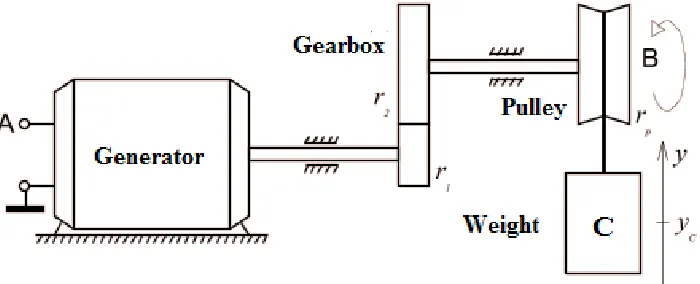
In this work, energy harvested from the movement of shaft of generator. The main block of energy harvesting system is the generator. Here shaft of generator is connected to pulley. The weight is attached to pulley through thin rope. The weight mechanically goes up and down while applying external force to pulley with the movement of weight up and down, pulley move forward and backward direction. The generator converts mechanical energy into electrical energy. In this work the pulley is attached to shaft of generator because of that while weight moves up and down cause’s movement of the shaft of generator. The movement of shaft generates electrical energy.
Fig. 2 shows the experimental setup of energy generated from weight lifting technique with gearbox.
Fig. 2 Experimental setup of energy generated from weight lifting technique with gearbox
The generator used for the present experimentation has 100rpm at 12V.The other parts attached to generator are thin rope, weight and pulley. The length of the rope is 35cm,the radius of pulley is 3cm and weight selected for experimentation are 10gm,20gm,30gm,40gm,50gm,60gm and 70gm.Table1 shows the voltage generated with respect to one rotation of generator. Table 1 shows the generated voltage for different weight attached to generator.
Table 1 Generated Voltage (V) for different weight attached to generator
Weight Position Voltage Generated(V)
10gm UP 0.141 0.198 0.204
Down 0.414 0.414 0.414
20gm UP 0.140 0.148 0.206
Down 0.610 0.804 0.875
30gm UP 0.151 0.168 0.221
Down 1.048 1.249 1.697
40gm UP 0.165 0.171 0.241
Down 1.10 1.85 1.86
50gm UP 0.195 0.200 0.222
Down 1.96 2.12 2.21
60gm UP 0.280 0.300 0.311
Down 1.89 2.156 2.185
70gm UP 0.310 0.366 0.411
Down 2.022 2.188 2.210
The gearbox is attached to shaft of generator which increases the rotation of shaft. The gearbox connected to pulley, the weight is attached vertically like pendulum using rope which has light weight. This helps to increase the generated voltage.
III. EXPERIMENTATION WITH ENERGY HARVESTING MODULE
For accumulation of the generated electrical signal, there is a need to use energy harvesting module. The following Fig.3 shows the experimental setup of energy generated from weight lifting technique with energy harvesting module
Up and down movement of weight up and down causes the pulley to rotate the shaft of the generator. The rotation of the shaft of the generator produces electrical energy. The generation of electrical energy depends upon the movement of shaft. The movement of shaft is dependent upon weight attached to pulley and distance between pulley and weight. As attached weight increases the shaft moves rapidly with up and down movement of weight. As weight goes down the generated electrical energy is very less. The output of generator is connected to energy harvesting module. The energy harvesting module stores the small amount of energy in capacitor bank. The generated energy is added in energy harvesting module. The energy harvesting module is a device which can accept electrical energy and store this energy. The harvesting module is self powered and always accept the energy get at input. This module is capture the energy generated, accumulate and store from external energy source.
V. RESULT AND DISCUSSION
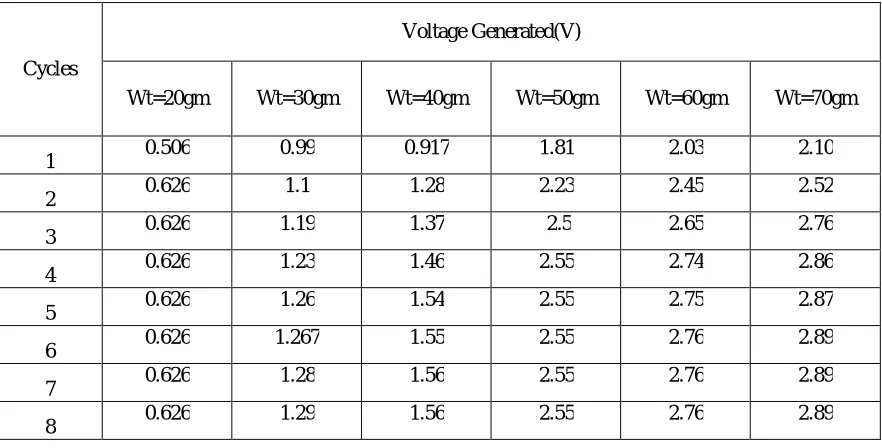
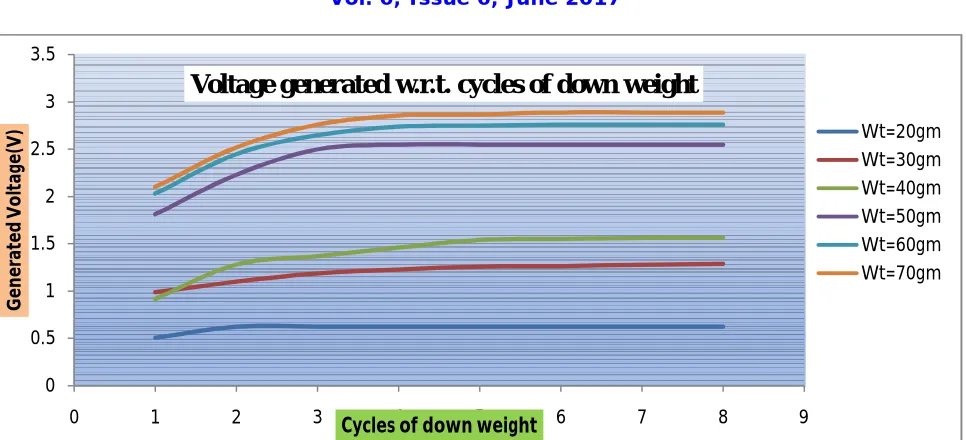
The electrical energy is generated from weight lifting technique for different weights. Initially the energy harvesting module is discharged. Usually it is set to 0.5V.When the weight is set to top position of pulley, the generator produces some finite voltage. This voltages increase as the weight moves down. Variation of voltage is recorded during this case and maximum voltage is recorded. Measurement of electrical energy has been carried out at least for eight different cycles. This is repeated eight times and maximum voltage is recorded. The electrical energy is captured in form of voltage. Table2 shows the Generated Voltage (V) for different weight attached to generator with energy harvesting module.
Table 2 Generated Voltage (V) for different weight attached to generator with energy harvesting module
Initial output voltage of module=0.50V
Cycles
Voltage Generated(V)
Wt=20gm Wt=30gm Wt=40gm Wt=50gm Wt=60gm Wt=70gm
1 0.506 0.99 0.917 1.81 2.03 2.10
2 0.626 1.1 1.28 2.23 2.45 2.52
3 0.626 1.19 1.37 2.5 2.65 2.76
4 0.626 1.23 1.46 2.55 2.74 2.86
5 0.626 1.26 1.54 2.55 2.75 2.87
6 0.626 1.267 1.55 2.55 2.76 2.89
7 0.626 1.28 1.56 2.55 2.76 2.89
8 0.626 1.29 1.56 2.55 2.76 2.89
Fig. 4 Voltages generated with respect to cycles of different weights
VI.CONCLUSION
The generated electrical energy is totally depending on weight attached to the thin rope. While moving weight up and down, the pulley moves right and left causes movement of the shaft. If it moves slowly then generated signal is also low. If pulley moves fast then generated signal is large. In first case, the pulley is rotated without energy harvesting module because of that generated energy cannot be stored. The energy generated from rotating pulley down is much more than energy generated from up the weight. The electrical energy generated is proportional to weight.
In second case, the generated energy from generator is stored in energy harvesting module. In this case different weights are attached to shaft of generator through pulley. This experiment is carried out for eight different weights and measures the generated voltage. The generated voltage increased and that stored in capacitor bank. The advantage of energy harvesting module is generated energy accumulate in previous energy so that stored energy increased to certain limits.
ACKNOWLEDGMENTS
One of the authors S.M.Dhavale would likes to thanks Head of Department, Savitribai Phule Pune University for valuable guidance and providing Laboratory facility. The authors are also thankful to Principal and Head of the Electronic Science Department and research colleagues of Fergusson College, Pune.
REFERENCES
[1] S.Nithiya, K.Sadhuna and A. Saravanan “Energy Harvesting Using Oscillating Pendulum”, International Journal for Research and Development in Engineering (IJRDE) ISSN: 2279-0500 Special Issue: pp-017-019.
[2] Paul D. Mitcheson, Eric M. Yeatman, G. Kondala Rao, Andrew S. Holmes and Tim C. Green “Energy Harvesting From Human and Machine Motion for Wireless Electronic Devices”, Proceedings of the IEEE Vol. 0018-9219/$25.00 _2008 IEEE 96, No. 9, September 2008.
[3] S. M. Dhavale, N. M. Kulkarni, A. D. Shaligram” Energy Harvesting from Dc Motor” 3rd and 4th January 2014 National Conference on Recent Advances in Computer Science & Electronics
[4] L.Ashok Kumar “Teleintimation Garment: A Wearable Electronic Garment for Soldier's Status Monitoring Applications”, RMUTP international Conference: Textiles & Fashion 2012 Bangkok Thailand, July 3-4, 2012.
[5] Zdenek Hadas, Vojtech Vetiska, Vladislav Singule, Ondrej Andrs, Jiri Kovar and Jan Vetiska “Energy Harvesting from Mechanical Shocks Using A Sensitive Vibration Energy Harvester”, Int J Adv Robotic Sy, Vol. 9, pp.225:2012, 2012.
0 0.5 1 1.5 2 2.5 3 3.5
0 1 2 3 4 5 6 7 8 9
G e n er at ed V o lt a ge (V )
Cycles of down weight
Voltage generated w.r.t. cycles of down weight
[6] S. M. Dhavale, N. M. Kulkarni, A. D. Shaligram “Design of Energy Harvesting System for Portable Wearable Electronic Gadgets “Published in proceedings of First conference on energy and environment NC2E-2014 ISBN 978-93-83993-10-9
[7] Robert GHERCA, Radu OLARU “Harvesting Vibration Energy By Electromagnetic Induction”, Annals of the University of Craiova, Electrical Engineering series, No.35; ISSN 1842- 4805, 2011.
[8] Xinping Cao, Wen-Ren Chiang, Ya-Chin King and Yi-Kuen Lee “Electromagnetic Energy Harvesting Circuit with Feed forward and Feedback DC-DC PWM Boost Converter for Vibration Power Generator System”, IEEE Transactions on Power Electronics, Vol. 22, No. 2, pp. 679-685, 2007.
[9] S P Beeby, M J Tudor and N M White “Energy harvesting vibration sources for Microsystems applications”, Institute of Physics Publishing Measurement Science and Technology Meas. Sci. Technol. 17 PP175–195, 2006.
[10] N.H. Diyana, Asan G.A. Muthalif, M.N. Fakhzan and A.N.Nordin “Vibration Energy harvesting using single and comb-shaped piezoelectric beam structures: Modeling and Simulation” , in International Symposium on Robotics and Intelligent Sensors 2012 (IRIS 2012).
[11] S. Turri, D. Miller, H. Ben Ahmed, B. Multon “Design of an electro-mechanical portable system using natural human body movements for electricity generation”, SATIE UMR CNRS 8029 - Brittany Branch, ENS de Cachan - Ker Lann Campus 35170 Bruz – France
[12] Vladimir Leonov “Energy Harvesting for Self-Powered Wearable Devices”, Smart Systems and Energy Technology Imec, Kapeldreef 75, 3001 Leuven, Belgium pp 27-49.
[13] Thomas Martin, Mark Jones, Josh Edmison, and Ravi Shenoy “Towards a design framework for wearable electronic textiles”, Bradley Dept. of Electrical and Computer Engineering Virginia Tech Blacksburg, VA 24061
[14] McAdams, Krupaviciute, Gehin, C,Dittmar, Delhomme, Rubel, and Fayn,McLaughlin “Wearable Electronic systems: Applications to Medical Diagnostics/Monitoring” , Biomedical Sensors Group, Nanotechnologies Institute of Lyon, INSA de Lyon, Bât. Léonard de Vinci, 20 avenues Albert Einstein, 69621 Villeurbanne Cedex, France.
[15] S. M. Dhavale, N. M. Kulkarni and A. D. Shaligram ”Development of Self Powered Energy Harvesting System for Mobile Health Monitoring” , International Journal of Research in Advent Technology(E-ISSN: 2321-9637), February 2015,52-55
[16] S. M. Dhavale, N. M. Kulkarni and A. D. Shaligram, “Development of Pendulum Based Alternative Energy System for Portable Application “in National Conference on Advances in Electronics and its Interdisciplinary Application [NCAEIA-2014] on 19th and 20th September 2014