Resonances from PHSD
E. L. Bratkovskaya1,2,a
1 Institute for Theoretical Physics, University of Frankfurt, Frankfurt, Germany 2 Frankfurt Institute for Advanced Studies, 60438 Frankfurt am Main
Abstract. The multi-strange baryon and vector meson resonance production in relativistic nucleus-nucleus collisions is studied within the parton-hadron-string dynamics (PHSD) approach which incorporates explicit partonic degrees-of-freedom in terms of strongly interacting quasiparticles (quarks and gluons) in line with an equation-of-state from lattice QCD as well as the dynamical hadronization and hadronic collision dynamics in the final reaction phase. We find a significant effect of the partonic phase on the production of multi-strange antibaryons at SPS energies due to a slightly enhanceds¯spair production from massive time-like gluon decay and a larger formation of antibaryons in the hadronization process. We, futhermore, obtain a visible in-medium effects in the low mass dilepton sector from dynamical vector-meson spectral functions from SIS to SPS energies whereas at RHIC and LHC energies such medium ef-fects become more moderate. In the intermediate mass regime from 1.1 to 3 GeV pronounced traces of the partonic degrees of freedom are found at SPS energies which superseed the hadronic (multi-meson) channels as well as the correlated and uncorrelated semi-leptonicD-meson decays. The dilepton production from the strongly interacting quark-gluon-plasma (sQGP) becomes already visible at top SPS energies and more pronounced at RHIC and LHC energies.
1 Introduction
The study of resonance production in heavy-ion collisions is considered as one of the promising ways to obtain information about the different reaction stages [1]. The resonances can be produced through out the whole history of the reaction at the hadronization of Quark-Gluon Plasma (QGP) as well as in hadronic phase by rescattring. Thus they can provide information about the partonic phase as well as about in-medium effects related to hadronic interactions. The resonances can decay to hadrons and some of them, as vector mesons, to leptonic modes. The hadronic decay mode is dominant whereas the leptonic decay (i.e. the production of dileptons - correlated electron-positron orμ+μ− pairs) is a very rare process due to the small branching ratio. However, there is a big disadvantage to use the hadronic mode in order to expand in-medium properties of the hadrons: it is very difficult experimentally to identify the products of hadronic decays due to their strong interactions with the environments. In this respect the leptonic mode is more promising since dileptons interact only electromagnetically, i.e. very weakly with the strongly interacting partonic or hadronic medium created in the collisions. Thus dileptons can provide an undistorted information about the different phases of the reactions as well as about in-medium properties of resonances.
An important dilepton observable is the invariant mass spectrum which can be roughly divided in 3 different regions, in each of which different physics dominates the radiation. In the low mass region (Me+e− < 1 GeV) the radiation is dominated by the decays of light
a e-mail:[email protected] C
Owned by the authors, published by EDP Sciences, 2012
mesons (consisting of u, d and s (anti)quarks) and especially gives information about in-medium properties of theρ0meson. In the intermediate mass region (1.1 GeV< Me+e−< 3 GeV) the dominant contribution to the invariant mass spectrum is obtained from the decays of open charm mesons, while above the J/ψ peak, first open beauty decays and later on initial state Drell-Yan radiation are expected to dominate the dilepton spectrum. On top of the previously mentioned sources, especially in the intermediate mass region, also radiation from the strongly interacting Quark-Gluon-Plasma (sQGP) can give a significant signal [2] as well as some other more exotic sources like simultaneous interactions of four pions [3–6]. These partonic and hadronic channels have been studied in detail in Refs. [7, 8] at the top Super-Proton-Synchrotron (SPS) and Relativistic-Heavy-Ion-Collider (RHIC) energies and it has been found that the partonic channels clearly dominate over multi-pion sources in the intermediate dilepton mass regime.
This contribution aims to summarize the perspectives of dilepton measurements for study-ing the vector meson resonances produced in heavy-ion collisions at relativistic energies as well as to discuss the possible QGP effects on hadronic observables. As an example we consider the enhancement of (multi-) strange (anti-) baryons. Our study is based on the Parton-Hadron-String Dynamics (PHSD) transport model [9].
2 The PHSD approach
The dynamics of partons, hadrons and strings in relativistic nucleus-nucleus collisions is an-alyzed here within the Parton-Hadron-String Dynamics approach [9]. In this transport ap-proach the partonic dynamics is based on Kadanoff-Baym equations for Green functions with self-energies from the Dynamical QuasiParticle Model (DQPM) [10] which describes QCD properties in terms of ’resummed’ single-particle Green functions. In Ref. [11], the actual three DQPM parameters for the temperature-dependent effective coupling were fitted to the recent lattice QCD results of Ref. [12]. The latter lead to a critical temperature Tc ≈ 160 MeV which corresponds to a critical energy density ofc≈0.5 GeV/fm3. In PHSD the parton spectral functions ρj (j = q,q, g¯ ) are no longer δ− functions in the invariant mass squared as in conventional cascade or transport models but depend on the parton mass and width parameters which were fixed by fitting the lattice QCD results from Ref. [12]. We recall that the DQPM allows one to extract a potential energy densityVpfrom the space-like part of the energy-momentum tensor as a function of the scalar parton densityρs. Derivatives ofVpw.r.t. ρs then define a scalar mean-field potential Us(ρs) which enters into the equation of motion for the dynamical partonic quasiparticles. Furthermore, a two-body interaction strength can be extracted from the DQPM as well from the quasiparticle width in line with Ref. [13]. The transition from partonic to hadronic d.o.f. (and vice versa) is described by covariant transition rates for the fusion of quark-antiquark pairs or three quarks (antiquarks), respectively, obeying flavor current-conservation, color neutrality as well as energy-momentum conservation [9, 11]. Since the dynamical quarks and antiquarks become very massive close to the phase transition, the formed resonant ’prehadronic’ color-dipole states (qq¯orqqq) are of high invariant mass, too, and sequentially decay to the groundstate meson and baryon octets increasing the total entropy.
On the hadronic side PHSD includes explicitly the baryon octet and decouplet, the 0− -and 1−-meson nonets as well, as selected higher resonances as in the Hadron-String-Dynamics (HSD) approach [14, 15]. Hadrons of higher masses (>1.5 GeV in case of baryons and>1.3 GeV for mesons) are treated as ’strings’ (color-dipoles) that decay to the known (low-mass) hadrons, according to the JETSET algorithm [16]. Note that PHSD and HSD merge at low energy density, in particular below the critical energy density c ≈ 0.5 GeV/fm3. For more detailed descriptions of PHSD and its ingredients we refer the reader to Refs. [10, 11, 17, 18].
nonpartonic, i.e. hadronic or string-like matter, which can be viewed as a hadronic corona. This finding implies that neither hadronic nor only partonic ’models’ can be employed to extract physical conclusions in comparing model results with data.
3 Strangeness enhancement
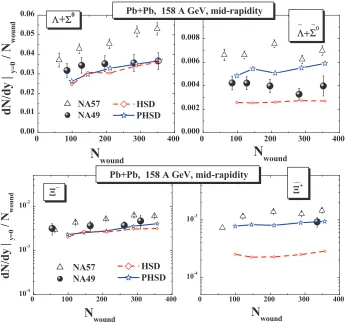
As found in Ref. [9] the impact of the partonic degrees of freedom in PHSD on the longitudinal rapidity distribution of protons, pions and kaons is only small in central Pb+Pb collisions at SPS energies from 40 to 158 A·GeV. Additional experimental information is provided by the centrality dependence of the strange (and antistrange) baryon yield. In this respect we compare in Fig. 1 the multiplicities of (Λ+Σ0)/Nwound(l.h.s.) and ( ¯Λ+ ¯Σ0)/Nwound(r.h.s.) as a function of the number of wounded nucleonsNwoundfor Pb+Pb collisions at 158 A·GeV at mid-rapidity from PHSD (blue solid lines) and HSD (red dashed-dotted lines) to the experimental data from the NA57 Collaboration [21] (open triangles) and the NA49 Collaboration [22] (solid dots). The (green) full squares correspond to the 10% central data points at midrapidity from Ref. [23]. We mention that we employ the same definition of wounded nucleonsNwoundas the NA49 Collaboration. Whereas the HSD and PHSD calculations both give a reasonable description of the Λ+Σ0 yield of the NA49 Collaboration, both models underestimate the NA57 data (open triangles) by about 30%. An even larger discrepancy in the data from the NA49 and NA57 Collaborations is seen for ( ¯Λ+ ¯Σ0)/Nwound (r.h.s.); here the PHSD calculations give results which are in between the NA49 data (solid dots) and the NA57 data (open triangles). We also see that HSD underestimates the ( ¯Λ+ ¯Σ0) midrapidity yield at all centralities.
The latter results suggest that the partonic phase does not show up explicitly in an en-hanced production of strangeness (or in particular strange mesons and baryons) but leads to a different redistribution of antistrange quarks between mesons and antibaryons in the hadronization process. To examine this issue in more detail we show in Fig. 1 (bottom part) the multiplicities of Ξ− baryons (l.h.s.) and ¯Ξ+ antibaryons (r.h.s.) - devided by Nwound - as a function of the number of wounded nucleons for Pb+Pb collisions at 158 A·GeV at mid-rapidity from PHSD and HSD in comparison to the experimental data from the NA57 Collaboration [21] and the NA49 Collaboration [23, 22]. The situation is very similar to the case of the strange baryons and antibaryons before: we find no sizeable differences in the double strange baryons from HSD and PHSD – in a good agreement with the NA49 data – but observe a large enhancement in the double strange antibaryon yield for PHSD relative to HSD.
We note in passing that in Ref. [24] similar results have been obtained in the HSD approach by including multi-meson fusion channels in the production of baryon-antibaryon pairs. In the latter approach mesonic states have been propagated also at local energy density above critical energy density of εC 0.5 GeV/fm3 and been allowed to interact. Such multi-meson fusion channels at high energy-density also lead to approximate chemical equilibrium. However, in PHSD mesonic reactions channels can not occur at energy densities aboveεC since here par-tonic degrees-of-freedom play the dominant role. The interaction rate of multi-meson channels decreases drastically for ε < εC due to the reduced hadron densities. Note that in Ref. [25] the high-energy density phase treated by hydro which implicitly implies thermal and chemical equilibrium. At least a chemical equilibration at high energy density appears mandatory to describe the experimental data. Such an equilibrium may be generated by partonic channels [9], by multi-hadronic interaction [24] or by model assumptions [25].
4 Results for dilepton spectra in comparison to experimental data
0 100 200 300 400 0.00 0.01 0.02 0.03 0.04 0.05 0.06
0 100 200 300 400
0.000 0.002 0.004 0.006 0.008 0.010 NA57 NA49 HSD PHSD
Λ
+
Σ0N
woundN
woundPb+Pb, 158 A GeV, mid-rapidity
_ _ Λ+Σ0
dN/dy |
y= 0/ N
wo und0 100 200 300 400
10-4 10-3
10-2
0 100 200 300 400
10-4 10-3 HSD PHSD NA57 NA49 Ξ−
dN/
dy |
y=0/ N
wo un d __ Ξ+ Pb+Pb, 158 A GeV, mid-rapidityN
woundN
woundFig. 1. Top: The multiplicities of (Λ+Σ0)/Nwound (l.h.s.) and ( ¯Λ+ ¯Σ0)/Nwound (r.h.s.) as a
function of the number of wounded nucleons for Pb+Pb collisions at 158 A·GeV at mid-rapidity from PHSD (blue solid lines) and HSD (red dashed-dotted lines) in comparison to the experimental data from the NA57 Collaboration [21] (open triangles) and the NA49 Collaboration [22] (solid dots). The calculations have an error of 5−10% due to limited statistics. Bottom: The multiplicities of
Ξ−/N
wound (l.h.s.) and ¯Ξ+/Nwound (r.h.s.) vs Nwound for Pb+Pb collisions at 158 A·GeV at
mid-rapidity. Line coding as above.
4.1 Dileptons at SPS energies
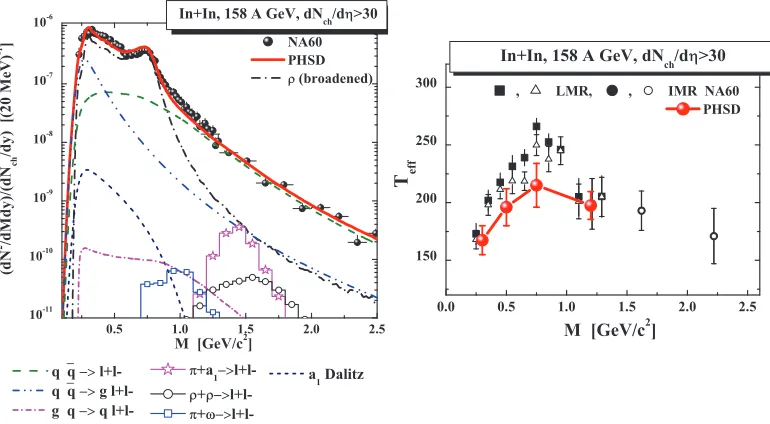
We start with a comparison of PHSD results to experimental data for dileptons from In+In collisions at 160 A GeV measured by the NA60 Collaboration. As has been shown in our early study [33] based on the off-shell HSD transport model without including an explicit partonic phase, the NA60 data favour a collisional broadening scenario for the in-medium modification of the vector mesons spectral function. However, the off-shell HSD calculations fail to explain the enhanced dilepton yield at large invariant massesM >1GeV - cf. Fig. 2 of Ref. [33].
Fig. 2. Left: Acceptance corrected mass spectra of excess dimuons from In+In at 158 A GeV inte-grated overpTin 0.2< pT <2.4 GeV from PHSD compared to the data of NA60 [26]. The dash-dotted
line shows the dilepton yield from the in-mediumρwith a broadened spectral function, the dashed line presents the yield from theq+ ¯qannihilation, the dash-dot-dot line gives the contribution of the gluon Bremsstrahlung process (qq¯→gl+l−), while the solid line is the sum of all contributions. For the description of the other lines, which correspond to the non-dominant channels, we refer to the figure legend. Right: The inverse slope parameterTef fof the dimuon yield from In+In at 158 A GeV
as a function of the dimuon invariant mass in PHSD compared to the data of the NA60 Collaboration [26, 27].
One concludes from Fig. 2 that the measured spectrum forM >1 GeV is dominated by
thepartonicsources. Indeed, the domination of the radiation from the QGP over the hadronic
sources in PHSD is related to a rather long – of the order or 3 fm/c – evolution in the partonic phase (in co-existence with the space-time separated hadronic phase) on one hand (cf. Fig. 10 of Ref. [9]) and the rather high initial energy densities created in the collision on the other hand (cf. Fig. 6 of Ref. [28]). In addition, we find from Fig. 2 that in PHSD the partonic sources also have a considerable contribution to the dilepton yield forM <0.6 GeV. The yield from the two-to-two processq+ ¯q→g+l+l−is especially important close to the threshold (≈0.211 GeV). This conclusion from the microscopic calculations is in qualitative agreement with the findings of an earlier (more schematic) investigation in Ref.[29] as well as the hybrid model calculations in Ref. [30] based on the hydro + UrQMD combined approach.
Fig. 3. Left: The PHSD results for the invariant mass spectra of inclusive dileptons in Au+Au collisions at √sNN = 200 GeV within the PHENIX acceptance cuts in comparison to the data
from the PHENIX Collaboration [31, 32] The different lines indicate the contributions from different channels as specified in the figure. Right: The PHSD results for the transverse-momentum spectra of dileptons from minimum bias Au+Au collisions at√sNN= 200 GeV in different mass bins compared
to the data from the PHENIX Collaboration [31, 32].
4.2 Dileptons at RHIC energies
Now we are coming to the top RHIC energy of√sN N = 200 GeV and present the most im-portant findings from the PHSD study in Ref. [7]. In the left part of Fig. 3 we show our results for the invariant mass spectra of inclusive dileptons in Au+Au collisions for the acceptance cuts on single electron transverse momenta peT, pseudorapiditiesηe, azimutal angleφe, and dilepton pair rapidityy:peT >0.2 GeV, |ηe|<0.35, −3π/16< φe<5π/16, 11π/16< φe< 19π/16, |y|<0.35.
In the low mass regionM = 0−1.2 GeV, the dilepton yield in the PHSD is dominated by hadronic sources and essentially coincides with the earlier HSD result [33]. Note that the collisional broadening scenario for the modification of theρ-meson was used in the calculations presented in Fig. 3 that underestimates the PHENIX data from 0.2 to 0.7 GeV substantially. In contrast, the partonic radiation as well as the yield from correlated D-meson decays are dominant in the mass regionM = 1−3 GeV as seen in Fig. 3 (left), i.e. in the mass region between theφand J/Ψ peaks. The dileptons generated by the quark-antiquark annihilation in the sQGP constitute about half of the observed yield in this intermediate-mass range. For M > 2.5 GeV the partonic yield even dominates over the D-meson contribution. Thus, the inclusion of the partonic radiation in the PHSD fills up the gap between the hadronic model results [33, 34] and the data of the PHENIX Collaboration for M > 1 GeV, however, the early expectation of a partonic signal in the low mass dilepton spectrum is not verified by the microscopic PHSD calculations.
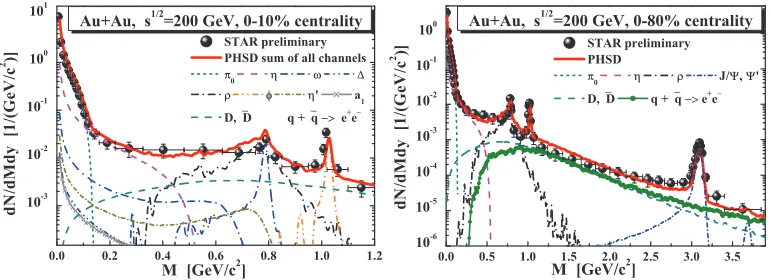
Fig. 4. The PHSD results for the invariant mass spectra of dileptons in Au+Au collisions at√sNN
= 200 GeV forM= 0−1.2 GeV (left part) and forM= 0−4 GeV (right part) and 0 - 10 % centrality within the cuts of the STAR experiment. The preliminary data from the STAR Collaboration are adopted from Ref. [35].
system. These channels are, however, insufficient to describe the very low slope of the pT spectra at the top RHIC energy.
In order to shed some light on the ’PHENIX puzzle’ we step to a comparison of the PHSD predictions with the preliminary STAR data measured for Au+Au collisions at√sN N = 200 GeV with the acceptance cuts on single electron transverse momenta peT, single electron pseudorapiditiesηe and the dilepton pair rapidityy, i.e. 0.2< peT <5 GeV, |ηe|<1, |y|< 1. Our predictions for the dilepton yield within these cuts are shown in Fig. 4 for 0-80% centrality. One can observe generally a good agreement with the preliminary data from the STAR Collaboration [35] in the whole mass regime. Surprisingly, our calculations are also roughly in line with the low mass dilepton spectrum from STAR in case of central collisions whereas the PHSD results severely underestimate the PHENIX data. The observed yield from STAR can be accounted for by the known hadronic sources, i.e. the decays of theπ0,η,η,ω, ρ,φand a1 mesons, of theΔ particle and the semileptonic decays of the D and ¯Dmesons, where the collisional broadening of theρmeson is taken into account.
The discrepancy between the PHENIX and STAR data will have to be investigated closer by the experimental collaborations. Furthermore, the upgrade of the PHENIX experiment with a hadron blind detector should provide decisive information on the origin of the low mass dileptons produced in the heavy-ion collisions at√sN N = 200 GeV.
5 Conclusions
We close this contribution by noting that the measurement of hadronic resonances is a promis-ing probe of the dynamical processes in heavy-ion collisions at all energy regimes. E.g., the enhancement of multi-strangene resonance production can signal the QGP formation. Futher-more, the low-mass dileptons provide information on the vector meson spectral function in the medium whereas the high mass part from 1.1 to 3 GeV can be attributed dominantly to the partonic annihilation in the QGP phase. At the higher RHIC energies the modifications of the low-mass sector are less pronounced than at SIS and SPS energies, however, the dilepton emissivity from the sQGP becomes substantial or even dominant relative to the background fromD-meson decays at RHIC and LHC energies.
and strangeness study presented in this contribution and C. Markert for stimulating discus-sions.
References
1. M. M. Aggarwalet al., STAR Colaboration, Phys. Rev.C71 (2005) 064902; Phys. Rev. Lett.97(2006) 132301; arXiv:1006.1961.
2. E. V. Shuryak, Phys. Lett.B78, 150 (1978), Sov. J. Nucl. Phys.28(1978) 408, Yad. Fiz. 28(1978) 796.
3. C. Song, C. M. Ko, and C. Gale, Phys. Rev.D50(1994) 1827. 4. G. Q. Li and C. Gale, Phys. Rev. C58(1998) 2914.
5. H. van Hees and R. Rapp, Phys. Rev. Lett.97(2006) 102301. 6. H. van Hees and R. Rapp, Nucl. Phys. A806(2008) 339.
7. O. Linnyk, W. Cassing, J. Manninen, E. L. Bratkovskaya and C. M. Ko, Phys. Rev. C 85, 024910 (2012).
8. O. Linnyk, E. L. Bratkovskaya, V. Ozvenchuk, W. Cassing and C. M. Ko, Phys. Rev. C 84(2011) 054917.
9. W. Cassing and E. L. Bratkovskaya, Nucl. Phys.A831(2009) 215. 10. W. Cassing, Nucl. Phys. AA795(2007) 70.
11. E. L. Bratkovskaya, W. Cassing, V. P. Konchakovski, and O. Linnyk, Nucl. Phys.A856 (2011) 162.
12. Y. Aokiet al., JHEP0906(2009) 088.
13. A. Peshier and W. Cassing, Phys. Rev. Lett.94(2005) 172301. 14. W. Ehehalt and W. Cassing, Nucl. Phys.A 602(1996) 449. 15. W. Cassing and E. L. Bratkovskaya, Phys. Rep.308(1999) 65.
16. H. U. Bengtsson and T. Sj¨ostrand, Comp. Phys. Commun.46(1987) 43. 17. W. Cassing, Nucl. Phys.A 791 (2007) 365.
18. W. Cassing, Eur. J. Phys.168(2009) 3.
19. C. Altet al., NA49 Collaboration, Phys. Rev.C66(2002) 054902; Phys. Rev. C 77, 2008, P. 024903.
20. J. Geiss, W. Cassing and C. Greiner, Nucl. Phys.A644(1998) 107.
21. F. Antinoriet al., Phys. Lett.B595(2004) 68; J. Phys. G: Nucl. Phys.32(2006) 427. 22. T. Anticicet al., NA49 Collaboration, Phys. Rev. C80(2009) 034906.
23. C. Altet al., NA49 Collaboration, Phys. Rev.C78(2008) 034918. 24. W. Cassing, Nucl. Phys.A 700(2002) 618.
25. H. Petersenet al., Phys. Rev. C80(2009) 054910.
26. R. Arnaldi et al., NA60 Collaboration, Eur. Phys.C 59(2009) 607.
27. R. Arnaldiat al., NA60 Collaboration, Phys. Rev. Lett.96 (2006) 162302; J. Seixaset
al., J. Phys. G34(2007) S1023; S. Damjanovicet al., Nucl. Phys.A 783(2007) 327c; R. Arnaldiet al., Eur. Phys. JC61(2009) 711.
28. O. Linnyk, E. L. Bratkovskaya, and W. Cassing, Int. J. Mod. Phys.E17(2008) 1367. 29. J. Alam, T. Hirano, J. K. Nayak, and B. Sinha, arXiv:0902.0446.
30. E. Santini et al., Phys. Rev. C84(2011) 014901.
31. A. Toiaet al., PHENIX Collaboration, Nucl. Phys.A774(2006) 743. 32. A. Adareet al., PHENIX Collaboration, Phys. Rev.C81(2010) 034911. 33. E. L. Bratkovskaya, W. Cassing, and O. Linnyk, Phys. Lett.B670(2009) 428.
34. J. Manninen, E. L. Bratkovskaya, W. Cassing and O. Linnyk, Eur. Phys. J. C71(2011) 1615.
![Fig. 3.dileptons from minimum bias Au+Au collisions at Left: The PHSD results for the invariant mass spectra of inclusive dileptons in Au+Aufrom the PHENIX Collaboration [31,32] The different lines indicate the contributions from differentchannels as specifie](https://thumb-us.123doks.com/thumbv2/123dok_us/8072466.1346494/6.482.49.420.69.212/collisions-invariant-inclusive-collaboration-dierent-contributions-dierentchannels-specie.webp)