Article
1
Optimization of Reaction Selectivity Using
CFD-2
Based Compartmental Modeling and
Surrogate-3
Based Optimization
4
Shu Yang, San Kiang, Parham Farzan and Marianthi Ierapetritou*
5
Department of Chemical and Biochemical Engineering, Rutgers, The State University of New Jersey, 98
6
Brett Road, Piscataway, NJ 08854, USA ; [email protected] (S.Y.); [email protected] (S.K.);
7
[email protected] (P.F.); [email protected] (M.I.)
8
* Correspondence: [email protected]; Tel.: +1-848-445-2971
9
10
Abstract: Mixing is considered as a critical process parameter (CPP) during process development
11
due to its significant influence on reaction selectivity and process safety. Nevertheless, mixing issues
12
are difficult to identify and solve owing to their complexity and dependence on knowledge of
13
kinetics and hydrodynamics. In this paper, we proposed an optimization methodology using
14
Computational Fluid Dynamics (CFD) based compartmental modelling to improve mixing and
15
reaction selectivity. More importantly, we have demonstrated that through the implementation of
16
surrogate-based optimization, the proposed methodology can be used as a computationally
non-17
intensive way for rapid process development of reaction unit operations. For illustration purpose,
18
reaction selectivity of a process with Bourne competitive reaction network is discussed. Results
19
demonstrate that we can improve reaction selectivity by dynamically controlling rates and locations
20
of feeding in the reactor. The proposed methodology incorporates mechanistic understanding of the
21
reaction kinetics together with an efficient optimization algorithm to determine the optimal process
22
operation and thus can serve as a tool for quality-by-design (QbD) during product development
23
stage.
24
Keywords: mixing; CFD-simulation; surrogate-based optimization; compartmental modeling;
25
competing reaction system; optimization; model order reduction
26
27
1. Introduction
28
In chemical synthesis, many important reactions can be accompanied by undesired
side-29
reactions. This leads to wastes and affects product quality. Therefore, incorporating knowledge of
30
mixing can substantially improve reaction selectivity and yield, in addition to enhancing process
31
safety. Furthermore, due to a growing variety of reactors, characterization of mixing has become vital
32
in process development [1, 2]. To achieve optimal selectivity and yield, appropriate modeling of the
33
mass transport process in reactors is critical [3]. Nevertheless, owing to the complexity of mass
34
transport in turbulent flow, analyzing mixing remains a difficult problem.
35
Frequently, mixing in reactor is approximated by residence time distribution (RTD) analysis,
36
where residence time is experimentally measured through a tracer test. This approximation has been
37
proved to work relatively well, however
“RTD is not a complete description of structure for a
38
particular reactor or system of reactors”
[3]. Therefore, when reaction with high conversion rates39
are considered, analysis solely based on RTD can lead to significant error [4]. Based on local sensors,
40
RTD characterization of tracer test can be improved by mixing time measurement [5, 6]. However,
41
considering potential bias and the requirement for specific equipment for tracer tests, RTD and
42
mixing time measurement have become less preferable comparing to the more resource-effective
43
benchmark reaction method [7]. Therefore, competitive reaction systems have become the standard
44
for mixing analysis [7-9]. Among the competitive reaction systems, the
“well-documented and
45
highly reliable”
[7] Bourne reaction and Villermaux reaction is most commonly adopted [10]. The46
mentioned systems of competitive reactions are based on the pioneering framework proposed by the
47
group of Bourne [11]. It has been proved that mixing can influence not only the reaction rate, but also
48
the distribution of products [12]. In Bourne’s framework, product distribution of competitive
49
reactions is analyzed to characterize mixing inhomogeneity inside reactors. Two most commonly
50
used categories of reactions have been proposed based on this framework: the neutralization and
51
alkaline hydrolysis of ester [13], and the iodide/iodate reaction scheme [14].
52
With rapid advances in computer technology, computational fluid dynamics (CFD) has become
53
a powerful tool to studying mixing. Comparing with the experimental methods, it provides detailed
54
understanding of mixing phenomenon in a timely-efficient manner without requiring meticulous
55
choice of equipment and sensors. In reaction engineering, CFD has been employed to study mixing
56
in chemical reactors [15-19], and bio-reactors [20-22], where good agreement with experiments were
57
achieved. The complex hydrodynamics, mass transfer, heat transfer and reaction kinetic can be
58
satisfactorily captured by CFD, making it a powerful tool in process design. Nonetheless, despite the
59
growing computational resources available, CFD still requires considerable computational time.
60
Despite the extensive study of mixing in different systems, owing to the resource and time
61
expense of experiments and CFD simulations, incorporating detailed understanding of mixing in
62
process operation optimization remains challenging. Even though CFD has been used to
63
systematically optimize reactor designs [23-26], optimization of process operations based on
64
dynamics of mixing remains complicated. For the past decade, research in mixing have started to
65
incorporate detailed knowledge of mixing from CFD to computationally inexpensive compartmental
66
models [20, 27-29], which has shown great potential for modeling mixing. Nevertheless, since space
67
is discrete in compartmental model, efficient optimization algorithm should be implemented to deal
68
with the complexity introduced by integer variables.
69
In this work, a modeling and optimization methodology is developed that systematically
70
improves reaction selectivity through optimized process operation and offers a more general
71
framework for improving reaction selectivity with a numerically efficient Quality-by-Design (QbD)
72
tool. In a case study, Bourne reaction is employed as a benchmark, which serve as a more explicit
73
quantification for the efficiency of mixing. It has been demonstrated in this work that CFD-based
74
compartmental model can be an efficient alternative for CFD simulations. By integrating CFD-based
75
compartmental model with surrogate-based optimization, the proposed framework has shown a
76
great potential for fast process development.
77
2. Integrating CFD-based compartmental model with surrogate based optimization
78
This section presents the development and implementation of the proposed methodology.
79
Initially, a detail description of flow field in the reactor is generated by a CFD simulation. It should
80
be noted that in stirred tank reactors the flow field are considered independent from chemical
81
reactions. As a result, the fluid dynamics data can be used for different reactions, which could
82
contribute to rapid process design and cost reduction. The result from CFD simulation is used to
83
develop a compartmental model, which would be discussed in subsections 2.1. Comparing to direct
84
CFD simulation, computational complexity of compartmental model is significantly reduced.
85
Therefore, the optimal process design can be determined numerically without prohibitive
86
computational expense. The process selectivity is then optimized by integrating the compartmental
87
model with surrogate-based optimization, as will be discussed in subsection 2.2.
88
2.1. CFD-based compartmental model
89
2.1.1. A brief review of compartmental model
90
Compartmental model defines a matrix of perfectly mixed control volumes interconnected by
91
the exchanging mass flux. In this method the reactors are discretized into a set of homogeneous
92
are solved together to represent the space distribution inside the reactor. Compartmental modeling
94
was regarded as a crude tool to study transport process and only provide basic understandings [30].
95
However, by incorporating detailed CFD simulation to compartmental model, substantial
96
improvement can be achieved leading to satisfactory agreement with experimental data without loss
97
of computational efficiency [29, 31].
98
Considering the excessive computational and economical expense usually required by CFD
99
simulation, for CMC development, CFD-based compartmental model have been adopted as
100
computationally cheaper alternative [4, 27, 31-33] In addition to the reduced computational expense,
101
CFD-based compartmental model provides the required simplifications for development work.
102
Unlike CFD, which is not widely available and requires special know-how, CFD-based
103
compartmental model can be easily implemented for different reaction systems based on flow field
104
data determined beforehand. Adjustment in chemical kinetics do not usually require extra CFD
105
simulation, which could save time and reduce cost.
106
In this proposed methodology, compartmental model is developed from CFD simulation based
107
on the idea outlined by Bezzo et al [27]. Two key steps are required for model construction: (1)
108
Topological mapping between two models through aggregating CFD cells into compartments. (2)
109
Quantifying mass flux between different compartments. Topology mapping between CFD and
110
compartmental model can be done either manually or automatically. Manual allocation of CFD cells
111
is based on preliminary knowledge of flow field, which can be conducted prior to CFD simulation
112
[20, 29, 34, 35]. Automatic mapping, on the other hand, merges computational cells based on CFD
113
simulation to form meaningful homogeneous control volumes [4, 36]. Manual allocation usually
114
leads to simpler mesh structure, which allow for efficient implementation of optimization tools.
115
Therefore, in this work manual allocation is conducted, as will be outlined in subsubsection 2.1.3.
116
2.1.2. Compartmental model development
117
Mixing of particles inside the reactor is described by Eq.1, where Ci is the concentration of
118
species i, Ni represents the mass flux of species i, and Ri denotes the source of species i.
119
Compartmental models are obtained by volume averaging Eq.1 over each predefined compartment
120
V, as described in Eq.2.
121
= −∇ ∙ 𝑵𝒊+ 𝑅, (1)
𝐶 𝑑𝑉= − ∇ ∙ 𝑵𝒊𝑑𝑉+ 𝑅 𝑑𝑉, (2)
Adopting the divergence theorem and replacing Ci with the volume-averaged concentration
122
𝐶, , Eq.2 is modified to Eq.3, where Vj is the volume of control volume Kj, and Sj is the surface of
123
control volume Kj. The mass flux N consist of convection and diffusion, where the diffusion is
124
modelled by Fick’s law with diffusion coefficient D. The source term Ri models the homogeneous
125
consumption and generation of species i, which include chemical reactions and micro mixing. Due to
126
the assumption of homogeneous compartments, the volume integral of source term in Eq.5 is
127
modified as follows:
128
𝑉 , + ∮ 𝑵𝒊,𝑲𝒋∙ 𝒏𝑑𝑆= 𝑅 𝑑𝑉, (3)
𝑉 , = − − 𝒗∙ 𝐶𝒊,𝜥 ∙ 𝒏 𝑑𝑆 + 𝐷 ∙ 𝛁𝐶 ∙ 𝒏 𝑑𝑆 + 𝑅 𝑑𝑉, (4)
𝑅𝒊,𝜥
𝜥 = 𝑉 ∙ 𝑅𝒊,𝜥, (5)
It should be recognized that the homogeneous assumption depends upon the Damköhler
129
number (Da) in each compartment, which is a strong function of grid size, as will be discussed in
130
subsubsection 2.1.3. Moreover, in this work diffusion mass transfer between different compartments
131
(Pe). The dominance of convective mass transfer would simplify Eq.4 into Eq.6, where Qjk denotes
133
the flow rate from control volume j to control volume k.
134
𝑉 𝒊,𝜥 = −𝐶,𝜥 ∑ 𝑄, + ∑ 𝑄, ∙ 𝐶,𝜥 + 𝑉 ∙ 𝑅𝒊,𝜥, (6)
From CFD simulation, mass flow rate Q between different compartments can be easy calculated
135
through the topology mapping and merging strategy as mentioned in subsubsection 2.1.2. As a result,
136
the computational complexity of CFD is reduced while preserving the accurate flow pattern
137
description. For illustration purposes, a well-known pair of parallel competitive Bourne reactions is
138
studied. As will be discussed later in the case study, this reaction system is composed of a first-order
139
decay and a parallel second order coupling reaction [37].
140
2.1.3. Grid independence
141
From numerical perspective, compartmental model is an upwind discretization of mass balance
142
equation with finite volume method. Underlying this discretization scheme lies the assumption of
143
homogeneity inside each control volume. Therefore, compartmental model would exhibit higher
144
diffusivity than the true medium. The deviation caused by compartmentalization depends on the
145
system being modelled and the type of discretization that is used.
146
One heuristic rule is that with higher resolution grid, the discretized model should behave more
147
like the continuous case. However, with increasing resolution, the complexity of the model also
148
increases, which leads to higher computational expenses. Moreover, decreasing grid size would lead
149
to a decreasing Péclet number, which would undermine the assumption of ignoring diffusion mass
150
transfer. Therefore, a grid independence analysis should be conducted to find the optimal grid
151
density to map the CFD data to compartmental model.
152
In this work the grid independence test is performed in two steps. First the Damköhler number
153
(Da) and Péclet number (Pe) are analyzed, as suggested in Eq.7 and Eq.8, which are critical to justify
154
the compartmentalization of model discussed in subsubsection 2.1.2.
155
156
Da = / < 1, (7)
Pe = > 1, (8)
This analysis determines the lower and upper bounds of length scale for the compartments,
157
which could serve as a starting point for the grid independence test. Then the initial choice of length
158
scale is improved in an iterative manner. Simulations based on compartmental models with
159
decreasing length scale are tested. When the simulation results are no longer changing with the
160
increasing grid density, the model resolution can be considered as sufficient.
161
It should be mentioned that the optimal grid density depends on reaction kinetics. If the time
162
constant of chemical reactions is significantly larger than that of mixing, this process could be
163
considered mixing-insensitive and perfect mixing assumption could be adopted without harming
164
model precision. By contrast, for fast reaction, the deviation caused by perfect-mixing assumption
165
could be significant, which require higher resolution. If the characteristic time scale of reaction is in
166
orders of magnitude less than micro-mixing, which is in the order of 10-3 s [15], micro-mixing would
167
dominate chemical reaction. As a result, the rate law of chemical reaction should be replaced with
168
micro-mixing models. Although for different reaction kinetics we can use the same steady state
169
solution from CFD, if new reaction kinetics are used, grid independence test should be conducted
170
with the updated model.
171
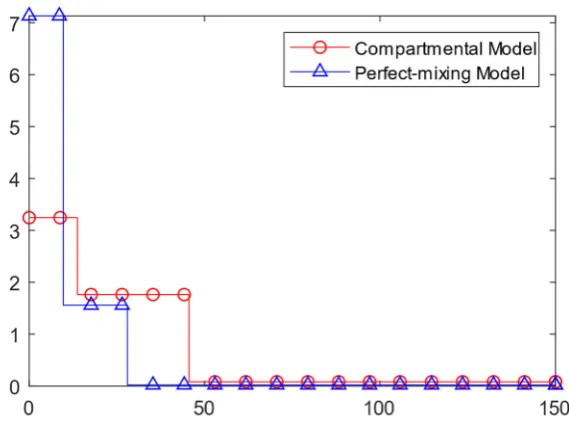
172
173
174
2.2.1. A brief review of surrogate-based optimization
176
Surrogate-based optimization have been the focus of interest in the derivative-free optimization
177
literature. Commonly seen in science and engineering studies are complex computer simulations and
178
experiments conducted to gain understanding of systems. As a result, for these problems derivative
179
information is either unavailable or prohibitively hard to get, making it impossible to implement
180
deterministic optimization methods efficiently [38]. Therefore, there is a high interest in developing
181
methods to handle the optimization problems where limited or noisy information is available[39].
182
Surrogate-based optimization use surrogate models, which are simpler models that can mimic
183
complex phenomenon, to guide the search in derivative-free optimization problems. Since surrogate
184
models are computationally less demanding, surrogate-based optimization is a good compromise
185
between describing the complex process and remaining computationally feasible. It has been
186
demonstrated that surrogate-based optimization displays superior performance for derivative-free
187
optimization problems [40]. Most popular surrogate models implemented for optimization methods
188
are radial basis function (RBF) [41-45] and Kriging [46-50], due to their capability to provide
189
prediction uncertainty. Artificial neural networks (ANN) have excellent fitting characteristics with
190
low complexity, therefore implementations of ANN for surrogate optimization is popular for various
191
engineering applications [51-54].
192
Surrogate optimization works in an iterative manner. In the initial step, several sampling point
193
are chosen, and an initial surrogate model is built based on function evaluation at those sampled
194
points. Then new sampling points are determined by evaluating the surrogate model. At new
195
sampling point, the original model is evaluated and the surrogate model is updated. This process is
196
conducted iteratively until a stopping criterion is met, and the best design point is chosen. In this
197
work, the mixed-integer optimization problem is solved with surrogate optimization based on the
198
work of Müller[55].
199
2.2.2. Problem formulation
200
In this work, the location and rate of feeding are optimized to improve reaction selectivity. Due
201
to the perfect mixing assumption of control volumes, feeding location is represented by the index of
202
compartment it resides at. It’s worth noting that while the feeding location should be fixed
203
throughout the process, the feeding rate could change dynamically. Therefore, by taking advantage
204
of the extra degree of freedom through adopting a changing feeding rate, reaction selectivity could
205
be further improved comparing to a fixed rate feeding, as will be discussed in subsection 4.2.
206
Dynamic profile of feeding rate is defined by splitting the whole process time into Nsdiscrete feeding
207
stages. Feeding rate is kept constant in each stage, but different feeding rate are employed for
208
different stages. Each feeding stage i is specified by its duration ti and the adopted feeding rate fi,
209
which are not defined a priori, instead they are determined by solving an optimization problem.
210
In order to solve for the optimal operating policy, reaction selectivity should be quantified based
211
on analyzing product distribution. The most intuitive definition is by segregation index, which is
212
based on the ratio of raw material consumed by the desired product to the total raw materials
213
injected. This method was widely adopted in previous work[2, 56, 57], where the influence of feeding
214
rate was not investigated. However, adopting segregation index as an objective function in this work
215
could lead to trivial solutions, due to the fact that feeding rate usually contributes monotonically to
216
product ratio. Without considering the economics of the process, solely focusing on the product ratio
217
would lead to unsatisfactory process design. Thus, it is recommended to use revenue as a way to
218
capture and optimize reaction selectivity. To maximize revenue of chemical processes, the
219
optimization problem is defined as followed.
220
221
222
223
𝑀𝑎𝑥𝑖𝑚𝑖𝑧𝑒 , , ∑ 𝑃 𝑦 − ∑ 𝑃 𝑦 , (9)
𝑦 , 𝑦 = 𝝋 𝑛, 𝑡 , 𝑓 , 𝑡 , 𝑓 , … , 𝑡 , 𝑓 , (10)
𝑡 = T, ∀𝑖 = 1, … , 𝑁 , (11)
𝑡 , 𝑓 ≥ 0, ∀𝑖 = 1, … , 𝑁 , (12)
𝑛 ∈ 0, 𝑁 , (13)
where PR denotes the price of desired product R while yR denotes its yield. PArepresents the unit
225
cost of raw material A and its consumption is denoted as yA. Both yRand yA are calculated through
226
the simulation φ based on the compartmental model. Addition point n and addition rate profile
227
which is defined by t1, f1, t2, f2…tNp, fNpare parameters of this simulation. The first set of constraints
228
describe the simulation based on the compartmental model. The second constraint represents that
229
the total time span of all stages is pre-defined as T.
230
Notice that the number of stages is introduced as a parameter instead of decision variable. This
231
is based on the difficulty of penalizing the monotonic increase of the number of stages. By allowing
232
extra degrees of freedom, an increasing number of stages is always preferred. Reaction selectivity
233
would always benefit from higher degree of freedom provided by the increasing Np, unless
234
computational expense of solving this optimization problem is taken into consideration. However,
235
this is beyond the scope of this paper. Also, the duration of process T is defined as a parameter, which
236
corresponds to the scheduling of different processes. It is recommended to define T similar to the
237
timescale of mixing in mixing controlled processes to maximize time efficiency of reactors.
238
3. Case Study
239
In this section, a case study of a semi-batch process inside a dual-impeller stirred tank reactor is
240
studied. The duration of the whole process is 150 seconds, in which the reagents feeding process is
241
analyzed and optimized. A well-known pair of competitive reactions [37] is introduced to study the
242
influence of mixing on reaction selectivity. The overall objective for the optimization problem is to
243
maximize process productivity, which is defined as the revenue from selling the products minus the
244
total cost of raw materials injected. In this case study, process designed according to CFD-based
245
compartmental model and perfect-mixing model are compared to illustrate the effectiveness of this
246
methodology. Furthermore, constant feeding rate design is compared with time-varying feeding rate
247
to demonstrate that this framework can further improve reaction selectivity by enabling dynamic
248
design.
249
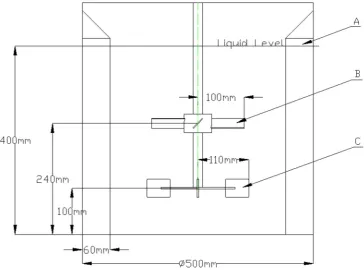
3.1. Reactor setup
250
This study was carried out in a 74L baffled stirred vessel agitated with a Rushton impeller and
251
a pitched blade turbine, as illustrated in Figure 1. The diameter of the vessel is D=0.5m, and the liquid
252
level is H=0.4m from the bottom of the vessel. The Rushton impeller is assembled T=0.14m below the
253
pitched blade turbine, whose blade angle is 45°. The agitation system is operated at 12rpm
254
256
Figure 1. Geometrical dimension of the two-impeller stirred tank. Where (A) stands for the baffles,
257
(B) represents the pitched blade impeller and (C) denotes the Rushton impeller.
258
3.2. Chemical kinetics
259
To study the influence of mixing on reaction selectivity, a well-documented pair of parallel
260
competitive Bourne reactions is integrated. This reaction system is composed of a first-order decay
261
and a parallel second order coupling, where A is a diazonium salt (diazotized 2-chloro-4-nitroaniline)
262
and B is pyrazolone (4-sulphophenyl-3-carboxypyrazol-5-one). R denotes the desirable product
263
which is a dyestuff, and S is the unwanted product of decomposition. The rate constants at 40℃ are
264
k1=10-3s-1 and k2=7000m3 kmol-1 s-1 at a PH=6.6[37]. Both reactants are dissolved in aqueous solution.
265
A ⎯ S, (13)
A + B ⎯ R, (14)
The vessel is initially charged with pyrazolone solution with a concentration of 1 x 10⁻³M.
266
diazonium solution is added into the stirred tank in a semi-batch manner, the concentration of which
267
is 7.4 x 10⁻¹M.
268
In this reaction system, the advantage of defining objective function in the form of productivity
269
is pronounced. Considering that the desired reaction happens faster than side reactions, infinitely
270
slow feeding would always be preferred if we want to maximize the ratio between desired product
271
and side product. Based the time scale of mixing, the duration of process is set as 150s.
272
3.3. Flow field simulation
273
CFD simulation is adopted to solve for velocity field inside this reactor based on the physical
274
property of the solvent. Although Pyrazolone solution is fed in a semi-batch manner into the stirred
275
tank, the influence of the feeding pipe over the flow pattern is ignored. Since the flow rate of injection
276
pipe is 102 order smaller than that of the bulk flow inside the reactor, influence of reagent injection
277
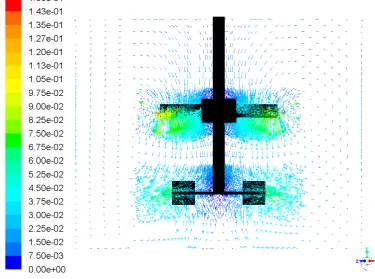
A steady state CFD simulation is conducted with the commercial code of Fluent 16.0. The
279
Reynolds-Averaged-Navier-Stocks (RANS) equation was numerically solved with multi-reference
280
frame (MRF) method. To close the equations, k-epsilon turbulence model with standard wall
281
functions was adopted. The velocity field is shown in Figure 2.
282
283
Figure 2. Simulated vector plot of velocity field inside the stirred tank (m/s)
284
3.4. Compartmental modeling and grid independence test
285
To develop compartmental models from steady state CFD simulation, computational cells
286
extracted from CFD are aggregated based on a predefined grid. The grid is defined by evenly
287
dividing the reactor in radial, axial and angular directions. The grid density of each direction is
288
determined based on the grid sensitivity test proposed in subsection 2.1.3.
289
To justify the perfect-mixing assumptions in each compartment, local Damköhler number (Da)
290
is analyzed. As suggested Figure 2, the bulk velocity inside the stirred tank is in the order of 10-2m/s.
291
Based on Eq.7, the upper bound of length scale in each compartment should be 1m. Furthermore, to
292
justify neglecting diffusive mass transfer, Péclet number (Pe) is analyzed according to Eq.8. Since
293
diffusion coefficient in aqueous solutions are in the order of 10-9m2/s, the lower bound of
294
compartment length scale is 10-7m. It can be concluded that since in single phase turbulent flow
295
convective mass transfer rate is usually several orders of magnitude higher than that of diffusion,
296
compartmental model can be safely adopted in most single phase stirred tank reactors.
297
Starting from the upper bound indicated by the analysis of Damköhler number, length scale of
298
the compartments is decreased to test the optimal grid density as discussed in section 2.1.3. In this
299
work, grid independence test is performed by simulating the injection of diazonium at the top free
300
surface of liquid near the wall. Considering that the injection should be fast enough to show mixing
301
effect, but not excessively fast so that the pyrazolone is instantly depleted and the mixing-sensitive
302
coupling is dominated by the decaying, the feeding rate of diazonium solution is set as 0.5mL/s,
303
scaled from the work of Nienow [37]. The distribution of different chemical species at the end of
304
process is predicted and monitored. The total number of compartments used for the grid sensitivity
305
test varied from 384 (8×8×6: axial×radial×angular) to 2352 (12×14×14). The predicted amount of
306
chemical species varies with the number of compartments and approaches asymptotic values as
307
1920(12×16×10) compartments for all species, which corresponds to Da<0.1. For fast model
309
development, Damköhler number can served as an efficient criterion for defining grids [31]. Further
310
results presented in this paper are based on this discretization scheme.
311
312
Figure 3. Convergence of predicted (a) Diazonium and (b) Pyrazolone distribution with number of
313
compartments
314
3.5. Optimization and results
315
The overall objective for the optimization problem is to maximize process productivity, which
316
is defined based on the price of different materials. In this case study the price of desired product is
317
assumed to be ten times as much as the price of diazonium, which is 104$/mol. The prices have
318
profound influence on the optimal operating policy. Feeding points are defined with 3 integer
319
variables, representing the corresponding radial, axial and angular index.
320
The optimization algorithm is first solved for the optimal static operating condition in which
321
reagent is injected in a constant rate. To further improve the process productivity, dynamic operating
322
conditions where the feeding rate changes dynamically are studied and optimized. Dynamic policies
323
comprised of 2 and 3 feeding stages are discussed. Furthermore, by optimizing process design with
324
perfect-mixing assumption, traditional design is compared with this proposed methodology.
325
3.5.1. Optimal location of feeding
326
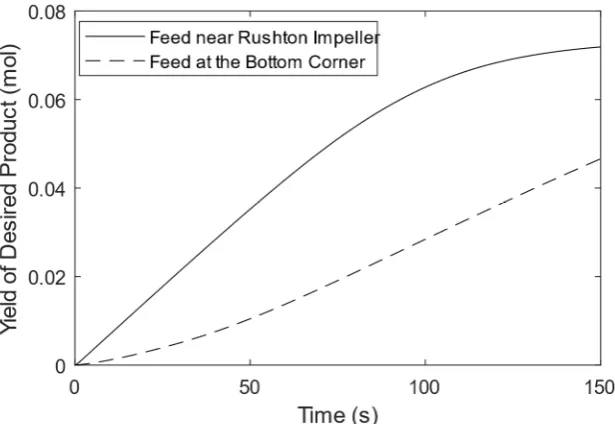
In this section, the influence of feeding location on mixing and reaction selectivity is studied.
327
Two operating conditions with different feeding locations are compared; one is at the bottom corner
328
of the reactor while the other one is at the tip of Rushton impeller. The feeding rate (1mL/s) is kept
329
constant throughout the simulation. In Figure 4 the yield trajectories of desired product are displayed
330
when different feeding locations are adopted. Considering that stronger convective flow presents
331
near impellers, in industry the injection point is usually placed in that region. Consistent with this
332
empirical rule, this simulation suggests that feeding at the corner of the reactor significantly hindered
333
the progress of reaction.
334
Table 1. Comparison of optimal feeding location for (a) constant rate feeding (b) two-stage dynamic
335
feeding policy and (c) three-stage feeding policy
336
Reagent Injection Policy Optimal Injection Location
Height(m) Radial Position(m)
Constant Rate Feeding 0.1-0.13 0.22-0.25
Two-stage Dynamic Feeding 0.1-0.13 0.22-0.25
337
The location for feeding is then numerically optimized with the proposed compartmental model.
338
As suggested in Table 1, it was found that irrespective of the number of stages, the maximum
339
productivity is reached when reagents are injected at the tip of Rushton impeller, which suggests a
340
higher mixing efficiency.
341
342
Figure 4. Simulated yield of the desired product when addition location is (a) at the bottom corner (b)
343
near Rushton impeller
344
3.5.2. Optimal rate of feeding
345
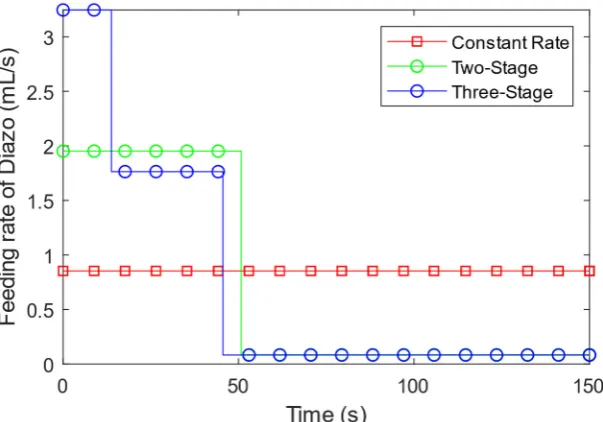
The optimal feeding rate profiles determined for different reagent injection policies are
346
illustrated in Figure 5. It can be concluded that the proposed methodology favors a decreasing
347
feeding rate profile, which leads to an increased process productivity. The reason behind this
348
productivity boost is studied through process dynamics. As illustrated in Table 2, approximately 4%
349
increase in process productivity is achieved by implementing a more dynamic operation.
350
Table 2. Comparison of optimal process productivity when (a) constant rate feeding (b) two-stage
351
dynamic feeding policy and (c) three-stage feeding policy are adopted
352
Reagent Injection Policy Optimal Process Productivity ($)
Constant Rate Feeding 6162.90
Two-stage Dynamic Feeding 6410.43
Three-stage Dynamic Feeding 6411.76
353
Simulated trajectories of chemical species when different injection policies are employed is
354
illustrated in Figure 6. It is suggested that through employing dynamic policies, the yield of desired
355
product is not significantly enhanced (Figure 6(c)), which can be explain by the way we formulate
356
this problem. Since the price of the desired product is 10 times as high as the price of diazonium,
357
through the effort to maximize the overall profit, sufficient diazonium is fed to exhaust pyrazolone,
358
which lead to similar yield of the product.
359
Nevertheless, dynamic feeding rate can improve process productivity through reducing the
360
waste of raw material. As suggested in Figure 6(a), considerable amount of diazonium is wasted if
361
constant rate feeding policy is adopted. When reactant is fed at a constant rate, with the consumption
362
of pyrazolone, diazonium would inevitably accumulate faster, which lead to material waste that
363
compromises economic performance. By adjusting feeding rate as pyrazolone is deleted, maximum
364
366
Figure 5. Optimal feeding rate profile solved for (a) Constant rate (b) Two-stage (c) Three-stage
367
reagent injection policies
368
369
Figure 6. Simulated trajectories of (a) Diazo (b) Pyrazolone and (c) Desired product when optimal
370
feeding policies solved with different number of stages are employed
371
3.5.3. Traditional process design with perfect-mixing assumptions
372
To illustrate the improvement of reaction selectivity by implementing this proposed
373
methodology, perfect-mixing model is studied and compared with compartmental model. The same
374
optimization algorithm is applied to the process dynamics model developed under perfect mixing
375
assumption. Specifically, in this section, three-stage dynamic feeding rate is considered. Table 3
376
shows the simulated process productivity when different methodologies are employed. It can be
377
concluded that by capturing the heterogeneity with CFD-based compartmental model, significant
378
improvement to process productivity could be achieved. The reason behind this productivity boost
379
is studied through process dynamics, as shown in Figure 7 and Figure 8.
380
Table 3. Comparison between optimal operating conditions solved with perfect mixing model and
381
the proposed methodology
382
Methodology Simulated Process Productivity ($)
Perfect-mixing Model 6162.90
Optimal feeding rate profiles determined with different methodologies are illustrated in Figure
383
7. It is suggested that process design based on perfect-mixing assumption would lead to faster feeding
384
at earlier period of process. Therefore, a high quantity of diazonium is accumulated in the earlier
385
stage of process (Figure 8(a)). As a result, the undesired decomposition of diazonium is accelerated,
386
which compromise reaction selectivity (Figure 8(d)). Moreover, without considering the insufficient
387
consumption of pyrazolone due to imperfect mixing, the overall yield of desired product is hindered,
388
which further reduced product productivity.
389
390
Figure 7. Optimal feeding rate profile solved with (a) CFD-based compartmental model and (b)
391
perfect mixing model
392
393
Figure 8. Simulated trajectories of (a) Diazonium (b) Pyrazolone (c) Desired product and (d)
394
undesired product when different methodologies are employed
395
4. Discussion
396
Mixing in turbulent flow can significantly influence reaction selectivity, therefore systematic
397
analysis of mass transfer inside reactors is crucial for process design. Despite the increasing
398
computational power available for gaining understanding of the mixing process, in-silico process
399
design can still be inefficient in time and cost. In this proposed framework, by replacing repetitive
400
dynamic CFD simulation with compartmental model, process design can be conducted in a timely
401
implemented to numerically optimize process productivity. Comparing to genetic algorithm, which
403
is most widely adopted in engineering design, surrogate–based method requires less simulations to
404
find the optimal process design. As a result, the overall time efficiency can be significantly improved.
405
From the case study in section 3, it can be concluded from Table 4 that by implementing
CFD-406
based compartmental modeling, significant time saving could be achieved. Single simulations were
407
performed to determine the computational effort for one design evaluation. The hardware used is a
408
4-cores Intel Xeon E5 V3 workstation. In active pharmaceutical ingredient (API) plant design where
409
a large number of simulations are conducted, computational expense could be reduced from weeks
410
to hours through the implementation of the proposed methodology. Moreover, considering that CFD
411
is not freely available and requires special know-how, by cutting back dynamics CFD simulations,
412
implementing compartmental modeling is economically beneficial. This approach has shown a good
413
potential to characterize mixing in all the reactors in an API plant.
414
Table 4. Comparing computational expense between the proposed methodology and direct CFD
415
simulation
416
Methodology Computational Expense for one Simulation (s)
Dynamic CFD simulation 104
CFD-based Compartmental Model 70
417
Despite the reduced model complexity, in this work the grid density is determined so that
418
inhomogeneity inside reactor is sufficiently captured. Comparing to traditional process design
419
strategies which are based on perfect-mixing assumption, better reaction selectivity could be
420
achieved through compartmental model. As has been discussed in subsubsection 3.5.3, by replacing
421
traditional process design strategy with this proposed compartmental model, more than 10% increase
422
in process profit has been achieved (Table 3).
423
Table 5. Comparison between optimal operating conditions solved with perfect mixing model and
424
the proposed methodology
425
Methodology Simulated Process Productivity ($)
Perfect-mixing Model 5713.18
Compartmental Model (constant rate) 6126.90 Compartmental Model (dynamic rate) 6411.76
426
Furthermore, this proposed framework allows the design of dynamic operations. As illustrated
427
in subsubsection 3.5.2, by adapting feeding rate in time to account for the depletion of raw materials,
428
material waste can be substantially reduced, which in turn leads to improved process productivity.
429
Considering that for complex reaction networks commonly encountered in organic synthesis, process
430
dynamics could be very complicated. By enabling the design of dynamic operations to fit the evolving
431
chemical processes, this proposed framework has exhibited a great potential of productivity
432
improvement.
433
5. Summary
434
In this work, a methodology to improve reaction selectivity by optimizing process operation is
435
proposed. Detailed CFD simulation is incorporated with computationally inexpensive
436
compartmental model and reaction kinetics, yielding a good compromise between accuracy and
437
complexity. An efficient surrogate optimization algorithm is integrated, making this framework
438
promising for rapid process design. As suggested in the case study, by directly accounting for the
439
product distribution from Bourne reactions, this proposed methodology can successfully improve
440
process design and optimize reaction selectivity. Furthermore, the proposed methodology allows for
441
dynamic process operation design, which has shown a great potential of further productivity
442
completely different reactors including flow reactors and crystallizers. Finally, the developed
444
simplification of complex transport model has the potential for advanced process monitoring and
445
control for reactors with limited instrumentation, such as single-use bioreactors and fermenters.
446
Author Contributions: Under supervision of M.I. and S.K., S.Y. was responsible for development of research
447
methodology and optimization framework, model development, optimization and analysis of the results. P.F.
448
contributed in model development.
449
Funding: This research received no external funding.
450
Acknowledgments: The authors gratefully acknowledge financial support from Gilead Science Inc. We also
451
appreciate the discussions and technical inputs from Chiajen Lai of Gilead Science Inc.
452
Conflicts of Interest: The authors declare no conflicts of interest.
453
References
454
1. Plutschack, M.B., et al., The Hitchhiker's Guide to Flow Chemistry(II).Chem. Rev., 2017. 117(18): p.
11796-455
11893.
456
2. Gobert, S.R.L., et al., Characterization of Milli- and Microflow Reactors: Mixing Efficiency and Residence
457
Time Distribution.Org. Process Res. Dev., 2017. 21(4): p. 531-542.
458
3. Fogler, H.S., Essentials of chemical reaction engineering. 2010: Pearson Education.
459
4. Gresch, M., et al., Compartmental Models for Continuous Flow Reactors Derived from CFD Simulations.
460
Environ. Sci. Technol., 2009. 43(7): p. 2381-2387.
461
5. Nienow, A.W., On impeller circulation and mixing effectiveness in the turbulent flow regime.Chem. Eng.
462
Sci., 1997. 52(15): p. 2557-2565.
463
6. Rosseburg, A., et al., Hydrodynamic inhomogeneities in large scale stirred tanks - Influence on mixing
464
time.Chem. Eng. Sci., 2018. 188: p. 208-220.
465
7. Levesque, F., et al., Advancing Flow Chemistry Portability: A Simplified Approach to Scaling Up Flow
466
Chemistry.Org. Process Res. Dev., 2018. 22(8): p. 1015-1021.
467
8. Aubin, J.; Ferrando, M.; Jiricny, V., Current methods for characterising mixing and flow in microchannels.
468
Chem. Eng. Sci., 2010. 65(6): p. 2065-2093.
469
9. Commenge, J.M.; Falk, L., Villermaux-Dushman protocol for experimental characterization of micromixers.
470
Chem. Eng. Process., 2011. 50(10): p. 979-990.
471
10. Reckamp, J.M., et al., Mixing Performance Evaluation for Commercially Available Micromixers Using
472
Villermaux-Dushman Reaction Scheme with the Interaction by Exchange with the Mean Model. Org.
473
Process Res. Dev., 2017. 21(6): p. 816-820.
474
11. Bourne, J.R.; Kozicki, F.; Rys, P., Mixing and fast chemical reaction—I:Test reactions to determine
475
segregation.Chem. Eng. Sci., 1981. 36(10): p. 1643-1648.
476
12. Bourne, J.R., Mixing and the selectivity of chemical reactions.Org. Process Res. Dev., 2003. 7(4): p. 471-508.
477
13. Bourne, J.R.; Yu, S.Y., Investigation of micromixing in stirred tank reactors using parallel reactions.Ind.
478
Eng. Chem. Res., 1994. 33(1): p. 41-55.
479
14. Fournier, M.C.; Falk, L.; Villermaux, J., A new parallel competing reaction system for assessing
480
micromixing efficiency—Experimental approach.Chem. Eng. Sci., 1996. 51(22): p. 5053-5064.
481
15. Cheng, D., et al., Numerical simulation of macro-mixing in liquid-liquid stirred tanks.Chem. Eng. Sci., 2013.
482
101: p. 272-282.
483
16. Liu, L.; Barigou, M., Experimentally Validated Computational Fluid Dynamics Simulations of
484
Multicomponent Hydrodynamics and Phase Distribution in Agitated High Solid Fraction Binary
485
Suspensions.Ind. Eng. Chem. Res., 2014. 53(2): p. 895-908.
486
17. Warmeling, H.; Behr, A.; Vorholt, A.J., Jet loop reactors as a versatile reactor set up - Intensifying catalytic
487
reactions: A review.Chem. Eng. Sci., 2016. 149: p. 229-248.
488
18. Reinecke, S.F., et al., Macro-mixing characterisation of a stirred model fermenter of non-Newtonian liquid
489
by flow following sensor particles and ERT.Chem. Eng. Res. Des., 2017. 118: p. 1-11.
490
19. Varela, S., et al., Numerical and experimental modelization of the two-phase mixing in a small scale stirred
491
vessel.J. Ind. Eng. Chem., 2018. 60: p. 286-296.
492
20. Farzan, P.; Ierapetritou, M.G., Integrated modeling to capture the interaction of physiology and fluid
493
21. Lladó Maldonado S., et al., Multiphase microreactors with intensification of oxygen mass transfer rate and
495
mixing performance for bioprocess development.Biochem. Eng. J., 2018. 139: p. 57-67.
496
22. Zhan, C.J., et al., Study of hydrodynamics in wave bioreactors by computational fluid dynamics reveals a
497
resonance phenomenon.Chem. Eng. Sci., 2019. 193: p. 53-65.
498
23. Smith, J.D., et al., CFD-Based Optimization of a Flooded Bed Algae Bioreactor.Ind. Eng. Chem. Res., 2013.
499
52(22): p. 7181-7188.
500
24. Uebel, K., et al., CFD-based multi-objective optimization of a quench reactor design.Fuel Process. Technol.,
501
2016. 149: p. 290-304.
502
25. Rossger, P.; Richter, A., Performance of different optimization concepts for reactive flow systems based on
503
combined CFD and response surface methods.Comput. Chem. Eng., 2018. 108: p. 232-239.
504
26. Park, S., et al., Multi-objective Bayesian optimization of chemical reactor design using computational fluid
505
dynamics.Comput. Chem. Eng., 2018. 119: p. 25-37.
506
27. Bezzo, F.; Macchietto, S.; Pantelides, C.C., A general methodology for hybrid multizonal/CFD models.
507
Comput. Chem. Eng., 2004. 28(4): p. 501-511.
508
28. Nauha, E.K., et al., Compartmental modeling of large stirred tank bioreactors with high gas volume
509
fractions.Chem. Eng. J., 2018. 334: p. 2319-2334.
510
29. Nørregaard, A., et al., Hypothesis-driven compartment model for stirred bioreactors utilizing
511
computational fluid dynamics and multiple pH sensors.Chem. Eng. J., 2019. 356: p. 161-169.
512
30. Boltersdorf, U.; Deerberg, G.; Schlüter, S., Computational study of the effects of process parameters on the
513
product distribution for mixing sensitive reactions and on distribution of gas in stirred tank reactors.Recent
514
research developments in chemical engineering, 2000: p. 15-43.
515
31. Guha, D., et al., CFD-based compartmental modeling of single phase stirred-tank reactors.AlChE J., 2006.
516
52(5): p. 1836-1846.
517
32. Zhao, W., et al., Application of the compartmental model to the gas-liquid precipitation of CO2-Ca(OH)2
518
aqueous system in a stirred tank.AlChE J., 2017. 63(1): p. 378-386.
519
33. Vrabel, P., et al., Compartment model approach: Mixing in large scale aerated reactors with multiple
520
impellers.Chem. Eng. Res. Des., 1999. 77(A4): p. 291-302.
521
34. Du, J.; Johansen, T.A., Integrated Multilinear Model Predictive Control of Nonlinear Systems Based on Gap
522
Metric.Ind. Eng. Chem. Res., 2015. 54(22): p. 6002-6011.
523
35. Srilatha, C., et al., Relation between hydrodynamics and drop size distributions in pump–mix mixer.Chem.
524
Eng. Sci., 2010. 65(11): p. 3409-3426.
525
36. Bezzo, F.; Macchietto, S., A general methodology for hybrid multizonal/CFD models - Part II. Automatic
526
zoning.Comput. Chem. Eng., 2004. 28(4): p. 513-525.
527
37. Nienow, A.W., et al., A new pair of reactions to characterize imperfect macro-mixing and partial
528
segregation in a stirred semi-batch reactor.Chem. Eng. Sci., 1992. 47(9–11): p. 2825-2830.
529
38. Conn, A.R.; Scheinberg, K.; Vicente, L.N., Introduction to derivative-free optimization. Vol. 8. 2009: Siam.
530
39. Boukouvala, F.; Misener, R.; Floudas, C.A., Global optimization advances in Mixed-Integer Nonlinear
531
Programming, MINLP, and Constrained Derivative-Free Optimization, CDFO. Eur. J. Oper. Res., 2016.
532
252(3): p. 701-727.
533
40. Bhosekar, A.; Ierapetritou, M., Advances in surrogate based modeling, feasibility analysis, and
534
optimization: A review.Comput. Chem. Eng., 2018. 108: p. 250-267.
535
41. Regis, R.G.; Shoemaker, C.A., Improved strategies for radial basis function methods for global
536
optimization.J. Glob. Optim., 2007. 37(1): p. 113-135.
537
42. Oeuvray, R.; Bierlaire, M., BOOSTERS: A derivative-free algorithm based on radial basis functions.Int. J.
538
Model. Simul., 2009. 29(1): p. 26-36.
539
43. Wild, S.M.; Shoemaker, C.A., Global Convergence of Radial Basis Function Trust-Region Algorithms for
540
Derivative-Free Optimization.SIAM Rev., 2013. 55(2): p. 349-371.
541
44. Regis, R.G.; Wild, S.M., CONORBIT: constrained optimization by radial basis function interpolation in trust
542
regions.Optim. Method Softw., 2017. 32(3): p. 552-580.
543
45. Wang, Z.L.; Ierapetritou, M., A novel feasibility analysis method for black-box processes using a radial
544
basis function adaptive sampling approach.AlChE J., 2017. 63(2): p. 532-550.
545
46. Jones, D.R.; Schonlau, M.; Welch, W.J., Efficient global optimization of expensive black-box functions.J.
546
47. Boukouvala, F.; Ierapetritou, M.G., Derivative-free optimization for expensive constrained problems using
548
a novel expected improvement objective function.AlChE J., 2014. 60(7): p. 2462-2474.
549
48. Regis, R.G., Trust regions in Kriging-based optimization with expected improvement.Eng. Optimiz., 2016.
550
48(6): p. 1037-1059.
551
49. Beykal, B., et al., Global optimization of grey-box computational systems using surrogate functions and
552
application to highly constrained oil-field operations.Comput. Chem. Eng., 2018. 114: p. 99-110.
553
50. Wang, Z.L.; Ierapetritou, M., Constrained optimization of black-box stochastic systems using a novel
554
feasibility enhanced Kriging-based method.Comput. Chem. Eng., 2018. 118: p. 210-223.
555
51. Fernandes, F.A.N., Optimization of Fischer-Tropsch synthesis using neural networks.Chem. Eng. Technol.,
556
2006. 29(4): p. 449-453.
557
52. Henao, C.A.; Maravelias, C.T., Surrogate-Based Superstructure Optimization Framework.AlChE J., 2011.
558
57(5): p. 1216-1232.
559
53. Brar, L.S.; Elsayed, K., Analysis and optimization of cyclone separators with eccentric vortex finders using
560
large eddy simulation and artificial neural network.Sep. Purif. Technol., 2018. 207: p. 269-283.
561
54. Sen, O., et al., Evaluation of multifidelity surrogate modeling techniques to construct closure laws for drag
562
in shock-particle interactions.J. Comput. Phys., 2018. 371: p. 434-451.
563
55. Müller, J., MISO: mixed-integer surrogate optimization framework.Optim. Eng., 2015. 17(1): p. 177-203.
564
56. Zhang, W.P., et al., Investigation of Mixing Performance in Passive Micromixers.Ind. Eng. Chem. Res., 2016.
565
55(38): p. 10036-10043.
566
Lin, X.Y., et al., Liquid-liquid mixing enhancement rules by microbubbles in three typical micro-mixers.