Basic Skills into the Community
Evaluation Report
Violet Windsor and Harvey Mellar
Institute of Education, University of London
24 March 2003
1 Introduction
The Basic Skills into the Community project began in March 2001. It was funded under Objective 1 of ESF, developed against Priority 4 measure 2 of the Human Resources Development Regional Action Plan. Its main purpose was to „broaden basic skills provision to staff within voluntary organisations and, in turn, the direct recipients within the disadvantaged groups so that they are better equipped to access learning and
employment.‟ (Proposal funding document, section 2).
The planning of this project was in advance of the strategic documents published by the Welsh National Assembly in 2001, and the launch of the National Strategy for Basic Skills in Wales in April 2002.
1.1 The project
The Basic Skills into the Community project is an important project pioneering new approaches to the delivery of basic skills through the involvement of voluntary
organisations within areas in Wales recognised as having particular economic difficulties. This quotation by Kevin Morgan, Professor of European Regional Development, at Cardiff University, possibly sets the context for this project,
The National Assembly Administration and the Welsh Development agency chant the following mantra: Wales will move up-market from the industrial economy to the knowledge economy, from volume production to value production. This may be the future if we can get there, but one wonders if we have the skills to enter the knowledge economy when one in four of the population is functionally illiterate and one in three functionally innumerate. To redress this policy we need not so much a training policy as a social crusade to upskill the Welsh workforce.’
Tools for a Learning Country, p. 4 It was understood from the start of the project that developing basic skills was a new venture for the organisations concerned (with the exception of NACRO) and that there would be a period of learning and adjustment.
ACLF (Adult and Community Learning Fund) and NVOPP. (National Voluntary
Organisations Partnership Project). The development officers kept partners, including the evaluation team, informed about the National Strategy (for basic skills) and this was extremely valuable because it helped to connect this project with the National Strategy and gave an increased sense of pride and purpose.
Important general questions raised by the project are:
a. In what ways can basic skills be delivered by voluntary organisations? b. How does this vary with the type of voluntary organisation?
c. What lessons can be learned from this project about implementing basic skills delivery through voluntary organisations in the future?
d. What are the significant differences/commonalties with other forms of provision i.e. FE, Adult, Training organisations, learning based in the workplace
Within the context of the wider questions raised by the project the grant application to ESF outlines a number of specific evaluation questions:
1. An evaluation of the effectiveness of the training to be carried out internally by basic skills experts attached to the project.
2. External evaluation by the Institute of Education, University of London, looking at: a. the quality of developed materials and operational management;
b. the quality and effectiveness of the support and guidance routes developed; c. assessment of increased basic skills capability of participating organisations; d. the efficiency and accessibility of the ICT elements;
e. Equal opportunity issues.
1.2 Evaluation process
Information for the evaluation was obtained through: a. Attendance at Steering Group Meetings
b. Interviews with project leaders from the voluntary organisations taking part in the project
c. Interview with tutors and project workers within the voluntary organisations, including facilitating a meeting (June 2002) with all the tutors in post, and meeting with the consultant to the Welsh Association of Youth Clubs d. Review of the Action Plans from the voluntary organisations
e. Review of the Interim Reports from the voluntary organisations
It was expected that we would also carry out a review of the Final Reports from the voluntary organisations but only two (from Tai Trothwy and Welsh Refugee Council) was received.
The voluntary organisations involved in the project were: a. Tai Trothwy
b. Welsh Refugee Council c. NACRO – in two sites
d. Groundwork Wales – in two sites e. Welsh Association of Youth Clubs1 f. The Welsh Council for Voluntary Action2
The Evaluation Team produced an Interim Report dated 22 April 2002, which was presented to the Steering Group Meeting. This report contained recommendations about the future development of the project.
Drafts of the present evaluation report were circulated to all partners for comment in February 2003.
2 The progress of the project
2.1 General
There was throughout the project a creative tension between the BSA‟s desire to have clearly recognisable basic skills objectives reached in order to provide accountability to the external funders, and the nature of the work of voluntary organisations. This may have led the BSA initially to see the work of the voluntary organisations too much through an educational lens, rather than adopting an explicit philosophy that recognized the bottom up client centred approach of voluntary organisations.
One of the organisations (NACRO) had basic skills as a key part of its agenda and was enthusiastic about achieving the BSA‟s Quality Mark for its provision.
There is evidence of objectives developing and changing throughout the project. Interviewees were sometimes apologetic about this, but it seems to us that this is to be welcomed, as it appeared to be a sign of an increasing appreciation of the work of voluntary organisations by the BSA, and increasing integration of the basic skills objectives with the core activities of the voluntary organisations.
The voluntary organisations have access to the local community, its resources and are in a good position to understand local culture, including attitudes to formal (and English
1 There was some delays in WAYC starting work in the project due to the untimely death of the person initially responsible for WAYC‟s involvement in the project.
medium) education. These advantages were utilised in all the organisations with
increasing confidence as the project progressed. By the time of the final Steering Group meeting it was clear that the organisations had taken on board the basic skills agenda.
2.2 Project start up
At the start of the project the Basic Skills Agency may not have been sufficiently aware of the nature of the work of the voluntary organisations that were involved, nor were these organisations necessarily in a position to make an informed contribution to writing the grant application. Most (but not all) of the voluntary organisations taking part in the project had little previous experience of basic skills. One manager looking back on the initial stages of the project described it as “the blind leading the blind; I guess at the beginning of this we weren‟t very clear in terms of putting it [basic skills] into our organisations.”
In the planning stages of the project there was a need (not always met) for both the BSA and the individual organisations to understand the nature of adult basic skills and the „fit‟ with the organisations‟ objectives. Most of the managers recognised this and in
interviews some acknowledged they were anxious about appearing ill-informed and kept quiet about their lack of understanding. The consequence of this was initial slowness in setting up the various elements of the project.
Two organisations, apart from NACRO, had some prior experience of basic skills
provision. One of these had a small project that led to developing a local strategy and this was then integrated into the organisation‟s work. The other had attempted to make provision but it had not been implemented.
It may well be that at the start of the project the BSA thought there was more experience of basic skills within the voluntary organisations than there actually was, and indeed it probably overestimated the level of understanding of adult learning generally within the voluntary organisations.
Discussions with managers in the voluntary organisations suggest that recruiting appropriate workers to deliver basic skills teaching was a challenging task, but that the process of recruitment pushed forward understanding of what might be accomplished. The BSA‟s own resources for work in Wales were initially limited, although both development officers were very supportive. A great deal of work and goodwill was also put in by managers and the appointed workers in the voluntary organisations.
It became clear during the progress of the project that there had been a lack of capacity mapping in the wider community at the start of the project, and of making links to other basic skills providers, and this was another factor that slowed the early progress of the project. However, this might also be caused by the relative absence of other providers, compounded by local geography, which results in greater physical isolation than in England.
community based provision. Since there was little delivery of basic skills through community organisations in South Wales it was difficult for the voluntary organisations to find partners to work with, and there was an absence of a range of models of provision for adult learners to call upon.
2.3 Action plans and appointment of staff
The first few months of the project posed a significant burden on the voluntary
organisations as they took on board the operational requirements of the project, and took on board the basic skills agenda.
2.3.1 The Action Plans
At the steering group meeting in May 2001 two initial tasks were identified: compiling an action plan and appointing a worker. BSA recognised the distinctiveness of each
organisation and advised that a common approach was not being looked for. A draft document based on the BSA Quality Mark was given out at the meeting as a model although it was pointed out by BSA, that this was only intended as a starting point. Three of the plans followed this model, but by contrast Groundwork‟s action plan did not have achieving the BSA Quality Mark as a primary aim and it was the only organisation to make explicit reference to the Welsh National Assembly‟s basic skills strategy.
The action plans were the main strategic document produced by each organisation and partners were advised to discuss their action plans with the Welsh BSA development officers. Despite the support given by the BSA the action plans were doubtless a
challenge to produce, although they proved invaluable in helping to identify what needed to be done. As a consequence the plans took longer to produce than had been envisaged, and they would have been of even greater use had they been produced earlier and one of the lessons is perhaps to investigate and attend to such blocks in future.
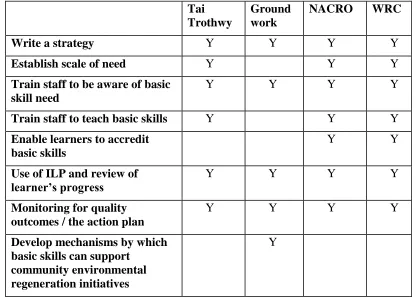
An analysis of the main objectives of the plans gives the following picture:
Tai Trothwy
Ground work
NACRO WRC
Write a strategy Y Y Y Y
Establish scale of need Y Y Y
Train staff to be aware of basic skill need
Y Y Y Y
Train staff to teach basic skills Y Y Y
Enable learners to accredit basic skills
Y Y
Use of ILP and review of learner’s progress
Y Y Y Y
Monitoring for quality outcomes / the action plan
Y Y Y Y
Develop mechanisms by which basic skills can support
community environmental regeneration initiatives
Y
Table 1: Analysis of Action Plans
Once Action Plans were drawn up and staff appointed, there was an increasing degree of acceptance of the basic skills agenda within the partner organisations, and hence a recognition of new sets of problems not previously identified. As one manager observed, “You don‟t realise the practicalities until you‟re doing it.”
The BSA development officers helped the organisations to develop the action plans but it was not clear to what extent they were systematically monitored. They seem not to have been systematically monitored by the BSA, and once the process of writing them was complete they are not referred to in the Steering Group minutes. It was left to the organisations to monitor their implementation.
Some tasks in the action plans proved to be difficult to deliver. “Everyone had difficulties” observed one manager. Appointing someone to deliver the bulk of the activities in the action plans was an initial hurdle. Awareness raising was, as managers quickly realised, a sensitive issue which was potentially disruptive for most of the organisations.
organisations became more confident about what they were doing and it was understood that objectives could change.
2.3.2 Appointment of staff
All the organisations found it very difficult to find suitable applicants to interview and appoint. Training to teach Basic Skills did not appear to be well developed in local areas and whilst courses are run at Swansea and Neath colleges there appears to be no pool of qualified Literacy and Numeracy staff looking for employment. There was agreement among managers that it was absolutely crucial to get the right staff and all the
organisations were concerned not to compromise over this.
Organisation Appointment -start Appointment – stop
Groundwork Bridgend Anna Wargan, Feb 2002 Employment continuing as a coordinator of local projects with educational focus.
Groundwork Caerphilly Christine Luff, Feb 2002 Oct. 2002 End of funding Tutor appointed / contracted from a training organisation for 36 weeks however she finished in September when initial funding ceased. BSA was looking into work based learning funding.
NACRO Caerphilly Hayley Jan / Feb 2002 April 2002 Maternity leave.
Then resigned.
NACRO (Anglesey Bryn Moore (already
employed by NACRO)
Continuing in 2003 to deliver basic skills.
WRC Rebekah Auty, Jan 2002
Phillip Jones, Sept 2002
April 2002 resigned Employed as an ESOL tutor. Presumed still in post 2003
WAYC John Holmes, July 2002 Consultancy 2003
activities.
Tai Trothwy Kathryn McAuliffe Jan
2002
Jan 2003 end of secondment from local FE. Plans to use Kathryn at Llanelli site
Table 2: Appointment of project workers
Apart from NACRO gaining the Quality Mark, accreditation for staff to deliver basic skills and qualifications proved to be unrealistic, and sometimes undesirable; although some organisations may want to reconsider this later. Tai Trothwy staff now have access to the C&G 9282 'Introduction to Basic Skills' certificate.
There were no strategies in place for pre-project support, and the workers appointed were not able immediately to provide mutual support. As a consequence project workers sometimes felt that they did not have sufficient support. Plans were made to develop a Partnership Programme Advisory Group with representatives from the Welsh Council for Voluntary Action but this did not materialise.
2.3.3 Initial objectives
The initial objectives in the action plans illustrate the differences between the organisations and the challenges they faced:
Groundwork intended to provide placements to expand and strengthen the direct basic skills training undertaken by other agencies and set up two projects. It also wanted to audit current provision and to assess its position in relation to the national strategy.
NACRO proposed writing additions to the strategy for one centre which would include basic skills and an equal opportunities statement for basic skills.
Tai Trothwy was primarily concerned with raising awareness of the need for basic skills provision and to secure agreement for the project. The main initial activity was to get the agreement of managers and directors.
WRC was concerned to recruit a basic skills tutor/project worker and to write a strategy for delivering basic skills within the organisation, including a statement on equal opportunities.
2.4 Development and understanding of basic skills
The existence of educational aims within some of the organisations before the project started, probably affected their ability to take up the opportunities offered by this project. For example NACRO has a remit to deliver basic skills and was inspected by ALI in summer 2002, and apparently received high praise for its work.
One of the common difficulties that emerged was that the among the organisations‟ workers some may have themselves had had weaknesses in literacy, and lacked the confidence and/or conviction to address basic skills needs in users. This was particularly true of organisations whose core activity allowed staff to see their role as a helping one; but one, which could also accommodate an informal approach to helping users address weaknesses in basic skills.
There is a continuum of approaches to teaching basic skills which ranges from one of extreme informality (learners don‟t realise they are being encouraged to learn) to explicit teaching to acquire formal qualifications. The organisations span this range and this needs to be recognised in future developments and decisions about basic skills provision in these and similar organisations. Recognition of this range of approaches, and its relevance, was probably only understood in the final six months of the project. This is an important achievement and is probably the result of two things: increasing contact with the two development officers and the organisations activation of their own networks. By mid 2002 there appeared to the evaluators a much greater understanding of what could be accomplished.
2.5
Ways of integrating basic skills within the organisation’s
work
Voluntary organisations generally lack the security of assured funding, tend to have a small core of full-time staff, a clear set of values which define relationships with users or clients (so educational terms like „student‟ or „learner‟ are not used) and are responsive to changes in society. They are accustomed to bidding for funding, frequently short-term funding, and do not generally have the resources to continue a project beyond its funding without strategic planning, which usually involves applying for further funding. Time, money and human resources are always in particularly short supply and these concerns are likely to lie very close to the surface in any discussion, although they may not be made explicit initially. Awareness of their existence needs to be borne in mind when planning meetings etc because of the pressures on staff to develop something new, outside what they see as the scope of their work, and this may lead to resistance to the project.
among project workers but commented that specific working arrangements (e.g secondment from local FE for short term contracts) made this difficult.
Resistance and initial rejection was a common experience and (unsurprisingly) all workers found this difficult to come to terms with. Workers reported cancelled staff meetings (when basic skills were on the agenda) and a refusal to see basic skills as
relevant. Workers found potential allies in staff also involved in human development (e.g. personnel) and learnt to value small changes as evidence that their role was effective. Most managers and workers interviewed recognised that the sense that „it‟s not our job‟ was an important issue within their organisation. One manager strongly disliked, and refused to use, the term basic skills because of its overtones of deficit. The project
worker, who agreed with him, was also able to use this in informal discussions with staff to gain their understanding if not more active support.
Many clients with basic skills needs are unwilling to enter into formal provision of basic skills teaching, partly through bad memories of institutions and formality within schools and colleges and partly as a result of their own self-image (as independent, adult and self sufficient). One manager said 90% of his users wouldn‟t entertain going to college. These clients have found strategies to manage without the skills they lack.
As the project progressed it was increasingly recognised that a more informal approach to learning is required. One manager spoke about finding ways of „doing basic skills
through the back door.‟ Organisations not delivering basic skills explicitly recognised that the personal and social development or social and life skills work already being done could (or did) involve basic skills. This realisation helped projects to move forward.
Groundwork
Within Groundwork, the trusts operate independently and two trusts elected to be involved in this project. The Caerphilly Trust used a tutor from a local training organisaton, „Include‟. The manager, who is active in the local community, was well informed about particular basic skills needs and understood the local barriers to
participating in FE. He was confident that the tutor had the skills and qualities to develop an approach which might be accepted by participants (mainly young men) involved with the Trust‟s furniture recycling project. The tutor used an approach based on delivering basic skills in the workplace. This involved developing her own context based learning materials and included digital images and using the CTAD authoring tool after training from the CTAD consultant. Unfortunately her contract came to an end shortly after this development. The CTAD consultant was able to use her work to demonstrate potential use to other tutors in September 2002.
local people and Creation tutors. This included: First Aid, Childcare, and soft toy making, which all incorporated literacy and numeracy and with some exciting potential for ICT use. Links were also beginning to be made with learndirect. These developments occurred at the end of the project and consequently further information is not available.
NACRO
There were two aspects to NACRO‟s work within the project. In Bridgend /Caerphilly the manager researched and did an analysis of need towards achieving the BSA Quality Mark. The ALI inspector praised this, and the learner centred, activity based delivery, and advocated it be used as a model for NACRO Wales.
In Anglesey the project worker is delivering basic skills in people‟s homes through a drop-in advice and guidance programme called Youth Choices. It includes an action plan with long and short-term aims, identified by the individual as important, and the worker has introduced literacy and numeracy into this.
Tai Trothwy
A very experienced Communications tutor with a strong background in community provision was seconded from the local FE college. She quickly developed her approach and tried out different ideas. These included: drop in support for study skills, taster courses (e.g. Yoga, pottery), a magazine produced by and for residents, and functional literacy activities. Soon after her appointment the project worker convinced the manager that poor literacy skills could prevent residents from understanding the heavily text based information manual. This led to a reconsideration of alternative ways of delivering the residents‟ handbook. The CTAD consultant helped the Foyer to produce centre specific interactive resources e.g. on using a cooker. Work with staff, to embed basic skills work, is ongoing. The concern to find alternatives to formal assessment is leading to links with
learndirect.
The project worker has compiled basic skills handbook which includes Tai Trothwy‟s policy on basic skills, indicating what the organisation does in relation to basic skills. This gives detailed, practical information on contacts and local provision, has a section on initial assessment materials and includes an information section addressed to support workers which has been designed to help staff. This is a useful document, and its
significance goes somewhat wider in that it helps to establish a sense of all staff being part of the agenda for change rather than it being simply the teacher‟s role.
WRC
The second appointment is based in Cardiff and has done some outreach work in the homes of beneficiaries and some teaching. WRC have begun to develop Entry level accreditation in ESOL and there is a formal system of referral with Swansea College.
WAYC
The consultant devised a questionnaire and carried out focus group interviews to examine the issue of youth workers‟ involvement with basic skills. He found that the youth
workers were aware of basic skills needs but were resistant to targeted work because they did not want to expose or embarrass young people.
3 Addressing the evaluation brief
3.1 Quality of developed materials and operational management
Each organisation received a laptop from the project, and CTAD provided copies of software including Basic Skills on-line (a tutor training programme).
Once the project worker had attended a training session provided by BSA, they were given a collection of basic skills resources for training organisations. (Worth about £2000). These included software (including TUC Communications and Numbers disks) These materials are generally only available to training organisations under contract to ELWa to deliver basic skills and there is the expectation of staff attending training and eventual achievement of the Quality Mark.
Project workers use and adapted published materials and some project workers produced materials specifically for their organisation and users.
Groundwork Caerphilly
Tutor produced context specific flash cards, activity sheets and worksheets. CTAD training led to incorporation of site specific materials within the software.
NACRO CTAD training for NACRO staff to customise software
Project materials on football developed
Tai Trothwy Magazine - Foyer Voices - produced by Tai Trothwy residents. Utilisation of residents‟ food diaries for teaching literacy and numeracy.
Induction manual for residents put into on-line format with CTAD Consistent use of functional literacy approach
Basic Skills handbook for staff
WAYC Questionnaire developed as a research instrument. This also
WRC Some materials developed
Customised CTAD software for ESOL learners
Table 3: Materials produced by project workers
Operational management
In the first phase of the project – that is until the second Steering Group meeting – the project devoted considerable attention to the development of the finance and
administrative systems that were necessary for capturing the appropriate beneficiary information. Once established these systems worked well.
In all the organisations the manager had to manage the new project worker and help them into their new role, a role that was new for the organisation itself. The introduction of the project worker was probably the most significant event in the life of each project, and the greatest challenge for the managers.
All the organisations felt comfortable with the idea of raising awareness of basic skills needs. They were less comfortable with the next step, of training. This was an issue for managers because training requires explicit leadership from managers to translate into action whereas awareness raising may be viewed as requiring less organisational change and is consequently less threatening.
Some organisations may have been particularly concerned about training in that they equated a training role with formal provision. By the end of the project such views had markedly changed as an understanding of informal approaches to learning developed. One problem for organisations was to find previous experience of a possible role within basic skills provision that they could refer to.
3.2 Quality and effectiveness of the support and guidance
routes developed
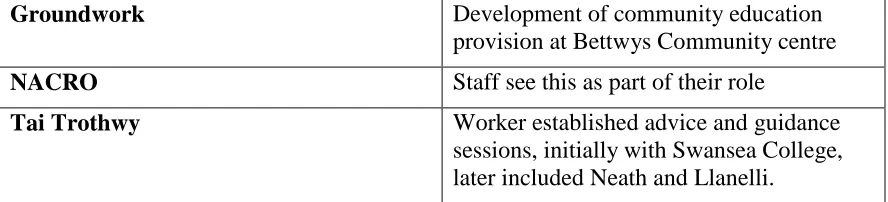
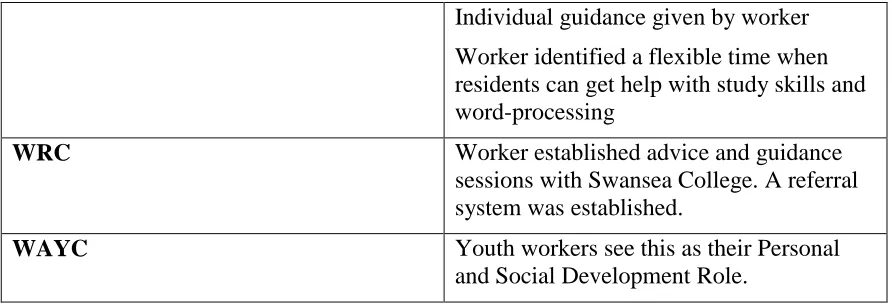
All the workers interviewed spoke of the importance of community links and of networking with other organisations, particularly those which could provide access to educational opportunities. Groundwork Bridgend is in the process of contributing to developing community education facilities in an area where access to other educational opportunities for adults do not exist. WRC is developing as an accreditation centre.
Groundwork Development of community education
provision at Bettwys Community centre
NACRO Staff see this as part of their role
Tai Trothwy Worker established advice and guidance
Individual guidance given by worker Worker identified a flexible time when residents can get help with study skills and word-processing
WRC Worker established advice and guidance
sessions with Swansea College. A referral system was established.
WAYC Youth workers see this as their Personal
and Social Development Role.
Table 4: Arrangements made for support and guidance to access educational opportunities
Several of the organisations were articulate about the need for anyone doing basic skills work with their clients to be able to empathise with young people, in particular to have a knowledge of drugs and alcohol abuse, and an awareness of issues around depression and long term unemployment. Advice and guidance frequently required a counselling
approach rather than „telling‟ people where to go.
3.3 Assessment of increased basic skills capability of
participating organisations
The Partners‟ progress reports for the penultimate steering group meeting contain
positive accounts from all the organisations and show that the final months were proving to be very productive.
By the end of the project all the organisations were rightly proud of what they had achieved and confident of their increased basic skills capability. All had realised the bulk of their objectives, and would meet the others with further time. Ongoing support is probably required by most of the organisations. This has been recognised by BSA who have placed the organisations (the only voluntary organisations included) on their active partners register and this will mean they are kept informed of training and other events.
3.4 Efficiency and accessibility of the ICT elements
For many potential basic skills learners, particularly young adults, the pressure to not stand out (real or imagined) from peers (neighbours, colleagues, friends) is a barrier adult literacy practitioners are familiar with.
ICT can sometimes be so attractive that the offer of ICT training breaks down these barriers (whilst maintaining some elements of self image) thus enabling these learners to get into formal provision. An alternative approach is to develop more informal
So ICT provision:
- is attractive to learners as it is seen as not school based
- fits with role of voluntary organisation worker who does not want to be seen in a formal educational role
- enables informal delivery outside schools/colleges/institutions
- needs to incorporate materials of relevance to users lives, and to reflect their identity if it is to be effective.
The use of ICT materials with users was only at an early stage of development within the project. However all organisations had understood the value of ICT based learning materials and some had begun to customise them for their own clients.
For a long time it appeared that ICT developments were not going to happen, but in the final months training opportunities were taken up and it seems likely that this was the direct result of the CTAD consultant visiting each organisation and discussing / planning staff support and training.
3.5 Equal opportunities issues.
At the first meeting of the Steering Group in March 2001 the partner organisations were asked to forward their equal opportunities statements to BSA as implementation of equal opportunities is an important element to achieving BSA‟s Quality Mark. This request is noted as having been made on a number of occasions at Steering Group meetings and the Agency received statements from all partner organisations.
Equal Opportunities was a standing agenda item for Steering Group meetings, and there was some discussion around the issue of disabilities at the February 2002 Steering Group meeting, but consideration of equal opportunities issues do not appear to have figured largely within the project. The majority of the projects‟ beneficiaries are reportedly young men in 18 – 25 age group. This is a particularly difficult group to attract to formal provision and so this distribution of beneficiaries may well be appropriate for this project. This project involves specific equal opportunities issues relating to Welsh language and culture. Tools for a Learning Country (BSA & IWA no date) states that there is no research into the level of literacy skills in Welsh for Welsh speaking adults and acknowledges that employers are increasingly requiring good communication skills in both languages. The report also states that BSA has commissioned research into this and the report (by Elspeth Cardy) was to have been available by November 2002.
4 Lessons learned
4.1 Project start up and support
came to have a better understanding of possible difficulties. The site visits generally (whoever made them; consultants, evaluators, BSA staff) were helpful and were regarded by the organisations as source of support.
It would have been useful to carry out capacity mapping in the wider community at an early stage of the project, and to make partnerships and links with existing basic skills providers.
4.2 The first activities
The identification of action plans and the appointment of workers at the start of the project were very useful means for focussing the thinking of the organisations on the project.
The action plans provided a structure that led to development of the projects and were valuable. Although the process of identifying action took time the judgements made by the managers proved to be appropriate for their organisations.
The reason for this delay was suggested by one manager who argued that the first stage of planning needed to focus on understanding within the organisation before developing an action plan.
4.3 Informal learning
There was a recognition through the project of the relevance of informal learning and learner or client centred approach to delivering basic skills in voluntary organisations links with the Individual Learning Plans (for providing a way of monitoring and encouraging achievement).
4.4 Tutors/workers
The role of the tutors/workers was not one that could be pre-defined, and they therefore had some difficulty in defining their own roles. The project could have more explicitly explored possible role descriptions for the project workers: trainer (awareness raising and Basic Skills), consultant, researcher, teacher, advice worker. Consideration of these roles in relation to the organisation might help implementation and could help clarify
boundaries created by new and different roles.
When appointing staff organisations realised they need staff with the ability to identify what needs to be done. This suggests a broader educational role for staff than just teaching basic skills, and so goes beyond the projects early conception of these as tutors with basic skills teaching qualifications.
4.5 Links
The link to the National Strategy and with the BSA was perceived as a positive element of the project
The opportunities for networking provided by the project were appreciated, as these voluntary organisations would otherwise not have been brought together
There needs to be further work done with the organisations to link their work with other providers to provide access to other opportunities, including with other voluntary organisations.
5 Recommendations
It is important for continuing commitment to ensure links with the National Strategy and with the BSA.
The results of the project should be publicised through the production of case studies describing how basic skills were integrated within each of the projects
In future projects where the BSA is seeking to involve voluntary organisations the BSA needs to put more resources and time into the initial planning of the project in order to take on board the differing nature of the organisations it is working with.
6 Bibliography
These publications were received from the BSA development officers in Wales ELWa (Education and Learning Wales) July 2001
Draft Corporate Strategy (National Council) Basic Skills Agency publications:
Not My Problem, Why improve basic skills in the workplace? Basic Skills and Personal Advisers
BSA Publications catalogue for 2002/2003
Basic Skills Agency with the National Assembly for Wales publications: The National Basic Skills Strategy for Wales (April 2001)
The Extent of the Problem, Basic Skills in Wales
Making it Happen, Improving the basic skills of the workforce in Wales Basic Skills Agency with the Institute of Welsh Affairs (IWA)
Tools for the Learning Country
CD-ROM Adults‟ Basic Skills, Benchmark information on the scale of need in different areas of Wales
7 ACRONYMS
ALI Adult Learning Inspectorate BSA Basic Skills Agency
ELWa Education and Learning Wales ILP Individual Learning Plan IWA Institute of Welsh Affairs
NACRO National Association for Care and Resettlement of Offenders WAYC Welsh Association of Youth Clubs