Securing Message Transactions through Modified Playfair
Cipher Technique
Yahaya Bala Zakariyau P
1
P
, Zirra Peter BubaP
2
P
, Gregory Maksha WajigaP
3
P
1
P
Department of Mathematics and Computer Science, Federal University, Kashere Gombe,0182, Nigeria.
P
2
P
Department of Mathematics and Computer Science, Federal University, Kashere Gombe,0182, Nigeria.
P
3
P
Department of Mathematics and Computer Science, Federal University of Technology Yola, 640284, Nigeria.
Abstract
Secured message transactions are the procedures to transfer the messages among the communicating parties with message confidentiality, message authentication, and message integrity. One of the several approaches used to implement the mentioned security services is Cryptography. In this paper we modified the 5 × 5 matrix Playfair cipher to 17 ×
17 matrix Playfair cipher. The modified cipher was implemented using java programming language. The result obtained revealed that, the modified 17 × 17 matrix Playfair cipher is more secure than the existing ones. This is because the modified system has a maximum key length of 289 characters and this range of key size yields 83521 possible keys that are strong enough to withstand attacks and this makes it very difficult for the eavesdropper to attack the message. As a result, this system is recommended to be used by banks for their online transaction and other institutions that deal with sensitive data and information.
.General Terms: Encryption, Decryption, Plaintext, Ciphertext.
Keywords: Playfair Cipher, Substitution, Cryptography, Network Security, Symmetric Key.
1. INTRODUCTION
In today’s world ‘information’ has become
indispensable to both individuals and
organizations. When a message is stored or
transmitted, there should be some
mechanism to protect that information from
hacking. If information reaches the wrong
person there might arise a lot of problems.
Hence there is a need to hide the message so
that a third person cannot find out the exact
message. Hence Cryptography plays an
important part in message transaction in
today’s world. The word cryptography
comes from the Greek origin. It is a
combination of two words Crypto and
Graphy. Crypto means Secret and Graphy
means writing [4].
Cryptography is the practice and study of
techniques for secure communication in the
presence of third parties (called adversaries).
More generally, it is about constructing and
analyzing protocols that overcome the
influence of adversaries and which are
related to various aspects in information
security such as data confidentiality, data
integrity, and authentication. Modern
cryptography intersects the disciplines of
mathematics, computer science, and
electrical engineering. Applications of
cryptography include ATM cards, computer
passwords, and electronic commerce.
Classical cryptography offers an insight into
how cryptography evolved over the years
(Stallings, 2006). The earliest forms of
secret writing required little more than local
pen and paper analogs, as most people could
not read. More literacy, or literate
opponents, required actual cryptography.
The main classical cipher types are
transposition ciphers, which rearrange the
order of letters in a message (e.g., 'hello
world' becomes 'ehlol owrdl' in a trivially
simple rearrangement scheme), and
substitution ciphers, which systematically
replace letters or groups of letters with other
letters or groups of letters (e.g., 'fly at once'
becomes 'gmz bu podf' by replacing each
letter with the one following it in the Latin
alphabet).
An early substitution cipher was the Caesar
cipher, in which each letter in the plaintext
was replaced by a letter some fixed number
of positions further down the alphabet.
Suetonius reports that Julius Caesar used it
with a shift of three to communicate with his
generals. Atbash is an example of an early
Hebrew cipher. The earliest known use of
cryptography is some carved ciphertext on
stone in Egypt (ca 1900 BCE), but this may
have been done for the amusement of
literate observers rather than as a way of
concealing information. Cryptography is
recommended in the Kama Sutra (ca 400
BCE) as a way for lovers to communicate
without inconvenient discovery. The Greeks
of Classical times are said to have known of
ciphers (e.g., the scytale transposition cipher
claimed to have been used by the Spartan
military). Steganography (i.e., hiding even
the existence of a message so as to keep it
confidential) was also first developed in
ancient times. An early example, from
Herodotus, concealed a message—a tattoo
on a slave's shaved head—under the
regrown hair. Another Greek method was
developed by Polybius (now called the
"Polybius Square"). More modern examples
of steganography include the use of invisible
ink, microdots, and digital watermarks to
conceal information.
Ciphertexts produced by a classical cipher
(and some modern ciphers) always reveal
statistical information about the plaintext,
which can often be used to break them.
After the discovery of frequency analysis
perhaps by the Arab mathematician and
polymath, Al-Kindi (also known as
Alkindus), in the 9th century, nearly all such
ciphers became more or less readily
breakable by any informed attacker.
Essentially all ciphers remained vulnerable
to cryptanalysis using the frequency analysis
technique until the development of the
polyalphabetic cipher, most clearly by Leon
Battista Alberti around the year 1467. He
also invented what was probably the first
automatic cipher device, a wheel which
implemented a partial realization of his
invention. Playfair cipher is one of the most
well known polyalphabetic cipher. Thus the
subject of the thesis was chosen.
The playfair cipher is more complicated than
the simple substitution cipher such as shift
and affine. In the Playfair cipher, there is no
single translation of each letter of the
alphabet, Instead, letters are translated into
other pairs of letters. Thus make it more
secure than mono-alphabetic cipher.
2. PLAYFAIR CIPHER
2.1 Existing 5 × 5 Matrix Playfair Algorithm
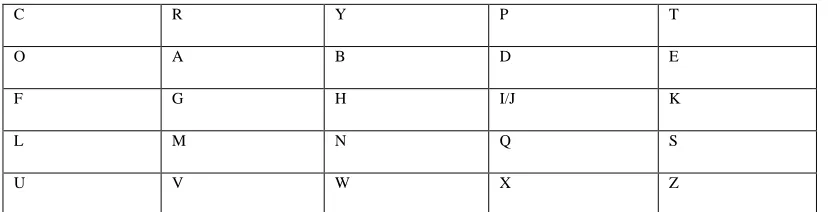
The existing playfair cipher working on 5 × 5 matrix is constructed with a keyword “CRYPTO”. The Table 6 below shows the construction of 5 × 5 matrix using the keyword “CRYPTO”
plus the uppercase alphabets satisfying the rules of preparing the table. The matrix is first filled by the keyword from left to right and the remaining cells are filled by the uppercase alphabets ignoring the letters of keyword as shown in Table 6 below.
TABLE 1: A 5 × 5 Matrix Playfair
Source: [2]
In this algorithm, the letters I & J are counted as one character. It is seen that the rules of encryption applies a pair of plaintext characters. So, it needs always even number of characters in plaintext message. In case, the message counts odd number of characters a spare letter X is added at the end of the plaintext message. Further repeating plaintext letters in the same pair are separated with a filler letter, such as X, so that the
word COMMUNICATE would be treated as CO MX MU NI CA TE.
Therefore, the 5×5 playfair exhibit the following rules
i. Plaintext letters that fall in the same row of the matrix are replaced / substituted by the letter to the right, with the first element of the row circularly following the last. For example pt is encrypted as TC
.
ii. Plain text letters that fall in the same column are replaced by the letter beneath, with the top element of the row circularly following in the last. For example, cu is encrypted as OC
iii. Otherwise, each plaintext letter is replaced by the letter that lies in its own row and the column occupied by the
other plaintext letter. Thus, oh becomes BF, and fd becomes IO (or JO, as the enciphered wishes) [3].
It has also the following limitations i. It considers the letters I and J as one
character.
ii. 26 letters alone can take as keyword without duplicates.
C R Y P T
O A B D E
F G H I/J K
L M N Q S
U V W X Z
iii. Space between two words in the plaintext is not considered as one character.
iv. It cannot use special characters and numbers.
v. It only used uppercase alphabets.
vi. A spare letter X is added when the plaintext word consists of odd number of character. In the decryption process this X is ignored.
vii. X is a valid character and creates confusion because it could be a part of plaintext, so we cannot simply remove X in decryption process.
viii. X is used a filler letter while repeating letter falls in the same pair are separated.
The 5 × 5 playfair can be broken, given a few hundred letters because it has much of plaintext structure [5]
2.2 Existing 7 × 4 Matrix Playfair Algorithms
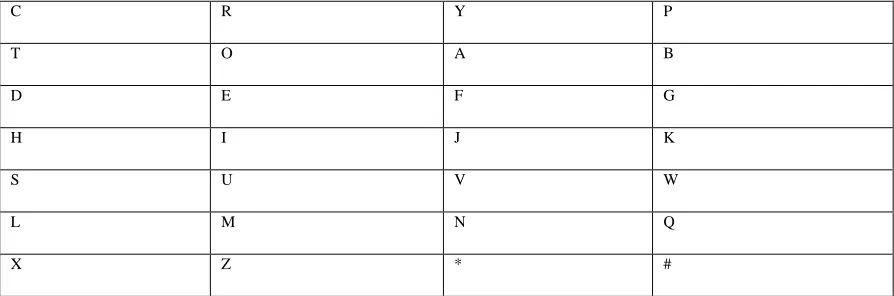
A keyword is used to construct 7 × 4 matrix using letters and symbols „*‟ and „#‟ which is the base for this Playfair Algorithm. The 7 × 4 matrix is constructed by filling keyword with no repeating letters. Here the keyword
“CRYPTO” is used. The remaining spaces are filled with the rest of alphabets. As shown in the Table 7 below, the last cell is filled by the symbol “#” and the remaining cell that is before the last cell is filled by the symbol “*” [1].
TABLE 2: A 7 × 4 Matrix Playfair
C R Y P
T O A B
D E F G
H I J K
S U V W
L M N Q
X Z * #
Source: [1].
The same rules of playfair 5 × 5 matrix are used here to encrypt the plaintext with the following modification.
i. When same letters fall in a pair it adds * so that the message BALLS become BAL*LS.
ii. If a word consists of odd number of letters, it will add symbol “#” to complete the pair. So BIT becomes BI
T#. The symbol # is simply ignored when the ciphertext is decrypted.
Therefore, the 7 × 4 matrix plafair has the following limitations
i. 26 characters only can take as a keyword without any repetition.
ii. The space between two words in the plaintext is not considered as one character.
iii. It cannot use numbers and special characters except * and #.
iv. It is not case sensitive
v. It ignores the symbols * and # at the time of decipherment.
The 7 × 4 playfair can be broken, given a few hundred letters because it has much of plaintext structure [5]
2.3 Existing 6 × 6 Matrix Playfair Algorithm
This playfair algorithm is based on the use of a 6 × 6 matrix using letters and numbers. Here also the keyword “CRYPTO” is used. The matrix is constructed by filling the letters of the keyword from left to right and from top to bottom, remaining cells of the matrix are filled by uppercase alphabets and numbers ignoring the letters of the
keyword as in Table 3 [2]. This algorithm cannot consider the letters I and J as one character. Place I and J in two different cells in order to avoid the ambiguity at the time of decipherment. The rules of playfair 5 × 5 matrix are used to encrypt the plaintext as shown in the Table 8 below
.
TABLE 3: A 6 × 6 Matrix Playfair
C R Y P T O
A B D E F G
H I J K L M
N Q S U V W
X Y 0 1 2 3
4 5 6 7 8 9
Source: [2]
Therefore, the 6 × 6 matrix playfair has the following limitations
i. This 6 × 6 matrix can only take 36 characters as a keyword without duplicates.
ii. Space between two words in plaintext is not considered as one character.
iii. The matrix cannot accept special character.
iv. It is not case sensitive. v. When plaintext word consists of odd
number of characters, a spare letter X is added with the word to complete the pair. In the decryption process this X is simply ignored. This creates confusion because X is a valid character and it can be a part of plaintext, so we cannot simply remove it in decryption process. vi. When repeating plaintext letters that
fall in the same pair are separated by a
filler letter, such as X. This letter X affects the plaintext at the time of decipherment [1].
To encrypt the plaintext, the rules of 5 x 5 playfair were employed with the following modification:
i. If the pair of plaintext are same, then “ ] ” will be used as filler.
ii. If a word consists of odd number of characters then, the character “ ] “ is added to complete the pairs, because ” ]
” character cannot affect the Plaintext at the time of decipherment.
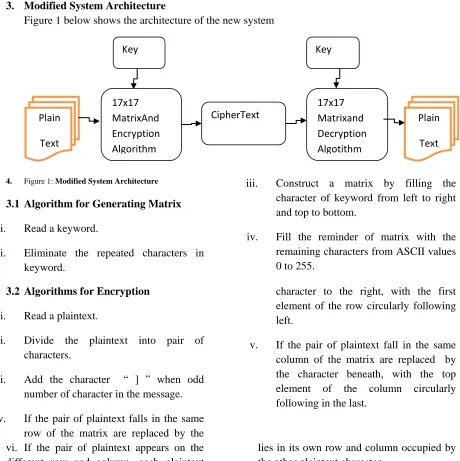
3. Modified System Architecture
Figure 1below shows the architecture of the new system
4. Figure 1: Modified System Architecture
3.1 Algorithm for Generating Matrix
i. Read a keyword.
ii. Eliminate the repeated characters in keyword.
iii. Construct a matrix by filling the character of keyword from left to right and top to bottom.
iv. Fill the reminder of matrix with the remaining characters from ASCII values 0 to 255.
3.2 Algorithms for Encryption
i. Read a plaintext.
ii. Divide the plaintext into pair of characters.
iii. Add the character “ ] ” when odd number of character in the message.
iv. If the pair of plaintext falls in the same row of the matrix are replaced by the
character to the right, with the first element of the row circularly following left.
v. If the pair of plaintext fall in the same column of the matrix are replaced by the character beneath, with the top element of the column circularly following in the last.
vi. If the pair of plaintext appears on the different row and column, each plaintext character is replaced by the character that
lies in its own row and column occupied by the other plaintext character.
3.3 Algorithm for Decryption
i. If the pair of ciphertext falls in the same row of the matrix are replaced by the character to the left, with the first element of the row circularly following right.
ii. If the pair of ciphertext fall in the same column of the matrix are replaced by the character at top, with the bottom element of the column circularly following in the last.
iii. If the pair of ciphertext appears on the different row and column, each plaintext Plain
Text
Plain
Text 17x17
MatrixAnd Encryption Algorithm
CipherText 17x17 Matrixand
Decryption Algotithm
Key Key
character is replaced by the character that lies in its own row and column
occupied by the other plaintext character.
3.4 Advantages of the Modified System
i. It allows more than 64 characters as keyword.
ii. The user can easily encrypt and decrypt the combination of alphabets, numbers and special characters efficiently.
iii. The system can accept large keyword length, therefore, it is very difficult to
find the Plaintext from Ciphertext without knowing the keyword.
iv. This algorithm adds the “ ] “ character to complete the pair, because the “ ] character cannot affect the plaintext at the end of the word Or sentence.
v. The new system considers space between two words in plaintext as character.
4. RESULT
To overcome the drawbacks in the traditional Playfair Cipher as discussed in the last chapters, a modified playfair cipher which uses a 17 x 17 matrix has been developed using Java programming language.
The 17 x 17 matrix contains almost all the printable characters. This includes lowercase and uppercase alphabets, punctuation marks, numerical and special characters. The order
of placement of different groups of characters can also be done so that the matrix formed by using the same secret keyword depends on the order of placement. This means that the ciphertext depends on the order of placement of different groups of characters. Below figures show the result obtained from the cipher.
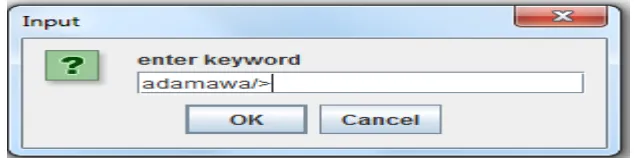
Figure 2 below shows the input dialog for keyword where user is expected to type in his/her secrete keyword or sentence
Figure 2: Input dialog for keyword
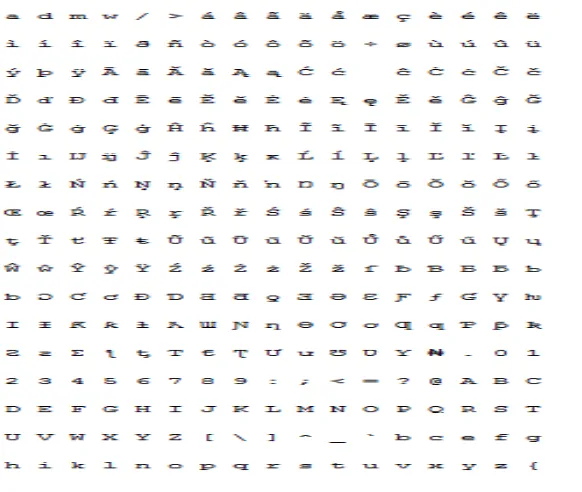
Figure 3 below shows the matrix generated based on the secrete key used:
Figure 3: Matrix Generated
Figure 4 below shows the input dialog for plaintext where user is expected to type in his/ her plaintext:
Figure 4: Input Dialog for Plaintext
Figure 5 below displays the encrypted text:
Figure 5: Encryption Output
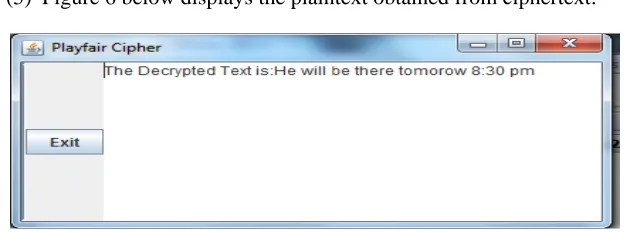
(5) Figure 6 below displays the plaintext obtained from ciphertext:
Figure 6: Decryption Output
5. DISCUSSION
Figure 3 above shows the matrix generated by the system based on the secrete keyword and it can be observed that the order of placement of characters in the matrix depends on the keyword used. And this is in conformity with the assertion of [2]. Who state that, the cryptographic system should only depend on the secrecy of the keys, and not on the secrecy of the encryption and decryption algorithms.
Figure 4 above shows the input dialog for plaintext. It can be observed that, the system can accept the combination of both
numbers and alphabets to encrypt. Thus make the system more flexible.
Figure 5 above shows the encrypted message. It can be observed that, the character “e” which appears more frequent in the plaintext does not appear more frequent in the cipher text. And this is in conformity with the assertion of [6] who stated that, if the most frequently used letter in the plaintext does not appear to be the most frequently occurring one in the ciphertext then, the system is difficult to be attacked by frequency distribution Analysis.
6. CONCLUSION
In conclusion, the modified 17 × 17 matrix Playfair cipher is more secure than the existing ones. This is because the lager the matrix the longer the key sizes and this
generally make encrypted text more difficult to decrypt without the appropriate key. This modified system has a maximum key length of 289 characters and this range of key size yields keys that are strong enough to withstand attacks using current technologies
.
7. REFERENCES
[1] Aftab, A., Sehat, U., Ishtiaq, W. and Shah, K. (2011). Universal Playfair
Cipher Using MXN Matrix. International Journal of Advanced Computer Science, 1(3), 113-117.
[2] Ravindra, B. K., Uday, S. K., Vinay, A. B., Aditya, I. V. and Komuraiah, P. (2011).
An Extension to Traditional Playfair Cryptographic Method. International Journal of Computer Applications 17(5), 75 – 87.
[3] Stallings, W. (2006). Cryptography and Network Security: Principles and Practice
(4th ed.). Prentice Hall: New York
[4] Stallings, W. (2004). Cryptography and Network Security – Principles and Practices
(3rd ed.). Pearson Education: Boston
[5] Stallings, W. (2003), Cryptography and Network Security, (3rd ed.). Pearson Education:
Boston
[6] Sinkov, A. (1998). Elementary Cryptanalysis: A Mathematical Approach (2nd ed.). USA
The Mathematical Association of America.