Multi-target DPA attacks: Pushing DPA beyond
the limits of a desktop computer
Luke Mather, Elisabeth Oswald, and Carolyn Whitnall
Department of Computer Science, University of Bristol, Merchant Venturers Building, Woodland Road,
Bristol, BS8 1UB, United Kingdom.
{luke.mather, elisabeth.oswald, carolyn.whitnall}@bris.ac.uk
Abstract. Following the pioneering CRYPTO ’99 paper by Kocher et
al. differential power analysis (DPA) was initially geared around low-cost computations performed using standard desktop equipment with minimal reliance on device-specific assumptions. In subsequent years, the scope was broadened by, e.g., making explicit use of (approximate) power models. An important practical incentive of so-doing is to reduce the data complexity of attacks, usually at the cost of increased computational complexity. It is this trade-off which we seek to explore in this paper. We draw together emerging ideas from several strands of the literature— high performance computing, post-side-channel global key enumeration, and effective combination of separate information sources—by way of advancing (non-profiled) ‘standard DPA’ towards a more realistic threat model in which trace acquisitions are scarce but adversaries are well resourced. Using our specially designed computing platform (including our parallel and scalable DPA implementation, which allows us to work efficiently with as many as 232 key hypotheses), we demonstrate some
dramatic improvements that are possible for ‘standard DPA’ when com-bining DPA outcomes for several intermediate targets. Unlike most pre-vious ‘information combining’ attempts, we are able to evidence the fact that the improvements apply even when the exact trace locations of the relevant information (i.e. the ‘interesting points’) are not knowna priori but must be searched simultaneously with the correct subkey.
1
Introduction
Differential power analysis (DPA) was initially conceived as a computationally ‘cheap’ way to recover secret information from side-channel leakages, under the assumption that trace measurements could be easily acquired [14]. Over time, the emphasis has changed and several directions have been pursued in the literature, e.g. attacks using power models [6] and attacks using several trace points [7] ([15] surveys the many variations of DPA style attacks). Across all these directions,
c
one ‘measure’ of attack success has emerged and now dominates the scientific discourse with regards to attack efficiency. This measure is the number of power traces needed to identify the correct (sub)key1.
What is the purpose of considering (sub)key recovery attacks? From a prac-tical perspective any strategy is considered successful if it reveals ‘enough’ infor-mation about the (global) key to enable a brute force search. It is crucial that side-channel resistance, like other aspects of security, be considered with respect to realistic threat models. Real world adversaries are then (arguably) mostly interested in exploring trade-offs between the number of leakage traces available and the computational resources dedicated to extracting as much information as possible from those traces. Recent work by Veyrat-Charvillon et al. [25,26] present an algorithm for searching the candidate space containing the key and a means to estimate its size if the enumeration capabilities of the analyst are below those of a better-resourced adversary.
Resources, from the point of view of a contemporary DPA adversary, include not only sophisticated measurement equipment but crucially also processing ca-pabilities that directly map to thetimenecessary to mount and complete attacks [8]. Moradi et al.’s recent work [18] demonstrates how the use of a handful of modern graphics cards allows for dramatic increase in processing capabilities, enabling an attack on 32-bit key hypotheses in a known point scenario (the leak-age point corresponding to the attacked operation was determineda priori via a known key attack).
In this submission we explore the possibilities for sophisticated use of modern processing capabilities (such as those associated with high performance comput-ing (HPC), albeit restricted to the settcomput-ing of a few machines or a ‘small’ cluster) to facilitate ‘multi-target’ DPA attacks. Multi-target DPA consists in amalga-mating outcomes from multiple single-target attacks with the aim of reducing global key entropy more quickly than an individual single-target attack. For ex-ample, against a sequential AES implementation, multi-target DPA could amal-gamate the outcomes of standard attacks on the AddRoundKey, SubBytes, and MixColumns operations. We will show later that we can do this meaningfully, and also efficiently, for correlation-based DPA attacks—even in realistic scenar-ios where the exact leakage points for those target functions are not known and must each be searched within windows of the trace. Most importantly, we show that such attacks can dramatically out-perform single-target attacks and are by far the best strategy to minimise the number of leakage traces required.
1.1 Our contribution
An adversary who is capable of attacking large numbers of key hypotheses has a greater choice of intermediate target functions to attack. For instance, possi-ble AES targets include the output of AES MixColumns (involving four bytes
1
of the secret key) as well as the (implementation-dependent) intermediate com-putations for MixColumns (involving two or three key bytes at once). Given the potential plethora of intermediate value combinations for a sequential AES implementation (as typically found on micro-processors) we investigate the ef-fectiveness of some of the possible combinations with respect to the reduction on key guessing entropy. We also touch on the possibility of combining different distinguisher outputs and explain when this is (or is not) going to be helpful.
We also take inspiration from the suggestion of Veyrat-Charvillon et al. [25,26] (originally for the purposes of a key enumeration algorithm) that
prob-ability distributions on the subkeys can be derived from the outcome of a DPA
attack. We propose an alternative (more conservative) heuristic for assigning ‘probability’ scores to subkeys, and show how these can be used to simply and usefully combine information from multiple standard univariate DPA attacks in a strategy inspired by Bayesian updating.
This research is rooted in our developed capability to efficiently process large numbers of key hypotheses over many repeat experiments; our architecture (which we sketch out) is influenced by the design of modern HPC platforms.
We structure our contribution as follows. We briefly provide the relevant preliminaries and then discuss prior literature (Section 2). We then introduce our specialised attack framework and explain our attack strategy, including our method of assigning and updating ‘probability’ scores, in Section 3. Section 4 reports the results of our experiments with simulated leakage data, exploring what can be achieved by combining the outcomes of attacks against different target functions, as well as investigating the potential to combine different DPA
strategies. In Section 5 we report the outcomes of some practical attacks against
traces measured from an ARM 7 microcontroller, including scenarios in which the precise locations of the intermediate targets in the traces are unknown.
1.2 Preliminaries: Differential power analysis
We consider a ‘standard DPA attack’ scenario as defined in [16], and briefly explain the underlying idea as well as introduce the necessary terminology here. We assume that the power consumption P of a cryptographic device depends on some internal value (or state) Fk∗(X) which we call the target: a function
Fk∗ :X → Z of some part of the known plaintext—a random variableX
R
∈ X—
which is dependent on some part of the secret key k∗ ∈ K. Consequently, we have that P =L◦Fk∗(X) +ε, whereL:Z →Rdescribes the data-dependent
component and ε comprises the remaining power consumption which can be modeled as independent random noise (this simplifying assumption is common in the literature—see, again, [16]). The attacker has N power measurements corresponding to encryptions of N known plaintexts xi ∈ X, i= 1, . . . , N and
wishes to recover the secret key k∗. The attacker can accurately compute the internal values as they would be under each key hypothesis{Fk(xi)}Ni=1, k∈ K and uses whatever information he possesses about the true leakage function L
DPA is motivated by the intuition that the model predictions under the correct key hypothesis should give more information about the true trace mea-surements than the model predictions under an incorrect key hypothesis. A dis-tinguisher D is some function which can be applied to the measurements and the hypothesis-dependent predictions in order to quantify the correspondence be-tween them. For a given such comparison statistic,D, theestimatedvector from a practical instantiation of the attack is ˆDN ={DˆN(L◦Fk∗(x)+e, M◦Fk(x))}k∈K
(wherex={xi}N
i=1are the known inputs ande={ei}Ni=1is the observed noise). Then the attack is o-th order successful if #{k∈ K: ˆDN[k∗]≤DˆN[k]} ≤o.
Thesuccess rate of a DPA attack is the probability that the correct key is
ranked first by the distinguisher (the o-th order success rate is the probability it is ranked among the ofirst candidates); theguessing entropy is the expected number of candidates to test before reaching the correct one [24]. These met-rics are often associated with the subkeys targeted in the ‘divide-and-conquer’ paradigm rather than with the global key when the partial outcomes are finally combined; we use the terms accordingly, unless explicitly stated.
Unless stated otherwise, we use the (estimate of the) Pearson correlation coefficient as distinguisher, in combination with a Hamming weight power model.
2
Related literature
Our work unites and advances three broad areas of the literature: resource-intensive side-channel strategies, post-SCA global key enumeration, and optimal combination of multiple sources of exploitable information.
Resource-intensive strategies. Such strategies have for a long time been
consid-ered mainly relevant in single-trace settings (e.g. SPA attacks using algebraic methods [19,20]); this has only lately begun to change, with a few recent studies making use of modern graphics cards to speed up DPA attacks [3,18]. These ar-ticles essentially use GPUs within a single machine to speed up the processing of standard correlation DPA attacks. Our more ambitious approach is to distribute all the different components of a DPA attack (including workloads related to combination functionality) across several cards and several machines.
Post-SCA global key enumeration. Recent work by Veyrat-Charvillon et al.
candidate. Deriving probabilities from these scores is tricky; the method sug-gested in [25] is to use the hypothesis-dependent fitted leakage models after a non-profiled linear regression (‘stochastic’) attack as estimates on the ‘true’ con-ditional distributions. However, non-profiled linear regression-based DPA specif-ically relies on the fact that the models built under incorrect key hypotheses are
invalid. Consequently, the hypothesised functions donotdescribe the true
data-dependent deterministic behaviour of the trace measurements, and so they are useless for (statistical) inference. For this reason, we opt for a different (‘safer’) heuristic for assigning ‘probability’ scores, as explained in Section 3.1.
Combining multiple sources of information. Whilst profiling attacks with
multi-variate Gaussian templates [7] naturally exploit multiple trace points, notions of ‘multivariate’ non-profiled DPA are varied in nature and intention. In particu-lar, techniques designed to defeat protected implementations are best considered separately from attempts to enhance trace efficiency, and we now focus on the latter. Already in an unprotected implementation, information on a given sub-key generally leaks via more than one target function (AddRoundKey, SubBytes and MixColumns, for example, in the case of AES) and moreover each of those target functions can be seen to leak at more than one trace point. In some cases, an adversary may even have opportunity to observe multiple side-channels si-multaneously (timing, power consumption, electromagnetic radiation. . . ).
In the realms of both profiled and non-profiled DPA, several efforts have been made to combine information from multiple trace points in such a way as to optimise the (trace) efficiency of an attack. Dimensionality reduction tech-niques such as principal component analysis or linear discriminant analysis can be used to transform the (often collinear) trace measurements into a reduced number of linearly uncorrelated variables, together accounting for the important variation in the original data [1,4,22]. In this way it is even possible to combine information from different side-channels, such as power and electro-magnetic ra-diation [22]. Such methods can be very effective if the leakage associated with a particular intermediate value is concentrated into a single component giving rise to a stronger attack outcome than the ‘best’ of any individual point in the raw dataset. A recent work by Hajra et al. [12] achieves a similar end via sig-nal processing techniques. They show how to maximise the sigsig-nal-to-noise ratio (SNR) (and consequently demonstrate the success rate of a univariate correla-tion DPA) by finding the linear Finite Impulse Response (FIR) filter coefficients for the leakage signal. Hutter et al. [13] also seek to enhance DPA efficiency by incorporating multiple sources of information, but take an entirely different ap-proach in which the combination is instead made at the trace acquisition stage. They measure the difference in consumption between two identical devices op-erating on different data, which they reason has a higher data-dependent signal because all environmental and operation-dependent noise is cancelled out.
order to avoid the ‘suboptimality’ associated with attacks exploiting only one or a few of the bits at a time. Whitnall et al. [28] try applying a multivariate extension of the mutual information to the AddRoundKey and an S-box jointly, but find that it isless efficient than the corresponding attack against the S-box alone, and moreover would not scale easily beyond a two-target scenario due to the complex nature of the statistic. Souissi et al. [21] suggest to combine different
distinguishers (namely, Pearson’s and Spearman’s correlation) applied against
the same or different leakage points by taking either the sum or the maximum of the two, and show that the former works better, and is most effective if the trace points contain non-equivalent information. Most directly related to our study is a paper by Elaabid et al. [10] which suggests to (pointwise) multiply
correlation distinguishing vectors together in order to enhance distinguishing outcomes. They do this for fourknown leakage points, all relating to the same target function and power model, and find that it substantially improves over the outcomes achieved for any one of those leakage points taken individually. Our own combining approach is different: we first convert distinguishing vectors to ‘probability’ scores and view the multiplication as a Bayesian updating-like procedure. Moreover, we focus on combinations between different target val-ues (rather than different leakage points for the same value) with potentially different-sized subkey hypotheses.
3
Methodology
3.1 Assigning probabilities
The attempt of [25] to estimate ‘genuine’ probabilities on the subkey hypotheses in the non-profiled setting (see Section 2), by using the recovered models derived from a linear regression based attacks, is expensive as well as unsuitable for our purpose. Ignoring the fact that the incorrect key hypotheses (using their approach) recover invalid models, the method of [25,26] may be viewed as one possible heuristic to assign probabilities to key guesses. It preserves the ranking of the keys as they appear in the distinguishing vector produced by a non-profiled linear regression-based DPA. However, because of the nature of the formula used it dramatically exaggerates the apparent distance between the high- and low-ranked key candidates. If the implied key is the right one it reinforces this ‘correct’ result. But if it is not the right one it reinforces the misleading result. In their application (i.e. key enumeration) this may cause a less efficient key search. However, we are aiming to combine distinguisher results, and hence key rankings, and mixing in a grossly exaggerated incorrect key ranking may destroy the effectiveness of the method.
to sum to one. We draw analogy between this idea and the notion ofsubjective
probability basic to a Bayesian view of statistics: both involve human-allocated
scores derived from one’s current best knowledge about reality.
3.2 Combining probabilities
A Bayesian interpretation views probabilities as measures of uncertainty on hy-potheses. Each time new information becomes available, the current state of knowledge can beupdated via Bayes’ theorem:
P(H|B) =P
(B|H)P(H)
P(B) ,
whereH is some hypothesis (for example, a guess on the key, “K=k”), andB
is some data (for example, a set of trace measurementsl=L◦Fk∗(x) +e).
Suppose that we have probabilities for (K=k) conditioned on two sources of datal1,l2, which are conditionally independent givenK=kso thatP(l1,l2|K=
k) =P(l1|K =k)P(l2|K=k). This is a natural assumption for the leakages of two target intermediate values: they are related via their shared dependence on the underlying key, but as long as they are separated in the trace, we would not expect any dependency in the residual variances after the key is taken into account. In this case, the task of combining the conditional probabilities is straightforward (see [2]):
P(K=k|l1,l2) = P
(l1,l2|K=k)P(K=k)
P(l1,l2)
= P(l1|K=k)P(l2|K=k)P(K=k) P(l1,l2)
= P(l1)P(l2) P(l1,l2)
×P(K=k|l1)P(K=k|l2)
P(K=k)
,
(via Bayes’ theorem again, since P(li|K =k) = P(K = k|li)P(li)/P(K = k)). Since a = P(l1)P(l2)/P(l1,l2) does not depend on the key hypothesis we can treat it as a normalisation constant which just needs to be computed so as to satisfyP
k∈KP(K =k|l1,l2) = 1. In the typical case that all keys area priori equally likely, the denominator in the second product term is |K|1 (constant for all key hypotheses) and simply gets absorbed into the normalising constant. Thus, conditional probabilities on the key candidates can be updated with the introduction of any new, independent information via a simple multiplication-and-normalisation step.
3.3 Parallelised attack architecture
Keys attacked per second, OpenCL kernel for attacking 32 bits of key using the MixColumns operation
2,000 traces 5,000 traces
2x AMD Radeon HD 7970 GHz Edition 2x AMD Radeon R9 290X 2x Intel Xeon E5 2670 @ 2.6 GHz, 16 cores Intel i5 3550 @ 3.3 GHz, single core
39,727,037 47,034,048 1,257,608
739
2x AMD Radeon HD 7970 GHz Edition 2x AMD Radeon R9 290X 2x Intel Xeon E5 2670 @ 2.6 GHz, 16 cores Intel i5 3550 @ 3.3 GHz, single core
15,549,116 19,219,889 498,627
295
Fig. 1.Average keys per second recorded during DPA attacks on 32-bits of the input
to the MixColumns operation for a variety of different sample sizes. Implementations are a ‘naive’ single-threaded CPU implementation, a parallelised OpenCL CPU-based implementation, and the two fastest OpenCL GPU implementations.
necessitate the use of parallelised computation. We elected to use the OpenCL language and a set of graphics cards to parallelise the computation needed to attack up to 32-bits of a key, the combination and normalisation of distinguish-ing vectors, and finally the statistics necessary for evaluatdistinguish-ing the effectiveness of each combined attack.
We took inspiration from modern HPC facilities, in which a significant amount of the computing power is delivered by GPUs. Hence our experimental setup con-sists of several (up to 6) workstations, each containing two discrete GPUs (the cost per machine is approximately 2000 GBP). These were various pairs of high-end AMD and Nvidia cards, installed in our own workstations or within the Bluecrystal Phase 3 supercomputing facility2. In total, including all the func-tionality used to fully produce and analyse our experimental results, we were able to complete at least 250 operations on combined distinguishing vectors, in very roughly a couple of weeks of computation time.
The most computationally demanding function was performing a 32-bit DPA attack on the MixColumns operation. Here we decided to share the cost over multiple GPUs, with each work group inside a single card computing a partial piece of the distinguishing vector using a portion of the traces and a subset of the key hypotheses, followed by a global reduction to compute the final vector. Fig. 1 shows the performance of our OpenCL attack implementation for a variety of devices, in terms of the number of key hypotheses tested per second.
We note that these benchmark timings are not likely to be optimal. We did not try to improve the memory coalescence of our kernels, nor did we try to perform any other non-trivial optimisation beyond maximising kernel occupancy, and so there may beconsiderableheadroom in key-search throughput still to be gained. It is clear from the extremely cheap price for a dual GPU setup, coupled with the considerable performance increases observed with the introduction of new GPU architectures, that an adversary can acquire very large side-channel key-search capabilities at minimal financial cost.
Bartkewitz et al. [3] use Nvidia’s CUDA technology and a Tesla C2070 to parallelise 8-bit CPA attacks on the SubBytes operation, and focus on
maximis-2
ing trace data throughput in an 8-bit setting. Our more ambitious goal is to optimise for large key-search problems as well as for trace data throughput. In this context Moradi et al. [18] utilise 4 Nvidia Tesla GPUs to attack 32-bits of key using 60,000 traces, and are able to attack a single time-point every 33 min-utes. A direct comparison is not possible as we are using slightly more modern hardware and the exact computational costs included in the benchmarking are not clear—however we might expect to be able to perform a similar attack in approximately 20 minutes.
4
Experiments with simulated data
The goal of our combining strategy is to reduce (relative to ‘standard univariate DPA’) the guessing entropy on the subkeys (and consequently on the global key). Many types of combination are possible. We study the effect of combining outcomes from different targets as well as, secondarily, the effect of combining outcomes from different distinguishers applied to the same target. We do this initially for simulated trace measurements so that we can take into account different noise levels (i.e. by varying the SNR) as well as the impact of using an imperfect power model. Both aspects have practical relevance.
4.1 Combining outcomes from different targets
We simulated leakages of AES AddRoundKey, SubBytes, and three 8-bit interim values in the computation of MixColumns: one involving two key bytes (namely
GF m2(statei⊕statei+1) wherestatei is the ith state byte after the SubBytes
operation, andGF m2 denotes doubling in Rijndael’s finite field), one involving three key bytes (namelyGF m2(statei⊕statei+1)⊕statei+1⊕statei+2), and one
involving four key bytes (namelyGF m2(statei⊕statei+1)⊕statei+1⊕statei+2⊕
statei+3)3.
In the case of the 16-bit multi-target attack we necessarily hypothesise over two key bytes (in order to incorporate the MixColumns leakage). The experi-ments each involve two AddRoundKey correlation-based DPA attacks (which are then combined into probabilities on the full 16-bit subkeys via multiplication), two S-box attacks (combined likewise), and the one MixColumns attack, before multiplying each possible target function pair together, as well as multiplying all three together. Similarly, for the 24-bit multi-target attack we hypothesise over three key bytes. The experiments in the 24-bit attack then involve three AddRoundKey attacks, three S-box attacks, and the one attack on an interim MixColumns value. We amalgamate probabilities by multiplication as in the 16-bit case. The 32-bit multi-target attack proceeds in the same fashion: we combine four AddRoundkey attack results and four SubBytes results into the
3 This targets a single intermediate byte. The relative effectiveness of combining all
S-box AddRoundKey + MixColumns S-box + MixColumns AddRoundKey + S-box All three
50 100 150 200 250 300 350 400 0 1 2 3 4 5 6 7 8 9
50 100 150 200 250 300 350 400 0 1 2 3 4 5 6 7
50 100 150 200 250 300 350 400 0 0.5 1 1.5 2 2.5 3 3.5 4 4.5
5 10 15 20 25 30 35 40 0 0.5 1 1.5 2 2.5 3 3.5 4 4.5
24-bit targets, SNR = 0.0625 32-bit targets, SNR = 0.0625 16-bit targets, SNR = 0.0625 16-bit targets, SNR = 1.0
Number of traces Number of traces
Guessing entropy (log
)
10
Guessing entropy (log
)
10
Guessing entropy (log
)
10
Guessing entropy (log
)
10
Number of traces Number of traces
(a) Outcomes for attacks combining several targets using up to 32-bit key hypotheses.
0 0.5 1 1.5 2 200 400 0
Guessing entropy (log
)
10
SNR = 0.0625
Best univariate Best bivariate (same) Best bivariate (independent) MIA+KSA+VRA (same) MIA+KSA+VRA(independent)
Guessing entropy (log
)
10
Imprecise power-model, 16-bit targets, SNR = 0.0625
Number of traces
200 400 0 0 66600 1 2 3 4 5
Number of traces
(b) Outcomes for attacks combining several distinguishers for the same target (the S-box output).
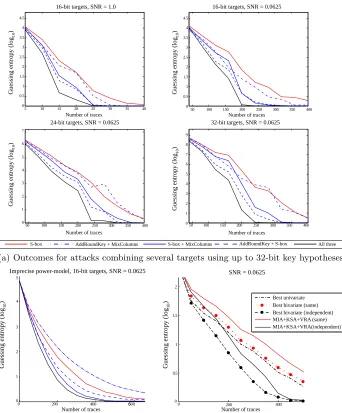
MixColumns attack result. The graphs in Fig. 2(a) show these different scenarios for a single column of the AES state.
In the following paragraphs we analyse these graphs with respect to three questions that are relevant for practice. Firstly, what is the impact of a (low) SNR with regards to our multi-target strategy? As we base our DPA attacks on correlation distinguishers, we would hope that, similarly to single-target attacks, multi-target attacks will ‘scale’ alongside the SNR. Secondly, we are interested in how the size of the key hypotheses impacts on the guessing entropy, and lastly, in how multi-target attacks behave when the attacker’s power model is imprecise.
Impact of SNR. The top two graphs in Fig. 2(a) show the subkey guessing
entropies (for a 16-bit key guess) as the number of traces increases, for the attacks against simulated Hamming weight leakages with two SNR levels. Aside from the fact that all attacks require increased numbers of traces as the SNR decreases (as we would expect) the scenarios exhibit similar outcomes. The attacks on S-boxes are effective at reducing uncertainty on the key (the results for these are printed in red), but are clearly outperformed by all three ‘bivariate’ combinations—even the one between the MixColumns sub-computation and AddRoundKey. The combination between all three further reduces the enumeration work required.
Impact of larger distinguishing vectors. The top right and the bottom graphs in
Fig. 2(a) show the subkey guessing entropies for increasing subkey sizes (16-bit in the top right, 24-bit in the bottom left, and 32-bit in the bottom right). In all three experiments the multi-target attacks outperform the single target attacks. Note that the guessing entropy range naturally increases with the size of the key hypothesis and is in no way an indicator of attack degradation. For the 16-bit attack the guessing entropy is out of 216 and eight such guesses need to be combined to get a global key with guessing entropy between 1 and 2128. For the 32-bit attack the guessing entropy is out of 232 but only four such guesses need to be combined. It is the global guessing entropy which ultimately matters and the subkeys always need to be combined at some point – incorporating information at (e.g.) the 32-bit level simply increases the scope of intermediate targets exploitable by the attacker. For both hypothesis sizes, the outcomes suggest that we are able to succeed with roughly half the number of leakage traces when using the best multi-target attack (for a fixed subkey guessing entropy, the best multi-target attacks require roughly half of the traces required by the best single-target attack). It is possible to estimate global key guessing entropies based on these results by assuming that the attacks on the other ‘chunks’ of the key would behave identically. For instance, in the 16-bit case, if all eight 16-bit attacks give identical outcomes, we could estimate global key entropies by raising the results of a single 16-bit attack to the power eight. However, this does not necessarily translate into practice, so we will instead show actual global key guessing entropies when we come to discuss attacks on real data.
Impact of imperfect power model. The left picture of Fig. 2(b) shows the
case where the Hamming weight isnot a perfect match to the leakage, because of the presence of a constant reference state (representing an address, for exam-ple) of Hamming weight 1. The most striking impact of this distortion occurs for attacks that include AddRoundKey as a target, which are no longer able to iden-tify the correct key as a likely candidate. This is because the Hamming distance of the AddRoundKey from the reference state when the correct key is guessed is the same as the Hamming weight of the AddRoundKey when the key guess is the correct key XORed with the reference state. In effect, an incorrect key is masquerading as the correct one, and the correlation DPA against AddRound-Key will naturally preference this. (The same cannot happen for the S-box, for example, because the key XOR is inside the highly nonlinear transformation, with the Hamming distance being taken afterwards).
Nonetheless, in this case where the reference state is itself of low weight, incorporating AddRoundKey information still produces marginal reductions on the guessing entropies after S-box and MixColumns (separately, and combined). Greater imprecision of the power model will more strongly impact on AddRound-Key attacks; it may be advisable to exclude it as a target in such cases.
4.2 Combining outputs from the same target
One might ask whether or not the outcomes of differentdistinguishing statistics
orpower models can likewise be combined to some advantage.
Using different distinguishing statistics. Suppose we run three different attacks
against the leakage of an AES S-box, e.g.: mutual information [11], Kolmogorov– Smirnov [27], and the variance ratio [23], all using a Hamming weight power model. The distinguishing vectors are transformed to have a baseline of zero and to sum to one, for use as heuristic ‘probability’ scores. We would then like to know whether the combined outcomes improve upon the individual ones.
The right picture in Fig. 2(b) shows what happens when we attempt this in the example scenario of Hamming weight leakage with SNR 0.0625. When the same measurements are used for all of the attacks, combining the outcomes actuallyincreasesthe guessing entropy. By contrast, when independent measure-ments are used in each case (i.e., each distinguisher has been applied against a different point in the trace leaking the same information but with independent noise), there is some scope to refine the information on the key by combin-ing outcomes—although all three outcomes together on average produce worse results than the best combination of two. We found that it was generally the addition of mutual information which degraded the outcome, as it required sub-stantially more data to estimate to an equivalent degree of precision.
a false sense of increased certainty. Note that the multiplication step implicitly assumesindependenceof the separate score vectors, which is clearly violated in the case that they are all based on the same leakage information.
Using different power models. In the light of the ineffectiveness of combining
information about the same target, we briefly revisit previous work by Bevan and Knudsen [5]. They suggest to combine eight difference-of-means attacks, each targeting a distinct bit of the intermediate value, by ‘summing over the distinguisher results’ (in our approach we convert them into ‘probability’ distri-butions on the set of 28 subkeys, as per Section 3.1). Since each attack exploits
a separated portion of the overall leaked value we may expect that each new
bit attacked helps to further reduce the candidate search space—and, indeed, our experiments confirm this (see Appendix A). Such a technique is hence very useful in leakage scenarios which are unfamiliar to an attacker, which is often the case when attacking dedicated hardware.
5
Practical attacks
We tested our strategy in practice using a dataset of 10,000 traces from an ARM7 microcontroller running an unprotected implementation of AES. The 10,000 traces were divided up in 200 sets of 50 traces each to conduct suffi-cient repeat experiments to report reasonably precise estimates for the guessing entropies in the same vein as our simulated attacks. Multi-target attacks, sim-ilar to multivariate attacks, are greatly helped by knowledge about where the attacked intermediate values leak in the traces. Consider for instance a (multi-variate) template attack: it is much harder for an adversary to conduct such an attack when in the profiling phase a similar device is available but not the exact implementation (of, say, AES). In such a case an adversary could still build tem-plates for microprocessor instructions during profiling, but in the attack phase the adversary would need to find the specific trace points at which to apply the templates. Similarly, knowing precisely where the single-target leakages occur is helpful for a multi-target attack. We consequently focus initially on a ‘known point’ scenario and then make a first attempt at relaxing this assumption.
5.1 Practical attacks against known interesting points
We applied two multi-target attacks (one involving 16-bit, one 32-bit key hy-potheses) under the assumption that interesting trace points are known, running 200 repeat experiments for increasing samples of up to size 50. For each 16-bit subkey, correlation DPA attacks were performed against the two corresponding AddRoundKey operations, the S-boxes and the MixColumns sub-computation
GF m2(statei⊕statei+1), where statei is the state byte corresponding to the
ith key byte after the S-box substitutions and (in this implementation) the
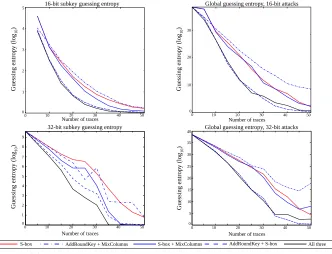
The first two graphs in Fig. 3(a) show the guessing entropies on the first key-byte pair and the final global guessing entropies, estimated by multiplying the eight subkey guessing entropies together (the outcomes for the other seven subkey guesses can be found in the Appendix of the full version of our paper, see [17]).4 They largely, but not perfectly, match up with our observations for simulated traces. This is an important point: theory and practice rarely perfectly align, even in the case of a relatively ‘simple’ platform like the ARM7. In the practical experiments, AddRoundKey and the MixColumns sub-value are con-sistently unable to identify the correct key alone (at least, not within 50 traces). However, the two together produce guessing entropies to rival the effectiveness of the S-box attack, and both produce improvements in combination with the S-box. All three together produce the best guessing entropies for many of the 16-bit subkeys, although they are sometimes outperformed by the two-target S-box+AddRoundKey attacks, which achieve a marginal advantage overall.
The second two graphs in Fig. 3(a) show the guessing entropies for the first 32-bit subkey and the final global guessing entropies. The global entropies were estimated by multiplying the four subkey entropies together. We observed vary-ing behaviour for our combined attacks on different subkeys; our targeted Mix-Columns computation does not leak nearly as much information in the middle 8 bytes of the state as it does in the first and final 4 bytes. Consequently, despite (as suggested by our simulated attacks) observing strong performance of the combined three-target attacks in the latter two cases, in the global setting this advantage is diminished, and the ‘trivariate’ attack produces similar performance to the combined four-byte S-box+AddRoundKey attacks. It is noteworthy that even in the presence of this variable leakage, most combined attacks outperform the S-box attack. Graphs and data for each of the four separate subkey attacks can be found in the Appendix of the full version of our paper [17].
5.2 Practical attacks where interesting points are a priori unknown
The natural next question to ask is whether we can relax the assumption that the leakage points are precisely known. We made some preliminary inroads using ‘desktop-level’ resources (whilst our GPU machines were occupied with other experiments), focusing, for computational feasibility, on 8-bit key hypotheses. The three targets we selected to combine were AddRoundKey, the S-box outputs, and the interim MixColumns valueGF m2(statei⊕statei+1) with the assumption
that the second involved key byte of the two is known.
We relaxed the ‘known point’ assumption by visually inspecting the AES traces in order to identify the intervals in which each of the three target functions are contained. The first round takes about 1,400 clock cycles in total and the (non-overlapping) windows we selected for experimentation were of widths 240, 230, and 180 for AddRoundKey, SubBytes and MixColumns respectively. Within
4 The more refined rank estimation methodology of [26] indicates that this simple
S-box AddRoundKey + MixColumns S-box + MixColumns AddRoundKey + S-box All three
16-bit subkey guessing entropy Global guessing entropy, 16-bit attacks
32-bit subkey guessing entropy Global guessing entropy, 32-bit attacks
0 0 1 2 3 4 5 6 7 8 9
10 20 30 40 50
Guessing entropy (log
)
10
0 10 20 30 40 50 0
10 20 30
Number of traces
0 1 2 3 5 4
0 10 20 30 40 50
Guessing entropy (log
)
10
Guessing entropy (log
)
10
0 10 20 30 40 50
Number of traces
0 5 10 15 20 25 30 35 40
Guessing entropy (log
)
10
Number of traces Number of traces
(a) Outcomes for multi-target attacks in a known points scenario.
Number of traces
Guessing e
ntropy
Number of traces
Guessing e ntropy AddRoundKey S-box MixColumns ARK+S-box ARK+MixCols S-box+MixCols All three S-box S-box (first 2) S-box (first 20)
All 3 All 3 (first 2) All 3 (first 20) 150
100
50
0
0 50 100 150
150
100
50
0
0 50 100 150
(b) Outcomes for multi-target attacks in a known interval scenario.
these windows we took an ‘exhaustive search’ approach. First, we subjected each point to a standard DPA attack against the associated target function, and computed the ‘probability’ scores. We then pairwise combined them in each of the three possible configurations, and finally we combined all three. We tried two strategies: in the first, we took (for each configuration) the combined vector with the largest peak as the one most likely to correspond to the correct key and pair/triple of leakage points, and in the second we took theNtcombined vectors
with the largest peaks and multiplied these together (for different values ofNt),
so achieving a sort of ‘majority vote’.
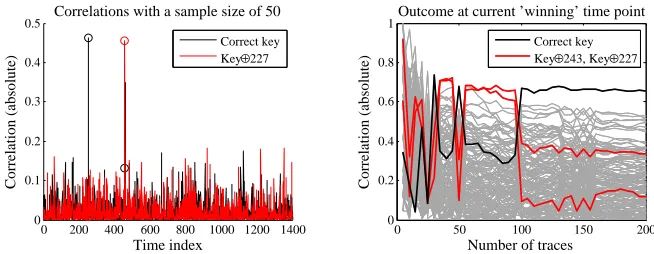
The left side of Fig. 3(b) shows the average guessing entropy for each of the attacks using the first ‘maximum peak’ strategy. The AddRoundKey attack in an unknown point scenario performs very badly. Further analysis of the trace window reveals that there are other points exhibiting strong correlations with AddRoundKey⊕R, forR some other (possibly address?) value in{0,255} (see Fig. 5 in Appendix B).5 Moreover, at these points thecorrect key correlations arelow, so that the contribution to the combined leakage is highly distorting (as opposed to when an ‘imperfect but close’ leakage prediction is made, in which case the combination can still improve distinguishability). In the presence of such misleading leakage information, it is reassuring that the attack outcomes
arerobust to the combining step.
The combined MixColumns and S-box attack exhibits lower guessing en-tropies than either of the two taken individually. The trivariate attack (as ex-pected from the above) does not really add much to this, but again we reflect that the inclusion of AddRoundKey at least does not seem to harm the outcome. The right side of Fig. 3(b) shows the advantage gained by multiplying the top-ranked few ‘probability’ vectors for the trivariate attack, as well as (for comparison) for the S-box attack on its own. Interestingly, even the addition of the second ranked vector degrades the S-box attack, whereas the product combining for the top-ranked triples reduces the guessing entropy at least up to Nt = 20. The subsequent total improvement over the S-box outcome on its
own indicates this as a potentially worthwhile strategy for key recovery in an unknown point scenario.
From a practical perspective, a useful forward approach for multi-target at-tacks would be to ‘try out’ (for a concrete device and implementation) different combinations of targets, and different point selection strategies, to see which give the best results. We want to caution against drawing too many conclusions from these last experiments: they clearly represent a first step only!
6
Conclusion
We have shown how to amalgamate single-target ‘standard’ DPA attacks (us-ing a correlation dist(us-inguisher and a Hamm(us-ing weight power model) into
multi-5 Note that the leakage of the S-box is less vulnerable to such distortions: a non-zero
target attacks capable of increasing information on the correct key by combining DPA outcomes that are treated as heuristic probabilities. Leveraging our mod-ern HPC-inspired computing platform, we are able to efficiently handle key hy-potheses of up to 32 bits using a small cluster of simple workstations containing consumer graphics cards. Such a capability allows us to combine many inter-mediate targets; in this work we made the first serious attempt to explore the characteristics of successful combinations. Our results indicate that combining S-box+AddRoundKey or additionally including an intermediate MixColumns computation typically produces the strongest results. Multi-target attacks scale predictably with noise and are robust with regards to imprecise power models. Our primary investigative effort is mainly on ‘known’ (leakage) point attacks, in line with assumptions generally made for multivariate attacks. When leakage points are not known, an exhaustive search in suitable visually-identified trace windows, together with a ‘majority vote’-style approach to decide on ‘peaks’, leads to improved practical attacks even in this challenging scenario.
Our definition of multi-target attacks and intuitive and efficient combination technique opens up many interesting new research questions: e.g. is there any single best combination of intermediate values for a given cipher? How effectively can we combine power and EM attack results in this way? Could we even move further on and include results from the second encryption round? What other strategies for combining in unknown point scenarios exist? How could we use this against implementations when masking and hiding are used? For better or worse, these are “interesting times”—to call to mind the fabled Chinese curse.
Acknowledgements. This work has been supported in part by EPSRC via grant
EP/I005226/1. This work was carried out using the computational facilities of the Advanced Computing Research Centre, University of Bristol—http://www. bris.ac.uk/acrc/.
References
1. C. Archambeau, E. Peeters, F.-X. Standaert, and J.-J. Quisquater. Template At-tacks in Principal Subspaces. In L. Goubin and M. Matsui, editors,CHES 2006, volume 4249 ofLNCS, pages 1–14. Springer, 2006.
2. C. Bailer-Jones and K. Smith. Combining probabilities. Technical Report GAIA-C8-TN-MPIA-CBJ-053, Max Planck Institute for Astronomy, Heidelberg, January 2010.
3. T. Bartkewitz and K. Lemke-Rust. A high-performance implementation of differ-ential power analysis on graphics cards. InCARDIS, volume 7079 ofLNCS, pages 252–265. Springer, 2011.
4. L. Batina, J. Hogenboom, and J. van Woudenberg. Getting More from PCA: First Results of Using Principal Component Analysis for Extensive Power Analysis. In O. Dunkelman, editor,Topics in Cryptology – CT-RSA ’12, volume 7178 ofLNCS, pages 383–397. Springer Berlin / Heidelberg, 2012.
6. E. Brier, C. Clavier, and F. Olivier. Correlation Power Analysis with a Leakage Model. In M. Joye and J.-J. Quisquater, editors, CHES 2004, volume 3156 of LNCS, pages 135–152. Springer Berlin / Heidelberg, 2004.
7. S. Chari, J. Rao, and P. Rohatgi. Template Attacks. In B. Kaliski, C¸ . Ko¸c, and C. Paar, editors,CHES 2002, volume 2523 ofLNCS, pages 51–62. Springer Berlin / Heidelberg, 2003.
8. Common Criteria, Techical editor: BSI. Application of Attack Potential to Smart Cards. http://www.commoncriteriaportal.org/files/supdocs/CCDB-2009-03-001.pdf, 2009.
9. J. Doget, E. Prouff, M. Rivain, and F.-X. Standaert. Univariate side channel attacks and leakage modeling. J. Cryptographic Engineering, 1(2):123–144, 2011. 10. M. Elaabid, O. Meynard, S. Guilley, and J.-L. Danger. Combined Side-Channel
Attacks. In Y. Chung and M. Yung, editors, Information Security Applications, volume 6513 ofLNCS, pages 175–190. Springer Berlin Heidelberg, 2011.
11. B. Gierlichs, L. Batina, P. Tuyls, and B. Preneel. Mutual Information Analysis: A Generic Side-Channel Distinguisher. In E. Oswald and P. Rohatgi, editors,CHES 2008, volume 5154 ofLNCS, pages 426–442. Springer-Verlag Berlin, 2008. 12. S. Hajra and D. Mukhopadhyay. SNR to Success Rate: Reaching the Limit of
Non-Profiling DPA. Cryptology ePrint Archive, Report 2013/865, 2013. http: //eprint.iacr.org/.
13. M. Hutter, M. Kirschbaum, T. Plos, J.-M. Schmidt, and S. Mangard. Exploiting the Difference of Side-Channel Leakages. In W. Schindler and S. A. Huss, editors, COSADE, volume 7275 ofLNCS, pages 1–16. Springer, 2012.
14. P. C. Kocher, J. Jaffe, and B. Jun. Differential Power Analysis. InProceedings of CRYPTO 1999, pages 388–397, London, UK, 1999. Springer-Verlag.
15. S. Mangard, E. Oswald, and T. Popp. Power Analysis Attacks: Revealing the Secrets of Smart Cards.
16. S. Mangard, E. Oswald, and F.-X. Standaert. One for All – All for One: Unifying Standard DPA Attacks. IET Information Security, 5(2):100–110, 2011.
17. L. Mather, E. Oswald, and C. Whitnall. Multi-target DPA attacks: Pushing DPA beyond the limits of a desktop computer. Cryptology ePrint Archive, Report 2014/365, 2014. http://eprint.iacr.org/.
18. A. Moradi, M. Kasper, and C. Paar. Black-Box Side-Channel Attacks Highlight the Importance of Countermeasures - An Analysis of the Xilinx 4 and Virtex-5 Bitstream Encryption Mechanism. In O. Dunkelman, editor,CT-RSA, volume 7178 ofLNCS, pages 1–18. Springer, 2012.
19. M. Renauld and F.-X. Standaert. Combining Algebraic and Side-Channel Crypt-analysis against Block Ciphers. In30thSymposium on Information Theory in the Benelux, 2009.
20. M. Renauld, F.-X. Standaert, and N. Veyrat-Charvillon. Algebraic Side-Channel Attacks on the AES: Why Time also Matters in DPA. In Workshop on Crypto-graphic Hardware and Embedded Systems (CHES 2009), volume 5747 ofLecture Notes in Computer Science, pages 97–111. Springer, 2009.
21. Y. Souissi, S. Bhasin, S. Guilley, M. Nassar, and J.-L. Danger. Towards Different Flavors of Combined Side Channel Attacks. In O. Dunkelman, editor,CT-RSA, volume 7178 ofLNCS, pages 245–259. Springer, 2012.
23. F.-X. Standaert, B. Gierlichs, and I. Verbauwhede. Partition vs. Comparison Side-Channel Distinguishers: An Empirical Evaluation of Statistical Tests for Univariate Side-Channel Attacks against Two Unprotected CMOS Devices. In P. Lee and J. Cheon, editors, ICISC 2008, volume 5461 of LNCS, pages 253–267. Springer Berlin / Heidelberg, 2009.
24. F.-X. Standaert, T. G. Malkin, and M. Yung. A Unified Framework for the Analysis of Side-Channel Key Recovery Attacks. In EUROCRYPT ’09, pages 443–461, Berlin, Heidelberg, 2009. Springer-Verlag.
25. N. Veyrat-Charvillon, B. G´erard, M. Renauld, and F.-X. Standaert. An Optimal Key Enumeration Algorithm and Its Application to Side-Channel Attacks. In L. R. Knudsen and H. Wu, editors,Selected Areas in Cryptography, volume 7707 ofLNCS, pages 390–406. Springer, 2012.
26. N. Veyrat-Charvillon, B. G´erard, and F.-X. Standaert. Security Evaluations be-yond Computing Power. In T. Johansson and P. Q. Nguyen, editors, EURO-CRYPT, volume 7881 ofLNCS, pages 126–141. Springer, 2013.
27. N. Veyrat-Charvillon and F.-X. Standaert. Mutual Information Analysis: How, When and Why? In C. Clavier and K. Gaj, editors, Proceedings of CHES 2009, volume 5747 ofLNCS, pages 429–443. Springer Berlin / Heidelberg, 2009. 28. C. Whitnall and E. Oswald. A Comprehensive Evaluation of Mutual Information
Analysis Using a Fair Evaluation Framework. In P. Rogaway, editor, CRYPTO, volume 6841 ofLNCS, pages 316–334. Springer, 2011.
A
Combining difference-of-means outcomes
Fig. 4 shows the reduction in subkey guessing entropy as an increasing number of difference-of-means (against different individual bits) are combined via our strategy.
0 50 100 150
0 50 100 150
SNR = 1
Number of traces
Guessing entropy
0 200 400
0 50 100 150
SNR = 0.25
Number of traces
Guessing entropy
0 1000 2000
0 50 100 150
SNR = 0.0625
Number of traces
Guessing entropy
1 bit 2 bits 4 bits 8 bits
Fig. 4. Combining the outcomes of up to eight difference-of-means attacks against
Hamming weight leakage of the AES S-box.
B
Unknown point attacks: problem of rival peaks
which reduces the ability to increase an attack’s effectiveness by the addition of AddRoundKey outcomes.
0 200 400 600 800 1000 1200 1400
0 0.1 0.2 0.3 0.4
0.5 Correlations with a sample size of 50
Time index
Correlation (absolute)
Correct key
Key⊕227
0 50 100 150 200
0 0.2 0.4 0.6 0.8 1
Number of traces
Correlation (absolute)
Outcome at current ’winning’ time point
Correct key
Key⊕243, Key⊕227
Fig. 5.Left: Example of a fixed XOR offset from the key producing a rival peak in the