Enhancement Transient Stability using UPFC
with ANN Controller
Luay G. Ibrahim 1, Asst. Prof.Dr. Rashid H. AL-Rubayi2
Department of Electrical Engineering, University of Technology, Baghdad, Iraq1
Assistant professor, Department of Electrical Engineering, University of Technology, Baghdad, Iraq2
ABSTRACT: The increasing pressure on the power system increases the complexity that is becoming a concern for the
stability of the power system and mainly for transitory stability. To operate the system in the event of faults, Flexible AC Transmission System (FACTS) devices that provide opportunities to control the power and damping oscillations are used. This paper presents the enhancement transient stability of the Multi-Machine power system (MMPS) with Unified Power Flow Controller (UPFC) by using Artificial Neural Network (ANN) controller. Performance the power system under event of fault is investigating by utilizes the proposed the strategy to simulate the operational characteristics of power system by the UPFC using Artificial Neural Network (ANN) controller. The simulation results show the behavior of power system with and without UPFC, that the proposed (ANN) technicality has enhanced response the system, that since it gives undershoot and over-shoot previously existence minimized in the transitions, it has a ripple lower. The use (MATLAB R2014a) in all simulations carried out.
KEYWORDS:ANN, FACTS; MMPS; UPFC; transient stability
I.INTRODUCTION
Power transmission networks have become narrower due to the increased demand for power. A result of many stability problems such as overloading some transmission lines after a disturbance. Therefore, the problem of transitory stability after the main defect is a special transmission-limiting factor [1]. Transient stability refers to the capacity of the power system to preserve synchronization when exposed to severe transient disturbances such as sudden change of load and faults [2]. Include system response resulting from large fluctuations in generator speed and rotor angle. Transient stability of the complex power system can be improved using FACTs devices [3]. The FACTs controllers are able to control network condition very quick. This allows the existing network to obtain used efficiently and thus avoid the need for constructing newlines [4]. The optimal tuning and modelling of various FACTs devices for a dynamic stability enhancement of MMPS studied in [5]. UPFC is the most widely deployed device in FACTs that can provide effective control of power system parameters such by way of transmission voltage, line impendence, and phase angle. Moreover, UPFC can provide either positive or negative power injections positive or interactive. Therefore, it can enhance the operation of the system because it allows for extra efficient control of power flow, super-control system, and stability [6]. The PI controller becomes been used in recent years to improve both temporary and fixed performance, as well as to reject disturbances caused by startup events [7], [8], [9].
Therefore, this paper suggests an Artificial Neural Network (ANN) controller the performance UPFC is improved in event of the fault.
II. CONTROLOF UPFC
ISSN (Print) : 2320 – 3765 ISSN (Online): 2278 – 8875
I
nternational
J
ournal of
A
dvanced
R
esearch in
E
lectrical,
E
lectronics and
I
nstrumentation
E
ngineering
(A High Impact Factor, Monthly, Peer Reviewed Journal)
Website: www.ijareeie.com
Vol. 7, Issue 12, December 2018
Fig. 1 Basic scheme of UPFC
Both of shunt and series converters utilize Voltage Sourced Converter (VSC), which connected to the secondary of the coupling transformer. VSC works to force the commutated power electronic devices (GTO, IGBT or IGCT) to create a voltage from the D.C voltage source. The shared capacitor, whichconnected to the D.C side of the VSC, operates as a D.C voltage source.
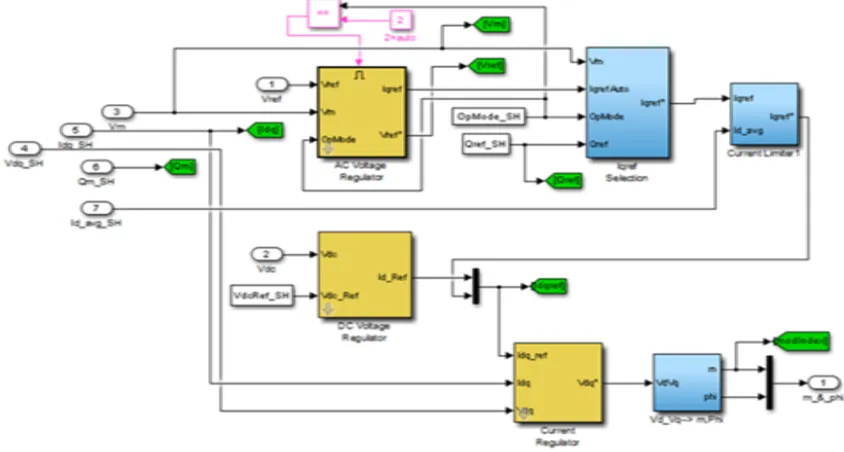
The shunt converter has two duties, namely, to control the voltage magnitude at the sending-end bus by locally generating or absorbing reactive power, and to supply or absorb real power at the dc terminals as demanded by the series converter. It is possible to achieve real power balance between the series and shunt converter by directly controlling the dc voltage Vdc, as any excess or deficit of real power will tend to increase or decrease the dc voltage, respectively. By varying the magnitude and angle of the shunt converter output voltage the real and reactive power flow in and out of the shunt converter is controlled [11] ,[12].The shunt converter controller as shown in fig. 2. Two different control schemes for the series converter were implemented. One scheme to control real power flow through transmission line and voltage magnitude at the receiving-end bus; another control scheme for controlling the real and the reactive power flows through the transmission line. From the basic principle of UPFC, series converter does main function of UPFC. The series converter active and reactive powers are controlled by using two separate PI controllers, taking advantage of the UPFC ability to independently control reactive and real power. The basic principle of real power flow being directly affected by changes in phase angles, while reactive power flow is directly associated with voltage magnitudes, is used here to design the UPFC control. The series converter controller as shown in fig. 3.
Fig. 3Dynamic Blocks of Series Controller for UPFC
III.ARTIFICIAL NEURAL NETWORK (ANN) CONTROLLER
Artificial Neural Networks (ANNs) are a data processing system consisting of a large number of simple, highly interconnected processing elements inspired by the biological system and designed to simulate neurological processing ability of human brain [13], [14].
A generic Artificial Neural Network (ANN) can be defined as a computational system consisting of a set of highly interconnected processing elements, called neurons, which process information as a response to external stimuli. An artificial neuron is a simplistic representation that emulates the signal integration and threshold firing behavior of biological neurons by means of mathematical equations. Like their biological counterpart, artificial neurons are bound together by connections that determine the flow of information between peer neurons. Stimuli are transmitted from one processing element to another via synapses or interconnections, which can be excitatory or inhibitory. If the input to a neuron is excitatory, it is more likely that this neuron will transmit an excitatory signal to the other neurons connected to it. Whereas an inhibitory input will most likely, be propagated as inhibitory [14].
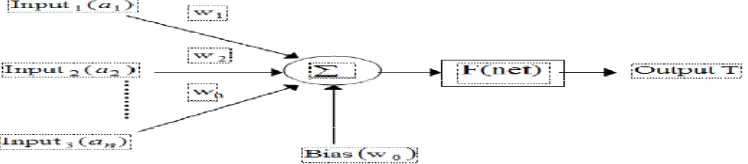
The artificial neuron is composed of a summer (net), which is just like the linear equation of the linear regression model, and a transfer function, which is linear or non-linear. The summing block is directly connected to the input vector (a1 , a2 ,…, an) from outside of the neuron. There is a weight (w1, w2…, wn) on each connection (path) between each input and the neuron. In addition, a bias whose input value is 1 is also associated with the neuron, a
ISSN (Print) : 2320 – 3765 ISSN (Online): 2278 – 8875
I
nternational
J
ournal of
A
dvanced
R
esearch in
E
lectrical,
E
lectronics and
I
nstrumentation
E
ngineering
(A High Impact Factor, Monthly, Peer Reviewed Journal)
Website: www.ijareeie.com
Vol. 7, Issue 12, December 2018
The following relation describes the transfer function of the basic neuron model [13]. T = F (net) (1)
Where
= +∑ (2)
Moreover, the function firing condition is: F (net) ≥ θ [For nonlinear activation function]
Or
∑ ≥ [For linear activation function]
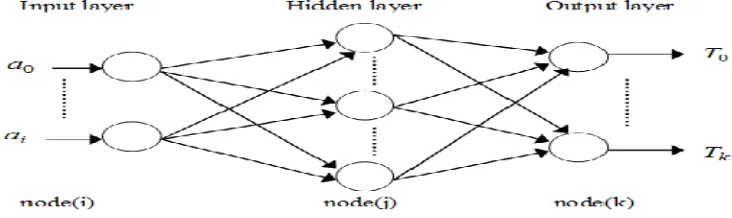
The neurons are assumed arranged in layers, and the neurons in the same layer behave in the same manner. All the neurons in a layer usually have the same activation function. Various multilayer Neural Networks (NN) types have been developed. Feed forward neural networks such as the standard multilayer Neural Networks (NN), functional link NN and product unit NN receive external signals and simply propagate these signals through all the layers to obtain the result (output) of the Neural Networks (NN). The architecture of a multilayer neural network is shown in fig.5. The most important characteristic of an artificial neural network is its ability to learn. Learning is a process in which the network adjusts its parameters the (synaptic weight) in response to input stimuli, so that the actual output response converges to the desired output response [14].
Fig. 5Multilayer Neural Network
Fig.6 Flowchart for Artificial Neural Network Training
IV.SIMULATIONRESULTS
ISSN (Print) : 2320 – 3765 ISSN (Online): 2278 – 8875
I
nternational
J
ournal of
A
dvanced
R
esearch in
E
lectrical,
E
lectronics and
I
nstrumentation
E
ngineering
(A High Impact Factor, Monthly, Peer Reviewed Journal)
Website: www.ijareeie.com
Vol. 7, Issue 12, December 2018
Fig.8 Rotor angle deviation of Gen. 2 with respect to Gen. 1 for ANN controller with and without UPFC
Fig.10 Rotor angle deviation of Gen. 3with respect to Gen. 1 for ANN controller with and without UPFC
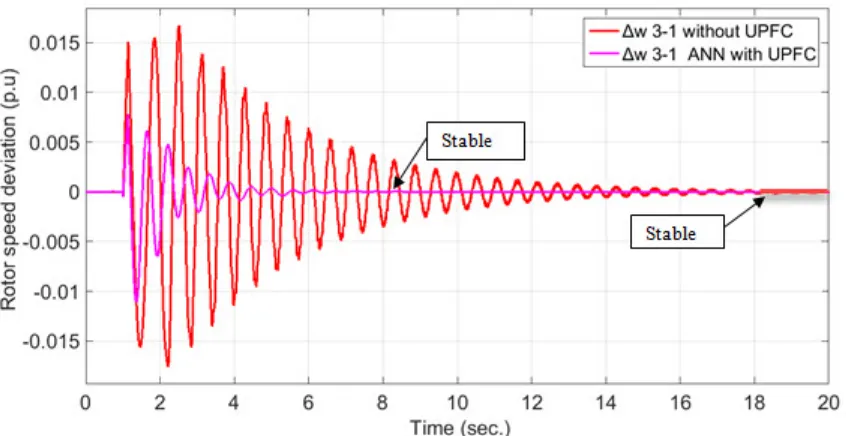
Fig. 11 Rotor speed deviation of Gen.3 with respect to Gen. 1 for ANN controller with and without UPFC
ISSN (Print) : 2320 – 3765 ISSN (Online): 2278 – 8875
I
nternational
J
ournal of
A
dvanced
R
esearch in
E
lectrical,
E
lectronics and
I
nstrumentation
E
ngineering
(A High Impact Factor, Monthly, Peer Reviewed Journal)
Website: www.ijareeie.com
Vol. 7, Issue 12, December 2018
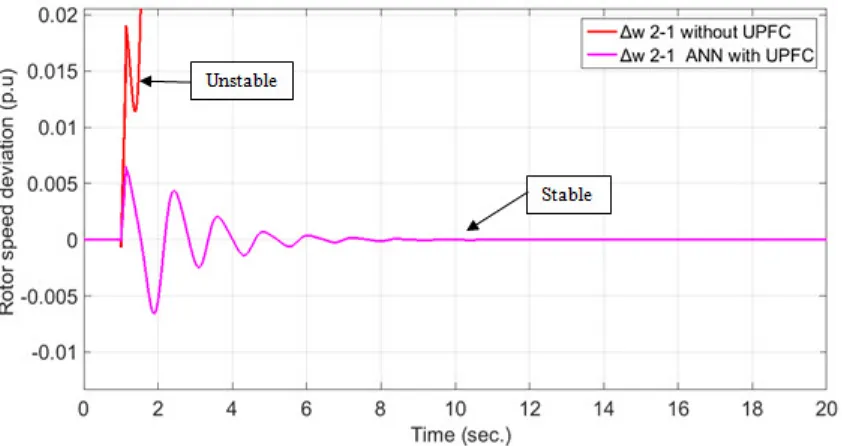
obvious from the Figures that UPFC with the proposed controller presents better results in the system. Besides the overshoot and undershoot already being minimized in the transitions, it has a lower ripple.
VI.CONCLUSION
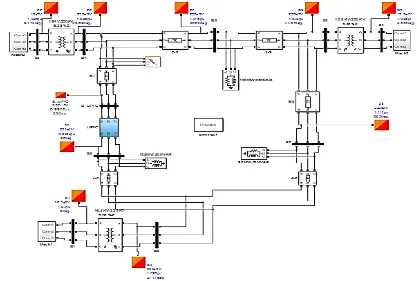
This paper presents the transient stability enhancement of 9 -bus system with UPFC.IEEE 9- bus system is modelled in MATLAB/SIMULINK and a 3-phases to ground fault. Results show that oscillations in speed and rotor angle difference of the generators are damped out speedy with the insertion of an ANN controller with UPFC thus enhancing the transient stability of the system.
REFERENCES
[1] P.Kundur,J.Paserba,V.Ajjarapu,G.Anderson,A.Bose,C.Canizares,N.Hatziargyriou,D.Hill,A.Stankovic,C.Taylor,T.VCutsemand V.Vittal, “Definition and classification of power system stability ”,IEEE Trans. Power systems, 2004.
[2] N.G.Hingorani, L.Gyugyi, “Understanding FACTS: Concepts and technology of flexible AC transmission systems”, New York, IEEE Press 2000.
[3] V.mahajan, “Power system stability improvement with flexible AC Transmission systems (FACTS) controller”, power system technology and IEEE power India conference, Power CON 2008.
[4] Mohammadinia .M, Borzouie.M, “Optimal placement of FACTS device to improve transient stability of multi-machine power system”, Transmission and distribution conference & exposition, IEEE/PES, April 2008.
[5] Haque, M.H, “Use of series & shunt FACTS device to improve first swing stability limit”, IEEE Power Engineering Conference, 104, 2005. [6] Mr.KetanG.Damor, Dr.DipeshM.Patel, Mr.VineshAgrawal, Mr.HirenkumarG. Patel, “ Improving Power System Transient Stability by using
Facts Devices”, International Journal of Engineering Research Technology, Vol.3, Issue 7, July2014.
[7] Khorramabadi, S.S and Bakhshai, “A Critic-Based Self-Tuning PI Structure for Active and Reactive Power Control of VSCs in Microgrid Systems”, IEEE Transactions on Smart Grid, Vol. 6, No. 1, pp.92-103, January, 2015.
[8] Sant,A.V; Rajagopal, K.R. and Sheth, N.K. “Permanent Magnet Synchronous Motor Drive Using Hybrid PI Speed Controller With Inherent and Noninherent Switching Functions”, IEEE Transactions on Magnetics, Vol. 47, No. 10,pp.4088-4090,October, 2011.
[9] Martinez, A.R; Ramirez, R.G. and Vela-Valdes, L.G. “PI Fuzzy Gain-Scheduling Speed Control at Startup of a Gas-Turbine Power Plant”, IEEE Transactions on Energy Conversion, Vol. 26, No. 1, pp.310-317,March, 2011.
[10] J. Guo, M. L. Crow, and JagannathanSarangapani, “An Improved UPFC Control for Oscillation Damping”, IEEE Transactions on Power Systems, Vol. 24, No. 1, pp.288 -296,February, 2009.
[11] K.R. Padiyar and A.M. Kulkarni, “Control Design and Simulation of Unified Power Flow Controller”, IEEE Transactions on Power Delivery, Vol. 13, No. 4, pp.1348-1354,October ,1998.
[12] C.D. Schauder, L. Gyugyi, M.R. Lund, D.M. Hamai, T.R. Rietman, D.R. Torgerson, A. Edris, “Operation of the Unified Power Flow controller (UPFC) under practical constraints”, IEEE Transactions on Power Delivery, Vol. 13,No2, pp.630-639,April, 1998.
[13] Andries P. Engelbrecht, “Computational Intelligence”, 2nd, The Atrium, Southern Gate, Chichester, John Wiley and Sons Ltd, England, 2007. [14] A. C. Kadhim, “Training of Artificial Neural Networks by Using Particle Swarm Optimization”, M. Sc. Thesis, University of Technology,
Baghdad, Iraq, 2009.