METHODS FOR MULTIMEDIA
INFORMATION
Kwok Chung Tse
^'- LIBRARY A
V • • i ^ : y
-This thesis is presented in fulfilment of the requirements of the degree of
Doctor of Philosophy
School of Communications and Informatics
Victoria University Australia
FTS THESIS 006.7 TSE
30001006994869 Tse, Kwok Chung
This thesis contains no materials that have been accepted for the award of any other degree or diploma in any university. The materials presented in this thesis are the product of the author's own independent research under the supervision of Professor Clement Leung.
1 am deeply indebted to my supervisor. Professor Clement Leung, for his guidance, constant direction, and countless hours of time. 1 thank him for his patience and trust that allow me perform at full potential. I also appreciate his encouragement and support through the darkest days. 1 have benefited immeasurably from his tutelage.
I gratefully acknowledge Associate Professor Neil Barnett, Head of the School of Communications and Informatics, for his approvals to the generous scholarship and financial support. I would like to thank other staff of the School of Communications and Informatics for being supportive and cooperative. 1 would like to thank my friends, Simon So, David Taniar, Dwi Sutanto, Tony Sahama, and Raymond Summit for many hours of technical discussions.
I deeply owe my appreciation to my wife, Peky, for her consistent support with trust and love in these years that I was able to do this research. I miss the moments that I could otherwise spend with my two sons, Joshua and Jonah, who understand their father's reason for returning home late. I also thank my parents who provide me with education and direction since I was very young.
1. Philip K. C. Tse and Clement H. C. Leung, "Improving Multimedia Systems Performance Using Constant Density Recording Disks", ACM
Multimedia Systems Journal, Springer-Verlag, Volume 8, Number 1, pages
47-56, 2000.
2. Clement H. C. Leung, Simon W. W. So, Audrey Tam, Dwi Sutanto, and
Philip K. C. Tse, "Visual Information Indexing for Content-Based Search
and Retrieval", to appear in Michael Lew (Ed.), Multimedia Search: State
of the Art.
3. David Taniar, Simon W. W. So, Philip K. C. Tse, and Clement H. C. Leung, "Parallel Content-Based Image Retrieval: A Case of Inter-Image Parallelism vs. Intra-Image Parallelism", Proceedings of the sixth Annual
Australasian Conference on Parallel And Real-Time Systems (PART '99),
pages 273-283, 29* Nov. to I'^Dec, 1999.
4. Philip K. C. Tse, Audrey Tam, Clement H. C. Leung, and W. W. S. So, "Efficient Storage Organization for the Execution of Visual Queries in Large Object Databases", SPIE Vol. 3846, Proceedings of Multimedia
Storage and Archiving Systems IV Conference, Boston, MA, pages
5. Clement H. C. Leung and Philip K. C. Tse, "Storage Organization and Performance for Multimedia Data", Handbook of Multimedia Computing, CRC Press, Chapter 24, pages 507-524, 1999.
6. PhiUp K. C. Tse and Clement H. C. Leung, "A low latency hierarchical storage system for Multimedia Data", lAPR International Workshop on
Multimedia Information Analysis and Retrieval, Springer-Verlag Lecture
Notes in Computer Science 1464, pages 181-194, August, 1998.
7. Simon W. W. So, Philip K. C. Tse, and Clement H. C. Leung, "A Comparative Evaluation of Algorithms Using Compressed Data for Image Indexing and Retrieval", Proceedings of International Conference on
Computational Intelligence and Multimedia Applications, pages 866-872,
February, 1998.
8. Philip K. C. Tse, "Tertiary Storage for Multimedia Systems", Proceedings
of CSPSC Conference, RMIT, Australia, pages 174-183, 10* to 11*
Declaration / Abstract ii Acknowledgment Hi
List of External Publications iv
Table of Contents vi List of Figures xii List of Tables xvi
1. Introduction 1
1.1 Objectives 1 1.2 Scope of Research 3
1.3 Contributions 5 1.4 Thesis Organization 7
2. Multimedia Storage Systems Performance Characteristics 8
2.1 Introduction 8 2.2 Problems of Existing Storage Systems 9
2.3.4 Disk Scheduling 22 2.3.5 Disk Arrays 23 2.3.6 Hierarchical Storage System 26
2.3.7 Data Migration 30 2.4 Multimedia Storage Systems Characteristics 32
2.4.1 Multimedia Data... 32 2.4.2 Display Modes 37 2.4.3 Access Pattern of Multimedia Data Requests 39
2.5 Storage Organizations on Disks 47
2.5.1 Naive Placement 49 2.5.2 Contiguous Placement 49 2.5.3 Log Structure Placement 50 2.5.4 Statistical Placement 50
2.5.5 FauU Tolerant 52 2.5.6 Data Replication 53
2.5.7 Striping 55 2.5.8 Constraint Allocation 58
2.6 Hierarchical Storage Systems 65
2.6.1 System Cost 66 2.6.2 Tertiary Storage Organizations 68
2.6.3 Data Migration Methods 73 2.6.4 Cache Replacement Methods 78
2.7 Other Related Works 82
3. New Efficient Storage Organizations for Multimedia Data 90
3.1 System Performance Measures 90
3.2 System Architecture 95 3.2.1 Primary Storage Level 96
3.2.2 Secondary Storage Level 96 3.2.3 Tertiary Storage Level 97 3.3 Data Striping on Tertiary Storage 99
3.3.1 First Level 99 3.3.2 SecondLevel 102 3.4 Data Placement on Tertiary Storage 104
3.4.1 High Concurrency Placement 105 3.4.2 Low Latency Placement I l l
3.5 Data Placement on Disks 113 3.6 Multimedia Data Migration Methods 116
3.6.1 Concurrent Streaming for High Concurrency Placement... 116
3.6.2 Segment Based Pipelining 123
3.7 Discussions 126 3.8 Chapter Summary 131
4. Disk Storage Structure Analysis 132
4.1 Introduction 132 4.2 Performance Model of Disk Requests 133
4.2.1 Seek time 135 4.2.2 Rotation latency 137
4.2.5 Waiting Time in Queue 140 4.3 Analysis of Request Service Time 142
4.3.1 Data Block Size 143 4.3.2 I/O Time Distribution 144 4.3.3 Data Stream Size 146
4.3.4 Disk Size 148 4.3.5 Seek Start/stop Time 149
4.3.6 Arm Moving Speed 150 4.3.7 Number of Disk Platters 151
4.3.8 Rotation Speed 152 4.3.9 Recording Density 153 4.3.10 Bandwidth Based Placement 154
4.4 Contention Analysis 156 4.4.1 Disk Utihzation 156 4.4.2 Request Waiting Time 158
4.4.3 Request Response Time 160
4.4.4 Queue Length 162 4.4.5 Number of Requests 163
4.5 Disk Storage Structure Simulations 164 4.5.1 Hardware Parameters 165 4.5.2 Data Access Time 166 4.5.3 Throughput of Partitioned Disk 167
4.5.8 Mean Number of Requests 172
4.6 Chapter Summary 173
5. Analysis of Hierarchical Storage Organizations 175
5.1 Introduction 175 5.2 Feasibility of Accepting Concurrent Streams 177
5.2.1 Homogeneous Streams 178 5.2.2 Heterogeneous Streams 180 5.2.3 Multiple Devices 183 5.2.4 Application on Storage Devices 186
5.2.5 Optimization of Probability Model 188 5.3 Performance Model of Large Multimedia Storage Systems 189
5.3.1 Assumptions and Notations 189
5.3.2 Arrival Pattern 190 5.3.3 State Transitions of Concurrent Streams 197
5.3.4 Service Times 201 5.3.5 System Throughput 212 5.3.6 Stream Response Time 214
5.3.7 Buffer Size 220 5.4 Segment Based Pipelining 222
5.4.1 Assumptions 223 5.4.2 Continuous display requirement 224
5.4.3 Number of Data Stripes and Size of the Last Data Stripe.. 225
5.4.4 Number of Segments and Segment Size 227
5.5.2 Concurrent Retrieving Streams 234 5.5.3 Maximum System Throughput 235 5.5.4 Mean Stream Response Time 236
5.5.5 Buffer Size 238 5.6 Performance of Data Migration Methods 240
5.6.1 Disk Space and User Latency 241 5.6.2 Data Stripes and Segments 243
5.6.3 Object Size 245 5.6.4 Disk Bandwidth 245 5.6.5 Display Bandwidth 247 5.7 Large Multimedia Storage Server Simulations 248
5.7.1 Simulation Parameters 251 5.7.2 Number of Concurrent Streams 252
5.7.3 Maximum System Throughput 253 5.7.4 Mean Stream Response Time 254
5.7.5 Buffer Size Per Stream 256
5.8 Chapter Summary 258
6. Conclusion 260
6.1 Summary of Research Results 260 6.2 Extensions and Future Research 266
Bibliography 268
1.1 Contributions within scopes of research 6
2.1 Variable density recording 15 2.2 Constant linear velocity format 16
2.3 Zoned disk layout 18 2.4 Hierarchical storage system 27
2.5 Composite multimedia object 45 2.6 Frequency based placement 51
2.7 Data replication 54 2.8 Simple striping 56 2.9 Staggered striping 57 2.10 Interleaved contiguous placement 60
2.11 Phase constraint allocation 62
3.1 Typical storage system architecture 95 3.2 Low temporal resolution data segments 100
3.3 Length cuts 101 3.4 Second level data striping 102
3.7 Placing data segments among media units 108 3.8 Placing data segments within media units 110 3.9 Reorder data stripes in low latency placement 111
3.10 Bandwidth based placement 114 3.11 Concurrent streams management 118
3.12 Request service order 120
4.1 Area of track of radius x 134
4.2 Seek distance 135 4.3 Disk service time vs data block size 144
4.4 I/O time distribution of CDR disk requests 145
4.5 Throughput vs data stream size 146 4.6 Reduction in access time vs data stream size 147
4.7 Throughput vs disk size 149 4.8 Data access time vs seek start/stop Time 149
4.9 Data access time vs arm moving speed 150 4.10 Throughput vs number of platters 151 4.11 Throughput vs rotation speed 152 4.12 Throughput vs recording density 153 4.13 Throughput of zone groups 155 4.14 Disk utilization vs request arrival rate 157
4.15 Mean waiting time vs request arrival rate 158 4.16 Mean response time vs request arrival rate 160 4.17 Mean queue length vs request arrival rate 162 4.18 Mean number of requests vs request arrival rate 163
4.20 Throughput of zone groups 167
4.21 Disk utilization 168 4.22 Mean waiting time 169
4.23 Mean response time 170
4.24 Mean queue length 171 4.25 Mean number of requests 172
5.1 Model of streams 191 5.2 Model of request arrival 192
5.3 Model of request queueing with feedback 195 5.4 Arrival times of streams and requests 196 5.5 State transition diagram of large multimedia storage system 198
5.6 Exchange request queue model 203 5.7 Model of single drive with feedback queue 214
5.8 Model of multiple drives 216 5.9 Components of stream response time 218
5.25 Individual group service time and mean stream service time vs
number of concurrent streams 233 5.11 Maximum number of concurrent streams vs segment length 234
5.12 Maximum system throughput vs segment length 235 5.13 Mean stream response time vs stream arrival rate 237 5.14 Mean stream response time vs media units per drive 238
5.15 Buffer size per stream vs stream arrival rate 239 5.16 Disk space required vs tertiary bandwidth 241
5.25 Start up data stripe size and data stnpes per segment vs
tertiary bandwidth 244 5.20 Segment size and number of segments vs tertiary bandwidth 244
5.21 User latency vs object size 245 5.22 Disk space required vs disk bandwidth 246
5.23 Reposition latency vs disk bandwidth 246 5.24 Reposition latency vs display bandwidth 247 5.25 Starving requests percentage vs number of accepted concurrent
streams for 1 to 4 drives 252 5.26 Measured maximum system throughput 253
2.1 Some specifications of CD andDVD disk 17 2.2 Comparison of types of storage devices 27 2.3 Typical exchange service times (seconds) 30 2.4 Zipf distribution of 1000 objects in groups of 100 41
4.1 Notations in disk performance model 133
5.1 Notations in feasibility conditions 177 5.2 Notations m LMSS performance model 190 5.3 Notations used in segment based pipelining model 222
5.4 List of parameter values in LMSS performance analysis 232
5.5 Parameters values in data migration analysis 240 5.6 Parameters for multimedia storage server simulations 251
A.l Data access time 290 A.2 Throughput of a CDR disk being partitioned into two zone groups 291
A.3 Disk utihzation 291 A.4 Mean waiting time 292
A.7 Mean number of requests 293 A.8 Maximum system throughput 294 A.9 Mean stream response time 295
Introduction
1.1 Objectives
Advanced technology in recent years increases the availability of video and audio information for computers. This trend leads to the merging of the computer and entertainment industries for the purpose of efficiently handling multimedia information in computer applications. This capability is able to support many new multimedia applications, such as video-on-demand systems, interactive television, and video conferencing.
The main objective of this research is to discover new knowledge and techniques in building storage systems for managing multimedia data. Efficient techniques to store, retrieve, and migrate multimedia data will be designed and evaluated in this thesis.
JPEG, MPEG, have helped to reduce the storage size and bandwidth, but new data placement techniques are necessary to meet the continuous retrieval requirements of multimedia data.
Although secondary storage devices can provide some storage capability for multimedia data, however, their size limitation and cost constraints present a significant obstacle for their large scale adoption. Tertiary storage devices are necessary to provide permanent storage for multimedia data. However, the performance of the current generation of tertiary storage devices is highly inadequate. It is widely felt that tertiary storage devices in combination with hierarchical storage management will provide the most workable approach. New knowledge on hierarchical storage systems will need to be found to make them efficient for storing multimedia data.
Multimedia data require large bulky storage space so that tertiary storage is inevitable in many large systems. Traditional storage organizations of tertiary storage devices are tailored for sequential data access and are inefficient in accessing multimedia data. Performance of these storage devices will degrade by the high switching overheads and latency of tertiary storage devices. We provide the design of a new storage organization for tertiary storage device to enhance their performance for multimedia data retrievals.
There is a recent trend to use disks based on constant density recording (CDR) structure, which have different storage formats and performance characteristics. The performance of multimedia requests on CDR disks so far has not been studied in detail. We provide a detailed analysis of CDR disks in handling multimedia data, present a new efficient method to place heterogeneous multimedia objects on these disks.
1.2 Scope of Research
Research studies in computer storage system performance is often divided into the following areas.
1. the architecture of the computer system, 2. the storage organizations, and
3. the data retrieval mechanisms.
In this thesis, we shall focus on the storage organizations aspects while taking consideration the other two aspects.
• System Architecture Design
We shall investigate the impact on the performance of multimedia requests when disks based on constant density organization are used in place of traditional organizations. The result of this analysis will have a direct bearing on future multimedia system design.
• Storage Organizations
Storage organizations determine the physical location of data placed at the storage devices. Since most overheads in storage devices are spent in moving to the physical locations of the accessed data, the storage organization is critical in determining the system performance. We develop two new storage organizations for multimedia data based on constant density recording structure and tertiary storage systems.
• Data Retrieval Mechanism
1.3 Contributions
This thesis makes four principal contributions. The relationships between our contributions and the scope of research are shown in Figure 1.1.
• New Bandwidth Based Placement
We design a novel bandwidth based placement method to store heterogeneous multimedia objects on constant density recording disks. This method of placement has the advantage of maintaining the balance between the space and bandwidth of disk zones to secure high bandwidth zones for high bandwidth objects.
• New High Concurrency Placement
We design a novel storage organization for the efficient execution of multimedia data requests on tertiary storage systems. This novel high concurrency placement method allows the overheads of concurrent multimedia data requests to be shared out, and increases the system throughput by means of data migration. Since the tertiary storage system performance is enhanced by application of the high concurrency placement method, large multimedia systems can be made more efficient through this new storage organization.
• New Segment Based Pipelining
• Performance Model and Analysis
We analytically demonstrate that constant density recording structures are superior to traditional disks in serving multimedia data requests. We also provide insight to the design of these storage structures.
data retrieval mechanism segment based pipelining
storage organization
bandwidth based placement
high
concurrency placement
system architecure
r ^
performance model and analysis
1.4 Thesis Organization
Multimedia Storage Systems
Performance Characteristics
2.1 Introduction
Multimedia systems are required to store and manipulate a variety of media types. The types of media include text, graphics, images, sound, audio and video. Because of the types of media being handled, multimedia information systems are able to produce striking visual and audio impact on the user. Applications, such as video-on-demand systems, interactive television, and video conferencing, are expected to be widely available.
2.2 Problems of Existing Storage Systems
There is a substantial performance gap between storage systems and other parts of the computer system. Main memory access time is of the order of 10"^ second, current disks support an access time of 10'^ second, and tertiary storage devices takes minutes to access data. Such performance gap already exists for conventional structured data and text based applications, but they are widened in multimedia applications. Conventional databases mainly focus on Online Transaction Processing (OLTP) applications and these typically require no more than a handful of rows from a relational table. Online Analytic Processing (OLAP), data warehouses, decision support applications, and data mining admittedly require a higher level of data intensity, but their performance constraint is much less stringent than that for real-time multimedia applications.
A multimedia file system needs to store a pool of multimedia objects, and is different from a conventional file system due to the support required for continuous retrieval of the multimedia streams and for efficient browsing and indexing of the data [135]. A multimedia object can consist of data from several media streams such as audio and video. Stored information of a multimedia object may consist of compressed media streams, lengths of data blocks, the inter-media synchronization information, the real-time access bandwidth, the display bandwidth, and the resolution of the objects. All these information must be maintained by the file system [88].
significant research area to improve the performance of multimedia storage systems.
Two approaches are commonly found in designing multimedia disk storage. In the first approach, the file organization is highly structured and optimized for storing audio and video files [99, 115, 142]. Some storage organizations have been proposed for multimedia data on magnetic disks: disk arrays provide large storage capacity; staggered striping reduces disk contentions; constraint allocations lower seek overheads to meet continuous display requirement; interleaving allocation supports concurrent streams. In the second approach, disk scheduling algorithms are specialized for accessing multimedia data efficiently [2, 55, 122, 142]. Both approaches aim to reduce the overheads of accessing multimedia data from disks.
Unfortunately, these storage methods that works well in magnetic disks are not directly applicable to tertiary storage in large multimedia systems. Current works on tertiary storage are also inadequate for accessing multimedia objects, resulting in low throughput and long response time. New storage organizations and data migration methods that provide efficient multimedia data retrievals from tertiary storage devices are an important research areas.
important research problem to create new storage organizations on tertiary storage for efficient multimedia data retrievals.
Traditional data migration methods are inefficient for multimedia data. The pipelining method minimizes the response time, but it also limits the display options. Hence, the pipelining method should be enhanced to increase flexibility.
2.3 Characteristics of Storage Devices
Computers access data from memory, magnetic disks, optical disks, optical jukeboxes, and magnetic tape libraries. Storage devices are often classified by the
access mechanism into three types: random access, direct access, and sequential access [102, 119].
2.3.1 Random Access Storage Device
Random access storage devices are memories that any particular location of small size (either a bit or a byte) has a unique, physically wired-in addressing mechanism. These memory chips are mounted permanently on the mother boards of the computer.
Since all stored locations are physically wired, data on these memories can be read and written without any mechanical movements. Time to access any given location is the same for all locations. Since the data access time is of the order of
o
10" seconds and this is much faster than other storage devices, we assume that the bandwidth of random access storage devices are unbounded in this thesis.
2.3.2 Sequential Access Storage Device
Sequential access storage device are memories that all the storage locations can only be accessed sequentially. Magnetic tapes, optical tapes and tape-like storage devices belong to this category.
The major advantage to sequential access storage device is their low media cost. The reason for such low cost is the separation of media surface from the heads assembly. All the array wirings in random access storage devices are eliminated and replaced with only one assembly of read/write heads to access the entire media surface.
The second advantage to sequential access storage device is their large storage capacity per physical volume. Since the storage surface is concealed by wrapping around a reel, whereas the platter surfaces are exposed in disks. The storage capacity per physical volume of a tape is larger than that of a disk. Thus, tapes provide one order of magnitude larger in storage capacity per volume than disks.
bandwidth is necessary, more drives can be added. The necessary bandwidth can easily be multiplied by the number of heads assembly being used.
Unfortunately, tape drives have a much greater price range starting from several hundred dollars to hundreds of thousand dollars though tape storage are cheaper than disk storage. The high end tape drives are very expensive, and a few drives are often used for a large number of tapes. This price factor makes tapes mainly used for storing large amount of low activity data. Thus, tapes are used in many write-once and seldom read type of applications, like archival of data. Since its introduction, magnetic tape has been used as the medium for mass storage.
Due to the long access latency and high transfer rate, the tape drive throughput is low for random access but high for sequential access. Hence, tapes are often used in sequential data access type of applications, such as data archival and merging of sorted records.
2.3.3 Direct Access Storage Device
Direct access storage devices (DASD) are memories that require both a direct operation and a sequential operation in accessing data. The direct operation goes directly to one area of the total storage and the sequential operation moves over a smaller portion of the storage area [95, 102, 119].
Magnetic disks contain several circular platters connected together at the centre spindle. Data are recorded on the surface on the platters. The read/write heads are mounted on arms that move in parallel to the surface of the platters. The disk motor rotates the spindle and the platters at a fixed rotation speed. Each read/write head then hovers at a circular track above the surface of the platter. Each track is then divided into a number of sectors. The tracks on all platters are grouped together to form a cylinder.
(a) Disk Formats
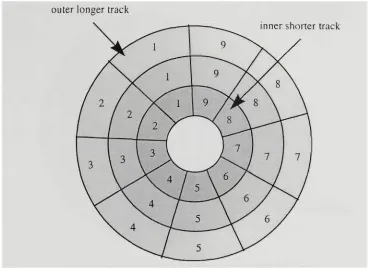
Magnetic disks can be classified according to the recording density divided into Variable Density Recording (VDR) disks and Constant Density Recording (CDR) disks.
outer longer track
inner sliorter track
Figure 2.1. Variable density recording
VDR disks use simple fixed motor speed and fixed linear recording speed. However, the maximum amount of data that can be recorded on each track are limited by the length and recording density at the innermost track. As the longer outer tracks can store more data using the same recording density as the innermost track, storage capacities of the outer tracks are somewhat wasted. Hence, these disks suffer from low recording density and low storage efficiency at outer tracks.
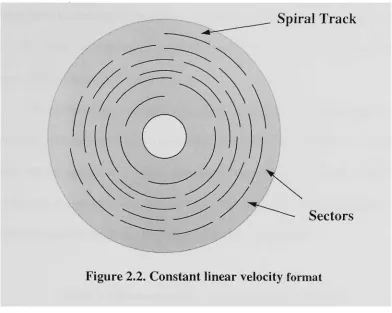
Spiral T r a c k
Sectors
Figure 2.2. Constant linear velocity format
• Constant Linear Velocity Approach
Optical disks, such as CD and DVD, use the CLV approach. When the read/write heads move towards the centre of the disks, the drive motor accelerates to a higher speed. When the read/write heads move away from the centre, the drive motor slows down. The read/write heads are then maintained at a fixed linear velocity above the disk track. Data are written on the sectors of a long continuous spiral track on each side of the disk surfaces (Figure 2.2). As the read/write heads traverse the disk surface at a fixed linear speed, the same amount of data are then transferred in a fixed period of time. Hence, their data transfer rates on different tracks are the same whereas their track capacities vary [132].
second layer is running in parallel or in opposite directions with that on the first layer. The opposite running spiral tracks are used to provide seamless jump and reverse play features in video access.
The performance and capacity of optical disks are increasing rapidly [113]. DVD disks can provide 7 to 26 times the capacity of CD (Table 2.1). A two-hour movie can be stored on a single side single layer disk, and their standard data transfer rate is comparable to that of a 9X CD-ROM. These characteristics make DVD very suitable for storing multimedia data, such as video.
Table 2.1. Some specifications of CD and DVD disk
Layers Sides
Capacity (gigabytes)
User data rate (10*^ bits/sec)
CD 1 1 0.65 0.15 DVD-5 1 1 4.7 11.08 DVD-9 2 1 8.4 11.08 DVD-10 1 2 9.5 11.08 DVD-17 2 2 17 11.08
• Constant Angular Velocity Approach
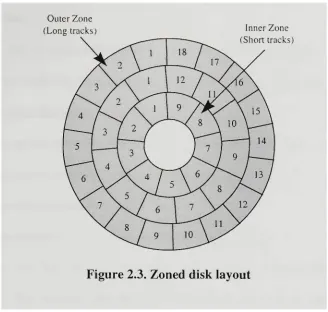
Outer Zone
(Long tracks) Inner Zone (Short tracks)
Figure 2.3. Zoned disk layout
Recording densities in each zone are optimized and are nearly equal. These disks are also called zoned disks. The disk platters rotate at a fixed speed and the read/write heads traverse data faster in the outer zones than in the inner zones. Hence, the data transfer rate is higher in the outer zones.
(b) Disk Drive Mechanism
• Seek Time
When the disk receives a SEEK command from the disk controller, it moves the arms and the read^write heads to the required cylinder. The seek action consists of the following components:
1. The arm is accelerated until it reaches the maximum speed. 2. The arm is travelling at the maximum speed.
3. The arm is decelerated until it stops.
4. The read/write heads are settled on the required track.
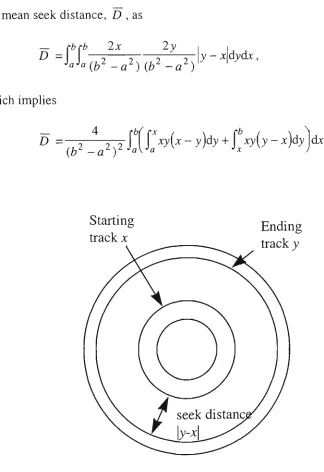
The heads will then stay on this track until the disk receives another SEEK command. The distance that the read/write heads travel in a seek action is commonly referred to as the seek distance. If all the seek destinations are random on VDR disks, the mean seek distance is {b-a)/3, where a and b are the radii of the innermost and outermost tracks respectively [95].
Seek time is the time required for the seek action and it depends on the seek distance. Frequently, the seek time is taken to be a linear function of the seek distance. The relationship between seek time and seek distance is generally non-linear. When the seek distance is short and the arm starts to decelerate before it reaches the maximum travelling speed, the seek time is proportional to the square root of the seek distance. When the seek distance is long and the arm needs to travel at the maximum speed, the seek time increases proportionately with the increase in seek distance [119]. The seek time s is shown in [126] to be
s =i rj , / ' (2-1)
[aj +a^^d, d <a^
• Rotational Latency
After the disk completes the seek action, it waits for the required data block to rotate under the read/write head. Rotational Latency is the time required for the starting position of the required data block to rotate under the read/write head. In most cases, rotational latency is assumed to be uniformly distributed and it is estimated as half of a disk revolution time. Letting T be the disk revolution time and / be the rotational latency, we have
/ = | . (2.2)
However, this is inaccurate for two reasons.
First, the rotational latency for fixed block size is not uniformly distributed because data transfer can only begin at fixed block starting positions and fixed angular positions. The sum of seek time plus rotational latency, hence, must necessarily be in integral multiples of basic block duration for consecutive accesses under busy conditions [93].
• Transfer Time
After the 1/0 path is established and the desired data come under the read/write head, the head starts to transfer data. The read/write head sends data over a bit-serial wire to the I/O controller. The speed of transferring data must be the same as the speed of data coming under the head. Hence, the speed of data transfer is directly proportional to the recording density and rotation speed of the disk.
Data transfer time is the time required for the required data to be read. The
data transfer time, T, to transfer a data block of size D from a VDR disk can easily be shown to be
T =J^lL, (2.3)
27ia-e
where T is the disk revolution time, a and e are the radius and recording density of the innermost track respectively. Therefore, the data transfer rate, p, is
p = 2m-e _ (2.4)
T
• Disk Throughput
Many researchers use the term disk throughput or disk bandwidth to indicate the disk performance. Disk throughput is often defined as the speed of accessing data from the disks. The disk throughput, ^, is given by
)8 = — ^ (2.5) S + l + T
or
)8 = \ (2.6)
We can see from Equation (2.6) that disk throughput increases with increase in data block size D. Unfortunately, increasing data block size would also increase the buffer size. It is a tradeoff between disk throughput and available memory. Very often, the block size used in traditional disks ranges from half to a few kilobytes.
2.3.4 Disk Scheduling
Traditionally, requests are served in First-In-First-Out (FIFO) or First-Come-First-Serve (FCFS) orders. When requests arrive at the disk, they are placed in a waiting queue. When the disk is free, the request that arrives earliest is served. The disk often serves each request in an n on-preemptive way without interruption from other requests.
The request that requires the shortest service time is served first in the Shortest Job First (SJF) method. Since a long request increases the waiting time of all waiting requests more than a short request, SJF scheduling chooses the shortest request in the waiting queue to be served. The total waiting time of all waiting requests is then minimized. However, long requests may wait indefinitely long when the disk is very busy.
Round-robin scheduling method places requests to priority queues. One or a few requests are served from each queue. This scheduling method tries to strike a balance between request priority and service arrival time.
previous request. The disk heads traverse across the disk surface and serve requests that accesses data on its way. This scheduling method efficiently reduces the total seek distance in serving a number of requests. The complexity of the SCAN algorithm is also low.
2.3.5 Disk Arrays
In order to store more data on a system, multiple disks can be used. The disks may serve requests in parallel or independently. When multiple disks are used as a disk array, data are striped across the disks. When data are accessed, each disk is issued a request. All the requests are then served simultaneously. Each request retrieves a fraction of the data block using shorter data transfer time. Hence, large data transfers are served efficiently.
Unfortunately, the mean time to disk failure shortens when many disks are used. In order to be able to recover data after disk failure, redundant data are encoded and stored. Data on the failed disks can then be recovered from data on other disks. This arrangement of disks forms a redundant disk array.
Redundant array of inexpensive disks (RAID) is an array of low capacity disks that store encoded redundant data to increase data reliability and data security. When a single disk fails, data on the failed disk are recovered from data on the remaining disks. There are at least six RAID levels [24, 63, 80].
RAID 1: Mirrored disks. The disks are arranged in pairs and each disk in the
RAID 2: Bit interleaved array. Several correction disks are added to the group
of data disks in a way similar to RAM chips. A single parity disk can detect a single error, but at least three disks are needed to correct an error. Larger group sizes yield a reduced overhead for fault tolerance, but smaller group means less I/O events per second. Since the whole group must be accessed to validate the correction codes, this is inefficient for small transfers.
RAID 3: Parity disk. Data are interleaved bit-wisely or byte-wisely across the
data disks. Disk controller can detect the failed bit position and a parity disk contains the parity of the data disks. It is possible to recover data on any single lost disk by reading the contents of the surviving disks, and re-computing the parity. The disk array performance is similar to a RA1D2 with a single correction disk.
RAID 4: Block interleaved. Every individual block is stored on a single disk. As
the data are interleaved between disks at the block level instead of the bit level or byte level. The new parity is calculated as new parity ( = old data xor new data xor old parity). A small write uses two disks to perform four accesses. Since all writes access the parity disk, contentions at the parity disk would suffer.
RAID 5: Rotated Parity. Parity blocks are interleaved among the disks in a
RAID5 tolerates single disk failure in each parity group of disks. Data are lost only when multiple disks in the same group of disks fail. Gibson used Mean-Time-To-Data-Loss to measure the reliability of disk arrays and showed that RAID5 can increase data reliability [63].
RAID 6: Two dimensional parity. The disks are arranged into a 2-dimensional
2.3.6 Hierarchical Storage System
Hierarchical Storage Systems (HSS) are storage systems such that their storage devices are grouped into at least two hierarchical levels. The lower level of storage devices provide fast data retrieval at higher media storage cost whereas the higher level of storage devices provide cheap media storage at a slower data retrieval rate. In general, any two types of storage devices may form a storage hierarchy. Typical storage hierarchies include cache memory/RAM, RAM/magnetic disk, magnetic disk/optical jukebox, and magnetic disk/tape library. When more than two levels of storage hierarchy are used together, the storage devices are divided into primary, secondary, and tertiary storage devices.
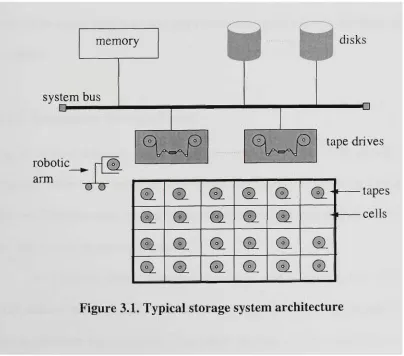
A hierarchical storage system often refers to a storage system that uses RAM, magnetic disks, and a robotic storage library to form its storage hierarchy (Figure 2.4). The robotic storage library often consists of a magnetic tape library or an optical jukebox that exchanges tapes and optical disks automatically.
Figure 2.4. Hierarchical storage system
In order to be useful, each level of storage devices differs from the next level of storage devices by at least one order of magnitude in storage capacity, media cost, and access latency. The media cost, unit capacity and access latency of different types of storage devices are compared in Table 2.2 [72]. These values only show the order of magnitude instead of the actual range of current values.
Table 2.2. Comparison of types of storage devices
Storage device Media cost Unit capacity Access time
In order to provide sufficiently large storage capacity in tertiary storage libraries, data are stored on removable media units, such as tape cassettes or optical disks. The media units can be exchanged automatically using robot arms or motor driven handling units.
(a) Removable Media Units
A reason that tertiary storage libraries can provide huge capacity is that some media units are not directly accessible at the drives. Since each drive can retrieve data on only one media unit at a time, it exchanges and loads the media unit before data on the required media unit can be accessed.
The tape cells in magnetic tape libraries are often arranged in a two dimensional grid or cylindrical manner. Optical disks in jukeboxes are often arranged in a stack. CD changers arrange disks in a round table manner. Although each CD changer can access only a few disks, an array of CD changers may access data from many media units.
(b) Exchange Mechanism
Exchange devices in typical tertiary storage libraries include robotic arms of tape libraries, exchange devices of optical jukeboxes, and turntables of CD changers. When data on a particular media unit are required, four steps are performed:
1. The new media unit is moved from the cell containing it to the drive. 2. The old media unit in the drive is ejected or unloaded.
Exchange devices can be dedicated to a drive or shared among drives. Magnetic tape library often uses only one or two robot arm for all drives. One exchange device is often shared among several optical drives in jukeboxes, whereas one exchange device is dedicated to each drive in a CD changer.
When the exchange device is a dedicated one, all drives can exchange media units concurrently. When an exchange device is shared among several drives, some drives may request for exchange while other drives are exchanging media. At this moment, the drive that issues new exchange requests need to wait for the exchange device becomes free. Since the drive cannot serve any requests while waiting for exchange, this contention for exchange device wastes substantial drive throughput.
(c) Time to Exchange Media
Media exchange time is the time required for the media unit to be exchanged. The exchange devices and the drives execute several mechanical movements. It takes time for the exchange device to fetch and move the media units, and for the drive to unload the old media unit and load the new media unit.
Table 2.3. Typical exchange service times (seconds)
Movement
mean rewind time drive eject time robot exchange drive load time
exchange service time
Exabyte 75 17 21-H22 65 200 StorageTek 30 5 15-f-15 7 72 Ampex 13 4 <20 5 42 HP Jukebox -3.0 10 5.5 18.5
2.3.7 Data Migration
Random access latency on tapes is three to four orders of magnitude slower than that on disks. Hillyer and Silberschatz studied I/O scheduling methods on serpentine tapes. They proposed the LOSS (a greedy algorithm for asymmetric travelling salesman) algorithm which performs better than other scheduling methods except the NP-hard optimal algorithm [72].
Although data migration requests can be scheduled using disk scheduling methods, their performance may become worse off due to the presence of large media exchange overheads. Therefore, data migration methods on tertiary storage devices are studied separately.
When data are placed on a storage hierarchy, tertiary storage devices provide permanent storage of all files at the lowest cost. Using a process of
staging in traditional systems, files are copied to the disks when required; these
data on disks become accessible to users and can be deleted later.
Traditional tertiary storage libraries migrate files across the storage hierarchy by the following steps:
1. (Start of stage one) Data are copied from tertiary storage devices to primary memory.
2. Old data are erased from disk cache to reclaim space if necessary, data are copied from primary memory to disk cache, and data are erased from primary memory to free primary memory for other use.
3. (Start of stage two) Data are copied from disks to primary memory. 4. Data are consumed from primary memory.
Since data are available in memory after stage one, the materialization time is the earliest time when data become accessible. The materialization time or time to complete stage one is given as
^ + X+^, (2.7)
2.4 Multimedia Storage Systems Characteristics
Optimization of system performance should consider the particular characteristics of the running application in order to deliver an efficient system. Application characteristics that are related to data storage include the data characteristics, access pattern of data requests, and specific requirements for the type of application. The file sizes directly affect the amount of time to transfer data from the storage systems. Request arrival patterns affect the contention of requests for storage devices. The application requirements limit the choices among methods that exhibit different performance characteristics.
Multimedia applications have many different requirements from traditional computer applications [9, 47, 69, 70, 71, 82]. New multimedia applications, including digital library, video-on-demand system, multimedia process control system, visual information system, multimedia information systems, and others, require to store multimedia data on multimedia storage systems. Multimedia storage systems are different from traditional computer storage systems in several aspects [49, 132, 143, 145].
2.4.1 Multimedia Data
The storage requirements of many applications are huge and most data kept in these applications are multimedia data. For example, the Thomas Jefferson National Accelerator Facility is expected to generate roughly 250 terabytes (250 x
practicable and economical solution to store these multimedia data is to use tertiary storage devices. We first describe the multimedia objects and their data sizes in part (a).
Multimedia objects should always be compressed and kept in the compressed format because of their large object size. Many methods are already available to compress multimedia data. Lossless compression techniques, such as Hoffman encoding, LZW, and wavelet, can reduce images data to one third of original data size. Lossy compression standards like JPEG (Joint Photographic Experts Group) and MPEG (Motion Picture Experts Group) standards can compress multimedia data to a much smaller size without much noticeable effects on novice users. Typically, the JPEG standard can compress images in the ratio of
15:1 [49]. We briefly describe the MPEG compression standards for video in part (b).
Even though compressions can reduce the original size by one to two orders of magnitude, multimedia objects are still too bulky to be handled in its entirety. Hence, they should be partitioned into smaller units. Multimedia data can be striped while keeping either the display time or data size constant. These two approaches to perform data striping are compared in part (c).
(a) Data Size
Audio objects store the information of recorded sound waves. The size of an audio object is proportional to the resolution, the frequency, and the duration of the object. A 60-minutes of 16-bit stereo audio is represented with 60x60x44100x2x16 bits or 605 MB.
Video objects are composed of a series of image frames displaying at a fixed rate. Each frame contains an image object and the frame size depends on the image resolution and the colour depth. The video object size also depends on the frame rate and the display duration. A two-hour colour PAL video may be represented with 576x384x24x25x60x60x2 bits or 119,439,360,000 bytes.
Since the data requirement increases linearly with each dimension of the resolutions, high resolution objects require many times more data storage space than the low resolution and preview objects.
(b) Compression
Since the amount of data to represent multimedia objects are so large, compression is inevitable in all levels of processing multimedia data. In MPEG compression, an object is organized as a video sequence. A video sequence consists of a sequence header followed by a number of Group of Pictures (GOP). Each GOP is composed of a GOP header followed by a number of pictures. Each picture can be an intra-frame (I-frame), a predicted frame (P-frame) or a bi-directional predicted frame (B-frame).
contains the vectors that predict its value from both the previous and the following I-frame or P-frame. Hence, a B-frame is always placed after the previous and the following I-frame and P-frame within the coded stream [49]. If the ratio of I:P:B frames is 1:3:8, then this sequence has one I-frame, three P-frames, and eight B-frames in every 12 B-frames. Since P-B-frames and B-B-frames contain motion compensation vectors that show only changes in the image content, the P-frames and B-frames are often smaller in size than the I-frames. The video data can be compressed by factors of 30:1 to 200:1 and audio data can be compressed by factors of 5:1 to 10:1 using MPEG compression [49].
Other video compression methods, such as H.261 and the new XYZ compression, could also reduce the data storage requirement by one to two orders of magnitude [51].
Compression techniques definitely can reduce the size of multimedia objects. Despite multimedia objects can be compressed to two orders of magnitude lower than that of its original size, the compressed objects are still very large. Their storage requirements in primary, secondary, and tertiary memories are vast, necessitating huge storage capacity on all storage devices [13, 49, 71, 127].
In the progressive compression technique, the system initially displays a low resolution image. It then displays a higher resolution object and the image resolution keeps increasing until the full resolution object is displayed.
(c) Data Striping
As compressed multimedia objects are still large, each object is often partitioned into smaller units called segments before they can be handled efficiently. Each segment is further subdivided into smaller units called data stripes. Each data stripe is accessed by one data requests. Data striping can be applied using two approaches, the Constant Data Length (CDL) approach or the Constant Time Length (CTL) approach [17].
If the CDL approach is used to create fixed length data stripes, it is difficult to predict the display time of each data stripe. The fixed data stripe size does not always form a multiple of the atomic unit for consumption, such as a frame. If an atomic unit spans several data stripes, data consumption may only start after all data stripes of the unit are transferred.
When the display duration of a data segment is long, more data stripes are created. The sizes of each data stripe vary from kilobytes to megabytes. If each MPEG frame forms one data stripe, the size of data stripes fluctuates depending on the type of frame. If each data stripe contain one GOP, the size of each data stripe depends on the amount of movements within that GOP. Hence, the size of data stripes can be more steady when data stripes are larger [87].
2.4.2 Display Modes
Multimedia applications often provide an interface to control the presentation of multimedia data over the time dimension like a Video Cassette Recorder (VCR). Hence, multimedia applications provide functions, such as play, fast forward, fast reverse, pause, stop, and slow, like a VCR. We shall describe how our design can support these display modes in Chapter 3.
(a) VCR like functions
1. The data object is supplied in a faster speed. This requires higher bandwidth in accessing the object.
2. A fast forward object is retrieved instead of the normal data object. This would require extra data storage space.
3. A low temporal resolution part of the object is accessed. This low temporal resolution part is displayed in a normal speed. Multi-resolution compression methods provide this low temporal resolution objects as part of the compressed objects.
No matter which method is chosen, the user can search the object and resume display at the desired position.
After the user has finished searching data using either fast modes, the user would resume to normal display mode. In some designs such as pipelining, there is a delay in resuming back to the normal mode if only part of the object has been transferred. This resume latency can be similar in magnitude to the latency of pipelining the object.
If the user wishes to skip to an earlier part of the object, he displays data in a fast reverse mode. If data can be retrieved in an reverse sequence, the fast reverse mode can be handled in a way similar to the fast forward mode. Otherwise, a reverse object has to be created and stored.
reasonable to assume that these display modes can also be supported with data buffering.
(b) Browsing Interface Functions
Many multimedia applications need to provide a browse mode for users to have a brief view before watching the details [41, 114]. This browse mode could reduce the workload on the storage system by skipping unnecessary details.
For continuous media, the beginning part is often played as a preview of the object. This method can only give the user a very rough idea of the object contents. When many objects begin with similar contents, the preview data does not provide enough distinguishable information. Alternatively, a preview method with some data from the content of the object is more informative. Multi-resolution compressed objects can provide such preview with their low temporal resolution segments without much additional data [43].
After the user has browsed the multimedia object, he may select one of the low resolution segments for displaying. The system should then display the high resolution objects beginning at the selected segment. In this situation, the storage system needs to jump to and retrieve data beginning at the appropriate location.
2.4.3 Access Pattern of Multimedia Data Requests
(a) Access Frequency
Several studies characterized user access pattern on video-on-demand systems according to the Zipf's Law [28]. Contrary to these research results, Griwodz et al. showed that the access probabilities of multimedia objects are sometimes less skewed [68]. Nevertheless, Zipf's distribution is still the most popular way to model multimedia object access frequencies.
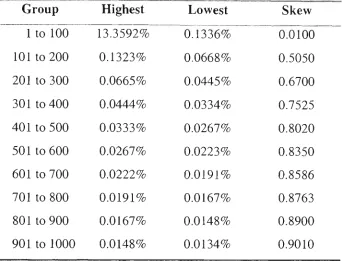
In Zipf's Law, the probability of choosing the nth most popular of M objects is taken to be Cln where C is a constant. We list the Zipf distribution for
1000 objects grouped by 100 objects in Table 2.4. The skew column shows the ratio between the lowest to the highest probability within each group. Although the probabilities of the first 100 objects are highly skewed, the probabilities for the last 800 objects at the tail of the Zipf distribution are much less skewed. If the first 200 objects are resident on disks, then requests for only the last 800 objects are directed to the tertiary storage. Thus, access probabilities of objects in the tertiary storage are less skewed.
Table 2.4. Zipf distribution of 1000 objects in groups of 100
Group
1 to 100 101 to 200 201 to 300 301 to 400 401 to 500 501 to 600 601 to 700 701 to 800 801 to 900 901 to 1000
Highest 13.3592% 0.1323% 0.0665% 0.0444% 0.0333% 0.0267% 0.0222% 0.0191% 0.0167% 0.0148% Lowest 0.1336% 0.0668% 0.0445% 0.0334% 0.0267% 0.0223% 0.0191% 0.0167% 0.0148% 0.0134% Skew 0.0100 0.5050 0.6700 0.7525 0.8020 0.8350 0.8586 0.8763 0.8900 0.9010
• Read/Write Frequency
Multimedia objects are commonly created by specific equipments such as video camera and audio recorder. Before multimedia objects are presentable, clips of the objects are cut and pasted together to produce the final product. While professional expertise is often required in the post-production process, novice users may retrieve objects. Thus, more users would retrieve multimedia objects whereas fewer users would modify them. While only read operation is required in displaying objects, both read and write operations are required in modifying objects. Multimedia objects are hence more often being read than being written.
(b) Stream of Requests
In traditional computer systems, data requests are discrete and discontinuous, and requests are normally independent of each other. On the contrary, multimedia data requests appear like an aperiodic stream. When a multimedia object is requested to display, a new stream is created. The stream generates new data requests that often access adjacent data stripes of the object.
• Real Time Constraints
Multimedia requests are bounded by real time constraints. Since multimedia data are displayed continuously to users, the supply of data should be continuous. If data are fed slower than the consumption rate, starving will occur and jitters will appear. If data supply is too fast, buffer may overflow. If data supply is discontinued, the display freezes. These artifacts undesirably affect the quality of service to users.
In particular, the execution time of requests is hence limited by the continuous display requirement such that the retrieval of a data request should complete before the previous data stripe is displayed. Let s be the seek time, I be the latency, M be the media block size, p be the data transfer rate, N be the number of disks in an array, and d be the display bandwidth. In order to support real-time continuous display of the media stream from disks, the retrieval time of one media block from each disk must be less than the display time of N media blocks. The continuous display constraint for N disks to support a single stream is
If the maximum seek time and the maximum latency are used, this constraint provides a hard guarantee for the streams; i.e. the data retrieval time is 100% guaranteed against starving.
• Read-ahead buffering
A mechanism to handle variations of data retrieval time called read-ahead
buffering is proposed in [36]. A number of read-ahead buffers are first filled
before display or consumption begins. If k read-ahead buffers are used, then buffers for A-i-^4-1 data stripes would be required. Increasing the number of read-ahead buffers per stream enables the system to absorb higher variability in disk response time. The same study showed that triple buffering is already sufficient to achieve the best cost-performance.
• Requests are separated evenly
Since each stream issues request periodically, consecutive requests are separated evenly from each other. Hence, the arrival pattern of requests is more regular than the random arrival pattern.
• Access neighbouring data
When data are displayed in the normal mode, data stripes are accessed according to the temporal dimension. Consecutive requests of the same stream access adjacent data stripes of the same object. They may access data stripes with a fixed time gap from each other when data are displayed in the fast mode. The storage location for neighbouring data stripes of an object is hence considered by many researchers to create highly structured storage organizations.
• Continuous over an extended period of time
A stream may issue requests over an extended period of time. Short video streams may be 5 to 10 minutes in length. Long video streams, such as movies, can be over two hours. Security video cameras may even record data continuously with indefinite length. Requests that access images being compressed using progressive compression techniques are also issued continuously over a short period of time.
(c) Streams Synchronization
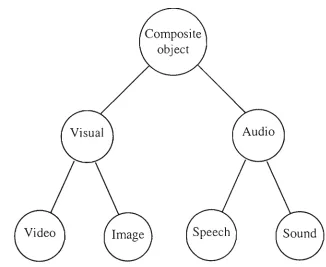
Multimedia composite objects are made up of several component objects [21, 111, 112]. Each component object may belong to a different media type. An example is given in Figure 2.5. These media components are separate at input and arrive at the storage devices as different media streams. They are usually retrieved from the storage devices at similar times and merged prior to consumption.
synchronization may result. Thus, the storage system that can handle multiple streams are more suitable for multimedia composite objects.
When synchronized objects are stored on storage system, the data stripes can be placed in an interleaving manner. Each stream can still be served independently. When several objects are retrieved at the same time, the retrieval efficiency is increased by merging the streams of requests. The feasibility of merging streams on optical disks is studied in [122, 151].
When synchronized objects are accessed in parallel, the objects can be retrieved in shorter total time by optimizing performance of accessing multiple objects together. [5, 57]. Since some buffers may already be required to perform synchronization, no additional buffers would be required to access them in parallel. Hence, parallel retrievals may not use much additional resources in accessing synchronized objects.
• Requests Scheduling
Instead of providing hard guarantee that limits disk throughput by the maximum seek, some researchers provide soft guarantee for multimedia streams. The requests are queued for disk accesses, and the waiting request is chosen according to a scheduling policy that is aware of the deadline of the waiting requests. The disks may achieve higher throughput, but the quality of streams can sometimes be lowered.
The Earliest Deadline First (EDF) algorithm serves the request with the earliest deadline first in order to satisfy its real-time constraint. Since requests may arrive in any order, seek overheads are significant. The SCAN-EDF algorithm combines seek optimization techniques and EDF together. Requests with the earliest deadline are served first. Requests that have the same deadline are served according to their track locations on the disk following the SCAN algorithm [123, 124].
The Group Sweeping Scheduling (GSS) algorithm partitions each round of requests into groups and each stream is assigned to one group. The groups are served in a fixed sequence within each round. The requests within each group are served according to the SCAN algorithm. The round length is hence traded off with the latency of successive stream retrievals by optimally deriving the number ofgroups[18, 22, 55].
workload on the storage system can be reduced [1, 66]. This piggyback merging technique is hence suitable for merging concurrent streams on the hot objects.
2.5 Storage Organizations on Disks
Many intelligent storage organizations, or data placement methods, have been designed for traditional data files and database systems. Traditional file placement methods are grouped into the following strategies [90]:
1. NaYve placement: Each data file is split into blocks and the file blocks are
randomly placed on any storage location. This is the simplest strategy to handle random accesses to file blocks.
2. Contiguous placement: Each data file is stored to contiguous physical locations. This strategy performs best when the entire file is accessed by consecutive requests. However, fragmentation prohibits the placement of large files.
3. Type based placement: Files containing the same type of data are grouped to the same category. Files of the same category are placed close to each other. This strategy trades off the seek distance of consecutive requests on data of the same type with that on data of different types.
5. Markovian Placement: Data files with the highest transition probabilities are stored to consecutive locations. This strategy optimizes the seek distance of requests according to the access history.
Many storage organizations and data placement methods that are specifically designed for multimedia data can be found in the literature. We also group them into the following strategies.
1. Naive placement: Data stripes are stored randomly. This simple method is
used for comparison only.
2. Contiguous placement: Objects are physically stored to consecutive physical locations.
3. Log structure placement: All write operations are appended to the end of a log file.
4. Statistical placement: Objects are stored according to the stationary or transition probabilities.
5. Fault tolerant: Redundant codes are encoded and stored to increase data reliability and security.
6. Replication: Objects are fully or partially replicated to increase availability of data.
7. Striping: Objects are partitioned to allow round robin or parallel retrievals.
8. Constraint Allocations: The physical storage locations are limited to reduce the maximum overheads in serving consecutive requests.
2.5.1 Naive Placement
This placement method places data blocks to random locations on disks. The only benefit of this method is simple. The system can find any empty space to store the data blocks. However, each request's response time can be very long and the system throughput can be very low.
2.5.2 Contiguous Placement
Some researchers placed multimedia objects contiguously on disks. Since the entire object can be accessed with only one seek action, the overheads in data access time are very low when objects are accessed in its entirety [2, 26].
2.5.3 Log Structure Placement
Some researchers store multimedia objects using log structure files. The disk layout consists of an index table and an append-only log table. The index table stores management information describing the log table status that is composed of a log head pointer and a logical log address pointing to physical disk block map table. Each log file is organized as a simple list of data blocks written contiguously to disk [99].
Since the log structure files are stored contiguously on disks, the seek overheads in writing them are low. Unfortunately, this placement method cannot guarantee performance on reading modified data blocks. Since all modified data blocks are appended to the tail of the log table, they require extra seek time overheads during retrieval. Therefore, this placement method is limited to multimedia applications without much editing.
2.5.4 Statistical Placement
In order to reduce the average seek time of disk requests, access probabilities have been considered in designing optimal file locations [45, 138]. Since the access frequencies or data temperatures of multimedia data can be obtained from prediction or access history, some researchers distribute movie data among disks following the access frequencies [98]. Some researchers store multimedia data objects on constant density recording disks according to the access frequencies [27, 136, 147].
then placed at the next optimal position available. The objects are stored following a skewed organ-pipe pattern (Figure 2.6). When all objects are independently accessed and in its entirety, the mean data access time is minimal.
If the access frequencies of objects are obtained from access history, extra disk storage space is required to store the access history. Fortunately, the data temperatures of objects in some multimedia applications can be predicted. However, their data temperature dynamically changes over time whereas the placement methods are static [68]. In order to maintain the optimal condition, data need to be reorganized frequently.
This strategy assumes that objects are independendy accessed. However, a stream of requests sequentially accesses data stripes of the same multimedia object. When there are several concurrent streams, the disk heads traverse to-and-fro between storage locations of objects. Therefore, this strategy should be refined to a finer granularity in order to handle concurrent multimedia streams.
When multimedia objects are not accessed independently, the transition probabilities must be considered. The Markov chain is used to model the access patterns for browsing graphs with low connectivity. A heuristic algorithm has been proposed to place the objects [20]. The running time of the proposed heuristic algorithm is O(n^).
zon
VsV.V, 1 V3V„Vj V.Vs VsV,o Vn V,.
e l 2 3 4 5 6
<
increase in radius
When objects are stored on tertiary storage and temporarily placed on staging buffers, the objects are written once and then read back once. After these two data accesses, the objects can be deleted to release disk space. The number of data accesses of each object on the disk is hence different from the object temperature in the placement. Moreover, the individual access frequency of these objects may be very low, but the staged buffers are accessed more frequently than other resident objects. If these buffers are allocated at the two ends of the disk, the mean seek distance would be very long. Therefore, these placement methods need to be refined for finding the optimal locations of staging buffers.
Similar to frequency based placement, extra storage space is also required to store the access history. The presence of concurrent streams and the continuous display requirement render that these statistical placement methods should be enhanced to handle streams of requests for multimedia data.