binding to TLS
(Full Version)
?Shijun Zhao, Qianying Zhang, Yu Qin, and Dengguo Feng
Institute of Software Chinese Academy of Sciences, ISCAS, Beijing, China.
{[email protected]},{zhangqy,qin_yu,[email protected]}
Abstract. Trusted Network Connect (TNC) requires both user authentication and integri-ty validation of an endpoint before it connects to the internet or accesses some web service. However, as the user authentication and integrity validation are usually done via independent protocols, TNC is vulnerable to the Man-in-the-Middle (MitM) attack. This paper analyzes T-NC which uses keys with Subject Key Attestation Evidence (SKAE) extension to perform user authentication and the IF-T protocol binding to TLS to carry integrity measurement messages in the Universally Composable (UC) framework. Our analysis result shows that TNC using keys with SKAE extension can resist the MitM attack. In this paper, we introduce two primitive ide-al functionide-alities for TNC: an ideide-al duide-al-authentication certification functionide-ality which binds messages and both the user and platform identities, and an ideal platform attestation function-ality which formalizes the integrity verification of a platform. We prove that the SKAE extension protocol and the basic TCG platform attestation protocol, both of which are defined by TCG specifications, UC-realizes the two primitive functionalities respectively. In the end, we intro-duce a general ideal TNC functionality and prove that the complete TNC protocol, combining the IF-T binding to TLS which uses keys with SKAE extension for client authentication and the basic TCG platform attestation platform protocol, securely realizes the TNC functionality in the hybrid model.
Key words: Universally Composable security, Trusted Network Connect, SKAE, TLS
1 Introduction
Many security solutions have been introduced to protect computers from attacks in the network, such as firewalls, virus scan engines and intrusion detection systems. However, as more and more security incidents ascend in numbers, these traditional solutions seem to be not sufficient to counter the current attacks. TNC, an open network access architecture enabling the network operators to authenticate the identity of the platform and perform the integrity verification of the platform before it connects to the network, is promoted and standardized by TCG to build a clean network environment. TNC aims to ensure that the integrity status of all the endpoints in the network are safe. The integrity information of an endpoint is collected and stored in a cost-effective, tamper-resistant Trusted Platform Module (TPM).
When an endpoint wants to connect to the network or access some web service, it first calls the IF-T protocol [14, 18] to establish a mutually authenticated secure channel with the TNC server, then it runs platform attestation protocol to attest its integrity status to the TNC server. The platform attestation protocol messages are transported in the established secure channel. However, Askan et al. [1] find that running an authentication protocol in a tunneling protocol is vulnerable to Man-in-the-Middle (MitM) attacks, and such attacks can apply to TNC using IF-T protocol. To prevent MitM attacks, TCG promotes the Subject Key Attestation Evidence (SKAE) extension, which enables a cryptographic binding of a platform identity key (which signs integrity information in the platform attestation protocol) with a user certificate. Both the user identity and SKAE extension should be authenticated in the user authentication. The SKAE extension implies that the user authentication and platform attestation happen on the same platform, so MitM attacks won’t work.
The UC framework defines the security goal of a protocol by an ideal functionality, which acts as a trusted third party. A good property of UC is the composability: a protocolπ communicating with an ideal functionalityF is identical toπcalling a subroutine protocol ρifρsecurely realizesπ
in the UC framework. This property suits the analysis of layered protocols very well: the high layer protocol invokes the ideal functionality realized by the lower layer protocol without considering the implementation details of the lower layer protocol. TNC is a layered architecture: the bottom layer is IF-T protocol, which establishes a mutual authentication secure channel, and the top layer is platform attestation protocol. So UC suits the analysis of TNC very well, and a proved TNC functionality will benefit the analysis of the protocols above TNC.
1.1 Related Work
To the best of our knowledge, few works on the formal analysis of TNC have been done since the publication of TNC. Zhang et al. [21] provide the first ideal TNC functionalityFTNC, and analyze the
EAP-TNC attestation protocol with Diffie-Hellman Pre-Negotiation (D-H PN) [14]. They find a MitM attack on the D-H PN EAP-TNC protocol and patch it by authenticating the Diffie-Hellman keys. However, their analysis is based on the assumption that the tunneled EAP protocol has provided an ideal mutually authenticated secure channel functionality. Some analysis of TNC using the symbolic logic method is proposed recently. Zhang et al. [22] propose a computationally sound symbolic analysis of D-H PN EAP-TNC protocol but not the complete TNC protocol. Xiao et al. [20] analyze the authentication property of the complete TNC protocol based on the IF-T protocol binding to TLS in their extended strand space model. They find that the complete TNC protocol can resist MitM attacks in the case the user is authenticated through a certificate with SKAE extension during the TLS setup phase. This result is in accord with our analysis result in the UC framework.
1.2 Our Contributions
In this paper, we investigate the complete TNC protocol in the UC framework. We adopt the compos-ability of the UC framework in our analysis. We first separate the Complete TNC protocol into IF-T protocol and platform attestation protocol. Then we analyze the two protocols separately. Finally, we analyze the complete TNC protocol in the hybrid model. The following lists our contributions more specifically.
1. We introduce two primitive ideal functionalities for TNC. The first is a dual-authentication cer-tification functionalityFD-Cert that authenticates both the user and platform identity. This
func-tionality is necessary in the analysis of TNC as authenticating both the user and platform is a basic security policy requirement in TNC. The second is a platform attestation functionalityFP-A
that captures the security requirement of the platform integrity status validation. These two prim-itive functionalities enable to analyze complex protocols based on SKAE extension and platform attestation in a modular way, and simplify the analysis.
2. We consider the realization ofFD-Cert andFP-A. We prove that 1) the SKAE extension creation
and processing protocol (which we call SKAE-EX for short), defined in the SKAE specification [13], securely realizesFD-Cert; and 2) the basic TCG platform attestation protocol realizesFP-A.
On the basis of FD-Cert, we show that the IF-T protocol binding to TLS which uses keys with
SKAE extension for client authentication (which we call IF-TLS-SKAE for short) realizes a dual-authentication secure channel functionalityFD-SC.
3. We introduce a general TNC functionality FTNC and show that the complete TNC protocol,
combining IF-TLS-SKAE and the basic TCG platform attestation protocol, UC-realizesFTNC.
1.3 Organization
Section 2 gives a brief overview of the background of this paper, i.e., TNC and the UC framework. Section 3 introduces the dual-authentication certification functionalityFD-Cert, and show that 1) the
SKAE-EX protocol securely realizesFD-Cert, and 2) the IF-TLS-SKAE protocol securely realizes the
dual-authentication secure channel functionalityFD-SC. Section 4 introduces the platform attestation
functionalityFP-Aand proves that the basic TCG platform attestation protocol realizesFP-A. Section
5 designs the general TNC functionalityFTNC and analyzes the complete TNC protocol in hybrid
model. Section 6 concludes this work.
2 Background
This section briefly describes the TNC architecture and the UC framework on which our analysis is based.
2.1 TNC in a nutshell
the current system. The integrity information is stored in a TPM, which cannot be compromised by a potentially malicious host system. In order to validate the integrity information of an endpoint, the existence and genuineness of a TPM should be authenticated, i.e., the platform identity authentication. TCG defines a series of specifications for TNC. The interoperability architecture specification [19] describes how TNC architecture can be implemented and integrated with existing network access control mechanisms such as 802.1X [7]. The IF-T specifications [14, 18] define how IF-T can be imple-mented over other lower layer protocols such as tunneled Extensible Authentication Protocol (EAP) and TLS. The IF-TNCCS messages, carrying the integrity measurement messages, are transported in the IF-T protocol, and its message format is defined in the IF-TNCCS specification [17]. The following gives a brief TNC flow based on the IF-T protocol binding to TLS:
0. Requirement. Before running TNC, the Network Access Requestor (NAR), which represents the endpoint that wants to get access to a TNC protected service, is already on the network thus has an IP address assigned.
1. TLS Setup. NAR establishes a TLS session with the Network Access Authority (NAA), who assesses NAR and decides whether NAR should be granted to access. In this phase, NAR must validate the certificate of NAA, e.g., NAA is authenticated to NAR. The NAR might use a client certificate with SKAE extension for client authentication, and this is the case analyzed in this paper.
2. User Authentication. If NAR isn’t authenticated to NAA in the TLS setup phase, user authen-tication must be performed after TLS setup phase over the established TLS session. The second version of [18] defines that the user authentication must be performed in the Simple Authentication and Security Layer (SASL) [10] framework, and some standards-based authentication mechanisms are provided in SASL.
3. Platform Attestation. In this phase, the IF-T session is available. NAA assesses the integrity of NAR in the IF-T session established in the above phases. The assessment messages are encapsu-lated in IF-TNCCS messages. Finally, NAA decides whether to grant NAR to access the protected service.
2.2 The UC framework
The UC framework [2] is a kind of formal method for the modular design and analysis of multi-party protocols. UC defines an additional entity called the environmentZ. It feeds arbitrary inputs to the parties and the adversary, then collects the outputs from the parties and the adversary.Z interacts with two worlds: the real world and the ideal world. The real world is composed of honest parties running a real protocol and an adversaryA which controls the communication between parties and may corrupt honest parties. The ideal world is composed of dummy parties and a simulatorS. The dummy parties simply receive inputs fromZ, and forward them to the ideal functionality F, which is a trusted party and performs the ideal cryptographic task. After completing the cryptographic task,F hands the desired outputs to the dummy parties. The security notion of UC is defined in an indistinguishable way as follows.
Definition 1.A protocolπ UC-realizes (or emulates) an ideal functionality F if for any adversary
A good feature of UC framework is its composition theorem.
Definition 2 (Composition theorem). Let π be a protocol that uses subroutine calls to an ideal functionalityf. We callπ is anf-hybrid protocol. If protocolρrealizesf, then the composed protocol πρ/f, in which each invocation off is replaced by an invocation of ρ, UC-realizes π. Another way of
saying it is,πρ/f UC-realizesπin f-hybrid model, i.e.,EXEC
πρ/f,A,Z≈EXEC
f π,S,Z.
3 SKAE Certification Functionality
FunctionalityFD-Cert
Signature Generation: Upon receiving a value (Sign, sid, m) from party S, verify that sid = (U, P, s) for somes(We denote byU the user identity andP the platform identity). If not, then ignore the request. Else send (Sign, sid, m) to the adversary. Upon receiving (Signature, sid, m, σ) from the adversary, verify that no entry (m, σ,0) is recorded. If it is, then output an error message to S and halt. Else, output (Signature, sid, m, σ) toS, and record the entry (m, σ,1).
Signature Verification:Upon receiving a value (Verify, sid, m, σ) from some partyS0, hand (Verify, sid, m, σ) to the adversary. Upon receiving (Verified, sid, m, φ) from the adversary, do:
1. If (m, σ,1) is recorded then setf= 1.
2. Else, if the signer is not corrupted, and no entry (m, σ0,1) for anyσ0 is recorded, then setf= 0 and record the entry (m, σ,0).
3. Else, if there is an entry (m, σ, f0) recorded, then set f=f0. 4. Else, setf=φ, and record the entry (m, σ0, φ).
Output (Verified, sid, m, f) toS0.
Fig. 1.The Dual-authentication Certification Functionality,FD-Cert
This section presents the dual-authentication certification functionality FD-Cert authenticating
both the user and platform identity. We analyze the SKAE extension creation and processing protocol (SKAE-EX) defined in [13]. SKAE-EX runs in a setting of the existence of 1) an Attestation Identity Key (AIK), which certifies that the user key with SKAE extension is under the protection of the TPM where AIK resides, 2) a trusted certificate authority that registers user identities together with public keys. We formalize the global assumptions by utilizing the certification functionality FCert and the
certificate authority functionalityFCA presented in [3]. We assume that the signature of the user key
with SKAE extension is secure, so we add the signature functionality FSIG presented in [3] to our
global assumptions. Our analysis shows that the SKAE extension creation and processing protocol defined in [13] UC-realizesFD-Cert in the (FCert,FCA,FSIG)-hybrid model. We don’t describeFCert,
FCA, andFSIGin this paper, and for readers who are interested in them please consult [3] for details.
It’s reasonable to assume that the AIK certification capability provided by TPM (see [15, 16] for details) securely realizesFCert, as the AIK certification with the help of a PrivacyCA [5] is the same
3.1 The Dual-authentication Certification Functionality,FD-Cert
The ideal dual-authentication certification functionality,FD-Cert is presented in Figure 1. It is similar
to FCert, except that it binds a signature for a message with the user identify and the platform
identify, which are encoded in thesid. The dual binding relationship is critical in the complete TNC protocol, and is one of the two essential approaches used in TNC to prevent MitM attacks. This binding relationship shows that the key used in the user authentication is protected by some TPM which is identified by an AIK. If the later platform attestation protocol uses the same AIK, then the user authentication and the platform attestation must operate in the same platform, which prevents MitM attacks.
3.2 Analysis of SKAE-EX
We show that the SKAE-EX protocol UC-realizes FD-Cert with the aid of an AIK certified by a
trusted PrivacyCA and ideally authenticated communication with a “trusted certification authority”. The certified AIK is formalized asFCert, and this formalization is reasonable as we have explained
that the AIK certification capability is the same as the CAS protocol3, which UC-realizesF
Cert. The
trusted certification authority assumption is formalized as FCA which registers user identities with
public values. We stress that FCA doesn’t check the possession of secret key corresponding to the
registered public value, which models most practical CAs.
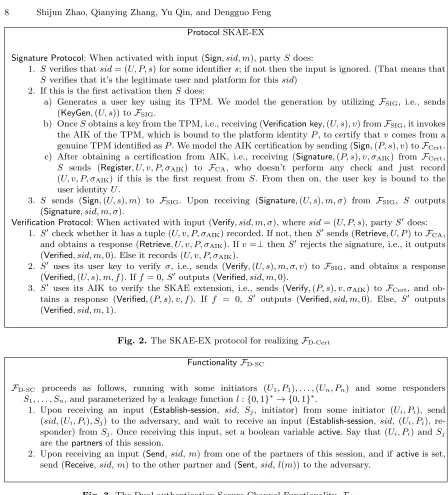
The formal description of SKAE-EX protocol is given in Figure 2.
Theorem 1.Protocol SKAE-EX securely realizes functionalityFD-Certin the(FCert,FCA,FSIG)-hybrid
model.
Proof. LetAbe an adversary that interacts with parties running SKAE-EX in the (FCert,FCA,FSIG)-hybrid
model. We construct an ideal adversary (simulator)S such that no environmentZ can distinguish whether it’s interacting withAand SKAE-EX in the real world or it’s interacting withSandFD-Cert
in the ideal world.S runs a simulated copy ofAand simulates for this copy interaction with parties running SKAE-EX. All messages fromZ toAand back are forwarded. The operations ofS are shown below:
Simulating signature generation.WhenSreceives a message (Sign, sid, m) fromFD-Cert, where
sid= (U, P, s) and bothU andP are not corrupted, it proceeds as follows: 1. If this is the first time that U generates a signature, then simulates for A:
a) The process of key generation: send (KeyGen,(U, s)) to A (in the name of FSIG), and
obtains (Verification key,(U, s), v) fromA.
b) The AIK certification: send (Sign,(P, s), v) to A, and obtain (Signature,(P, s), v, σAIK)
fromA, and record (v, σAIK).
c) The registration of user key: send toAthe message (Registered, U, v, P, σAIK) in the term
ofFCA, and record (U, v, P, σAIK) after receivingOkfromA.
2. Simulate forAthe processing of signingm. That is, in the name ofFSIG, send toAthe message
(Sign,(U, s), m). After receiving (Signature,(U, s), m, σ) from A, records the pair (m, σ) and sends (Signature, sid, m, σ) toFD-Cert.
S simulates the interaction of a party whose user identity is corrupted or platform identity is corrupted (or both are corrupted) as follows:
3
1. If the user identityU is corrupted, the process of key generation and signature generation is similar to the uncorrupted user, except thatAcan register a different public valuev0 toFCA.
Note that the simulation is still valid, as if the user is corrupted, FSIG follows the instruction
ofAto verify a signature.
2. If the platform identityP is corrupted, all thatS has to do is to simulate forAthe interaction withFCert. That is, whenever a party sends a messages (Sign,(P, s), v0) toFCert,FCertqueries
Ato get a signatureσAIK.
Simulating signature verification.WhenSreceives a verification request made by an uncorrupted partyS0 (bothU0 andP0 are uncorrupted) fromFD-Cert,S proceeds as follows:
1. If this is the first verification request from S0, then simulates forA: a) The exchange between S0 andF
CA. That is, send a message (Retrieve,(U, P), S0) in the
name ofFCA. WhenAresponds withOk, ifFCA has a tuple (U, v, P, σAIK) recorded then
record this tuple for the simulatedS0, else record a (U, P,⊥).
b) The AIK verification. That is,S simulates forAfollowing the logic of FCert: when FCert
decides to send (Verify,(P, s), v, σAIK) to A then send this message to A and obtain
(Verified,(P, s), m, φ) from A; whenFCert decides to output to S0, if neither U norP is
corrupted then follow the logic ofFCert to output (Verified,(P, s), v, f) to S0 (If (v, σAIK)
is recorded previously, thenf = 1, elsef = 0), else output (Verified,(P, s), v, φ) toS0. 2. The process of signature verification. Denote the message from FD-Cert by (Verify, sid, m, σ)
where sid= (U, P, s). Forward (Verify,(U, s), m, σ, v) to Ain the name of FSIG, and forward
A’s response toFD-Cert.
Simulating party corruptions.WhenAcorrupts the user or platform of some party,S corrupts the corresponding user or platform in the ideal world, and provides the obtained information to A. This has no effect on the simulation, as the real world protocol maintains no secret state.
It can be readily seen that the view of of Z in an interaction of A and SKAE-EX protocol is distributed identically to the view ofZ in an interaction with andS andFD-Cert in the ideal world.
3.3 Dual-authentication Secure Channel Functionality
We describe our dual-authentication secure channel functionalityFD-SCin Figure 3.FD-SCenables the
responder of the secure channel to authenticate both the user and the platform identify of the initiator, and guarantees that the adversary gains no more information than some side channel information about the transmitted plaintextm, such as the length ofm. The leakage information is expressed by a leakage functionl(m).
We argue that the IF-T protocol binding to TLS using keys with SKAE extension for client authen-tication (IF-TLS-SKAE) securely realizesFD-SC. Gajek et al. [6] has presented the security analysis
of the complete TLS protocol, combining Handshake and Record Layer, in the UC framework. They first showed that the master key generation subroutines in Handshake protocol UC-realize the key ex-change functionalityFKEgiven the traditional certification functionalityFCert, then that the complete
TLS protocol framework securely realizes secure channel functionalityFSCin theFKE-hybrid model.
Since 1) we have proved that user keys with SKAE extension UC-realizes the dual-authentication functionality, and 2) the IF-TLS-SKAE protocol is a complete TLS protocol using keys with SKAE extension for client authentication, we directly get theorem 2. The proof can be easily got following the proof of [6].
ProtocolSKAE-EX
Signature Protocol:When activated with input (Sign, sid, m), partyS does:
1. S verifies thatsid= (U, P, s) for some identifiers; if not then the input is ignored. (That means that
S verifies that it’s the legitimate user and platform for thissid) 2. If this is the first activation thenS does:
a) Generates a user key using its TPM. We model the generation by utilizing FSIG, i.e., sends
(KeyGen,(U, s)) toFSIG.
b) OnceSobtains a key from the TPM, i.e., receiving (Verification key,(U, s), v) fromFSIG, it invokes
the AIK of the TPM, which is bound to the platform identityP, to certify thatvcomes from a genuine TPM identified asP. We model the AIK certification by sending (Sign,(P, s), v) toFCert.
c) After obtaining a certification from AIK, i.e., receiving (Signature,(P, s), v, σAIK) from FCert, S sends (Register, U, v, P, σAIK) to FCA, who doesn’t perform any check and just record
(U, v, P, σAIK) if this is the first request from S. From then on, the user key is bound to the
user identityU.
3. S sends (Sign,(U, s), m) to FSIG. Upon receiving (Signature,(U, s), m, σ) from FSIG, S outputs
(Signature, sid, m, σ).
Verification Protocol:When activated with input (Verify, sid, m, σ), wheresid= (U, P, s), partyS0 does: 1. S0 check whether it has a tuple (U, v, P, σAIK) recorded. If not, thenS0sends (Retrieve, U, P) toFCA,
and obtains a response (Retrieve, U, v, P, σAIK). Ifv=⊥thenS0 rejects the signature, i.e., it outputs
(Verified, sid, m,0). Else it records (U, v, P, σAIK).
2. S0 uses its user key to verify σ, i.e., sends (Verify,(U, s), m, σ, v) to FSIG, and obtains a response
(Verified,(U, s), m, f). Iff= 0,S0outputs (Verified, sid, m,0).
3. S0 uses its AIK to verify the SKAE extension, i.e., sends (Verify,(P, s), v, σAIK) to FCert, and
ob-tains a response (Verified,(P, s), v, f). If f = 0, S0 outputs (Verified, sid, m,0). Else, S0 outputs (Verified, sid, m,1).
Fig. 2. The SKAE-EX protocol for realizingFD-Cert
FunctionalityFD-SC
FD-SC proceeds as follows, running with some initiators (U1, P1), . . . ,(Un, Pn) and some responders
S1, . . . , Sn, and parameterized by a leakage functionl:{0,1}∗→ {0,1}∗.
1. Upon receiving an input (Establish-session, sid, Sj, initiator) from some initiator (Ui, Pi), send (sid,(Ui, Pi), Sj) to the adversary, and wait to receive an input (Establish-session, sid, (Ui, Pi), re-sponder) fromSj. Once receiving this input, set a boolean variableactive. Say that (Ui, Pi) andSj are thepartnersof this session.
2. Upon receiving an input (Send,sid,m) from one of the partners of this session, and if activeis set, send (Receive,sid,m) to the other partner and (Sent,sid,l(m)) to the adversary.
4 Analysis of Platform Attestation
In this section we first introduce the ideal platform attestation functionalityFP-Awhich formalizes the
PCR-based platform attestation proposed by TCG, and then show that the TCG platform attestation protocol securely realizesFP-Agiven an incorruptibleFCertfunctionality. The incorruptibility models
the protection capability provided by TPM, a tamper-resistant hardware token.
4.1 Platform Attestation Functionality
We first describe the ideal platform attestation functionalityFP-Amodeling a prover to attest its PCR
information to a verifier informally. See Figure 4 for a precise definition.
FunctionalityFP-A
FD-SC proceeds as follows, running with some proversP1, . . . , Pn and some verifiers V1, . . . , Vn, and every
proverPi is initialized with a acceptable PCR statusP CRi.
1. Upon receiving an input (Challenge,sid,P, verifier) from some verifierV, do:
a) Send (sid, P, V) to the adversary, and receive an response (Ok,nonce0) from the adversary. IfV
is corrupted, then recordnonce0, else generate a freshnonceand record it. Then output (sid, n) to the adversary,V andP (nstands for the recorded nonce).
b) Wait to receive an input (Attest, sid, V, prover) from P. Once receiving this input, output (SentPCR,sid,P,V) to the adversary.
2. Upon receiving (SendPCR,sid,V, (n, P CR0)) from the adversary, check whether (n, P CR0) is record-ed. If it’s recorded, output (SentPCR,sid,P, (n, P CR0)) toV. Else, record the pair (n, P CR), and output (SentPCR,sid,P, (n, P CR)) toV.
3. Upon receiving an input (Corrupt,sid,V, Verifier) from the adversary, markV as corrupted. 4. Upon receiving an input (Corrupt,sid,P, Prover) from the adversary, changeP CRtoP CR.
Fig. 4. The Platform Attestation Functionality,FP-A
At beginning, each honest prover is initialized with a PCR status which is acceptable for a honest verifier. Through theChallengeinterface, a verifier declares that it’s willing to verify the PCR status of a prover. This request is forwarded to the prover and the adversary. If the verifier is corrupted, FP-Areceive a nonce from the adversary and record it. If the verifier is not corrupted,FP-Agenerates
a fresh random nonce itself and record it. The nonce is then output to the adversary, the verifier and the prover. Through the Attest interface, the requested prover provides its received nonce and declares that it wants to attest its PCR status to the verifier. After receiving the challenge and attest messages,FP-A record the nonce and the current PCR status, then: 1) if the verifier is not corrupted,
FP-A returns the nonce and the current PCR status to the verifier, and 2) if the verifier is corrupted,
and there exists a nonce and a PCR status in the record,FP-Aasks the adversary whether to return
the previous or the current PCR status. Through the corruption interface, the adversary can corrupt any prover or verifier. If the adversary decides to corrupt the prover, the PCR of the prover will be changed to a unacceptable status.FP-Acaptures the intuitive notion of TNC:
verifier. This property captures the integrity measurement and storage capability of a platform equipped with a TPM.
2. Against the replay attack for honest parties.FP-Asends not only the PCR status but also a fresh
nonce aiming to prove that the PCR status is fresh.
3. If the verifier is corrupted, the platform attestation will not be reliable. That is, if the nonce is not fresh, then the adversary can mount a replay attack.
4.2 Analysis of TCG Platform Attestation Protocol
We show that the TCG platform attestation protocol (we call P-Attest for short), depicted in Figure 5, securely realizesFP-AgivenFCertwhich models an AIK. In order to model the protection capability
of TPM, corruption of a prover only changes the PCR status of the prover and the certification party inFCert, which means that the AIK is incorruptible.
TCG Platform Attestation Protocol
Each prover is initialized a PCR status which is valid to the verifier.
1. Upon receiving an input (Challenge, sid,P, verifier), verifier V generates a fresh random nonce n, sends (sid, V, n) toP.
2. Upon receiving an input (Attest,sid,V, prover), proverP waits for a noncenfrom verifierV. Upon receiving of (sid, V, n), P sets sid0 = (P, sid), sets m = (n, P CR), sends (Sign, sid0, m) to FCert,
obtains the response (Signature, sid0, m, σ), and sends (sid, P, m, σ) toV.
3. Upon receiving (sid, P, m, σ), V sets sid0 = (P, sid), checks whether the nonce inm equals n, sets
m = (n, P CR), sends (Verify, sid0, m, σ) toFCert, and obtains a response (Verified, sid0, m, σ, f). If f= 1 thenV outputs (SentPCR, sid,P,V,(n, P CR)) and halts, elseBhalts without output.
Fig. 5. The TCG Platform Attestation Protocol
Theorem 3.The P-Attest protocol securely realizes functionality FP-A in theFCert-hybrid model.
Proof. LetAbe an adversary that interacts with parties running P-Attest in theFCert-hybrid model.
We construct an ideal world adversary (or simulator)S such that no environment Z can distinguish whether it’s interacting withAand P-Attest in the real world or it’s interacting withS and FP-A in
the ideal world.S runs a simulated copy of Aand simulates for this copy an interaction with parties running P-Attest. All messages fromZ toAand back are forwarded. The operations ofS are shown below:
Simulating the verifier. When an uncorrupted verifierV is activated with input (Challenge,sid,
P, verifier),S obtains this input fromFP-Aand waits for a message (sid, n) fromFP-A. Then,S
simulates a run ofV and the interaction withFCert forA.
1. S deliversAthe message (sid, V, n) sent from P to V.
2. When receiving a message (sid, P, m, σ) where m = (n, P CR) from A, S simulates for A the interaction with FCert. That’s, send (Verify, sid0 = (P, sid), m, σ) to A and record the
response. If there exists a recorded signature (m, σ) (simulating FCert), then S deliver the
Simulating the prover. When an uncorrupted proverP is activated with inputs (Attest, sid,V, prover), S obtains this input from FP-A and waits for a message (sid, V, n) fromFP-A. Then,S
simulates a run ofP and the interaction withFCertforA:S sends toAthe message (Sign, sid0 =
(P, sid), m= (n, P CR)) in the name ofFCert, and obtains a signatureσ fromA. Next, S hands
Athe message (sid, P, m, σ) sent fromP toV.
If the prover is corrupted, which means the PCR status ofP is invalid, the simulation is similar to a uncorrupted party.
Simulating party corruptions.WhenAcorrupts a party, S corrupts the corresponding party in the ideal world, and provides the obtained information toA. This has no effect on the simulation, as the real world protocol maintains no secret state.
The only potential case in which the view ofZin the real world and in the ideal world may differ is if the verifier receives a message (Verified, sid0, m, σ, f = 1) fromFCertin the real world, whileAnever
delivered the message (sid, P, m= (n, P CR), σ). But ifAnever delivered (sid, P, m= (n, P CR), σ), thenmwas never signed byFCert. So in this case,V would always receive (Verified, sid0, m, σ, f= 0).
In a conclusion, the simulation is perfect.
5 Analysis of Complete TNC
We first introduce our general ideal TNC functionalityFTNC. We then analyze the complete TNC
protocol, combining TCG attestation protocol and IF-TLS-SKAE protocol, and show that it realizes the ideal TNC functionality in the (FD-SC,FP-A)-hybrid model. To show the usefulness of the
dual-authentication feature provided byFD-SC, we show that the above simulation will not hold if FD-SC
is replaced with an usual secure channel functionality without dual-authentication feature.
5.1 A General TNC functionality
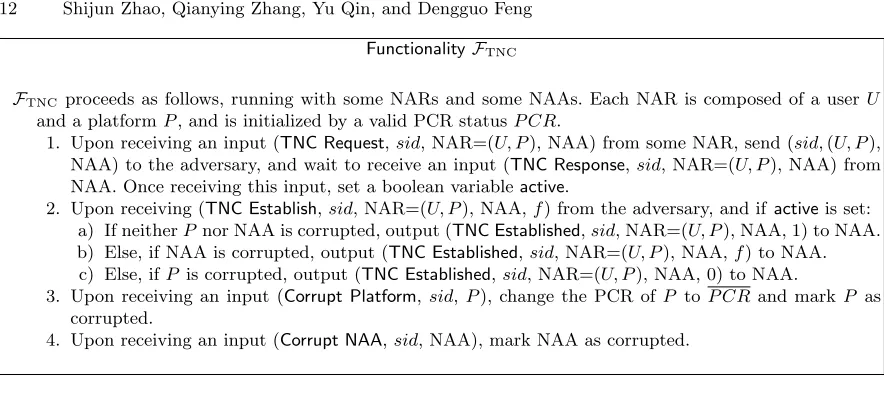
Our ideal TNC functionality is depicted in Figure 6. Our functionalityFTNCis much more general than
the TNC functionality presented in [21] as our functionality models the IF-T protocol and the above IF-TNCCS protocol as secure channel and platform authentication functionality respectively, while the TNC functionality in [21] only models the IF-T binding to EAP protocol. Our TNC functionality captures the following TNC features:
1. User Authentication and Platform Authentication. FD-SC authenticates both user and platform
identities of connecting endpoints.
2. Platform Attestation. FP-A abstracts the main goal of the IF-TNCCS protocol carried in the
secure channel established by IF-T, that is, the platform integrity attestation.
3. Corrupt Platforms. TheFP-A models the corruption of a platform in TNC by marking the PCR
status as invalid.
FunctionalityFTNC
FTNCproceeds as follows, running with some NARs and some NAAs. Each NAR is composed of a userU
and a platformP, and is initialized by a valid PCR statusP CR.
1. Upon receiving an input (TNC Request,sid, NAR=(U, P), NAA) from some NAR, send (sid,(U, P), NAA) to the adversary, and wait to receive an input (TNC Response,sid, NAR=(U, P), NAA) from NAA. Once receiving this input, set a boolean variableactive.
2. Upon receiving (TNC Establish,sid, NAR=(U, P), NAA,f) from the adversary, and if activeis set: a) If neitherPnor NAA is corrupted, output (TNC Established,sid, NAR=(U, P), NAA, 1) to NAA. b) Else, if NAA is corrupted, output (TNC Established,sid, NAR=(U, P), NAA,f) to NAA.
c) Else, ifP is corrupted, output (TNC Established,sid, NAR=(U, P), NAA, 0) to NAA.
3. Upon receiving an input (Corrupt Platform,sid,P), change the PCR ofP toP CR and markP as corrupted.
4. Upon receiving an input (Corrupt NAA,sid, NAA), mark NAA as corrupted.
Fig. 6.The TNC Functionality,FTNC
5.2 Realizing TNC functionality
Figure 7 shows the complete TNC protocol. We prove it in the following theorem.
Theorem 4.The complete TNC protocol securely realizes functionality FTNC in the (FD-SC,FP-A)
-hybrid model.
ProtocolTNC
1. When activated with input (TNC Request,sid, NAR=(U, P), NAA) byZ, NAR sends an input (Establish-session,sid, (U, P), initiator) toFD-SC, then waits for a challenge from NAA.
2. When activated with input (TNC Response,sid, NAR=(U, P), NAA)byZ, NAA do: a) Send an input (Establish-session,sid, (U, P), responder) toFD-SC.
b) Send an input (Challenge,sid,P, verifier) toFP-A, receive (sid, n), and recordn.
c) Send (Send,sid,n) toFD-SC.
3. Upon receiving the challengenfromFD-SC, NAR sends (Attest,sid, NAA, prover) toFP-A.
4. Upon receiving (SentPCR,sid,P,m= (n0, P CR0)) fromFP-A, NAA checks whethern0=nandP CR0is
valid. Ifmpasses the two checks, NAA setsf= 1, else setsf= 0. Then NAA outputs(TNC Established,
sid, NAR=(U, P), NAA,f).
Fig. 7. The TNC protocol for realizingFTNC
Proof. Let Abe an adversary that interacts with parties running TNC in the (FD-SC,FP-A)-hybrid
model. We construct an ideal world adversarySsuch that no environmentZ can distinguish whether it’s interacting withA and TNC in the real world or it’s interacting withS and FTNC in the ideal
Simulating the NAR. When an uncorrupted NAR is activated with input (TNC Request, sid, NAR=(U, P), NAA) byZ,Sobtains this input fromFTNC. ThenS simulates a run of NAR and
the interaction with (FD-SC,FP-A) for A. For the seek of simplicity, we omit the simulation of
NAR, which directly follows the flow of Figure 7. We focus on the interaction with FD-SC and
FP-A:
– When the logic of NAR instructs it to send (Attest, sid, V, prover) to FP-A, send (SentPCR,
sid,P, NAA) toA.
Simulating the NAA. When an uncorrupted NAA is activated with input (TNC Response, sid, NAR=(U, P), NAA) byZ,Sobtains this input fromFTNC. ThenS simulates a run of NAA and
the interaction with (FD-SC,FP-A) forA. Similarly, we omit the simulation of NAA, and focus on
the interaction withFD-SC andFP-A:
– When NAA sends (Challenge,sid,P, verifier) toFP-A, send (sid, P, V) toA.
– When NAA sends a noncentoFD-SC, send (Send,sid,l(n)) toAin the name ofFD-SC.
Simulating party corruptions. When A corrupts NAR or NAA, S corrupts the corresponding party in the ideal world, and provides the obtained information toA.
It is easy to verify that the above simulation is perfect, i.e., for any environmentZandAthe view ofZ in an interaction ofA and TNC is distributed identically to the view in an interaction withS and the ideal TNC functionality.
5.3 Realizing TNC without Dual Authentication
To demonstrate the usefulness of the dual-authentication feature we proposed in this paper, we show that the complete TNC protocol depicted in Figure 7 cannot realizeFTNC if the dual-authentication
feature is removed, i.e., replacingFD-SC withFSC.
Theorem 5.The complete TNC protocol doesn’t UC-realize functionality FTNC in the (FSC,FP-A)
-hybrid model.
Proof. Consider the following environment Z and adversary A. Z first activates a NAR=(U, P1)
with input (TNC Request, sid, NAR=(U, P1), NAA) and a NAA with input (TNC Response, sid,
NAR0=(U, P), NAA). ThenZ instructsAto:
1. Corrupt both the userU and platformP1of NAR.
2. Instruct NAR to send an input (Establish-session,sid, U, responder) toFSC.
3. After receiving challenge noncenfrom FSC, notify Z.
Finally,ZinstructsP to send (Attest,sid,V, prover) toFP-A(or activates a NAA00=(U0, P)). If NAA
outputs (TNC Established,sid, NAR0=(U, P), NAA, 1), thenZ outputsREAL. OtherwiseZ outputs IDEAL.
In the real execution of TNC, NAA authenticates the user U and checks that the PCR status of platformP is not corrupted, so it would output that NAR is allowed to access the requested network. However, in the simulation of ideal world,FTNC never receives the TNC request from NAR=(U, P),
6 Conclusion
We analyze the complete TNC protocol, combining the IF-T binding to TLS and TCG platform attestation protocol, in the UC framework. We show that the SKAE extension introduced by TCG plays an important part in preventing the MitM attack presented in [1]. Our roadmap for the analysis of the complete TNC protocol adopts the modular feature of UC framework. We partition the com-plete TNC into a secure channel functionality and a platform attestation functionality. Then show that the IF-TLS-SKAE protocol and the basic TCG platform attestation protocol securely realizes the two primitive functionalities respectively. Finally, we use the composition theorem to argue that the complete TNC protocol realizes TNC. Besides, the dual-authentication certification functionality FD-Certand the platform attestation functionalityFP-Aenable us to analyze protocols that use SKAE
extension or TCG platform attestation in a modular way.
References
1. N. Asokan, V. Niemi, and K. Nyberg. Man-in-the-middle in tunnelled authentication protocols. InSecurity Protocols, pages 28–41. Springer, 2005.
2. R. Canetti. Universally composable security: A new paradigm for cryptographic protocols. InFoundations of Computer Science, 2001. Proceedings. 42nd IEEE Symposium on, pages 136–145. IEEE, 2001. 3. R. Canetti. Universally composable signature, certification, and authentication. InComputer Security
Foundations Workshop, 2004. Proceedings. 17th IEEE, pages 219–233. IEEE, 2004.
4. R. Canetti and H. Krawczyk. Universally composable notions of key exchange and secure channels. In Advances in Cryptology-EUROCRYPT 2002, pages 337–351. Springer, 2002.
5. L. Chen and B. Warinschi. Security of the TCG Privacy-CA solution. In Embedded and Ubiquitous Computing (EUC), 2010 IEEE/IFIP 8th International Conference on, pages 609–616. IEEE, 2010. 6. S. Gajek, M. Manulis, O. Pereira, A.-R. Sadeghi, and J. Schwenk. Universally composable security analysis
of tls. InProvable Security, pages 313–327. Springer, 2008.
7. Institute for Electrical and Electronics Engineers (IEEE). IEEE802, Port-Based Network Access Control, IEEE Std 802.1X-2004, December 2004.
8. R. K¨usters and M. Tuengerthal. Joint state theorems for public-key encryption and digital signature functionalities with local computation. In Computer Security Foundations Symposium, 2008. CSF’08. IEEE 21st, pages 270–284. IEEE, 2008.
9. J. M. McCune, B. J. Parno, A. Perrig, M. K. Reiter, and H. Isozaki. Flicker: An execution infrastructure for tcb minimization. In ACM SIGOPS Operating Systems Review, volume 42, pages 315–328. ACM, 2008.
10. A. Melnikov and K. Zeilenga. Simple Authentication and Security Layer (SASL). Technical report, RFC 4422, June, 2006.
11. B. Pfitzmann and M. Waidner. A model for asynchronous reactive systems and its application to secure message transmission. InSecurity and Privacy, 2001. S&P 2001. Proceedings. 2001 IEEE Symposium on, pages 184–200. IEEE, 2001.
12. R. Sailer, X. Zhang, T. Jaeger, and L. Van Doorn. Design and implementation of a tcg-based integrity measurement architecture. InUSENIX Security Symposium, volume 13, pages 16–16, 2004.
13. Trusted Computing Group. Subject Key Attestation Evidence Extension Version 1.0, Revision 7., 16 June 2005.
14. Trusted Computing Group. TNC IF-T: Protocol Bindings for Tunneled EAP Methods Specification Version 1.1, Revision 10., 21 May 2007.
16. Trusted Computing Group. Trusted Platform Module Library Part 3: Commands, Family “2.0” Level 00, Revision 00.99., 22 August 2013.
17. Trusted Computing Group. TNC IF-TNCCS: TLV Binding Specification Version 2.0, Revision 16., 22 January 2010.
18. Trusted Computing Group. TNC IF-T: Binding to TLS Specification Version 2.0, Revision 7., 27 February 2013.
19. Trusted Computing Group. TNC Architecture for Interoperability Specification Version 1.5, Revision 3., 7 May 2012.
20. Y. Xiao, Y. Wang, and L. Pang. Security analysis and improvement of TNC IF-T Protocol Binding to TLS. Communications, China, 10(7):85–92, 2013.
21. J. Zhang, J. Ma, and S. Moon. Universally composable secure TNC model and EAP-TNC protocol in IF-T. Science China Information Sciences, 53(3):465–482, 2010.