IST-Africa 2015 Conference Proceedings Paul Cunningham and Miriam Cunningham (Eds)
IIMC International Information Management Corporation, 2015 ISBN: 978-1-905824-51-9
Use of Tablets in Blended Learning:
A Case Study of an Institution
of Higher Learning in Kenya
E. Muuro MAINA1, Rose W. NJOROGE1, Peter W. WAIGANJO2, Rhoda GITONGA1 1Kenyatta University, P.O. Box 43844, 00100, Nairobi, Kenya
+254 20 8710901-19, Fax: +254 020 8711575
Emails: [email protected]; [email protected]; [email protected]
2University of Nairobi, P. O. Box 30197, 00100, Nairobi, Kenya
+254 020 4447870, Fax: +254 020 4447870, Email: [email protected]
Abstract: The tablet has been introduced as a tool for learning in Institutions of Higher Learning in Kenya. Due to this introduction there was a need to carry out research that highlights the potential benefits and drawbacks in the use of tablets for learning in an Institution of Higher Learning. The objective of this research was to investigate the learners’ perceived benefits and challenges on the introduction of tablets in blended learning in Higher Education. Purposive sampling was used to select learners who had received their learning materials through these tablets. The findings revealed that the tablets were highly accepted as a learning device due to their convenience and it was noted that there were some learner factors such as work schedules influenced their use. It was noted that learners experienced hardware, software and instructional design challenges in their use of these tablets. Tablet features, instructor availability, the quality of learning recourses were some of the areas which needed improvement.
Keywords:Blended learning; Tablets; Institutions of Higher Learning; Learners.
1. Introduction
The increasing availability of low cost digital devices such as smartphones, laptops and tablets has led to increased ownership of digital devices by learners in Institutions of Higher Learning (IHL) in Kenya [1]. Some universities in Kenya such as Kenyatta University have embraced the use of tablets in their blended learning and have introduced a digital school which provides enrolled learners with free tablets (http://www.ku.ac.ke). Consequently, this provides both opportunities and challenges to educational institutions, their teachers and learners. In light of this, it is important to continuously evaluate the use of mobile devices such as tablets in e-learning so as identify the learners’ perceived benefits and challenges in the use of tablets in IHL in Kenya.
1.1 The use of Tablets in Education
[6]. Culture is also an aspect that needs to be considered carefully along with other context in mobile technologies for learning [7].
Researchers from the University of Northern Colorado in their study on learners’ perceptions of using tablets revealed that learners appreciated the use tablets because they were able to have ‘everything in one device’, access to digital learning resources, presentation and note-taking software and being able to communicate on the go, making them ‘more connected’ [8]. Studies in other Universities such as Indian University, not all learners found tablets helpful; some found them to be difficulty to use mostly when taking notes [9]. In addition, the researchers found that instructor’s support and availing of reliable digital learning resources were key factors in the successful use of tablets in education [8].
To realize the full potential of tablets in education, the technology must be fully integrated into teaching and learning so that technology is not used for supplementary purposes but it is viewed as an essential tool for learning. Therefore the use of tablets in education must be supported by a pedagogical vision in order to reach its potential impacts on learning [3], [10], [11]. More research is needed to design appropriate guidelines on e-learning pedagogies which can support the use of mobile devices such as tablets in education [12]. To successfully adopt tablet technology in African universities, the universities need more information about the learners’ tablet access, their learning experiences and related challenges, as this is currently missing from the literature.
2. Objectives
The focus of this study was to investigate how University learners in one University in Kenya used tablets, their perceived benefits and challenges. It also summarizes recommendations from learners on how to improve digital learning through the use of tablets. The following research questions guided the study:
1. How do University learners use tablets as compared with other digital devices for learning?
2. What are the learners’ perceived benefits and challenges in the use of tablets?
3. What recommendations should be considered to improve digital learning through tablets from the learners’ perspective?
3. Methodology
The researchers used the following research methodology: 3.1 Research Design
A descriptive survey was used to investigate learners’ perceived benefits and challenges in the use of tablets in a blended learning environment. A descriptive survey was adopted as it could examine the situation the way it was and provide quantitative information that could be summarized through statistical analysis, thus providing the basis for answering our research questions[13]. This survey was conducted by administering questionnaires using a cloud-based tool to a group of learners who were in an Open Distance and e-Learning (ODeL) mode of study in one of the Universities in Kenya. This approach was preferred because learners were geographically dispersed; it enabled faster data collection and the ease of exporting the data to Statistical Package for Social Sciences (SPSS) for analysis. 3.2 Sample and Sampling Procedures
3.3 Research Instruments
Data was collected through a questionnaire that consisted of twenty five items. Twenty one items in the questionnaire were close-ended while four items were open-ended questions. To ensure validity, content related evidence was used and two experts in e-learning were requested to review the content and the format of the instrument. From their comments some items were paraphrased, some content added and questionnaire reformatting done as recommended. Content-related evidence was adopted to ensure the instrument contained the required content as per the research questions.
3.4 Data Collection and Analysis
The questionnaire was distributed through email invitations to the participants. The invitation email contained the purpose of the study and a link to the URL where the questionnaire was hosted. The questionnaire was made available for a period of three weeks as most of the learners did not respond immediately. A total of 207 learners responded: The collected data was exported to SPSS and coded as per the research objective. A quantitative analysis was carried out, such as frequencies and percentages on: demographic information, use of digital devices in e-learning and learners’ perceptions on the use of tablets for digital learning. For the open-ended items themes were created.
4. Results
In this section, we present our results using descriptive statistics for quantitative data and narratives based on themes for the qualitative data.
4.1 Learner Demographic and Characteristics Information
The study findings on demographic and characteristics information are presented on Table 1. As shown in Table 1 the majority of the learners were young adults aged between 20-30 years (47%) and between 31-40 years (43%). A high percent of the respondents were male at 71%. The majorities of the respondents were employed (93%) and therefore preferred the ODeL mode of study (81%).
Table 1: Frequencies (n) on the demographic Information (N= 207)
Characteristics n % Characteristics n % 1. Age 2. ReasonsforoptioningtostudyinODeL
Below 20 years 3 1% It was cheaper than other modes ʹ ͳ͵Ψ
20-30 years 98 47% My work schedule could not allow other modes ͳ ͺͳΨ
31-40 years 90 43% My resident place was not favorable for other modes ͳͻ ͻΨ
41-50 years 11 5% My sponsor recommend it ͵Ψ
50 years and above 5 2% Others ͳͷ Ψ
3. Gender 4. Employment
Male ͳͶͺ ͳΨ Yes ͳͻ͵ ͻ͵Ψ
Female ͷͻ ʹͻΨ No ͳͶ Ψ
5. Levelofstudy 6. NatureofWok
Certificate 2 1% Involves traveling ͵ʹΨ
Diploma 16 8% Stationed in one location ͻ͵ ͶͷΨ
Undergraduate 148 71% Working many hours( both day and night shift) ͳ ʹͻΨ
Postgraduate 41 20%
4.2 Utilization of the digital device on different learning activities
desktop for learning purpose (7%) which could indicate that they preferred a mobile device, as laptop came second (17%) among the devices preferred for learning purposes.
Table 2: Frequencies (n) on the utilization of the digital device on different learning activities
Lecture
notes Assign-ments Quizzes Chatting SocialMedia e-Books Forums Emails/ SMS
Digital Device
n % n % n % n % n % n % n % n % Mobile
phone 3 1% 10 5% 4 2% 39 19% 112 54% 28 14% 7 3% 86 42% Tablet 154 74% 108 52% 87 42% 94 45% 43 21% 81 39% 139 67% 67 32% Laptop 35 17% 55 27% 74 36% 46 22% 31 15% 59 29% 32 15% 32 15% Desktop
Comp. 15 7% 34 16% 42 20% 28 14% 21 10% 39 19% 29 14% 22 11%
4.3 Challenges experienced
The major challenges which learners encountered were related to the following; the e-learning platform (60%), the internet connectivity (51%) and lack of facilitation from the instructors (48%). Table 3 summarizes the observed challenges and their frequencies.
Table 3: Frequencies (n) on the challenges experienced by the learners while using tablets
Type of Challenge n % Type of Challenge n %
Hanging of e-learning platform 124 60% Slow internet connection 78 38% High cost of internet connection 106 51% Others 53 26% Lack of interaction with instructor 99 48% Power failure 36 17% Unable to download learning materials 91 44% Screen resolution 31 15% Limited mode of access to learning materials 90 43% None 3 1%
4.4 Experiences in the Use of Tablets
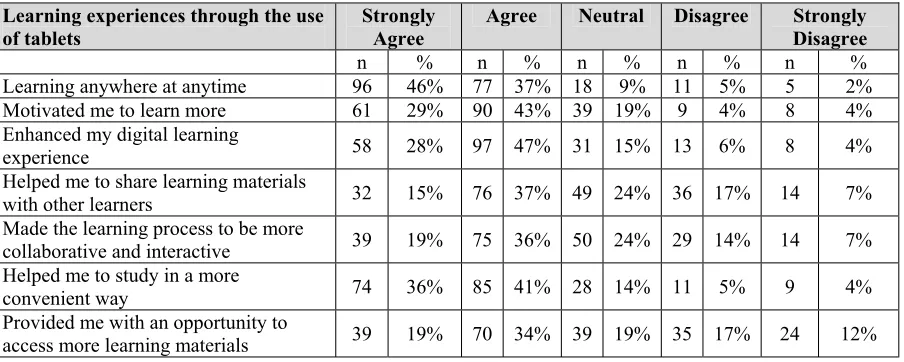
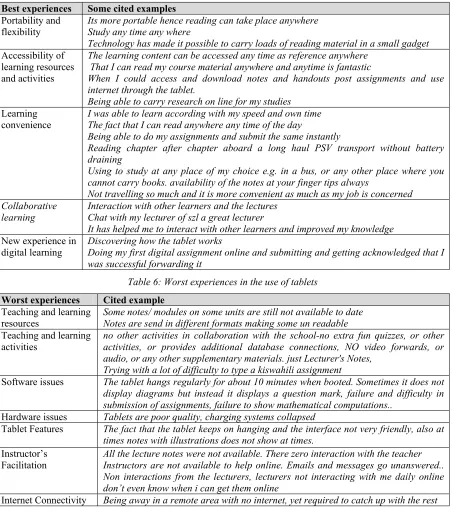
The researchers endeavored to elicit from the learners, their best and worst experiences using tablets for learning. Table 4 summarizes learners’ learning experiences. The learners also provided a myriad of best and worst experience. These are summarized in Table 5 and Table 6.
Table 4: Frequencies (n) on the Learning experiences through the use of tablets
Learning experiences through the use
of tablets Strongly Agree Agree Neutral Disagree Strongly Disagree
n % n % n % n % n % Learning anywhere at anytime 96 46% 77 37% 18 9% 11 5% 5 2% Motivated me to learn more 61 29% 90 43% 39 19% 9 4% 8 4% Enhanced my digital learning
experience 58 28% 97 47% 31 15% 13 6% 8 4% Helped me to share learning materials
with other learners 32 15% 76 37% 49 24% 36 17% 14 7% Made the learning process to be more
collaborative and interactive 39 19% 75 36% 50 24% 29 14% 14 7% Helped me to study in a more
convenient way 74 36% 85 41% 28 14% 11 5% 9 4% Provided me with an opportunity to
Table 5: Best experiences in the use of tablets
Best experiences Some cited examples
Portability and
flexibility Its more portable hence reading can take place anywhere Study any time any where
Technology has made it possible to carry loads of reading material in a small gadget
Accessibility of learning resources and activities
The learning content can be accessed any time as reference anywhere That I can read my course material anywhere and anytime is fantastic
When I could access and download notes and handouts post assignments and use internet through the tablet.
Being able to carry research on line for my studies
Learning
convenience I was able to learn according with my speed and own time The fact that I can read anywhere any time of the day Being able to do my assignments and submit the same instantly
Reading chapter after chapter aboard a long haul PSV transport without battery draining
Using to study at any place of my choice e.g. in a bus, or any other place where you cannot carry books. availability of the notes at your finger tips always
Not travelling so much and it is more convenient as much as my job is concerned Collaborative
learning Interaction with other learners and the lectures Chat with my lecturer of szl a great lecturer
It has helped me to interact with other learners and improved my knowledge
New experience in
digital learning Discovering how the tablet works Doing my first digital assignment online and submitting and getting acknowledged that I was successful forwarding it
Table 6: Worst experiences in the use of tablets
Worst experiences Cited example
Teaching and learning
resources Some notes/ modules on some units are still not available to date Notes are send in different formats making some un readable
Teaching and learning
activities no other activities in collaboration with the school-no extra fun quizzes, or other activities, or provides additional database connections, NO video forwards, or audio, or any other supplementary materials. just Lecturer's Notes,
Trying with a lot of difficulty to type a kiswahili assignment
Software issues The tablet hangs regularly for about 10 minutes when booted. Sometimes it does not display diagrams but instead it displays a question mark, failure and difficulty in submission of assignments, failure to show mathematical computations..
Hardware issues Tablets are poor quality, charging systems collapsed
Tablet Features The fact that the tablet keeps on hanging and the interface not very friendly, also at times notes with illustrations does not show at times.
Instructor’s Facilitation
All the lecture notes were not available. There zero interaction with the teacher Instructors are not available to help online. Emails and messages go unanswered.. Non interactions from the lecturers, lecturers not interacting with me daily online don’t even know when i can get them online
Internet Connectivity Being away in a remote area with no internet, yet required to catch up with the rest 4.5 Suggested improvements on the use of tablets from learner’s perspective
Table 7: Suggested improvements in the use of tablets
Improvement
suggested Cited example
Teaching and
learning resources Modules should be clear for easy understanding Enhanced downloading and uploading of files. Materials loaded for the modules too shallow
learning activities The submission of assignments through tablet isn't guaranteed that it gets to the examiner
Mode of delivery Abolish live tutorials and upload video tutorials in the tablets i.e. by recording regular learners lectures and uploading it
Lecturers to upload modules into the system early enough. where possible video/audio tutorials to be provided.
Integrate videos derived from Institutional based courses that are similar, get audio, get more supplementary quizzes, forums , make it compulsory for everyone to participate, let learners work together, create study groups, etc
Software issues Provide with better tablets. The current ones have poor software that can't support important apps like YouTube
Hardware issues Better tablets with high resolutions and capacity
Tablet Features The platform is poor cannot support diagrams and illustration. more video and audio contents.The screen of tablet is too small thus is a challenge to read for many hours if we could get ipad to replace the tablets it could be better, because we incurred high cost making hardcopies of the notes since its strenuous to use the tablet for all course materials.
Instructor’s
Facilitation It is good mode but I wish I could my lecturers could post assignments, forums and quizzes on weekly basis To increase the learner teacher interaction and also to respond quickly to learner queries
I would recommend that lecturers be time flexible because i do not have time to always access the chats and they should give more time for assignments. assignments given for a week is not enough time for me because i may be in the bush for one week with clients so by the time I am getting a good connection for network the assignment will be closed down.
Internet Connectivity Not all places in Kenya have strong networks for internet connectivity. i work in northern Kenya and I have experienced poor network reception by the tablet which has affected my performance very much.
Improve internet connectivity, to support, quick synchronization and more advanced tutorials, faster connectivity and strong Wifi while at the university compound
5. Discussion
Our discussion here is guided by the research questions. Researchers observed that tablets were highly utilized for learning purpose opposed to desktop and mobile phones. This could be attributed to that fact that tablets do offer better functionality such as larger screens, greater processing power, long life battery and host a variety of interactive applications as compared with other mobile devices such as smart phones. In addition, tablets offered other attributes such as portability and multi-functionality (phone, computer, camera and notepad) unlike a desktop and a laptop.
learner motivation. This could be attributed to that fact that tablets allowed learners to learn at their own speed, anytime, anyplace, and within their working schedule.
The learners experienced a number of challenges in the use of tablets such as: hardware malfunction, software inefficiency, instructor unavailability, low quality and few learning resources and activities, higher cost internet connectivity among others. Some of the findings such as instructor unavailability and few learning resources do agree with findings from other studies in IHL in Kenya [14], [15].
From learner perspective various aspects on digital learning through the use of tablets ought to be improved. These include: integration of multimedia learning resources; enhancing tablets capability; streamlining the process of tablet issuance, delivery and maintenance of tablets and ensuring that instructors are actively involved in teaching and learning activities. This too was observed in other universities where tablets had been used for learning purposes. Additionally, some learners had difficulties in the use of tablets while facilitators provided inadequate digital resources [9].
6. Research Contributions
Little empirical research currently exists that considers one-to-one tablet use in IHL in Kenya. This research provides a baseline on tablet technology usage in blended learning on which to build future research. The researchers expect that the results will guide new initiatives to facilitate learners and instructors in adopting more effective learning and teaching practices through mobile technology and ensure positive outcomes and pedagogical benefits are realized in digital learning through the use of tablets.
7. Conclusion
In conclusion the Tablets are highly utilized for purpose of learning though some learners continued to use other digital devices such as laptops and desktop computers. However, for the tablet to be more beneficial to the learners, issues pertaining to the platform needed to be addressed to enhance the process of acceptance. Though the learners perceived the use of tablets as convenient and motivating, the poor instructor support and participation needed to be addressed in order to encourage digital learning. Use of tablets provided an opportunity for peer learning through collaborative activities such as chats and discussion forums. This is an indication that digital learning can also support constructivism theory of learning [16] and make learners realize the benefits of peer learning [17].
Further research is recommended to establish the instructor’s perceived benefits and challenges in the use of tablets for digital learning and teaching. There is also need for a longitudinal research study monitoring the use of tablets in IHL over time.
References
[1] M. Kashorda and T. Waema, “E-readiness survey of Kenyan universities (2013),” Nairobi, 2014.
[2] M. Kearney, S. Schuck, K. Burden, and P. Aubusson, “Viewing mobile learning from a pedagogical perspective,” Res. Learn. Technol., vol. 20, 2012.
[3] M. van’t Hooft, “The Potential of Mobile Technologies to Connect Teaching and Learning Inside and Outside of the Classroom,” in Emerging Technologies for the Classroom, Springer, 2013, pp. 175–186. [4] E. Muuro, P. Wagacha, and R.Oboko, “Improving Online Collaborative learning Using Machine
Learning,” in Models for Improving and Optimizing Online and Blended Learning in Higher Education, Jared Keengwe and J. J. Agamba, Eds. IGI Global. Pennsylvania, USA, 2014, pp. 204–219.
[5] L. Sha, C.-K. Looi, W. Chen, and B. H. Zhang, “Understanding mobile learning from the perspective of self-regulated learning,” J. Comput. Assist. Learn., vol. 28, no. 4, pp. 366–378, 2012.
[6] L.-H. Wong, “A learner-centric view of mobile seamless learning,” Br. J. Educ. Technol., vol. 43, no. 1, pp. E19–E23, 2012.
[8] S. Alyahya and J. E. Gall, “iPads in education: A qualitative study of students attitudes’ and experiences,” in World Conference on Educational Multimedia, Hypermedia and Telecommunications, 2012, vol. 2012, no. 1, pp. 1266–1271.
[9] J. P. Rossing, W. M. Miller, A. K. Cecil, and S. E. Stamper, “iLearning: The Future of Higher Education? Student Perceptions on Learning with Mobile Tablets.,” J. Scholarsh. Teach. Learn., vol. 12, no. 2, pp. 1– 26, 2012.
[10] C. C. Chou, L. Block, and R. Jesness, “A case study of mobile learning pilot project in K-12 schools,” J. Educ. Technol. Dev. Exch., vol. 5, no. 2, pp. 11–26, 2012.
[11] J. Rikala, M. Vesisenaho, and J. Mylläri, “Actual and Potential Pedagogical Use of Tablets in Schools,”
Hum. Technol. An Interdiscip. J. Humans ICT Environ., vol. 9, no. 2, pp. 113–131, 2013.
[12] A. Dhir, N. M. Gahwaji, and G. Nyman, “The Role of the iPad in the Hands of the Learner.,” J. Univers. Comput. Sci., vol. 19, no. 5, pp. 706–727, 2013.
[13] J. R. Fraenkel, N. E. Wallen, and H. H. Hyun, How to design and evaluate research in education. New York, N.Y: McGraw-Hill Higher Education, 2012.
[14] J. A. Nyerere, F. Q. Gravenir, and G. S. Mse, “Delivery of open, distance and e-learning in Kenya,” Int. Rev. Res. Open Distance Learn., vol. 13, no. 3, pp. 185–205, 2012.
[15] E. Muuro, P. Wagacha, R.Oboko, and J. M. Kihoro, “Students’ Perceived Challenges in an Online Collaborative Learning Environment: A Case of Higher Learning Institutions in Nairobi, Kenya,” Int. Rev. Res. Open Distance Learn., vol. 15, 2014.
[16] L. S. Vygotsky, “Mind in Society: The Development of Higher Psychological Processes.” 1978.