© 2015, IRJET | ISO 9001:2008 Certified Journal | Page 1353
Enhanced Fuzzy Model Reference Learning Control for
Conical tank
process
S.Ramesh
1Assistant Professor, Dept. of Electronics and Instrumentation Engineering, Annamalai University,
Annamalainagar, Tamilnadu.
---***---Abstract - Enhanced Fuzzy Model Reference Learning Control
(EFMRLC) is an efficient technique for the control of non linear process. In this paper, a FMRLC is applied in to a non linear spherical tank system. First, the mathematical model of the spherical tank level system is derived and simulation runs are carried out by considering the EFMRLC in a closed loop. A similar test runs are also carried out with Neural Network based IMC PI and conventional ZN based PI-mode for comparison analysis. The results clearly indicate that the incorporation of EFMRLC in the control loop in spherical tank system provides a good tracking performance than the NNIMC and conventional PID mode.
Key word: EFMRLC, FOPDT, NNIMC, PID
1. INTRODUCTION
Control of non linear process is main criteria in the process control industries. These kind of nonlinear process exhibit many not easy control problems due to their non-linear dynamic behavior, uncertain and time varying parameters. Especially, control of a level in a spherical tank is vital, because the change in shape gives rise to the non-linear characteristics. An evaluation of a controller using variable transformation proposed by Anathanatrajan [1] on hemi-spherical tank which shows a better response than PI controller. A simple PI controller design method has been proposed by Wang and Shao [2] that achieves high performance for a wide range of linear self-regulating processes. Later in this research field, Fuzzy control is a practical alternative for a variety of challenging control applications, since it provides a convenient method for constructing nonlinear controllers via the use of heuristic information. Procyk and Mamdani [3] have discussed the advantage of Fuzzy Logic Controllers (FLC) is that it can be applied to plants that are difficult to get the mathematical model. Recently, Fuzzy logic and conventional control design methods have been combined to design a Proportional - Integral Fuzzy Logic Controller (PI - FLC). Tang and Mulholland [4] have discussed about the comparison of fuzzy logic with conventional controller.
Recent years, neural network (NN) had been adopted in nonlinear IMC design due to its good ability of approximate arbitrarily nonlinear vector functions [5][6]. For some complex processes, however, when the work condition of system varies, the process characteristic changes drastically and falls outside training region. Even
though the NN model is available, it is difficult to design the NN inverse controller unless the model is open-loop stable[7]. When the process is unstable in local region, the controller based on a fixed model will be unreliable and thus the system performance is affected seriously.
To trounce these problems, in this paper a “learning” control algorithm is presented which helps to resolve some of the issues of fuzzy controller design and NN inverse model. This algorithm employs a reference model (a model of how you would like the plant to behave) to provide closed-loop performance feedback for synthesizing and tuning a fuzzy controller’s knowledge-base. Consequently, this algorithm is referred to as a “Fuzzy Model Reference Learning Controller” (FMRLC) [8][9][10].
The paper is divided as follows: Section 2 presents a brief description of the mathematical model of Spherical tank system, section 3 and 4 shows the methodology, algorithms of EFMRLC and NNIMC , section 5 presents the results and discussion and finally the conclusions are presented in section 6.
2. MATHEMATICALMODELINGOF(STHE)
Here Fi is the inlet flow rate to the tank, F0 be the
outlet flow rate from the tank, FL be the disturbance applied
to the tank.
Figure-1 Diagram of Conical Tank
Fi – Inlet flow rate to the tank (m3 / min)
© 2015, IRJET | ISO 9001:2008 Certified Journal | Page 1354 Fl- Load applied to the tank (1pm)
H - Height of the conical tank (m)
h - Height of the liquid level in the tank at any time 't' (m)
R- Top radius of the conical tank (m)
r - Radius of the conical vessel at a particular level of height h(m)
A -Area of the conical tank (m2)
The nominal operating level h is given by (1)
= (2)
At any level (h)
= (3)
Equating (2) and (3)
r = (4)
Cross sectional area of the tank at any level(h)is (5) Substitute (4) in (5)
(6)
Also,
(7)
Substituting (7) in (1)
(8)
(9)
From equation (8)
(10)
Where
=Nominal value of outflow rate
Hence the transfer function of the above system is
= (11)
Where
h and U are nominal values of PV and MV from equation (11)
Time constant of the level process
The gain constant of the level process k =
In order to find the open loop response, the step input of 2.0v is applied to the ADC input in simulink tool of MATLAB platform directly with the fixed inflow rate and outflow rate. For the given step input the system attains the steady state at 15cm. After that a step increment from 2.0v to 2.25v is given and various readings are noted till the process becomes stable at different regions in the conical tank. The experimental data are approximated to be a FOPDT model, the model parameters of the transfer functions for the above mentioned are tabulated in Table 3.
Table-1: Transfer Function Model of the Conical Tank
Level Process for various operating region Level in cm Transfer Function Model
15 – 30 30 – 38 38 – 42
3. ENHANCED FUZZY MODEL REFERENCE LEARNING CONTROL (FMRLC)
This section discusses the design and development of the EFMRLC and it is applied to the spherical tank level system. The following steps are considered for the design of EFMRLC.
I. Direct fuzzy control II. Adaptive fuzzy control
3.1 Direct Fuzzy Control
The rule base, the inference engine, the fuzzification and the defuzzification interfaces are the our major components to design the direct fuzzy controller [8].
© 2015, IRJET | ISO 9001:2008 Certified Journal | Page 1355
e(kT)=r(kT) – y(kT) (12)
c(kT) = ( e(kT) - e(kT-T) ) / T (13)
and the output variable is
u(kT) =level in cm (14)
-1 -0.5 0 0.5 1
NB NS Z PS PB
NB NS Z PS PB
-1 -0.66 -0.33 0 0.33 0.66 1 u(k T)
[image:3.595.44.271.75.309.2]e(k T) , ec(k T)
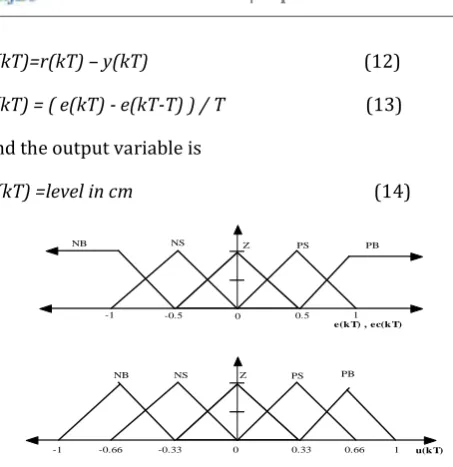
Figure 2. Membership functions for the fuzzy controller.
The universe of discourse of the variables (that is, their domain) is normalized to cover a range of
[-1, 1] and a standard choice for the membership functions is used with five membership functions for the three fuzzy variables (meaning 25 = 52 rules in the rule base) and
symmetric, 50% overlapping triangular shaped membership functions (Figure 1), meaning that only 4 (=22) rules at most
can be active at any given time
The fuzzy controller implements a rule base made of a set of IF-THEN type of rules. These rules were determined heuristically based on the knowledge of the plant. An example of IF THEN rules is the following
IF e is negative big (NB) and ce is negative big (NB) THEN u is Positive big (PB)
This rule quantifies the situation where the Conical tank level process is far to minimum level to maximum hence the control valve stem position changes from 0 -100% so that it control the particular operating point of the conical tank. The resulting rule table is shown in the Table 2.
Table 2: Rule base for the fuzzy controller
Here min-max inference engine is selected, utilizes minimum for the AND operator and maximum for the OR operator. The end of each rule, introduced by THEN, is also done by minimum. The final conclusion for the active rules is obtained by the maximum of the considered fuzzy sets. To obtain the crisp output, the centre of gravity (COG) defuzzification method is used. This crisp value is the resulting controller output.
3.2 Adaptive Fuzzy Control
[image:3.595.318.558.313.444.2]In this section, design and development of a EFMRLC, which will adaptively tune on-line the centers of the output membership functions of the fuzzy controller determined earlier. Figure 3 shows the EFMRLC as applied to the STHE process. The FMRLC uses a (learning mechanism) that emphasizes
Figure 3. Enhanced Fuzzy Model Reference Learning Control
a) observes data from a fuzzy control system (i.e. r(kT) and
y(kT))
b) Characterizes its current performance, and
c) Automatically synthesizes and/or adjusts the fuzzy controller using rule base modifier so that some pre-specified performance objectives are satisfied.
In general, the reference model, which characterizes the desired performance of the system, can take any form (linear or nonlinear equations, transfer functions, numerical values etc.). In the case of the level process reference model is shown in the figure.3.
An additional fuzzy system is developed called
“fuzzy inverse model” which adjusts the centers of the output
membership functions of the fuzzy controller, which still controls the process, This fuzzy system acts like a second controller, which updates the rule base of the fuzzy controller by acting upon the output variable (its membership functions centers). The output of the inverse fuzzy model is an adaptation factor p(kT) which is used by the rule base modifier to adjust the centers of the output membership functions of the fuzzy controller. The
“Level” u “ Change in error” ce
NB NS Z PS PB
“Error” e
NB PB PB PB PS Z
NS PB PB PS Z NS
Z PB PS Z NS NB
PS PS Z NS NB NB
PB Z NS NB NB NB
FUZZY
CONTROLLER PLANT
FUZZY INVERSE MODEL RULE
BASED MODIFIER REFERENCE
MODEL
FUZZY CONTROLLER
-+
+
-LEARNING MECHANISM
r(kT)
e(k T)
ec(k T)
u(k T) ym(k T)
y(k T) ye(k T)
yce(k T) p(k T)
s T z1 1
s T
z1 1
gu
[image:3.595.64.250.632.756.2]© 2015, IRJET | ISO 9001:2008 Certified Journal | Page 1356 adaptation is stopped when p(kT) gets very small and the
changes made to the rule base are no longer significant. The fuzzy controller used by the FMRLC structure is the same as the one developed in the previous section.
The fuzzy inverse model has a similar structure to that of the
controller (the same rule base, membership functions, inference engine, fuzzification and defuzzification interfaces. See section 3.1).
The inputs of the fuzzy inverse model are
ye(kT) = ym(kT) – y(kT) (15)
yc(kT) = ( ye(kT) – ye(KT-T) ) / T (16)
and the output variable is the adaptation factor p(kT).
The rule base modifier adjusts the centers of the output
membership functions in two stages
1. the active set of rules for the fuzzy controller at time
(k-1)T is first determined
(17)
The pair (i, j) will determine the activated rule. We denoted by i and j the i-th, respectively the j-th membership function for the input fuzzy variables error and change in error. 2. the centers of the output membership functions, which
were found in the active set of rules determined earlier, are adjusted. The centers of these membership functions (bl) at time kT will have the following value
b (kT ) =b (kT- T) +p(kT) (18)
We denoted by l the consequence of the rule introduced by the pair (i, j). The centers of the output membership functions, which are not found in the active set of rules (i, j), will not be updated. This ensures that only those rules that actually contributed to the current output y(kT) were modified. We can easily notice that only local changes are made to the controller’s rule base.
4. OPTIMIZATION GAIN (GU )
Here scaling gain gu is identified using an optimization
technique by considering Integral Square Error as an objective function. In proposed EFMRLC, for a small number of output membership functions a small value of the gain gu
(0 < gu < 1) is sufficient for quick adaptation. In addition to
that the small value of gu decreases risk of instability of the
adaptation mechanism.
For better learning control a larger number of output membership functions (a separate one for each input
combination) would be required. This way a larger memory would be available to store information. Since the inverse model updates only the output centers of the rules which apply at that time instant and does not change the outcome of the other rules, a larger number of output membership functions would mean a better capacity to map different working the adjustments it made in the past for a wider range of specific conditions. This represents an advantage for this method since time consuming re-learning is avoided. At the same time this is one of the characteristics that differences learning control from the more conventional adaptive control.
5. RESULTS AND DISCUSSION
In this section, To examine the performance of proposed EFMRLC at operation point 1, it is realized from the Figure. 4
and Table 3 that the EFMRLC enhances the performances as well as reduces the ISE value to minimum of 1.544 after 37 sec.
Table 3 Performance indices in term of ISE and settling
time(ts) for servo response
At the same time, the other two controller strategies reflect the poor performance (Fig. 4).The NNIMCand PID in STHE are capable of bringing the error to value of 3.16& 46.67 respectively.
In the case of variations in different regions , the proposed EFMRLC behaves in the same trend of performance and brings minimum ISE error values as given in same Table 2. At the same time, other controllers give slow performance under all other conditions. The calculated ISE values as given in Table clearly indicate that the performance of NNIMC is moderate and PID is poor when compared to proposed EFMRLC.
Table 4. Performance indices in term of ISE and settling
time(ts) for servo regulatory response
PID NNIMC EFMRLC
ISE ts ISE ts ISE ts
15-30 39.6 299 2.16 77 1.71 24
30-38 27.6 221 2.23 82 1.49 31
38-42 16 131 2.85 85 1.50 39
PID NNIMC EFMRLC
ISE ts ISE ts ISE ts
15-30 46.6 380 3.16 85 1.544 37
30-38 28.4 240 3.23 78 1.487 51
© 2015, IRJET | ISO 9001:2008 Certified Journal | Page 1357 From the Fig. 5, in the adaptability test also EFMRLC
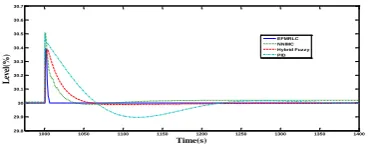
gives satisfied performance and fetches minimum ISE error values. But the other controllers show their sluggishness in performance index as tabulated in Table 3 The results predict that a conventional PID and NNIMC exposes deficient performance as compared to EFMRLC.
6. CONCLUSION
This paper, a Enhanced Fuzzy Model Reference Learning Control (EFMRLC) is applied in to a non linear conical tank system. Simulation runs are carried out by considering the EFMRLC algorithm, NNIMC and conventional PID-mode in a closed loop. The results clearly indicate that the incorporation of FMRLC in the control loop in spherical tank system provides a superior tracking performance than the NNIMC and conventional PI mode.
500 550 600 650 700 750 800 850 900 950 1000
24 25 26 27 28 29 30 31 32
Time(s)
Le
ve
l(%) EFMRLC
[image:5.595.69.254.321.390.2]NNIMC Hybrid Fuzzy PID
Figure 4. Servo Response of conical tank at operating
point1
1000 1050 1100 1150 1200 1250 1300 1350 1400 29.8
29.9 30 30.1 30.2 30.3 30.4 30.5 30.6 30.7
Time(s)
Le
ve
l(%)
EFMRLC NNIMC Hybrid Fuzzy PID
Figure 5. Regulatory Response of conical tank at
operating point1
REFERENCES
[1] Anandanatarajan and M.Chidambaram.”Experimental
evaluation of a controller using variable tansformation on a hemi-spherical tank level process”, Proceedings of National Conference NCPICD , pp. 195-200,2005.
[2] Ya-Gang Wang, Hui-He Shao, “Optimal tuning for PIcontroller”, Automatica, vol.36, pp.147-152, 2000. [3] T.J.Procyk, H.Mamdani, “A Linguistic self-organizing process controller”, Automatica, vol. 15, pp.15-30, 1979. [4] K.L.Tang , R.J. Mulholland, “Comparing fuzzy logic with classical controller design” , IEEE Transaction on systems, Manan cybernetics ,vol.17 , pp.1085-1087,1987
[5] Isabelle Rivals. “Nonlinear internal model control using neural networks application to processes with delay and design issues”,IEEE Transaction on Neural Networks, Vol.11, No.1, pp. 80-90, Jan 2000.
[6] Hunt K J.. “Neural networks for nonlinear internal model control”,IEE.Pro-D, Vol.138, No.5, pp. 431-438, May 1991. [7] R.Boukezzoula, S.galichet and L.Foulloy. “Nonlinear internal model control: application of inverse model based fuzzy control”, IEEE Trans.Fuzzy System, Vol.11, No.6, pp. 814-829, Dec 2003.
[8] Adrian-Vasile Duka, Stelian Emilian Oltean, Mircea Dulău
“model reference adaptive vs. learning control for the inverted pendulum. comparative case study” CEAI, Vol. 9, No. 3;4, pp.67-75, 2007
[9] Scott C. Brown,Kevin M. Passino,”Intelligent Control for an Acrobot”, Journal of Intelligent and Robotic Systems Vol. 18,No. 3, March 1997,pp. 209-248.
[10] Jeffery R. Layne, Kevin M. Passino, “Fuzzy Model Reference Learning Control for Cargo Ship Steering”. IEEE Control Systems Magazine, Vol. 13, Dec. 1993, pp. 23-34. [11] Ramesh sekar and Abraham Lincon Srinivasan, "Fuzzy Based Learning Control for Shall and Tube HeatExchanger Process.", Australian Journal of Basic and
Applied Sciences, Volume 8, Number 17, Nov 2014, pp.
[image:5.595.69.254.439.513.2]