Combinatorial Solutions Providing Improved Security for the
Generalized Russian Cards Problem
Colleen M. Swanson and Douglas R. Stinson∗ David R. Cheriton School of Computer Science
University of Waterloo
Waterloo, Ontario N2L 3G1, Canada
July 3, 2012
Abstract
We present the first formal mathematical presentation of the generalized Russian cards problem, and provide rigorous security definitions that capture both basic and extended versions of weak and perfect security notions. In the generalized Russian cards problem, three players, Alice, Bob, and Cathy, are dealt a deck of n cards, each givena, b, and c cards, respectively. The goal is for Alice and Bob to learn each other’s hands via public communication, without Cathy learning the fate of any particular card. The basic idea is that Alice announces a set of possible hands she might hold, and Bob, using knowledge of his own hand, should be able to learn Alice’s cards from this announcement, but Cathy should not. Using a combinatorial approach, we are able to give a nice characterization of informative strategies (i.e., strategies allowing Bob to learn Alice’s hand), having optimal communication complexity, namely the set of possible hands Alice announces must be equivalent to a large set oft−(n, a,1)-designs, where t = a−c. We also provide some interesting necessary conditions for certain types of deals to be simultaneously informative and secure. That is, for deals satisfying c =a−dfor somed≥2, whereb≥d−1 and the strategy is assumed to satisfy a strong version of security (namely perfect (d−1)-security), we show that a = d+ 1 and hence c = 1. We also give a precise characterization of informative and perfectly (d−1)-secure deals of the form (d+ 1, b,1) satisfyingb≥d−1 involvingd−(n, d+ 1,1)-designs.
1
Introduction
Suppose X is a deck of n cards, and we have three participants, Alice, Bob and Cathy. Let
a+b+c=nand suppose that Alice is dealt ahandof acards, Bob is dealt a hand ofbcards and Cathy is dealt a hand ofccards. These hands are random and dealt by some entity external to the scheme. We denote Alice’s hand byHA, Bob’s hand byHB and Cathy’s hand by HC. Of course it must be the case thatHA∪HB∪HC =X. We refer to this as an (a, b, c)-deal of the cards.
For a positive integer t, let Xt denote the set of nt t-subsets of X. An announcement by Alice A is a subset of Xa
. It is required that when Alice makes an announcement A, the hand she holds is one of thea-subsets inA. The goal of the scheme is that, after a deal has taken place
∗
and Alice has made an announcement, Bob should be able to determine Alice’s hand, but Cathy should not be able to determine if Alice holds any particular card not held by Cathy. These notions will be formalized as we proceed. We remark that we focus on the scenario of Bob learning Alice’s hand, although the original version of this problem is for Bob and Alice to learn each other’s hand. We omit the latter case, since for any protocol whereby Bob may learn Alice’s hand, Bob may then announce Cathy’s hand publicly. This second step provides sufficient information for Alice to determine Bob’s hand, without giving Cathy any more information than she previously had.
This problem was first introduced in the case (a, b, c) = (3,3,1) in the 2000 Moscow Mathematics Olympiad. Since then, there have been numerous papers investigating the problem (called the Russian cards problem) and generalizations of it. Some are interested in card deal protocols that allow players to agree on a common secret without a given eavesdropper being able to determine this secret value. This area of research is especially interesting in terms of possible applications to key generation; see, for example [10, 11, 12, 13, 14, 17, 16, 2]. Others are concerned with analyzing variations of the problem using epistemic logic [18, 19, 20, 7]. Duan and Yang [9] and He and Duan [15] consider a special generalization, with n−1 players each dealt ncards, and one player (the intruder) dealt one card; the authors give an algorithm by which a dealer, acting as a trusted third party, can construct announcements for each player. Recently, there have been some papers that take a combinatorial approach [1, 3, 2, 4], which we discuss in some detail in Section 5.
We take a combinatorial point of view motivated by cryptographic considerations. To be spe-cific, we provide definitions based on security conditions in the unconditionally secure framework, phrased in terms of probability distributions regarding information available to the various players (analogous to Shannon’s definitions relating to perfect secrecy of a cryptosystem). In particular, we provide a formal mathematical presentation of the generalized Russian cards problem. We intro-duce rigorous mathematical definitions of security, which in turn allows for systematic and thorough analysis of proposed protocols. We then give necessary conditions and provide constructions for schemes that satisfy the relevant definitions. Here there is a natural interplay with combinatorics.
1.1 Overview of Contributions
The main contributions of our work are as follows:
• We provide a formal mathematical presentation of the generalized Russian Cards problem. In particular, we define an announcement strategy for Alice, which designates a probability distribution on a fixed set of possible announcements A1,A2, . . . ,Am Alice can make. In keeping with standard practice in cryptography (i.e., Kerckhoff’s principle), we assume that Alice’s announcement strategy is public knowledge. Security through obscurity is not consid-ered an effective security method, as secrets are difficult to keep; providing security under the assumption the adversary has full knowledge of the set-up of the given scheme is therefore the goal. This allows us to define thecommunication complexity of the protocol to be log2m
bits, since Alice need only broadcast the index i of her chosen announcement, which is an integer between 1 andm. In order to minimize the communication complexity of the scheme, our goal will be to minimize m, the number of possible announcements.
• We examine necessary and sufficient conditions for a strategy to be informative for Bob, i.e. strategies that allow Bob to determine Alice’s hand. In particular, we give a lower bound on the communication complexitym for informative strategies and provide a nice combinatorial characterization of strategies that meet this bound, which we term optimal strategies.
• We provide the first formal security definitions that account for bothweak andperfectsecurity in an unconditionally secure framework. We remark that current literature focuses on weak security. In addition, we provide simpler, but equivalent combinatorial security conditions that apply when Alice’s strategy is equitable. Here weak and perfect security are defined with respect to individual cards. If a scheme satisfies weak security (which we will term weak 1-security), Cathy should not be able to say whether a given card is held by Alice or Bob; if a scheme satisfies perfect security (which we will term perfect 1-security), each card is equally likely to be held by Alice.
• We use constructions and results from the field of combinatorial designs to explore strategies that are simultaneously informative and perfectly secure; this is especially useful for the case
c = 1. In particular, we analyze the case c = a−2 in detail, and show that strategies for (a, b, a−2)-deals that are simultaneously informative and perfectly secure must satisfyc= 1. We also show a precise characterization betweenSteiner triple systems and (3, n−4,1)-deals.
• We generalize our notions of weak and perfect security, which focus on the probability that individual cards are held by Alice, and consider instead the probability that a given set of cards (of cardinality less than or equal to a) is held by Alice. We consider deals satisfying
c=a−dand achieve parallel results to the c=a−2 case.
1.2 Preliminary Notation and Examples
Alice will choose a set of announcements, sayA1,A2, . . . ,Amsuch that everyHA∈ Xa
is in at least one of them announcements. ForHA∈ Xa
, defineg(HA) ={i:HA∈ Ai}. Alice’sannouncement
strategy, or more simply, strategy, consists of a probability distribution pHA on g(HA), for every
HA∈ Xa
. The set of announcements and probability distributions are fixed ahead of time and they are public knowledge. We will use the phrase (a, b, c)-strategy to denote a strategy for an (a, b, c )-deal. In addition, we will assume without loss of generality thatpHA(i)>0 for alli∈g(HA). To
see this, note that if pHA(i) = 0 for some HA ∈
X a
and i ∈ g(HA), this means Alice will never choose Ai when she holds HA. But since the set of announcements and probability distributions are public knowledge, Cathy also knows this, so there is no reason to have included HA in the announcement Ai.
When Alice is dealt a hand HA ∈ Xa
, she randomly chooses an index i ∈ g(HA) according to the probability distribution pHA. Alice broadcasts the integer i to specify her announcement Ai. Because the set of announcements and probability distributions are fixed and public, the only information that is broadcast by Alice is the indexi, which is an integer between 1 andm. Therefore we define thecommunication complexityof the protocol to be log2mbits. In order to minimize the communication complexity of the scheme, our goal will be to minimize m, the number of possible announcements.
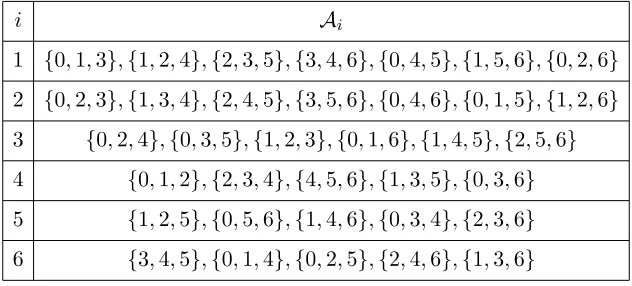
Figure 1: A deterministic (3,3,1)-strategy having a set of six possible announcements
i Ai
1 {0,1,3},{1,2,4},{2,3,5},{3,4,6},{0,4,5},{1,5,6},{0,2,6}
2 {0,2,3},{1,3,4},{2,4,5},{3,5,6},{0,4,6},{0,1,5},{1,2,6}
3 {0,2,4},{0,3,5},{1,2,3},{0,1,6},{1,4,5},{2,5,6}
4 {0,1,2},{2,3,4},{4,5,6},{1,3,5},{0,3,6}
5 {1,2,5},{0,5,6},{1,4,6},{0,3,4},{2,3,6}
6 {3,4,5},{0,1,4},{0,2,5},{2,4,6},{1,3,6}
scheme, for any given hand, there is only one possible announcement that is permitted by the given strategy.
More generally, suppose there exists a constantγ such that |g(HA)|=γ for everyHA. Further, suppose that every probability distributionpHA isuniform, i.e.,pHA(i) = 1/γfor everyHAand for
every i∈g(HA). We refer to such a strategy as aγ-equitable strategy. A deterministic scheme is just a 1-equitable strategy.
Example 1.1. Let X = {0, . . . ,6}. Figure 1 presents a partition of X3
that is due to Charlie Colbourn and Alex Rosa (private communication). This yields a deterministic (3,3,1)-strategy having m= 6 possible announcements.
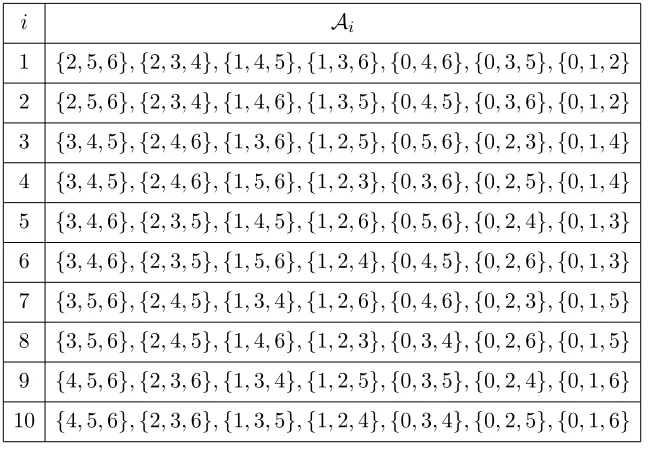
Example 1.2. Let X ={0, . . . ,6}. In Figure 2, we present a set of ten announcements found by Don Kreher (private communication). It can be verified that every 3-subset of X occurs in exactly two of these announcements. Therefore we have a2-equitable(3,3,1)-strategy.
1.3 Organization of the Paper
In Section 2, we study and define the notions of informative, weakly secure, and perfectly 1-secure strategies. In Section 3, we explore strategies that are simultaneously informative and either weakly or perfectly 1-secure, and include an analysis of perfectly 1-secure strategies withc=a−2 in Section 3.1. We present a generalization of the notions of weak and perfect 1-security and analyze the case of perfectly (d−1)-secure strategies satisfying c = a−d in Section 4. We conclude in Section 6.
2
Informative and Secure Strategies
2.1 Strategies that are Informative for Bob
Let’s first consider an (a, b, c)-deal from Bob’s point of view, after hearing Alice’s announcement. Suppose that HB ∈ Xb
and i∈ {1, . . . , m}. Define
Figure 2: An equitable (3,3,1)-strategy having a set of ten possible announcements
i Ai
1 {2,5,6},{2,3,4},{1,4,5},{1,3,6},{0,4,6},{0,3,5},{0,1,2}
2 {2,5,6},{2,3,4},{1,4,6},{1,3,5},{0,4,5},{0,3,6},{0,1,2}
3 {3,4,5},{2,4,6},{1,3,6},{1,2,5},{0,5,6},{0,2,3},{0,1,4}
4 {3,4,5},{2,4,6},{1,5,6},{1,2,3},{0,3,6},{0,2,5},{0,1,4}
5 {3,4,6},{2,3,5},{1,4,5},{1,2,6},{0,5,6},{0,2,4},{0,1,3}
6 {3,4,6},{2,3,5},{1,5,6},{1,2,4},{0,4,5},{0,2,6},{0,1,3}
7 {3,5,6},{2,4,5},{1,3,4},{1,2,6},{0,4,6},{0,2,3},{0,1,5}
8 {3,5,6},{2,4,5},{1,4,6},{1,2,3},{0,3,4},{0,2,6},{0,1,5}
9 {4,5,6},{2,3,6},{1,3,4},{1,2,5},{0,3,5},{0,2,4},{0,1,6}
10 {4,5,6},{2,3,6},{1,3,5},{1,2,4},{0,3,4},{0,2,5},{0,1,6}
P(HB, i) denotes the set ofpossible handsthat Alice might hold, given that Bob’s hand is HB and Alice’s announcement isAi. Alice’s strategy is informative for Bobprovided that
|P(HB, i)| ≤1 (1)
for allHB∈ Xb
and for alli. In this situation, if Bob holds the cards inHB and Alice broadcasts
i, then Bob can determine the set ofacards that Alice holds. If for a particular announcement Ai and any handHB ∈ Xb
, we have |P(HB, i)| ≤ 1, we say thatAi is aninformative announcement. This terminology is in keeping with previous work, which considers protocol characteristics only on the level of individual announcements.
The following result was shown by Albert et al. [1], albeit using different terminology:
Theorem 2.1. The announcement Ai is informative for Bob if and only if there do not exist two
distinct sets HA, HA0 ∈ Ai such that|HA∩HA0 | ≥a−c.
Proof. Suppose there exist two distinct sets HA, HA0 ∈ Ai such that |HA∩HA0 | ≥ a−c. We have that |HA∪HA0 | ≤ 2a−(a−c) = a+c = n−b. Hence, there exists HB ∈ Xb
such that
HB∩(HA∪HA0 ) =∅. Then {HA, HA0 } ⊆ P(HB, i),which contradicts (1).
Conversely, suppose {HA, HA0 } ⊆ P(HB, i), whereHA6=HA0 . Then|HA∪HA0 | ≤n−b=a+c, and hence|HA∩HA0 | ≥a−c.
It follows from Theorem 2.1 that the (3,3,1)-strategies presented in Examples 1.1 and 1.2 are both informative for Bob, because |HA∩HA0 | ≤ 1 whenever HA and HA0 are two distinct sets in the same announcement.
We also have the following necessary condition.
Furthermore, when a > c, we can derive a lower bound on the size of Alice’s announcement.
Theorem 2.3. Suppose a > c and there exists a strategy for Alice that is informative for Bob. Then m≥ n−ca+c
.
Proof. Let X0 ⊆ X where |X0| =a−c. There are precisely n−ca+c a-subsets of X that contain
X0. These a-subsets must occur in different announcements, by Theorem 2.1. Therefore m ≥
n−a+c c
.
In view of the above theorem, an (a, b, c)-strategy for Alice that is informative for Bob is said to beoptimalifm= n−ca+c. We will next give a nice combinatorial characterization of such optimal strategies. First, we require some definitions from design theory.
Definition 2.1. Suppose that t, v, k and λ are positive integers with t ≤ k < v. A t-(v, k, λ )-design is a pair (X,B), where X is a set of v points and B is a multiset of k-element subsets of
X called blocks, such that every subset of t points from X occurs in precisely λ blocks in B. A
t-(v, k, λ)-design, (X,B) is simpleif every block in B occurs with multiplicity one.
In a 2-(v, k, λ)-design, every point occurs in exactlyλ(v−1)/(k−1) blocks and the total number of blocks is λv(v−1)/(k(k−1)).
ASteiner triple system of orderv (denoted STS(v)) is a 2-(v,3,1)-design. It is well-known that an STS(v) exists if and only ifv≡1,3 mod 6, v≥7 (Theorem 4.18 of [6], p. 70).
Definition 2.2. A large setof t-(v, k,1)-designs is a set oft-(v, k,1)-designs,(X,B1), . . . ,(X,BN)
(all of which have the same point set,X), in which everyk-subset ofXoccurs as a block in precisely one of theBis. (Thus, theBis form a partition of Xk
.) It is easy to prove that there must be exactly
N = vk−−tt designs in the large set.
There are v−2 designs in a large set of STS(v); it is known that a large set of STS(v) exists if and only if v≡1,3 mod 6,v≥9 (Theorem 4.24 of [6], p. 70).
Theorem 2.4. Suppose that a > c. An optimal (a, b, c)-strategy for Alice that is informative for Bob is equivalent to a large set of t-(n, a,1)-designs, where t=a−c.
Proof. Suppose there exists a large set of (a−c)-(n, a,1)-designs. Then it is easy to see that this immediately yields an optimal (a, b, c)-strategy for Alice that is informative for Bob.
Conversely, suppose there is an optimal (a, b, c)-strategy for Alice that is informative for Bob. We need to show that every announcement is an (a−c)-(n, a,1)-design. Denote t = a−c and let X0 ⊆ X, |X0| = t. From the proof of Theorem 2.3, the a-subsets containing X0 occur in
n−a+c c
different announcements. However, there are a total of n−ca+c
announcements, so every announcement must contain a block that containsX0.
An optimal (3,3,1)-strategy would have m = 5. From Theorem 2.4, the existence of such a strategy would be equivalent to a large set of five STS(7). As mentioned above, it is known that this large set does not exist. However, from Example 1.1, we obtain a (3,3,1)-strategy for Alice withm= 6 that is informative for Bob. Thus we have proven the following.
2.2 Strategies that are Secure against Cathy
Now we consider security requirements for an (a, b, c)-strategy. Suppose that Alice makes an an-nouncementAiwhile trying to conceal information about her hand from Cathy. Necessarily Alice’s hand is an a-subset in Ai. In fact, Cathy knows that Alice’s hand must be one of the a-subsets in the set P(HC, i) = {HA ∈ Ai : HA∩HC = ∅}. Therefore Cathy does obtain some partial information about Alice’s hand. However, it might be possible to prevent Cathy from determining whether any individual card in X\HC is held by Alice or by Bob. We define two versions of this security property:
Definition 2.3.
1. Alice’s strategy is weakly 1-secure against Cathy provided that, for any announcement i, for anyHC ∈ Xc
such thatP(HC, i)6=∅, and for any x∈X\HC, it holds that
0<Pr[x∈HA|i, HC]<1.
Weak security means that, from Cathy’s point of view, any individual card inX\HC could be
held by either Alice or Bob.
2. Alice’s strategy is perfectly 1-secure against Cathyprovided that for any announcement i, for anyHC ∈ Xc
such thatP(HC, i)6=∅, and for any x∈X\HC, it holds that
Pr[x∈HA|i, HC] =
a a+b.
Perfect security means that, from Cathy’s point of view, the probability that any individual card in X\HC is held by Alice is a constant. This probability must equal a/(a+b) because
Alice holds aof the a+b cards not held by Cathy.
It is obvious that perfect 1-security implies weak 1-security.
Remark: The conditionP(HC, i)6=∅is included to account for the possibility that an announce-mentiis not compatible with certain hands HC held by Cathy.
The conditions for weak and perfect 1-security depend on the probability distributionspHA and
the possible announcements. We will derive simpler, but equivalent, conditions of a combinatorial nature when Alice’s strategy is equitable. First we state and prove a useful lemma which establishes that in an equitable strategy, from Cathy’s point of view, any handHA∈ P(HC, i) is equally likely.
Lemma 2.6. Suppose that Alice’s strategy is γ-equitable, Alice’s announcement is i, HC ∈ Xc
and HA∈ P(HC, i). Then
Pr[HA|HC, i] = 1
|P(HC, i)|
. (2)
Proof. We have
Pr[HA|HC, i] =
Pr[HA, HC, i] Pr[HC, i]
We can compute
Pr[HA, HC, i] = Pr[HC|HA, i]Pr[i|HA]Pr[HA] = b+1c
c
×
1
γ ×
1 n a
.
Similarly, we have
Pr[HC, i] =
X
HA0 ∈P(HC,i)
Pr[HC|HA0 , i]Pr[i|H 0 A]Pr[H
0 A]
= |P(HC, i)| × 1 b+c
c
×
1
γ ×
1 n a
.
The result follows.
Theorem 2.7. Suppose that Alice’s strategy is γ-equitable. Then the following hold:
1. Alice’s strategy is weakly 1-secure against Cathy if and only if, for any announcement i, for anyHC ∈ Xc
such thatP(HC, i)6=∅, and for any x∈X\HC, it holds that 1≤ |{HA∈ P(HC, i) :x∈HA}| ≤ |P(HC, i))| −1.
2. Alice’s strategy is perfectly1-secure against Cathy if and only if, for any announcementiand for anyHC ∈ Xc
such that P(HC, i)6=∅, it holds that
|{HA∈ P(HC, i) :x∈HA}=
a|P(HC, i)|
a+b
for anyx∈X\HC.
Proof. Since (2) holds, it immediately follows that
Pr[x∈HA|i, HC] =
|{HA∈ P(HC, i) :x∈HA}|
|P(HC, i)|
. (3)
Using Equation (3), we observe that
0< |{HA∈ P(HC, i) :x∈HA}|
|P(HC, i)|
<1
holds if and only if
1≤ |{HA∈ P(HC, i) :x∈HA}| ≤ |P(HC, i)| −1. This gives the first condition of the theorem.
Define rx =|{HA∈ P(HC, i) :x∈HA}|. Alice’s strategy is perfectly 1-secure against Cathy if and only if the valuePr[x∈HA|i, HC] is independent ofx. From (3), this occurs if and only ifrx is independent of x. We have that
X
x∈X\HC
rx=a|P(HC, i)|.
Remark: The above characterization of weak 1-security for equitable strategies is equivalent to axiomsCA2 and CA3 in [1]. The characterization of perfect 1-security for equitable strategies is equivalent to axiomCA4 in [3].
It can be verified that the (3,3,1)-strategy in Example 1.2 is perfectly 1-secure against Cathy. However, the (3,3,1)-strategy in Example 1.1 is only weakly 1-secure against Cathy.
Here is a sufficient condition for a strategy to be perfectly 1-secure against Cathy.
Lemma 2.8. Suppose that each announcement in an equitable (a, b,1)-strategy is a 2-(n, a, λ) -design. Then the strategy is perfectly 1-secure against Cathy.
Proof. Given an announcement Ai and a pointx, there are
λ
n(n−1)
a(a−1) −
n−1
a−1
blocks in Ai that do not containx. Each of the points inX\{x}is contained in precisely
λ
n−1
a−1 −1
of these blocks.
3
Simultaneously Informative and Secure Strategies
In general, we want to find an (a, b, c)-strategy (for Alice) that is simultaneously informative for Bob and (perfectly or weakly) 1-secure against Cathy.
The following was first shown by Albert et al. [1] using a different proof technique:
Theorem 3.1. If a ≤c+ 1, then there does not exist a strategy for Alice that is simultaneously informative for Bob and weakly 1-secure against Cathy.
Proof. In view of Corollary 2.2, we only need to consider the case a = c+ 1. In this case, any two a-subsets in an announcement must be disjoint, by Theorem 2.1. For any announcement Ai and any x ∈X, the definition of weak 1-security necessitates the existence of a block in Ai that containsx. It therefore follows that everyAi forms a partition ofX inton/ablocks.
Now, suppose that Alice’s announcement is Ai and Cathy’s hand is HC. There exists at least one HA ∈ Ai such that HA∩HC 6= ∅. Now, |HC|<|HA|, so there is a point x ∈HA\HC. The existence of this point violates the requirement of weak 1-security.
Theorem 3.2. Suppose (a, b, c) = (3, n−4,1), where n≡1,3 mod 6, n >7. Then there exists an optimal strategy for Alice that is informative for Bob and perfectly 1-secure against Cathy.
Proof. If n ≡ 1,3 mod 6, n > 7, then there exists a large set of disjoint STS(n) on an n-set X. Theorem 2.4 establishes that the resulting strategy is informative for Bob, because no announcement
In the casen= 7, there does not exist a large set of STS(7), so we cannot construct an optimal (3,3,1)-strategy. However, Example 1.2 provides us with an equitable strategy with m = 10 and
γ = 2 that is informative for Bob and perfectly 1-secure against Cathy. This is because every announcement in this strategy is an STS(7) and every 3-subset occurs in exactly two announce-ments. Examples from the literature for this case typically only provide weak 1-security. Atkinson et al. [3] give a solution for the perfect 1-security case that requires a much larger communication complexitym and also involves a complicated procedure in order to avoid card bias.
Next, we give a general method of obtaining equitable strategies from a single “starting design”. First we require some definitions.
Definition 3.1. Suppose that D = (X,B) is a t-(v, k, λ)-design. An automorphism of D is a permutation π of X such that π fixes the multiset B. The collection of all automorphisms of D is denoted Aut(D); it is easy to see that Aut(D) is a subgroup of the symmetric group SX.
Theorem 3.3. Suppose that D= (X,B) is a t-(n, a,1)-design with t=a−1. Then there exists a
γ-equitable(a, n−a−1,1)-strategy withmannouncements that is informative for Bob and perfectly
1-secure against Cathy, where γ=n!/|Aut(D)|and m=γ(n−t).
Proof. Let the symmetric group Sn act on D. We obtain a set of designs isomorphic to D. Every one of these designs is a 2-design becausea≥3, so the resulting scheme is perfectly 1-secure against Cathy by Lemma 2.8. Every design is also an (a−1)-design with λ= 1, so Theorem 2.1 implies the scheme is informative for Bob.
Finally, every block is in n!/|Aut(D)| of the resulting set of designs and the total number of designs is equal toγ(n−a+ 1).
Example 3.1. It is known that there is a3-(8,4,1)-design having an automorphism group of order
1344. (See, for example, result 13 of Section 1.4 of Dembowski [8].) Theorem 3.3 thus yields a 30-equitable (4,3,1)-strategy with 150 announcements that is informative for Bob and perfectly
1-secure against Cathy. However, in this particular case, we can do better. Don Kreher (private communication) has found a set of ten 3-(8,4,1)-designs on a set of points X = {0, . . . ,7} such that every 4-subset of X occurs in exactly two of these designs. Therefore we have a 2-equitable
(4,3,1)-strategy with ten announcements that is informative for Bob and perfectly1-secure against Cathy. The set of 3-(8,4,1)-designs can be constructed as follows: Begin with a 3-(8,4,1)-design having the following set A0 of 14 blocks:
{3,4,5,6},{2,5,6,7},{2,3,4,7},{1,4,5,7},{1,3,6,7},{1,2,4,6},{1,2,3,5},
{0,4,6,7},{0,3,5,7},{0,2,4,5},{0,2,3,6},{0,1,5,6},{0,1,3,4},{0,1,2,7}.
Define the permutation π= (0,1)(2)(3,4,6,7,5)and let π (and its powers) act onA0.
3.1 Strategies with c=a−2
Consider an (a, b, c)-deal and a corresponding announcement Ai. For any point x ∈ X, we define theblock neighborhood of x with respect toAi, denotedBi
x, to be Bxi ={HA∈ Ai :x∈HA} and theneighborhood ofx with respect toAi, denoted Ni(x), to be
Ni(x) =
[
HA∈Bxi
HA
\{x}.
For ease of notation, if the choice ofAi is understood from context, we sometimes write Gfor Gi,
N(x) for Ni(x), and Bx forBxi.
We can also extend these notions as follows. Define Bx1,...,xi t ={HA ∈ Ai : x1, . . . , xt ∈HA}. That is, we say Bx1,...,xi t is the block neighborhood of the set {x1, . . . , xt}. Similarly, define the
neighborhood ofx1, . . . , xt, denoted N(x1, . . . , xt)i, to be
N(x1, . . . , xt)i =
[
HA∈Bxi1,...,xt
HA
\{x1, . . . , xt}.
If iis understood from context, we refer toBx1,...,xt and N(x1, . . . , xt).
We begin with a preliminary lemma concerning block neighborhoods. A simple consequence of an (a, b, a−2)-strategy being informative is that the intersection of any two distinct block neighborhoods has cardinality less than one.
Lemma 3.4. Consider an(a, b, c)-deal such thata−c= 2 and a corresponding announcementAi.
Suppose that Alice’s strategy is informative for Bob. Then for any distinct x, y ∈ X, there is at most one hand HA∈ Ai such thatx, y∈HA. That is, |Bx∩By| ≤1.
Proof. This follows directly from Theorem 2.1.
An interesting question concerns which hands are possible (i.e., occur with probability greater than zero) for Cathy for any given announcementAi. The following lemma shows that Cathy may hold a subset of any hand HA that appears in Ai. We will then extend this result to show that Cathy’s hand may consist of a subset of size c−1 from any hand HA appearing in Ai, together with another card z /∈HA.
Lemma 3.5. Consider an (a, b, c)-deal such that a−c = 2 and a corresponding announcement
Ai. Suppose that Alice’s strategy is informative for Bob and weakly 1-secure against Cathy. Let
HA∈ Ai and Y ⊂HA satisfying |Y|=c. Then P(Y, i)6=∅.
Proof. We proceed by contradiction. Write HA = {x1, . . . , xa} and Y = {x1, . . . , xc}. Suppose
P(Y, i) = ∅. Then every hand of Ai intersects Y. In particular, by Lemma 3.4, every hand in Ai (excluding HA) contains exactly one element of Y.
Now, since Alice’s strategy is weakly 1-secure against Cathy, there must be some HA0 ∈ Ai such that HA0 6=HA. By the above argument, |HA0 ∩Y|= 1. Suppose, without loss of generality, HA0
containsx1. We will now use the existence ofHA0 to construct a possible hand for Cathy that would imply Alice holdsx1.
DefineY0 ={x2, . . . , xa−1}, so|Y0|=c. ThenP(Y0, i) consists of all the blocks inAi containing
x1 (except for HA). In particular, HA0 ∈ P(Y0, i), so this set is nonempty, and therefore Y0 is a possible hand for Cathy. But if Cathy holdsY0, Alice must holdx1, which contradicts the security
Before we generalize Lemma 3.5, we will need the following result, which shows that, given a particular announcementAi and choice of card x, at least two hands in Ai must contain x and at least two hands in Ai must not contain x. We remark that Albert et al. [1] show a related result, namely that given an informative and weakly 1-secure announcement, each card must appear in at leastc+ 1 hands.
Lemma 3.6. Consider an(a, b, c)-deal such thata−c= 2 and a corresponding announcementAi. Suppose that Alice’s strategy is informative for Bob and weakly 1-secure against Cathy. Suppose
x∈X. Then there are at least two hands of Ai containing x and at least two hands of Ai that do
not contain x.
Proof. We proceed by contradiction. We first show there existHA, HA0 ∈ Ai which containx. Now, there must be some HA ∈ Ai satisfying x ∈ HA, as otherwise x is not held by Alice. Suppose all other hands of Ai do not contain x. By Lemma 3.5, we may pick Y ⊂ HA, |Y| = c, where
P(Y, i) 6=∅. That is, Y is a possible hand for Cathy. But since HA∈ P/ (Y, i), there must be some otherHA0 ∈ Ai such thatx∈HA0 . Otherwise, if Cathy holdsY, then Cathy knowsx is not held by Alice.
We show in a similar fashion there exist HA, HA0 ∈ Ai which do not contain x. There must be someHA∈ Ai satisfying x /∈HA, as otherwise x must be held by Alice. Suppose all other hands of Ai contain x. By Lemma 3.5, we may pick Y ⊂HA, |Y|=c, where P(Y, i)6=∅. That is, Y is a possible hand for Cathy. But since HA∈ P/ (Y, i), there must be some other HA0 ∈ Ai such that
x /∈HA0 . Otherwise, if Cathy holds Y, then Cathy knows xis held by Alice.
Lemma 3.7. Consider an (a, b, c)-deal such that a−c = 2. Suppose that Alice’s strategy is informative for Bob and weakly 1-secure against Cathy. Let HA ∈ Ai and Y ⊂ HA satisfying
|Y|=c−1. Let z∈X such that z /∈HA. Then P(Y ∪ {z}, i)6=∅.
Proof. We proceed by contradiction. Write HA = {x1, . . . , xa} and Y ={x1, . . . , xc−1}. Suppose P(Y ∪ {z}, i) =∅. Then every hand of Ai intersectsY ∪ {z}. In particular, by Lemma 3.4, every hand inAi (excludingHA) contains at most one element ofY.
Now, by Lemma 3.6, there must be some HA0 ∈ Ai such thatHA0 6=HA and z /∈HA0 . By the above argument, |HA0 ∩(Y ∪ {z})|= 1. Suppose, without loss of generality, HA0 contains x1. We
will now use the existence ofHA0 to construct a possible handY0 for Cathy that would imply Alice holds x1.
Define Y0 ={x2, . . . , xc, z}=Y ∪ {z} ∪ {xc}, so |Y0|=c. Here we includexc∈Y0 for technical reasons. We want |Y0|=cand we need HA0 ∩Y0 =∅, which we have since Lemma 3.4 implies the elements x1, xc cannot both be inHA0 .
Then P(Y0, i) consists of all the blocks in Ai that do not contain x2, . . . , xc, orz. This implies
the elements of P(Y0, i) must contain x1, since every hand of Ai necessarily intersects Y ∪ {z}. Since HA0 ∈ P(Y0, i), we have that this set is nonempty, soY0 is a possible hand for Cathy. But if Cathy holds Y0, Alice must hold x1, which contradicts the security assumption.
We remark that it is possible to use the above results to show that any hand is actually possible for Cathy in this case. That is, consider an (a, b, c)-strategy such thata−c= 2, which is informative for Bob and weakly 1-secure against Cathy. Given an announcement Ai and a hand HC ∈ Xc
We are now ready to show one of our main results concerning the special casec=a−2. Namely, any (a, b, a−2)-strategy that is informative, equitable, and perfectly 1-secure also satisfiesc= 1:
Theorem 3.8. Consider an (a, b, c)-deal such that a−c = 2. Suppose that Alice’s strategy is equitable, informative for Bob, and perfectly 1-secure against Cathy. Then a= 3 and hence c= 1.
Proof. Consider an announcement Ai. Suppose HA = {x1, . . . , xa} ∈ Ai. First note that a ≥3, sincec≥1 anda−c= 2.
Let Bx1 be the block neighborhood of x1 and suppose |Bx1|=r. Let Bx2 be the block neigh-borhood of x2 and suppose|Bx2|=s. By Lemma 3.6, we have r, s≥2.
Set HC ={x3, . . . , xa}. By Lemma 3.5, we haveP(HC, i)6=∅. Then we have (by Lemma 3.4),
|Bx1\BHC|=r−1 and|Bx2\BHC|=s−1. By Theorem 2.7, we have|Bx1\BHC|=|Bx2\BHC|, so
r=s.
Now considerzsuch thatz∈N(x1). We showz∈N(x2) as well. For the casec= 1, Lemma 3.5
implies we may setHC ={z}. Then ifz /∈N(x2), by Lemma 3.4, we would have|Bx1\BHC|=r−1
and|Bx2\BHC|=s. By Theorem 2.7, we haver−1 =s, a contradiction sincer=s. It now suffices
to consider a ≥ 4. Set HC = {x4, . . . , xa, z}; by Lemma 3.7, we have P(HC, i) 6= ∅, so HC is a possible hand for Cathy. If z /∈ N(x2), by Lemma 3.4, we would have |Bx1\BHC| = r−2 and |Bx2\BHC| = s−1. But by Theorem 2.7, we have r −2 = s−1, a contradiction since r = s.
Thereforez∈N(x2).
Suppose HA0 = {z1, . . . , za−1, x1} ∈ Bx1, where HA0 6= HA, and set HC = {z1, . . . , za−2}. By
Lemma 3.4,|Bx1\BHC|=r−1. By the above argument,z1, . . . , za−2∈N(x2) and by Lemma 3.4,
these points occur in different blocks of x2 and each point occurs exactly once. So |Bx2\BHC|=
s−(a−2). By Lemma 3.5, we have P(HC, i) 6= ∅. So by Theorem 2.7, we have |Bx1\BHC| = |Bx2\BHC|, sor−1 =s−a+ 2. Since we also haver =s, this impliesa= 3, as desired.
In light of Theorem 3.8, we now focus on (3, n−4,1)-strategies that are equitable and perfectly 1-secure. Given this special case, the stronger security assumption allows us to state some useful results concerning the neighborhoods of particular cards. We first show that any two points must have a common neighbor, which provides the basis for a much stronger result concerning neighbor-hoods. In fact, the neighborhoods of any two distinct points (minus the points themselves) are the same. The next two lemmas are the final ingredients needed for our second main result, namely that announcements in such strategies are necessarilySteiner triple systems.
Lemma 3.9. Suppose (a, b, c) = (3, n−4,1) and fix a corresponding announcement Ai. Suppose
that Alice’s strategy is equitable, informative for Bob, and perfectly 1-secure against Cathy. Then for any distinct x, y∈X, there exists z∈X such thatz∈N(x)∩N(y).
Proof. We proceed by contradiction. Let x, y∈X and suppose N(x)∩N(y) =∅. We proceed by using a combination of Lemma 3.4 and the results of Theorem 2.7 to count and compare the size of the block neighborhoods ofx andy in light of possible hands for Cathy. Recall that, from Cathy’s point of view, the block neighborhoods of x andy must have the same size.
LetBxbe the block neighborhood ofxand suppose|Bx|=r. LetBy be the block neighborhood of y and suppose|By|=s. From Lemma 3.6, we haver, s≥2.
Thus, there must be some`∈N(x) such that` /∈N(y). By Lemma 3.5, we may setHC ={`}. Consider Bx\BHC. By Lemma 3.4 and since `∈N(x), we see that |Bx\BHC|=|Bx| −1 =r−1.
Since ` /∈ N(y), we have |By\BHC|= s. Then since Alice’s strategy is perfectly 1-secure against
Similarly, we have some`0 ∈N(y) such that `0 ∈/ N(x). By Lemma 3.5, we may setHC ={`0}. By the same argument as above, we have|By\BHC|=|By| −1 =s−1 and |Bx\BHC|=r. Since |Bx\BHC|=|By\BHC|, we conclude s=r+ 1.
Thus we have a contradiction.
Lemma 3.10. Suppose (a, b, c) = (3, n −4,1) and and fix a corresponding announcement Ai.
Suppose that Alice’s strategy is equitable, informative for Bob, and perfectly 1-secure against Cathy. Then for any distinct x, y∈X, we have N(x)\{y}=N(y)\{x}.
Proof. Letx, y∈X be distinct. Let Bx be the block neighborhood ofx and suppose|Bx|=r. Let
By be the block neighborhood of y and suppose |By|=s. From Lemma 3.6, we have r, s≥2. We use a technique similar to that used in the proof of Lemma 3.9, i.e., counting and comparing the sizes of block neighborhoods.
By Lemma 3.9, there existsz∈Xsuch thatz∈N(x)∩N(y). We observe that, by Lemma 3.5, we may setHC ={z}. Then we have (by Lemma 3.4)|Bx\BHC|=r−1 and |By\BHC|=s−1.
By Theorem 2.7, we have |Bx\BHC|=|By\BHC|, sor=s.
We proceed by contradiction. First suppose there is `6=x, ysuch that `∈N(x) but ` /∈N(y). By Lemma 3.5, we may set HC = {`}. We then have (by Lemma 3.4) |Bx\BHC| = r−1 and |By\BHC| = s. By Theorem 2.7, we have |Bx\BHC|= |By\BHC|, so s= r−1, a contradiction.
This implies thatN(x)\{y} ⊆N(y)\{x}.
Now suppose there there is `0 6=x, y such that `0 ∈ N(y) but `0 ∈/ N(x). We observe that, by Lemma 3.5, we may setHC ={`0}. We then have (by Lemma 3.4)|Bx\BHC|=r and |By\BHC|=
s−1. By Theorem 2.7, we have|Bx\BHC|=|By\BHC|, so r=s−1, a contradiction. This implies
thatN(y)\{x} ⊆N(x)\{y}.
Theorem 3.11. Suppose (a, b, c) = (3, n−4,1) and suppose that Alice’s strategy is equitable, informative for Bob, and perfectly 1-secure against Cathy. Then every announcement is a Steiner triple system.
Proof. Fix an (a, b, c)-deal and suppose Alice’s strategy is equitable, informative for Bob, and perfectly 1-secure against Cathy. Consider a corresponding announcementAi. Then in particular, each hand ofAi has size 3.
We first observe that Lemma 3.4 implies that any pair x, y∈X occurs in at most one hand of
Ai. It remains to show that any pairx, y∈X occurs in exactly one hand ofAi.
Let x, y ∈ X. By Lemma 3.9, there is some point z ∈ X such that z ∈ N(x)∩N(y). In particular, x ∈ N(z). By Lemma 3.10, we have N(z)\{y} = N(y)\{z}. Since z ∈ N(y), we see that N(z)\{y} ∪ {z}=N(y). Butx6=y, zand x∈N(z), so we havex∈N(y). This gives us the desired result.
We present an interesting example in the case a= 4, c= 2.
Example 3.2. It was proven by Chouinard [5] that there is a large set of 2-(13,4,1)-designs. There are 112
= 55designs in the large set. This yields a deterministic(4,7,2)-strategy that is informative for Bob. We can easily determine the security of the scheme against Cathy. Suppose that Alice’s announcement is Ai and Cathy’s hand is HC ={y, z}. There is a unique block inAi that contains
of six blocks. Within these six blocks,w and x occur three times, and every point inX\{w, x, y, z}
occurs twice. Therefore, we have
Pr[w∈HA|HC] =Pr[x∈HA|HC] = 1 2
and
Pr[u∈HA|HC] = 1 3
for all u ∈ X\{w, x, y, z}. If a (4,7,2)-strategy were perfectly 1-secure against Cathy (which is impossible, in view of Theorem 3.8), we would havePr[u∈HA|HC] = 4/11 for all u∈X\HC.
4
Generalized Notions of Security
We may generalize the definitions of weak and perfect 1-security to weak and perfectδ-security in the natural way.
Definition 4.1. Let 1≤δ ≤a.
1. Alice’s strategy is weaklyδ-secure against Cathyprovided that for anyδ0 such that1≤δ0 ≤δ, for any announcementi, for any HC ∈ Xc
such thatP(HC, i)=6 ∅, and for anyx1, . . . , xδ0 ∈
X\HC, it holds that
0<Pr[x1, . . . , xδ0 ∈HA|i, HC]<1.
Weak security means that, from Cathy’s point of view, any set of δ or fewer elements from
X\HC may or may not be held by Alice.
2. Alice’s strategy is perfectly δ-secure against Cathy provided that for any δ0 such that 1 ≤
δ0 ≤ δ, for any announcement i, for any HC ∈ Xc
such that P(HC, i) 6= ∅, and for any
x1, . . . , xδ0 ∈X\HC, it holds that
Pr[x1, . . . , xδ0 ∈HA|i, HC] =
a δ0
a+b δ0
.
Perfect security means that, from Cathy’s point of view, the probability that any set of δ or fewer cards fromX\HC is held by Alice is a constant.
It is obvious that perfect δ-security implies weak δ-security.
Remark: The conditionP(HC, i)6=∅is included to account for the possibility that an announce-mentiis not compatible with certain hands HC held by Cathy.
The conditions for weak and perfect δ-security depend on the probability distributions pHA
and the possible announcements. As before, we will derive simpler, but equivalent, conditions of a combinatorial nature when Alice’s strategy is equitable.
Theorem 4.1. Suppose that Alice’s strategy is γ-equitable. Then the following hold:
1. Alice’s strategy is weaklyδ-secure against Cathy if and only if, for anyδ0 such that1≤δ0 ≤δ, for any announcementi, for any HC ∈ Xc
such thatP(HC, i)=6 ∅, and for anyx1, . . . , xδ0 ∈
X\HC, it holds that
2. Alice’s strategy is perfectlyδ-secure against Cathy if and only if, for any announcementiand for anyHC ∈ Xc
such that P(HC, i)6=∅, it holds that
|{HA∈ P(HC, i) :x1, . . . , xδ ∈HA}|= a δ
|P(HC, i)| a+b
δ
for anyx1, . . . , xδ∈X\HC.
Proof. Let 1≤δ0 ≤δ.
Since (2) (from Lemma 2.6) holds, it immediately follows that
Pr[x1, . . . , xδ0 ∈HA|i, HC] =
|{HA∈ P(HC, i) :x1, . . . , xδ0 ∈HA}|
|P(HC, i)|
. (4)
Using Equation (4), we observe that
0< |{HA∈ P(HC, i) :x1, . . . , xδ0 ∈HA}|
|P(HC, i)|
<1
holds if and only if
1≤ |{HA∈ P(HC, i) :x1, . . . , xδ0 ∈HA}| ≤ |P(HC, i)| −1.
This gives the first condition of the theorem.
For the second condition of the theorem, we first remark that, if the given security property holds for δ, it will automatically hold for δ0 such that 1 ≤ δ0 ≤ δ. This is because the security property for δ says that every δ-subset occurs the same number of times within a certain set of blocks of size|P(HC, i)|. That is, we have at-design with t=δ. It is a standard result that every
t-design is at0-design for all t0 ≤t. Thus it suffices to show that, for any announcement iand for any HC ∈ Xc
such thatP(HC, i)6=∅, and for any x1, . . . , xδ∈X\HC, then
|{HA∈ P(HC, i) :x1, . . . , xδ∈HA}|= a δ
|P(HC, i)| a+b
δ
holds if and only if
Pr[x1, . . . , xδ∈HA|i, HC] = a δ
a+b δ
.
Define rx1,...,xδ = |{HA ∈ P(HC, i) : x1, . . . , xδ ∈ HA}|. Alice’s strategy is perfectly δ-secure
against Cathy if and only if the value Pr[x1, . . . , xδ ∈ HA|i, HC] is independent of the δ-subset
{x1, . . . , xδ}. From (4), this occurs if and only ifrx1,...,xδ is independent of theδ-subset{x1, . . . , xδ}.
We have that
X
D∈(X\HC
δ )
rD =
a δ
|P(HC, i)|.
There are a+δb
terms rD in the above sum. These terms are all equal if and only if they all have the valuer = aδ
|P(HC, i)|/ a+δb
Lemma 4.2. Suppose that each announcement in an equitable (a, b,1)-strategy is a t-(n, a, λ) -design. Then the strategy is perfectly (t−1)-secure against Cathy.
Proof. Given an announcement Ai and a pointx, there are
λ
n t
a t
−
n−1
t−1
a−1
t−1
!
blocks inAi that do not containx. For any subsetS={x1, . . . , xs−1} ⊂X\{x}of sizes−1, where
1≤s≤t, the subset S is contained in precisely
λ
n−s+1
t−s+1
a−s+1
t−s−1
−
n−s a−s
a−s t−s
!
of these blocks.
Remark 4.1. Lemma 4.2 is a generalization of Lemma 2.8.
Lemma 4.2 immediately implies the following:
Corollary 4.3. The construction method given in Theorem 3.3, which shows how to obtain an equitable strategy from a single starting t−(n, a,1)-design, where t=a−1, yields a strategy that is perfectly (a−2)-secure.
4.1 Strategies with c=a−d
In this section, we generalize the results of Section 3.1. That is, we consider the case of (a, b, a−d )-deals that are simultaneously informative for Bob and perfectly (d−1)-secure against Cathy. Where possible, we weaken our assumption that the strategy is equitable and satisfies perfect (d− 1)-security to achieve the given result. We do assume that the strategies discussed are informative throughout.
Although the results of Section 3.1 are subsumed by the parallel results of this section, we feel it is useful to include both. Section 3.1 provides a good basis for understanding the results of this section; the proofs of the generalized results are much more technical and complicated than those for the simple case wherec =a−2. For readability, we include a list of correspondences between the results of these two sections:
Result in Section 3.1 Corresponding Result in Section 4.1
Lemma 3.4 Lemma 4.4
Lemma 3.5 Lemma 4.5
Lemma 3.6 Lemma 4.6
Lemma 3.7 Lemma 4.7
Theorem 3.8 Theorem 4.8 Lemmas 3.9, 3.10 Lemma 4.9
Theorem 3.11 Theorem 4.10
strategies are necessarily d-(n, d+ 1,1) designs. To achieve these results, however, we do need an additional assumption; namely thatbis sufficiently large. As we will see, taking b≥d−1 suffices. We do not know if this assumption is necessary, however.
Lemma 4.4. Consider an(a, b, c)-deal such thata−c=d, and a corresponding announcementAi.
Suppose that Alice’s strategy is informative for Bob. Then for any distinct x1, . . . , xd∈X, there is
at most one handHA∈ Ai such that x1, . . . , xd∈HA. That is, |Bx1,...,xd| ≤1.
Proof. This follows directly from Theorem 2.1.
Lemma 4.5. Consider an (a, b, c)-deal such that a−c = d and b ≥ d−1. Fix a corresponding announcement Ai. Suppose that Alice’s strategy is informative for Bob and weakly (d−1)-secure against Cathy. Let HA∈ Ai and Y ⊂HA satisfy |Y|=c. Then P(Y, i)6=∅.
Proof. We proceed by contradiction. Write HA = {x1, . . . , xa} and Y = {x1, . . . , xc}. Suppose
P(Y, i) =∅. Then every hand ofAi intersectsY.
Now, since Alice’s strategy is weakly (d−1)-secure against Cathy, there must be someHA0 ∈ Ai such thatHA0 6=HA. By the above argument, |HA0 ∩Y| ≥1.
Suppose |HA0 ∩Y|=`0 and |HA∩HA0 |=`. Note that `0 ≤`≤d−1 holds by Lemma 4.4 and
`0 ≤cholds by construction. Without loss of generality, assume HA0 containsx1, . . . , x`0.
We now wish to construct a special possible hand for Cathy, sayY0, that will allow us to derive a contradiction. That is, we will construct a Y0 such that HA ∈ P/ (Y0, i), butP(Y0, i) contains a hand HA00 satisfying |HA∩HA00| ≥ d. To ensure Y0 is a possible hand for Cathy, we construct Y0 using elements that do not appear in HA0 , so that HA0 ∈ P(Y0, i) and henceP(Y0, i) is nonempty. For technical reasons, we pick one element z that occurs in HA but not HA0 , and `0−1 elements
z1, . . . , z`0−1 that occur outside of both HA and H0
A, and use these in our construction ofY 0.
Since HA 6= HA0 , there is some z ∈ HA such thatz /∈ HA0 and z is distinct from x`0+1, . . . , xc.
To see this, write `=`0+tfor somet. There ared−telements inHA\(Y ∪HA0 ). Thus d−t≥1 suffices, but necessarily we have t≤`≤d−1. From a technical standpoint, we need such a point
z for the case c= 1; this will ensure that HA∩Y0 6=∅. In addition, we may pick distinct z1, . . . , z`0−1 ∈/ HA∪H0
A. This follows because there are at least a+b+ (a−d)−(2a−`) =b−d+`points not in HA∪HA0 . We have b−d+`≥`0−1 so long as b≥d−1, which is true by assumption.
Define Y0 ={x`0+1, . . . , xc, z1, . . . z`0−1, z}, so|Y0|=c. Then H0
A∈ P(Y0, i) by construction, so this set is nonempty, and thereforeY0 is a possible hand for Cathy. Note also thatHA∈ P/ (Y0, i). Consider the set T ={xc+1, . . . , xa} ⊂HA, which contains delements. Note that at most one of these elements isz, so we may pick a subsetT0⊂T satisfying|T0|=d−1 andT0∩Y0 =∅. Since the scheme satisfies weak (d−1)-security by assumption, T0 ⊂HA00 for some HA00 ∈ P(Y0, i). Note that HA00 6= HA. Now, HA00 must intersect Y (but not Y0), so HA00 must contain an element from
{x1, . . . , x`0}. Suppose (without loss of generality) that H00
A containsx1. Then the set {x1} ∪T0 of
sizedappears in bothHA andHA00, a contradiction.
Lemma 4.6. Consider an (a, b, c)-deal such that a−c = d and b ≥ d−1. Fix a corresponding announcement Ai. Suppose that Alice’s strategy is informative for Bob and weakly (d−1)-secure
against Cathy. SupposeD={x1, . . . , xd−1} ⊂X. Then there are at least two hands ofAi
Proof. We first show there existHA, HA0 ∈ Ai which containD. Now, there must be someHA∈ Ai satisfyingD⊆HA, as otherwiseDis not held by Alice, which contradicts the assumption that the scheme is weakly (d−1)-secure. Suppose all other hands ofAi do not containD. LetY ⊂HAsuch that |Y|= c. By Lemma 4.5, we have P(Y, i) 6=∅; that is, Y is a possible hand for Cathy. But since HA ∈ P/ (Y, i), there must be some other HA0 ∈ Ai such that D⊆ HA0 . Otherwise, if Cathy holds Y, then Cathy knowsD is not held by Alice.
We show in a similar fashion there exist HA, HA0 ∈ Ai which do not contain D. There must be someHA∈ Ai satisfying D*HA, as otherwiseD must be held by Alice. Suppose all other hands ofAi containD. LetY ⊂HA such that|Y|=c. By Lemma 4.5, we haveP(Y, i)6=∅; that is,Y is a possible hand for Cathy. But sinceHA*P(Y, i), there must be some other HA0 ∈ Ai such that
D /∈HA0 . Otherwise, if Cathy holds Y, then Cathy knowsD is held by Alice.
Lemma 4.7. Consider an (a, b, c)-deal such that a−c = d and b ≥ d−1. Fix a corresponding announcement Ai. Suppose that Alice’s strategy is informative for Bob and weakly (d−1)-secure
against Cathy. Let HA ∈ Ai and Y ⊂HA satisfy |Y|=c−1. Let z∈X such that z /∈HA. Then
P(Y ∪ {z}, i)6=∅.
Proof. This result is only interesting forc≥2. The casec= 1 is follows directly from Lemma 4.5, since for anyz∈X, there is some hand in Ai that contains z.
We proceed by contradiction. Write HA = {x1, . . . , xa} and Y = {x1, . . . , xc−1}. Let z ∈ X
such thatz /∈HA. SupposeP(Y ∪ {z}, i) =∅. Then every hand ofAi intersectsY ∪ {z}.
Now, since Alice’s strategy is weakly (d−1)-secure against Cathy, there must be someHA0 ∈ Ai
such that HA0 6= HA and z /∈ HA0 (Lemma 4.6 gives a stronger result). By the above argument,
|HA0 ∩Y| ≥1.
Suppose|HA0 ∩Y|=`0 and|HA∩HA0 |=`. Note that`0 ≤`≤d−1 by Lemma 4.4 and`0 ≤c−1 holds by construction. Without loss of generality, assume HA0 containsx1, . . . , x`0.
We now wish to construct a special possible hand for Cathy, sayY0, that will allow us to derive a contradiction. That is, we will construct a Y0 such that HA ∈ P/ (Y0, i), butP(Y0, i) contains a hand HA00 satisfying |HA∩HA00| ≥ d. To ensure Y0 is a possible hand for Cathy, we construct Y0 using elements that do not appear in HA0 , so that HA0 ∈ P(Y0, i) and henceP(Y0, i) is nonempty. For technical reasons, we pick one element z0 that occurs in HA but not HA0 , and `
0−2 elements
z1, . . . , z`0−2 that occur outside of both HA and H0
A, and use these in our construction ofY0. Since HA6=HA0 , there is some z0 ∈HA such that z0 ∈/ HA0 and z0 is distinct from x`0+1, . . . , xc.
To see this, write ` =`0+t for some t. There are d−t elements in HA\(Y ∪HA0 ∪ {xc}). Thus
d−t≥1 suffices, which holds because t≤`≤d−1 by the security assumption. From a technical standpoint, we need such a pointz0 for the case c= 2; this will ensure that HA∩Y0 6=∅.
In addition, we may pick distinct z1, . . . , z`0−2 ∈/ HA∪H0
A such that zi 6=z for 1≤i≤`0−2. This follows because there are at leasta+b+ (a−d)−(2a−`) =b−d+`points not inHA∪HA0. We have b−d+`≥`0 −1 so long as b ≥d−1, which holds by assumption. (Note that we need
`0−1 points, not `0 −2 points, because z must be distinct from z1, . . . , z`0−2, and all are points
occurring outside ofHA∪HA0 .)
Define Y0 ={x`0+1, . . . , xc, z1, . . . z`0−2, z, z0}, so|Y0|=c. Then H0
A∈ P(Y
Note thatHA00 6=HA. ButHA00 must intersect Y (but not Y0) so HA00 must contain an element from
{x1, . . . , x`0}. Suppose (without loss of generality) H00
Acontains x1. Then the set {x1} ∪T0 of size
dappears in bothHA andHA00, a contradiction.
Theorem 4.8. Consider an (a, b, c)-deal such that a−c=d and b≥d−1. Suppose that Alice’s strategy is equitable, informative for Bob, and perfectly(d−1)-secure against Cathy. Thena=d+1
and hence c= 1.
Proof. We remark that a≥d+ 1, sincec≥1.
Consider an announcement Ai. Suppose HA={x1, . . . , xa} ∈ Ai. Let Bx1,...,xd−1 be the block neighborhood ofx1, . . . , xd−1 and suppose|Bx1,...,xd−1|=r. LetBx2,...,xd be the block neighborhood
of x2, . . . , xd and suppose|Bx2,...,xd|=s. By Lemma 4.6, we have r, s≥2.
Set HC ={xd+1, . . . , xa}. By Lemma 4.5, we have P(HC, i)6=∅, so HC is a possible hand for Cathy. Then we have, by Lemma 4.4, |Bx1,...,xd−1\BHC|= r−1 and|Bx2,...,xd\BHC|=s−1. By
Theorem 4.1, we have |Bx1,...,xd−1\BHC|=|Bx2,...,xd\BHC|, so we concluder =s.
Now consider z such that z ∈ N(x1, . . . , xd−1), but z /∈ HA. We show z ∈ N(x2, . . . , xd) as
well. For the case c= 1, Lemma 4.5 implies we may setHC ={z}. Then if z /∈N(x2, . . . , xd), by Lemma 4.4, we would have |Bx1,...,xd−1\BHC|= r−1 and |Bx2,...,xd\BHC| =s. By Theorem 2.7,
we have r−1 = s, a contradiction since r =s. For c > 1, we may setHC ={xd+1, . . . , xa−1, z}.
By Lemma 4.7, we have P(HC, i) 6=∅, so HC is a possible hand for Cathy. If z /∈N(x2, . . . , xd), by Lemma 4.4, we would have |Bx1,...,xd−1\BHC| = r −2 and |Bx2,...,xd\BHC| = s−1. But by
Theorem 2.7, we have r−2 =s−1, a contradiction since r=s. Thereforez∈N(x2, . . . , xd).
Suppose HA0 ={x1, . . . , xd−1} ∪ {z1, . . . , za−d+1} ∈Bx1,...,xd−1 and setHC ={z1, . . . , za−d}. By Lemma 4.5, we haveP(HC, i)6=∅, soHC is a possible hand for Cathy.
Now, we may pickHA0 6=HA by Lemma 4.6. Then by Lemma 4.4, we have|Bx1,...,xd−1\BHC|=
r−1. By the above argument,z1, . . . , za−d∈N(x2, . . . , xd) and by Lemma 4.4, these points occur in different blocks ofBx2,...,xd and each point occurs exactly once. So|Bx2,...,xd\BHC|=s−(a−d).
So by Theorem 4.1, we have |Bx1,...,xd−1\BHC| =|Bx2,...,xd\BHC|, so r−1 =s−a+d. Since we
also have r=s, this impliesa=d+ 1, as desired.
As before, we can now focus our attention on (d+ 1, b,1)-strategies that are equitable, informa-tive for Bob, and perfectly (d−1)-secure.
Lemma 4.9. Consider a(d+1, b,1)-deal satisfyingb≥d−1and fix a corresponding announcement
Ai. Suppose that Alice’s strategy is equitable, informative for Bob, and perfectly (d−1)-secure
against Cathy. Then for any distinct D, D0 ⊂X satisfying |D|=|D0|=d−1, there exists z∈X
such that z∈N(D)∩N(D0). Moreover,N(D)\{D0}=N(D0)\{D}.
Proof. Let D, D0 ⊂ X satisfy |D| = |D0| = d−1. Let BD be the block neighborhood of D and suppose |BD| = r. Let BD0 be the block neighborhood of D0 and suppose |BD0| = s. From
Lemma 4.6, we haver, s≥2.
As in the proof of Theorem 4.8, suppose there exists`∈N(D) such that` /∈N(D0). We may, by Lemma 4.5, setHC ={`}. Then by Lemma 4.4, we see that|BD\BHC|=r−1 and|BD0\BHC|=s.
Then since Alice’s strategy is perfectly (d−1)-secure against Cathy, by Theorem 4.1, we also have
|BD\BHC|=|BD0\BHC|. This implies s=r−1.
Similarly, suppose we have some `0 ∈N(D0) such that `0 ∈/ N(D). By Lemma 4.5, we may set
HC ={`0}. By the same argument as above, we have |BD0\BH
The above argument implies a contradiction if there exists both`∈N(D) such that` /∈N(D0) and `0∈N(D0) such that`0 ∈/N(D). But ifN(D)∩N(D0) =∅, such an`and `0 must exist, since
r, s≥2. Thus, we conclude that there exists z∈N(D)∩N(D0).
Moreover, by Lemma 4.5, we may setHC ={z}. Then by Lemma 4.4, we see that|BD\BHC|=
r−1 and|By\BHC|=s−1. Then since Alice’s strategy is perfectly (d−1)-secure against Cathy,
by Theorem 4.1, we also have |BD\BHC|=|BD0\BHC|. This implies r =s. But this also implies
that there cannot be `∈N(D) such that` /∈N(D0) or`0 ∈N(D0) such that `0 ∈/ N(D). Thus we concludeN(D)\{D0}=N(D0)\{D}, as desired.
Theorem 4.10. Suppose (a, b, c) = (d+ 1, n−(d+ 2),1) satisfying b ≥ d−1 and suppose that Alice’s strategy is equitable, informative for Bob, and perfectly (d−1)-secure against Cathy. Then every announcement is a d−(n, d+ 1,1)-design.
Proof. Fix an (d+ 1, n−(d+ 2),1)-deal and suppose Alice’s strategy is equitable, informative for Bob, and perfectly (d−1)-secure against Cathy. Consider a corresponding announcementAi. Then in particular, each hand of Ai has orderd+ 1.
We first observe that Lemma 4.4 implies that any set of delements ofX occurs in at most one hand of Ai. It remains to show that D = {x1, . . . , xd} occurs in exactly one hand of Ai for any
x1, . . . , xd∈X.
WriteD0 ={x1, . . . , xd−1}andD00={x2, . . . , xd}. By Lemma 4.9, there existsz∈X satisfying
z∈N(D0)∩N(D00). (Note that this impliesz6=x1, . . . , xd.) That is, there exist handsHA, HA0 ∈ Ai satisfying D0∪ {z} ⊆HA and D00∪ {z} ⊆HA0 .
Also by Lemma 4.9, we have
N(D00)\{z, x2, . . . , xd−1}=N(z, x2, . . . , xd−1)\D00.
This is equivalent to
N(D00)\{z}=N(z, x2, . . . , xd−1)\{xd}.
NowD0∪{z} ⊆HAimpliesx1 ∈N(z, x2, . . . , xd−1). Givenx1 6=z, xd, we concludex1 ∈N(D00).
That is, D=D00∪ {x1} occurs in some hand ofAi, as desired.
Example 4.1. The construction given in Example 3.1 is actually an example of a 2-equitable
(4,3,1)-strategy that is informative for Bob and perfectly 2-secure against Cathy. The fact that the scheme is perfectly 2-secure follows from Lemma 4.2.
5
Discussion and Comparison with Related Work
As mentioned in Section 1, there are have been many papers studying the Russian cards problem and generalizations of it. Here we concentrate on recent work that takes a combinatorial approach [1, 3, 2, 4].
that a good announcement even exists. Our definitions, on the other hand, require that Alice have a (secure) announcement for every possible hand HA ∈ Xa
. In particular, we argue that it is not possible to formally define or discuss the security of a scheme using definitions that focus on individual announcements.
The authors [1] present several useful results, some of which we have cited in this paper, on the relationships between the parametersaandc, and bandc, as well as bounds on the minimum and maximum number of hands in a good announcement. The focus is on the level of announcements throughout: the authors argue that, to minimize information gained by Cathy, the size of the announcement should be maximized. Moreover, the authors show good announcements exist for some special cases, including using block designs for the case (a,2,1), when a ≡ 0,4 (mod 6) (corresponding to the Steiner triple systems), and using Singer difference sets for the case (a, b, c), whereaand c are given, andb is sufficiently large. A few other small cases are also given.
Atkinson and van Ditmarsch [3] extend these notions to include a new axiom, CA4, which roughly corresponds to our notion of perfect 1-security. That is, the authors recognize the possibility of card occurrence bias in a good announcement, which gives Cathy an advantage in guessing Alice’s hand. Axiom CA4 introduces the requirement that, in the set of hands Cathy knows are possible for Alice, each card Cathy does not hold occurs a constant number of times. In this setting, the authors use binary designs to construct a good announcement (also satisfying CA4) for parameters of the form (2k−1,2k−1−1,1), wherek≥3. Atkinson and van Ditmarsch also consider the problem of unbiasing an announcement by applying a protocol that takes the existence of bias into account. An example of two possible methods for achieving this are given for the parameter set (3,3,1). We remark that our approach is much simpler and yields nice solutions for the (3,3,1) case. In particular, we require fewer announcements and thereby less communication complexity.
Albert et al. [2] investigate both the problem of communicating the entire hand (or state infor-mation) and communicating a secret bit. In effect, their notion of card/state safe is similar to our notion of weak 1-security. The analysis includes a sum announcement protocol for the case (k, k,1), where k ≥ 3; that is, both players announce the sum of their cards modulo 2k+ 1. In addition, Albert et al. show thatstate safeimpliesbit safe, and pose the interesting open question of whether a protocol for sharing a secret bit implies the existence of a protocol for sharing states/card deals. Cord`on-Franco et al. [4] focus on the case c = 1, and present a protocol in which Alice and Bob announce the sum of their hands modulo a given (public) integer. The authors deal with the case of the modulus being either n(the size of the deck) or the least prime p larger thann, and show that, by choosing one of these protocols as appropriate, deals of the form (a, b,1) are secure (in the weak 1-secure sense) and informative. That is, Alice and Bob learn each other’s cards, but Cathy does not know any of Alice or Bob’s cards afterwards.
6
Conclusion and Open Problems
is assumed to be perfectly (d−1)-secure, we show thata=d+ 1 and hence c= 1. Moreover, for informative and perfectly (d−1)-secure deals of the form (d+ 1, b,1) satisfying b ≥ d−1, every announcement must necessarily be a d−(n, d+ 1,1)-design.
There are many open problems in the area, especially for deals with c > 1. An interesting question is whether we can achieve generalizations of Theorems 3.11 and 3.8 without assuming (d−1) security. That is, we wish to study the case of deals satisfying c > 1, where perfect 1-security holds. In particular, it is unclear if there even exist protocols that are simultaneously informative for Bob and perfectly 1-secure against Cathy for deals with c >1.
References
[1] Albert, M., Aldred, R., Atkinson, M., van Ditmarsch, H., and Handley, C.: Safe communi-cation for card players by combinatorial designs for two-step protocols. Australasian Journal of Combinatorics, vol. 33, pp. 33–46 (2005)
[2] Albert, M., Cord´on-Franco, A., van Ditmarsch, H., Fernandez-Duque, D., Joosten, J., and Soler-Toscano, F.: Secure communication of local states in interpreted systems. In: Interna-tional Symposium on Distributed Computing and Artificial Intelligence. Advances in Intelli-gent and Soft Computing, vol. 91, pp. 117–124, Springer (2011)
[3] Atkinson, M. and van Ditmarsch, H.: Avoiding bias in cards cryptography. Australasian Journal of Combinatorics, vol. 44, pp. 3–18 (2009)
[4] Cord´on-Franco, A., Ditmarsch, H., Fernandez-Duque, D., Joosten, J., and Soler-Toscano, F.: A secure additive protocol for card players. Available at arXiv:1111.0156, http://arxiv. org/abs/1111.0156.
[5] Chouinard II, L.: Partitions of the 4-subsets of a 13-set into disjoint projective planes. Discrete Mathematics, vol. 45, pp. 297–300 (1983)
[6] Colbourn, C. and Dinitz, J.: The CRC Handbook of Combinatorial Designs. CRC Press (1996)
[7] Cyriac, A. and Krishnan, K. M.: Lower bound for the communication complexity of the Russian cards problem. Available at arXiv:0805.1974, http://arxiv.org/abs/0805.1974.
[8] Dembowski, P.: Finite Geometries. Springer-Verlag, New York (1968)
[9] Duan, Z. and Yang, C.: Unconditional secure communication: a Russian cards protocol. Journal of Combinatorial Optimization, vol. 19, pp. 501–530 (2010)
[10] Fischer, M., Paterson, M., and Rackoff, C.: Secret bit transmission using a random deal of cards. In: DIMACS Series in Discrete Mathematics and Theoretical Computer Science. AMS, vol. 2, pp. 173–181 (1991)
[12] Fischer, M. and Wright, R.: An application of game-theoretic techniques to cryptography. In: DIMACS Series in Discrete Mathematics and Theoretical Computer Science. AMS, vol. 13, pp.99–118 (1993)
[13] Fischer, M. and Wright, R.: An efficient protocol for unconditional secure secret key exchange. In: Proceedings of 4th Annual ACM-SIAM Symposium on Discrete Algorithms (SODA ’93). Society for Industrial and Applied Mathematics, pp. 475–483 (1993)
[14] Fischer, M. and Wright, R.: Bounds on secret key exchange using a random deal of cards. Journal of Cryptology, vol. 9, pp. 71–99 (1996)
[15] He, J., and Duan, Z.: Public communication based on Russian cards protocol: a case study. LNCS, vol. 6831, pp. 192–206 (2011)
[16] Koizumi, K., Mizuki, T., and Nishizeki, T.: Necessary and sufficient numbers of cards for the transformation protocol. In: Computing and Combinatorics 10th Annual International Conference (COCOON 2004). LNCS, vol. 3106, pp. 92–101 (2004)
[17] Mizuki, T., Shizuya, H., and Nishizeki, T.: A complete characterization of a family of key exchange protocols. International Journal of Information Security, vol. 1, pp. 131–142 (2002)
[18] van Ditmarsch, H.: The Russian cards problem. In: The Dynamics of Knowledge. Studia Logica, vol. 75, pp. 31–62 (2003)
[19] van Ditmarsch, H.: The case of the hidden hand. Journal of Applied Non-Classical Logics, vol. 15(4), pp. 437–452 (2005)