Low complexity bit-parallel
GF
(2
m) multiplier
for all-one polynomials
Yin Li1, Gong-liang Chen2, and Xiao-ning Xie
1
Xinyang local taxation bureau, Henan, China. Email:[email protected], 2 School of Information Security Engineering, Shanghai Jiaotong University,
Shanghai, China. Email:[email protected]
Abstract. This paper presents a new bit-parallel multiplier for the finite fieldGF(2m) generated with an irreducible all-one polynomial. Redun-dant representation is used to reduce the time delay of the proposed multiplier, while a three-term Karatsuba-like formula is combined with this representation to decrease the space complexity. As a result, the proposed multiplier requires about 10 percent fewer AND/XOR gates than the most efficient bit-parallel multipliers using an all-one polyno-mial, while it has almost the same time delay as the previously proposed ones.
1
Introduction
The arithmetic operations in GF(2m) are frequently desired in many areas of
computer algebra and public-key cryptosystems [1]. Thus it is necessary to design efficient algorithms for finite field operations such as addition, multiplication, ex-ponentiation, and multiplicative inversion. In particular, efficient design of the multiplier is required by hardware implementation of multiplication, since other time consuming operations such as exponentiation and inversion can be carried out by iterative multiplications. The multiplication in a polynomial basis con-sists of multiplying two polynomials and then reducing the result modulo an irreducible polynomial. The choice of corresponding irreducible polynomial is important to perform the reduction efficiently. The most used irreducible poly-nomials are the all-one polypoly-nomials (AOP) [2, 3] and the sparse polypoly-nomials such as trinomials [4, 5] and pentanomials [5, 6].
In hardware implementation, the efficiency of the architecture is always e-valuated by space and time complexity. The former is expressed as the number of logic gates (XOR and AND) and the latter is expressed as the sum of gates delay of the critical path. Based on the special form of AOP, efficient bit-parallel multipliers are proposed using polynomial basis (PB)[2], normal basis (NB) [3, 7, 8], weakly dual basis [9] and non-conventional basis [10]. These multipliers are known as the most efficient ones among the previous bit-parallel multipliers and require m2 AND gates, m2−1 XOR gates and T
A+ (1 +dlog2(m−1)e)TX
In a recent paper, Chang et al. [15] has proposed a low complexity bit-parallel multiplier for AOP using redundant representation. A redundant representation [16] was derived from the minimal cyclotomic ring. In this case, the fieldGF(2m)
is represented as a subring of a residue class ring F2[x]/(xn+ 1) with n > m.
Advantages of using redundant representation include free squaring operation and elimination of the modular reduction step in the field multiplication. Based on this representation, Chang et al. can apply Karatsuba approach to reduce the space complexity without increasing gates delay. Consequently, with nearly the same time complexity, the proposed multiplier only requires approximately 3/4 gates compared with previous multipliers.
In this paper, we present an improvement of Chang et al. approach. Unlike previous multipliers, we apply a three-term Karatsuba-like formula [17, 18] to the polynomial multiplication which can save even more logic gates. On the other hand, it still maintains a relatively low time complexity with the use of redun-dant representation. In consequence, we can obtain a bit-parallel multiplier with approximately 8/9 gates of Chang et al. multiplier, while the time complexity is TA+ (3 +dlog2m3e)TX. For a large number of AOPs, this delay is equal to TA+ (1 +dlog2(m−1)e)TX which matches the best results.
The rest of this paper is organized as follows: In Section 2, we briefly review the redundant representation forGF(2m) defined by the AOP. Then we propose
a new bit-parallel multiplier architecture using the redundant representation in Section 3. Section 4 presents a comparison between the proposed multiplier and some others. Finally, some conclusions are drawn.
2
Redundant representation
The notion of redundant representation was firstly used by Itoh and Tsujii [16] for design of efficient multiplier. Later, such representation had been applied in many multipliers [19–21]. The idea was to use the minimal cyclotomic ring
F2[x]/(xn+ 1) where the current field can be embedded and the field arithmetic
operations are performed in such ring. If the fieldGF(2m) is generated with an
irreducible AOP, we haven=m+ 1 which has the minimal redundant bits. The irreducible AOP in the formf(x) =Pm
i=0x
i over
F2exist if and only if m+ 1 is prime and 2 is primitive modulom+ 1 [1]. The definition of redundant representation with respect to AOP is presented as follows:
Definition 1. [15] Let x be a root of the irreducible AOP f(x) of degree m.
Then the set {1, x, x2,· · ·, xm−1} induce a polynomial basis ofGF(2m). Expand
such set as {1, x, x2,· · ·, xm}. Any elementα∈GF(2m)is represented as
α=
m
X
i=0
αixi, αi∈F2.
The modular reduction using redundant representation is very simple. Since xm+1= 1, for anyA=Pm
i=0aixi∈GF(2m), we have
A·ximodxm+1+ 1 =am−ixm+· · ·+a0xi+amxi−1+· · ·+am−i+1.
Therefore,A·xi can be computed by ani-bit left cyclic shift ofA. In hardware
implementation, this can be carried out by a simple rewiring and does not cost any logic gates.
3
Multiplier based on 3-term Karatsuba-like formula
The classic Karatsuba method [24] has been used to improved the efficiency of bit-parallel multiplier for GF(2m) generated by an AOP [15] and a trinomial
[22, 23]. This method starts with a way to multiply two 2-term polynomials using three scalar multiplications, thus it can reduce the space complexity by approximately a factor of 3/4. However, there is also a way to multiply two 3-term polynomials using six scalar multiplications [17, 18]. InF2[x], we can check
that
(a2x2+a1x+a0)(b2x2+b1x+b0)
= a2b2(x4+x3+x2) +a1b1(x3+x2+x) + a0b0(x2+x+ 1) + (a2+a1)(b2+b1)x3 + (a2+a0)(b2+b0)x2+ (a1+a0)(b1+b0)x.
In the following, we will use this approach, referred as 3-term Karatsuba-like formula, to computed the polynomial multiplication and to reduce the space complexity even further. Moreover, based on the property of redundant repre-sentation presented in Section 2, the proposed multiplier can also obtain a low time complexity.
Consider the field GF(2m) generated with an irreducible AOP f(x). Let
x be a root of f(x), then we represent the field element U ∈ GF(2m) as U =
Pm
i=0uixi, ui∈F2. Sincem+ 1 is a prime,m+ 1 mod 3 = 1 orm+ 1 mod 3 = 2, then we have 3|mor 3|m−1. In order to apply the 3-term Karatsuba-like formula, we split the polynomial into two blocks with one containsmbits (orm−1 bits) and another contains the left bits, then use this formula tom-bit (orm−1-bit) polynomial multiplications. We deal with these two cases separately.
(i) when 3|m : Assume that A = A0x+a0, B = B0x+b0 where A0 =
Pm−1
i=0 aix
i, B0 = Pm−1
i=0 bix
i, a
i, bi, a0, b0 ∈ F2. The multiplication AB can be
computed as:
AB= (A0x+a0)(B0x+b0)
=A0B0x2+ (A0b0+B0a0)x+a0b0. (1)
Letk=m/3 and we partitionA0=A3x2k+A2xk+A1, B0 =B3x2k+B2xk+B1 where Ai =Pkj=0−1aj+(i−1)kxj, Bi =Pkj=0−1bj+(i−1)kxj, for i= 1,2,3. Then we
as follows:
A0B0= (A3x2k+A2xk+A1)·(B3x2k+B2xk+B1) =A3B3(x4k+x3k+x2k) +A2B2(x3k+x2k+xk)
+A1B1(x2k+xk+ 1) +C3D3x3k+C2D2x2k+C1D1xk = (A3B3x2k+A2B2xk+A1B1)(x2k+xk+ 1)
+(C3D3x2k+C2D2xk+C1D1)xk.
where C3 =A3+A2, C2 =A3+A1, C1 =A2+A1 and D3 = B3+B2, D2 = B3+B1, D1=B2+B1. Thus (1) can be rewritten as:
AB= (A3B3x2k+A2B2xk+A1B1)(x2k+2+xk+2+x2) + (C3D3x2k+C2D2xk+C1D1)xk+2
+(A0b0+B0a0)x+a0b0.
(2)
LetS1= (A3B3x2k+A2B2xk+A1B1)(x2k+2+xk+2+x2) and S2 denote the left parts of (2). Then the modular multiplication ABmodxm+1+ 1 = S
1+ S2modxm+1+ 1. We computeS1, S2 moduloxm+1+ 1 separately.
Firstly, we consider the computation of (A3B3x2k+A2B2xk +A1B1) mod xm+1+ 1. Let A
1B1 = (P
k−1
i=0 aixi)·(P k−1
i=0 bixi) =P
2k−2
i=0 rixi. These ris can
be calculated as following equation:
ri=
(Pi
j=0ajbi−j, 0≤i≤k−1,
Pk−1
j=i−k+1ajbi−j, k≤i≤2k−2.
(3)
Similarly, we get the coefficients ofA2B2=Pi2=0k−2sixiandA3B3=P2i=0k−2tixi
as:
si =
(Pi
j=0aj+kbi−j+k, 0≤i≤k−1,
Pk−1
j=i−k+1aj+kbi−j+k, k≤i≤2k−2.
(4)
and
ti=
(Pi
j=0aj+2kbi−j+2k, 0≤i≤k−1,
Pk−1
j=i−k+1aj+2kbi−j+2k, k≤i≤2k−2.
(5)
Note thatk=m/3 andm+ 1 = 3k+ 1, the expression (A3B3x2k+A2B2xk+ A1B1) modxm+1+ 1 =P
3k
i=0zixi can be obtained as follows:
zi=
ri+ti+k+1, 0≤i≤k−3, ri, k−2≤i≤k−1,
si−k+ri, k≤i≤2k−2,
si−k, i= 2k−1,
si−k+ti−2k, 2k≤i≤3k−2,
ti−2k, 3k−1≤i≤3k.
(6)
According to (3), (4), (5) and (6), we can find that, for 0 ≤ i ≤ k−2 and i= 3k,zi consists of sums ofk−1 elements, fork−1≤i≤3k−1,zi consists
of sums of k elements. Therefore, circuit implementation ofP3k
i=0zix
Table 1.Space and time complexities ofS1modxm+1+ 1, if 3|m
Operation # AND #XOR Time delay
A3B3x2k+A2B2xk+A1B13k2 3k2 TA+dlog2keTX
S1modxm+1+ 1 - 5k+ 1 2TX
k(k−1)+(2k+1)k= 3k2XOR. Note that the computation ofA
3B3, A2B2, A1B1 also need 3k2AND gates. Consequently, the space complexity for this operation is equal to 3k2XOR and 3k2 AND, and time delay isT
A+dlog2keTX.
Moreover, based on previous description, the operation (A3B3x2k+A2B2xk+ A1B1)·xn, forn= 2, k+ 2,2k+ 2 can be computed by an-bit left cyclic shift of P3k
i=0zixi, we can obtain the result by a simple rewiring without using any
gates. Therefore,
S1modxm+1+ 1 =P
m i=0
zi+2 modm+1 +zi+k+2 modm+1+zi+2k+2 modm+1
xi. (7)
It can be seen that the partial sums can be reused in the addition of (7) andk+1 XOR gates can be saved. The space and time complexities ofS1modxm+1+ 1 are summarized in Table 1.
Then we consider the computation of
S2modxm+1+ 1
= (C3D3x2k+C2D2xk+C1D1)xk+2 +(A0b0+B0a0)x+a0b0modxm+1+ 1.
(8)
Since (C3D3x2k+C2D2xk+C1D1)xk+2 moduloxm+1+ 1 can be carried out by a k+ 2 -bit left cyclic shift of C3D3x2k +C2D2xk +C1D1modxm+1+ 1, we only need to computed this expression. Note thatCi, Di, i= 1,2,3 consist of
the same bits asAi, Bi, we just follow the same line as the computation in (6)
to obtain the result. It also costs 3k2 XOR plus 3k2 AND, with time delay is TA+dlog2keTX.
Table 2.Space and time complexities ofS2modxm+1+ 1, if 3|m
Operation # AND #XOR Time delay
C1, C2, C3 - 3k TX
D1, D2, D3 - 3k
C3D3x2k+C2D2xk+C1D1 3k2 3k2 TA+dlog2keTX
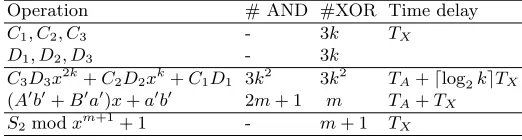
(A0b0+B0a0)x+a0b0 2m+ 1 m TA+TX
Furthermore, note that degA0= degB0=m−1, the computation of (A0b0+ B0a0)x+a0b0 do not need any reduction. Thus such expression totally requires 2m+ 1 AND gates plusmXOR gates and the time delay isTA+TX. The space
and time complexities of the two expressions are presented in Table 2.
As seen in Table 1 and 2, the two operations have the same time delay thus they can be computed in parallel. Finally, we add together (7) and (8). This addition requiresm+ 1 XOR gates andTXgate delay. Thus the total space and
time complexities of the proposed architecture can be calculated from Table 1 and 2 plus extra gates for the final addition:
# AND = 2m2
3 + 2m+ 1,
# XOR = 2m32 +203m+ 3, Time delay =TA+ (3 +dlog2keTX).
Sincek=m/3, we have dlog2ke ≤ dlog2me −1. But this is interesting only if
dlog2ke<dlog2me −1. (9)
This happens frequently when m = 2n +c where c is less than 2n−1. In this case, the time delay of our architecture becomes TA+ (1 +dlog2meTX). Since
m is even, dlog2me=dlog2(m−1)e, the time complexity can be rewritten as TA+ (1 +dlog2(m−1)eTX).
(ii) when 3|m−1: In this case, assume that A = A0x2+a0
1x+a00, B = B0x2+b01x+b00where A0=Pm−2
i=0 aixi, B0=P m−2
i=0 bixi, for all the coefficients
in F2. Let k = (m−1)/3 and we partition A0 = A3x2k +A2xk +A1, B0 = B3x2k+B2xk+B1 with each part consists ofkelements. Similar with previous case, the multiplication ABis computed as:
AB= (A3B3x2k+A2B2xk+A1B1)(x2k+4+xk+4+x4) +(C3D3x2k+C2D2xk+C1D1)xk+4+A0(b10x3+b00x2) +B0(a01x3+a0
0x2) + (a01x+a00)(b01x+b00).
where C3 =A3+A2, C2 =A3+A1, C1 =A2+A1 and D3 = B3+B2, D2 = B3+B1, D1 =B2+B1. Then we divide above expression into two blocks and compute each block moduloxm+1+ 1, separately.
S1= (A3B3x2k+A2B2xk+A1B1)(x2k+4+xk+4+x4)
and
S2= (C3D3x2k+C2D2xk+C1D1)xk+4+A0(b10x3+b00x2) +B0(a01x3+a0
0x2) + (a01x+a00)(b01x+b00).
Table 3.Space and time complexities ofS1modxm+1+ 1, if 3|m−1
Operation # AND #XOR Time delay
A3B3x2k+A2B2xk+A1B13k2 3k2 TA+dlog2keTX
S1modxm+1+ 1 - 5k+ 3 2TX
Table 4.Space and time complexities ofS2modxm+1+ 1, if 3|m−1
Operation # AND #XOR Time delay
C1, C2, C3 - 3k TX
D1, D2, D3 - 3k
C3D3x2k+C2D2xk+C1D1 3k2 3k2 TA+dlog2keTX
A0(b01x3+b
0
0x2) +B
0
(a01x3 4m−2 3m−2TA+ 3TX
+a00x2) + (a01x+a00)(b01x+b00)
S2modxm+1+ 1 - m+ 1 TX
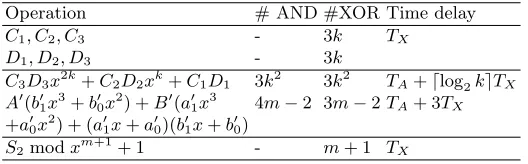
Note that, in practical application dlog2ke is usually larger than 3, thus operations of the third and forth row in Table 4 can be carried out in parallel with time delayTA+dlog2keTX. In the end, anotherm+ 1 XOR gates andTX delay
should be added to compute the final result. Thus the total space complexity and time complexity of the proposed architecture can be calculated from Tables 3, 4 and extra gates on addingS1modxm+1+ 1 andS2modxm+1+ 1 together:
# AND = 2m32 +83m−4 3,
# XOR = 2m2
3 + 22m
3 , Time delay =TA+ (3 +dlog2(
m−1 3 )eTX).
Furthermore, ifm−1 = 2n+c withc ≤2n−1, the time delay of our archi-tecture can be rewritten asTA+ (1 +dlog2(m−1)eTX).
4
Comparison
Table 5 gives a comparison of different implementations of bit-parallel multipliers in the class of fields defined by an irreducible AOP. From Table 5, we can see that our multiplier requires about 33% fewer circuit gates than the previous five architectures and about 10% fewer circuit gates than Chang et al. multiplier. On the other hand, the time complexity of the proposed multiplier isTA+ (3 +
dlog2(m3)e)TX. In fact, we have searched all irreducible AOP with degreemless
than 8000 and it is found that for more than 50% AOPs satisfy the inequality (9). In this case, the time delay of our architecture is equal toTA+(1+dlog2(m− 1)e)TX which matches the best results.
In addition, there are many general bit-parallel multipliers for the fieldGF(2m)
Table 5.Comparison of bit-parallel Multipliers forGF(2m) generated with AOP
Multiplier # AND #XOR Time delay
Hasan [3] m2 m2−1 T
A+ (1 +dlog2(m−1)e)TX
Ko¸c [2] m2 m2−1 TA+ (2 +dlog2(m−1)e)TX
Wu [9] m2 m2−1 T
A+ (1 +dlog2(m−1)e)TX
Kim [10] m2 m2−1 TA+ (1 +dlog2(m−1)e)TX
Reyhani-Masoleh [8]m2 m2−1 T
A+ (1 +dlog2(m−1)e)TX
Chang [15] 3m2
4 + 2m+ 1 3m2
4 + 3m+ 1 TA+ (1 +dlog2(m+ 1)e)TX
3|m 2m2
3 + 2m+ 1 2m2
3 + 20m
3 + 3TA+ (3 +dlog2(
m
3)e)TX
3|m−1 2m2
3 + 8m
3 − 4 3
2m2
3 + 22m
3 TA+ (3 +dlog2(
m−1 3 )e)TX
into two categories according to space complexity, namely, quadratic multipliers and subquadratic multipliers. The best multiplier for the first type contains at leastm2AND andm2−1 XOR gates with time delay ofTA+ (1 +dlog2me)TX
[25] (for good field it is equal to TA+dlog2meTX). The multiplier of the
sec-ond type contains about O(mlog23) circuit gates and usually requires at least TA+ (1 + 2dlog2me)TX gates delay [26, 27]. It is obvious that our architecture
still has certain advantage compared with other general multipliers. The time complexity of our multiplier is comparable to the fastest bit-parallel multiplier and much faster than the subquadratic multipliers, but the space complexity is smaller than the fastest ones [5]. Therefore, our architecture offers a proper tradeoff between space and time complexity.
In [28], Ciet et al. resuscitate elliptic curve cryptography (ECC) over the field which is generated with an irreducible AOP. They have proposed a sequence of such finite fields which are secure for ECC. Among the four examples suggested for ECC in [28], there are two fields, namely, GF(2178) and GF(21186), which satisfy the inequality (9). In these cases, our architecture outperforms Chang et al. approach by saving 10% logic gates with the same time delay. The details are presented in Table 6.
Table 6.Complexity for practical field defined by irreducible AOP
Field our method Chang et al.
#AND #XOR Time #AND #XOR Time
GF(2178) 21596 22428 T
A+ 9TX 24120 24298 TA+ 9TX
GF(21186) 940892 946428 TA+ 12TX 1057320 1058506TA+ 12TX
5
Conclusion
3-term Karatsuba-like formula are combined which can reduce the time complexity and space complexity, respectively. This multiplier can be used in area-critical occasion because it has low space complexity but maintains a relatively low time delay.
Moreover, besides the 3-term Karatsuba-like formula, other Karatsuba-like formulas could also be used for the optimization. We are currently working on applying the five and seven term Karatsuba-like formulae to the AOP multiplier.
References
1. A.J. Menezes, I.F. Blake, X. Gao, R.C. Mullin, S.A. Vanstone, and T. Yaghoobian, Applications of Finite Fields, Kluwer Academic, Norwell, Massachusetts, USA, 1993.
2. C¸ . K. Ko¸c, B. Sunar, Low-complexity bit-parallel canonical and normal basis mul-tipliers for a class of finite fields, IEEE Trans. Comput. 47 (3) (1998) 353–356. 3. M. A. Hasan, M. Z. Wang, V. K. Bhargava, A modified massey-omura parallel
multiplier for a class of finite fields, IEEE Trans. Comput. 42 (10) (1993) 1278– 1280.
4. B. Sunar, C¸ . K. Ko¸c, Mastrovito multiplier for all trinomials, IEEE Trans. Comput. 48 (5) (1999) 522–527.
5. H. Fan, M. A. Hasan, Fast bit parallel shifted polynomial basis multiplier in
GF(2n), IEEE Trans. Circuits and Systems I, Foundamental Theory and Applica-tions, 53 (12) (2006) 2606–2615.
6. F. Rodr´ıguez-Henr´ıquez, C¸ etin Kaya Ko¸c, Parallel multipliers based on special irreducible pentanomials, IEEE Trans. Comput. 52 (12) (2003) 1535–1542. 7. A. Reyhani-Masoleh, M. A. Hasan, A new construction of massey-omura parallel
multiplier overGF(2m), IEEE Trans. Comput. 51 (5) (2002) 511–520.
8. A. Reyhani-Masoleh, M. A. Hasan, Efficient multiplication beyond optimal normal bases, IEEE Trans. Comput. 52 (4) (2003) 428–439.
9. H. Wu, M. A. Hasan, Low complexity bit-parallel multipliers for a class of finite fields, IEEE Trans. Comput. 47 (8) (1998) 883–887.
10. C. H. Kim, S. Oh, J. Lim, A new hardware architecture for operations inGF(2m),
IEEE Trans. Comput. 51 (1) (2002) 90–92.
11. M. Leone, A new low complexity parallel multiplier for a class of finite fields, in: CHES ’01: Proceedings of the Third International Workshop on Cryptographic Hardware and Embedded Systems, Springer-Verlag, London, UK, 2001, pp. 160– 170.
12. H.-S. Kim, S.-W. Lee, LFSR multipliers over GF(2m) defined by all-one polyno-mial, Integr. VLSI J. 40 (4) (2007) 473–478.
13. P. K. Meher, Y. Ha, C.-Y. Lee, An optimized design for serial-parallel finite field multiplication overGF(2m) based on all-one polynomials, in: ASP-DAC ’09:
Pro-ceedings of the 2009 Asia and South Pacific Design Automation Conference, IEEE Press, Piscataway, NJ, USA, 2009, pp. 210–215.
14. H.-S. Kim, S.-W. Lee, Area and time efficient AB2 multipliers based on cellular automata, Comput. Stand. Interfaces 31 (1) (2009) 137–143.
15. K.-Y. Chang, D. Hong, H.-S. Cho, Low complexity bit-parallel multiplier for
16. T. Itoh, S. Tsujii, Structure of parallel multipliers for a class of fieldsGF(2m), Inf.
Comput. 83 (1) (1989) 21–40.
17. P. L. Montgomery, Five, six, and seven-term karatsuba-like formulae, IEEE Trans. Comput. 54 (3) (2005) 362–369.
18. A. Weimerskirch and C. Paar, Generalizations of the Karatsuba Algorithm for Effi-cient Implementations, 2003,http://www.crypto.ruhr-uni-bochum.de/imperia/ md/\\content/texte/kaweb.pdf
19. H. Wu, M. A. Hasan, I. F. Blake, S. Gao, Finite field multiplier using redundant representation, IEEE Trans. Comput. 51 (11) (2002) 1306–1316.
20. A. H. Namin, H. Wu, M. Ahmadi, A new finite-field multiplier using redundant representation, IEEE Trans. Comput. 57 (5) (2008) 716–720.
21. A. H. Namin, H. Wu, M. Ahmadi, A high-speed word level finite field multiplier in
F2m using redundant representation, IEEE Trans. Very Large Scale Integr. Syst.
17 (10) (2009) 1546–1550.
22. M. Elia, M. Leone, C. Visentin, Low complexity bit-parallel multipliers forGF(2m) with generator polynomialxm+xk+ 1, Electronic Letters 35 (7) (1999) 551–552. 23. H. Shen, Y. Jin, Low complexity bit parallel multiplier forGF(2m) generated by
equally-spaced trinomials, Inf. Process. Lett. 107 (6) (2008) 211–215.
24. D. E. Knuth, Art of Computer Programming, Volume 2: Seminumerical Algorithm-s, 3rd Edition. Addison-Wesley Professional, 1997.
25. H. Fan, J. Sun, M. Gu, K.-Y. Lam, Overlap-free Karatsuba-Ofman polynomial multiplication algorithms, IET Inf. Secur. 4 (1) (2010) 8–14.
26. H. Fan, M. A. Hasan, A new approach to subquadratic space complexity parallel multipliers for extended binary fields, IEEE Trans. Comput. 56 (2) (2007) 224–233. 27. H. Fan, M. A. Hasan, Subquadratic computational complexity schemes for extend-ed binary field multiplication using optimal normal bases, IEEE Trans. Comput. 56 (10) (2007) 1435–1437.