CSEIT184696 | Published – 08 May 2018 | May-June 2018 [ (4 ) 6 : 516-521 ]
National Conference on Engineering Innovations and Solutions (NCEIS – 2018)
International Journal of Scientific Research in Computer Science, Engineering and Information Technology © 2018 IJSRCSEIT | Volume 4 | Issue 6 | ISSN : 2456-3307
516
Smart Energy Utilization On Demand Using Image Processing
Dimple B M1, Nandini S1, Kokila Venugopal1, Thanuja K S1, Chaya P21Student, Department of information science and engineering, GSSSIETW, Mysuru, Karnataka, India
2Assistant professor, Department of information science and engineering,GSSSIETW, Mysuru, Karnataka,
India
ABSTRACT
Life without electricity can never be imagined in this world, so it’s every human duty to save electricity. But due to the busy schedule existing in present, often many of us forget to switch off lights and fans which increase wastage of electricity. Often we find lights and fans in the monitoring region(MR) is where we perform the operation to detect the motion of the object, will be on though the MR is empty which increases the electricity bill. This is the major issue in most of the educational institutions. Over the past decade, there has been significant advancement and innovations in the field of consumer electronics by using new technologies we can automate the control of main power supply provided to the MR which significantly reduces the power consumption. Automation provides some sort of automatic control to the electrical appliances present in the building. Proposed work demonstrates detection of motion of objects as a parameter to decide whether to switch on/off the power supply.
Keywords: Background subtraction, Image Processing, Raspberry Pi ,Relay ,Monitoring region.
I.
INTRODUCTION
A Lighting control system is a network based lighting control solution that incorporates communication between various system inputs and outputs related to lighting control with the use of one or more central computing devices. It provides the right amount of light where and when it is needed. They are employed to maximize the energy savings from the lighting system and energy conservation programs. Lighting control system are often referred to as Smart Lighting. Smart lighting is a lighting technology designed for energy efficiency. It is to accurately detect object and take a proper decision of turning on/off of light, which is going to be completely automatic. Here we are using image processing technique to detect the motion and based on the result whether to turn on/off the power
an object present in the MR and it has to turn on the initialized GPIO pin which in turn triggers the relay and turns on the main power supply. If there is no motion detected then the GPIO pin is not turned on and so is the main power supply provided to the MR. The objective is to control the switching of power supply in Monitoring region(MR) and helps in using power supply efficiently. Design a smart automated device which controls the switching of Power supply in the MR based on presence/absence of an object.
EXISTING SYSTEM
The existing systems are operated manually. Infrared sensors can keep count of a number of objects entering /leaving the monitoring region.
a. It is a tedious job to switch on/off the light every time when an object enter/leave the monitoring region.
b. Infrared sensors are unable to detect if the monitoring region is occupied or not.
c. Infrared radiations are harmful.
d. Switchboards have to be replaced with new ones, but we use the existing switchboards and CCTV cameras, which are pre installed in most of the triggers switching ON/OFF of the main power supply. Implementing this system using Raspberry pi. When the raspberry pi boots up the Passive infrared sensor(PIR)starts executing and detecting the motion of objects by comparing the reference image and the current image captured by the camera. If there is any motion detected then the PIR sensor sends raspberry pi a message that there is an object present in the MR and it has to turn on the initialized GPIO pin which in turn triggers the relay and turns on the main power supply. If there is no motion detected then
the GPIO pin is not turned on and so is the main power supply provided to the MR.
There is no need to switch main supply on/off manually. The CCTV camera is used in almost all campuses, so there is no need to install new cameras. The device is going to be completely automatic without need of any human intervention at any stage thereby reducing the manpower. The device will be easy to handle with less maintenance. The use of Raspberry pi helps in multitasking since it is a processor and can be accessed remotely.
II.
LITERATURE SURVEY
[1]“Automatic Control of Power Supply in Classroom using Image Processing” by Darshan Ganiger, Kishor A Patil, [10 February 2017] ,International Conference on Recent Advances in Electronics and Communication.
Although there are a lot of products available in the market which will turn lights on/off based on the Arduino for the efficient use of energy in class room.
[3] “Internet of Things Enabled Smart Switch” by Vishwateja Mudian Reddy, Naresh Vinay etal Manipal, India, [21 July 2016],Wireless and Optical
Communications Networks(WOCN), 2016
Thirteenth International Conference.
work makes use of a web app and a cloud to control the operation of the switches.
[4] “Automated Energy Saving and Safety System” by Md. Kamrul Majumdar, Himel Biswas, Md. Haider Ali Shaim ,[10 April 2014], Electrical Engineering and Information and Communication
Technology(ICEEICT),2014 International
Conference.
This paper reports on a system that can save electricity. Many times we leave the room without switching off lights and fans. In this work they have presented a system in which energy will be saved based on number of people entering in or leaving out of the room.
[5] “Energy Conservation using Automatic Lighting System using FPGA”
by Payal Rodi,Leena Chandrakar, S Saylee, Ginde Sivanantham.[27 Nov 2015], Green Engineering and technologies(IC-GET),2015 online international conference.
This paper proposes efficient use of solar energy for automatic street lighting system using micro controller. The main objective is to make street lighting system free from manual operation so that there would not be any unnecessary usage of light.
III. METHODS AND MATERIALS
System architecture
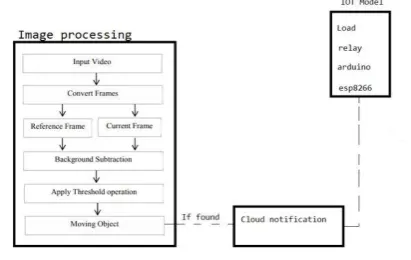
Figure 1. Block diagram of automatic control of power supply.
Figure 2. System architecture of automatic control of power supply
From the system architecture the process is divided into five modules
1.Cameramodule:a device for capturing a photogra hic image or recording a video,using film. Here the input video will be recorded in the camera and then it will be converted into frames.
background subtraction is applied(frame difference algorithm).
3. Cloud Notification Module: is an information technology that enables ubiquitous access to shared
pools of configurable system resources and
higher-level services that can store and rapidly work with
minimal management effort, often over the internet.
After the background subtraction threshold
operation will be applied where if the motion of the object is detected within the threshold range then the notification will be sent to the cloud.
4.IOT Module: is the network of physical devices,
vehicles, home appliances and other
items embedded with electronics, software, sensors, a ctuators, and connectivity which enables these
objects to connect and exchange data. The Passive
Infrared Sensor (PIR) is fixed along with the Raspberry pi where it is an additional feature which is a sensor that measures IR light radiating from objects in its field of view which is used to detect the motion of the object.
5.Hardware Design Module: are the physical parts
or components of a computer, such as the monitor,
keyboard, computer data storage, graphic card, sound
card and motherboard. By contrast, software are the
instructions that can be stored and ran by hardware. The hardware components used such as raspberry pi, electromagnetic switch(relay), arduino micro control
and GPIO(general purpose input output)
ESP8266,When motion is also detected in the PIR sensor then the bulb will glow(load).
Design
1. Raspberry pi:
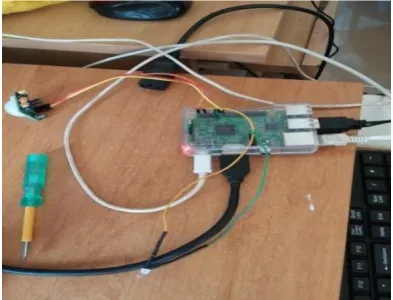
The Raspberry Pi is neither a microcontroller nor a microprocessor. It is a small computer, which uses keyboard and mouse as input devices and displays on the monitor. It is a low cost, portable, small-sized computer, which has a large number of peripherals, and it has the network for
programming languages like Scratch, Python, and C++. Python and IDLE 3 are preloaded in Raspberry Pi. Python is the official programming language of the Raspberry Pi .
Figure 3. Raspberry pi
2. PIR Sensor
A passive infrared sensor is an
electronic sensor that measures infrared (IR)
light radiating from objects in its field of view.
They are most often used in PIR-based motion
detectors. It is used to sense movement of people, animals, or other objects. They are
commonly used in burglar
alarms andautomaticallyactivated lighting syste ms. They are commonly called simply "PIR", or sometimes "PID", for "passive infrared detector".
Figure 4. PIR Sensor
3. Image Processing
processing are normally in the form of a matrix(i.e. rows * columns). In Background subtraction method one image or frame is considered as a reference image (i.e. as a background image). This method subtracts two images that is reference image and the image captured from the current frame of the video (i.e. difference image = background image – current frame image).
Figure 5. Background subtraction
IV.
RESULTS AND DISCUSSIONS
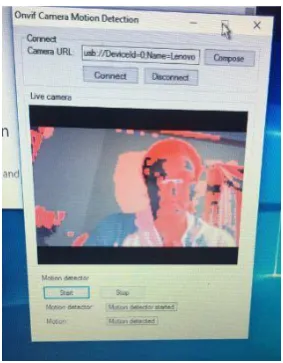
Figure 6. When image is captured from the camera then Motion will be detected in image processing
module through camera to perform operation.
Figure 7. When motion is detected from the sensor, it gives instruction to led to turn on.
Figure 8. Led is turned on when motion is detected from the sensor.
Figure 10. Led is turned off when no motion is detected from the sensor.
V.
CONCLUSION
The proposed methodology can be implemented in real time and is reliable in automatic controlling of lights without any human intervention, using image processing technique like frame subtraction . A visual representation can also be captured for security purposes and stored in the cloud and viewed from the remote control.
VI. REFERENCES
1. “Automatic Control of Power Supply in Classroom using Image Processing” by Darshan Ganiger, Kishor A Patil, [10 February 2017] ,International Conference on Recent Advances in Electronics and Communication.
2. “Automatic Lighting and Control System for Classroom” By Suresh S, H N S Anusha, J Rajath etal, SRM University, [06 April 2017], ICT in Business Industry and Government(ICTBIG) 3. “Internet of Things Enabled Smart Switch” by
Vishwateja Mudian Reddy, Naresh Vinay etal Manipal, India, [21 July 2016],Wireless and Optical Communications Networks(WOCN), 2016 Thirteenth International Conference 4. “Automated Energy Saving and Safety System”
by Md. Kamrul Majumdar, Himel Biswas, Md. Haider Ali Shaim ,[10 April 2014], Electrical
Engineering and Information and
Communication Technology(ICEEICT),2014 International Conference.
5. Raspberry pi, https://www.raspberrypi.org/ 6. M B. Yassein, W.Mardini and A. Khalil, "Smart
homes automation using Z-wave protocol," 2016 International Conference on Engineering & MIS (ICEMIS), Agadir, 2016, pp. 16.
7. S Khedkar and G. M. Malwatkar, "Using raspberry Pi and GSM survey on home automation," 2016 International Conference on Electrical, Electronics, and Optimization Techniques (ICEEOT), Chennai, India, 2016, pp. 758-761.
8. V Puri and A. Nayyar, "Real time smart home automation based on PIC microcontroller, Bluetooth and Android technology," 2016 3rd International Conference on Computing for Sustainable Global Development (INDIACom), New Delhi, 2016, pp. 1478-1484