On Automated Hypernym Hierarchy Construction
Using an Internet Search Engine
?Sergey Afonin
Institute of Mechanics, Moscow State University, 119192, Michurinskij av., 1, Moscow, Russian Federation
Abstract. In this paper we propose an approach for automatic construction of concept hier-archies from the snippets returned by Internet search engines using a number of well known techniques. We use surface lexical patterns to construct a set of candidate hypernyms of a given term and additional filtering that is based on both lexical patterns and distributional analysis. Preliminary experimental results for real life English examples are presented.
Keywords: ontology learning, concept hierarchy, hypernyms, lexical patterns.
1 Introduction
Ontology is an ambiguous notion. In philosophy it goes back to Ancient Greeks and refers to the study of nature, or more generally, to the study of what might exist (Smith, 2004). In the context of computer science, terminological, information and knowledge anthologies (van Heijst et al., 1997) were introduced. Later two ontologies deal withconcepts, while terminological ontologies are focused on natural languagetermsthat may or may not be directly mapped into concepts. In contrast to information ontologies, knowledge ontologies use some formal languages to represent sematic relations between concepts.
Terminological ontologies, such as WordNet, contain information about hyponym-hypernym (subtype-supertype, or IS-A relation), synonymy, and other semantic relations between terms. Such information can be used in variety of natural language processing applications, including query reformulation (Jones et al., 2006; Chirita et al., 2007), text summarization (Dang et al., 2008), categorization (Li et al., 2009), query answering (Lopezet al., 2007), and many others. Unfortunately, good quality ontologies are mostly manually created and they exist for a limited number of domains. Moreover, it is difficult to support an ontology for rapidly changing domains when new concepts or semantic relations frequently appear, so ontology construction and updat-ing become a bottleneck for many applications. A possible solution to the above problem is an automatic or semi-automaticontology learning.
There is a lot of work has been done in the area of ontology learning during past two decades. While there exist many types of semantic relations between concepts and many different sources of information (e.g. databases, structured text, dictionaries) the problem of concept hierarchy learning from unstructured texts may be considered as the main topic in the area. An importance of this problem can justified by the fact that concept hierarchy forms a core of every ontology and that unstructured text is the most frequent data format.
Automated ontology learning from text is a challenging task. It is well known that the set of concepts and terminology varies between different languages and cultures. For example, in many northen languages there exist a lot of terms describing specific conditions of snow, that
?
This work was supported in part by the Russian Foundation of Basic Research under grant 09-07-00366a.
can not be easily translated into other languages. Even in the same language some terms can be treated differently. For example, in the UK the wordcitymeans a settlement of high importance, differentiated from town or village by size, population density, or status. In the US almost all settlements are cities. One can find hundreds of Internet pages containing statements like “Canyon city is a small village”.
Most of the work on concept hierarchy learning can be divided into two classes. The first class consists of work that are based on Harris’ distributional hypothesis (Harris, 1968) which states that semantically similar terms tend to occur in similar contexts. For instance, one can expect that contexts of wordscar andautomobilewill contain many common words. Although the semantic similarity can be measured by means of statistics it is hard to describe the reason of high similarity. An example of statistical approach application to ontology learning is (Sanderson and Croft, 1999) which based on subsumption hypothesis, stating that the set of documents where two terms co-occur is a subset of the set documents where their hypernyms co-occur.
The second class of work, which the current work belongs to, useslexical patterns (Hearst, 1992) that reflect specific semantic relations between terms. In particular, in order to estimate IS-A relation between terms A and B (e.g. hyponym-hypernym) one can search a corpus for “B is a A”, “B is a kind of A”, or “B, C and other As”. If such expressions exist in a corpus then one can assume that term A is a hypernym of B and C. Similar patterns were found for PART-OF relation (Berland and Charniak, 1999; Girju et al., 2003). This approach is based on the assumption that in a sufficiently large corpus one can find a “definition” of term B written in one of above forms. The set of semantic pattern can be either manually coded, or automatically constructed by means of some machine learning technique. In contrast to statistical approaches, lexical patterns may deduce a hypernym from single occurrence. It is worth noticing that lexical patterns approach outperforms many statistical methods for semantic similarity measurement as well (Bollegala et al., 2009). This is a surprising result because it is not evident what lexical patterns can reflect similarity between terms likenailandhammer, orgroupandhomomorphism.
Lexical pattern approach suffers from two problems, namely,sparsity of patternsin real life texts (which is also a strong point), andnoisy output. There are hundred thousand pages containing the pattern “robbery is a”, but only a hundred of pages containing the pattern “oroshi is a”. In the later case there exist a page with the correct definition, but it is given in a different form: “Oroshi is a word with a very specific meaning: wind blowing down from the mountain”. Such snippet will produce an erroneous hypernymoroshi - word, that can be considered as a noise. For more rare terms no required patterns could be found at all. A combined “pattern-statistical” approach was very recently proposed in (Drumond and Girardi, 2010).
Our goal is development of a method for automatic hypernym learning from natural texts. Using lexical patterns approach and an Internet search engine as a mean for large corpus access we compute a set of candidate hypernyms of a given seeding term. For each candidate hypernym we compute the set of possible hypernyms (that are in some sense are neighbors of the seeding term) using the so-called double anchoring hyponyms discovery (Kozarevaet al., 2008). Finally we apply a filter that removes noisy seeding term’s hypernyms. The filtering technique is based on the assumption thatthe set of hyponyms of a correct hypernym of the seeding term should contain tarms that are sematically similar to the seeding term. This is performed by means of statistical semantic similarity measurement and clustering. It is worth noticing that we do not require that all hyponyms should be semantically similar, so the noisy outut that can be generated by both double anchoring hyponym discovery and statistic similarity measure is not a problem.
2 Lexical Patterns and Related Work
Lexical patterns were introduced in (Hearst, 1992) as a mean for automatic IS-A (or hyponym-hypernim) relation mining. It was found that if two terms A and B are in this relation then they occur in a context likeA is a (kind of) B, so a search for such pattern may yield a list of possible hyponyms. In contrast to statistical methods, lexical patterns approach allows to discover hyponym (or hypernym) of a given term from single occurrence in a corpus.
There is plenty of work based on the idea of lexical patterns, but we mention here the double-anchoring approach to hyponym discovery only, introduced in (Kozareva et al., 2008). If one needs to construct a set of hyponyms of a given term, say H, provided that one hyponym, say A, is known, then it is possible to search a corpus for expression likeHs such as A and *. Doubly-anchored patterns serve two purposes: putting A into the query along with H (1) increases the likelihood of selected terms, and (2) eliminates possible ambiguity of H and/or A.
An attractive property of the above methods is that they could be implemented using commer-cial Internet search engines that makes it possible to run the algorithms on huge corpus. At the same time, capabilities of search engines are limited by their query languages that are not powerful enough to solve complex natural language processing tasks. In case when whole documents are available for processing additional information could be used. For example, in (Shinzato and Tori-sawa, 2004) the structure if HTML documents was utilized. The key assumption states that terms appearing in an HTML enumeration list could be hyponyms of some term, and this hypernym term is likely to appear in the text preceding to the list. Large text corpora in connection with lexical patterns used for solving other problems, like automatic construction of attribute words (Tokunaga and Torisawa, 2005).
As it was already mentioned, the proposed method for hypernym discovery assume seman-tic similaritybetween hyponyms of a term. Quantitative semantic similarity estimation is a well known and challenging problem. A number of “simply looking” methods that estimate similarity by means of statistical distribution of terms analysis were proposed, e.g. the Normalized Google Distance, Pointwise Mutual Information and their context-aware versions (Cilibrasi and Vitanyi, 2007; Gligorov et al., 2007), but it seems that all such methods fail on ambiguous words. For ambiguous words clustering approach, such as one presented in (Pantel and Lin, 2002), produce consistent results, but clustering is computationally expensive. Taking into account specific prop-erties of the problem we have to solve (we should compute semantic similarity between terms that assumed to be hyponyms of some common term), we narrowed our attention to the already mentioned hyponym-specific solutions.
3 Hypernym Construction Algorithm
Hypernym construction consists of three major steps, common to many natural language process-ing algorithms. They are:
• hypernym candidates set construction;
• candidates filtering (“termness” estimation);
• hypernym validity estimation.
In this section we describe how these steps are implemented. For Internet search tasks we use the YahooBOSS API1.
3.1 Hypernym Candidates Set Construction
For initial hypernym candidate set construction corresponding to the seeding term term we use query of the form “term is a *”, where the whole expression is enclosed into quotation marks
forcing the engine to search for exact matching2. The actual query differs from this one in the following.
Let us consider the query“Paris is a *”expected to return such definitions of Paris ascityor
capital. In real search engine output we find a lot of the formHotel * in Paris is a. In order to eliminate such results from the output we search the snippets returned for most frequent words preceding seeding termParis.The resulting query has the form
“term is a *” -qt1. . . -qtk,
whereqt1 . . . -qtk are qualificator terms exceeding some frequency threshold. Hypernym candi-dates are extracted from the snippets by taking all possible subsequences of words following the word matched by asterisk. This allow to extract right candidates from snippets like Paris is a beautiful city, orParis is a huge, often confusing city.
3.2 Candidates Filtering
At this point one should decide that sequences of words form a term. Good terms should corre-spond to concepts. As it was mentioned in (Hearst, 1992), the measure of “termness likeliness” is domain-specific. For general domains terms should be as short as possible, while in biomedical applications terms can not be shortened because adjectives carry meaningful information. We use following criteria for termness likeliness estimation:
• relative difference between lengths of a term and the title of the nearest Wikipedia article (Wiki titles are polished by removing suffixes like- Wikipedia, the free encyclopedia); • a logarithm of the number of pages containing the patternterm is a *;
• a logarithm of the number of pages containing the pattern* is a term; • and a logarithm of the number of pages containingtermin their HTML titles.
The intuition behind these numbers is as follows. If there exist a Wikipedia article with exactly the same or very similar title it is likely that the term under consideration represents some concept. Number of pages containing term in their titles reflects importance of the concept. Finally, a term corresponding to a concept should appear in both part ofIS-Arelation.
The resulting likeliness value is a weighted sum of these numbers. Clearly, that absolute values of counting numbers are not important, because the number of occurrences of aIS-Apattern in the corpus depends of popularity of specific concept in the corpus. Let us consider an example:
term wiki title * is a is a *
bread 1. 12.9359 9.98525 10.6727
life 1. 15.6568 13.254 14.4916
sunny day 1. 10.1012 9.554 8.03496 semigroup 1. 6.20859 8.60594 7.76472 hypernym 0. 5.0876 7.73456 5.5835 fantastic destination 0.428571 4.39445 8.73311 2.89037 narrow garage 0.26087 5.54126 2.89037 0 garage 1. 13.9627 10.4113 10.5031 hesitation pause 0.625 1.79176 2.07944 1.79176 collaborative model 1. 6.10925 6.89264 5.15329 referential ambiguity 0. 3.43399 0 1.94591
One can find that if a term corresponds to some concept, then the ratio of last two columns is close to one, while for other terms this is not the case. Comparing termsnarrow garage(which is not a
2
burglary
theft
robbery felony
murder
home
rape
violence
trafficking
Figure 1:Felony is a crime.
concept) andreferential ambiguity(a concept) one can assume that small values for number of* is apages are allowed, and this is an indication ofbottom concepts. Finally, let us note that term sunny dayscores so high because of existence of a quite popular music band called “A sunny day in Glasgow”.
The score of a termtis computed by a functionscore(t) =f(w(t), u(t)/d(t)),whereu(t)is the logarithm of number of* is apages,d(t)is the logarithm of number ofis a *pages, that tries to assign large values to (1) wiki-terms, (2) terms withu(t)/d(t)close to one, and (3) terms that have zerou(t)/d(t)ratio.
For each hypernym candidate we compute its score and Part-Of-Speech tags (we use (Tsuruoka and Tsujii, 2005)3). A candidate passes the test if it either has a score greater some threshold, or it has a score greater than average and ends with a noun. Threshold value 0.5 guarantees that terms presented in wiki titles are not removed because of erroneous POS tagging.
3.3 Hypernym Validity Estimation
The goal of hypernym validity estimation is computing for given terms T and H a real numberα∈
[0,1]reflecting the probability that H is a hypernym of T. The method is based on the assumption thatthe set of hyponyms of a correct hypernym of the seeding term should contain terms that are semantically similar to the seeding term. We perform the following steps.
1. Evaluate the query* is a Hand extract from the snippets candidates for terms T neighbors (terms sharing with T common hypernym).
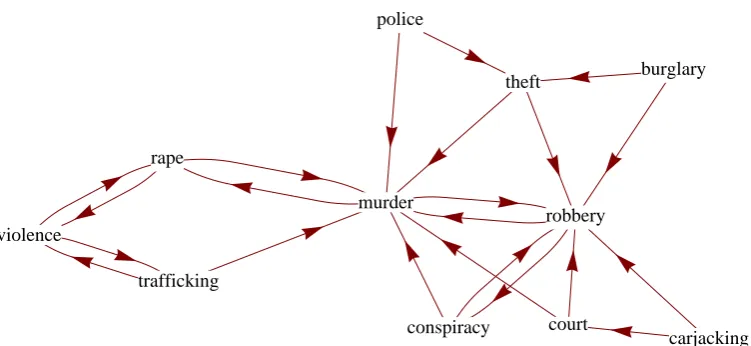
2. For selected candidates we construct a graph, similar to thehypernym pattern linkage graph described in (Kozareva et al., 2008). Graph nodes correspond to T’s neighbor candidates. Each node has exactlykout-going edges (in the examples belowk = 2) leading to nodes with highest similarity measure. The similarity between two nodes, sayN1 andN2, mea-sured as the number of pages returned by the search engine for the query
N1, N2and other Hs.
Due to search engine query limitations the actual query isN1 NEARN2 NEAR “and other Hs”. Examples of similarity graphs for (T,H)={felony,crime}, and (T,H)={robbery,crime} represented on Fig. 1 and Fig. 2, respectively.
3. Finally, we apply PageRank algorithm to compute the weight of the node corresponding to the seeding term T.
3
burglary theft
robbery
carjacking court
conspiracy murder
rape
police
violence
trafficking
Figure 2:Robbery is a crime.
Let us note that we use an is-a query for T’s hypernym candidates set construction and plural formand other Hsfor validity estimation. It gives additional filter for hypernym candidates. If a term H was erroneously selected as a hypernym candidate for T, then it is likely that the “plural” query yields the empty set.
Usage of PageRank algorithm for validity estimation may be justified by the fact that it gives a higher value to a node if there exist incoming edges. Recall that incoming edge indicates that two term frequently occur in lexical patternA,B and other Cs.
4 Experimental Results
Our experiment dials with the set of terms that are semantically related to the concept of crime
in Roguet thesaurus: robbery, theft, burglary, banditry, fraud, swindle, snatch, plunder, stealing, larceny, felony, identity theft, crime against humanity.
The result of* is a crimequery is the set (with number of patterns found):
murder 504
burglary 62
theft 58
rape 45
robbery 38
home 18
violence 16
misdemeanor 9
court 9
vandalism 8
law 8
crime 6
conspiracy 6
immigration 4
offense 3
forgery 3
act 3
evidence 2
computer 2
terrorism 1
clayton 1
fraud 0.830539
theft 0.852935
felony 0.877171
larceny 0.882474
robbery 0.885167
banditry 0.888889
stealing 0.888889
identity theft 0.896961
plunder 0.907692
burglary 0.943271
crime against humanity 1.
snatch 1.
swindle 1.
For terms such asjoke, that are definitely not related to crimes, the algorithm states outputs
zero validity of a hypernym relation between joke and crime.
5 Conclusion
In this paper an approach to automated terminological hyponym/hypernum hierarchy construction using Internet search engine is proposed. The method combines various well-known techniques of
lexical patterns (Hearst, 1992), such as doubly-anchored hyponyms search (Kozarevaet al., 2008).
Very preliminary experimental results show that such combination could yield meaningful output without usage of any handcoded lexical resources.
There is a lot of work to do before one can state that this approach is feasible for real life applications. For example, a more sophisticated algorithms for hyponym construction can be used.
In particular, a bootstrapping algorithm (Kozarevaet al., 2008) that starts from the seeding term
and its hypernym and iteratively extends the set of term’s candidates using theA, B and other Cs
query. Although multi-word terms are very frequent in real text the problem of their identification
was not addressed. Hypernym extraction from snippets likeTyphoon is a twin-engine canard-delta
wing multirole aircraftorTyphoon is a fantastic aircraftis a crucial feature. Finally, an extended evaluation on manually verified data should be performed.
References
Berland, Matthew and Eugene Charniak. 1999. Finding parts in very large corpora. In
Proceed-ings of the 37th annual meeting of the Association for Computational Linguistics on Computa-tional Linguistics, pp. 57–64, Morristown, NJ, USA. Association for Computational Linguis-tics.
Bollegala, Danushka, Yutaka Matsuo, and Mitsuru Ishizuka. 2009. A relational model of se-mantic similarity between words using automatically extracted lexical pattern clusters from the
web. In EMNLP ’09: Proceedings of the 2009 Conference on Empirical Methods in
Natu-ral Language Processing, pp. 803–812, Morristown, NJ, USA. Association for Computational Linguistics.
Chirita, Paul Alexandru, Claudiu S. Firan, and Wolfgang Nejdl. 2007. Personalized query
ex-pansion for the web. InSIGIR ’07: Proceedings of the 30th annual international ACM SIGIR
conference on Research and development in information retrieval, pp. 7–14, New York, NY, USA. ACM.
Cilibrasi, R. L. and P. M. B. Vitanyi. 2007. The google similarity distance. IEEE Transactions on
Knowledge and Data Engineering, 19(3), 370–383.
Dang, Chenghua, Xinjun Luo, and Haibin Zhang. 2008. Wordnet-based summarization of
un-structured document. W. Trans. on Comp., 7(9), 1467–1472.
Drumond, Lucas and Rosario Girardi. 2010. Extracting ontology concept hierarchies from text
using markov logic. InSAC ’10: Proceedings of the 2010 ACM Symposium on Applied
Girju, Roxana, Adriana Badulescu, and Dan Moldovan. 2003. Learning semantic constraints
for the automatic discovery of part-whole relations. InNAACL ’03: Proceedings of the 2003
Conference of the North American Chapter of the Association for Computational Linguistics on Human Language Technology, pp. 1–8, Morristown, NJ, USA. Association for Computational Linguistics.
Gligorov, Risto, Zharko Aleksovski, Warner ten Kate, and F. van Harmelen. 2007. Using google
distance to weight approximate ontology matches. InProceedings of the seventeenth World
Wide Web conference WWWW’17, pp. 767–775, Canada, May.
Harris, Z. S. 1968. Mathematical Structures of Language. Wiley, New York.
Hearst, Marti A. 1992. Automatic acquisition of hyponyms from large text corpora. InIn
Pro-ceedings of the 14th International Conference on Computational Linguistics, pp. 539–545.
Jones, Rosie, Benjamin Rey, Omid Madani, and Wiley Greiner. 2006. Generating query
substitu-tions. InWWW ’06: Proceedings of the 15th international conference on World Wide Web, pp.
387–396, New York, NY, USA. ACM.
Kozareva, Zornitsa, Ellen Riloff, and Eduard Hovy. 2008. Semantic class learning from the web
with hyponym pattern linkage graphs. InProceedings of the Association for Computational
Linguistics.
Li, Jianqiang, Yu Zhao, and Bo Liu. 2009. Fully automatic text categorization by exploiting
word-net. InAIRS ’09: Proceedings of the 5th Asia Information Retrieval Symposium on Information
Retrieval Technology, pp. 1–12, Berlin, Heidelberg. Springer-Verlag.
Lopez, Vanessa, Victoria Uren, Enrico Motta, and Michele Pasin. 2007. Aqualog: An
ontology-driven question answering system for organizational semantic intranets. Web
Se-mant., 5(2), 72–105.
Pantel, Patrick and Dekang Lin. 2002. Discovering word senses from text. InKDD ’02:
Proceed-ings of the eighth ACM SIGKDD international conference on Knowledge discovery and data mining, pp. 613–619, New York, NY, USA. ACM Press.
Sanderson, Mark and Bruce Croft. 1999. Deriving concept hierarchies from text. In SIGIR
’99: Proceedings of the 22nd annual international ACM SIGIR conference on Research and development in information retrieval, pp. 206–213, New York, NY, USA. ACM.
Shinzato, Keiji and Kentaro Torisawa. 2004. Extracting hyponyms of prespecified hypernyms
from itemizations and headings in web documents. InCOLING ’04: Proceedings of the 20th
international conference on Computational Linguistics, p. 938, Morristown, NJ, USA. Associ-ation for ComputAssoci-ational Linguistics.
Smith, Barry. 2004. Ontology. In The Blackwell Guide to the Philosophy of Computing and
Information, pp. 155–166. Blackwell.
Tokunaga, Kosuke and Kentaro Torisawa. 2005. Automatic discovery of attribute words from web
documents. InProceedings of the 2nd International Joint Conference on Natural Language
Processing (IJCNLP-05), pages 106118, Jeju Island, Korea, pp. 106–118.
Tsuruoka, Yoshimasa and Jun’ichi Tsujii. 2005. Bidirectional inference with the easiest-first
strategy for tagging sequence data. In HLT ’05: Proceedings of the conference on Human
Language Technology and Empirical Methods in Natural Language Processing, pp. 467–474, Morristown, NJ, USA. Association for Computational Linguistics.
van Heijst, Gertjan, A. Th. Schreiber, and Bob J. Wielinga. 1997. Using explicit ontologies in kbs