Proceedings of the 57th Annual Meeting of the Association for Computational Linguistics, pages 516–526 516
Decompositional Argument Mining: A General Purpose Approach for
Argument Graph Construction
Debela Gemechu and Chris Reed
Centre for Argument Technology, School of Science & Engineering University of Dundee, Dundee, UK
[email protected], [email protected]
Abstract
This work presents an approach decomposing propositions into four functional components and identify the patterns linking those com-ponents to determine argument structure. The entities addressed by a proposition aretarget conceptsand the features selected to make a point about the target concepts are aspects. A line of reasoning is followed by providing evidence for the points made about the tar-get concepts via aspects. Opinions on target conceptsandopinions on aspectsare used to support or attack the ideas expressed by target concepts and aspects. The relations between aspects, target concepts, opinions on target concepts and aspects are used to infer the ar-gument relations. Propositions are connected iteratively to form a graph structure. The ap-proach is generic in that it is not tuned for a specific corpus and evaluated on three differ-ent corpora from the literature: AAEC, AMT, US2016G1tv and achieved an F score of 0.79, 0.77 and 0.64, respectively.
1 Introduction
Argument mining is the process of identifying ar-gumentative structure contained within a text. It involves segmenting arguments into elementary discourse units (EDUs), distinguishing argumen-tative units from non-argumenargumen-tative units, classi-fying argument components into classes such as premise and claim, identifying and labeling argu-ment relations between the components, and iden-tifying argument schemes. We are here aimed at mining argument structure from text segmented into EDUs (or, more precisely for argument min-ing, Argumentative Discourse Units, ADUs ( Peld-szus and Stede,2015)).
Several argument mining approaches use fea-tures identified from individual EDUs and apply classifiers (Moens et al.,2007); others use features that span EDUs and apply dependency parsing
(Muller et al.,2012), similarity (Lawrence et al.,
2014), linguistic indicators (Villalba and Saint-Dizier, 2012) and their combinations (Lawrence and Reed, 2015). Recently, a neural end-to-end method for argument mining shows that depen-dency parsing outperforms an EDU-level classifier (Eger et al., 2017). Stab and Gurevych (2014b) use both EDU-level and cross-EDU features to im-prove performance. The EDU-spanning features used by these latter approaches include syntac-tic dependency and lexical overlap between the EDUs. For instance, Eger et al. (2017) applied token level syntactic dependency to learn the re-lations between EDUs. Even though cross-EDU tokens are used for argument mining, the nature of such tokens is not studied well.
Following the same line of reasoning, similar-ity approaches use EDU level similarsimilar-ity to deter-mine argument structure. Lawrence et al. (2014) use Latent Dirichlet Allocation (LDA) topic mod-eling; Lawrence and Reed (2015) use WordNet1 Synset hierarchy to determine similarity between propositions. Such approaches start from a con-clusion and determine the most related proposi-tion to create hierarchical graph structure based on the assumption that a conclusion is similar to a premise. Similarity, however, does not necessar-ily entail an argument relation and vice-versa.
In this work, we aim to detect argument rela-tions (AR) and their category (support vs attack) based on the nature of the relations existing among the functional components of propositions. The functional components of propositions are: tar-get concepts (C), aspects (A), opinions on aspects (OA) and opinions on target concepts (OC). In or-der to identify ARs and their category, we train classifiers using the relations between the four components. The classifiers provide an output
dicting whether any pair of propositions involve an AR or not, and categorize the AR.
To the best of our knowledge there is no ap-proach that decomposes propositions into fine-grained components and uses them to determine argument structure. OurDecompositional Argu-ment Mining (DAM) identifies argument struc-ture by exploiting similarity (between C and A) and relations between the polarities of OC and
OA. Our first hypothesis is then the AR between EDUs is governed by the relations between their functional components. For instance, the support relation between (2) and (9) from Table 1 is a function of the similarity betweenCof (9) “cook-ing; potato; burger”and A of (2)“food”and the agreement between the polarities of their respec-tive opinion expressions (i.e. the opinions“have an opportunity; interesting”and“better”are both positive). Similarly the support relation between (6) and (7) is the function of the similarity be-tweenAof (6)“job”andCof (7)“job”and the agreement between the polarities of their respec-tive opinion expressions (i.e. “are losing” and
“are fleeing”are both negative). The attack rela-tion between (10) and (11) is the funcrela-tion of the similarity between C of (10) “advertising” and
Aof (11)“advertising”and the contradiction be-tween the polarities of the opinion on A of (10)
“should be prohibited” and the opinion on C of (11)“needs”.
Our second hypothesis is that automatic recog-nition of argument structure can be substantially enhanced by using the relations between the four functional components of propositions as com-pared to other features like discourse indicators which are rare to find. For instance, none of the propositions presented in the example are linked via discourse indicators, and yet the relations be-tween the four components can be used as a ba-sis for identifying their ARs. The third hypotheba-sis is that fine-grained similarity is more reliable and accurate than EDU level similarity. The similar-ity between the entirety of propositions is not a good indicator of AR. For instance the similarity between (3) and (8) is 0.737 (as provided by ADW (Pilehvar et al.,2013)) and yet does not involve an AR, but (8) and (1) has a similarity score of 0.45 and involves an AR since there is a strong similar-ity between the aspect of (1)“family” and target concept of (8)“family”.
The contribution of this work is three-fold: (a)
a model to identify components linking proposi-tions; (b) directional similarity indicating the di-rection of AR between propositions; (c) an ap-proach determining the entire argument structure based on just the relations between the four func-tional components of proposition across three het-erogeneous corpora of which two are monological and the other is dialogical (see Section 3).
2 Argument Graph Model
A proposition in the Frege’s sense, is decomposed into four functional components: C, A, OC and
OA.CandAare used to link a premise and a con-clusion; the polarity ofOCandOAis used to iden-tify the type of relations (inference vs conflict).
2.1 Functional Decomposition of a Proposition and their relations
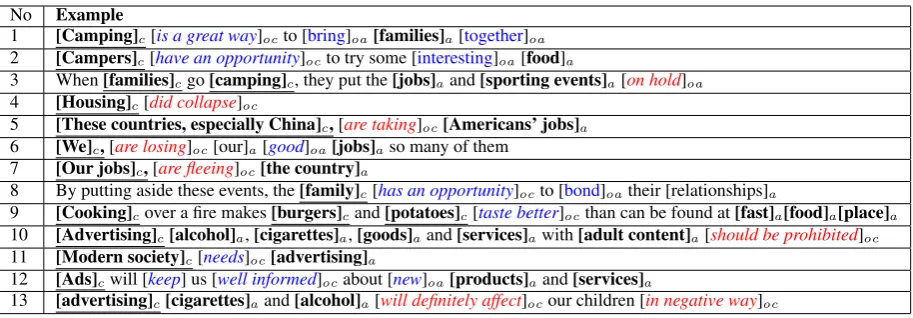
We define the four functional components of a proposition before formalizing the representation of proposition in terms of the components. Ex-amples (4) to (7) in Table 1 are taken from the first US 2016 presidential election television de-bate corpus (US2016G1tv) (Lawrence and Reed,
2017; Visser et al., 2019) and (1) to (3), (8) to (13) are taken from the Argument Annotated Es-say Corpus (AAEC) (Stab and Gurevych,2014a) to illustrate the components.
2.1.1 Target Concept (C)
A proposition makes a point about (at least one) concept: an idea, physical or abstract entity, fol-lowing (Lima et al, 2010):
“Concepts, also known as classes, are used in a broad sense. They can be abstract or concrete, elementary or composite, real or fict[it]ious. In short, a concept can be anything about which something is said, and, therefore, could also be the description of a task, function, action, strategy, reasoning process, etc.” (Lima et al.,2010, p:428).
The set of concepts addressed by a proposition are referred to as target concepts, (C). The ex-amples in Table 1 are annotated to show C (seg-mented with [], and marked by the subscript c
No Example
1 [Camping]c[is a great way]octo [bring]oa[families]a[together]oa
2 [Campers]c[have an opportunity]octo try some [interesting]oa[food]a
3 When[families]cgo[camping]c, they put the[jobs]aand[sporting events]a[on hold]oa
4 [Housing]c[did collapse]oc
5 [These countries, especially China]c,[are taking]oc[Americans’ jobs]a
6 [We]c,[are losing]oc[our]a[good]oa[jobs]aso many of them
7 [Our jobs]c,[are fleeing]oc[the country]a
8 By putting aside these events, the[family]c[has an opportunity]octo [bond]oatheir [relationships]a
9 [Cooking]cover a fire makes[burgers]cand[potatoes]c[taste better]octhan can be found at[fast]a[food]a[place]a
10 [Advertising]c[alcohol]a,[cigarettes]a,[goods]aand[services]awith[adult content]a[should be prohibited]oc
11 [Modern society]c[needs]oc[advertising]a
12 [Ads]cwill [keep] us [well informed]ocabout [new]oa[products]aand[services]a
13 [advertising]c[cigarettes]aand[alcohol]a[will definitely affect]ocour children [in negative way]oc
Table 1: Examples to illustrate the four functional components of a proposition:C,A,OCandOA. (In the online version, positive and negative polarity is indicated in blue and red, respectively).
2.1.2 Aspect (A)
Often, a specific angle of reasoning is selected to make a point aboutC. The concepts providing such angles of reasoning are denoted as aspects (A). For instance, (1) and (2) address the target concept“camp”with respect to the aspects “fam-ily”and“food”(in bold) respectively. Similarly, the aspects of (3) are“job, sporting event”. The difference between CandAis not an ontological distinction, it is rather the syntactic and semantic role they play in the respective propositions. An aspect in one proposition can be a target concept in another (see (1) and (3)).
2.1.3 Opinion on Target Concept (OC)
OCis an opinion expressed onCto express posi-tive or negaposi-tive attitudes. The opinionated words in a proposition are usually ambiguous and do not fall into the conventional opinionated words cate-gory. For instance, in (5), the opinion “are tak-ing”, which is expressed on the target concept
“country, china”, does not fall into the conven-tional opinionated word category.
2.1.4 Opinion on Aspect (OA)
OAis an opinion expressed on anAto provide pos-itive or negative attitudes. For instance, in (2) the opinion “interesting” is expressed on the aspect
“food”.
Since we have defined the four components of a proposition, we can now formalise the representa-tion of a proposirepresenta-tion in terms of the components. Hence, a proposition, p, can be represented as a set of tuples,
P ={hC0, oC0,{hA0, oA0i,· · · ,hAi, oAii}i, hC1, oC1,{hA1, oA1i, ...,hAj, oAji}i,· · ·
hCn, oC n,{hAj, oAji,· · · ,hAk, oAki}i}
(1) Where,Ci,Ai,oC i,oAirepresentsC,A,OCand
OA, respectively.
2.1.5 The Relations Between the Four Functional Components
The relations between the four components fall into two categories: similarity and agreement. The relation between C and A is similarity whereas agreement (or contradiction) betweenOCandOA. The relations between C and A are further cate-gorized into four: (a) similarity between C of a premise and a conclusion, (b) similarity between
Aof a premise and a conclusion, (c) similarity be-tweenAof a premise andCof a conclusion, and (d) similarity betweenAof a conclusion andCof a premise. The relations betweenOCandOAare also categorized into four: (a) the agreement be-tweenOCof a conclusion and a premise, (b) the agreement betweenOAof a premise and a conclu-sion, (c) the agreement betweenOCof a conclu-sion andOAof a premise, and (d) the agreement betweenOAof a conclusion andOCof a premise.
2.2 Argument Relation
Inference relations: A pair of propositions in-volving support relation.
Conflict relations: A pair of propositions involv-ing attack relation.
To mention, when a premise develops one or more aspects of a conclusion, the aspects of a con-clusion form Cof a premise (i.e are highly simi-lar). For instance, (8) supports (1) in relation to the aspect“family”; (9) supports (2) in relation to the aspect“food”. The relation betweenOCandOA
is identified through matching the polarity of the opinions. For instance the polarity of the opinions on (1 and 8) matches (both are positive), since the propositions involve support relation. Similarly, the attack relation between (10) and (11) is indi-cated by the similarity betweenCof (10) andAof (11) and the contradiction between the polarities of the opinions onOCof (10) andOCof (11).
Accordingly, the AR between propositions is defined by,
AR=
S ifrel(C, A, OC, OA) =θ
AT ifrel(C, A, OC, OA) =β N otherwise
(2)
where, S stands for support, AT for attack and N for none, whileθ,β representing the result of a classifier (θfor support andβfor attack).
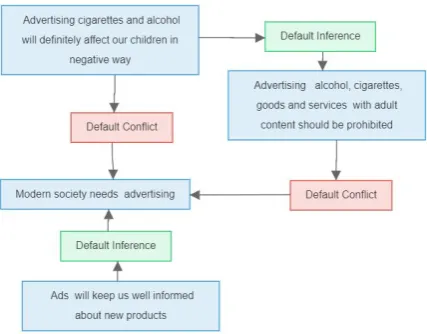
A graph structure is formed to represent an ar-gument by linking proposition whose components are related via the valid relations encoded by AR. Propositions and the relations between them are nodes, the connections between the nodes form the edges. Figure 1 shows an argument structure for a portion of propositions in Table 1, where (11) is attacking (10), (12) is supporting (11), (13) is at-tacking (11), and (13) is supporting (10) based on the similarity betweenCandAand the agreement between the polarities of the opinion expressions onCandA.
3 Methodology
In this section, we present the data-sets and the major components of our approach.
3.1 Data
We aim to cover varieties of data-sets (though not comprehensive), annotated based on the underly-ing set of argumentation theory to see how our approach behaves across heterogeneous data-sets without tuning to a specific data-set. we use three
Figure 1: Argument structure for propositions (10), (11), (12), and (13) from Table 1
corpora, with different types of source material (monologue, dialogue), different creation rubrics (naturally occurring, created under direction), dif-ferent argument structure conventions (recursive, limited), different notions of inference (typed, un-typed) and different notions of conflict (rebut-only, rebut and undercut).
The first is Argument Annotated Essay Corpus (AAEC) (Stab and Gurevych, 2014a) which has a total of 90 arguments. Propositions under each argument are labelled as premise, claim or ma-jor claim. The corpus has 31,194 tokens, 1,552 propositions and 1214 Argument relations (AR). The second corpus is the Argumentative Micro Text (AMT) (Peldszus and Stede,2013) which is a collection of 112 short texts collected from hu-man subjects in Gerhu-man and were translated into English. It is annotated following the argumen-tation structure outlined by Peldszus and Stede (2013) and attain high inter-annotator agreement score. The structure consists of a central claim, and support/attack propositions. It has a total of 8,007 tokens, 576 propositions and 272 argument relations. We have also used dialogical corpus from the first US 2016 presidential election tele-vision debate between the candidates Clinton and Trump (US2016G1tv) (Lawrence and Reed,2017;
Visser et al., 2019) which is annotated based on AIF (Chesnevar et al.,2006) using the OVA+ an-notation tool (Janier et al., 2014)2 and stored in the AIFdb database (Lawrence et al.,2015). The corpus has a total of 15,805 tokens, 1,473 propo-sitions and 505 inferences.
In addition to the original annotation, we
tateC,A,OCandOA. We obtain the total of 3,455, 4,113, 4,359, and 2,987C,A,OCandOA respec-tively. For the corpus evaluation, a second annota-tor analysed 10% of claim-premise pairs form the combined corpora. To this end, we combine the three corpora and randomly select 10% of claim-premise pairs and provide it to the second annota-tor after removing the annotation labels of the first annotation. The annotation of the four compo-nents is compared against the original annotation to calculate the inter-annotators agreement. This gave a Cohen’s kappa scoreκ = 0.86,κ = 0.82,
κ = 0.81, andκ = 0.80onC,A,OCandOA, re-spectively. The annotation of the second annotator is discarded after calculating the Cohen’s kappa score. The description of the annotation process and guideline is available online3.
3.2 Identifying Argument Structure
Our approach involves a pipeline of four steps: Given segmented argumentative text, the first step identifiesC,A,OCandOA. The similarity compo-nent determines the degree of similarity between C and A. The next step identifies the polarity of the opinions to determine if they contradict or agree. The last component uses the similarity betweenC
andA, and the relation betweenOCandOA (con-tradiction or agreement) to link propositions and iteratively construct a graph. The details are pro-vided below.
3.2.1 Identifying Aspects, Target Concepts and Opinions
We formulate the task in two ways: relation ex-traction task adapted from information exex-traction, and a sequence labeling task adapted from aspect based opinion mining.
C, A, OC and OA identification as a rela-tion extracrela-tion task. We model it as a re-lation extraction task since C, A, OC and OA
are syntactically interdependent. Relation ex-traction has been studied extensively in natu-ral language processing using supervised meth-ods (Kambhatla,2004;Zhao and Grishman,2005) and semi-supervised methods (Etzioni et al.,2005;
Banko et al.,2007). Supervised methods use clas-sification techniques: Maximum Entropy Models (Borthwick et al., 1998), Hidden Markov Mod-els (Bikei et al.,1997), Support Vector Machines
3
http://arg.tech/˜debela/Guidelines. pdf
(Asahara and Matsumoto,2003), and Conditional Random Fields (McCallum and Li,2003).
Following the same line of reasoning, we train four classifiers (Naive Bayes, CRF, bag of features based SVM, and tree kernel based SVM) to clas-sify the words in a proposition asC,A,OCorOA. The first three classifiers use frequency, part of speech category and universal dependency as clas-sification features. The tree kernel SVM is trained using the portion of the dependency tree connect-ing the four components as positive examples and the rest as negative examples.
C,A,OCandOAidentification as a sequence labeling task. The sequence labeling model is adapted from aspect based opinion mining. As-pect based opinion mining identifies opinions ex-pressed on a target object and specific aspects of the object (Zhang and Liu,2014). Taking the anal-ogy of target object:aspects in opinionated text to
C:A:OC:OAin argumentative text, we apply simi-lar techniques for identifyingC,A,OCandOA.
The underlying idea behind the model is thatC,
A,OCandOAare interdependent and occur in a sequence in a sentence. The model is based on the Inside-Outside-Begin (IOB) labelling schema (Ramshaw and Marcus, 1999). Accordingly, we use the IOB labeling schema where, B-Concept denotes the beginning of a concept; I-Concept, de-notes that the token is inside the concept, and O for other (non C, A, OC orOA) tokens. Hidden Markov Models (HMM) (Jin et al.,2009), Condi-tional Random Fields (CRF) (Sminchisescu et al.,
2006) and recently, convolutional neural networks (CNN) (Poria et al.,2016) are common techniques employed. The assumption that an observation only depends on the current state and that a given state depends on its immediate predecessor state made HMM approaches less applicable for rela-tions involving long distance dependencies. CRF is also a linear model and suffers from the same criticism as HMM. CNN on the other hand can en-code long distance relations existing between con-cepts. As a result, we use CNN to train the model since C, A, OC and OA can appear a long way away from each other.
3.2.2 Identifying the contradiction between opinions
Our aim here is to compare the polarities between
allows for computing similarity between phrases, sentences, paragraphs or documents.
3.2.4 Identify Argument Relations and Category
A classifier is trained to learn the relations be-tween the four components in order to link propo-sitions. The classification features are: the similar-ity betweenCandA; the relation betweenOCand
OA. To facilitate the training, we convert the con-tinues similarity values (which ranges from 0.0 to 1.0) to a discrete value by tuning a thresholdαon a development set to categorize them into two: un-related or similar. Likewise, the relation between
OCandOAholds discreet values: agreement, dis-agreement or neutral.
3.2.5 Iterative Graph Construction
Given a set of propositions, we build a struc-ture consisting the valid ARs holding between the propositions. Propositions and ARs are nodes and the links between them form edges.
We start with any arbitrary proposition Pi and
then identify the associated functional compo-nents. The similarity between C and A of Pi
and all the other propositions (Pi+1...n); the agree-ment betweenOCandOAofPi and all the other
remaining propositions (Pi+1...n) are identified. A classifier is then used to identify the AR tween the propositions based on the relations be-tween their components. Accordingly, a proposi-tion whose funcproposi-tional components are related with the functional components ofPiis connected toPi
to form an edge(Pi+1 → Pi). Once all the child nodes (all the premises) are connected, the propo-sition is marked as visited. Continuing with the next unvisited proposition, the same procedure is applied until all the propositions in the entire ar-gument are visited.
4 Experiments
Four machine learning approaches are trained to detect C, A, OC and OA. Two similarity ap-proaches are tried to identify similarity betweenC
andA. CSPP is tried to identify the polarity ofOC
andOA. Our DAM combines the best performing component identifier, similarity and the CSPP to train a classifier in order to identify AR existing between proposition. The implementation of our approach is available online4. It takes
argumenta-4http://ws.arg.tech/
tive text as an input and returns the argument struc-ture using AIF-JSON (Chesnevar et al.,2006) for-mat.
4.1 Evaluation technique and setup
We use ten-fold cross-validation, where the data-set is randomly divided into ten groups. Argu-ments are randomly split into 80% training and 20% test sets with the same class distribution. To balance the class distribution (composition of premise, conclusion, attack relation, and support relation), we follow the unitization in the respec-tive corpus. For instance, AAEC is originally presented as 90 self contained essays consisting of conclusions, premises and the associated argu-ment relations. Hence, we consider an arguargu-ment as a unit to take all the constituted elements at a time. We report average precision, recall and F-measure computed by ten-fold cross-validation over these units.
4.2 Results and Discussions
We present the results of the individual compo-nents separately:
C,A,OCandOAextraction. The four classifiers are evaluated on the three corpora as presented in Table 2. We use the class distribution of the com-ponents as a baseline. We divide the number of
C andAby the total number of concepts (C and
A) to obtain the class distribution for C and A. The same procedure is followed for the opinions (OC and OA). The sequential labeling approach out-performed all the classifiers and the baseline across the corpora. The syntactic dependency ex-isting betweenC,A,OCandOA, regardless of the distance existing between them, is recognized by the CNN more reliably than the other classifiers. The kernel-based SVM outperformed the feature based SVM which is again attributed to its ability of encoding the syntactic dependency linking the target concepts and the aspects.
523 Data-Sets
AAEC AMT US2016G1tv
Approaches C A OC OA C A OC OA C A OC OA Baseline 0.45 0.55 0.57 0.43 0.48 0.52 0.6 0.4 0.43 0.57 0.61 0.39 SVM-kernel 0.82 0.71 0.81 0.62 0.78 0.65 0.69 0.65 0.77 0.69 0.69 0.66 SVM-feature 0.81 0.70 0.81 0.65 0.75 0.68 0.67 0.66 0.76 0.69 0.67 0.66 CNN-Sequence 0.83 0.72 0.82 0.7 0.77 0.69 0.7 0.67 0.78 0.71 0.68 0.67
CRF 0.80 0.69 0.72 0.65 0.78 0.67 0.66 0.69 0.76 0.67 0.67 0.67
Naive Bayes 0.79 0.69 0.76 0.66 0.75 0.62 0.62 0.62 0.75 0.66 0.65 0.64
Table 2: The performance (F-measure) ofC,A,OCandOAextraction on AAEC, AMT and US2016G1tv corpus
Approaches
S&G2014b P&S2016 PLS DAM
Data-Sets Components P R F P R F P R F P R F AAEC Para Propositions 0.77 0.68 0.73 n/a n/a 0.81 0.77 0.79
AR 0.74 0.71 0.72 0.62 0.67 0.64 0.82 0.76 0.79
ARC 0.74 0.71 0.72 n/a 0.81 0.74 0.77
AAEC Essay Propositions n/a n/a n/a 0.76 0.73 0.74
AR 0.58 0.7 0.63 0.73 0.75 0.74
ARC n/a 0.73 0.74 0.74
AMT Propositions
n/a
n/a n/a n/a 0.9 0.67 0.77
AR n/a n/a 0.76 0.61 0.64 0.62 0.91 0.66 0.77
ARC n/a n/a 0.88 0.66 0.75
US2016G1tv Propositions n/a n/a n/a 0.66 0.62 0.64
Inference 0.51 0.62 0.56 0.65 0.63 0.64
ARC n/a 0.63 0.61 0.62
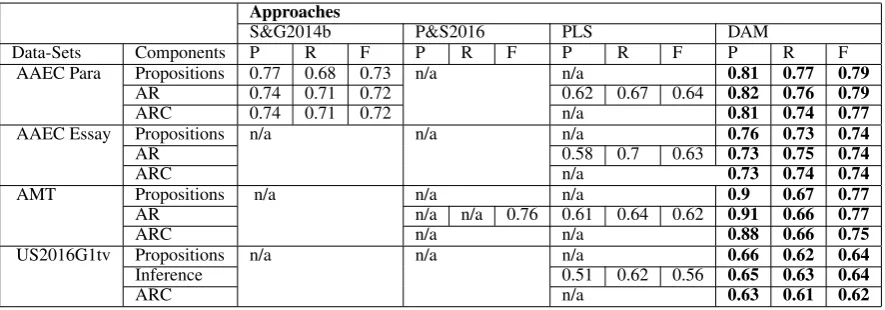
Table 3: The performance of Stab and Gurevyech’s technique (2014b) (SG2014b), Peldszus and Stede’s technique (2016) (PS2016), PLS and DAM in extracting the components of an argument, AR and the category of AR (ARC) (inference vs conflict) on AAEC (paragraph and essay level), AMT and US2016G1tv.
AR identification. The performance of our ap-proach in identifying premises, conclusions, AR and the category of AR (inference vs conflict) is presented in Table 3. Since the AR between a premise and conclusion depends on the similarity between theCandA, we tune the value ofαto 0.4 on a development set (similar components have a similarity measure greater than 0.4).
Following the evaluation strategy of Stab and Gurevych (2014b), we first evaluate our approach on AAEC at paragraph and essay levels where we achieve F measures of 0.79 and 0.74, respectively. We have also achieved an F measure of 0.77 on the AMT corpus and 0.64 on US2016G1tv cor-pus. The performance of our approach tends to confirm our initial hypothesis: the AR between propositions is indeed governed by the relation between their functional components. The per-formance varies across the three corpora with the lowest performance observed on the US2016G1tv corpus. We have inspected the three corpora to identify the possible factors and identified three issues: (a) similarity is dependent on the infor-mation presented in the propositions alone, yet US2016G1tv is particularly demanding in that un-derstanding many of the utterances depends upon
(external) context in addition to what is present in the discourse; (b) since US2016G1tv corpus is di-alogical, unlike the others, it includes the speak-ers’ text in the construction of propositions and hence their representation is more complex than the monological corpora. The complex represen-tations of propositions make the formalization and the extraction of target concepts and aspects diffi-cult; (c) the AMT corpus has a high proportion of co-reference to representCandAresulting in poor similarity, since the similarity between a word and its co-reference is low.
4.3 Error Analysis
Two major error types are observed. The first is related to propagation of the errors encountered duringC andA extraction to the similarity iden-tifier and AR ideniden-tifier affecting the overall per-formance. Specifically, when a word is incorrectly identified as part of CorA, their similarity mea-sure is affected and then the decision about the AR.
and between “food” and “family”. Yet the first pair is more closely related as compared to the later. Moreover, propositions involving two or more categories of aspects (where each category is supported or attacked by different propositions) present a challenge, since it requires grouping of the aspects and consider each group as a unit to compute similarity.
4.4 Comparison Systems
We have compared our approach against the lead-ing techniques in the field includlead-ing Stab and Gurevych’s work (2014b), Peldszus and Stede’s (2016) work, and proposition level similarity. We re-implement proposition level similarity and use the results reported by the authors for the remain-ing approaches.
Stab and Gurevych (2014b) propose a classifier which identify argument components and AR cat-egory using a multiclass classification on (AAEC) (Stab and Gurevych, 2014a). Instead of consid-ering the entirety of essay, they connect proposi-tions within the same paragraph. They use Weka implementation of four different classifiers: SVM, Naive Bayes, C4.5 Decision Tree and Random Forest (Hall et al., 2009). SVM scored the best result with an overall accuracy of 0.73 and 0.72 in identifying argument components and AR re-spectively on AAEC (Stab and Gurevych,2014a) at paragraph level.
Peldszus and Stede (2016) aim to map RST trees to argumentation structures (Taboada and Mann,2006) using subgraph matching and an ev-idence graph model. They evaluate several fea-tures of their system on AMT (Peldszus and Stede,
2013). We are concerned with one of the features in order to make direct comparison: identifying if two EDUs are connected on which they achieve an overall F-measure of 0.76.
Most related to our work is an approach us-ing proposition level similarity (PLS) as an inte-gral component to determine argument structure (Lawrence and Reed, 2015). They use similar-ity to indicate the AR existing between EDUs and supplement other features to identify the entire ar-gument structure. Since the similarity component alone can not induce the direction of the relation between the EDUs, we compared its performance in terms of detecting the existence of AR be-tween EDUs. PLS provides a challenge to identify among different relations, since a pair of
proposi-tions in a given argument can score strong sim-ilarity without involving AR. PLS does not iden-tify the direction of relation (claim vs premise) and hence these values are listed as n/a in Tables 3. We also use n/a to indicate that the evaluation result for the respective evaluation criteria (identifying premise, conclusion and AR) is not available for the comparison approaches.
Table 3 shows the performance of DAM, PLS, Stab and Gurevych’s approach (2014b), and Peld-szus and Stede’s (2016) approach on the three data-sets. DAM outperformed all the approaches across the three corpora achieving the highest pre-cision, recall and F-measure. The decrease in recall on AMT is attributed to the fact that co-references are productive in the corpus affecting similarity output, since similarity techniques are dependent on the lexicon choice (i.e the similarity between a word and its co-reference is low).
5 Conclusion
In this work, we have presented an approach for linking premises and conclusions that uses the similarity of target concepts and aspects, and the agreement between the opinions on target con-cepts and aspects of EDUs. We have demon-strated that the argument relations existing be-tween propositions are largely dependent on the relations existing between the individual compo-nents (target concepts, aspects, opinions on target concepts and opinions on aspects) of the proposi-tions. It would also be nice to explore about more fine-grained functional components and grammat-ical entities in the future works. Not only does our DAM approach outperform the current state of the art, most importantly, it is shown to work without modification across heterogeneous cor-pora (AAEC, AMT and US2016G1tv) which are substantially different in kind. This generality is an important milestone in the development of argument mining techniques and suggests that a combination of structural and distributional tech-niques, as employed here, offers the potential for robust, domain-independent performance in this extremely demanding task.
Acknowledgments
References
Masayuki Asahara and Yuji Matsumoto. 2003. Japanese named entity extraction with redundant morphological analysis. In Proceedings of the 2003 Conference of the North American Chapter of the Association for Computational Linguistics on Human Language Technology, pages 8–15. Association for Computational Linguistics.
Michele Banko, Michael J Cafarella, Stephen Soder-land, Matt Broadhead, and Oren Etzioni. 2007. Open information extraction from the web. In IJ-CAI, pages 2670–2676.
Daniel M. Bikei, Scott Miller, Richard Schwartz, and Ralph Weischedel. 1997. Nymble: a high-performance learning name-finder. InProceedings of the fifth conference on Applied natural language processing, pages 194–201. Association for Compu-tational Linguistics.
Andrew Borthwick, John Sterling, Eugene Agichtein, and Ralph Grishman. 1998. Exploiting diverse knowledge sources via maximum entropy in named entity recognition. InSixth Workshop on Very Large Corpora, pages 152–160.
Carlos Chesnevar, Jarred McGinnis, Sanjay Mod-gil, Iyad Rahwan, Chris Reed, Guillermo Simari, Matthew South, Gerard Vreeswijk, and Steven Will-mott. 2006. Towards an argument interchange for-mat. The knowledge engineering review, 21(4):293– 316.
Steffen Eger, Johannes Daxenberger, and Iryna Gurevych. 2017. Neural end-to-end learning for computational argumentation mining. In Proceed-ings of the 55th Annual Meeting of the Association for Computational Linguistics, pages 11–22. Asso-ciation for Computational Linguistics.
Oren Etzioni, Michael Cafarella, Doug Downey, Ana-Maria Popescu, Tal Shaked, Stephen Soderland, Daniel S Weld, and Alexander Yates. 2005. Un-supervised named-entity extraction from the web: An experimental study. Artificial intelligence, 165(1):91–134.
Minqing Hu and Bing Liu. 2004. Mining and sum-marizing customer reviews. In Proceedings of the ACM SIGKDD International Conference on Knowl-edge Discovery and Data Mining (KDD-2004).
Mathilde Janier, John Lawrence, and Chris Reed. 2014. OVA+: an argument analysis interface. In Com-putational Models of Argument: Proceedings of COMMA, volume 266, page 463.
Wei Jin, Hung Hay Ho, and Rohini K. Srihari. 2009. Opinionminer: A novel machine learn-ing system
for web opinion mining and extraction. In Proceed-ings of the 15th ACM SIGKDD international con-ference on Knowledge discovery and data mining, pages 1195–1204. ACM.
Nanda Kambhatla. 2004. Combining lexical, syntactic, and semantic features with maximum entropy mod-els for extracting relations. In Proceedings of the ACL 2004 on Interactive poster and demonstration sessions, page 22. Association for Computational Linguistics.
John Lawrence, Mathilde Janier, and Chris Reed. 2015. Working with open argument corpora. InEuropean Conference on Argumentation, pages 367–380.
John Lawrence and Chris Reed. 2015. Combining argument mining techniques. In Proceedings of the 2nd Workshop on Argumentation Mining, pages 127–136.
John Lawrence and Chris Reed. 2017. Using com-plex argumentative interactions to reconstruct the argumentative structure of large-scale debates. In
Proceedings of the 4th International ACL/EMNLP Workshop on Argument Mining, pages 108–117.
John Lawrence, Chris Reed, Colin Allen, Simon McAl-ister, and Andrew Ravenscroft. 2014. Mining argu-ments from 19th century philosophical texts using topic based modelling. In Proceedings of the First Workshop on Argumentation Mining, pages 79–87.
Quoc Le and Tomas Mikolov. 2014. Distributed rep-resentations of sentences and documents. In Inter-national Conference on Machine Learning, pages 1188–1196.
Joselice Ferreira Lima, Clia M. Gomes Amaral, and Lus Fernando R. Molinaro. 2010. Alternation.
CENTERIS, 2(11):426–435.
Andrew McCallum and Wei Li. 2003. Early results for named entity recognition with conditional random fields, feature induction and web-enhanced lexicons. InProceedings of the seventh conference on Natural language learning at HLT-NAACL, pages 188–191. Association for Computational Linguistics.
Tomas Mikolov, Kai Chen, Greg Corrado, and Jef-frey Dean. 2013. Efficient estimation of word representations in vector space. arXiv preprint arXiv:1301.3781.
Marie-Francine Moens, Eric Boiy, Raquel Mochales Palau, and Chris Reed. 2007. Automatic detection of arguments in legal texts. In Proceedings of the 11th international conference on Artificial intelli-gence and law, pages 225–230. ACM.
Andreas Peldszus and Manfred Stede. 2013. Ranking the annotators: An agreement study on argumenta-tion structure. InProceedings of the 7th linguistic annotation workshop and interoperability with dis-course, pages 196–204.
Andreas Peldszus and Manfred Stede. 2015. Joint pre-diction in mst-style discourse parsing for argumen-tation mining. InProceedings of the 2015 Confer-ence on Empirical Methods in Natural Language Processing, pages 938–948.
Andreas Peldszus and Manfred Stede. 2016. Rhetori-cal structure and argumentation structure in mono-logue text. InProceedings of the Third Workshop on Argument Mining, pages 103–112.
Mohammad Taher Pilehvar, David Jurgens, and Roberto Navigli. 2013. Align, disambiguate and-walk: A unified approach for measuring semantic similarity. InProceedings of the 51st Annual Meet-ing of the Association for Computational LMeet-inguis- Linguis-tics, pages 1341–1351.
Soujanya Poria, Erik Cambria, and Alexander Gel-bukh. 2016. Aspect extraction for opinion min-ing with a deep convolutional neural network.
Knowledge-Based Systems, 108:42–49.
Lance A Ramshaw and Mitchell P Marcus. 1999. Text chunking using transformation-based learning. In
Natural language processing using very large cor-pora, pages 157–176. Springer.
Sara Rosenthal, Noura Farra, and Preslav Nakov. 2017. Semeval-2017 task 4: Sentiment analysis in Twit-ter. InProceedings of the 11th International Work-shop on Semantic Evaluation,SemEval ’17,Associa-tion for Computa’17,Associa-tional Linguistics.
Cristian Sminchisescu, Atul Kanaujia, and Dimitris Metaxas. 2006. Conditional models for contextual human motion recognition. Computer Vision and Image Understanding, 104(2-3):210–220.
Christian Stab and Iryna Gurevych. 2014a. Annotating argument components and relations in persuasive es-says. pages 1501–1510.
Christian Stab and Iryna Gurevych. 2014b. Identify-ing argumentative discourse structures in persuasive essays. InProceedings of the 2014 Conference on Empirical Methods in Natural Language Process-ing, pages 46–56.
Maite Taboada and William Mann. 2006. Rhetorical structure theory: Looking back and moving ahead.
Discourse studies, 8(3):423–459.
Mikolov Tomas, Chen Kai, Corrado Greg, and Dean Jeffrey. 2013. Efficient estimation of word repre-sentations in vector space. InarXiv preprint arXiv, pages 1301–3781.
Maria P.G. Villalba and Patrick Saint-Dizier. 2012. Some facets of argument mining for opinion anal-ysis. COMMA, 245:23–34.
Jacky Visser, Barbara Konat, Rory Duthie, Marcin Koszowy, Katarzyna Budzynska, and Chris Reed. 2019. Argumentation in the 2016 US presidential elections: annotated corpora of television debates and social media reaction.Language Resources and Evaluation.
Lei Zhang and Bing Liu. 2014. Aspect and entity extraction for opinion mining. In Data mining and knowledge discovery for big data, pages 1–40. Springer.