Towards a Lexicon-grammar based Framework for NLP
an Opinion Mining Application
Annibale Elia, Serena Pelosi,
Alessandro Maisto and Raffaele Guarasci
Department of Political, Social and Communication Science University of Salerno
{elia,spelosi,amaisto,rguarasci}@unisa.it
Abstract
The present research exploits the large amount of linguistic resources developed into the Lexicon-grammar paradigm in the domain of the Opinion Mining. Grounded on the Semantic Predicates theory, the proposed system is able to automatically match the syntactic structures selected by special classes of verbs, indicating positive or negative Sentiment, Opinion or Physi-cal acts, with the semantic frames evoked by the same lexical items. This methods has been tested on a large dataset com-posed of short texts, such as tweets and news headings.
1 Introduction
In our research we propose a computational use of the Lexicon-grammar (LG) theories in the domain of the Opinion Mining.
We take advantage of both the huge amount of lin-guistic facts, accurately formalized and described in the LG paradigm, and from the possibility to apply and test them on big data. The purpose is to build a fine grained Information Extraction tool able to locate meaningful information in raw texts and to characterize them with thorough semantic descriptions.
According with the Semantic Predicates theory (Gross, 1981), it has been possible to perform a matching between the definitional syntactic struc-tures, attributed to each class of verbs, and the se-mantic information we attached in the database to every lexical entry.
This way we could create a strict connection be-tween the arguments, selected by a given Predi-cate listed in our tables, and the actants involved into the same verb’s Semantic Frame (Fillmore, 1976; Fillmore and Baker, 2001; Fillmore, 2006). Thanks to our LG-based linguistic rules, anchored
on the Semantic Predicates, we started with this research the development of an NLP framework that, on the base of sophisticated syntactic and se-mantic analyses, extracts real text occurrences and labels them with the semantic roles involved in ev-ery matched sentence.
This ambitious work, that in this preliminary stage focused just on the predicates indicating senti-ments, opinions and physical acts, intends, in fu-ture works, to become a larger development of an LG-based Italian cross-platform open library for various kind of linguistic analyses.
We excluded from this work the Transfer, the Spa-tial and the also the Psychological Predicates, be-cause they have been already tested on different kinds of raw data with satisfactory results (Vietri, 2014; Elia et al., 2010; Elia and Vietri, 2010; Elia et al., 2013; Maisto and Pelosi, 2014b).
2 Theoretical Background
The Lexicon-grammar (LG), the method and the practice of formal description of the natural lan-guage, introduced important changes in the way in which the relationship between lexicon and syntax was conceived. (Gross, 1971; Gross, 1975). In the LG theoretical framework the minimum discourse units endowed with meaning are the whole nuclear sentences, generally anchored on the verbs, which hold together the relationships between the selected arguments.
That means that the sentence structure is already contained in the operator (Harris, 1971; Harris, 1976).
We chose this paradigm because of its compatibil-ity with the purposes of the computational linguis-tics, that, in order to reach high performances in results, requires a large amount of linguistic data, as much as possible, exhaustive, reproducible and well organized.
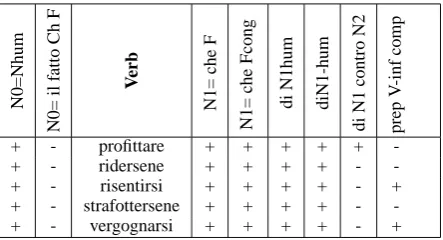
The collection of the linguistic information is con-stantly registered into LG tables, binary matrices
that cross-check the lexical entries with transfor-mational, distributional and structural properties (see Table 1).
The LG classification and description of the Italian verbs1 (Elia et al., 1981; Elia, 1984; D’Agostino, 1992) is grounded on the differentiation of three different macro-classes: transitive verbs; intransi-tive verbs and verbs that select compleintransi-tive clauses as complement. Every LG class has its own def-initional structure, that corresponds with the syn-tactic structure of the nuclear sentence selected by a given number of verbs2. All the lexical entries are, then, differentiated from one another in each class, by taking into account all the transforma-tional, distributional and structural properties ac-cepted or rejected by every item.
The formal notation used in the LG framework can be summarized in the following way: N, that al-ways indicates a nominal group, is followed by a number, which specifies its nature. (N0 stands for the sentence formal subject, N1 for the first com-plement and N2 for the second comcom-plement); V stands for the verbs; Prep for the prepositions and
Che F suggests the presence of completive or
sub-jective clauses.
2.1 Semantic Predicates
The whole set of syntactical structure of a given language (Sy) is linkable to the entire collection of the semantic items of the same language (Se) by means of specific interpretation rules. This is the basic assumption on which has been build the Semantic Predicates theory into the LG framework, that postulates a parallelism between the Sy actants and the Se aurguments (Gross, 1981). As an example, in [1]
[1] Quello slogan[N0/h]offende[V/O] le donne[N1/t] “That slogan offends the women”
the verb offendere “to offend”, belonging to the LG class 20UM (N0 V N1hum), will be associated to a Predicate with two variables, described by the function O (h,t), through the following rules of in-terpretations (see Section 3 for the other seman-tic functions for the annotation of Semanseman-tic
Predi-1freely available at the addresshttp://dsc.unisa.
it/composti/tavole/combo/tavole.asp 2e.g. V for piovere “to rain” and all the verbs of the class
1; N0 V for bruciare “to burn” and the other verbs of the class 3; N0 V da N1 for provenire“to come from” and the verbs belonging to the class 6; etc...
cates of different nature):
1. the Opinion Holder (h in the Se) corresponds to the formal subject (N0 in Sy);
2. the opinion Target (t in the Se) is the human complement (N1 in Sy).
As shown in [2], the syntactic transformations in which the same Predicate is involved do not modify the role played by its arguments, that, in order to be semantically labeled in a correct way, must be always led back to their original form [3].
[2] Il fuoriclasse `e stato offeso da un politico messicano
“The champion has been offended by a Mexican politician”
[3] Un politico messicano[N0/h] ha offeso[V/O] Il fuoriclasse[N1/t]
“a Mexican politician offended the champion”
Special kinds of Semantic Predicates have been already used in NLP applications into a lexicon-grammar context; we mention (Vietri, 2014; Elia et al., 2010; Elia and Vietri, 2010) that formalized and tested the Transfer Predicates on the Italian Civil Code; (Elia et al., 2013) that focused on the Spatial Predicates and (Maisto and Pelosi, 2014b) that exploited the Psychological Semantic Predi-cates for Sentiment Analysis purposes.
2.2 Frame Semantics
“Some words exist in order to provide access to knowledge of such frames to the participants in the communication process, and simultaneously serve to perform a categorization which takes such framing for granted” (Fillmore, 2006). With these words it has been depicted the Frame Seman-tics, which describes the sentences on the base of predicators able to bring to mind the semantic
frames (inference structures, linked through
cates under consideration.
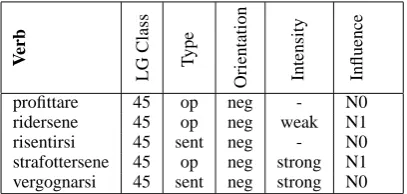
Differently from the most used Italian tagsets (Bosco et al., 2009), in order to avoid high compu-tational costs, our lexical databases are provided with basic semantic description. In detail, the tagset used in this work is the following:
1. Type
(a) SENT, sentiment
(b) OP, opinion
(c) PHY physical act
2. Orientation
(a) POS, positive
(b) NEG, negative
3. Intensity
(a) STRONG, intense
(b) WEAK, feeble
Speaking in terms of Frame Semantics, we identified in the Opinion Mining and in the Emo-tion DetecEmo-tion field three Frames of interest, re-called by specific Predicates: Sentiment, Opinion and Physical act. The frame elements evoked by such frames are described below.
Sentiment. It refers to the expression of any given frame of mind or affective state. The “sentiment” words can be put in connection with some WordNet Affect categories (Strapparava et al., 2004), such as emotion, mood, hedonic signal. Examples are sdegnarsi “to be indignant” (class 10); odiare “to hate” (class 20); affezionarsi “to grow fond” (class 44B); flirtare “to flirt” (class 9); disprezzare “to despise” (class 20); gioire “to rejoice” (class 45).
Predicates of that kind evoke as frame elements an experiencer (e), that feels the emotion or other internal states, and a causer (c), an event or a person that instigates such states (Gildea and Ju-rafsky, 2002; Swier and Stevenson, 2004; Palmer et al., 2005). This semantic frame summarizes the FrameNet ones connected to emotions, such as Cause to experience, Sensation Emotions, Cause emotion, Emotions of mental activity, Emotion active, etc...
In this work, they are described by a function of that sort: S(e,c)
Opinion. The type “Opinion”, instead, is the ex-pression of positive or negative viewpoints, beliefs or judgments, that can be personal or shared by most people. It comprises, among the WN-affect categories, trait, cognitive state, behavior,
atti-tude. OP examples are ignorare “to neglect” (class
20); premiare “to reward” (class 20); difendere “to defend” (class 27); esaltare “to exalt” (class 22); dubitare “to doubt” (class 45); condannare “to condemn” (class 49); deridere “to make fun of” (class 50).
The frame elements they evoke are an opinion
holder (h), that states an opinion about an object or
an event, and an opinion target (t), that represents the event or the object on which the opinion is ex-pressed about (Kim and Hovy, 2006; Liu, 2012). Into the FrameNet frame Opinion and Judgment, the opinion holder is called Cognizer, but we pre-ferred to use a word which is more common in the Sentiment Analysis and in the Opinion Mining lit-erature.
O(h,t) is the function by which they are
semanti-cally described.
Physical act. The type “Physical act” comprises verbs like baciare “to kiss” (class 18); suicidarsi “to commit suicide” (class 2); vomitare “to vomit” (class 2A); sparare “to shoot” (class 4);
schiaffeg-giare “to slap” (class 20); palpegschiaffeg-giare “to grope”
(class 18).
For this group of predicates the selected frame el-ements ara a patient (z) that is the victim (for the negative actions) or the beneficiary (for the pos-itive ones) of the physical act carried out by an
agent (a) (Carreras and M`arquez, 2005; M`arquez
et al., 2008).
It includes a large number of FrameNet frames, such as Cause bodily experience, Cause harm
Killing, Rape, Sex, Shoot projectiles, Violence,
etc...
The meaning of the sentences in which occur pred-icates of that kind is summarized in the function
P(z,a).
Semantic Orientation and Intensity. To per-form the Orientation and the Intensity attribution, we manually explored the Italian LG tables of verbs and weighted the Prior Polarity (Osgood, 1952) of the words endowed with a positive or negative SO.
V
Mortal Kombat
| {z }
holder
ambisce
| {z }
OP+3
a il miglior lancio della storia| {z }
target
N0 prep N1
V
50enne
| {z }
agent
accoltella
| {z }
PHY-3
la moglie
| {z }
patient
N0 N1
V
Brunetta
| {z }
experiencer
si infuria
| {z }
SENT-2
con la P residente Boldrini| {z }
causer
N0 prep N1
Figure 1: Examples of syntactically and semantically annotated sentences
4.3 Results and Open Issues
The corpus described in section 4.1, that counts 127,044 short texts, has been analyzed and seman-tically and syntacseman-tically annotated.
The representative sample on which the hu-man evaluation has been performed, instead, has 42,348 texts.
The evaluation of the performances of our tool proved the effectiveness of the Lexicon-grammar approach. The average F-scores achieved in the different datasets are 0.71 in the Twitter and 0.76 in the Heading corpus.
Although such results, in this preliminary stage of the research, can be considered satisfactory, they shown that applying a lexicon-grammar method through a dependency parser is not the greatest solution for our purposes. The main goal of this work was, in fact, to demonstrate the validity and the reliability a LG based framework for NLP, but, in order to improve our performances, in fu-ture works we aim to build from scratch a syn-tactic parser completely inspired on the Lexicon-grammar theories, able to take into account not only the definitional syntactic structures of the LG verb classes, but also capable to handle every lemma’s idiosyncrasies and any one of the proper-ties systematically recorded into the LG tables. In the end, it must be pointed out that this re-search represents just an aspect of a broader Sen-timent Analysis framework, which involves not
only the verbs in its lexicon, but also other, simple and compound, parts of speech, including special kinds of opinionated idioms (Maisto and Pelosi, 2014b; Maisto and Pelosi, 2014a). The novel as-pect introduced in this work concerns, above all, the lexicon-grammar idea that in the lexicon are already contained syntactic clues.
5 Conclusion
This paper has introduced the possibility to apply and test the Lexicon-grammar theories and lexi-cal resources on large corpora for different kinds of information extraction and content analysis pur-poses.
In detail, this research focused on the automatic extraction from raw data of sentences regarding Sentiments, Opinions and Physical Acts and on the semantic annotation of the roles involved in each one of the mentioned frames. Both the ex-traction and the analysis are anchored on a lexicon of Semantic Predicates, able to evoke, at the same time, the syntactic structures of their arguments in real text occurrences and the nature of the roles that those arguments play into specific semantic frames.
re-liability of a Lexicon-grammar based framework for many kinds of NLP purposes. We started the experimentation on a corpus of tweets and news headlines, with satisfactory results.
References
Rodrigo Agerri and Ana Garc´ıa-Serrano. 2010. Q-wordnet: Extracting polarity from wordnet senses. In LREC.
Shlomo Argamon, Kenneth Bloom, Andrea Esuli, and Fabrizio Sebastiani. 2009. Automatically determin-ing attitude type and force for sentiment analysis. pages 218–231.
Giuseppe Attardi, Felice DellOrletta, Maria Simi, and Joseph Turian. 2009. Accurate dependency parsing with a stacked multilayer perceptron. Proceedings
of EVALITA, 9.
Collin F Baker, Charles J Fillmore, and John B Lowe. 1998. The berkeley framenet project. In
Proceed-ings of the 17th international conference on Compu-tational linguistics-Volume 1, pages 86–90.
Associ-ation for ComputAssoci-ational Linguistics.
Farah Benamara, Carmine Cesarano, Antonio Pi-cariello, Diego Reforgiato Recupero, and
Venkatra-mana S Subrahmanian. 2007. Sentiment
analy-sis: Adjectives and adverbs are better than adjectives alone. In ICWSM.
Cristina Bosco, Simonetta Montemagni, Alessandro Mazzei, Vincenzo Lombardo, Felice DellOrletta,
and Alessandro Lenci. 2009. Evalita09 parsing
task: comparing dependency parsers and treebanks.
Proceedings of EVALITA, 9.
Xavier Carreras and Llu´ıs M`arquez. 2005. Introduc-tion to the conll-2005 shared task: Semantic role la-beling. In Proceedings of the Ninth Conference on
Computational Natural Language Learning, pages
152–164. Association for Computational Linguis-tics.
Emilio D’Agostino. 1992. Analisi del discorso:
metodi descrittivi dell’italiano d’uso. Loffredo.
Jorge Carrillo de Albornoz, Laura Plaza, and Pablo
Gerv´as. 2012. Sentisense: An easily scalable
concept-based affective lexicon for sentiment anal-ysis. In LREC, pages 3562–3567.
Annibale Elia and Simonetta Vietri. 2010.
Lexis-grammar & semantic web. INFOtheca, 11:15a–38a.
Annibale Elia, Maurizio Martinelli, and Emilio
D’Agostino. 1981. Lessico e Strutture sintattiche.
Introduzione alla sintassi del verbo italiano. Napoli:
Liguori.
Annibale Elia, Simonetta Vietri, Alberto Postiglione,
Mario Monteleone, and Federica Marano. 2010.
Data mining modular software system. In SWWS, pages 127–133.
Annibale Elia, Daniela Guglielmo, Alessandro Maisto, and Serena Pelosi. 2013. A linguistic-based method for automatically extracting spatial relations from large non-structured data. In Algorithms and
Ar-chitectures for Parallel Processing, pages 193–200.
Springer.
Annibale Elia. 1984. Le verbe italien. Les compl´etives
dans les phrases `a un compl´ement.
Andrea Esuli and Fabrizio Sebastiani. 2006. Deter-mining term subjectivity and term orientation for opinion mining. 6:2006.
Charles J Fillmore and Collin F Baker. 2001. Frame semantics for text understanding. In Proceedings
of WordNet and Other Lexical Resources Workshop, NAACL.
Charles J Fillmore, Collin F Baker, and Hiroaki Sato. 2002. The framenet database and software tools. In
LREC.
Charles J Fillmore. 1976. Frame semantics and the na-ture of language*. Annals of the New York Academy
of Sciences, 280(1):20–32.
Charles J Fillmore. 2006. Frame semantics. Cognitive
linguistics: Basic readings, 34:373–400.
Daniel Gildea and Daniel Jurafsky. 2002. Automatic labeling of semantic roles. Computational
linguis-tics, 28(3):245–288.
Maurice Gross. 1971. Transformational Analysis of
French Verbal Constructions. University of
Penn-sylvania.
Maurice Gross. 1975. M´ethodes en syntaxe. Hermann.
Maurice Gross. 1981. Les bases empiriques de la no-tion de pr´edicat s´emantique. Langages, pages 7–52.
Zellig Sabbettai Harris. 1971. Structures
math´ematiques du langage, volume 3. Dunod.
Zellig Sabbeta¨ı Harris. 1976. Notes du cours de syn-taxe, traduction franc¸aise par maurice gross. Paris:
Le Seuil.
Vasileios Hatzivassiloglou and Kathleen R McKeown. 1997. Predicting the semantic orientation of adjec-tives. In Proceedings of the 35th annual meeting
of the association for computational linguistics and eighth conference of the european chapter of the as-sociation for computational linguistics, pages 174–
181. Association for Computational Linguistics.
Soo-Min Kim and Eduard Hovy. 2006. Extracting opinions, opinion holders, and topics expressed in online news media text. In Proceedings of the
Work-shop on Sentiment and Subjectivity in Text, pages 1–
8. Association for Computational Linguistics.
Alessandro Lenci, Gabriella Lapesa, and Giulia Bo-nansinga. 2012. Lexit: A computational resource
on italian argument structure. In LREC, pages
3712–3718.
Bing Liu. 2012. Sentiment analysis and opinion min-ing. Synthesis Lectures on Human Language
Tech-nologies, 5(1):1–167.
Alessandro Maisto and Serena Pelosi. 2014a. Feature-based customer review summarization. In On the
Move to Meaningful Internet Systems: OTM 2014 Workshops, pages 299–308. Springer.
Alessandro Maisto and Serena Pelosi. 2014b. A
lexicon-based approach to sentiment analysis. the italian module for nooj. In Proceedings of the
Inter-national Nooj 2014 Conference, University of Sas-sari, Italy. Cambridge Scholar Publishing.
Llu´ıs M`arquez, Xavier Carreras, Kenneth C Litkowski, and Suzanne Stevenson. 2008. Semantic role label-ing: an introduction to the special issue.
Computa-tional linguistics, 34(2):145–159.
Saif Mohammad, Cody Dunne, and Bonnie Dorr. 2009. Generating high-coverage semantic orienta-tion lexicons from overtly marked words and a the-saurus. In Proceedings of the 2009 Conference on
Empirical Methods in Natural Language Process-ing: Volume 2-Volume 2, pages 599–608.
Associa-tion for ComputaAssocia-tional Linguistics.
Alena Neviarouskaya, Helmut Prendinger, and Mit-suru Ishizuka. 2009. Compositionality principle in recognition of fine-grained emotions from text. In
ICWSM.
Alena Neviarouskaya, Helmut Prendinger, and Mitsuru Ishizuka. 2011. Sentiful: A lexicon for sentiment analysis. Affective Computing, IEEE Transactions
on, 2(1):22–36.
Charles E Osgood. 1952. The nature and measurement of meaning. Psychological bulletin, 49(3):197.
Martha Palmer, Daniel Gildea, and Paul Kingsbury.
2005. The proposition bank: An annotated
cor-pus of semantic roles. Computational linguistics, 31(1):71–106.
Bo Pang and Lillian Lee. 2008. Opinion mining and sentiment analysis. Foundations and trends in
infor-mation retrieval, 2(1-2):1–135.
Ellen Riloff, Janyce Wiebe, and Theresa Wilson. 2003. Learning subjective nouns using extraction pattern bootstrapping. In Proceedings of the seventh
confer-ence on Natural language learning at HLT-NAACL 2003-Volume 4, pages 25–32. Association for
Com-putational Linguistics.
Josef Ruppenhofer, Michael Ellsworth, Miriam RL Petruck, Christopher R Johnson, and Jan Schef-fczyk. 2006. Framenet ii: Extended theory and practice.
H Schmid, M Baroni, E Zanchetta, and A Stein. 2007. The enriched treetagger system. In proceedings of
the EVALITA 2007 workshop.
Helmut Schmid. 1994. Probabilistic part-of-speech tagging using decision trees. In Proceedings of the
international conference on new methods in lan-guage processing, volume 12, pages 44–49.
Cite-seer.
Philip J Stone, Dexter C Dunphy, and Marshall S Smith. 1966. The general inquirer: A computer approach to content analysis.
Carlo Strapparava, Alessandro Valitutti, et al. 2004. Wordnet affect: an affective extension of wordnet. In LREC, volume 4, pages 1083–1086.
Robert S Swier and Suzanne Stevenson. 2004. Unsu-pervised semantic role labelling. In Proceedings of
EMNLP, volume 95, page 102.
Maite Taboada, Caroline Anthony, and Kimberly Voll.
2006. Methods for creating semantic orientation
dictionaries. In Proceedings of the 5th International
Conference on Language Resources and Evaluation (LREC), Genova, Italy, pages 427–432.
Maite Taboada, Julian Brooke, Milan Tofiloski,
Kim-berly Voll, and Manfred Stede. 2011.
Lexicon-based methods for sentiment analysis.
Computa-tional linguistics, 37(2):267–307.
Leonid Velikovich, Sasha Blair-Goldensohn, Kerry Hannan, and Ryan McDonald. 2010. The viability of web-derived polarity lexicons. In Human
Lan-guage Technologies: The 2010 Annual Conference of the North American Chapter of the Association for Computational Linguistics, pages 777–785.
As-sociation for Computational Linguistics.
MJM Vermeij. 2005. The orientation of user opinions through adverbs, verbs and nouns. In 3rd Twente
Student Conference on IT, Enschede June. Citeseer.
Simona Vietri. 2014. The italian module for nooj. In In Proceedings of the First Italian Conference on
Computational Linguistics, CLiC-it 2014. Pisa
Uni-versity Press.