Aspect-based Opinion Mining: A Survey
K. Vivekanandan Ph.D.
ProfessorBharathiar University Coimbatore, India
J. Soonu Aravindan
Research Scholar (Ph.D.)Bharathiar University Coimbatore, India
ABSTRACT
Opinion mining has been an emerging research field in Computational Linguistics, Text Analysis and Natural Language Processing (NLP) in recent years. It is the computational study of people‟s opinions towards entities and their aspects. Entities usually refer to individuals, events, topics, products and organizations. Aspects are attributes or components of entities. In the last few years, social media has become an excellent source to express and share people‟s opinion on entities and their aspects. With the availability of vast opinionated web contents in the form of comments, reviews, blogs, tweets, status updates, etc. it is harder for people to analyze all opinions at a time to make good decisions. So, there is a need for effective automated systems to evaluate opinions and generate accurate results. Sentiment Analysis, Emotion Analysis, Subjectivity Detection has also become an active research area in recent years along with opinion mining. This article presents a brief overview of opinion mining and its classifications and specifically focuses on the sub topic aspect-based opinion mining, its approaches, metrics used for evaluation and latest research challenges.
General Terms
Opinion Mining, Text Mining.
Keywords
Sentiment Analysis, Emotion Analysis, Subjectivity Detection, Polarity Detection, Text Analysis.
1.
INTRODUCTION
Textual information can be broadly classified into two main types: facts and opinions [1]. Facts are objective expressions about entities, events and their properties. They are something which already happened or actually the case itself. (e.g., “iPhone is an Apple product”). Opinions are subjective expressions that describe peoples‟ judgment, viewpoint, feelings towards entities, events and their properties. (e.g., “I like this Apple iPhone 6”).
A decade ago, when an individual needed to make a decision, He/she typically asked for opinions from friends, neighbors and families. Similarly, when an organization wanted to find the opinions about its products and services, it conducted opinion polls, surveys, and focus groups.
In the last few years, volumes of opinionated text have grown rapidly and are also publically available. Social media plays a major role by allowing people to share and express their opinion on products, events, topics, individuals, and organizations in the form of comments, reviews, blogs, tweets, status updates, etc. instantly. Therefore, it‟s quite obvious that people always prefer to hear other‟s opinion before making a decision.
Some people express their opinions in binary scale (i.e. Positive or Negative) and some other expresses their opinions explicitly in terms of ratings (i.e. one to three or five stars). The term „Polarity‟ in opinion mining refers to the orientation scale. The polarity is predicted on either a binary (positive or negative) or multivariate scale using sentiment polarity classification or polarity classification techniques [2]. Literature study shows that for polarity classification on binary scale, Peter D. Turney has presented an unsupervised learning algorithm for classifying reviews of automobiles, banks, movies, and travel destinations as recommended (thumbs up) or not recommended (thumbs down) [3] and for multivariate scale, Bo Pang and Lillian Lee has addressed the rating-inference problem by determining the evaluation with respect to a multi-point scale (e.g., one to five stars) [4]. Zhang and Varadarajan have built regression models for utility scoring on three real-world data sets [5].
The rest of the paper is organized as follows. Section 2 provides a brief overview of major opinion mining tasks. Section 3 discusses about aspect based opinion mining. Section 4 deals with different approaches followed in aspect based opinion mining. In Section 5, evaluations of metrics are discussed. Sections 6 explain about different classifications in opinion. Section 7 deals with the emerging challenges in aspect based opinion mining. Section 8 concludes this paper with future scopes in opinion mining.
2.
OPINION MINING TASKS
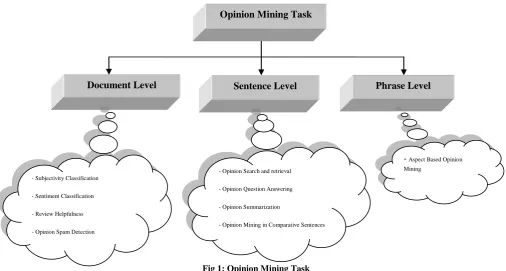
In General, opinions are found from user‟s text. Text can be a word, phrase, sentence or document. According to Bing Liu, Opinion mining tasks are generally classified into three major levels: document-level, sentence-level, and phrase-level [6]. Each level has its own sub-level tasks. Tasks at each level might also be applied to other levels.
Fig 1: Opinion Mining Task
In Sentence level, there are two steps involved. First, to classify whether the sentence is a subjective or objective sentence. Second, to classify the polarity of subjective sentences. Sentence that express factual information are said to be objective sentence and sentence that express subjective views and opinions are said to be subjective sentence. Weibe et al. has mentioned the effectiveness of subjectivity analysis in a sentence and the natural language processing applications to which it is relevant [8]. The following subtasks such as opinion search and retrieval (to find public opinion on any entity), opinion question answering (to answer opinion based questions about the target entities), opinion summarization (to give a summary of opinions), and opinion mining in comparative sentences (to identify and extract comparative opinions) can be performed. Early works [12], [13], [14], [15] have addressed the problems of each sub tasks.
In Phrase level, classification is performed in fine-grained manner. Here, features or aspects of entities are mainly focused and polarity is calculated for each and every individual aspects. For example, the sentence “The laptop‟s sound is good, but the battery life is very short” evaluates two aspects (Speaker Quality, Battery Life) of laptop (entity). The sentiment on laptop‟s sound is positive and battery life of laptop is negative. Aspect based opinion mining comes under phrase level opinion mining task. Several methods for aspect based opinion mining [16], [17], [18], [19] have been proposed to extract features or aspects from user reviews.
3.
ASPECT BASED OPINION MINING
People not only express their opinion on documents and sentences, but also in aspects and entities. Level of information provided in document level or sentence level is not sufficient for making a good decision and therefore looking in-depth into aspects and entities gave a new direction for research called aspect or feature based opinion mining. A drawback in document or sentence level is that they cannot
provide complete information of a product, For example, a positive or negative review of a particular product doesn‟t mean that the reviewer likes or dislikes all aspects of that product. A person who needs to buy a mobile with excellent camera quality will search only for the reviews about that particular aspect i.e. „picture quality‟ rather than overall review of that mobile.
Single aspect opinions are reviews where people focus only on one aspect of the product, whereas in multi-aspect, people express differing opinions on more than one aspect simultaneously in the same review and even in same sentence of that product. For example, “This book had a good storyline, but the paper quality is bad”. Here, the reviewer gave a positive mention on the “story” aspect and negative mention on the “paper quality” aspect of the book. Segmenting multi-aspect sentence into multiple single multi-aspect sentences is called sentence segmentation and it is a challenging task in aspect based opinion mining.
Two major tasks in aspect based opinion mining are aspect extraction and aspect sentiment classification. Process of identifying the opinion words from the given sentence is called aspect extraction and categorizing the extracted opinion words into one of the polarity scales is called aspect sentiment classification. People express opinions either implicitly (Indirect) or explicitly (Direct). Extracting implicit aspect expression is a difficult task since opinion words differs from people to people. To identify implicit aspects, some previous studies [22], [23], [24], [25] attempted to use different approaches like hybrid association rule mining, pointwise mutual information, co-occurrence association rule mining and classification based approach. Study shows that adjectives, adverbs and subjective nouns are considered to be aspect related words in most cases and gives high performance [3], [20], [21].
Opinion Mining Task
Document Level Sentence Level Phrase Level
- Subjectivity Classification - Sentiment Classification - Review Helpfulness - Opinion Spam Detection
- Opinion Search and retrieval - Opinion Question Answering - Opinion Summarization
- Opinion Mining in Comparative Sentences
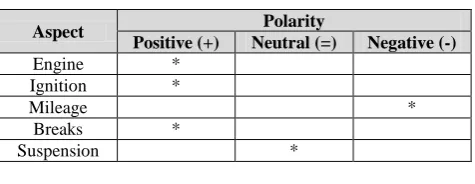
Consider this review “This bike is very smooth to ride, breaks are good, engine is not noisy, suspension of wheels are ok, ignition is digital and also has self-start option, mileage is not up to the mark”. It is clearly known that reviewer has given his views on multiple aspects of the bike. Polarity of each aspect is evaluated and given in the table below.
Table 1. Polarity of Aspect
Aspect Polarity
Positive (+) Neutral (=) Negative (-)
Engine *
Ignition *
Mileage *
Breaks *
Suspension *
4.
APPROACHES IN ASPECT BASED
OPINION MINING
In general, not all people like or dislikes all aspects of a product, it differs from every individual, from a review of 1000 sentence it is difficult for potential customer to read reviews of all aspects at a time and make a decision whether to purchase the product or not. Many research works have been carried out in order to overcome this difficulty. Most of the early works of aspect based opinion mining are categorized as one of these approaches. Frequency-based, Relation-based and Model-based approaches [34].
4.1
Frequency-based approach
This approach identifies the frequent aspects of product on which many people have expressed their opinion. If the occurrence of aspect related terms is more than that of the pre-defined threshold value then that term is considered to be frequent aspect. Ana-Maria Popescu and Oren Etzioni [26] has introduced an unsupervised information extraction system called OPINE which mines reviews to extract important product features. It extracts all noun phrases and keeps those with frequency greater than the threshold. Finally a classification technique is applied. Hu and Liu [13] have used part-of-speech (POS) tagger to identify frequent nouns and noun phrases from the reviews. Scanffidi et al. [27] has compared the frequency of extracted candidates with their occurrence rates.
4.2
Relation-based approach
This approach finds the relationship between the words and sentiments to identify aspects. For example, the sentence “This phone has a good display” denotes [sentiment, aspect] that the aspect is „display‟ of the phone and the sentiment „good‟ is said to be positive. This approach usually engages part-of-speech (POS) patterns to extract aspects. Liu et al. has introduced an unsupervised information extraction system called OPINE which mines reviews to extract important product features. It extracts all noun phrases and keeps those with frequency greater than the threshold. Finally a classification technique is applied. Hu and Liu [13] have used part-of-speech (POS) tagger to identify frequent nouns and noun phrases from the reviews. Scanffidi et al. [27] has compared the frequency of extracted candidates with their occurrence rates.
4.3
Model-based approach
In this approach, several models are created for aspect extraction so that it can be applied to domain independent data sets. This approach overcomes the limitation of frequency and relation based approach. Most commonly used mathematical model based on supervised learning techniques are Hidden Markov Model (HMM) and Conditional Random Field (CRF), and based on unsupervised topic modeling techniques are Probabilistic Latent Semantic Indexing (PLSI) and Latent Dirichlet Allocation (LDA) [6]. Jin et al. [30] proposed a model called Opinion Miner based on HMM to identify aspects, sentiments and their polarities. Wong et al. [31] proposed a generative probabilistic graphical model incorporated with HMM to extract aspects from websites. Titoc et al. [32] has proposed a topic model to induce multi-grain topics based on LDA for extracting aspects from user reviews. Zhao et al. [33] has proposed a MaxEnt-LDA hybrid model to jointly discover both aspects and aspect-specific opinion words.
5.
EVALUATION METRICS
The performance of any method for aspect-based opinion mining can be evaluated using measures such as accuracy, precision, and recall if the ground truth is available [34]. However, for real life data sets it is typically not available. In those cases, humans act as judges and they are asked to read the reviews and manually create a set of „true‟ aspects and ratings for them which is then compared with the system generated results to measure the performance. In the context of opinion mining, accuracy is used as a measure of how well a binary classification test correctly identifies or excludes the given condition which is further compared with the manually created ratings.
)
(
.
.
.
FN
TN
FP
TP
of
no
TN
of
no
TP
of
no
accuracy
Where,
TP – True Positive
TN – True Negative
FP – False Positive
FN – False Negative
Precision is the fraction of extracted aspect that is relevant to the problem.
aspects
extracted
aspects
true
aspects
extracted
precission
Recall is the fraction of aspects that are relevant to the query that are successfully retrieved.
aspects
true
aspects
true
aspects
extracted
recall
F-measure is used for evaluation of extracted aspects
x
x
2
precission
recall
precission
recall
measure
F
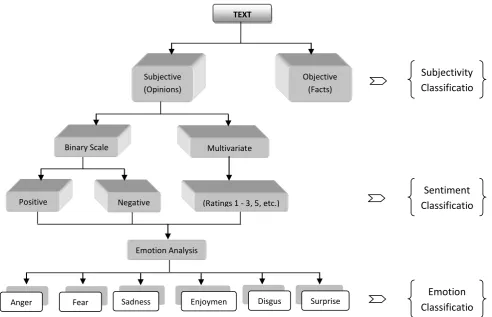
Fig 2: Opinion Classification
6.
OPINION CLASSIFICATION
In general, opinion text is classified into two major categories: Subjective and Objective. Further, subjective sentences are classified into binary scale and multivariate scale. Binary scale classifies opinion as either positive or negative whereas multivariate scale classifies opinion as a likert scale which can be 3 point, 5 point or more than that. These sentiment classifications can further helps to extract the emotions involved in the opinion. According to Paul Ekman [35], basic emotions are classified into six categories (i.e. Anger, Fear, Sadness, Enjoyment, Disgust and Surprise). Consider this review “I couldn‟t believe my eyes. I was amazed to see the author signed copy of my favorite book which I ordered in flipkart”. It is clearly known that the reviewer was surprised to see the book. He has expressed one of the basic emotions.
7.
EMERGING RESEARCH
CHALLENGES
Although much works has been carried out in the field of aspect based sentiment analysis, there are still many challenges to overcome.
7.1
Implicit Aspects
Most of the current works focus on explicit aspects. Handling implicit aspects is a challenging task. In general, there may be many implicit expressions in a review, e.g., „This mobile will not fit in a pocket.‟ „Fit in a pocket‟ indicates the „size‟ aspect of that mobile. Further research is needed to handle this kind of sentences.
7.2
Sarcastic Sentence
These kinds of sentences are frequently seen in online reviews or blogs about politics. Here, if a person says something
positive he/she actually means negative, and vice versa. For example, „yesterday I bought a superb car; engine doesn‟t start the next day‟. Sarcasm has been studied in linguistics, psychology and cognitive science [35], [36].
7.3
Aspect-based Segmentation
Aspect-based segmentation of word level will be more effective compared to sentence level. Study shows that work has been done more on sentence level segmentation. To handle multi-aspect sub sentence, word level segmentation is needed.
7.4
Domain Adaptation
Aspects differ from product to product. It is very important to have domain knowledge before mining sentiments from the aspect. The same sentiment word might indicate different polarities in different domains. For example, the sentence „please go and read the book‟ indicates positive opinion in a book review and the same denotes negative opinion in movie review. Developing domain-independent algorithms, methods, models, for aspect based opinion are still in progress.
8.
CONCLUSION
This paper surveyed the field of opinion mining and sentiment analysis. It has been a very active area of research in recent years due to many challenging research problems and also involves more practical applications in various fields. For Decades, commercial organizations have been making business decisions based on transactional data stored in relational databases. In the contemporary world of multi-national business enterprises, processing numerical data alone seems insufficient. The advanced development in Web Content Mining, Natural Language Processing (NLP) and
TEXT
Subjective (Opinions)
Objective (Facts)
Binary Scale Multivariate Scale
(Ratings 1 - 3, 5, etc.) Positive Negative
Emotion Analysis
Anger Disgus Surprise
t Enjoymen
t Sadness
Fear
Subjectivity
Classificatio
n
Sentiment
Classificatio
n
Emotion
Classificatio
Social Media Analytics supports large business enterprise to make good business decisions. This paper gives a brief introduction about opinion mining, its classification tasks and specifically focused on the sub topic aspect based opinion mining, its approaches, evaluation metrics and emerging research challenges. Future scope in opinion mining includes emotion and emoticon mining and analysis which deal with textual sentences or documents expressing various human emotions. Emotion analysis is widely used for market
decision making. Thus new innovations are encouraged in challenging area of opinion mining.
9.
ACKNOWLEDGEMENTS
The authors are thankful to the faculty members and research scholars of the Department of Computer Science and Department of Management Studies, Bharathiar University for their support and encouragement.
10.
REFERENCES
[1] Liu, Bing. 2010. “Sentiment Analysis and Subjectivity.” Handbook of Natural Language Processing: 1–38. [2] Sarvabhotla, Kiran, Prasad Pingali, and Vasudeva
Varma. 2011. “Sentiment Classification: A Lexical Similarity Based Approach for Extracting Subjectivity in Documents.” Information Retrieval 14: 337–53.
[3] Turney, Peter D. 2001. "Thumbs up or thumbs down?: semantic orientation applied to unsupervised classification of reviews.” In Proceedings of the 40th Annual Meeting on Association for Computational Linguistics, ACL ‘02 417- 424.
[4] Goldberg, Andrew, Andrew Goldberg, Xiaojin Zhu, and Xiaojin Zhu. 2006. “Seeing Stars When There Aren‟t Many Stars: Graph-Based Semi-Supervised Learning for Sentiment Categorization.” In Proceedings of TextGraphs: The First Workshop on Graph Based Methods for Natural Language Processing, 45–52. [5] Zhang, Zhu, and Balaji Varadarajan. 2006. “Utility
Scoring of Product Reviews.” In Proceedings of the 15th ACM International Conference on Information and Knowledge Management, 51–57.
[6] Pang, Bo, and Lillian Lee. 2008. “Opinion Mining and Sentiment Analysis.” Foundations and Trends® in Information Retrieval 2: 1–135.
[7] Pang, Bo, Lillian Lee, and Shivakumar Vaithyanathan. 2002. “Thumbs up? Sentiment Classification Using Machine Learning Techniques.” In Conference on Empirical Methods in Natural Language Processing (EMNLP 2002), 79–86.
[8] Wiebe, Janyce et al. 2004. “Learning Subjective Language.” Computational Linguistics 30: 277–308.
[9] Yu, Lei, Jia Ma, Seiji Tsuchiya, and Fuji Ren. 2008. “Opinion Mining: A Study on Semantic Orientation Analysis for Online Document.” In Proceedings of the World Congress on Intelligent Control and Automation (WCICA), 4548–52.
[10]Lim, Ee-Peng et al. 2010. “Detecting Product Review Spammers Using Rating Behaviors.” Proceedings of the 19th ACM International Conference on Information and Knowledge Management: 939–48.
[11]Liu, Jingjing et al. 2007. “Low-Quality Product Review Detection in Opinion Summarization.” In Computational Linguistics, 334–42.
[12]Moghaddam, Samaneh, and Martin Ester. 2011. “AQA: Aspect-Based Opinion Question Answering.” In Proceedings - IEEE International Conference on Data Mining, ICDM, 89–96.
[13]Hu, Minqing, and Bing Liu. 2004. “Mining and Summarizing Customer Reviews.” Proceedings of the 2004 ACM SIGKDD international conference on Knowledge discovery and data mining KDD 04 04: 168. [14]Huang, Shen et al. 2009. “Improving Product Review
Search Experiences on General Search Engines.” In Proceedings of the 11th International Conference on Electronic Commerce - ICEC ’09, 107.
[15]Jindal, Nitin, Bing Liu, and Liu Bing. 2006. “Mining Comparative Sentences and Relations.” In Proceedings of the 29th Annual International ACM SIGIR Conference on Research and Development in Information Retrieval - SIGIR ’06, 1331–36.
[16]Lu, Yue, ChengXiang Zhai, and Neel Sundaresan. 2009. “Rated Aspect Summarization of Short Comments.” Proceedings of the 18th international conference on World wide web - WWW ’09: 131.
[17]Wong, Tak-Lam, Wai Lam, and Tik-Shun Wong. 2008. “An Unsupervised Framework for Extracting and Normalizing Product Attributes from Multiple Web Sites.” Proceedings of the 31st annual international ACM SIGIR conference on Research and development in information retrieval SIGIR 08: 35.
[18]Popescu, Ana Maria, and Orena Etzioni. 2007. “Extracting Product Features and Opinions from Reviews.” In Natural Language Processing and Text Mining, 9–28.
[19]Liu, Bing, and South Morgan Street. 2005. “Opinion Observer : Analyzing and Comparing Opinions on the Web.” In Proceedings of the 14th International Conference on World Wide Web, 342–51.
[20]Riloff, Ellen et al. 2003. “Learning Subjective Nouns Using Extraction Pattern Bootstrapping.” Proceedings of the seventh conference on Natural language learning at HLT-NAACL 2003 -: 25–32.
[21]Hatzivassiloglou, V., V. Hatzivassiloglou, K.R. McKeown, and K.R. McKeown. 1997. “Predicting the Semantic Orientation of Adjectives.” Proceedings of the 35th Annual Meeting of the Association for Computational Linguistics and Eighth Conference of the European Chapter of the Association for Computational Linguistics pages: 181.
[22]Lingwei Zeng and Fang Li. 2013. “A Classification-Based Approach for Implicit Feature Identification.” Chinese Computational Linguistics and Natural Language Processing Based on Naturally Annotated Big Data Lecture Notes in Computer Science: 190-202. [23]Wang, Wei, Hua Xu, and Wei Wan. 2013. “Implicit
[24]Su, Qi et al. 2006. “Using Pointwise Mutual Information to Identify Implicit Features in Customer Reviews.” In Lecture Notes in Computer Science (including Subseries Lecture Notes in Artificial Intelligence and Lecture Notes in Bioinformatics), 22–30.
[25]Scaffidi, Christopher et al. 2007. “Red Opal: Product-Feature Scoring from Reviews.” In Proceedings of the 8th ACM Conference on Electronic Commerce - EC ’07, 182.
[26]Baccianella, Stefano, Andrea Esuli, and Fabrizio Sebastiani. 2009. “Multi-Facet Rating of Product Reviews.” In Lecture Notes in Computer Science (including Subseries Lecture Notes in Artificial Intelligence and Lecture Notes in Bioinformatics), 485– 96.
[27]Zhuang, Li, Feng Jing, and Xiao-Yan Zhu. 2006. “Movie Review Mining and Summarization.” In Proceedings of the 15th ACM International Conference on Information and Knowledge Management - CIKM ’06, 43.
[28]Jin, Wei, Hung Hay Ho, and Rohini K Srihari. 2009. “OpinionMiner: A Novel Machine Learning System for Web Opinion Mining and Extraction.” Proceedings of the 15th ACM SIGKDD international conference on Knowledge discovery and data mining: 1195–1203.
[29]Wong, Tak-Lam, Lidong Bing, and Wai Lam. 2011. “Normalizing Web Product Attributes and Discovering Domain Ontology with Minimal Effort.” In Proceedings of the Fourth ACM International Conference on Web Search and Data Mining, 805–14.
[30]Titov, Ivan, and Ryan McDonald. 2008. "Modeling online reviews with multi-grain topic models." In Proceedings of the 17th international conference on World Wide Web-WWW ’08, 111-120.
[31]Zhao, Wayne Xin, Jing Jiang, Hongfei Yan, and Xiaoming Li. 2010. “Jointly Modeling Aspects and Opinions with a MaxEnt-LDA Hybrid.” Computational Linguistics 16: 56–65.
[32]Samaneh Abbasi Moghaddam, (2013), “Aspect-Based Opinion Mining in Online Reviews” (Doctoral Dissertation), Simon Fraser University, Canada.
[33]Gibbs, Raymond W. 1986. “On the Psycholinguistics of Sarcasm.” Journal of Experimental Psychology: General 115: 3–15.
[34]Kreuz, Roger J., and Sam Glucksberg. 1989. “How to Be Sarcastic: The Echoic Reminder Theory of Verbal Irony.” Journal of Experimental Psychology: General 118: 374–86.