More than Bag-of-Words:
Sentence-based Document Representation for Sentiment Analysis
Georgios Paltoglou
Faculty of Science and Technology University of Wolverhampton Wulfruna Street, WV1 1LY, UK
Mike Thelwall
Faculty of Science and Technology University of Wolverhampton Wulfruna Street, WV1 1LY, UK
Abstract
Most sentiment analysis approaches rely on machine-learning techniques, using a bag-of-words (BoW) document represen-tation as their basis. In this paper, we examine whether a more fine-grained rep-resentation of documents as sequences of emotionally-annotated sentences can in-crease document classification accuracy. Experiments conducted on a sentence and document level annotated corpus show that the proposed solution, combined with BoW features, offers an increase in classi-fication accuracy.
1 Introduction
Sentiment analysis is concerned with automat-ically extracting sentiment-related information from text. A typical problem is to determine whether a text is positive, negative or neutral over-all. Most of the proposed solutions are based on supervised machine-learning approaches, with some notable exceptions (Turney, 2002; Lin and He, 2009), although unsupervised, lexicon-based solutions have also been used, especially in non review-based corpora (Thelwall et al., 2010).
This paper deals with the problem of detecting the overall polarity of a document. A common theme with a significant number of proposed solu-tions is the bag-of-words (BoW) document sentation, according to which a document is repre-sented as a binary or frequency-based feature vec-tor of the tokens it contains, regardless of their po-sition in the text. Nonetheless, significant seman-tic information is lost when all positional informa-tion is discarded. Consider, the following extract of a movie review (taken from Pang (2008)):
This film should be brilliant. It sounds like a great plot, . . . a good performance. However, it cant hold up.
Most of bag-of-words machine learning or lexicon-based solutions would be expected to clas-sify the extract aspositive because of the signif-icant number of positive words that it contains. However, a human reader studying the review, rec-ognizes thechange of polarity that occurs in the last sentence, a change that is hinted at by the first sentence (“should be brilliant”) but is only fully realized at the end. In fact, this phenomenon of “thwarted expectations” is particularly common in reviews and has been observed by both Pang et. al (2002) and Turney (2002) who noted that “the whole is not necessarily the sum of the parts”.
In this work we propose a solution to the afore-mentioned problem by building a meta-classifier which models each document as a sequence of emotionally annotated sentences. The advantage of this modeling is that it implicitly captures word position in the whole document in a semantically and structurally meaningful way, while at the same time drastically reducing the feature space for the final classification. Additionally, the proposed so-lution is conceptually simple, intuitive and can be used in addition to standard BoW features.
2 Prior Work
The commercial potential of sentiment analysis has resulted in a significant amount of research and Pang (2008) provides an overview. In this sec-tion, we limit our presentation to the work that is most relevant to our approach.
McDonald et al. (2007) used structured mod-els for classifying a document at different levmod-els of granularity. The approach has the advantage that it allows for classifications at different levels to influence the classification outcome of other lev-els. However, at training time, it requires labeled data at all levels of analysis, which is a signifi-cant practical drawback. T¨ackstr¨om and McDon-ald (2011) attempt to elevate the aforementioned requirement, focusing on sentence-level sentiment
analysis. Their results showed that this approach significantly reduced sentence classification errors over simpler baselines.
Although relevant to our approach, the focus of this paper is different. First, the overall purpose of our approach is to aid document-level classifi-cation. Second, the algorithm presented here uti-lizes sentence-level classification in order to train a document meta-classifier and explicitly retains the position and the polarity of each sentence.
Mao and Lebanon (2006) use isotonic Con-ditional Random Fields, in order to capture the flow of emotion in documents. They focus on sentence-level sentiment analysis, where the con-text of each sentence plays a vital role in pre-dicting the sentiment of the sentence itself. They also present some results for predicting global sen-timent, but convert the sentence-based flow to a smooth length-normalized flow for the whole doc-ument in order to compare docdoc-uments of different length and use ak-nearest neighbor classifier using Lpdistances as a measure of document similarity. Our work can be seen as an extension of their solution, where the fine-grained sentiment analy-sis is given as input to the meta-classifier in or-der to predict the overall polarity of the document. Nonetheless, in our modeling we retain the struc-tural coherence of the original document by repre-senting it as a discrete-valued feature vector of the sentiment of its sentences instead of converting it to a real-valued continuous function.
3 Sentence-based document
representation
The algorithm proposed in this paper is simple in its inception, intuitive and can be used in addi-tion to standard or extended (Mishne, 2005) docu-ment representations. Although the approach isn’t limited to sentiment classification and can be ap-plied to other classification tasks, the fact that phenomena such as “thwarted expectation” occur mainly in this context, makes the approach partic-ularly suitable for sentiment analysis.
3.1 Sentence classification
At the first level classification, the algorithm needs to estimate the affective content of the sentences contained in a document. The affective content of each sentence is characterized in two dimen-sions; subjectivity and polarity. The former esti-mation will aid in removing sentences which
con-tain no or little emotional content and thus don’t contribute to the overall polarity of the document and the latter estimation will be used in the final document representation as a surrogate for each sentence. Therefore, for each sentence we need to estimate its subjectivity and polarity, that is, build asubjectivityand apolarity detector.
Polarity detector: Given a set of positive and negative documents, the algorithm initially trains a standard unigram-based polarity classifier. In our experiments we tested Naive Bayes and Max-imum Entropy classifiers, but focus on the for-mer since both classifiers perform similarly, due to space constraints. The classifier utilizes the labels of the training documents as positive and negative instances. The trained classifier will be used at the second-level classification in order to estimate the polarity of individual sentences.
Subjectivity detector: As above, in this stage the algorithm trains a unigram-based subjectivity classifier, that will be used at a later stage for fil-tering out the sentences that don’t contribute to the overall polarity of the document. Training such a classifier is less straight-forward than training the polarity classifier, because of the potential lack of appropriate training data. We propose two solu-tions to this problem. The first one is based on using a static, external subjectivity corpus. The second partly elevates the need for a full subjec-tivity corpus, by requiring only a set of objective documents, which are usually easier to come by (e.g. wikipedia). In the this case, we can use the training documents as subjective instances and the objective documents as objective instances1. We present results with both approaches in section 5.
3.2 Document classification
Having built the unigram-based subjectivity and polarity classifiers in the first stage of the process, the sentence of each training document is classi-fied in terms of its subjectivity and polarity. The former estimation is used in order to remove ob-jective sentences which do not contribute to the overall polarity of the document and also helps in “normalizing” documents to a common length.
More specifically, the sentences are ranked in reference to their probability of being subjective and only the top M are retained, where M is a predetermined parameter. In section 5 we present
1Duringn-fold cross-validation, we utilize only the
Figure 1: Examples of document representation.
results with various threshold values, but experi-ments show that a value forMin the[15,25] inter-val performs best. A natural question is how does the algorithm deal with documents which have less thanM sentences. We provide the answer to this question subsequently, after we explain how the remaining sentences are ordered and utilized in producing the final document representation.
Having removed the least subjective sentences, the remaining are ordered in reference to their rel-ative position in the original document, that is, sentences that precede others are placed before them (see first example in middle section of Fig-ure 1). Using the polarity classifier built on the first stage of the algorithm, we estimate the po-larity of each sentence and use this information in order to represent the document as a sequence of emotionally annotated sentences. Alternatively, we can use the probability of polarity of the sen-tences (e.g.,P r(+1|sentence)) in order to repre-sent a document. In fact, the latter reprerepre-sentation retains more information than the simple polar-ity, for example distinguishing between a “barely” positive and a “highly” positive sentence. Al-though the polarity of both sentences would be the same (i.e., +1) retaining information about the probability provides the document-level classifier with additional information. This decision con-trasts with the way that sentence-based sentiment analysis is utilized by Mao and Lebanon (2006)
and the experiments presented in section 5 indi-cate that it typically results in increased accuracy.
The modeling serves two purposes: first of all, by retaining only the more subjective sentences, we remove all sentences which do not contribute to the final polarity of the document. Secondly, by ordering the remaining sentences by their relative original position, we maintain positional informa-tion about the emoinforma-tional content of the most sub-jective sentences in the document and thus may be able to extract useful positional patterns.
3.3 Dealing with small documents
sec-tions are attributed the maximum equal number of sentences and the remaining sentences are at-tributed as follows: ifM mod3 = 1, then the ex-tra sentence is added to the middle section and if M mod3 = 2then each one of the extra sentences are added to the beginning and last sections. For example ifM = 15, then the distribution of sen-tences is{5,5,5}, ifM = 16then the distribution is{5,6,5}and ifM = 17then{6,5,6}. Clearly, the decision of representing a document as three sections is ad-hoc, and some prior evidence sug-gests that a 4-way split is better for sentiment anal-ysis (Pang et al., 2002), but we believe it is more in accordance with the intuitive interpretation of doc-uments (Kress, 1999). See top section of Figure 1 for an example withM = 20.
Having determined the number of sentences that should be allocated to each section, the next logi-cal step is distributing the existing document sen-tences to each2. We adopt the same process as above, using the number of sentences in the doc-umentminstead ofM. Therefore, if for example a document has 7 sentences, then their distribu-tion would be{2,3,2}. The placement of the sen-tences for the beginning and ending sections be-gin at the first and last position respectively while for the middle section, they are placed around the center. The middle section of Figure 1 provides examples for differentmvalues.
Two final issues subsequently need to be re-solved. The first one refers to the filling of the empty positions and the second refers to the dis-tribution of sentences on the middle section when m andM differ in terms of their parity (odd vs. even). For the first issue we propose two solu-tions; the first one fills the empty positions with zeros and the second one fills them with the av-erage of the proceeding polarities or probabilities (e.g., the average of s1 ands2 in the first exam-ple, see lower section of Figure 1). For the sec-ond problem, we propose two possible solutions; a “forward weighting” approach where the sen-tences in the middle section are placed one posi-tion toward the beginning of the document and the “backward weighting” approach in which the re-verse happens. For example in the middle section of Figure 1 the former approach is used.
2Recall that this process is only adopted for documents
with less thanM sentences.
3.4 Training and testing
To summarize the whole process, during training the algorithm is given a set of positive and neg-ative documents, and initially trains a unigram-based polarity classifier using the labels of the documents. A subjectivity classifier is also built either using a separate subjectivity corpus or al-ternatively, utilizing the documents in the training set assubjective instances and only a separate set ofobjectivedocuments as objective instances. Us-ing those classifiers, every sentence in the original training documents are classified in terms of sub-jectivity and polarity. The sentences are ranked in terms of their probability of being subjective and only the top M are retained, where M is a pre-defined threshold. Next, the sentences are ordered in reference to their position at the document and their polarity or probability of polarity is used to represent the document and train the second-level, sentence-based classifier.
During testing time, the unigram based classi-fiers that were built from the training corpus are utilized in order to classify all the sentences in the testing documents in terms of their subjectivity and polarity. As described previously, only theM most subjective sentences are kept and they are re-ordered in reference to their position in the origi-nal document. The learnt sentence-based classifier is applied and a final polarity prediction is made.
4 Experimental Setup
For our experiments, we used a corpus of customer reviews containing reviews of books, DVDs, elec-tronics, music and videogames, split by polar-ity (henceforth referred to as the consumer re-views dataset). The dataset was introduced by T¨ackstr¨om and McDonald (2011) and is freely available3. It comprises 97 positive, 98 neutral and 99 negative reviews, annotated by two human as-sessors both at the document and at the sentence level. Overall inter-annotator agreement is 86% and Cohen’s κ value is 0.79. More information about the dataset can be found at T¨ackstr¨om and McDonald (2011). The existence of a set of neu-traldocuments and the fact that the corpus is also annotated at the sentence level make it very appro-priate for our purposes. Alternatively, we could have utilized the corpus presented by McDonald
3The dataset can be obtained from http://www.
Training Dataset Naive Bayes MaxEnt
Subjectivity corpus (whole documents)
60.75% 59.04%
Subjectivity corpus (filtered documents)
64.87% 62.00%
Consumer reviews (whole documents)
59.81% 63.12%
Consumer reviews (filtered documents)
62.69% 67.73%
Table 1: Subjectivity detection accuracy on the consumer reviews dataset. Result for the last two rows are based on 10-fold cross validation.
et al. (2007), but due to licensing issues, it is cur-rently not publicly available.
For building the subjectivity classifier we use two different approaches. First, we utilize the ob-jective documents of the corpus as obob-jective in-stances and the training documents as subjective. Two parameterizations are tested: in the first case, we train the classifier on the whole documents and in the second we train the classifier only on the ob-jective/subjective sentences for each category re-spectively. This way, we’ll be able to test whether using much less noisy training data significantly aids the effectiveness of the classifier. In the sec-ond approach, we use a static, external corpus to train the subjectivity classifier. In this paper, we use thesubjectivitycorpus by Pang et al. (2002). The corpus is larger than the current dataset, but is only partly relevant to it, as it was built primar-ily for movie reviews while the consumer dataset that we are utilizing contains reviews from multi-ple domains.
As baselines, we use the standard unigram rep-resentation with presence-based features, with and without length normalization. The first-stage uni-gram based sentence classifiers are built using the MALLET toolkit (McCallum, 2002). For the fi-nal document classification, either using unigram or sentence-based features, we use the SVM im-plementation from Chang and Lin (2001). Experi-ments are based on 10-fold cross-validation.
5 Results
5.1 Sentence classification
We begin the analysis of the results by reporting the effectiveness of the subjectivity unigram clas-sifiers in Table 1.
Approach Accuracy Accuracy (setting 1) (setting 2)
Baselines
Unigrams 69.81% 69.81%
Unigrams (N.) 71.76% 71.76% S-based (M=5)
Standard 65.55% 64.55%
+ Unigrams 74.39% 72.81% + Unigrams (N.) 75.39% 72.81% S-based (M=10)
Standard 69.21% 69.71%
+ Unigrams 74.86% 76.42%
+ Unigrams (N.) 73.76% 72.31% S-based (M=20)
Standard 69.55% 65.10%
+ Unigrams 75.39% 74.42% + Unigrams (N.) 77.42% 76.42%
S-based (M=30)
Standard 68.63% 65.60%
+ Unigrams 74.92% 74.92% + Unigrams (N.) 76.92% 76.42%
S-based (M=max)
Standard 67.13% 67.13%
+ Unigrams 74.92% 74.9% + Unigrams (N.) 76.42% 76.42%
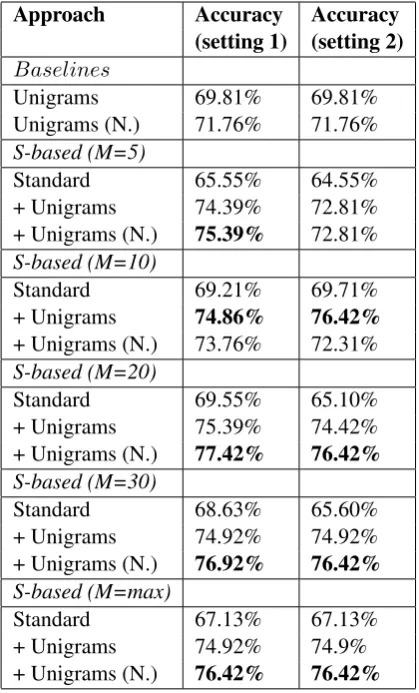
Table 2: 10-fold cross-validation accuracy. S-based denotes the sentence-based approach. For theM =max setting we use the number of sen-tences of the longest document.
5.2 Document classification
Due to the number of variations of different doc-ument representations that can be explored (e.g., values of parameter M) and space constraints in this section we will present results with the opti-mal settings that we’ve discovered for those pa-rameters4. Therefore in this section, all presented
results are based on backward balancing where the documents are represented as a sequence of prob-abilitiesP r(+1|sentence)and the empty features for small documents are set to 0.
Table 2 presents results for various values ofM, with and without additional unigram-based fea-tures. The Standard approach is based on using only sentences while the+Unigramsadditionally adds unigram tokens as features. Lastly, we denote full document length-normalization with “(N.)”. The results on the2ndcolumn of Table 2 (i.e., set-ting 1) are based on using theobjectivedocuments of the dataset for training the objectivity classifier while the results in the3rd column are based on using thesubjectivitycorpus (i.e., setting 2).
The first rows of the tables present the unigram-based classification accuracy. As already stated, the proposed algorithm can be used in combina-tion with other approaches, so we’ve opted to uti-lize this simple approach as a baseline in order to demonstrate its applicability. The baseline re-sults indicate that the specific dataset offers par-ticular challenges, with the standard unigram ap-proach with a length-normalized document vec-tor obtaining an accuracy of71.76%, much lower that the typical 88% typically reported for other datasets (Pang et al., 2002). Using the sentence-based document representation of documents, ini-tially doesn’t provide any significant advantage, maintaining the accuracy effectiveness roughly at the same levels for most values of M. Espe-cially when utilizing the external subjectivity cor-pus, the effectiveness seems to drop by approx-imately 6% (Table 2, 3rd column, Standard ap-proach forM = 20andM = 30).
Nonetheless, using the sentence-based docu-ment representation in combination with standard presence-based unigram features always results in an increase in classification accuracy, especially for values ofM in the[20,30]range, reaching an accuracy of76%in most cases, a rough increase of 6%and77.42%at best, withM = 20. The results
4Detailed results with different parameter values are
avail-able from the authors upon request.
overall indicate that the algorithm is quite robust to the value of parameterM. The algorithm retains the high level of effectiveness even whenM is set to the number of sentences of the longest docu-ment, that is, no sentences are removed and the approach presented in section 3.3 for small docu-ments is applied to the rest of the docudocu-ments.
The observed differences between using the ex-ternalsubjectivitycorpus and the objective docu-ments of the dataset aren’t as pronounced as ex-pected. Although the observed accuracy for a low value of M in this case is decreased, overall the accuracy levels for higherMvalues remain stable, typically higher than76%. The results indicate the potential robustness of the algorithm in reference to the effectiveness of the subjectivity classifier and demonstrate that a static external subjectivity corpus can provide comparable performance.
Limitations: In addition to the experiments presented here, some experiments were also con-ducted on the MovieReview dataset (Pang et al., 2002) and initial results showed smaller improve-ments in accuracy. This fact may indicate that the proposed method is more suited for datasets with only limited training data or when unigram fea-tures alone attain reduced accuracy.
6 Conclusion
In this paper, we presented a simple and intuitive method of document representation that both im-plicitly retains word position in documents and explicitly trains a document classifier on the se-quence of sentence-based opinions expressed in the document. The proposed algorithm aims to overcome some of the drawbacks of the standard bag-of-words representation, by offering a struc-turally and semantically meaningful way of effec-tively representing documents for sentiment anal-ysis.
An obvious extension of the proposed algorithm is the utilization of sequential models, such as CRFs (Lafferty et al., 2001) and structurally-based features (T¨ackstr¨om and McDonald, 2011) in or-der to increase the effectiveness of the sentence polarity detection, as it was shown that increased sentence classification accuracy typically resulted in increased document classification accuracy.
References
Chih-Chung Chang and Chih-Jen Lin,
vector machines. Software available at http://www.csie.ntu.edu.tw/ cjlin/libsvm.
Nancy Kress. 1999. Beginnings, Middles and Ends (The elements of fiction writing). Writer’s Digest Books.
John D. Lafferty, Andrew McCallum, and Fernando C. N. Pereira. 2001. Conditional random fields: Probabilistic models for segmenting and labeling se-quence data. InProceedings of the Eighteenth Inter-national Conference on Machine Learning, ICML ’01, pages 282–289, San Francisco, CA, USA. Mor-gan Kaufmann Publishers Inc.
Chenghua Lin and Yulan He. 2009. Joint senti-ment/topic model for sentiment analysis. In Pro-ceeding of the 18th ACM conference on Information and knowledge management, CIKM ’09, pages 375– 384, New York, NY, USA. ACM.
Y. Mao and G. Lebanon. 2006. Sequential models for sentiment prediction. ICML Workshop on Learning in Structured Output Spaces.
Andrew Kachites McCallum. 2002. Mal-let: A machine learning for language toolkit. http://mallet.cs.umass.edu.
Ryan McDonald, Kerry Hannan, Tyler Neylon, Mike Wells, and Jeff Reynar. 2007. Structured models for fine-to-coarse sentiment analysis. In Proceed-ings of the Association for Computational Linguis-tics (ACL), pages 432–439, Prague, Czech Republic, June. Association for Computational Linguistics.
G. Mishne. 2005. Experiments with mood classifi-cation in blog posts. In 1st Workshop on Stylistic Analysis Of Text For Information Access.
B. Pang and L. Lee. 2008. Opinion Mining and Senti-ment Analysis. Now Publishers Inc.
Bo Pang, Lillian Lee, and Shivakumar Vaithyanathan. 2002. Thumbs up? sentiment classification using machine learning techniques. InProceedings of the 2002 Conference on Empirical Methods in Natural Language Processing (EMNLP).
O. T¨ackstr¨om and R. McDonald. 2011. Discover-ing fine-grained sentiment with latent variable struc-tured prediction models. In Proceedings of the 33rd European Conference on Information Retrieval (ECIR 2011), Dublin, Ireland.
Mike Thelwall, Kevan Buckley, Georgios Paltoglou, Di Cai, and Arvid Kappas. 2010. Sentiment strength detection in short informal text.J. Am. Soc. Inf. Sci. Technol., 61:2544–2558, December.