Computational Linguistics and Chinese Language Processing
Vol. 20, No. 2, December 2015, pp. 45-64 45 The Association for Computational Linguistics and Chinese Language Processing
Word Co-occurrence Augmented Topic Model in
Short Text
Guan-Bin Chen
and Hung-Yu Kao
Abstract
The large amount of text on the Internet cause people hard to understand the meaning in a short limit time. Topic models (e.g. LDA and PLSA) has been proposed to summarize the long text into several topic terms. In the recent years, the short text media such as tweet is very popular. However, directly applies the transitional topic model on the short text corpus usually gating non-coherent topics. Because there is no enough words to discover the word co-occurrence pattern in a short document. The Bi-term topic model (BTM) has been proposed to improve this problem. However, BTM just consider simple bi-term frequency which cause the generated topics are dominated by common words. In this paper, we solve the problem of the frequent bi-term in BTM. Thus, we proposed an improvement of word co-occurrence method to enhance the topic models. We apply the word co-occurrence information to the BTM. The experimental result that show our PMI-β-BTM gets well result in the both of regular short news title text and the noisy tweet text. Moreover, there are two advantages in our method. We do not need any external data and our proposed methods are based on the original topic model that we did not modify the model itself, thus our methods can easily apply to some other existing BTM based models.
Keywords: Short Text, Topic Model, Document Clustering, Document Classification
1.
Introduction
With the advancement of information and communication technology, the information we obtained is very abundant and multivariate. Especially, in the recent 15 years, many type of the Internet media grow up so that people can get large amount of the information in a short time. These internet media include Wikipedia, blogs and the recently popular social medial
46 Guan-Bin Chen & Hung-Yu Kao
such as Twitter, Facebook et.al. Generally, the articles/documents in the Wikipedia, and blogs are usually the long text and have the complete content. While the short text social media, such as Twitter, become very popular in the recent years. The reason is that these short text social media provide a very convenient way to share the people feeling and thinking.
Generally, these Internet media deliver the people thinking by using the text. However, the large amount of text on the Internet cause people hard to understand the meaning in a short limit time. To solve the problem, many document summarization technologies have been proposed. Among them, topic models summarize the context in large amount of documents into several topic terms. By reading these topic terms, people will understand the content in a short time. Topic model can be performed by the vector space model or the probability model. In the recent years, the probability models such as Probabilistic Latent Semantic Analysis (pLSA) (Hofmann, 1999) and Latent Dirichlet Allocation (LDA) (Blei et al., 2003) are very popular because the probability models base on the document generation process. The inspirations of the document generation process come from the human written articles. When a person writes an article, he or she will inspire some thinking in mind, then extend these thinking into some related words. Finally, they write down these words to complete an article. Probability topic models simulate the behavior of above document generating process. In the view of the vectorization of the probability topic models, when we have a text corpus, we have known the documents and its words distribution by statistic the word vector. Then, the probability topic models split the document-word matrix into the document-topic and topic-word matrices. The distribution of the document-topic matrix describes that the degree of each document belongs each topic while the topic-word matrix describes the degree of each word belongs each topic. The “topic” in these two matrices is the latent factor as the human thinking.
48 Guan-Bin Chen & Hung-Yu Kao
2013; Cheng et al., 2014) which directly model the word co-occurrence and use the corpus-level bi-term to overcome the lack of the text information problem. A bi-term is an unordered word pair co-occurring in a short text document. The major advantage of BTM is that 1) BTM model the word co-occurrence by using the explicit bi-term, and 2) BTM aggregate these word co-occurrence patterns in the corpus for topic discovering (Yan et al., 2013; Cheng et al., 2014). BTM abandons the document-level directly. A topic in BTM contains several bi-term and a bi-term crosses many documents. BTM emphasizes that the co-occurrence information comes from all bi-terms in whole corpus. However, BTM will make the common words be performed excessively because the frequency of bi-term comes from the whole corpus instead of a short document.
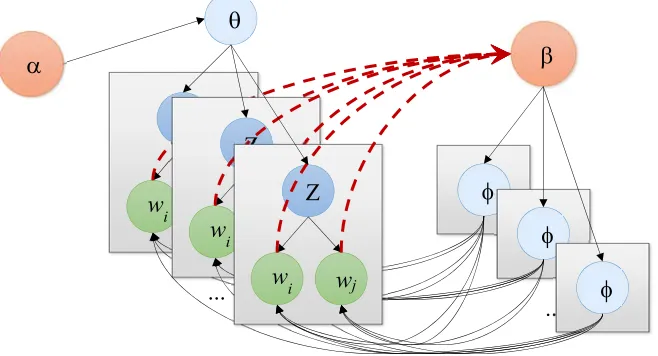
Figure 2. The graphical representation of the PMI-β-BTM
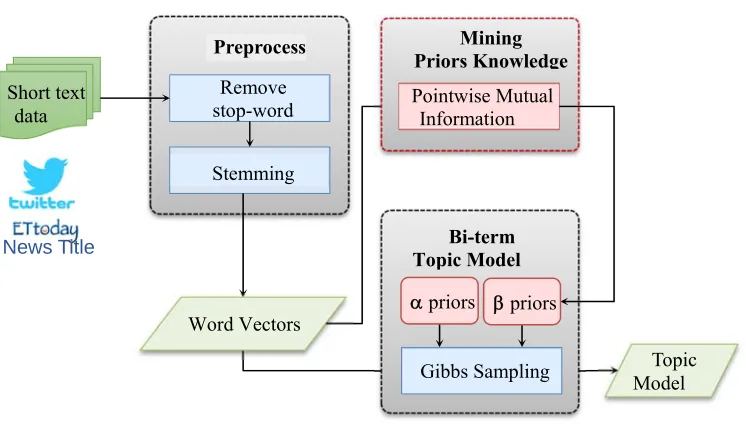
In this paper, we solve the frequent bi-term problem in BTM. We propose an approach base on BTM. For the problem in BTM, a simple and intuitive solution is to use pointwise mutual information (PMI) (Church & Hanks, 1990) to decrease the statistical amount of the frequent words in whole corpus. With respect to the frequency of bi-term, the PMI can normalize the score by each single word frequency in the bi-term. Otherwise, the priors in the topic models usually set symmetric. This symmetric priors mean that there is not any preference of words in any specific topic (Wallach et al., 2009). An intuitive idea is that why not adopt some word co-occurrence information in priors to restrict the generated topics. Base on above two ideas, we propose a novel prior adjustment method, PMI-β priors, which first use the PMI to mine the word co-occurrence from the whole corpus. Then, we transform such PMI scores to the priors of BTM. Figure 2 shows the graphical representation of the PMI-β-BTM.
In summary, the proposed approach enhance the amount of the word co-occurrence and
w
i
w
j
...
...
w
i
w
j
...
...
w
i
Word Co-occurrence Augmented Topic Model in Short Text 49
also based on the original topic model. Basing on the original topic model means we did not modify the model itself, thus our methods can easily apply to some other existing BTM based models, to overcome the short text problem without any modification. To test the performance of our two methods completely, we prepare two different types of short text corpus for the experiments. One is the tweet text and another is the news title. The context of news title dataset is regular and formal while the text in tweet usually contain many noise. Experimental results show our PMI-β priors method is better than the BTM in both tweet and news title datasets.
The remaining of this paper shows below. In Section 2, we show the survey of some traditional topic models and the previous works of topic model to overcome the short text. Section 3 shows our proposed PMI-β priors and the re-organized document methods. The experiment results show in Section 4. Finally, we conclude this research in Section 5.
2.
Related Work
2.1 The Survey of the Traditional Topic Models for Normal Text
Topic Model is a method to find out the hidden semantic topics from the observed documents in the text corpus. Topic Models have been researched several years. Generally, topic model can be performed by the vector space model or the probability model. The early one of the vector space topic model, Latent Semantic Analysis (LSA) (Landauer et al., 1998), uses the singular value decomposition (SVD) to find out the latent topic. However, LSA does not model the polysemy well and the cost of SVD is very high (Hofmann, 1999; Blei et al., 2003). Afterward, Thomas Hofmann proposed the one-document-multi-topics model, probabilistic Latent Semantic Analysis (pLSA) (Hofmann, 1999). pLSA bases on the document generation process which like the human writing. However, the numerous parameters of pLSA cause the overfitting problem and pLSA does not define the generation of the unknown documents. In 2003, Blei et al. proposed a well-known Latent Dirichlet Allocation (LDA) (Blei et al., 2003), LDA use the prior probability in Bayes theory to extents pLSA and simplify the parameters estimate process in pLSA. Also, the non-zero priors let LDA have the ability to infer the new documents.
50 Guan-Bin Chen & Hung-Yu Kao
fourth drawback is that in spite of the LDA has the concept of the prior probabilities but LDA priors generally set the symmetric values in each prior vector, like <0.1> or <0.01>. The symmetric prior means no bias of each words in the specific topic (Wallach et al., 2009). In this situation, the priors only provide the smooth technology to avoid the zero probability and the model only use the statistical information from the data to discover the hidden topics.
To overcome above four drawbacks, many researchers propose new modify models. Such as N-gram Topic Model (Wang et al., 2007) and HMM-LDA (Griffiths et al., 2004) provide the context modeling. Wei Li et al. proposed the Pachinko Allocation Model (PAM) (Li & McCallum, 2006) which adds the super topic concept and make the topic have the hierarchical structure. Otherwise, Zhiyuan Chen et al. apply the must-link and cannot-link information to guide the document generation process which words must or not to be put into a topic (Chen & Liu, 2014).
2.2 Topic Models for Short Text
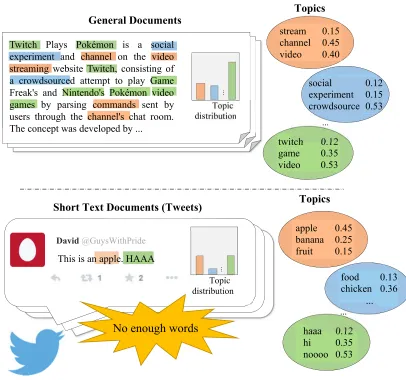
With the rise of social media in recent years, topic models have been utilized for social media analysis. For example, some researches apply topic models in social media for event tracking (Lin et al., 2010), content characterizing (Zhao et al., 2011; Ramage et al., 2010), and content recommendation (Chen et al., 2010; Phelan et al., 2009). However, to share people thinking conveniently, the context is usually short. These short text contexts make topic models hard to discover the amount of word co-occurrence. For the short text corpus, there are three directions to overcome the insufficient of the word co-occurrence problem. One is using the external resources to guide the model generation, another is aggregating several short texts into a long text, and the other is improving the model to satisfy the short text properties. For the first direction, Phan et al. (Phan et al., 2008) proposed a framework that adopt the large external resources (such as Wiki and blog) to deal with the data sparsity problem. R.Z. Michal et al. proposed an author topic model (Rosen-Zvi et al., 2004) which adopt the user information and make the model suitable for specific users. Jin et al. proposed the Dual-LDA model (Jin et al., 2011), it use not only the short text corpus but also the related long text corpus to generate topics, respectively. The generation process use the long text to help the short text modeling. If the quality of the external long text or knowledge base is high, the generated topic quality will be improve. However, we cannot always obtain the related long text to guide short text and the related long text is very domain specific. So, using external resources is not suitable for the general short text dataset. In addition to adopt the long text, Hong et al. aggregate the tweets which shared the same words and get better results than the original tweet text (Hong & Davison, 2010).
Word Co-occurrence Augmented Topic Model in Short Text 51
that the mixture of unigram model can discover more coherent topics than LDA in the short text corpus. Further, Xiaohui Yan et al. proposed the Bi-term Topic Model (BTM) (Yan et al., 2013; Cheng et al., 2014) which directly model the word co-occurrence and use the corpus level bi-term to overcome the lack of the text information problem. A bi-term is a word pair containing a co-occur relation in this two words. The advantage is that BTM can model the general text without any domain specific external data. Comparing with the mixture of unigram, BTM is a special case of the mixture of unigram. They both model the corpus level topic but BTM generates two words (bi-term) every time the generation process. However, BTM discovers the word co-occurrence just by considering the bi-term frequency. The bi-term frequency will be failed to judge the word co-occurrence when the bi-term frequency is high but one of the frequency of two words in a bi-term is high and another is low.
3.
The Word Co-occurrence Augmented Methods
Topic models learn topics base on the amount of the word co-occurrence in the documents. The word co-occurrence is a degree which describes how often the two words appear together. BTM, discovers topics from bi-terms in the whole corpus to overcome the lack of local word co-occurrence information. However, BTM will make the common words be performed excessively because BTM identifies the word co-occurrence information by the bi-term frequency in corpus-level. Thus, we propose a PMI-β priors methods on BTM. Our PMI-β priors method can adjust the co-occurrence score to prevent the common words problem. Next, we will describe the detail of our method of PMI-β priors.
We first describe the detail of BTM. First, we introduce the notation of “bi-term”. Bi-term is the word pair co-occurring in the short text. Any two distinct words in a document construct a bi-term. For example, a document with three terms will generate three bi-term (Yan et al., 2013):
t t t1 2 3, ,
t t1 2,
, ,
t t2 3
, ,t t1 3
.(1)
Note that each bi-term is unordered. For a real case example, we have a document and the context is “I visit apple store”. Because “I” is a stop-word, we remove it. The remaining three terms “visit”, “apple” and “store” will generate three bi-terms “visit apple”, “apple store”, and “visit store”. We generate all possible bi-terms for each document and put all bi-terms in the bi-term set B.
Word Co-occurrence Augmented Topic Model in Short Text 55
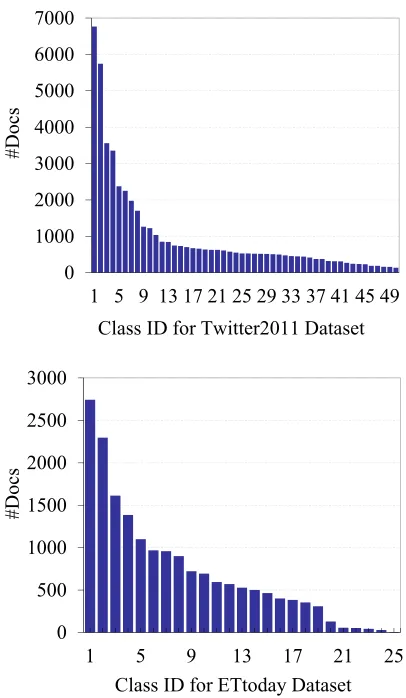
Figure 4. The number of documents in each class
4.1 Experimental Setup
All of the experiments were done on the Intel i7 3.4 GHz CPU and 16G memory PC. All of the pre-process and topic models were written by JAVA code. The parameters priors and the base β priors of topic models are all set <0.1>. The number of iterations in Gibbs sampling is set 1,000. To make our results more reliable, we run each experiments 10 times and average these scores.
For the clustering experiment, we first get the document-topic posteriori probability distribution and we use the highest probability topic P(z|d) as the cluster assignment for each document in . For the classification experiment, we divide our dataset into five parts in which four parts for training and one for testing. After training the topic model, we fix the topic-word distribution and then we re-infer document-topic posteriori probability
0 1000 2000 3000 4000 5000 6000 7000
1 5 9 13 17 21 25 29 33 37 41 45 49
#Docs
Class ID for Twitter2011 Dataset
0 500 1000 1500 2000 2500 3000
1 5 9 13 17 21 25
#Docs
58 Guan-Bin Chen & Hung-Yu Kao
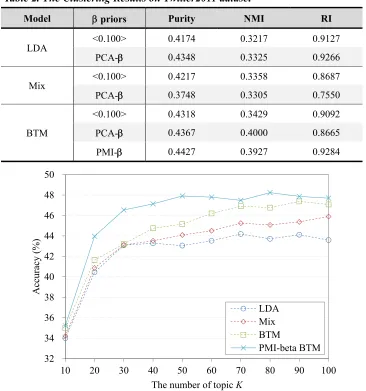
better result than BTM with symmetric priors. Otherwise, our baseline method, PCA-β, is better than the original LDA because the PCA-β prior can make up the lack of the global word co-occurrence information in the original LDA.
Table 2. The Clustering Results on Twitter2011 dataset
Model priors Purity NMI RI
LDA <0.100> 0.4174 0.3217 0.9127
PCA- 0.4348 0.3325 0.9266
Mix <0.100> 0.4217 0.3358 0.8687
PCA- 0.3748 0.3305 0.7550
BTM
<0.100> 0.4318 0.3429 0.9092
PCA- 0.4367 0.4000 0.8665
PMI- 0.4427 0.3927 0.9284
Figure 5. The Classification Results on Twitter2011 dataset
Figure 5 shows the classification results on the Twitter2011 dataset by using LIBLINEAR classifier. When apply the PMI-β priors, we get the better result than BTM with symmetric priors. Table 3 presents the top-10 topic words of the “job” topic in the Twitter2011 dataset for LDA, mixture of unigram, BTM and PMI-β-BTM respectively, when the number of topic is 70. The top-10 words are the 10 highest probability words of the topics. The bold words in this table are the words which highly correlated with the topic by the
32 34 36 38 40 42 44 46 48 50
10 20 30 40 50 60 70 80 90 100
Accuracy (%)
The number of topic K
LDA Mix BTM
Word Co-occurrence Augmented Topic Model in Short Text 59
human judgment. The topic words in the LDA and mixture of unigram models are almost non-correlated or low-correlated with the topic “job”, such as “jay” and “emote”. In BTM and PMI-β-BTM, the model capture the more high-correlated words, such as “engineer” and “management”.
Table 3. The top-10 topic words of the “job” topic in Twitter2011 dataset
Top-10 Topic words
LDA job, house, jay, steal, material, burglary, construct, park, pick, ur
Mix job, robbery, material, construct, steal, warehouse, emote, feel, woman, does BTM job, management, engineer, media, social, open, sale, analyst, develop, senior
PMI--BTM job, real, open, estate, management, market, company, sale, develop, engineer
4.4 Experimental Results for ETtoday News Title Dataset
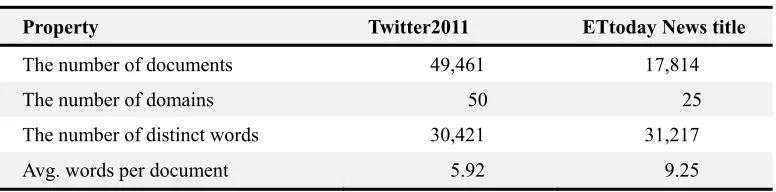
The ETtoday News Title dataset is collected from the overview list of the ETtoday News website3 between January 1st and January 31, 2015. There are totally 25 predefined news
labels in the dataset. These labels include some classical news category such as “society news”, “international news” and “political news”, and some special news category such as “animal and pets”, “3C” and “games”. In both the clustering and the classification experiments, we use these labels as the ground-truth. Because the Chinese text does not contain the break word, we must adopt the additional word breaker in the pre-process step. We adopt the jieba4, the
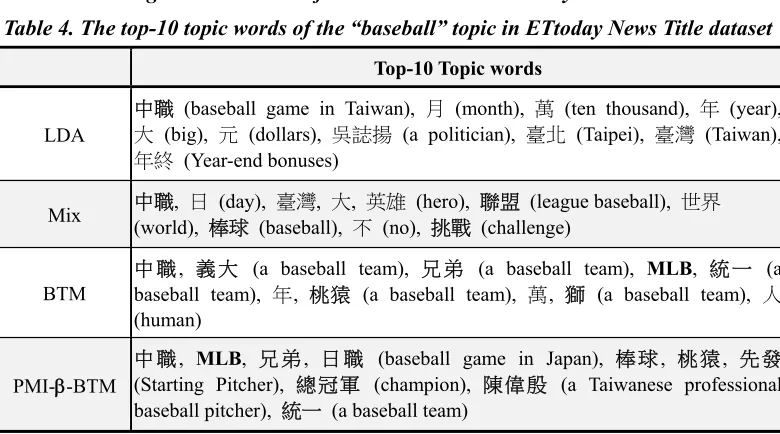
Python Chinese word segmentation module, to segment all news title into several words. Figure 6 shows the classification results on the ETtoday News Title dataset. The three original topic model LDA, mixture of unigram, and BTM perform the same order as the results of the Tweet2011 dataset. The PMI-β BTM is outperform all other methods. Our PMI-β-BTM is also suitable to model the regular short text. The top-10 topic words of the “baseball” topic of ETtoday news title dataset lists in the Table 4. Because these words are almost Chinese, we also attach the simple explanation in English. There are many non-related words in the LDA and mixture of unigram, such as “年終” (Year-end bonuses) and “不” (no). Especially, we compare the topic words in BTM with in PMI-β-BTM, the topic words in BTM contain some frequent but low-correlated words with the topic, such as “年” (means year) and “萬” (means ten thousand). While in the PMI-β-BTM, this noisy words do not appear. The reason is that the original BTM just consider the simple bi-term frequency and this bi-term frequency make some frequent words be extracted together with other words from the
60 Guan-Bin Chen & Hung-Yu Kao
document. Our PMI-β priors can decrease the probability of the common words by the word normalization effect in the PMI.
Figure 6. The Classification Results on ETtoday dataset
Table 4. The top-10 topic words of the “baseball” topic in ETtoday News Title dataset
Top-10 Topic words
LDA
中職 (baseball game in Taiwan), 月 (month), 萬 (ten thousand), 年 (year),
大 (big), 元 (dollars), 吳誌揚 (a politician), 臺北 (Taipei), 臺灣 (Taiwan),
年終 (Year-end bonuses)
Mix 中職(world), , 日 (day), 臺灣, 大, 英雄 (hero), 聯盟 (league baseball), 世界
棒球 (baseball), 不 (no), 挑戰 (challenge)
BTM
中 職, 義 大 (a baseball team), 兄 弟 (a baseball team), MLB, 統 一 (a baseball team), 年, 桃猿 (a baseball team), 萬, 獅 (a baseball team), 人
(human)
PMI--BTM
中 職, MLB, 兄 弟, 日 職 (baseball game in Japan), 棒 球, 桃 猿, 先 發
(Starting Pitcher), 總冠軍 (champion), 陳偉殷 (a Taiwanese professional baseball pitcher), 統一 (a baseball team)
5.
Conclusions
In this paper, we propose a solution for topic model to enhance the amount of the word co-occurrence relation in the short text corpus. First, we find the BTM identifies the word co-occurrence by considering the bi-term frequency in the corpus-level. BTM will make the
32 35 38 41 44 47 50 53 56
10 20 30 40 50 60 70 80 90 100
Accuracy (%)
The number of topic K LDA Mix BTM
Word Co-occurrence Augmented Topic Model in Short Text 61
common words be performed excessively because the frequency of bi-term comes from the whole corpus instead of a short document. We propose a PMI-β priors method to overcome this problem. The experimental results show our PMI-β-BTM get the best results in the regular short news title text.
Moreover, there are two advantages in our methods. We do not need any external data and the proposed two improvement of the word co-occurrence methods are both based on the original topic model and easy to extend. Bases on the original topic model means we did not modify the model itself, thus our methods can easily apply to some other existing BTM based models to overcome the short text problem without any modification. In the future, we can extend some other steps in PMI-priors to deal the further improvement, such as removing the redundant documents by clustering.
References
Hofmann, T. (1999). Probabilistic latent semantic analysis. In Proceedings of the Fifteenth conference on Uncertainty in artificial intelligence, 289-296.
Blei, D. M., Ng, A. Y., & Jordan, M. I. (2003). Latent dirichlet allocation. the Journal of machine Learning research, 3, 993-1022.
Divya, M., Thendral, K., & Chitrakala, S. (2013). A Survey on Topic Modeling. International Journal of Recent Advances in Engineering & Technology (IJRAET), 1, 57-61.
Mimno, D., Wallach, H. M., Talley, E., Leenders, M., & McCallum, A. (2011). Optimizing semantic coherence in topic models. In Proceedings of the Conference on Empirical Methods in Natural Language Processing, 262-272.
Yan, X., Guo, J., Lan, Y., & Cheng, X. (2013). A biterm topic model for short texts. In Proceedings of the 22nd international conference on World Wide Web, Rio de Janeiro, Brazil, 1445-1456.
Nigam, K., McCallum, A. K., Thrun, S., & Mitchell, T. (2000). Text classification from labeled and unlabeled documents using EM. Machine learning, 39(2), 103-134.
Zhao, W. X., Jiang, J., Weng, J., He, J., Lim, E.-P., Yan, H., et al. (2011). Comparing twitter and traditional media using topic models. In Advances in Information Retrieval. ed: Springer, 338-349.
Cheng, X., Yan, X., Lan, Y., & Guo, J. (2014). BTM: Topic Modeling over Short Texts. Knowledge and Data Engineering, IEEE Transactions on, 26(12), 2928-2941.
Church, K. W., & Hanks, P. (1990). Word association norms, mutual information, and lexicography. Computational linguistics, 16(1), 22-29.
Wallach, H. M., Minmo, D., & McCallum, A. (2009). Rethinking LDA: Why priors matter. In Advances in Neural Information Processing Systems 22 (NIPS 2009).
62 Guan-Bin Chen & Hung-Yu Kao
Wallach, H. M. (2006). Topic modeling: beyond bag-of-words. In Proceedings of the 23rd international conference on Machine learning, 977-984.
Wang, X., McCallum, A., & Wei, X. (2007). Topical n-grams: Phrase and topic discovery, with an application to information retrieval. In Seventh IEEE International Conference on Data Mining (ICDM 2007), 697-702.
Griffiths, T. L., Steyvers, M., Blei, D. M., & Tenenbaum, J. B. (2004). Integrating topics and syntax. In Advances in neural information processing systems 17, 537-544.
Li, W. & McCallum, A. (2006). Pachinko allocation: DAG-structured mixture models of topic correlations. In Proceedings of the 23rd international conference on Machine learning, 577-584.
Chen, Z. & Liu, B. (2014). Mining topics in documents: standing on the shoulders of big data. In Proceedings of the 20th ACM SIGKDD international conference on Knowledge discovery and data mining, New York, New York, USA, 1116-1125.
Lin, C. X., Zhao, B., Mei, Q., & Han, J. (2010). PET: a statistical model for popular events tracking in social communities. In Proceedings of the 16th ACM SIGKDD international conference on Knowledge discovery and data mining, 929-938.
Ramage, D., Dumais, S. T., & Liebling, D. J. (2010). Characterizing Microblogs with Topic Models. In Fourth International AAAI Conference on Weblogs and Social Media. Chen, J., Nairn, R., Nelson, L., Bernstein, M., & Chi, E. (2010). Short and tweet: experiments
on recommending content from information streams. In Proceedings of the SIGCHI Conference on Human Factors in Computing Systems, 1185-1194.
Phelan, O., McCarthy, K., & Smyth, B. (2009). Using twitter to recommend real-time topical news. In Proceedings of the third ACM conference on Recommender systems, 385-388. Phan, X.-H., Nguyen, L.-M., & Horiguchi, S. (2008). Learning to classify short and sparse text
& web with hidden topics from large-scale data collections. In Proceedings of the 17th international conference on World Wide Web, 91-100.
Rosen-Zvi, M., Griffiths, T., Steyvers, M., & Smyth, P. (2004). The author-topic model for authors and documents. In Proceedings of the 20th conference on Uncertainty in artificial intelligence, 487-494.
Jin, O., Liu, N. N., Zhao, K., Yu, Y., & Yang, Q. (2011). Transferring topical knowledge from auxiliary long texts for short text clustering. In Proceedings of the 20th ACM international conference on Information and knowledge management, 775-784.
Hong, L. & Davison, B. D. (2010). Empirical study of topic modeling in twitter. In Proceedings of the First Workshop on Social Media Analytics, 80-88.
Liu, J. S. (1994). The collapsed Gibbs sampler in Bayesian computations with applications to a gene regulation problem. Journal of the American Statistical Association, 89(427), 958-966.
Word Co-occurrence Augmented Topic Model in Short Text 63
Ramage, D., Hall, D., Nallapati, R., & Manning, C. D. (2009). Labeled LDA: A supervised topic model for credit attribution in multi-labeled corpora. In Proceedings of the 2009 Conference on Empirical Methods in Natural Language Processing, 1, 248-256.