Training Data in Statistical Machine Translation
– The More, the Better? –
Monica Gavrila
University of Hamburg, Germany gavrila@informatik.
uni-hamburg.de
Cristina Vertan
University of Hamburg, Germany [email protected]
Abstract
Current statistical machine translation (SMT) systems are stated to be dependent on the availability of a very large training data for producing the language and trans-lation models. Unfortunately, large paral-lel corpora are available for a limited set of language pairs and for an even more lim-ited set of domains.
In this paper we investigate the behavior of an SMT system exposed to training data of different sizes and types. Our experimen-tal results show that even parallel corpora of modest sizes can be used for training purposes without lowering too much the evaluation scores. We consider two lan-guage pairs in both translation directions for the experiments: English-Romanian and German-Romanian.
1 Introduction
Statistical machine translation (SMT) is the most frequently used paradigm, especially when a trans-lation system has to be implemented for a new (less researched) language pair. The pure statisti-cal approach has the advantage that no additional bilingual linguistic expertise is required. Once the training data is available, open-source, language independent systems can be reused. However, the quality of the results is strongly influenced by the size and type of the available training data.
State-of-the-art literature tends to share the opinion that the larger the data, the better the re-sults. (Suresh, 2010) shows that a larger corpus size for training increases the quality of a Moses-based SMT system, for the Europarl corpus for English-French. The same conclusion appears also in (Koehn et al., 2003), for German-English. In (Brants et al., 2007) experiments for Arabic-English data with billions of tokens are presented
and a dependency between the output quality and the size of the training data is also demonstrated.
Unfortunately, large amount of parallel train-ing data is available only for a restricted num-ber of language pairs and domains. Addition-ally, the training step on large corpora is time and (computing-) resources consuming. On the other hand, smaller corpora can be more easily achieved and have the advantage of requiring less time for training. They also offer the possibility of manu-ally correcting and creating the data.
Experiments with smaller data for Serbian-English (approx. 2.6K sentences) are presented in (Popovic and Ney, 2006). In the same paper also experimental results for Spanish-English, with dif-ferent data sizes are reported. The systems trained on smaller data give acceptable results. However, the trend remains the same: larger data provides better results.
For English-Romanian, SMT systems are pre-sented in (Cristea, 2009) and (Ignat, 2009), with BLEU results of 0.5464 and 0.3208, respec-tively. Although both systems use as training and test data parts of the JRC-Acquis corpus, the architecture described in (Cristea, 2009) in-volves the use of linguistic resources and the sys-tem implemented in (Ignat, 2009) uses pivot lan-guages. As long as comparisons are not made on identical training and test data, it is difficult to estimate if, overall, the inclusion of linguis-tic tools increases significantly the performance. The SMT results for Romanian-English, German-Romanian and German-Romanian-German reported in (Ig-nat, 2009) are 0.3840, 0.2373 and 0.2415, respec-tively. For Romanian-English the BLEU score ob-tained in (Cristea, 2009) is 0.4604.
Especially for MT systems embedded in on-line applications, which face a dynamic domain change and involve several language pairs, it is ex-tremely important to be aware of the small amount of training data which is available. Such a case
is the ATLAS content management system, de-veloped within the EU-Project “Applied Language Technology for Content Management Systems”1. In this project a machine translation (MT) engine should be available to translate abstracts from var-ious domains across twelve language pairs.
In this paper we present the results of a Moses-based SMT system, trained on different types of small size corpora (2.2K). For comparison reasons we additionally consider a larger corpus (330K). Especially with respect to the availability of paral-lel corpora and linguistic resources, Romanian can be considered a lesser resourced language2.
We chose two language pairs (English-Romanian and German-(English-Romanian) in both directions of translations and, in contrast to (Popovic and Ney, 2006), we use for all exper-iments the same language pairs. The language pair Romanian (ro)-German (ge) is particularly interesting as both languages present morphologi-cal and syntactimorphologi-cal features which do not occur in English (en) and make the process of translation even more challenging.
In the following sections we present the Moses-based SMT system used and the data employed in our experiments (Section 2), the translation results and their interpretation (Section 3). Conclusions and further work are described in Section 4.
2 Experimental Setting
2.1 The SMT System
Our MT system follows the description of the baseline architecture provided at the Sixth Work-shop on SMT3 and uses Moses4. Moses imple-ments the statistical paradigm and allows the user to train automatically translation models (TM) for the involved language pair. It is assumed that the user has the required training data. The target lan-guage model (LM) and the word alignment for the parallel corpus are obtained through external ap-plications. We used for our experiments SRILM5
1http://www.atlasproject.eu.
2While the interest for translation from or into German
or English appeared in an early stage of MT, an increased demand for automatic translation from and into Romanian was noticed after the enlargement of the European Union in 2007.
3http://www.statmt.org/wmt11/baseline.
html.
4http://www.statmt.org/moses/, (Koehn et al.,
2007).
5http://www.speech.sri.com/projects/
srilm/, (Stolcke, 2002).
and GIZA++6, respectively.
Two changes have been made to the specifica-tions of the Workshop on SMT: we left out the tun-ing step and considered the language model (LM) order 3 (instead of 5). Leaving out the tuning step is motivated by previous experiments we made, in which the tuned system did not always provide the best results. A reason for choosing the order three for the LM was provided by the results shown in the presentation of the SMART7 project (Rousu, 2008), in which it was stated that “3-grams work generally the best”.
2.2 Data Description
We want to study the influence of the training data on the translation results. Therefore, we use for our experiments three corpora of different sizes, which have various compilation methods: JRC-Acquis L(a large-size parallel corpus, automati-cally aligned at sentence level),JRC-Acquis S(a small-size parallel corpus, automatically aligned at sentence level), and RoGER S (a small-size technical manual, manually compiled and aligned at sentence level).
The first corpus (JRC-Acquis L) is part of the JRC-Acquis8, a freely available parallel corpus in 22 languages, which consists of European Union documents of legal nature. In order to reduce er-rors we considered only the one-to-one sentence alignments obtained with Vanilla9. In fact, the alignment is realized at paragraph level10, where a paragraph can be a simple or complex sen-tence, or a sub-sentential phrase (such as a noun phrase). More details on JRC-Acquis can be found in (Steinberger et al., 2006).
Filtering the sentence alignments had different influences on the data-size. For English - Roma-nian, from 391324 links (< p >-alignments) in 6557 documents, only 336509 links were retained. Subsequently, the cleaning step11of the SMT sys-tem reduced the translation model (TM) to 240219 links. This represents approx. 61.38% of the ini-tial corpus. For German - Romanian, from 391972
6Details on GIZA++ can be found in (Och and Ney,
2003).
7www.smart-project.eu - last accessed on June
27th, 2011.
8The JRC Collection of the Acquis Communautaire:
http://wt.jrc.it/lt/Acquis/.
9Seehttp://nl.ijs.si/telri/Vanilla/. 10The tag< p >from the initial HTML files.
11The cleaning step is integrated in Moses and supposes
links in 6558 documents, only 324448 links were considered for the LM. The TM was reduced to 238172 links (i.e 60.76% of the initial corpus).
The corpus is not manually corrected. There-fore, translation, alignment or spelling errors might influence negatively the output quality.
The tests were run on 897 (3 x 299) sentences, which were not used for training. Sentences were randomly removed from different parts of JRC-Acquis to ensure a relevant lexical, syntactic and semantic coverage. These test sets of 299 sen-tences represent in the following sections the data sets Test 1, Test 2, and Test 3. Test 1+2+3 is formed from all 897 sentences. The test data has no sentence length restriction. Some statistical information on JRC-Acquis L are summarized in Table 1, in which an item represents a word, a number or a punctuation sign.
Data No. of Voc.* Average
items size sent.* length
en – ro
Training (SL) 3579856 39784 14.90
LM Romanian 9572058 81616 28.45
Test 1 (SL) 6424 1048 21.48
Test 2 (SL) 7523 735 25.16
Test 3 (SL) 5609 1111 18.76
Test 1+2+3 (SL) 19556 2345 21.80
ro – en
Training (SL) 3386495 55871 14.10
LM English 9955983 55856 29.59
Test 1 (SL) 5672 1245 18.97
Test 2 (SL) 7194 923 24.06
Test 3 (SL) 5144 1355 17.20
Test 1+2+3 (SL) 18010 2717 20.08
ge – ro
Training (SL) 3256047 76600 13.67
LM Romanian 9122333 80484 28.12
Test 1 (SL) 5325 1140 17.81
Test 2 (SL) 10286 1439 34.40
Test 3 (SL) 5125 1292 17.23
Test 1+2+3 (SL) 20763 3000 23.15
ro – ge
Training (SL) 3453586 56219 14.50
LM German 8469146 121969 26.10
Test 1 (SL) 5432 1294 18.17
Test 2 (SL) 11488 1663 38.42
Test 3 (SL) 5317 1388 17.78
Test 1+2+3 (SL) 22237 3336 24.79
Table 1: Corpus statistics for JRC-Acquis L (* voc = vocabulary, sent=sentence).
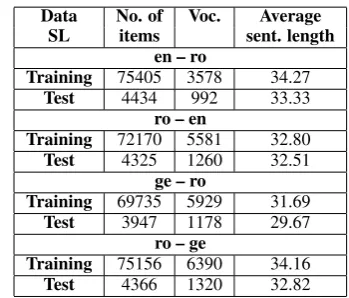
The second corpus we used is JRC-Acquis S, a sub-corpus of JRC-Acquis L, which consists of 2333 sentences. The sentences were extracted from the middle of JRC-Acquis L. From these, 133 sentences were randomly selected as test data. The remaining 2200 sentences represent the
train-ing data. The statistics on this corpus are presented in Table 2.
Data No. of Voc. Average
SL items sent. length
en – ro
Training 75405 3578 34.27
Test 4434 992 33.33
ro – en
Training 72170 5581 32.80
Test 4325 1260 32.51
ge – ro
Training 69735 5929 31.69
Test 3947 1178 29.67
ro – ge
Training 75156 6390 34.16
Test 4366 1320 32.82 Table 2: Statistics for JRC-Acquis S.
RoGER S, the third corpus in this paper, is a parallel corpus, consisting of technical texts in four languages12, which is manually aligned at sentence level. The text is preprocessed by re-placing concepts such as numbers or web pages with ‘meta-notions’: numbers = NUM, websites = WWW etc. More about the RoGER corpus can be found in (Gavrila and Elita, 2006). RoGER S has the same number of training and test sentences as Acquis S. The main difference to JRC-Acquis S is the correctness of the translations and sentence alignments. The statistical information about this corpus is presented in Table 3.
Data No. of Voc. Average
SL items sent. length
en – ro
Training 27889 2367 12.68
Test 1613 522 12.13
ro – en
Training 28946 3349 13.16
Test 1649 659 12.40
ge – ro
Training 28361 3230 12.89
Test 1657 604 12.46
ro – ge
Training 28946 3349 13.16
Test 1649 659 12.40
Table 3: Statistics for RoGER S.
3 Evaluation and Interpretation of Translation Results
3.1 Automatic Evaluation
The obtained translations have been evaluated us-ing two automatic metrics: BLEU and TER. The choice of the metrics is motivated by the available
resources and, for comparison reason, by the re-sults reported in the literature. The comparison was done with only one reference translation, as we work in a realistic scenario with dynamic do-main change (see section 1.)
Although criticized, BLEU (bilingual
evaluation understudy) is the score mostly used for MT evaluation in the last couple of years. It measures the number of n-grams, of different lengths, of the system output that appear in a set of reference translations. More details about BLEU13can be found in (Papineni et al., 2002).
TER14 calculates the minimum number of ed-its required to get from obtained translations to the reference translations, normalized by the av-erage length of the references. It considers in-sertions, deletions, substitutions of single words and an edit-operation which moves sequences of words. More information about TER can be found in (Snover et al., 2006).
In Table 4 we present the results we obtained for all three corpora. The boldface numbers rep-resent the highest scores for the specific language combination and evaluation metric.
Score RoGER S JRC-Acquis S JRC-Acquis L
(Test 1+2+3) en – ro
BLEU 0.4386 0.4801 0.4015
TER 0.3784 0.5032 0.5023
ro – en
BLEU 0.4765 0.4904 0.4255
TER 0.3465 0.4509 0.4457
ge – ro
BLEU 0.3240 0.2811 0.3644
TER 0.5239 0.6658 0.6113
ro – ge
BLEU 0.3405 0.2926 0.3726
TER 0.5570 0.6816 0.6112
Table 4: Evaluation results (all three corpora).
The results from Table 4 for Romanian-English are overall similar with state-of-the art evaluation described in Section 1. For Romanian-German our result overtake the system presented in (Ignat, 2009). However, a truly one-to-one comparison is not possible, as we do not work with identical test and training data as the referred systems.
Even for same training data evaluation results 13We considered the NIST/BLEU implementation mte-val v12, as on http://www.itl.nist.gov/iad/ mig/tests/mt/2008/scoring.html.
14TER (translation error rate.) as implemented on
http://www.cs.umd.edu/˜snover/tercom/- last accessed on 12.01.2010.
Score Test 1 Test 2 Test 3 Test 1+2+3
en – ro
BLEU 0.3997 0.4179 0.3797 0.4015
TER 0.5007 0.4898 0.5208 0.5023
ro – en
BLEU 0.2545 0.5628 0.4271 0.4255
TER 0.5020 0.3756 0.4684 0.4457
ge – ro
BLEU 0.2955 0.4244 0.2884 0.3644
TER 0.6200 0.5905 0.6438 0.6113
ro – ge
BLEU 0.2953 0.4411 0.2939 0.3726
TER 0.6437 0.5588 0.6791 0.6112 Table 5: Evaluation results for JRC-Acquis L
may vary across test sets, as presented in Table 5. Here we show how dependent are the SMT re-sults on the test data. As the size and domain-type of the test data (Test 1 - Test 3) is identical, the differences in BLEU and TER score can be ex-plained only through lexical and syntactical varia-tion across test-sets. Some sources for these vari-ations are represented by out-of-vocabulary words (OOV-words) and the number of test sentences al-ready found in training data. An overview of these two aspects in all the three corpora can be seen in Tables 6 and 7. As expected, best results are obtained for the test data set which has less OOV-words and which contains most sentences in the training data: Test 2. As it is not the topic of this paper, we will not extend the explanation for these variations or present any possible solutions.
Corpus No. of Sentences
OOV-Words in the corpus
(% from voc. size) JRC-Acquis L
en – ro
Test 1 33 (3.15%) 69 (23.07%)
Test 2 2 (0.27%) 134 (44.81%)
Test 3 96 (8.64%) 85 (28.42%)
Test 1+2+3 131 (5.59%) 288 (21.10%)
ro – en
Test 1 51 (4.10%) 69 (23.07%)
Test 2 7 (0.76%) 117 (39.13%)
Test 3 111 (8.19%) 81 (27.09%)
Test 1+2+3 169 (6.22%) 267 (29.76%)
ge – ro
Test 1 69 (6.05%) 73 (24.41%)
Test 2 53 (3.68%) 121 (40.46%)
Test 3 187 (14.47%) 83 (27.75%)
Test 1+2+3 309 (10.30%) 277 (30.88%)
ro – ge
Test 1 44 (3.40%) 76 (25.41%)
Test 2 97 (5.83%) 109 (36.45%)
Test 3 105 (7.56%) 79 (26.42%)
Test 1+2+3 246 (7.37%) 264 (29.43%)
Corpus No. of Sentences
OOV-Words in the corpus
(% from voc. size) RoGER S
en – ro
Test 60 (11.49%) 37 (27.81%)
ro – en
Test 84 (12.75%) 34 (25.56%)
ge – ro
Test 101 (16.72%) 31 (23.30%)
ro – ge
Test 84 (12.75%) 34 (25.56%)
JRC-Acquis S en – ro
Test 72 (7.25%) 38 (28.57%)
ro – en
Test 129 (10.23%) 33 (24.81%)
ge – ro
Test 171 (14.51%) 41 (30.82%)
ro – ge
Test 160 (12.12%) 40 (30.07%) Table 7: Analysis of the test data sets (RoGER and JRC-Acquis S)
In the next subsection we will show more de-tailed the sensitivity of SMT systems to training and test data size and type.
3.2 Interpretation of the Results
In Table 4 we presented the variation of BLEU and TER scores across the three corpora. In (Koehn et al., 2003) a log-linear dependency be-tween the size of the training corpora and the BLEU scores was observed. In contrast, our re-sults cannot confirm this dependency for all lan-guage pairs investigated15. While for German-Romanian the log-linear dependency seem to be preserved, for English-Romanian the BLEU scores for JRC-Acquis S are better than the ones for JRC-Acquis L. Also worth to remark is that the BLEU scores for the other small corpus – ROGER S –, are in the case of English-Romanian between the other two BLEU scores, and in the case of Romanian-English closer to the BLEU score for JRC-Acquis S. This leads us to the con-clusion that the hypothesis of log-linear depen-dency has to be tested before one decides to invest a lot of work in collecting large data sets. Giving the fact that in both of our experiments, as well as in (Koehn et al., 2003), the log-linear dependency was noticed in case of language pairs involving German, it could be an indication that the German specific morphological features, in special the
dy-15We also do not exclude the difference in the results due
also to different evaluation methodology. However, this as-pect is not analyzed in this paper
namic word composition, could be a reason for this behavior. The high number of compounds in German may imply a higher data-sparseness, which can be compensated only through large amounts of training data.
Another interesting observation can be done re-garding the TER Scores. The best TER scores were obtained, independent of the chosen lan-guage pair, for the ROGER S corpus. One expla-nation is the particular syntax of this corpus: tech-nical short sentences, in which the translation usu-ally preserves the SL word order, as far as the syn-tax in both source and target languages allows. In contrast, in JRC-Acquis one finds often reformu-lations or shorter sentences. As TER measures the differences between output and reference transla-tion in number of insertransla-tions, deletransla-tions and replace-ments, this may be cause of alternation of the TER scores.
Given the fact that the BLEU scores for the ROGER S corpus are also in line with current state-of-the-art systems, we can conclude that for technical domains a small, manually corrected corpus can be successfully used for obtaining a reasonable translation output.
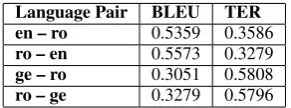
All the results we have presented reinforce the idea that SMT is fully dependent on the training and test data size and type and on the evaluation procedure. We will further show how dependent the results are to all the steps involved in the trans-lation and evaluation processes by presenting the results in Table 8. We evaluated the results for the JRC-Acquis S corpus, when no detokeniza-tion or recasing in the post-processing has been done. In contrast to the information from Table 4, in this last case, the translation evaluation scores are better. This shows that, next to the training and test data itself, sometimes pre- or post-processing steps affect (negatively) the evaluation scores.
Language Pair BLEU TER
en – ro 0.5359 0.3586
ro – en 0.5573 0.3279
ge – ro 0.3051 0.5808
ro – ge 0.3279 0.5796
Table 8: Results for JRC-Acquis S (no recasing, no detokenization)
4 Conclusions
pri-ori size which can be recommended for develop-ing a standard SMT systems independent of lan-guage pair and domain. The experiments we made showed (again) how dependent SMT results are on training and test data and on all processing steps. Especially for on-line applications which embed MT systems, where translation domain changes dynamically and a large number of language pairs is involved, a framework criteria for the training and test data is necessary. Our further work in-cludes more experiments with different data (type and size) and language pairs. Also the associated statistical confidence intervals need to be calcu-lated to have a better view on the evaluation re-sults.
Acknowledgments
Ideas and results presented in this paper are part of Monica Gavrila’s PhD research, conducted at the University of Hamburg, and of the AT-LAS EU-Project (www.atlasproject.eu), supported through the ICT-PSP-Programme of the EU-Commission.
References
Thorsten Brants, Ashok C. Popat, Peng Xu, Franz J. Och, and Jeffrey Dean. 2007. Large language
models in machine translation. In Proceedings
of the 2007 Joint Conference on Empirical Meth-ods in Natural Language Processing and Computa-tional Natural Language Learning, pages 858–867, Prague, Czech Republic.
Dan Cristea. 2009. Romanian language
technol-ogy and resources go to europe. Presentated
at the FP7 Language Technology
Informa-tive Days, January, 20-11. To be found at:
ftp://ftp.cordis.europe.eu/pub/fp7/ict/docs/language-technologies/cristea en.pdf - last accessed on 10.04.2009.
Monica Gavrila and Natalia Elita. 2006. Roger
-un corpus paralel aliniat. InIn Resurse Lingvistice
s¸i Instrumente pentru Prelucrarea Limbii Romˆane Workshop Proceedings, pages 63–67, December. Workshop held in November 2006, Publisher: Ed. Univ. Alexandru Ioan Cuza, ISBN: 978-973-703-208-9.
Camelia Ignat. 2009. Improving Statistical
Align-ment and Translation Using Highly Multilingual Corpora. Ph.D. thesis, INSA - LGeco- LICIA, Strasbourg, France, June, 16th. It can be found on: http://sites.google.com/site/cameliaignat/home/phd-thesis - last accessed on 3.08.09.
Philipp Koehn, Franz Josef Och, and Daniel Marcu.
2003. Statistical phrase-based translation. In
NAACL ’03: Proceedings of the 2003 Conference of the North American Chapter of the Association for Computational Linguistics on Human Language Technology, pages 48–54, Morristown, NJ, USA. Association for Computational Linguistics.
Philipp Koehn, Hieu Hoang, Alexandra Birch, Chris Callison-Burch, Marcello Federico, Nicola Bertoldi, Brooke Cowan, Wade Shen, Christine Moran, Richard Zens, Chris Dyer, Ondrej Bojar, Alexandra Constantin, and Evan Herbst. 2007. Moses: Open source toolkit for statistical machine translation. In Annual Meeting of the Association for Compu-tational Linguistics (ACL), demonstration session, pages 177–180, Prague, Czech Republic, June. Franz Josef Och and Hermann Ney. 2003. A
sys-tematic comparison of various statistical alignment
models. Computational Linguistics, 29(1):19–51.
Kishore Papineni, Salim Roukos, Todd Ward, and Wei-Jing Zhu. 2002. Bleu: a method for automatic
eval-uation of machine translation. InProceedings of the
40th Annual Meeting on Association for Computa-tional Linguistics, Session: Machine translation and evaluation, pages 311 – 318, Philadelphia, Penn-sylvania. Publisher: Association for Computational Linguistics Morristown, NJ, USA.
Maja Popovic and Hermann Ney. 2006. Statistical machine translation with a small amount of
bilin-gual training data. In LREC-2006: Fifth
Interna-tional Conference on Language Resources and Eval-uation. 5th SALTMIL Workshop on Minority Lan-guages: Strategies for developing machine transla-tion for minority languages, pages 25–29, Genoa, Italy, May.
Juho Rousu. 2008. Workpackage 3 advanced language models. Online, January. SMART Project.
Matthew Snover, Bonnie Dorr, Richard Schwartz, Lin-nea Micciulla, and John Makhoul. 2006. A study of translation edit rate with targeted human annotation. InProceedings of Association for Machine Transla-tion in the Americas, pages 223–231, August. Ralf Steinberger, Bruno Pouliquen, Anna Widiger,
Camelia Ignat, Tomaz Erjavec, Dan Tufis, and Daniel Varga. 2006. The jrc-acquis: A multilin-gual aligned parallel corpus with 20+ languages. In Proceedings of the 5th International Conference on Language Resources and Evaluation (LREC’2006), pages 2142–2147, Genoa, Italy, May, 24-16. Andreas Stolcke. 2002. Srilm - an extensible
lan-guage modeling toolkit. InProc. Intl. Conf. Spoken
Language Processing, pages 901–904, Denver, Col-orado, September.