Munich Personal RePEc Archive
Global dynamic timelines for IPRs
harmonization against software piracy
Andrés, Antonio R and Asongu, Simplice A
5 January 2013
Online at
https://mpra.ub.uni-muenchen.de/45631/
Global dynamic timelines for IPRs harmonization against software piracy
Antonio R. Andrésa and Simplice A. Asongub,
a
Al Akhawayn University, School of Business Administration, P.O. Box 104, 53000 Ifrane,
Morocco
b
African Governance and Development Institute, B.P 18 SOA/ 1365 Yaoundé, Cameroon.
Abstract
This paper employs a recent methodological innovation on intellectual property rights (IPRs) harmonization to project global timelines for common policies against business software piracy. The findings on 99 countries are premised on 15 fundamental characteristics of software piracy based on income-levels (high-income, lower-middle-income, upper-middle-income and low-income), legal-origins (English common-law, French civil-law, German civil-law and, Scandinavian civil-law) and, regional proximity (South Asia, Europe & Central Asia, East Asia & the Pacific, Middle East & North Africa, Latin America & the Caribbean and, Sub-Saharan Africa). The results broadly show that a feasible horizon for the harmonization of blanket policies ranges from 4 to 10 years.
JEL Classification: F42; K42; O34; O38; O57
1. Introduction
According to the Business Software Alliance (BSA), the tide of decline in software piracy on personal computers (PCs) in many countries a few years ago has been stemmed and
reversed by fast growing PC makers in some of the world’s highest piracy nations which have
caused the overall numbers to worsen (BSA, 2007). Accordingly, dollar losses from software piracy have risen by $8 billion to nearly $48 billion, and with the trend expected to soar exponentially, there has been renewed interest in measures of fighting software piracy (Andrés, 2006; Andrés & Goel, 2011; Andrés & Goel, 2012; Andrés & Asongu, 2013a; Asongu, 2012a). However, a recent trend has emerged on the feasibility of and timelines for common policies against the scourge (Andrés & Asongu, 2013b; Asongu, 2012b).
In light of the above, this paper provides a global picture on feasible timelines for intellectual property rights (henceforth, IPRs) harmonization against software piracy based on recent methodological innovations on the adoption of common policies. The empirical evidence is based on 99 countries, and the richness of the dataset provides us with the degrees of freedom necessary to disaggregate countries into fundamental characteristics of piracy based on income-levels, legal origins and regional proximity. The intuition motivating the study is that, upholding blanket IPRs policies in the battle against software piracy may not be effective unless they are contingent on the fundamental characteristics and prevailing trajectories, dynamics and tendencies of software piracy within identified fundamental characteristics. The theoretical and empirical underpinnings from the convergence literature are twofold: convergence in piracy rates within a fundamental characteristic will mean the adoption of common policies is feasible, and full convergence implies the enforcement of the common policies without distinction of nationality or locality within each fundamental characteristic (Asongu, 2012b).
The rest of the paper is organized as follows. Section 2 presents the data and outlines the empirical method. Section 3 discusses the estimation results, and Section 4 concludes.
2. Data and Methodology 2.1 Data
The data includes annual observations for ninety nine countries for the years 1994-2010. The limitations to 99 countries and the 17 year annual periodicity are due to constraints in software piracy data availability. In our paper, the measure of piracy employed is the percentage of software (primarily business software) in a country that is illegally installed (without a license) annually and is taken to capture the extent of software piracy. Piracy rates are obtained from the Business Software Alliance (BSA, 2011)1. Since it is unlikely to find convergence within a highly heterogeneous set of countries, fundamental characteristics are determined in terms of legal origins (Asongu, 2012ab; La Porta et al., 1998, 1999), income-levels (Husted, 2000; Marron & Steel, 2000; Kranenburg & Hogenbirk, 2005; Kim, 2004; Depken & Simmons, 2004; Moores & Esichaikul, 2011) and regional proximity (Narayan et al., 2011; BSA, 2011)2. The choice of the control variables is contingent on theoretical underpinnings of conditional convergence, which state that, if countries differ in macroeconomic and institutional characteristics on which software piracy is endogenous then, it is possible for conditional convergence to take place. Nine control variables are employed in two different specifications to control for macroeconomic and institutional determinants of
1
Among the many researchers that have used this data are Andrés (2006), Andrés and Goel (2011), Asongu (2013a,b), Andrés and Asongu (2013ab) and Marron and Steel (2000).
2
Note should be taken of the fact that, government quality (transparency, corruption, regulation quality, etc …)
software piracy. These include: economic prosperity, research and development (R&D), internet penetration, population growth and IPRs laws (Constitution, Main intellectual property (IP) law, World Intellectual Property Organization (WIPO) treaties, Multilateral treaties and Bilateral treaties)3. Data for the explanatory variables were taken from the World Bank Development Indicators (WDI), and the Financial Development and Structure Database (FDSD). The summary statistics show that, there is quite a degree of variation in the data utilized so that one should be comfortable and confident that reasonable estimated relationships would emerge. Pearson’s correlation coefficients were computed. These coefficients indicate that multicollinearity does not appear to be at hand here. 4
2.2 Methodology
The estimation procedure typically follows evidence from recent convergence literature (Asongu, 2012b). The choice of the β-convergence strategy is due to constraints in the data set, which is a panel. The dynamic panel system GMM employed is as follows:
t i t i t i t i t i t
i Y Y W
Y,) ln( , ) ln( , ) , ,
ln( (1)
t i t i t i t i t
i Y W
Y,) ln( , ) , ,
ln( (2)
) ( ) ( ) ( )) ln( ) (ln( ) ln( )
ln(Yi,t Yi,t Yi,t Yi,t2 Wi,t Wi,t2 t t i,t i,t (3)
where Yi,t is the proxy for the rate of piracy in a country i at period t. σ = 1+ β. Wi,t is a vector of determinants of piracy (or control variables), i is a country-specific effect, t is a time-specific constant, and,i,t an error term. The first two equations above are the standard
approaches in the literature for investigating conditional convergence if Wi,t is taken as strictly exogenous (Fung, 2009, p. 3). The dynamic system GMM approach is based on the last two equations. Absolute convergence is estimated without Wi,t. In line with Islam (1995, p. 14), yearly time spans are too short to be appropriate for studying convergence as short-run disturbances may loom substantially in such brief time spans. Therefore, considering the data span of 17 years, we are consistent with Asongu (2012b) in using two-year non-overlapping intervals (NOI)5. This means in our analysis, τ is set to 2. We also compute the implied rate of
convergence by calculating σ/2. Hence, the estimated coefficient of the lagged differenced endogenous variable is divided by 2 because we have used a two year interval to absorb the short-term disturbances. With 0 1, we conclude on the evidence of convergence. The broader interpretation suggests, past variations have less proportionate impact on future differences, implying the variation on the left hand side of Eq. (2) is decreasing overtime (Asongu, 2012b).
3. Empirical results
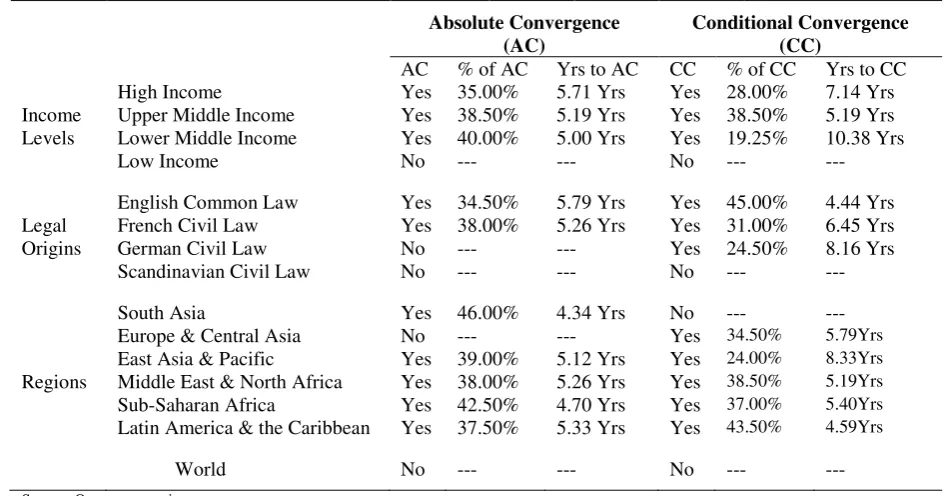
Table 1 presents the main findings that answer the three questions motivating paper. In other words, policy makers are most likely to ask the following three questions before
3
Please see Appendix 1 for definitions and sources of the variables.
4
Owing space constraints, the summary statistics and correlation analysis have not been presented but can be provided upon request.
5
considering the harmonization of IPRs policies on software piracy. (1) Is software piracy converging globally or not? (2) If this were so, what are the rate and timing of the convergence process? (3) For which relevant fundamental characteristics (of software piracy) do answers to the first and second questions apply? Whereas an answer to the first question will guide on the feasibility of harmonizing blanket policies, the answer to the second will guide on an optimal timeframe for such blanket policies. Ultimately, the answer to the third (given that the first-two are already answered), will determine the feasibility-of, timeframe-for and exclusiveness (or non-arbitrariness) of the common IPRs policies. This third question is most relevant because, it underlines the need for common policies to be contingent on the prevailing speeds of and time for full (100%) convergence within each identified fundamental characteristic of software piracy.
[image:5.595.60.533.333.581.2]Concerning the first question raised, software piracy is not converging from a global perspective. This implies the answer to the second question is not applicable. The absence of convergence at the world level justifies the harmonization of policies based on fundamental characteristics of income-levels, legal origins and regional proximities. The findings based on these fundamental characteristics broadly show that a feasible horizon for the harmonization of blanket policies ranges from 4 to 10 years.
Table 1: Timelines for policy harmonization against software piracy
Absolute Convergence (AC)
Conditional Convergence (CC)
AC % of AC Yrs to AC CC % of CC Yrs to CC
Income Levels
High Income Yes 35.00% 5.71 Yrs Yes 28.00% 7.14 Yrs
Upper Middle Income Yes 38.50% 5.19 Yrs Yes 38.50% 5.19 Yrs
Lower Middle Income Yes 40.00% 5.00 Yrs Yes 19.25% 10.38 Yrs
Low Income No --- --- No --- ---
Legal Origins
English Common Law Yes 34.50% 5.79 Yrs Yes 45.00% 4.44 Yrs
French Civil Law Yes 38.00% 5.26 Yrs Yes 31.00% 6.45 Yrs
German Civil Law No --- --- Yes 24.50% 8.16 Yrs
Scandinavian Civil Law No --- --- No --- ---
Regions
South Asia Yes 46.00% 4.34 Yrs No --- ---
Europe & Central Asia No --- --- Yes 34.50% 5.79Yrs
East Asia & Pacific Yes 39.00% 5.12 Yrs Yes 24.00% 8.33Yrs
Middle East & North Africa Yes 38.00% 5.26 Yrs Yes 38.50% 5.19Yrs
Sub-Saharan Africa Yes 42.50% 4.70 Yrs Yes 37.00% 5.40Yrs
Latin America & the Caribbean Yes 37.50% 5.33 Yrs Yes 43.50% 4.59Yrs
World No --- --- No --- ---
Source: Own construction Yrs: Years.
4. Conclusion
characteristic can work toward feasible common policies and upon full convergence (100%), the adopted policies can be implemented without distinction of nationality or locality.
Appendix
Appendix 1: Variable Definitions, and sources
Variables Variable Definitions (Measurement) Sources
Piracy Piracy Logarithm of Piracy rate (annual %) BSA
Growth per capita GDP Logarithm of real GDP per Capita, PPP (international
constant dollars, 2005)
World Bank (WDI)
Research and Development
R & D Research and Development Expenditure (% of GDP) World Bank (WDI)
Internet Penetration Internet Logarithm of Internet Users per 1000 GMID
PC Users PC Logarithm of PC Users per capita GMID
Population Pop. Logarithm of the total Population World Bank (WDI)
Constitution Const. Dummy variable: Copyright is mentioned in the constitution WIPO
Main_IP_law MIPlaw Main Intellectual Property Law WIPO
IP_rlaw IPrlaw Intellectual Property Rights Law WIPO
Wipo_treaties WIIPO World Intellectual Property Organization WIPO
Mutilateral Multi. Multilateral Treaties WIPO
Bilateral Bilat. Bilateral Treaties WIPO
WDI: World Bank Development Indicators. FDSD: Financial Development and Structure Database. BSA: Business Software Alliance. GMID: Global Market Information Database. GDP: Gross Domestic Product. Log: Logarithm. WIPO: World Intellectual Property Organization.
Acknowledgements
References
Andrés, A. R., (2006). “The relationship between copyright software protection and piracy: Evidence from Europe”, European Journal of Law and Economics21, 29–51.
Andrés, A. R., & Goel, R. K., (2011). “Corruption and software piracy: A comparative perspective”, Policy & Internet3(3), 1-24.
Andrés, A. R., & Goel, R. K., (2012). “Does software piracy affect economic growth?
Evidence across countries”, Journal of Policy Modeling34, 284-295.
Andrés, A. R., & Asongu, S. A., (2013a). “Fighting software piracy: which governance tools
matter for Africa?”, Journal of Business Ethics.
http://link.springer.com/article/10.1007%2Fs10551-013-1620-7 (accessed: 15/01/2013).
Andrés, A. R., & Asongu, S. A., (2013b). “Global trajectories, dynamics and tendencies of software piracy: benchmarking IPRs harmonization” Journal of Business Ethics:
Forthcoming.
Asongu, S. A., (2012a). “Fighting software piracy in Africa: How do legal origins and IPRs
protection channels matter?” Journal of the Knowledge Economy: Forthcoming. http://link.springer.com/article/10.1007/s13132-012-0137-0 (accessed: 29/12/2012).
Asongu, S. A., (2012b). “Harmonizing IPRs on software piracy: Empirics of trajectories in
Africa”, Journal of Business Ethics: Forthcoming.
http://link.springer.com/article/10.1007%2Fs10551-012-1552-7?LI=true#page-1 (accessed: 29/12/2012).
Business Software Alliance, (2007). 2006 Piracy study. BSA, New York.
Business Software Alliance, (2011). “NinthAnnual BSA Global Software 2011 Piracy Study” http://portal.bsa.org/globalpiracy2011 (accessed: 21/12/2012).
Depken, C. A., & Simmons, L., (2004). "Social construct and the propensity for software piracy", Applied Economics Letters11, 97-100.
Fung, M. K., (2009). “Financial development and economic growth: Convergence or
divergence?”, Journal of International Money and Finance28, 56-67.
Husted, B. W., (2000). “The impact of national culture on software piracy”, Journal of
Business Ethics 26, 197-211.
Islam, N., (1995). “Growth empirics: A panel data approach”, The Quarterly Journal of
Economics110, 1127-1170.
Kranenburg, H. L., & Hogenbirk, A.E., (2005). “Determinants of multimedia, entertainment, and business software copyright piracy: A cross-national study,” Journal of Media Economics
18, 109-129.
La Porta, R., Lopez-de-Silanes, F., Shleifer, A., & Vishny, R. W., (1998). “Law and finance”,
Journal of Political Economy106, 1113-1155.
La Porta, R., Lopez-de-Silanes, F., Shleifer, A., & Vishny, R. W., (1999), “The quality of government”, Journal of Law, Economics and Organization15, 222-279.
Moores, T. T., & Esichaikul, V., (2011). “Socialization and software piracy: A study”,
Journal of Computer Information Systems, 1-9.
(http://iacis.org/jcis/articles/Moores_Esichaikul_51_3.pdf) (accessed: 25/10/2012).
Marron, D. B., & Steel, D. G., (2000). “Which countries protect intellectual property? The case of software piracy”, Economic Inquiry 38(2), 147-74.