Lexicon Optimization: Maximizing Lexical Coverage in Speech Recognition
through Automated Compounding
Vincent Vandeghinste
Centre for Computational Linguistics Maria Theresiastraat 21, 3000 Leuven, Belgium
Abstract
In this report we show that a lexicon can be designed in such a way that lexical coverage can be maximized by real-time lexicon expansion and a limited word part lexicon for Dutch speech recognition. More specifically, we describe how the lexicon is designed and how the real-time expansion module was built and tested. Tests were performed using a 36.000 entries lexicon. The test results show that out-of-vocabulary rates are rather small, due to automated rule-based compounding of the lexical building blocks. Statistical information was included to improve the accuracy of the rule-based compounding system. This approach proved to be successful.
1.
Introduction
When designing a speech recognition system for con-tinuous spontaneous speech, it should be taken into account that, even with a lexicon size of approximately 40.000 en-tries, a number of words uttered by the speaker will not be amongst those entries.
It should also be taken into account that Dutch is a pro-ductive language: Content words form an open class. New words can be formed on the basis of already existing words, they can be taken from another language, or they can result from a combination of a foreign word with Dutch affixa-tion. Language users are capable of forming new words by using the relations between the newly formed words and their base forms (Booij & van Santen, 1995). A number of these relations are systematic, and can hence be captured by an automated system.
Designing a lexicon where the lexical coverage is op-timized for a fixed vocabulary size is an important aspect in lexicon development for large vocabulary speech recog-nition systems. Minimizing the out-of-vocabulary (OOV) rate contributes to minimizing the global error rate of a recognition system. Different estimates of the number of recognition errors due to each OOV-word range from 1.2 to 2.2 recognition errors per OOV-word (Adda-Decker & Lamel, 2000).
So, to get a maximal lexical coverage, the lexicon con-sists of two parts: the word lists on one hand and a com-pounding module on the other hand. Word lists are care-fully chosen to be the basic building blocks for the most frequent words in Dutch. All the compounds that can be formed by the software module on the basis of simplex base words have been removed from the word lists. This proce-dure of decompounding is also used by Ordelman, van Hes-sen & de Jong (2001): A decompounding procedure could improve the lexical coverage when infrequent compounds are to be expected. It enhances the lexical coverage, as in-stead of having 40.000 entries in our lexicon, the lexicon can consist of 40.000 base forms, with which compounds can be formed. The creation of the word lists is described in section 2. The design of the automated compounding module is described in section 3.
To test the automated compounding module, a test pro-gram was written that produces accuracy percentages for the compounding module. This test program and the the test results are described in section 4.
2.
The Creation of the Word Lists
To create accurate word lists containing the building blocks with the highest lexical coverage, we started with the CGN-lexicon (Piepenbrock, 2000) and began reducing this in several steps.
The CGN-lexicon is a very large lexicon containing word forms, parts of speech, morpho-syntactic informa-tion, lemmas (Van Eynde, Zavrel, & Daelemans, 2000) and phonological information. It has about 570.000 entries.
A first reduction was the reorganization of the CGN-lexicon to a one entry per word form per part of speech (POS) lexicon.
For instance, the word werk (work) appeared several times in the CGN-lexicon. Once as a noun, and twice as a verb.
werk - N(soort,ev,basis,zijd,stan)
werk - WW(pv,imp,ev)
werk - WW(pv,tgw,ev)
The verb-form of “werk” has a morpho-syntactic tag for its use as a singular present tense verb, and it has another morpho-syntactic tag for its imperative use. As a result of the first reduction, the word werk remains as two entries in the lexicon: once as a noun and once as a verb.
werk - N(soort,ev,basis,zijd,stan)
werk - WW((pv,imp,ev)
(pv,tgw,ev))
The verb entry has a morpho-syntactic tag that is a merger of the two syntactic verb tags of the word. This first reduction is done without information loss. About 300.000 entries remained.
A next step in the selection of the words contained by the word lists was the selection of the most frequent
en-tries. A number of word-frequency lists for Dutch1 were
combined to get a large data set on which the frequencies are counted.
A first list is created by taking the 36.000 most frequent words. This list is called the Basic-Word-list (BWL).
For the building blocks which do not occur by them-selves, a second list is created, called the Quasi-Word-list (QWL). The idea of using a separate list for building blocks that cannot exist by themselves was already tested and im-plemented by Verloren van Themaat (1972)! The QWL contains all the word parts from the CGN-lexicon which cannot occur by themselves, but which are variations on words that do exist by themselves.
For example: the word zonneschijn (sunshine) consists of two parts, the part zonne (sun) and the part schijn (shine). The part zonne is not a lexical entry by itself, but it corre-sponds to the lexical entry zon. The part zonne is the word
zon plus a binding phoneme. The part zonne is added to the
QWL, while the word zon is part of the BWL.
The QWL was constructed by taking the list of com-pounds that were removed from the lexicon during lexical reduction. From this list, all the modifiers that were not valid words were taken. Surprisingly, this concerns only a small amount of entries: The QWL contains about 1000 entries, because a lot of modifiers and binding phonemes form the plural of the modifier, or they form the adjective with s form, as the binding phoneme is often an s. If we take the compound hemelsblauw (heavenly blue), we have the word hemels and the word blue. The word hemels in the compound is the singular word hemel plus the bind-ing phoneme s, but this is equal to the adjective hemels. These are considered existing words, and are not added to the QWL.
With the combination of the Word List and the QWL the lexicon is designed in such a way that the applicability of the rules used in the compounding module is maximized.
3.
The Compounding Module
To allow for real-time lexical expansion, the sequence of words that result from the recognition process are offered as input to the compounding module. The current module allows for two up to five input base forms.
For each input unit, the module checks if this input unit is part of the BWL or of the QWL. If an input unit is found in the QWL, it gets a ’Quasi’-tag. If the input unit appears to be a word found in the BWL, the word is looked up in the CGN lexicon (Piepenbrock, 2000), and all its possible morpho-syntactic tags are retrieved. For a description of the morpho-syntactic tags, see Van Eynde (2000).
1The frequency lists used are the CGN-frequency list from
re-lease 7.0 with 3.073.251 words, the ILK-frequency list (Induc-tion of Linguistic Knowledge, see http://ilk.kub.nl) with 455.885 words, the Celex frequency list with 40.252.523 words, the De Standaard frequency list with 32.544.615 words and the MLCC frequency list (the Dutch part of the Multilingual Corpora for Co-operation, see http://www.issco.unige.ch/projects/MLCC.html) with 7.252.109 words. These are all frequency lists based on Dutch corpora.
For instance: if we input zonne+schijn, the result of the first step will be:
zonne - QUASI
schijn - N(soort,ev,basis,zijd,stan)
WW((pv,imp,ev)
(pv,tgw,ev))
For each of the tags of each input unit, it is checked whether the rules are applicable. If the rules fire, then the resulting word is a potential compound, with its morpho-syntactic tag. If none of the rules fire, no compounds can be formed with these units, and the input units are identified as noncompounds.
For the resulting compounds, their compounding confi-dence is calculated. How this is done is explained in section 3.2.2.
3.1. Declarative Knowledge: the Rules
If more than two input units are given, the module tries to compound them two by two, recursively. The recursion tries left branching first. If left branching does not succeed, right branching is tried. The branching which results in the compound does not always reflect the semantic branching, but it yields the correct compound.
An example of left branching is
samen-stellingsprobleem [E: compounding problem]:
((samen+stellings)+probleem). An example of right
branching is overgrootmoeder [E: great grandmother]: (over +(groot+moeder)).
All the rules stated here are rules concerning two input units: the modifier and the head. As is stated in Booij & van Santen (1995) and De Wachter & Provoost (1993), the head determines the syntactic category of the compound. The compound hence inherits the tag from its head. In regular compounds, the head is always the right hand side
of the compound.2 A compound can be formed:
If the head is a noun,
– and the modifier is a quasi-word (hersen+tumor
[E: brain growth]), a preposition3 (voor+ruit
[E: wind shield]), an adverb4 (samen+stelling
[E: compound]), a noun (spraak+herkenning [E:
2
There are some exceptions to this rule, but these cannot be formed with the compounding module. The solution we chose for such words was to put them in the BWL, as a compound. We consider those exceptions to be lexicalised. A word like na-apen is a preposition + a noun, but the compound is a verb. See Booij & van Santen (1995) for more examples.
3
Not all prepositions can be used in compounds. This is a list of the prepositions which can be modifiers: aan, achter, af, bij,
binnen, boven, buiten, heen, langs, mede, mee, na, om, onder, op, over, rond, tegen, toe, tussen, uit, voor. This restriction applies to
all the rules were prepositions are involved.
4
Not all adverbs can be used in compounds. This is a list of the adverbs which can be modifiers: aaneen, achterna, achterom,
achterop, achterover, bijeen, dooreen, ineen, mis, neder, neer, omhoog, omlaag, omver, ondereen, onderuit, opeen, overeen, overhoop, samen, tegemoet, teloor, teniet, terug, teweeg, tewerk, thuis, uiteen, vaneen, vast, verder, vooraf, voorop, voorover, voort, vooruit, weder, weer, weg. This restriction applies to all the rules
because we also want to test how much the compound mod-ule overgenerates. The compound modmod-ule has three possi-ble return values:
The first word part cannot be compounded with the second. It is identified as a noncompound word. If the second part is a punctuation mark, the first word is always identified as a noncompound.
The first word can be compounded with the second, according to the rules, and the compound word is con-firmed by the CGN-lexicon (full version).
The first word can be compounded with the second, according to the rules, but the compound is not con-firmed by the CGN-lexicon (full version).
We make a distinction between compounds confirmed by the full CGN-lexicon, and compounds which are not con-firmed, to get a detailed analysis of the accuracy of the rules and to get a clear view on what kind of compounds are found or missed with the compounding module. As the test results in section 4.2.3 show, this distinction is useful.
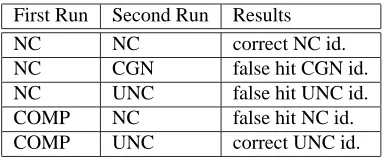
The returned result from the compound module is then compared with the result for the same word in the first run. In table 1, the values of the outcome of the first and second run and their resulting values are presented.
First Run Second Run Results
NC NC correct NC id.
NC CGN false hit CGN id.
NC UNC false hit UNC id.
COMP NC false hit NC id.
COMP UNC correct UNC id.
Table 1: First and Second Run Outcome and Resulting Val-ues (NC=Noncompound,COMP=Compound,CGN=CGN-confirmed,UNC=unconfirmed)
If the word is identified as a three part compound in the first run, the compounding results for the first two parts, and for the second and the third part are irrelevant9. At this
point we get results on the accuracy of the compounding module for two-part compounding. We also want to know the accuracy for three-part compounding. Analogous to the description of the two-part compounding, every three units are sent to the compounding module. The possible out-comes are the same as for the two-part compounding. Re-sults are compared with what the first run taught us about the input, and the accuracy of the compounding module for three-part compounding can be calculated.
As every two and three consecutive word parts are tested, this is an under-estimation of the performance the system would have in a real recognition system, as word
9
An example: For the input word overgrootmoeder (E: great
grandmother) it is irrelevant if “over+groot” can form a
com-pound, as the input text does not contain the word “overgroot” nor the words “over” and “groot”, hence we cannot score the cor-rectness of compounding “over+groot”.
parts which are already used in compounding with the pre-vious word part, are tried again to compound with the next word part.
In the test system, as it is used for generating the test results, described in section 4.2, a BWL of approximately 35.000 words and a QWL of approximately 1000 words was used. This means that we are not yet at the limits of what can be put in the speech recognizer lexicon (approx. 40.000 entries).
4.2. The Test Results
4.2.1. The Test Texts and their Properties.
Three texts were used as input texts. The texts differ in language use. Here is a description of the input texts:
Thuis.txt is one episode of a Dutch soap series. Only
the dialogues were used. The language used in this
text is rather simple, on the edge of dialect. The
amount of compounds in this text is limited (50 words). The text contains 3415 words.
Aspe.txt is the first chapter of a novel, written by Pieter
Aspe. The language used is very literate, with a high amount of compounds (279 words). The text contains 4589 words.
Interview.txt is an interview that was transcribed for
the CGN-project. The language used is spontaneous speech. The amount of compounds is in between the two other test texts (131 words). The text contains 4645 words.
To get an idea about the complexity of the test texts, and the amount of compounds occurring in those texts, a com-pound counter was added to the test program: when the test program is performing its first run through the input text, each word gets a code for whether it is a noncompound, a 2-part compound, a 3-part compound or an OOV-word. The frequency of these codes is counted. The result is the rela-tive frequency of noncompounds, 2-part compounds, 3-part compounds, and OOV-words on the total amount of words, as shown in table 2.
Text NonComps 2-parts 3-parts OOV
Thuis 95.45% 1.41% 0.06% 3.08%
Aspe 90.15 % 5.64% 0.44% 3.77%
Interview 96.21% 2.84% 0.11% 0.84%
Table 2: Test Text Complexity
4.2.2. The Correct Identification of Noncompounds and Compounds
The amount of correct identification is dependent on the threshold values of the parameters10. For the RFT
param-eter, we show two values: RFT=0 and RFT=0.05, as the results didn’t vary significantly on other values of the pa-rameter.
For the Compound probability different values were tried in order to get a maximum recognition accuracy. Fig-ure 1 shows how many of the input words are correctly identified by the compound module as being a noncom-pound, a 2-part compound or a 3-part compound. Note that a word is identified as a noncompound only if it is not a 2-part compound and not a 3-part compound. These two conditions need to be true.
Figure 1: Correct Identification Rate
Table 3 shows at which parameter value the highest recognition rate was reached.
Text RFT CPT % Correct Id
Aspe 0.05 0.003 94.53 %
Thuis 0.05 0.003 96.28 %
Interview 0.05 0.003 98.47 %
Table 3: Highest Recognition Rates
The most salient facts in figure 1 is the strong rise in correct identification as soon as the RFT-parameter is used. The introduction of the RFT-parameter shows to be a good idea.
Another strong rise in correct identification percentage can be noted at the introduction of the Compound Proba-bility Threshold. If the value of the compound probaProba-bility parameter of the compound (as described in section 3.2) is below the threshold set by the test system, the compound is not accepted. The values listed in the CPT column of ta-ble 2 are the average values of the ranges where the highest identification percentage was reached.
These values show a nearly perfect negative correlation of -0.98 with the amount of compounds in the test text. The more compounds present in the text, the lower the parame-ter threshold should be set to reach a maximum identifica-tion percentage.
10
Parameters are described in section 3.2
4.2.3. Accuracy of the Compound Module
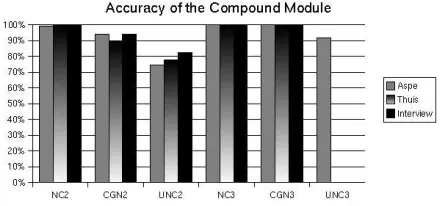
In figure 2, you can see the results split out over differ-ent conditions. This enables us to spot the strong and weak points of the module.
Figure 2: Accuracy of the Compound Module
The strong points in the system are clearly the identifi-cation of noncompounds for two and three part compound-ing, and the identification of 3-part CGN confirmed pounds. The identification of 2-part CGN confirmed com-pounds ranges between 89% and 94.5%. The identification of 2-part unconfirmed compounds ranges between 74% and 82.5%. Although this is much lower than in most other con-ditions, it should be noted that we did some tests before the Compound Probability Threshold was used, and these re-sults were at 19% accuracy maximum. The biggest gain by introducing the CPT was for 2-part unconfirmed words.
The identification of 3-part unconfirmed compounds is 91.5% for Aspe.txt, and 0% for the other two texts. For Aspe.txt, before the CPT was used, a maximum of 23% could be reached for this value. The 0% results are due to the fact that there are very little unconfirmed 3-part com-pounds in Thuis.txt and in Interview.txt. Even if we could get these words to be correctly identified as unconfirmed 3-part compounds, this would have little or no impact on the total correct identification percentage.
4.3. The Test Conclusions
The test results show that the general identification of words as consisting of one, two, or three parts is between 94.5 and 98.5%, if the RFT-parameter is used and the CPT-parameter is optimized.
It should be noted that the OOV-rates are rather small, considering that the real lexicon size used for these tests is 35.000 items in the BWL and 1.000 items in the QWL.
the spelling11.
5.
General Conclusions
The building of a lexicon that can be extended in real-time, to capture some of the productive processes which occur in Dutch proves to be successful. The building of a compounding module that generates information about the
compoundability of the input word parts proves to provide
a way of reaching a high lexical coverage with a limited lexicon size.
As the lexicon can be expanded in real time, by com-bining word parts using the compound module, the entries present in this expanded lexicon are practically limitless. The number of entries which is present in the BWL and the QWL can be kept under 40.000, without compromising the lexical coverage.
The aim of building a lexicon that comprises already existing compounds proves to be successful. The aim of building a lexicon that comprises new words based on al-ready existing word parts seems a lot harder. New words are included in the lexicon, through the real-time expan-sion module, but the rules are only applicable with a low accuracy. By using frequency information based on a large data set, the accuracy can be lifted to a reasonable amount. We can conclude by saying that designing a lexicon with a minimized out-of-vocabulary rate and a limited size can be done in a successful way by real-time lexical expan-sion through automated compounding.
6.
Acknoledgments
Research funded by IWT (Institute for Innovation in Science and Technology) in the STWW program, project ATraNoS (Automatic Transcrption and Normalisation of Speech). The research consortium consists of CCL and ESAT (K.U.Leuven), CNTS (U. Antwerpen), and ELIS (U. Gent). The project aims at generic basic research on speech recognition and normalization of unrestricted speech with automatic subtitling from speech as a case study.
7.
References
Adda-Decker, M. & Lamel, L. (2000). The use of lex-ica in automatic speech recognition. In F.Van Eynde & D.Gibbon (Eds.), Lexicon Development for Speech and
Language Processing, pages 43–75, Kluwer Academic
Publishers. Dordrecht.
Booij, G. and van Santen, A. (1995). Morfologie. De
woordstructuur van het Nederlands. Amsterdam
Univer-sity Press, Amsterdam.
De Wachter, L. & Provoost, J. (1993). A
computa-tional interpretation of compounds. In F.Van Eynde and D.Heylen (Eds.), Working Papers in Natural Language
Processing.
11
Consider the construction “binnen kijken” [E: watch indoors] vs. the construction “binnenkijken” [E: look inside] in the sen-tences: Binnen kijken we televisie. [E: Indoors we watch televi-sion.] vs. Als men niet mag binnenkijken, moet je de gordijnen
sluiten. [E: If people are not allowed to look inside, you have to
close the curtains.]
Haeseryn, W., Geerts, G., de Rooij, J. & van den Toorn, M. (1997). Algemene Nederlandse Spraakkunst. Martinus Nijhoff Uitgevers, Groningen.
Ordelman, R. ,van Hessen, A. & de Jong, F. (2001). Lexi-con optimization for Dutch speech recognition in spoken document retrieval. Eurospeech 2001.
Piepenbrock, R. (2000). CGN Lexicon 7.0. Corpus
Gesproken Nederlands.
Placeway, P., Schwartz, R., Fung, P. & Nguyen, L. (1993). The estimation of powerful language models from small and large corpora. Proceedings of the ICASSP 1993, Vol.2, pp. 33-36, ICASSP, Minneapolis, Minesota, USA.
Van Eynde, F. (2000). Part of Speech
Tag-ging en Lemmatisering CCL, Leuven. Online: http://lands.let.kun.nl/cgn/publicat.htm.
Van Eynde, F., Zavrel, J. & Daelemans, W. (2000). Part of speech tagging and lemmatisation for the spoken dutch corpus. Proceedings of the Second International
Con-ference on Language Resources and Evaluation.
Verloren Van Themaat (1972). Automatic Analysis of