Available Online atwww.ijcsmc.com
International Journal of Computer Science and Mobile Computing
A Monthly Journal of Computer Science and Information Technology
ISSN 2320–088X
IJCSMC, Vol. 3, Issue. 10, October 2014, pg.687 – 692
RESEARCH ARTICLE
A NEW GENERIC SEARCHING ALGORITHM
FOR HIGH FAULT IMPEDANCE DETECTION IN
TELEPHONE SYSTEM NETWORK
T.Ramkumar
1, M.Geetha
21
Research Scholar, Muthayammal College of Arts and Science,Rasipuram
2
Assistant Professor, Dept. of Computer Science,Muthayammal College of Arts and Science,Rasipuram
ABSTRACT: In the thesis the aim was to detect the high impedance fault occurring on radial
distribution system using a new generic search algorithm. A Three layer perceptron was used for
distinguishing the linear and nonlinear high impedance faults by taking the feature vector as input
value of third and fifth harmonic components of feeder voltage and feeder current were used as a
feature vector obtained by applying the fast Fourier Transformation on the feeder voltage and feeder
current. The values of feeder voltage and feeder current are obtained for two kinds of fault cases by
simulating the model of high impedance fault system. The values of third and fifth harmonics were
obtained by applying the Fast Fourier Transformation. RMS values of these harmonics were used to
train the three layers for classification of these two types of faults detection. Each hidden layer consists
of four neurons and one. Output layer consists of two neuron. This network was trained by using the
Back propagation algorithm.
1. INTRODUCTION
High impedance fault (HIFs) on distribution systems creates single challenge for the protection engineer. HIFs often occur when a transparency conductor breaks down and touches high impedance surfaces or where the conductors become in contact with a high impedance object such as tree. The main principle of in the HIF discovery, in the contrary to short circuit faults, be not to guard system, but to protect the lives and preventing fire hazards due to acting experience. These faults are characterize by intermittent arc-type nature and very low current rich in low harmonic content and high frequency noise spectra. High Impedance faults are safety hazard to Humans, Live stocks and Electric Utility Personnel. If left unnoticed for hours, weeks, and perhaps months can prove fatal to humans and nature at typical current level of 50 mill ampere or above. HIFs that occur do not produce enough fault current detectable of low-level ground current using any conventional over-current or ground fault type relays[2] is both difficult and sometimes inaccurate therefore need to develop another method to solve this problem engineering effort for the development of a reliable method for the detection of high impedance arc-type faults led during the last two decades to important progress in understanding the electrical characteristics of these faults and in the evaluation of several detection concept[3].
A variety of technique of fault detection encompass fractal technique, expert system, neural networks and leading harmonic vector [4,5].
The use of high frequency harmonics is not feasible in practical relay since of the filter by the calculation current transformers. Other methods that try to reduce the restraint of frequency domain method contain Kalman filtering [6] and wavelet transforms based methods[7].
In the midst of many technique proposed by different study groups, use of information contained in the low frequency spectral behavior, in stipulations of both magnitude and phase seems to be the most talented approach for the high impedance arc-type faults on a radial distribution system.
2. RELATED WORK
Artificial neuron network whose architecture is model after the brain consists of many hundreds of simple dispensation units wired together in a complex communication network. Each unit is a beginner's replica of a real neuron, which fires a new signal based on the strength of the signal received. The computational power of the network depends on the working together of these rather feeble processing units on any task, termed parallel processing, which is earlier to the physical mechanism of the brain. Telecommunications, which deals with the transmission of voice, data, and pictures in form of electronic signals, requires thorough monitoring for optimum efficiency [2].
The present Telephone network based on the development of Almond Stronger in 1889 is comprised of a few basic system components [2]. These are the user equipment, access network, main network, transmission equipment and switching equipment. Telephone switching system is based on circuit-switching concept [3]. It provides an end-to-end connection on demand, which is maintained without any interference, until the call is complete.
This concept also preserves the quality of communication. It is assumed that it takes about 10 seconds for the relation to come through. Information called input is sent to the neuron on its incoming weights. This input is processed by propagation function that adds up the values of all incoming weights, the resulting value is compared with a certain Threshold value by the neuron’s activation function. If the input exceeds the threshold value, the neuron will be activated, and otherwise it will be inhibited. If activated, the neuron sends an output on its outgoing weights to all connected neurons. In a neuron network, the neurons are grouped in layers called Neuron Layers [4].
Usually, each neuron of one layer is connected to all neurons of the following layer. Only the input and output layers are no connected to preceding or succeeding layers respectively. The information given to a neural network is propagated layer-by-layers from input layer to output layer through none, one or more hidden layers. Depending on the learning algorithm, it is also possible that information is propagated backwards through the network.
Faults are only acted upon when a customer reports a Line problem to an operator. The operator will perfumed a demand test on a customer’s line to identify any possible problems. After a problem has been identified, an electronic fault report is generated and stored in an electronic queuing system once the report makes its way to the head of the queue; it is then transferred to a maintenance engineer through their works Manager.
A works Manager is a portable electronic device that connects to the Switched Network and allows an engineer to download information collected by the fault operator is then available to the engineer who will finally locate and rectify any problems.
3. A New Generic Algorithm
The intuitive idea behind the generic search algorithm, given a graph, a set of start nodes, and a set of goal nodes, is to incrementally explore paths from the start nodes. This is done by maintaining a frontier (or fringe) of paths from the start node that have been explored. The frontier contains all of the paths that could form initial segments of paths from a start node to a goal node. Where the frontier is the set of paths to the gray shaded nodes.) Initially, the frontier contains trivial paths containing no arcs from the start nodes. As the search proceeds, the frontier expands into the unexplored nodes until a goal node is encountered. To expand the frontier, the searcher selects and removes a path from the frontier, extends the path with each arc leaving the last node, and adds these new paths to the frontier.
Otherwise, the path is extended by one more arc by finding the neighbors of s k. For every neighbor s of s k , the path ⟨ s 0 ,...,s k ,s ⟩Is added to the frontier. This step is known as expanding the node s k .
This algorithm has a few features that should be noted:
The selection of a path at line 13 is non deterministic. The choice of path that is selected can affect the efficiency; see the box for more details on our use of "select". A particular search strategy will determine which path is selected.
It is useful to think of the return At line 15 as a temporary return; another path to a goal can be searched for by continuing to line 16.
If the procedure returns , no solutions exist (or there are no remaining solutions if the proof has been retried).
The algorithm only tests if a path ends in a goal node after the path has been selected from the frontier, not when it is added to the frontier. There are two main reasons for this. Sometimes a very costly arc exists from a node on the frontier to a goal node. The search should not always return the path with this arc, because a lower- cost solution may exist. This is crucial when the least-cost path is required. The second b reason is that it may be expensive to determine whether a node is a goal node.
3.1 Hard limiter transfer function:
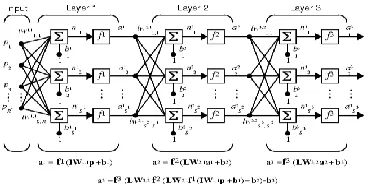
The multilayer perceptron is shown in fig 3.5 which have equal number of neuron in all 3 layers.
A network can have several layers. Each layer has a weight matrix W, a bias vector b, and an output vector a ,referring to figure each neuron receives a signal from the neurons in the previous layer ,and each of those signals is multiplied by separate weight value. The weighted inputs are summed, and passed through activation function is then broadcast to all of the Neurons in the next layer. So, to use the network to solve a problem, we apply the input values of the first layer allow the signal to propagate through the network, and read the output values. In the given figure the activation function is sigmoid function.
The back propagation learning process works in small iterative steps: one of the example cases is applied to the network, and the network produces some output based on the current state of its synaptic weights (initially, the output will be random).This output is compared to the known to the known-good output ,and a mean squared error signal is calculated. The error value is then propagated backward through the network, and small changes are made to the weights in each layer. The weight changes are calculated to reduce the error signal. The whole process is repeated for each of the example cases, then back to the first case again and so on. The cycle is repeated until the overall error value drops below some pre-determined threshold. At this point we say that the network has learned the problem “well enough” the network will never exactly learn the ideal function, but rather it will generalized the ideal function.
3.3 Performance Metrics
The training and testing of the feed forward neural network for distinguishing the linear and nonlinear faults is done using a new generic algorithm. The first step in training a feed forward is to create the network object. The function new creates a feed forward network. Before training a feed forward network, the weight and biases must be initialized .The new command will automatically initialize the weights. The function sim simulates the networks. Sim takes the network input p, and the network object net, and returns the network output a. Once the network weights and biases have been initialized, the network is ready for training.
The network can be trained for function approximation, pattern association, or pattern classification. In this thesis training is being done for pattern classification. The training process requires a set of examples of proper network behavior network input p and target output. During training the weights and the biases of the network iteratively adjusted to minimize the network performance function. The default performance function for feed forward is mean square error the average squared error between the networks outputs and the target outputs.
4. CONCLUSION
A proposed hybrid system, currently under development, was discussed. Alarms are initially filtered through a rule-based or expert system and correlated with a neural network. The filtered and correlated alarms are then further analyzed through the use of a new generic system that attempts to identify the fault based on past cases or problem solving experiences. A second generic system is used to determine a correction plan, which is then executed and the results analyzed and stored as a new case. Future work implement the time reduce the fault detection and improve.
REFERENCES
1. B.M Aucoin, B.Don Russell,” Distribution High Impedance Fault Detection Utilizing High Frequency Current Component “IEEE Trans. On PAS,Vol.PAS-101,No.6 June 1982.pp.15961606.
3.Aucoin B,Michel, and Jones,Robert H.,”High impedance Fault Detection Implementation Issues”,IEEE Transaction on power Delivery,Vol.11,No.1 January,1996,pp.139-148.
4. A.M Sharaf, L.A. Snider, K.Debnath,” A Third Harmonic Sequence ANN Based Detection Scheme For High Impedance Faults”,Proceedings of the ISEDEM Singapore ,pp.802-806.
5.L.A Snider ,Yuen Yee Shan,”The Artificial Neural Networks based Relay Algorithm Distribution System High Impedance Fault Detection”, Proceedings of the fourth International Conference on Advances in Power Sytem Control ,Operation and Management,APSCOM-97,Hong Kong,November1997,pp 100-106.
6. L.A. Snider,Yuen yee Shan” The Artificial Neural Networks based Relay Algorithm For the DetectionOf High Impedance Faults”,ELSEVIER Transactions on Neuro Computing ,1988,pp 243-254
7. T.M. Li Snider ,L.A. Snider. Lo,C.H. Cheung and K.W.Chan “High Impedance fault detection UsingArtificial Neural Network”, Proceedings of the fourth International Conference on Advances in power System Control , Operation and Management,APSCOM ,Hong Kong, November 2003,pp 821-826
8. A.M Sharaf ,L.A Snider,K,Debnath ,” A Neural Network based Back error Propagation Relay Algorithm for Distribution System High Impedance fault Detection”, Proceeding the ISEDEM.Singapore,pp.613-20
9.Adel M.Sharaf,Guosheng Wang,”High Impedance Fault Detection using Low Order Pattern Harmonic Detection”,IEEE TRANS.pp 883-886.
10.Adel M.Sharaf,Guosheng Wang,”High Impedance Fault Detection using Feature Pattern Based Relaying”IEEE trans.pp 222-226.
11.A.M,RM.EISharkawy,H.E.A,Talaat,M.A.L.Badr”Novel Alpha-Transformation Distance RelayingScheme”.IEEE trans.pp 754-757.
12. A.M.Sharaf, L.A. Snider, K.Debnath,” A Neural Network Based relaying Scheme For Distribution System High Impedance Fault Detection “,IEEE trans.pp 321-326
13.T.M Lai Snider,L.A.Snder.E.Lo”Wavelet transform based algorithm for the detection of stochastic high impedance faults”,ELSEVIER Transaction on Electric Power System Research,pp 626-633.
14. Abhishek Bansal and G.N.pillai “High Impedance Fault Detection Using Artificial Neural Networks”,trans.pp 148-152
15. M.M,Eissa (SMIEEE) G.MA. Sowilam,A.M Sharaf (SMIEEE)” Anew Protection Detection Technique For High Impedance Fault Using Neural Network” IEEE trans .pp 146-151.