A Study on Level of Satisfaction of
Handloom Weavers
*X. Maria Muthu Shanthini ** Dr.R.Rathiha
* Research Scholar, Women’s Christian College, Nagercoil-1**Associate Professor of Commerce, Women’s Christian College, Nagercoil-1. Abstract
Handloom industry had a highly developed stage even in epic times. There are innumerable references to the exquisite qualities and wide range of fabrics worn by the kings and the people at large. This paper is aimed at studying the level of satisfaction among handloom weavers by taking sample weavers from handloom zone of Kanniyakumari District. Study concluded that the government of India is liable to promote the industry. So, the government has announced many schemes and developed many policies to develop the sector.
Key words: Handloom industry, satisfaction, weavers and schemes.
INTRODUCTION
Handloom industry had a highly developed stage even in epic times. There are innumerable references to the exquisite qualities and wide range of fabrics worn by the kings
and the people at large. In India, it was said a belief that even gods were attracted by the
beautiful designs and textiles of fabrics worn by women on the earth. Handloom industry is a cottage industry in the best sense of the term, as the work is done largely in the home of the weaver himself. The loom just like the plough symbolizes the ethos of India. In fact, the handloom industry along with agriculture is the mainstay of our rural economy. The handloom textile is unique and it has a very good glorious heritage, over the years. Handloom goods are no longer the choice of the poor alone, but a favourite of the elite in India and abroad. Handloom industry gets importance because it is not only meets clothing needs of the people, but also gives expression to Indian art and culture, craftsmanship and heritage. The Handloom industry, the largest segment in the organised and unorganized sector, plays a very important role in the country’s economy.
REVIEW OF LITERATURE
P.B. Nimbalkar, (2002) has pointed out in his study that the Handloom sector provides direct and indirect employment to 6.5 million persons engaged in weaving and allied activities. As a result of Government intervention through financial assistance and implementation of various development and welfare schemes, this sector has been able to withstand competition from the power loom and Mill sectors production in this sector has reached to 6792million square metres in 1998-99. This sector contributed to 19 percent cloth produced in the country and contribution substantially to the country’s export earnings.
Co-operative Society in Andra Pradesh should encourage the weavers to participate actively in the exhibitions cum sales counters by meeting the weaver’s expenses. The Government of Andhra Pradesh should also encourage the weavers by giving prizes, rewards, and mementos for the best weaving art and for craftsmanship. These awards may be in cash or in kind. And researcher found that there is no respondent has received any rewards by the Government, in this regard.
STATEMENT OF PROBLEM
This research paper is aimed at studying the level of satisfaction among handloom weavers by taking sample weavers from handloom zone of Kanniyakumari District. Handloom sector was ignored by the government from the angle of revival of traditional techniques adopted by weavers. So it is necessary to know regarding their satisfaction to develop the industry.
OBJECTIVES OF THE STUDY
The objective of the study is to find out the level of satisfaction among handloom weavers and to provide some appropriate suggestions for the purpose of improving the Handloom Industry in future.
METHODOLOGY
The study mainly depends upon primary as well as secondary data. Primary data has been collected from 337 respondents using interview schedule. Secondary data were collected from books, journal, magazines and reports. As census method is not possible to collect the primary data within stipulated period convenience sampling method was used for collecting the data. Mean score with rank and t-test were used for the purpose of analysis.
LEVEL OF SATISFACTION OF HANDLOOM WEAVERS
TABLE 1
LEVEL OF SATISFACTION OF HANDLOOM WEAVERS
Sl.No Factors Mean score Rank
1 Work environment 3.61 II
2 Wage factor 1.29 V
3 Government benefits 2.90 III
4 Co-workers 1.77 IV
5 Knowledge in this field 4.68 I
Source: Direct Enquiry
Table 1 depicts that the level of satisfaction of handloom weavers are high for the variable Knowledge in this field’ with the mean score of 4.68 followed by ‘work environment’, government benefits’ with the mean score of 3.61 and 2.90 respectively. However, they have low level of satisfaction towards ‘Wage factor’, ‘Co-workers’ with the mean score of 1.29 and 1.77 respectively.
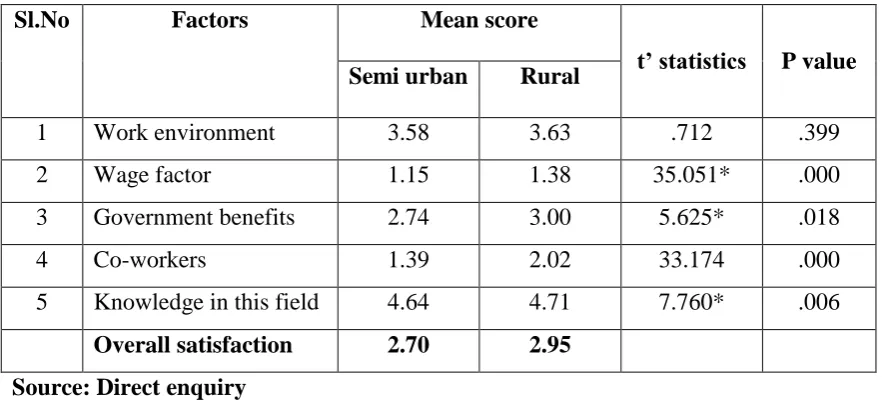
The t’ statistics is calculated for the purpose of identifying significant differences on the level of satisfaction for selected variables among different area handloom weavers. The resulted mean and t’ statistics of each variables for level of satisfaction are shown under the table.
TABLE 2
LEVEL OF SATISFACTION OF HANDLOOM WEAVERS AMONG DIFFERENT
REGION
Sl.No Factors Mean score
t’ statistics P value
Semi urban Rural
1 Work environment 3.58 3.63 .712 .399
2 Wage factor 1.15 1.38 35.051* .000
3 Government benefits 2.74 3.00 5.625* .018
4 Co-workers 1.39 2.02 33.174 .000
5 Knowledge in this field 4.64 4.71 7.760* .006
Overall satisfaction 2.70 2.95
Source: Direct enquiry
*Significant at five percent level
It is shown in the Table 2 that in semi urban area, handloom weavers have high level
(3.58). However, they have low level of satisfaction for ‘income factors’ (1.15) and
‘Co-workers’ (1.39). Similarly, in rural area, handloom weavers have high level of satisfaction in
the factors like ‘knowledge in this field’ (4.71) and work environment (2.02). However, they
have low level of satisfaction for ‘income factors (1.15) and Co-workers (1.38).
It has been found that handloom weavers in rural area are more satisfied than other
semi urban sample respondents, as their standard of living is not high and expectation is low
compared to semi urban area respondents with the mean score of 2.95. It explains that,
workers in handloom industry are having well knowledge in this field as it is traditional
industry and they or their ancestors are doing it for long years. After that, handloom weavers
are satisfied with their work environment which may be industry or home as work place.
They feel comfortable in work place environment include sanitation, relationship and the like.
Finally income of handloom weavers is not enough and requires more income to be satisfied.
‘t- test has revealed that the level of satisfaction ‘work environment, government
benefit and knowledge in this field differ significantly among handloom weavers under the
different area respondents, since the t values are significant at 5% level.
SUGGESTIONS
Total work satisfaction depends upon the wage earned by the weavers. So government
should take necessary steps to increase the income of the handloom weavers.
All schemes provided by the government, should be made available for all the
weavers in Kanniyakumari District to protect them from poverty.
Special programmes should be conducted to make unity among workers. And
grievances redresal should be established to solve the grievances between them.
CONCLUSION
World-wide reputation and craze for handloom clothes raised from the Indian Handlooms industry. India enjoyed a prominence as a producer of textiles. Handloom industry plays an important role in improving economic condition. The government of India is liable to promote the industry. So, the government has announced many schemes and developed many policies to develop the sector.
REFERENCES
[1] Dr.K.Venugopal Rao, Prof.M.
Chandrasekhar, ‘Problems of Handlooms
industry’, Kurukshetra, Vol.XLVI,
1998,p.24.
[2] Golden, S. A. R. (2017). Recent Research in Social Sciences & Humanities. EduPedia Publications (P) Ltd.
[3] N.P. Seshadri, ‘Handloom in the
Tiny Sector’, Journal of Industry and
[4] P.B.Nimbalker, “Traditional Industries” SIDBI Report on SSI Sector-2001, issue:3 Feb.2002, PP.36-38.
[5] Regi, S. B., & Golden, S. A. R. (2014). A Study On Attitude Of Employee Towards Working Environment With Special Reference To RR Pvt Ltd. Review Of Research, 2 (2), 1, 5.
[6] Regi, S. B., & Golden, S. A. R. (2014). A Study On Attitude Of Employee Towards Working Environment With Special Reference To RR Pvt Ltd. Review Of Research, 2 (2), 1, 5.
[7] Regi, S. B., Golden, S. A. R., & Franco, C. E. (2014). Employee Perception Towards Effectiveness Of Hr Practices In Public Sector Banks In Tirunelveli District. Tactful Management Research Journal, 2(6), 1-4.
[8] Regi, S. B., Golden, S. A. R., & Franco, C. E. (2014). Role of Commercial Bank in the Growth of Micro and Small Enterprises. Golden Research Thoughts, 3 (7), 1, 5.
[9] Sunita G. Shejwadkar and Geeta
Mahale, ‘Handloom Products of
Karnataka’, Indian Journal of Marketing,
vol.XXXI, 2001, p.11.
[10] Y. Prasada Rao, ‘Marketing