253
EFFECT OF UTILIZATION OF BIOLOGY TEACHING AND LEARNING
RESOURCES ON STUDENTS’ ACADEMIC PERFORMANCE IN
SECONDARY SCHOOLS IN SIAYA DISTRICT – KENYA
Bernard Lawrence Ong’amo Samson Rosana Ondigi Alice Omariba Kenyatta University Kenyatta University Kenyatta University
P.O Box 43844, P.O Box 43844, P.O Box 43844, Nairobi—00100 Nairobi---00100 Nairobi--00100
[email protected] [email protected] [email protected]
Abstract
This study sought to find out the effects of utilization of biology teaching and learning resources on students’ academic performance. The study was carried out in public secondary schools in Siaya District. The researcher used a sample of twenty-three schools drawn from ninety two public secondary schools. They were selected through stratified random sampling. The teacher respondents were purposively or randomly sampled. Purposive sampling was used to choose an experienced teacher where two or more teachers taught biology in form two classes and the teacher was the most experienced. Where there existed more than one long serving and experienced teachers teaching form two classes, random sampling was employed to pick one of them for interview. Student respondents were chosen through random sampling in single sex schools and stratified random sampling in mixed schools. Headteachers from each of the sampled schools were selected for personal interview. The data were collected using questionnaires, checklists, observation schedules and interview guides for headteachers. Observation schedules were used by the researcher to ascertain use of resources by teachers and learners and the resultant tests used to determine the score differences in achievement between classes taught using resources and those taught without resources. Interviews with headteachers of schools were used to countercheck the information given by teachers and students on utilization of resources. The findings of the study established that textbooks were the most widely used teaching and learning resources while audio visual resources were the least used. The resources were mainly bought by the headteachers and very few improvised by teachers. The textbooks in schools were inadequate and had to be shared by students who could not buy their own or borrow from friends. It was also observed that schools that were endowed with abundant resources were performing much better than those schools with few resources. The researcher’s assessment during live lesson teaching using observation schedule showed that students taught using teaching and learning resources performed better than those taught without the use of resources. The research also established that availability or utilization of resources was not the only factor determining student’s academic performance but other factors like teacher’s qualification, pedagogy, attitudes and students entry behaviour also affect academic performance.
Key words: Learning resource centre Improvisation
254
Specific Objectives
The objectives of this research were to:
i. Investigate the types of resources in secondary schools in Siaya District that are used for teaching and learning of Biology.
ii. Identify the challenges experienced in the utilization of biology resources by teachers and learners.
iii. Investigate the relationship between the use of teaching and learning resources and students’ academic performance in school.
Background to the Study
255 Project were due to heavy requirements of costly equipment, apparatus books and lack of highly trained and qualified teachers.
In 1968, the United Nations Educational Scientific and Cultural Organization pressed ahead and sponsored a conference on the development of education in Africa at Addis Ababa (UNESCO, 2006). The final report of the conference is summarized by Makulu (1971) as having recommended among other things:
a) Matching of economic planning with educational planning, b) Increasing facilities for training teachers
c) Reforming curriculum to include new and better methods of teaching science subjects placing emphasis on observation and experimentation.
This was borne out of the fact that a change in teaching science subjects was necessary from teacher-centered to student-centered method where individualized learning using resources take precedent.( Haggis 1972).The government, through its various Commissions made policy changes in education that were meant to bring about efficiency, relevance and quality to post-independence education in the country. The committees and their recommendations mentioned below, went a long way in improving learning standards in the classrooms:
a) National Committee on Education and policies in 1975(Gachathi report) resulted in laying more emphasis on technical subjects that would be more responsive to the country’s needs (Republic of Kenya, 1976; 66).
b) Presidential working party on second University (Mackay report) looked into the shortcomings of 7-4-2-3 system of education where Principal biology in high school was replaced by Biology and Biological science. The system of education was changed from 7-4-2-3 to 8-4-4. (Republic of Kenya, 1981).
c) Presidential Working party on Education and Manpower training for the next Decade and Beyond(Kamunge Commission) was set to look at resource and personnel challenge in teaching and learning and recommended cost-sharing between Communities and government(Republic of Kenya,1988:32)
d) Total Integration and Quality Education and training (TIQET) set up in 1998, gave its recommendations to rationalize Biology and Biological science syllabus leading to only Biology syllabus (Republic of Kenya, 2000).This move was meant to take care of shortage of biology teachers for effective teaching.
The KCSE examination results in biology have continued to fluctuate with changes in the setting of biology examinations and the changing curriculum as reported by numerous reports by Kenya National Examinations Council (KNEC 2000, 2007) reports. In 2000, biology registered the lowest mean grade than in any other year since 1997 according to analysis made by Kenya National Examinations Council (KNEC, 2000). In 2007, biology results dropped due to introduction of photographs instead of real specimens in an attempt to curb cheating in examinations (KNEC, 2007). Among the reasons that have contributed to this unsatisfactory performances according to the reports (KNEC 2000, 2007) was inadequate resources and improper utilization of the available few resources
Purpose of Study
256 of various teaching and learning resources influence the learning process in the subject leading to understanding of difficult concepts.
Rationale for the use of resources in teaching and learning of Biology
Effective instructions in a classroom require careful planning geared towards individualizing learning. Resource- based learning is the response to the need to individualize
instruction. Orlich (2001), states that students learn better where instructional activities are sequenced, that is knowledge presented in a carefully interrelated steps generally starting with a simple step, followed by complex and abstract concepts. Use of teaching and learning resources help achieve this objective as learning proceeds from the known to the unknown. This inductive method of learning where reasoning progresses from specific to general constitutes effective learning. Deductive reasoning on the other hand involves most lecture methods where learning proceeds from general to specific with little or no resources required for effective learning. A rich biology lesson requires integration of resources for proper understanding of concepts. Beswick(1975) says that when sufficient range in suitably graded aid becomes available, it makes lockstep advance unnecessary as it discourages uniformity of opinion by learners enabling teachers to have a real opportunity to individualize learning. When this happens he adds, increasing number of pupils will reach more and more objectives. Robler and King (1988) consider an increase of approximately ten per cent in time for learning as an important gain when using computer applications such as computer-assisted instruction.
Challenges Faced in the Utilization of Resources
There are many challenges facing utilization of resources the major one according to Lawton,Campbell & Burkitt(1971:116) is that the teacher must know all available teaching aids, select appropriate ones and guide pupils in their use so as to obtain correct information. Patel and Mukwa (1993) concur with the above challenges but also add that timely and proper presentation is very crucial in attaining a learning objective, availability of proper selection of resources notwithstanding. The high cost of teaching and learning resources according to Orwa and Underwood (1986) is an impediment to learning especially in the district schools that frequently experience shortage of funds.
Young people face problems while observing biological specimens especially where they are required to compare them. They often look at differences than similarity (Hertem & Jelly, 1990). This can result in wrong hypotheses or conclusions on observed items in a classroom situation. High costs of instructional resources is an impediment to learning especially in rural schools with low financial ability prompting Orwa and Underwood (1986) to suggest that classroom resources should not involve outlay of expensive scientific equipment. Sometimes low quality resources may make achievement of learning objective difficult (Brown & Wragg, 1993).
Methodology
257 collection were student and teacher questionnaires, checklists, interview schedules for headteachers and quality assurance and standards officer and class observation schedule. Data analysis, presentation of findings, conclusions and recommendations were made after research work.
Findings
Types of resources used for the teaching and learning of biology.
The raw data obtained using students questionnaires were compiled and processed. Editing and coding was done and data classified. Percentages were derived and tabulation done. Table 1 below summarizes the findings from the students.
Table 1: Types of biology resources mostly used for T/L in secondary schools in Siaya District—Students views
Resources Frequency Percentage (%)
Videos 0 0
Textbooks 110 95
Realia 20 17
All of the above 2 1
Textbooks were the main type of resources used. The total percentage response exceeded 100% since some students mentioned more than one resource.
i. Availability of Biology teaching and learning resources
The processed data on availability of teaching and learning resources put into percentage after determining the frequency of various responses on items put to students and then tabulated in Table 2 below
Table 2: How biology resources are made available
Response Frequency Percentage
Teacher brings 100 86
Students make 0 0
Teachers and students observe in natural habitat 10 7
All of the above 10 6
No answer 1 4
Due to multiplicity of the responses, the total percentage comes to more than 100. This meant that some students gave a response to more than one item. It is virtually the teachers who make the resources and take to the students.
ii) Adequacy of biology teaching and learning resources
When asked whether teaching and learning resources in biology are adequate, the response by students was as given in the table 3 below:
Table 3: Adequacy level of biology resources-Students view
Responses Frequency Percentage (%)
Adequate 10 7
Inadequate 104 90
258 The inadequacy may be largely due to low level of improvisation by the students and low level of resource acquisition by the schools according to the data collected (Table 4).
iii. Improvisation of resources
Students were asked if they get involved in making resources for teaching and learning. Their responses were captured in the questionnaire. Analysis was done and results tabulated as below.
Table 4: Involvement of students in the provision of learning materials
Responses Frequency Percentage
Yes 70 60
No 46 40
Not sure 0 0
Students can indeed make or have access to inexpensive equipment (Orwa & Underwood, 1986). This is the aim of SMASSE that has been carrying out INSET in the district since 2004. This is based on the premises that not all resources can be purchased.
vi. Individualized learning without teachers
When asked whether they carry out practical on their own without initiation of the teacher, students responded as given in table 5. Results are given in percentages.
Table 5: Utilization of resources without teacher’s initiation
Responses Frequency Percentage
Yes 50 40
No 70 60
Not sure 0 0
During classroom observation of teaching using resources, the researcher observed that learners were motivated. Beswick (1977) and Hanson (1975) reiterate that with available resources, students can achieve without teacher being available. The data on utilization of resources without teacher’s initiation revealed that most students in secondary schools in Siaya District do not carry out practical activities on their own and as Parkinson (1994) observes this lack of interest and drive is what the use of resources should provide.
Challenges encountered by learners in the use of resources
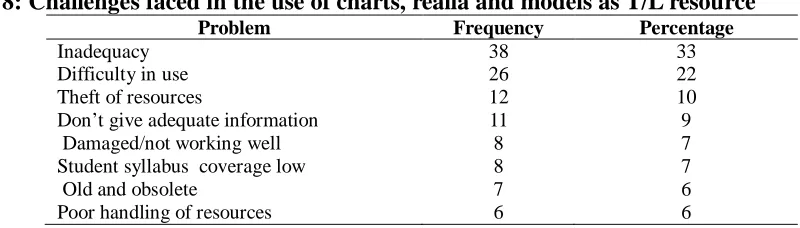
Utilization of resources is a challenging experience as most students found out. This question was left open and unstructured for the respondents. The responses from the respondents were represented in the table below in frequencies and percentages.
Table 8: Challenges faced in the use of charts, realia and models as T/L resource
Problem Frequency Percentage
Inadequacy 38 33
Difficulty in use 26 22
Theft of resources 12 10
Don’t give adequate information 11 9
Damaged/not working well 8 7
Student syllabus coverage low 8 7
Old and obsolete 7 6
259 Charts, models real specimens were found to be in schools in Siaya District in varying quantities. Table 8 gives responses on challenges experienced by learners in using them. Nicholas (1975) says that without sufficient range of resources learners cannot individualize learning and in fact learning and performance becomes difficult (Orlich & Harder, 2001).
The researcher sought to know from the respondents how they could overcome the above challenges. Inadequacy of the resources attracted the largest number of possible solutions for those who mentioned it as a problem. Many students (35%) felt they could share with others. About a quarter of the students felt they could borrow from other schools or just use what they have while few (20%) felt they could buy their own. Their response is captured in table 9.
Table 9: Dealing with the challenges of Biology resources shortage
Responses Frequency Percentage
Borrowing 9 22
Sharing 15 35
Buying own 8 21
Using available resources 6 22
Total 38 100
Relating resource utilization with academic performance in biology
High academic performance is a sum of all factors relating to proper utilization of resources and pedagogy. This includes adequacy of resources, presence of separate equipped biology laboratory and proper student-teacher ratio.
Table 10: Relationship between resource utilization and academic performance
Measure of practical activity Measure of academic
performance
Using standard exam/tests Percentage (%)
1.Effect of resources in teaching biology
a, Class taught using resources .-observed by researcher
b, Class taught without resources-observed by researcher
Performance in administered test given by researcher
52%
48%
1 Extent of resource use in the Siaya District
Response Frequency Frequently used No 71 Yes 26
Performance in KCSE
Mean : 5.47 Before INSET (1999-2003)
Mean: 6.25 After INSET (2004-2008)
3 Adequate use of laboratory
Response Frequency
260
4. Spending free time doing practical
Response Frequency No 61 Yes 22
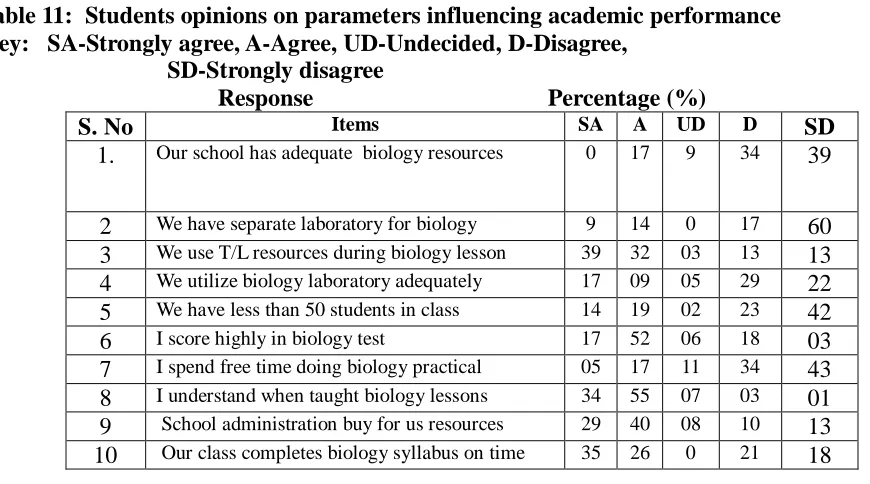
The table above indicates that with adequate use of biology T/L resources, academic performance is higher (52%) compared to that obtained without using resource (48%). KCSE average mean results before INSET was started stands at 5.47 compared to 6.25 after INSET when teachers were trained to use teaching and learning resources in every lesson. The following statements from learners were used to provide indicators of academic performance in the district.
Table 11: Students opinions on parameters influencing academic performance Key: SA-Strongly agree, A-Agree, UD-Undecided, D-Disagree,
SD-Strongly disagree
Response Percentage (%)
S. No Items SA A UD D SD
1. Our school has adequate biology resources 0 17 9 34 39
2 We have separate laboratory for biology 9 14 0 17 60 3 We use T/L resources during biology lesson 39 32 03 13 13 4 We utilize biology laboratory adequately 17 09 05 29 22 5 We have less than 50 students in class 14 19 02 23 42 6 I score highly in biology test 17 52 06 18 03 7 I spend free time doing biology practical 05 17 11 34 43 8 I understand when taught biology lessons 34 55 07 03 01 9 School administration buy for us resources 29 40 08 10 13 10 Our class completes biology syllabus on time 35 26 0 21 18
Students’ statement analysis from questionnaires; Source-Researcher (2011)
i. Adequacy of up to-date biology resources
From the research observation based on administered questionnaire, very few students (17%) agreed that there were adequate biology teaching and learning resources, while minority (9%) were undecided. The majority (73%) said they lacked adequate resources in the school.
ii. Availability of separate laboratory for biology practical
261
iii. Use of teaching and learning resources during biology lesson
Majority of the student respondents (71%) agreed that they use teaching and learning resources while learning biology; while very few (3%) were undecided. Few however (26%) indicated that they do not use teaching and learning resources during biology lessons.
iv. Adequate use of laboratory
A small number of students (26%) said they use biology laboratory adequately, while minority (5%) were undecided. Majority (69%) disagreed with the proposal.
v. Class with less than fifty students
When asked whether they had a class with less than fifty students, less than a half (33%) agreed while a small number (26%) were non-committal and about half (51%) refuted.
vi. High score in biology
The researcher did not indicate what score he considered high but left this statement open to test the level of student’s satisfaction in their biology performance. Other indicators were used to look at performance in total. Many students (69%) were happy with their biology performance saying they score highly in the subject. Very few, (6%) were non-committal while a quarter (27%) said they performed poorly.
vii. Spending free time doing biology practical
Less than a quarter (22%) of the students said they spend their free time doing biology practical. A few (11%) were undecided. The majority (67%) however, denied spending their free time carrying out biology practical.
Viii. Understanding when taught biology
Most students understand when taught biology (89%). Few (7%) were undecided on this while very few (4%) said they don’t understand when biology is taught.
ix. Purchase of biology resources by head teachers
Most headteachers are doing a good job by buying resources for students, according to majority (69%) of the students. Very few (8%) of the students were undecided on this while about a quarter (23%) felt the headteachers were not purchasing resource materials.
x. Timely completion of biology syllabus
When asked about syllabus coverage, the majority (61%) of students said they completed Biology syllabus on time while few (3%) said they never completed syllabus on time.
Background Information of Teachers
262
Table 12: Age distribution of teachers in the district
Age bracket Frequency Percentage (%)
25-34 7 30
35-44 9 40
45 and above 7 30
a). Teaching experience
Teachers experience is considered important in knowing available teaching aids selection of appropriate ones and in guiding learners in their use to obtain correct information (Lawton et al., 1971:116). Asked about teaching experience it was noted that about half of the teachers (48%) had teaching experience of fifteen years and above. The table below gives the findings.
Table 13: Teachers teaching experience
Experience in teaching Frequency Percentage (%)
6-9 years 7 30
10-14 years 5 22
15 years and above 11 48
Source-School records (2011)
Almost half of the teachers in the district had teaching experience of fifteen years and above and had attended four cycles SMASSE INSET course. They are able to use and improvise teaching and learning resources. There was no teacher with less than six years teaching experience and were expected to use teaching and learning resources to the maximum.
b). Teachers professional qualifications
The researcher sought to find out whether teachers professional qualifications had effect on utilization of resources and performance. It was discovered that majority of respondents (91%) had either Bachelor of Education or Post-graduate diploma in education. Only a small number (8%) had Diploma in Education. There were no form four school leavers in the staff. Most teachers (48%) had a teaching experience of fifteen years and above and were deemed able to use most of the resources for teaching and learning in secondary schools in the district.
Table 14: Teachers professional qualification
Teacher qualification Frequency Percentage (%)
Diploma in Education 3 8 Bachelor’s degree(BSc/BA) 1 9
BED/PGDE 19 83
It was noted by the researcher that more than three quarters of the teachers were degree holders either having Bachelor of Education or Post graduate diploma in Education.
d. Biology classes taught
When asked about the biology classes they teach, the following data were obtained.
Table 15: Teaching distribution in classes
Class Frequency Percentage (%)
Form 1 22 96
Form 2 18 78
Form 3 19 83
Form 4 15 65
263 It can be noted that the same teachers of form 2 were largely responsible for teaching other forms and had more than fifteen years teaching experience. This is because only twenty three form two teachers were asked about the classes they teach but all classes were mentioned by at least nineteen teachers except for form four that was mentioned by an equally large number of teachers (15) which represents sixty-five per cent. It can be observed from table 4.15 that most teachers of biology teach the subject in all the forms.
e. Class size
Class size influences the use of resources especially if resources are scarce. Asked about the size of classes, they can comfortably teach using resources, many teachers indicated that they can comfortably teach a class of forty students.
Type of resources used by teachers
When asked about the types of resources they normally use in schools, most teachers mentioned print (mainly text books).The table below summarizes the responses. Frequencies and percentages were derived from the raw data obtained from the teachers’ questionnaire.
Table 16: Resources normally used by teachers in schools
S. No. Resources Frequency Percentage
1 Audio visual 8 35
2 Print 14 61
3 Realia 5 22
The total number of respondents was higher than 100% since more than three teachers made multiple choice of the media they preferred with sixty-one per cent of the teachers mentioned print as the mostly used resource in teaching and realia the least used resource. Kimui (1988) and Nyongesa (1990) observe that our schools continue to function as though print is the only instructional media that can be used. Davies (1975) calls this information source ‘passive’ that must be activated to facilitate direct use.
Challenges in using ICT
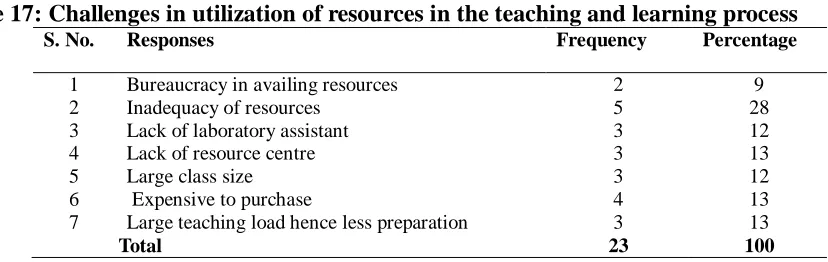
Challenges in the use of resources were varied and many but the most commonly suggested was inadequacy of resources at twenty-eight per cent while bureaucracy in the attainment of the resource was least mentioned at nine percent.
Table 17: Challenges in utilization of resources in the teaching and learning process
S. No. Responses Frequency Percentage
1 Bureaucracy in availing resources 2 9
2 Inadequacy of resources 5 28
3 Lack of laboratory assistant 3 12
4 Lack of resource centre 3 13
5 Large class size 3 12
6 Expensive to purchase 4 13
7 Large teaching load hence less preparation 3 13
Total 23 100
264
Table 18: Overcoming resource shortage
Item Frequency Percentage
One teacher to be at INSET centre 2 9
Donation of books to schools 3 13
Daily operation of INSET centre 2 9
Purchase of resources 4 17
Reduction of teachers workload 3 13
Teachers to improvise resources 4 17
Reduction of class size 3 13
Teachers had various opinions on how to overcome resource shortages. According to the feedback from administered questionnaires, only one third of the schools had computers. When asked whether they use computers, many (74%) affirmed while about a quarter (26%) said they do not use such resources.
Table 19: Do you use computers for teaching and learning? Item Frequency Percentage (%)
Yes 6 26 No 17 74
Those who said they used ICT said they used computers for teaching and learning. Asked about the frequency of use about a third (33%) of the respondents said they use them frequently while about two thirds (67%) said they use them infrequently.
Table 20: Challenges encountered in the use of ICT
Response Frequency Percentage
Lack of relevant CDs 5 15
Cost factor 9 40
High frequency of power failure 6 25
Inadequate space in computer laboratory 5 20
Total 25 100
A large percentage of teachers (74%) said they use computers but the biggest challenge in the use of computers was the cost factor according to many teachers (40%) who use them. A quarter of the teachers mentioned power failure as an impediment to the use of computers in schools. Inadequate space in the computer laboratory is considered by a fifth of the teachers (20%) to be a challenge in the use of computers in schools. A smaller number of teachers (15%) felt that lack of relevant CDs for storing information was a challenge in embracing computers as a teaching and learning resource in secondary schools in the district.
Relationship between resource utilization and academic performance
265
Table 21: Teachers opinion on parameters influencing academic performance Key; SA-Strongly agree; A-Agree; UD-Undecided; D-Disagree; SD-Strongly disagree
Items Percentage approval Ratings (%)
SA A UD D SD
Our school has adequate resources in biology 0 26 09 65 0
I use resources whenever I teach biology lesson 0 35 26 35 0 There are more than fifty (50) students in my class 17 35 0 35 13 My biology students are less than fifty (50) in class 0 26 0 57 17 We have separate biology laboratory in our school 04 09 0 09 78 I mostly use lecture and demonstration method in
teaching
17 65 0 09 09
Our school administration supports us in acquiring resources
04 61 09 09 17
I have adequate time to plan for biology practical lessons
09 17 0 61 13
My students perform well in biology 0 35 0 52 13
a) Adequacy of resources in biology
About a quarter (26%) of teachers said the resources were adequate, while a small number (9%) were non-committal. About two thirds (65%) disagreed that biology teaching and learning resources were adequate.
Utilization of resources during lessons
A reasonable number (35%) of teachers agreed that they use resources, while about a quarter (26%) were undecided on this while the remaining (35%) refuted the idea.
c) Number of students in class
About a half (52%) of teachers agreed that they have above fifty students in their classes while almost a half (48%) disagreed. When the opposite was asked (Class having less the 50), about a half (24%) said they have less than fifty students in class while about three quarters (74%) said their students are more than fifty. It is possible that the less than fifty questions which could mean anything between one and fifty was too large a range to invoke a definite response.
d) Separate biology laboratory in school
A small number (13%) of teachers agreed that they have separate laboratory for biology practical while the majority (87%) said they did not have separate laboratory.
e) Use of lecture method in teaching biology
Majority (82%) of the teachers acknowledged that they use lecture and demonstration method of teaching biology while the minority (18%) refuted it.
f) Support from school administration in resource acquisition
A large number (65%) of teachers said school administration support them in resource acquisition, 26%) said they were not supported while (9%) were not committal.
g) Adequate time to plan practical lessons
About a quarter (26%) of teachers said they have adequate time for planning biology practical lessons as opposed to the majority (74%) who said to the contrary.
h) Performance in biology
266
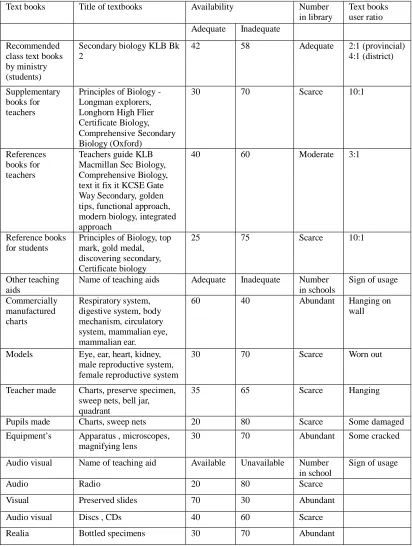
Table 22: Biology teaching resource checklist
Text books Title of textbooks Availability Number
in library
Text books user ratio Adequate Inadequate
Recommended class text books by ministry (students)
Secondary biology KLB Bk 2
42 58 Adequate 2:1 (provincial)
4:1 (district)
Supplementary books for teachers
Principles of Biology -Longman explorers, Longhorn High Flier Certificate Biology, Comprehensive Secondary Biology (Oxford)
30 70 Scarce 10:1
References books for teachers
Teachers guide KLB Macmillan Sec Biology, Comprehensive Biology, text it fix it KCSE Gate Way Secondary, golden tips, functional approach, modern biology, integrated approach
40 60 Moderate 3:1
Reference books for students
Principles of Biology, top mark, gold medal, discovering secondary, Certificate biology
25 75 Scarce 10:1
Other teaching aids
Name of teaching aids Adequate Inadequate Number in schools
Sign of usage
Commercially manufactured charts
Respiratory system, digestive system, body mechanism, circulatory system, mammalian eye, mammalian ear.
60 40 Abundant Hanging on
wall
Models Eye, ear, heart, kidney, male reproductive system, female reproductive system
30 70 Scarce Worn out
Teacher made Charts, preserve specimen, sweep nets, bell jar, quadrant
35 65 Scarce Hanging
Pupils made Charts, sweep nets 20 80 Scarce Some damaged
Equipment’s Apparatus , microscopes, magnifying lens
30 70 Abundant Some cracked
Audio visual Name of teaching aid Available Unavailable Number in school
Sign of usage
Audio Radio 20 80 Scarce
Visual Preserved slides 70 30 Abundant
Audio visual Discs , CDs 40 60 Scarce
Realia Bottled specimens 30 70 Abundant
Results from Observation Checklist
267 shows that commercially manufactured charts, equipment and relia were available in reasonable numbers that could be satisfactorily used to instruct learners. Reference books for teachers were moderately sufficient with teacher-book ratio standing at 3:1 while for students it stood at 10:1. Supplementary books for teachers stood at a ratio of 10:1 per book.
The researcher considered a sharing ratio of 4:1 for textbooks as the most stretched limit for effective learning. Glassware, magnifying glass, slides and other apparatus that can be shared between two students were considered sufficient. Other teaching and learning aids like charts on each topic for a class of forty-five was considered sufficient as was a computer serving two students. All in all the provincial schools were fairly stocked with conventional resources while district schools with high student- resource ratio (Table 22) were largely lacking in sufficient resources.
Findings from Lesson Observation Schedule
The researcher observed live lessons and recorded the observations using lesson observation schedule. The researcher sat at the back of the class as the teachers taught using resources in some classes and taught without in other classes. The researcher had visited the class before and briefed the students that he would learn with them when he comes back. Two evenly matched classes were selected in the three schools selected for classroom observation. One class was taught using teaching and learning resources while the other was taught by their teacher without use of resources as had been arranged between the teacher and researcher. The aim of classroom observation was to find out if the use of teaching and learning resources had any effect on academic performance of the students based on administered test. The researcher selected three schools for observation. These schools were part of the sampled schools for classroom observation. The two tests were marked by the researcher. Differences between the results were analyzed. It was found that in each school, the stream that was taught using resources performed better than the one taught without resources. The average marks obtained from evaluating students taught using resources was higher (54%) than those taught without (48%) showing that resource use during teaching improves performance. The tests were selected from KCSE past paper which had been standardized and marking scheme moderated by senior examiners (See appendix ix).
Table 23: Average marks of students taught with & without resources in the District
Activity Percentage(%) in marked test
Class taught without T/L resources 48 Classes taught using T/L resources 52
The activity, concentration and interest of the students during the lesson were evaluated by the researcher who found the said indicators highest in classes taught using teaching and learning resources. Tests administered to the students separately showed that the average marks of students taught without resources stood at 48%. This contrasted with 52% which the average marks obtained by students were taught using resources for the same lesson. Use of teaching and learning resources was seen to add value to academic performance.
Results from Use of Interview Schedule for Headteachers
268 inclusive and balanced view on all the factors involved in utilization of Biology teaching and learning resources and resultant student academic performances. The researcher captured responses from headteachers during the interview in a tape recorder which was later used to ascertain the level of resource use in the schools.
On the question of the adequacy level of biology teaching and learning resources in their schools, majority (80%) of the headteachers said they had inadequate resources while twenty per cent said they had adequate resources in their schools. It is instructive to note that the few (20%) headteachers who indicated they had adequate resources were from four provincial schools that are deemed to have sufficient resources according to list of schools from the DEO office.
Enough or scarce, the utilization aspect of the teaching and learning resources is what determines whether learning objectives can be realized, taking into account what we want our students to know (Brown & Wragg, 1993). When asked to comment on resource utilization in their schools, many (60%) headteachers said that the available resources are not utilized to the maximum. Quarter (25%) said they were moderately utilized while minority (15%) said they were utilized to the maximum. Most of the principals felt that the available resources are not being used to the maximum.
Utilization of resources has its own challenges which head teachers –majority of who were active classroom teachers knew. Headteachers were quick to point out inadequacy of resources as the main challenges facing resource utilization. A quarter (25%) of headteachers however, blamed lack of improvisation as a major challenge with the same percentage (25%) identifying lack of exposure to the available resources as the challenge.
The researcher discerned that there existed a possible planning and knowledge gap on the part of the teacher (Lawton, Campbell & Burkitt, 1997) whose heads (25%) blame lack of exposure. The researcher then asked whether teacher training and qualification influence student achievements in biology. Many (60%) headteachers said yes, few (30%) said it affects to some extent while minority (10%) said it did not. The headteachers were asked whether they thought availability and utilization of biology teaching and learning resources contributed to learners’ achievements. Quoting from one headteacher who is also a SMASSE biology trainer in the district, “Availability of resources provides students with more hands-on activity and enhances their understanding of taught precepts. The headteacher’s sentiments are in line with Sepulveda (1983) who reveals that use of instructional resources influences learning and determine achievements.
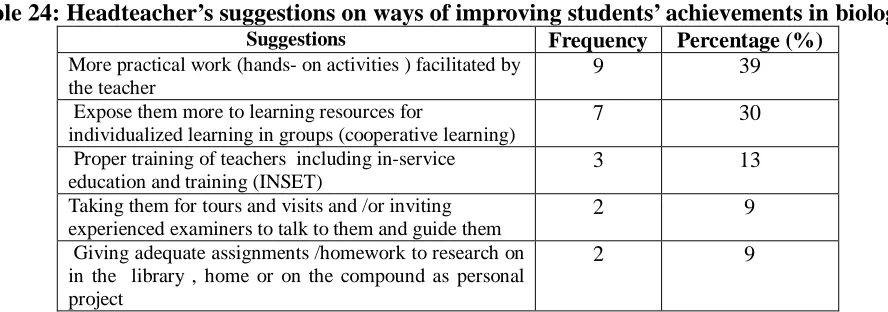
The researcher posed a final question to the school headteachers on what could be done to improve student’s achievement in biology. Their responses were varied and numerous. The researcher condensed and categorized responses into four major suggestions ( Table 24).
Table 24: Headteacher’s suggestions on ways of improving students’ achievements in biology
Suggestions Frequency Percentage (%)
More practical work (hands- on activities ) facilitated by the teacher
9 39
Expose them more to learning resources for
individualized learning in groups (cooperative learning)
7 30
Proper training of teachers including in-service education and training (INSET)
3 13
Taking them for tours and visits and /or inviting experienced examiners to talk to them and guide them
2 9
Giving adequate assignments /homework to research on in the library , home or on the compound as personal project
269 Improvement of academic performance was central in the headteachers list of desires with thirty-nine per cent of the headteachers suggesting that more practical work should be done to enhance students’ academic performance in biology. This view is shared by Bennars and Otiende (1994) and Ellington (1985). Proper training of teachers was suggested by the headteachers as a necessary prerequisite to good performance by teachers in class that could enhance students’ performance. This is what the Kenya government in collaboration with Japanese government under JICA has been doing to strengthen the teaching of Science and Mathematics in Kenya under auspices of SMASSE. The suggestion by headteachers that more assignments be given (9%) resonates well with individualized learning method that Beswick (1977) sees as important in motivating learners. The headteachers further suggested that students should be exposed to learning resources in school (30%) which according to Parkinson (1994), is very effective in the learning process.
Relationship between Utilization of Resources and Academic Performance
Majority of Headteachers interviewed (39%) suggested that more practical work is required in order to improve biology performance in schools. This is in line with suggestions made by Saunders that much learning (83%) takes place when a teacher engages students’ sense of sight and further says that students retain fifty per cent of what they are taught while seeing and hearing as opposed to twenty per cent retention of what they are taught through hearing alone. Teachers (26%) also suggested that using resources while teaching helps in clarity of ideas. Students said they sometimes use resources during teaching and learning process. This made teachers (65%) and headteachers (75%) say that students are performing poorly in biology.
The researcher further proved using tests that academic performance improved when students are taught using resources (51%) than when they are taught without resources (48%). Siaya District mean score in Biology during the five years after INSET was started in the district increased by 0.8 compared to the period before INSET. In-service Education and training of teachers (INSET) is meant to train teachers on the practical approach of teaching science subjects and mathematics using teaching and learning resources. The findings on the relationship between utilization of resources and academic performance is that availability and proper utilization of T/L resources improves academic performance (Patel & Mukwa, 1993).
Conclusion
The findings from the study necessitate the following conclusions:
a) Most of the essential instructional resources recommended for teaching and learning biology were available in the schools in the district but they were inadequate.
b) Textbooks were the most widely available resources as confirmed by the students (95%) and video the least available.
c) Teachers appreciated the role instructional resources play in the teaching and learning process by using the available teaching and learning resources during their lessons as indicated by the learners (71%) and themselves (38%).
d) Most teachers do not take their students for academic trips and hence denying students’ clarity of ideas through interaction with environment and resource personnel (Trowbridge, Leslie, Bybee & Powel, 2004).
270 instructions increase learning time by reasonable percentage of (10%) according to (Robler et al., 1988) hence makes learning more efficient.
f) Some learning facilities in schools require re-innovation and /or repair due to age according to students (6%).
g) Performance of students is being compromised by continued lack of resources according to headteachers (90%), and teachers (65%). Although students indicated that they perform well (61%), other indicators like district examinations analysis and marks from the researcher’s classroom observation schedule together with their headteachers and teachers’ observation revealed to the contrary. This is probably because the researcher left the performance questions open with no quantitative boundaries for performance categories.
Recommendations
Utilization of biology teaching and learning resources is very important for good results to be realized in biology. The following recommendations have been made by the researcher:
i. Availing resources-Basic resources should be made available by the headteachers. Teachers of biology should set up simple aquarium, vivarium and botanical gardens in schools. The government should also supply basic resources to schools through special funds.
ii. Subsidy on imported computers-The government should subsidize on costs of computer and related soft and hardware to make computers cheap to be afforded by schools. This will encourage teachers to employ use of ICT in instructions to make learning efficient.
iii. Updating teacher training programmes-To ensure new teachers go through the practical requirements of the changing syllabus and technological aspects of teaching like e-learning and innovative activities that emphasize resource use. Regular review of the teacher training programs in light of the changing educational trends is desirable.
iv. Improvisation of teaching and learning resources- Teachers should attempt to improvise resources in their schools based on knowledge from the INSET centers and training.
i. Setting up of resource centers-Schools and the surrounding community should be sensitized on preservation of teaching and learning resources and if possible a learning resource center should be set up centrally near a group of schools to enhance learning.
Suggestions for Further Research
a) The research which was carried out in one district -Siaya is not representative of the whole country. Similar research should be carried out in other districts.
b) A research should be carried out on the extent to which biology teachers can improvise teaching and learning resources and recommendation given for further action to ensure availability and utilization of biology teaching and learning resources in secondary schools in Kenya.
c) A research should be carried out on why teachers do not always teach using available resources in their schools
d) A study to investigate the relationship between continuous use of T/L resources and its impact on the future of student’s scientific potential is necessary.
271
REFERENCES
Bell, J. (1993). Doing your research project. Buckingham: Open University Press. Beswick, N. (1975). Resource based learning. London: Longman.
Bennars,G. A., Otiende, J. E. & R. (1994). Theory and practice of education. East African publisher
Brown, G. & Wragg, E. (1993). Questioning, Rutledge. London: Longman Press.
Davies,W, K. (1975). An argument for schools learning resources. USA: Chicago Press Ellington, H. (1985). Producing teaching materials. USA: Chicago Press.
Fisher, R. P., Power, C. N. & Endean, L. (1972). Fundamental issues in biology education. Sydney: John Wiley & Sons.
Grobman, B.A. & Mayer, V. W. (1975). Biological Science curriculum study. Rutgers University. New Brunswick: BScs Publication
Haggis, S. (1972). Science education in national development. London: Longman. Hanson, J. (1975). The use of resources.Unwind educational books. London: Longman
Hertem, W. & Jelly, S. (1990). Developing science in the classroom. Portsmouth: Heinemann. Hughes, A. & Hughes, E. H. (1966). An introduction. Learning and teaching to psychology and Education. Longmans
JICA report. (1998). Basement studies: A hand book presented at Cemastea. Karen. Nairobi.. KIE (2002). Needs assessment survey report on the second education curriculum. Nairobi: KNEC (2000). KCSE Analysis Report. Nairobi: Government Printer.
KNEC (2007). KCSE Analysis Report. Nairobi: Government Printer
Lawton, D., Campbell, J. & Burkitt,V. (1971). Social studies 8-13: A report on the middle years of school. London: Evans / Muthuen
Makulu, H. P. (1975). Education development and nation building in independent Africa London: SCM Press Ltd.
Maundu, J.N., Muchirii, M. & Sambili, J. (1998). Biology education. A Methodological Approach. Nairobi: Lectern Press.
Maritim, E.K.(1983). Observed classroom interactions and academic performance of primary schools, KERA research report No 19, Bureau of Educational research. Nairobi: Kenyatta University.
Nicholas, H. (1975). Creative writting. London: Longman
Orlich, Harder. (2001). Teaching strategies. Aguide to better understanding. Callahan, Gibson. Orwa,W.O. & Underwood, M. (1986). Science education. Nairobi: Kenyatta University.
Parkinson, J. (1994). The effective teaching of secondary biology: A Peason Education print on demand edition. London: Longman.
Patel, M.M. & Mukwa,W. (1993). Design and use of media in education. Nairobi: Lec Republic of Kenya. -(1964). Kenya Education Report.Nairobi Government Printer.
-(1981). Second University in Kenya: Report of the Presidential Working Party. Nairobi: Government Printer.
-(1976). Report on the national committee on educational objectives and policy. Gachathi Report
-(1981). The presidential working party on second University in Kenya. Mackey Report.
272 Robler, M.D., William, H., King, F.J. (1988). Assessing the impact of computer based instructions; a review of recent research computers in schools. S. Nos3/4
Sheffield, J. (1973). Education in Kenya: An historical study. New York: Teachers College, Columbia University Press.
Smith, L.,Keith P. (1975). Anatomy of educational Innovations. London: Longman. Toili, W. (1987). Role of primary science instructional and teacher training strategies in the promotion of scientific literacy in primary schools in Kenya: Constraints and prospects.Nairobi: KIE Paper 1
Trowbridge, W. Leslie, T, Bybee W., & Powel, G. (2004). Teaching secondary school Biology. Strategies for developing scientific literacy.(8th edition). Upper Saddle R, New Jersey Columbus, Ohio.
UNESCO, International science and Technology, (2006). Environmental education newsletter Vol. XXXI number 3&4
UNESCO, International Understanding at School, (1967). London.