ISSN 2286-4822 www.euacademic.org
Impact Factor: 3.1 (UIF)
DRJI Value: 5.9 (B+)
The Impact of Reforms
on the Russian Education System
ARVIND KUMAR
Centre for Russian, Central Asian and East European Studies School of International Studies Jawaharlal Nehru University New Delhi, India
Abstract:
Key words: Oblast1, Rayon2, Charter School, Friskolar, Core
Knowledge, Profile Education3, Unified State Examination, Licensing,
Attestation and Accreditation.
Since 1991 Russia has ushered in a new era after more than seven decades of the communist regime of Soviet Union that came to an end. After a long debate during perestroika the leaders and reformers of the Soviet Union decided in favor of democracy within communism, a system of decentralization in place of strong centralization, a system of demand economy along with a planned economy.
The collapse of the Soviet Union set in motion the process of transition to a purely market based economy and a system of decentralized, democratic and autonomous institutions in place of centrally controlled educational institutions. In accordance with the general policy of allowing private business to function, private educational establishments were not only allowed but widely propagated and promoted.
We cannot say that the Soviet education system was not good or there was some serious drawback inherent in the Soviet system due to which the government was bound to bring the change; rather we can say that the earlier situation in the Soviet Union was different than what exists today. Since 1991, many significant decisions regarding educational development were taken either by passing Laws in the Duma or by presidential Ordinances or decrees and the process is still on. Since the education system has a great role in preparing the future citizens of a country, the Russian authorities tried their
1. An oblast is a type of administrative division in certain Slavic countries, including some countries of the former Soviet Union like Russia, Belarus, Ukrain, Kazakhastan.
2. Subdivision of "oblast" is called "Raion” which is translated as "region" or "district", in English depending on the context.
best to improve the same, to produce a citizen who is fully aware about the democratic rights, duties and the market economy. Since the current socio-economic system is based on capitalism and democracy in contrast to communist system, the interests of government also differ considerably.
All governments want to establish that type of educational system in the country which best suits their political interest. In a newly established democratic country like Russia, a serious need arose for its development and consolidation which was, in the widely held opinion in Russia at that time, best possible through the democratization of the education system. This would be effectively done through favorable education system through teaching, textbooks and other literatures as some educationist like Robert Dahl and Ball opined. Krouse supported the political education of the masses and for a successful democracy, he adds “moral and rational education is a must instead supporting elite consensus with mass passivity” (Krouse 1982). To enhance these values from the beginning of the schooling it was necessary to inculcate these values through the content of the courses.
Dahl's method of maximisation stems out three meaningful things from the populist theory a) popular sovereignty, b) political equality and c) majority rule. Ball (2008) emphasised on the pressure of globalisation in the educational policies passed by the various democratic governments in the world which he prefers to call as a 'global education policy'. He opined that school based management, information and accountability system, parental choice, and the elements of privatisation are now being exported throughout the globe by English education business and policy entrepreneurs. He further adds that the English business policy is also influenced by US charter school4, Core Knowledge5, and
4. In U.S.A. Charter Schools are schools which receive public funding but operates independently.
Swedish Independent schools6. The Friskolar (independent school) system in Sweden has become so popular and successful that this model has been put forward for a solution in both UK and USA for educational quality and excellence. In the words of Karin Svanborg Sjovall “Sweden proves that private profit improves services and influences policy” (The Guardian
February 5, 2013). Even education unions and labour unions supported the programme of Friskolar. The foundation stones were already laid down even before the birth of Russian Federation during the period of debate under Perestroika where people from every walk of life were in favour of reform in every field, including education.
To achieve the end of democracy, the Law of the Russian Federation No. 3266-1 which is generally called “The Law on Education 1992” was passed in the Duma on July 10, 1992. This law is a very comprehensive document which includes the elements of democracy, privatisation, globalisation, decentralisation, capitalism as well as pluralism of thought in the education system. In Chapter 2 of the law on education it is said that the founder of an educational establishment could be any citizen of the Russian federation as well as foreign citizens. Besides, the combined establishment of non-government educational institutions shall be allowed (article 11, clause 5). Article 12 clause (3) states that Educational institutions can be governmental ones (federal ones or those within the scope of jurisdiction of a subject of the Russian Federation), municipal ones or non-governmental ones (private ones, institutions of public and religious organisations (associations).
Jr. and now expanded throughout the world. The Foundation is dedicated to excellence and fairness in early education. This educational reform movement advocates that for academic excellence early education curriculum should be solid, specific, shared, and sequenced. The core knowledge curriculum begins in preschool and continues till eighth grade.
Article 13, clause 6 (d) of the same chapter empower educational establishments to exercise business and other profit-making activities for the benefit of the institution which was not allowed during the Soviet period. Chapter 6 of the law clearly exhibits the effect of globalisation and decentralisation in the new legislation as article 57 clause 2 states that Organs of education administration, educational establishments have the right to establish direct ties with foreign enterprises, establishments or organizations. It shows the delegation of the central power to educational establishments.
Article 50, clause (2) provides the rights to the citizens of the Russian Federation to choose the educational establishments and the form in which the education is provided. Earlier there was no such opportunity to choose the educational establishments during the Soviet period.
Humanities Russian Language, Literature and Arts
Social Sciences Foreign Language, Russian History, World History, Law, Economic and Social Geography, Political Science and Economics
Natural Sciences Biology, Physics, Astronomy, Chemistry and Ecology
Mathematics Algebra and Geometry
Physical Education Various Sports
Labour Home Economics, Sewing, Cooking, Metal Work and Carpentry
Table 1: Core Subject Group in the Basic Curriculum in Schools of Russian Federation: Grade 1-11
*Source: United Nations Educational, Scientific and Cultural Organization, 2000.
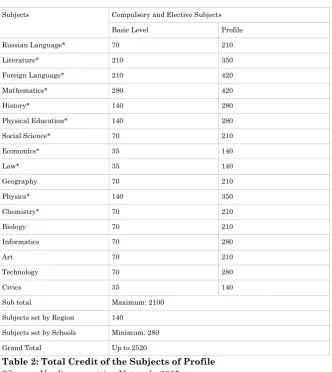
Subjects Compulsory and Elective Subjects
Basic Level Profile
Russian Language* 70 210
Literature* 210 350
Foreign Language* 210 420
Mathematics* 280 420
History* 140 280
Physical Education* 140 280
Social Science* 70 210
Economics* 35 140
Law* 35 140
Geography 70 210
Physics* 140 350
Chemistry* 70 210
Biology 70 210
Informatics 70 280
Art 70 210
Technology 70 280
Civics 35 140
Sub total Maximum: 2100
Subjects set by Region 140
Subjects set by Schools Minimum: 280
Grand Total Up to 2520
Table 2: Total Credit of the Subjects of Profile
The process of democratization has been implemented by providing civic education, change in the content of the books of the social studies, languages and history by removing the texts that emphasized the greatness of Lenin and Stalin and other heroes of the Soviet period from the pages of social studies and history and incorporating new elements of democracy, citizenship and patriotism and the constitution of Russian Federation from the beginning of the schooling.
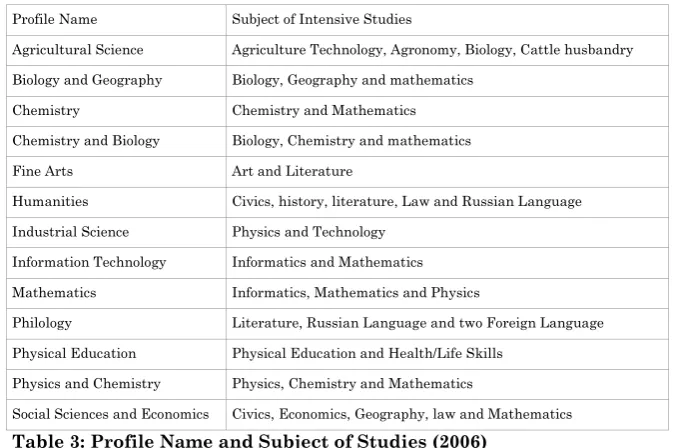
Profile Name Subject of Intensive Studies
Agricultural Science Agriculture Technology, Agronomy, Biology, Cattle husbandry
Biology and Geography Biology, Geography and mathematics
Chemistry Chemistry and Mathematics
Chemistry and Biology Biology, Chemistry and mathematics
Fine Arts Art and Literature
Humanities Civics, history, literature, Law and Russian Language
Industrial Science Physics and Technology
Information Technology Informatics and Mathematics
Mathematics Informatics, Mathematics and Physics
Philology Literature, Russian Language and two Foreign Language
Physical Education Physical Education and Health/Life Skills
Physics and Chemistry Physics, Chemistry and Mathematics
Social Sciences and Economics Civics, Economics, Geography, law and Mathematics
Table 3: Profile Name and Subject of Studies (2006)
*Source: Profile Education in Upper Secondary School. (Retrieved from www.profile-edu.ru)
changes in organisational practice, methods, adoption of new social relationships, values and ethical principles (Gee and Lankshear 1995).
The patriotism towards Soviet Union has been replaced by the patriotism towards Russian Federation. This may cause emergence of aggressive nationalism, aggravating the ethnic relations in the country, reducing the relevance of collective values and increasing individualism in the country, which are the very basic elements of a capitalist country. As a consequence present students or the future citizens, may forget the achievements and sacrifices of their forefathers of the Soviet period.
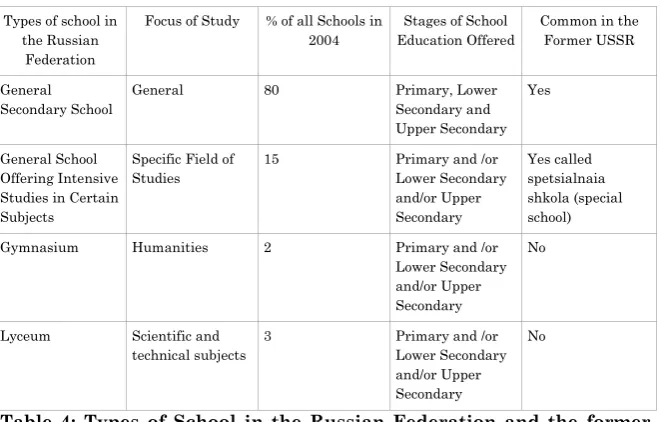
Types of school in the Russian
Federation
Focus of Study % of all Schools in 2004
Stages of School Education Offered
Common in the Former USSR
General Secondary School
General 80 Primary, Lower Secondary and Upper Secondary
Yes
General School Offering Intensive Studies in Certain Subjects
Specific Field of Studies
15 Primary and /or Lower Secondary and/or Upper Secondary Yes called spetsialnaia shkola (special school)
Gymnasium Humanities 2 Primary and /or Lower Secondary and/or Upper Secondary
No
Lyceum Scientific and technical subjects
3 Primary and /or Lower Secondary and/or Upper Secondary
No
Table 4: Types of School in the Russian Federation and the former USSR
*Source: Nordic recognition Network, 2005.
Note: *Very few general schools offer primary and lower secondary education only.
in Scientific and technical subjects from primary to upper secondary schools in Russia, the number of enrolled students in these schools is 13% of the total number of school students in Russia. (MoE, Russian Federation 2012). Privatisation is more visible in the field of higher education as well as technical education where around 60% of the total higher education institutions are in the private sector. They are mostly institutions of management, tourism, business administration, or humanities.
Allyson Pollack supported the rise of private sector in the field of education. Pollack describes that the public sector is bad at management and that only the private sector is efficient and can manage the private sector well (Pollack 2004). But the Russian authorities are not in favour of full privatisation of the education sector as the control is still in the hand of government through the instrument of licensing, attestation and accreditation. Kelner opined that globalisation represents the triumph of economy over politics and culture (Kelner 2000). In other words he is trying to say that economics has a greater role behind the political decisions of state.
Boyles describes school as a site for consumer materialism (Boyles 2000) as day by day it is becoming like a consumer item for which you have to pay more to get better education. Hatcher (2000) makes a distinction between the form of privatisation which he named exogenous and endogenous privatisation. Where the former involves private companies entering education to take over directly responsibilities, services or programmes, the later refers to the change in the behaviour of public sector organisation themselves, where they act as though they were businesses, both in relation to clients and workers, and in dealings with other public sector organisations. In the Russian education system both types of privatisation took place and the process is still on.
(institutions), producers (the owners and the management) and consumer behaviour (student interests), commercialisation (charging fees and other charges in lieu of service), commodification, values (fare deal), ethics (of business) and outcomes (the result) though these are not clearly visible like privatisation in other field. Here owners of the institutions also attempt to make profit though they openly not do it pretending they are doing it as a social service. Legalising the private ownership and profit making activities by Law speeds up the pace of privatisation in education. In Chapter IV, Article 47(1) of the Law on education 1992 it is clearly stated that “an educational establishment shall have the right to carry out entrepreneurial and other profit-making activities activity provided for by its Charter”.
From an administrative point of view, decentralisation was the major change in education sector which has been brought by the Russian Federal government. It was found that the central command and control system of the Soviet period was inefficient and unable to take quick decisions and manage efficiently. According to “the Law on Education 1992” the Federal government has delegated its educational administrative function to the regional governments, municipal bodies and the institutions and encouraged to solve the problem, if and when it arises, at the lower levels, as far as possible.
The administrative decision at the lower level is based on local needs, traditions and cultures and will also help to decrease corruption in the educational administration. It will also facilitate in taking quick decisions earlier, the decisions taken by the central government taking a long time to reach the ultimate beneficiaries (the students), passing through three or more administrative levels viz. the regional, the municipal and the institutional levels.
funds for the smooth functioning of the educational establishments; on the other hand, it also wants to strengthen its control over the government and private educational establishments by introducing new measures of control like licensing, certification and accreditation of the government and nongovernmental institutions. This will facilitate the smooth functioning of the educational establishments and prevent them from becoming autocratic.
This administrative reform also has some demerits. Overlapping the jurisdiction among regional, local and institutional levels leads to inefficiencies such as the multiplicity of textbooks. Different textbooks have been supplied by the regions, municipalities and by the institutions. This puts students at a loss about which textbook to use. Besides this, corruption was widespread in getting the licensing, certification and accreditation of an institute, particularly a private one. As a result, substandard institutions too are being accredited.
Moreover, the government too is very reluctant to issue these certificates as due to financial crunch the government has no option but let them allow to open and function. To some extent the Unified State Examination has curbed the corruption and bribery in admission process of higher education which has been implemented in 2001 for the justiciable evaluation of secondary school students and a standardised national entry examination to enter into higher education. Since its inception, it is continuously performing excellent tasks towards transparency and equity in the higher education admission process and in reducing corruption and bribery in this field.
educationists argue that the prestige of higher education in society has gone up immeasurably, and people believe that it is necessary today for the existence of a social prestige. They think that it is impossible to find a good job without proper higher education and, consequently in the conditions of capitalism, to earn more money to enhance social prestige.
The introduction of content based on local needs, geographical conditions and socio-cultural heritage is another important step towards decentralisation of education. This reform also has some demerits, as privatization leads to capitalism, which will increase inequality and exclusion of the financially weaker students. This exclusion will inevitably create a rift in society between rich and poor as an educational market runs only for the motive of profit and not for social welfare. Besides, incorporating religious content in the textbook can also lead to religious conservatism which can eventually disrupt the secular fabric of the society laid down during the seven decades of Soviet period.
One of the reasons of allowing privatisation in the field of education was the economic requirements of the country which have changed dramatically during the years of perestroika and afterwards. That's why in the very first document of the Russian Federation government “The Law on Education 1992” private educational establishments from the pre-school education to the higher education were allowed to open.
they have completed their education or training.
Now the number of seats are decided by the institutions themselves according to the demand of market. Student’s choice is based on future monetary gains in domestic and international skilled manpower market allowing for greater mobility of job. For making individual careers the market economy could prove to be a boon. Thus the economic reforms would satisfy the market demand both in terms of quality and structure, provision of high income specialization. To solve the financial problem of education, multi-channel financing has been introduced. Now a government educational establishment, beside a private one too, is allowed to levy tuition fees for its financial obligations. Besides tuition fees, government educational establishments can also receive private donations while a private educational establishments tries to get government grants besides levying tuition fees and receiving private donations. Thus the gap between private and government institutions in respect of financial resources is gradually decreasing.
Globalisation has also a great role in the creation of a global educational market. To compete in the global economy, Russia is now endeavouring for the global placement of its graduates. As Jessop (2002) argued “Educational policies for the past 25 years viz, since 1990's, are nothing but political response to the challenges and opportunities which arise from economic and extra economic tendencies of globalisation.” Ball (1998) hold that globalisation is a heterogeneous process having economic, cultural and political dimensions which constitute the element of capital, goods, services, labour and ideas (policy ideas) which have a definite impact on education sector too.
The influence of these ideas were clearly visible when Russia signed the Bologna Declaration.
“Bologna Declaration” was the landmark development towards achieving this objective of globalisation which advocates for the global acceptance of the certificates of the diplomas and decrees throughout the Europe viz., the unification of the courses related to international placement and the certificates of diplomas and decrees.
One of the goals is to make academic degree and quality assurance standards more comparable throughout Europe. As a result many higher education institutions split the old five-year program of specialist (Специалист, Spetsialist) into the four-year bachelor’s (Бакалавр, Bakalavr) and the two-four-year master’s (Магист, Magistr) programs. However this change is not compulsory and many departments and institutions are still following the five year specialist (Специалист, Spetsialist) programme.
To fulfil a global demand of graduates it was necessary to teach those courses which were currently in the demand of the global market. Courses like BBA (Bachelor of Business Administration), MBA (Master of Business Administration), Tourism and Guidance, Hotel Management, Computer and Information Technology, Accounting Education, Courses in Foreign Languages are in great demand in national and international market in which more and more graduates are seeking admission every year for better monetary gain. Besides this many joint Russian-European institutions in the courses like BBA, MBA and Computer and Information Technology have opened in Russia and in Europe which would be helpful for the international placement of skilled manpower, access to international skilled labor market and access to foreign funding in education.
employment in low paid, low skilled service jobs (Ball et al. 2000). This is a natural outcome of a market economy.
Besides these benefits, the reform has also some shortcomings. As the market exists only for profit motive, it makes education a purely commercial commodity neglecting the cause of social justice. The salaries and wages are also determined by the market, making the future of the less skilled manpower more hopeless. It is very obvious that a market is run for profit and not for social cause. The graduates are not produced according to the national demand rather according to the market and personal choice of the courses. Moreover the salaries provided in the market economy are not fixed rather they are based on individual capability. Obviously this situation would lead towards unemployment or temporary employment depending upon the current trend of the market and uncertainty of the employment when any skilled or semiskilled labour could be hired or fired at any stage of employment. The government institutions providing these courses are very few, insufficient to cater the market demand. Some of these courses were absent and some of them are very few like BBA or MBA and till now the government has no option except to allow the private sectors to expand in this field.
institutions may grant diplomas of the state format and only for their accredited programs. Licensing7 and attestation8 are prerequisites for accreditation9.
Due to financial crisis, on the one hand many permanent faculties of government educational establishments are teaching in more than one institution to increase their incomes, on the other hand private educational establishments are usually hire contract teachers. Both these activities would badly affect the teaching and the quality of output as the former will not give more attention and time for the students of his own institute, the latter are not fully experienced and efficient and also they cannot not teach earnestly knowing the fact that at any time their jobs will be terminated. Moreover, the private teachers are not paid during the time of vacations. Lacks of incentives in the government sector also affect the teaching and output.
The reform has brought an acceptance of pluralism of thought --freedom to propagate different theories which was not possible earlier in the Soviet period as only one school of thought, that is “Marxist”, was allowed. The acceptance of pluralism of thought allows access to rich intellectual world heritage, the broader debate and fuller understanding of the problems and challenges facing the Russian education. Now we
7. Licensing permits an institution to engage in educational activities in specified specializations and levels but not to grant diplomas of the state format unless they are accredited. An evaluation team considers whether the institution meets state norms with respect to educational facilities, equipment, teaching staff and teaching materials and qualification of teachers and non teaching staffs.
8. Attestation is based on a self-evaluation and an external examination by a central or regional agency. The confirmation of attestation is granted by the State Attestation Board that the institution complies with the State Education Standard for higher education in terms of the level and quality of its graduates and teachers as well as teaching.
come across different schools of thought regarding the development of the education system and resolution of the problems facing it.
While educationists of one school of thought argue in favour of independence and autonomy of the educational establishments by saying that the governmental control, provisions and production have been proved to be inefficient and presently continue to exist purely for political and economic reasons. Stringent rules and extensive control mechanisms negatively influence the development of the institutions. Further this school also holds that the lack of individual incentives, i.e., job security (tenure) and low and non-competitive salaries in governmental sector lead to minimum personal effort for a good output or the quality in education. This school of educationists is in strong favour of privatization and marketisation of higher education. These reformers view marketisation of higher education as commercialization of teaching and research, the emergence and expansion of the private sector and introduction and cultivation of the entrepreneurial culture in education system. Further they hold that collective decision making is time and resource consuming, and therefore inefficient in the current socio-economic and political situation.
On the other hand some of the educationists opined that the free market model of education would undermine social and cultural responsibilities and the very end of social justice as it responds only to benefits and costs, based on the demand and supply of buyers and sellers and lack of social justice making education as a pure commercial commodity. This way it could badly hamper the social cause, increasing the rift between poor and rich as well as privileged and exploited in the society by selling enrolments and not the products viz the quality in education. Further they opine that the universities should act as a non-profit organizations, work for profiting the society as a whole and not for their own selves.
makes education more responsive to public demand, more efficient, more adaptive and creative and shifts burden from society as a whole to parents and students who are the ultimate beneficiaries of education; the decision making power shifts from the faculty and the ministry to the student and the family and increases accountability and promotes cooperation and trust.
The opponents of privatisation argue that there should be some sort of governmental control over the private educational establishments as the government protects the vital national interests by its corrective policies and accountability as well as political interests. They further stated that the academic democracy is a slow and cumbersome decision structure. They also argue that academic democratic governance often becomes non-governance as sometimes the academic freedom is used to rationalise the inability to make hard decisions, take unpopular actions for the benefit of educational establishments and the student. This school of thought holds that the market forces limit academic democracy as their influence is equal to if not greater than that exercised by a totalitarian state. Moreover a faculty’s freedom for research and teaching would become constrained by the demands of the market. The academic community would erode due to fragmentation, differentiation and competition of the market forces. They also hold a market-driven university is an institution where the consumer will be a king, and the university will be governed by marginal revenue equals marginal cost and the short-term orientation of the market in vocationalism and applied research, may compromise goals and values of liberal education and fundamental theoretical exploration.
Suggestions:
rather the best features of socialist education should be incorporated in the context of the textbooks and the government of the Russian Federation should implement those elements of the communist education system which were based on the welfare of the people.
The shortcomings and the drawbacks that have been mentioned seriously inhibit the establishment of an educational system based on principles of freedom, equity and social justice. In this sense these negative aspects do not allow to satisfy the requirements of a society that supposedly wants to build a new state founded on these principles. Keeping this in view some recommendations are made as a way of redressing these issues which may possibly have relevance for a future national educational policy of the country.
In the administration of the educational system, to prevent the overlapping jurisdiction of the educational administration, it is suggested that the jurisdiction of every level of educational administration should be exactly defined by the government decrees and circulars. Moreover, the problem of multiplicity of the textbooks should also be solved by clear instructions from the Federal and regional governments. The problem of corruption does not only exist in Russia rather it is a global problem. The corruption in the process of licensing, certification and accreditation should be checked by a constant monitoring service and the licenses of those institutes found substandard should be cancelled, whether they happen to be government or private educational establishments.
establishments who are offering bribes to get government licensing and accreditation.
The religious education should not be allowed to propagate the religious fundamentalism rather it should be taught for the benefit of the society by incorporating good elements of all religions besides this the teaching of moral education should also be provided along with the religious education. To solve the existing socio-economic problems of Russian education system the Non Government Organizations should also come forward.
To resolve these problems it is suggested that there should be private-public mixed education sector complementary to each other. The government should also provide teaching of courses that are in great demand in the market like the BBA (Bachelor of Business Administration), MBA (Master of Business Administration), Tourism and Guidance, Hotel Management, Computer and Information Technology, Accounting Education and Courses in Foreign Languages.
This needs to be done in government institutions to prevent the students from paying exorbitant fees in private educational establishments. Thus both sectors should exist together and they should be complementary to each other. Besides these, facilities such as educational loans and other financial support should be made available to the students of weaker sections of the society. Salaries of the faculties for both teaching and non teaching staff should be attractive enough to attract good teaching and non teaching staffs. The number of permanent faculties should also be increased for better output.
conditions. Now after the establishment of democracy in the Russian Federation, different educational theories, world literature and outstanding works of foreign authors should be widely available at all levels of education, discussions and seminars as there is freedom to propagate.
REFERENCES:
Ball, S. J. 2008. “Ethics, Self Interest and the Market Forms in Education.” In Markets, Managers and Public Service?, edited by A. Crib, Occasional Paper No. 1, Kings College, London: Centre for Public Policy Research.
Ball, S. J. 2000. “School Based Management: New Culture and New Subjectivity.” Lisbon: Superior School of Education and Open University of Portugal.
Ball, S. J. 1998. The Education Debate: Policy and Practice in the Twenty First Century. London: Policy Press.
Ball, S. J. 1998. “Big Policies/Small World: An Introduction to International Perspectives in Education Policy.”
Comparative Education 34(2): 119-129
Ball, S. J., M. M. Maguire and S. Macrae. 2000. “Space, Work and the “New Urban Economies”.” Journal of Youth Studies 3(3): 279-300.
Boyles, D. 2000. American Education and Corporations: The Free Market Goes to School. New York: Palmer Press. Burbules, N. and C. A. Torres. Eds. 2003. Globalisation and
Education. New York: Routledge.
Centre for Public Services. 2003. Mortgaging Our Children's Future. Sheffield: University of Sheffield.
Fitz, John and Bryan Beers. 2002. “Education Management Organisations and the Privatisation of Public Education: A Cross-National Comparison of the USA and Britain.”
Comparative Education 38(2): 137-154.
Discourse 16 (1): 5-20.
Giddens, A. 1998. The Third Way: The Renewal of Social
Democracy. Cambridge: Polity Press.
Giddens, A. 1996. Introduction to Sociology. New York: Norton. Hall, P. 1986. Governing the Economy. Cambridge: Polity Press. Hatcher, R. 2000. “Profit and Power: Business and Education
ActionZones.” Education Review 13(1): 71-77.
Jessop, B. 2002. The Future of the Capitalist State. Cambridge: Polity Press.
Kahn, Richard and Douglas Kellner. 2007. “Resisting Globalization.” In The Blackwell Companion to
Globalization, edited by George Ritzer. Oxford:
Blackwell.
Kellner, Douglas. 2007. “Globalization, Terrorism, and Democracy: 9/11 and Its Aftermath”. In Frontiers of Globalization Research: Theoretical and Methodological Approaches, edited by Ino Rossi, 243-71. New York: Springer.
Kellner, D. 2000. “Globalization and New Social Movements: Lessons for Critical Theory and Pedagogy.” In
Globalization and Education: Critical Perspectives, edited by N. C. Burbules & C. A. Torres, 299–321. New York: Routledge.
Krouse, R. W. 1982. “Polyarchy & Participation: The Changing Democratic Theory of Robert Dahl.” Polity 14(3): 441-463.
Law of the Russian Federation No. 3266-1 of July 10, 1992 –
available at
http://en.russia.edu.ru/information/npb/fzakon/law/3266-1/
Leys, C. 2001. Market-Driven Politics. Neoliberal Democracy and the Public Interest. London: Verso Books.
Pollack, A. 2004. NHS plc: The Privatisation of our Health Care. London: Verso.
European Integration of Higher Education. Moscow: Russian-European Centre for Economic Policy (RECEP). World Data on Education. 7th Edition (Revised Version),
September 2011.
World Development Indicator. 2013. Washington D.C: IBRD/The World Bank.
Websites:
Education at a Glance 2013 OECD Indicators http://www.oecd.org/edu/eag.htm
Federal Agency on Education www.ed.gov.ru
Federal Service for Supervision in Education and Science www.obrnadzor.gov.ru
Federal State Research Institute of Information technologies and telecommunications
www.informika.ru/text/index.html Ministry of Education and Science www.mon.gov.ru
National Accreditation Agency of Russia www.nica.ru
Ministry of Education of the Russian Federation, National Information Centre on Academic Recognition and Mobility www.russianenic.ru/
www.russianenic.ru/english/index.html Russian Rectors’ Union
http://rsr-online.ru/english/about.htm
Profile Education in Upper Secondary School www.profile-edu.ru
The Unified State Exam Portal www.ege.ru/
World Education Services www.wes.org/
World higher Education database