THE RELATIONSHIP OF CROSSOVER FREQUENCY TO SYNAPTIC
EXTENT A T PACHYTENE IN MAIZE1
MARJORIE P. MAGUIRE
Genetics Foundation, University of Texas, Austin
Received July 29, 1964
early meiotic prophase and preceding interphase of eukaryotic organisms 'fr! stages of the most intense interest to geneticists but also, unfortunately, among the most unyielding to the techniques of chromosome cytologists. Con- flicting reports in the literature on the orientation and structure of the chromo- some material emphasize the present difficulties of direct observation with either light o r electron microscope. While we know on a gross level that chromosomes generally must pair homologously and that replication and crossing over must occur within these stages, it is not known whether chromosomes tend to (or must) complete observable synapsis before crossing over occurs or whether it can immediately follow the homologous meeting of short segments, whether crossing over accompanies or follows replication, or whether both are true, but occur by differing mechanisms.
This study is based on quantitative observations of chromosomes at the earliest meiotic stage in maize during which chromosomes can be accurately traced (pachytene). It is designed to permit inferences on chromosome behavior prior to this stage.
M ATERIAL S A N D M E T H O D S
Over a number of years the cytogenetics of maize backcross progenies of maize-Tripsacum hybrids has been studied. Particular attention has been paid to a derivative stock containing a
pair of maize-Tripsacum interchange chromosomes in addition to a normal chromosome 2 (parent constitution of Figure 1 ) . The exchange point was estimated cytologically to have been located at about 25 percent of the total length of chromosome 2 from the end of the short arm (MAGUIRE
1960a) and genetically at about 54 crossover units from the same end of chromosome 2 (MAGUIRE
1964). The interchange chromosomes in this case have exchanged parts partially homologous in that the knob-bearing Tripsacum segment carries fully dominant alleles for three genetic markers found i n the corresponding region of the short arm of chromosome 2 of maize, white sheath (ws),
liguleless (Zg) and glossy seedling (gZ) (MAGUIRE 1962a) ; normal appearing synapsis is usually found a t pachytene i n disomic plants carrying a 2 T chromosome and a normal chromosome 2, and plants homozygous 2T2T are viable although somewhat reduced i n vigor (MAGUIRE 1961a). The exchanged segments are considered to correspond in homology only partially, however, since two maize segments for this region pair preferentially in trivalent configuration with almost total exclusion of the Tripsacum segment in those plants where the choice is available (MAGUIRE
1957). Analysis of chromosome distribution patterns at pachytene in plants carrying two 2T chromosomes and a Tz chromosome (where the T' chromosome appears as a univalent) left doubt of the existence of a significant affinity between the corresponding Tripsacum and maize This work was supported in part by a grant (GhI-OG492) from the Public Health Service, and by a grant (G-7068) from the National Science Foundation.
24 M. P. MAGUIRE
segments (MAGUIRE 1961b). Crossing over or secondary exchange between the correspanding maize and Tripsacum segments occurs only rarely (MAGUIRE 1960b), but derivatives of such exchange have been found and crossed to give 21-chromosome plants with an array of constitu- tions differing in duplication or triplication of corresponding chromosome regions. extent and position of segments of the Tripsacum chromosome in maize chromosome 2, and extent of seg- ments of maize chromosome 2 in the T2 chromosome. Chromosome pairing relationships at pachytene and metaphase I were studied and compared in these constitutions. A maize inbred noted for excellence of pachytene configurations (L289) formed the major genetic background of the stocks used (WELLWOOD and RANDOLPH 1957).
Microsporocyte samples were fixed in alcohol-acetic 3:l mixture and stored under refrigera- tion until studied in acetocarmine smear preparations. For frequency estimations. slid-s were systematically scanned undtr low power, where those cells whose chromosomes appeared suff- ciently well spread were selected for study under oil immersion. Only very occasional metaphase cells were rejected as unanalyzable either under low power or oil immersion, but many pachytene cells were clearly unsuited for further study when viewed under low power magnification (be- cause of poor spreading of chromosomes). It is thought probable that no important bias in esti- mation of trivalent frequencies was introduced by the rejection of these cells although the pos- sibility of error introduced by this technique should be kept in mind. At best in pachytene prepa- rations it was necessary to reject as unanalyzable 10 percent of those cells which were studied under oil immersion. The possible effect of such rejections will be discussed later. Since classifi- cation of nonrejected cells was clear and easily accomplished, errors here are considered unlikely. All observations were made by the author. All available plants of each of the new constitutions were studied. Variability within and between plants of like constitutions will be discussed later. Measurements of lengths of pachytme chromosome regions were made from camera lucida drawings traced under uniform conditions. Relative extents of synapsis at pachytene in trivalent configurations where no homologous segments were triplicated were taken as the best indication for extent of homology. Since it is recognized that these measurements are subject to errors intro- duced by the smear technique and that there may be some haphazard pairing failure of homolo- gous regions as well as some nonhomologous or homeologous pairing, estimations of the cyto- logical location of the exchanges are based on averages of a number of measurements and. where feasible, on such pairing behavior in more than one type of constitution.
It should be pointed out that trivalent formation in this material depends directly on the pair- ing of the T2 chromosome (or its derivatives), since any combination of normal chromosome 2 and 2T chromosomes (or derivatives) virtually always pair with each other and form one or more chiasmata in the long arm and proximal short-am regions.
RESULTS
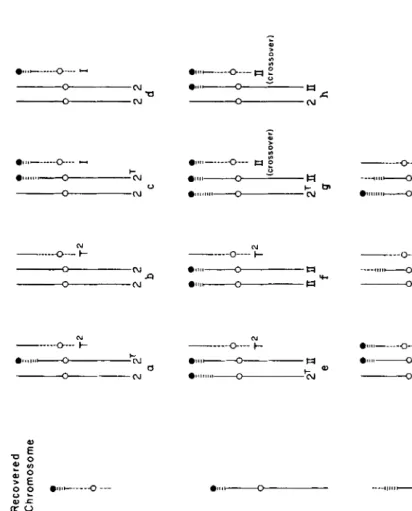
Secondary exchanges between maize and Tripsacum segments: So far, one product of each of three secondary exchanges has been recovered for further crosses. For convenience these are referred to as I, I1 and I11 in the description which follows. The probable origin of each of the three exchanges is diagrammed in Figure 1.
I
0
Parent Constitution
0.
-1
0
0
4
i II(crossover)
Reciprocol Exchonge Products Recovered Chromosome
FIGURE 1 .-Diagrammatic representation of the probable course of three secondary exchanges (involving maize and Tripsacum chromo- somes) and the products recovered. Maize chromosome 2 is represented by a solid line, the Tiipsacuni chromosome by horizontal and vertical dashed lines. The different symbols for different parts of the Tripsacum chromosome serve only to distinguish the parts separated by the original interchange. Open circles indicate the approximate locations of centro- neres. i
f
i
:m
ik
?*
11
(crossover)26 M. P. MAGUIRE
shorter knob-bearing Tripsacum segment of an exchange-I type chromosome can be shifted to a standard chromosome 2 by normal crossing over between homolo- gous maize segments.
Exchange I1 was detected genetically among the test-cross progeny of a disomic plant which was heterozygous for the knob-bearing Tripsacum segment substi- tution, with dominant Ws L g GI in the Tripsacum segment and recessive ws Ig gl in maize chromosome 2. The secondary exchange chromosome recovered carried the terminal knob and dominant W s and L g alleles from Tripsacum and recessive gl from maize chromosome 2. An exchange was therefore thought to have been located between lg (at 11) and gl (at 30) on the genetic map of chromosome 2. When this secondary exchange chromosome was combined with the original maize-Tripsacum interchange chromosomes (constitution illustrated in Figure 2e)
,
and measurements of pachytene trivalent configurations were made, it was estimated that this secondary exchange occurred at a point about 12 percent of the total length of chromosome 2 from the end of its short arm. Thus exchanges Iand I1 appear to have occurred at very nearly the same point (or conceivably at precisely the same point). Note that the short knob bearing Tripsacum segment in the exchange-I1 type chromosome can also be shifted to the T2 chromosome by normal crossing over. Such a crossover product has been found and studied in the constitutions illustrated in Figure 2g and h. Plants of constitutions 2h and 2i differed in that the smallest chromosome of Figure 2h carried a type-I1 exchange while that of Figure 2i carried a type-I exchange, but their pairing relationships were found to be remarkably similar (as described later). This is considered further evidence of the similarity of the location of exchanges I and 11.
S Y N A P S I S A N D CROSSING OVER 27
homologous exchanges, however, between the knob bearing Tripsacum segment and the short arm of the
T2
chromosome would be expected to yield new mono- centric T' and 12T chromosomes. The viability of the new 2T chromosome, in the absence of additional chromosome 2 material for the terminal region, would depend upon the extent and importance of the missing segment. The postulated derivation of the type-I11 exchange is diagrammed in Figure 1-111.Only a small number of measurements of synaptic extent in pachytene tri- valent configurations involving the exchange-111 chromosome are available. An
estimate based on these measurements would place the exchange point at ap- proximately 15 percent of the total length of chromosome 2 from the end of the short arm, but it is emphasized that this is a comparatively unreliable estimate. Pairing behavior
in
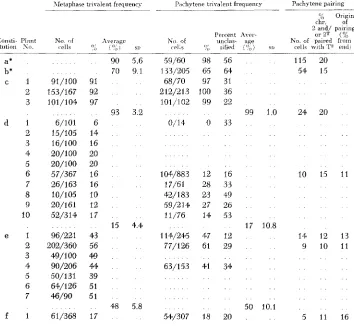
derived and original constitutions: By intercrossing plants carrying the various chromosomal arrangements the constitutions illustrated in Figure 2 hare been constructed. Each of these types has been studied intensivelyTABLE 1
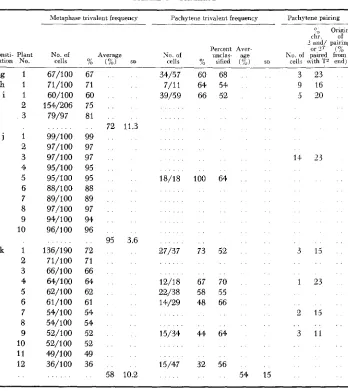
Data on pairing relationships of plants of the various constitutions (correspondingly designated in Figure 2 )
1Ietaphase trivalent frequency P,ichytene trivalent frequency Pachytene pairing
a* b* c 1 2 3 d 1 2 3 4 5 6 7 8 9 10 e l 2 3 4 5 6 7 f 1 91/100 153/167 101 / 104
6/101 15/105 16/100 20/100 20/100 57/367 26/163 10/105 20/16 1 52/3 14 96/221 202/360 49/100 90/206 50/131 64/126 46/90 61/368 91 92 97 6 14 16 20 20 16 16 10 12 17 43 56 44l 44. 39 51 51 17
90 5.6 70 9.1
93 3.2
15 4.4
48 5.8
Percent Aver- No of unclas- age
CL'IIS 'j,; sified (0") SI,
59/60 98 56 133/205 65 64 68/70 97 31 212/213 100 36 101/102 99 22
99 1.0 0/14 0 33
",A Origin chr. of
2. and/ pairing o r 2T (%,
No. of paired froin celli w i t h T" e n d ,
115 20 54 15
24 20
104/883 17/61 42/183 59/214 11/76 1 1 4 / 2 6
77/126
10 15 11 12 16
28 33 23 49 27 26 14 53
47 12 14 12 13
61 29 9 10 11
17 10.8
63/153 41 34
50 10.1
28 M . P. MAGUIRE
TABLE I-Continued
Metaphase trivalent frequency Pachytene trivalent frequency Pachytene pairing
o* Orlgln chr. of
.? and/ pairing
( %
Percent Aver- or 2.r Consti- Plant No. of Average No. of unclas- age Kv. of paired from
tution No. cells % (%) SD cells % sified (?() SD cells n i t h T' end)
g 1 h 1 i 1 2 3 j 1 2 3 4 5 6 7 8 9 10 k 1 2 3 4 5 6 7 8 9 10 11 12 . . 67/100 71/100 60/100 154/206 79/97 99/100 97/100 97/ 100 95/100 95/100 88/100 89/100 97/100 94/100 96/100 136/190 71/100 66/100 64/100 62/100 61/100 54/100 54/100 52/100 52/100 49/100 36/100 67 71 60 75 81 99 97 97 95 95 88 89 97 94 96 72 71 66 64 62 61 54 54 52 52 49 36
72 11.3
95 3.6
58 10.2
34/57 60 68 7/11 64 54 39/59 66 52
18/18 100 64
27/37 73 52
12/18 67 70 22/38 58 55 14/29 48 66
15/34 44 64
15/47 32 56
54 15
3 23 9 16
3 20
11 2 3
3 15
1 23
2 13
3 I1
* Reported in MncuInE 19GOa. Pachytene values for constitutions a and b were from single plants: metaphase values were the average of GO plants for constitution a, and of 17 plants fur constitution b.
as to pachytene and metaphase trivalent frequencies, and position and extent of synapsis in pachytene trivalent configurations. The data from these studies are summarized in Table 1 ; the constitutions are those correspondingly designated in Figure 2.
SYNAPSIS A N D CROSSING OVER 29
of variation among plants in both pachytene and metaphase trivalent frequencies was exceptionally large suggesting the possibility of undetected differences among plants in constitution, perhaps due to further exchanges in their parent. This progeny was also unusual in having a very high transmission frequency of the T' chromosome (16/19) through the female parent and is the subject of further study in this respect.
The values of metaphase and pachytene trivalent frequencies given in Table 1
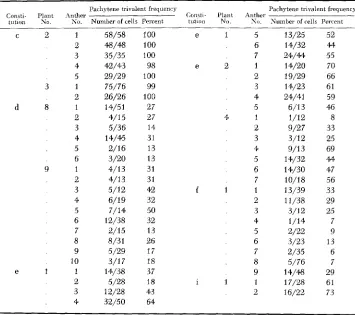
represent in many cases pooled data from several anthers of a plant. From those cases where more than one anther of a plant were studied, trivalent frequencies found at pachytene and metaphase are listed in Tables 2 and 3. Again frequency variations are often greater at pachytene than at metaphase. It can be seen that in some cases plants with apparent low variability at metaphase show high vari- ability at pachytene. Thus, unless there is some leveling off mechanism inherent in the process of chiasma formation, the best explanation for the greater pachy- tene variability would seem to be greater sampling error there due to the com-
TABLE 2
Pachytene trivalent frequencies of different anthers within plants of seueral of the constitutions*
Pachytene t n \ alent frequenry Consti Plant inther
tiition h o No Number of cells Percent
C 2 1 58/58 100
3 35/35 100
2 48/48 100
4 42/43 98
5 29/29 100
3 1 76/76 99
2 26/26 100
d 8 1 14/51 27
2 4/15 27
3 5/36 14
4 14/45 31
5 2/16 13
6 3/20 13
9 1 4/13 31
2 4/13 31
3 5/12 42
4 6/19 32
5 7/14 50
6 12/38 32
7 2/15 13
8 8/31 26
9 5/29 17
10 3/17 18
e 1 1 14/38 37
2 5/28 18
3 12/28 43
4 32/50 64
Consti- Plant tutinn No.
e 1
e 2
4
f 1
i 1
Pachytene trivalent frequency Anther
No. Number of cells Percent
5 6 7 1 2 3 4 5 1 2 3 4 5 6 7 1 2 3 4 5 6 7 8 9 1 2
13/25 52 14/32 44 24/44 55 14/20 70 19/29 66 14/23 61 24/41 59 6/13 46
1/12 8
9/27 33 3/12 25 9/13 69 14/32 44 14/30 47 10/18 56 13/39 33 11/38 29 3/12 25
1/14 7
2/22 9
3/23 13
2/35 6
5/76 7
14/48 29 17/28 61 16/22 73
30 M. P. MAGUIRE
TABLE 3
Metaphase trivalent frequencies of diflerent anthers within plants of several of the consitutions
Metaphase trivalent frequency Metaphase trivalent frequency Consti- Plant Anther Consti- Plant Anther
tution No. No. Number of cells Percent tution No. No. Number of cells Percent
C 2 1 2
e 1 1
2
2 1
2
4 1
2
5 1
2 29/32 124/135 41/100 55/121 148/260 54/100 46/106 &/IO0 9/20 41/111 91 92 41 45 57 54 43 44 45 37
6 1
2
f 1 1
2 3
g 1 1
2
i 2 1
2 26/47 38/79 20/133 10/56 31/179 38/60 78/106 76/100 29/44 55 48 15 18 17 63 73 74 76
paratively small size of pachytene samples and the rejection of a much larger proportion of cells as unanalyzable.
A
test for normal distribution of pachytene trivalent frequencies among anthers of a plant ( e l ) from which seven were studied (each with 25 or more cells classified) showed no significant deviation from the normal at the 10 percent level. Such a distribution provides some justi- fication for the supposition that rejection of unanalyzable celIs introduces no important sampling bias. It should be continually borne in mind, however, that the smaller pachytene samples may give comparatively unreliable estimates of trivalent frequency.Since plants of all chromosomal constitutions had similar genetic backgrounds and all were grown under similar conditions, for purposes of broad comparisons the averages are taken as approximations of values of pachytene and metaphase trivalent frequencies to be expected for each of the constitutions in their current background (Table
4).
TABLE 4
Summary of pachytene and metaphase trivalent frequencies for all constitutions
~~~~ ~ ~ ~
Average pachytene Average metaphase trivalent frequency trivalent frequency
Constitution (percent) (percent)
SYNAPSIS A N D CROSSING OVER 31
A
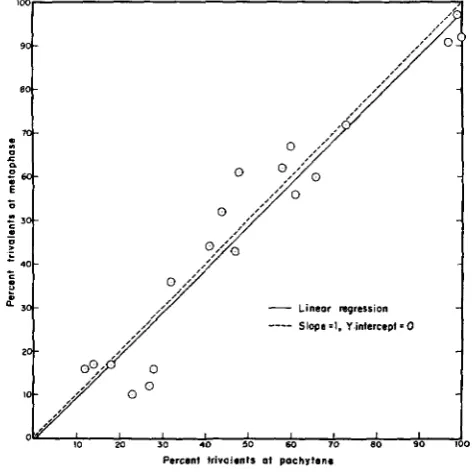
striking feature throughout the trivalent frequency data is the similarity of metaphase and pachytene estimates. When these are placed on ordinate and abscissa scales respectively, and points are plotted for those individual plants where estimates (based on at least 25 cells) of both pachytene and metaphase trivalent frequencies are available, it can be seen that their distribution is ap- proximately linear with a Y intercept near the origin and a slope of about 1 (Figure 3 ) . A linear regression of metaphase trivalent frequencies on pachytene trivalent frequencies gives aY
intercept of -0.72 percent and a slope of 4-0.99 (product-moment correlation coefficient r = 4-0.97). By the traditional view, in those constitutions where fewer than 50 map units in the T? chromosome are available for homologous pairing, metaphase trivalent frequency would be ex- pected to lag below pachytene trivalent frequency even if synaptic extent were always maximal. Actually, even in those cases where about 50 map units of homology may be available, synaptic extents are often substantially less than this (MAGUIRE 1960a, 1964). Further, unless the processes of synapsis and chi- asma formation in this arm of the trivalent configuration are strongly causally related (or both are strongly linked to some other factor) other variables might be expected to influence them differently.The most meaningful individual comparison of pachytene pairing to meta- phase chiasma frequency in this study can be made in the case of data from several anthers with unusually clear pachytene cells from a plant of constitution 2e. Here it was possible to classify 90 percent of 116 cells at pachytene for
Percent Irivalents a t pachytene
FIGURE 3.-Metaphase I trivalent frequency as a function of pachytene trivalent frequency. Points are plotted for each plant where both measurements of frequency are based on at least 25
32 M. P. M A G U I R E
presence of a trivalent or univalent; 52/104 (or 50 percent) contained a tri- valent. I n the unlikely event that all 1'2 of the unclassified cells actually con- tained a trivalent, the pachytene trivalent frequency was 55 percent. Forty-three percent of 221 metaphase cells from this plant contained a trivalent, thus the minimum frequency of cells with at least one chiasma per pachytene trivalent (in the appropriate arm) is inferred to have been about 43/55 or 78 percent.
If,
as seems more likely, the trivalent frequency in the 12 unclassified cells did not differ greatly from the rest of the sample, then the minimum frequency of cells with at least one chiasma per pachytene trivalent (in the appropriate arm) was about 43/50 or 86 percent. The extent of homologous pairing available for cross- ing over in the pertinent region of these trivalent configurations is estimated to have included a maximum of 29 genetic map units; this estimate is based on synaptic extents in constitutions 2d, 2e and 2f and an estimate of 54 genetic units within the maize segment originally transferred to the
T2
chromosome (MAGUIRE1964). The estimate of 29 map units is probably an overestimation since it as- sumes a uniform cytological distribution of the genetic map although it is known to be somewhat concentrated distally. But if as much as 29 genetic map units are available on the average in homologous pairing in trivaIent configurations, a maximum expectation of chiasma frequency in them would be 58 percent where an actual minimum found was estimated at 78 percent.
It seems unlikely that pachytene trivalent frequencies were generally under- estimated as a result of sampling error for the following reason. I n plants of those chromosomal constitutions where high metaphase trivalent frequencies were found, correspondingly high frequencies were found at pachytene. If unclassified cells tend to contain a disproportionately high frequency of trivalents, lower fre- quencies might be expected here, since the short chromosome is comparable cytologically, and in some cases identical to that of constitutions with lower meta- phase trivalent frequencies. The same sort of classification difficulties in pachytene cells might be expected throughout.
SYNAPSIS A N D CROSSING OVER
90
80
-
7 0 -m
-D 6 0 - E
n M- -
1 40-
c 30-
20
33
-
-
-
lot
1
0 I
5 10 13 2 0 Z S 30 35 4 0 Proboble c y 1 0 1 0 g ~ o I exlent ipcrcent chiom 21 of homology #n Short chrom lo others
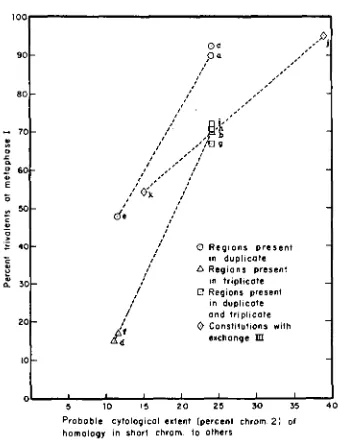
FIGURE 4.-Average metaphase I trivalent frequency as a function of probable cytological extent (percent chromosome 2) of homology in the T2 chromosome to the representatives of chromosome 2 present in each complement. The letter at each point designates a constitution of Figure 2.
than constitutions 2a and 2c by about the same fraction as that by which con- stitution 2d and 2f are less than that of the 2b, 2g, ,2h and 2i cluster. This cluster has maximum homologous extent in the T2 chromosome and regions present in triplicate. Direct comparisons to the others of constitutions 2j and 2k are probably unjustified since their nature, though not thoroughly understood, is thought to differ fundamentally. Homologous pairing of entirely different regions may be involved as well as homeologous pairing. Nevertheless, when these two are com- pared, the one with the supposed greater extent of common homology shows markedly greater metaphase trivalent frequency.
34 M. P. MAGUIRE
lent frequency, and that common homology to the T2 chromosome may be divided between the 2T chromosome and a normal chromosome 2 (as in constitution 2c) without reduction in trivalent frequency. In plants of constitution 2c, where homology to the modified T2 chromosomes was approximately equally divided between the normal chromosome 2 (intercalary region) and a 2T chromosome (terminal region)
,
pairing was more frequent between the homologous terminal regions, and from here it commonly extended into the intercalary region non- homologously, at the exclusion of pairing-partner change and homologous pair- ing. This suggests that pairing of the modifiedTz
chromosome may be more readily initiated terminally than centrally.DISCUSSION
Correlation of metaphase and pachytene trivalent frequencies: Alternate in- terpretations are possible for the close similarity of pachytene and metaphase trivalent frequencies described above. A 1 : 1 relationship of true chiasma fre-
quency to gross-level crossover frequency is considered highly probable; aside from widespread support for such a view in the literature, a comparison of ob- served genetic recombination and chiasma frequencies in material of constitution 2a strongly supported an assumption of close correspondence between the two frequencies in this material (MAGUIRE 1964). Presumably either crossing over (and therefore chiasma formation) is established before the generalized synapsis of pachytene occurs (in such a way that both pachytene and metaphase trivalent frequencies are dependent on crossover frequencies)
,
or in the synaptic configu- rations of the types described above, crossing over generally occurs in the per- tinent arm of the trivalent regardless of the extent of genetic map available in the synapsed regions. The former interpretation supports the views of PRITCHARD(1960) who proposed that crossing over generally occurs in short “effectively paired” segments before synapsis is widespread. It is difficult at present to con- ceive of a mechanism by which crossing over could occur in completed synaptic configurations in such a way that the shape of the configuration would be a more important determiner of crossover frequency within it than the extent of pairing. However, such a system has not been ruled out, and would be required if the discovery of some DNA replication at pachytene is to be interpreted as the result of regular crossing over by some sort of copy or repair mechanism at this stage
SYNAPSIS A N D CROSSING OVER 35
frequencies at both pachytene and diplotene than at diakinesis and metaphase in a maize trisome 3 plant. The apparent complete loss (not terminal accumula- tion) of a number of chiasmata between diplotene and diakinesis and the re- ported ease of classification of pachytene cells suggest that EINSET’S data may have been complicated by the presence of nonhomologous pachytene pairing and the difficulty of classification of diplotene cells.
General considerations of synapsis and crossing over: The view is widely held that synapsis begins by chance meeting of moving homologues at a stage when chromosomes are in a greatly extended state (the typical very early meiotic prophase), perhaps aided by a bouquet formation or remnant anaphase orienta- tion. It has often been pointed out, however, that this view is faced with many difficulties. In the first place it can be questioned whether there is ever substantial movement of greatly attenuated chromosomes. It has been observed that in Neu- rospora (where karyogamy usually immediately precedes meiosis) that synapsis is initiated between chromosomes which are extremely condensed ( MCCLINTOCK 1945: SINGLETON 1953). Other important movements appear to occur during condensed stages, and available evidence indicates that there is as a rule no more than slight stirring of nuclear contents during interphase and very early prophase stages (EVANS and BIGGER 1961; RHOADES 1961). There is some evidence that even during pachytene there may be little, if any, change of positions of chromo- somes with respect to each other (MAGUIRE 1961b). The assumption of relic anaphase orientation helps little since available evidence in maize argues against usual initiation of synapsis at the centromere region ( MCCLINTOCK 1931 ;
RHOADES 1936, 1940; TABATA 1962; MAGUIRE 1962), and it is difficult to see how the specific pairing of certain aberration configurations could be promoted by such orientation (as pointed out by FABERGB [1942]). Another difficulty of the traditional model is the rarity of the interlocking synaptic configurations which might be expected if synapsis can be randomly initiated independently at widely separated points along each chromosome (SMITH 1942). Furthermore, examples of zygotene stage cells are difficult to find and interpret. Observations have been limited to fixed and stained material, and in many (or perhaps all) cases where clear partial pairing has been seen, synapsis may actually have reached its maxi- mum extent (DARLINGTON 1935; MAGUIRE 1960b). MOENS (1964) has re- cently reported evidence that synapsis may be completed in interphase in to- matoes, that the pachytene stage then follows (with bivalents at first clumped, then well spread). Between pachytene and diplotene there is a diffuse stage easily confused with traditional zygotene and leptotene during which homologous arms and then centromeres separate.
36 M. P . MAGUIRE
casionally differ between homeologues or homologues among the sporocytes of a single plant indicating either that a premeiotic exchange has occurred or that early meiotic pairing, exchange, separation and repairing have all occurred be- fore pachytene
(MAGUIRE
1 9 6 1 ~ ) . (2) In material containing occasional plas- modial sporocytes, extra nuclei with incomplete complements nevertheless gen- erally contain only bivalents, as SNOAD (1954) found in Helianthemum(MAGUIRE,
unpublished). These extra nuclei are thought to have resulted in each case from the separation of components of a complete nucleus. No stages of such separation have been found among thousands of appropriate meiotic cells ex- amined. If a separation occurred premeiotically, it must be assumed that homo- logues were paired at this time o r were somehow consistently distributed to the same nucleus.The major findings of the present paper which must be taken into account in the construction of a model f o r synapsis and crossing over are: (1) Pachytene trivalent frequency is sufficiently similar to metaphase trivalent frequency throughout the array of available chromosomal constitutions to suggest either that existence of homologously paired trivalent configurations at pachytene is dependent upon prior crossing over (as it presumably is at metaphase) or that crossing over almost always follows trivalent formation (in this material), re- gardless of the extent of genetic map available in homologous pairing. (2) The frequency of trivalent formation is depressed in the presence of homologous regions in triplicate in a way which is relatively insensitive to the length of the triplicated regions. (3) The frequency of trivalent formation nevertheless in- creases with the extent of homology in the T2 chromosome to either o r both of the other two chromosomes.
These results are also difficult to reconcile with the traditional model which invokes initiation of synapsis by random meeting of homologous points followed by zipping up. In some cases an anticipation of difficulties to be encountered in parts as yet unpaired would seem to be required at the beginning of the process.
DOYLE
(1963) found evidence for not only a reduction in multivalent formation with the inclusion of inversion heterozygosity in polyploids and polysomics of maize, but also preferential pairing among bivalents of chromosomes sequenti- ally matched, beyond that conceivably explainable as a result of multivalent failure. Although his findings are also difficult to fit to a chance meeting model, they may be at least partially accounted for by the additional assumption of per- sistence of a general alignment of the premeiotic anaphase by which homologous units within the arm heterozygous for the inversion would be brought closer to- gether when in similar sequence. On the other hand, in the present study relative location of the centromere of the T2 chromosome (and derivatives) is presumed constant throughout the various constitutions with respect to the positions of the component units of the chromosome.A model which seems simplest and consistent with all observations is as fol- lows:
S Y N A P S I S A N D CROSSING OVER 37
is susceptible to check by direct observation. In some fixed and stained material, e.g. Trillium, a general alignment or loose pairing of homologues can be seen at early meiotic prophase, in the absence of apparent polarization. The general alignment phase may be nonsaturated in that more than two members (when present) may participate at any point
FAB BERG^
1942). This alignment is fol- lowed (sometime before pachytene) by intimate two-by-two pairing of short segments (PRITCHARD 1960; HOLLIDAY 1964) which are spaced at a considerable distance in any particular configuration, perhaps owing to coiling or kinking relationships ( MAGUIRE 1960c), with chiasma interference the observed conse- quence. The overall frequency of these effectively paired segments along a chro- mosome pair is (other things being equal) proportional to the extent of available homology in alignment. (This frequency is, of course, also influenced by a number of factors such as coiling o r kinking relationships of the chromosomes involved or their chemical environment, which may in turn vary for any par- ticular region with external conditions, presence or absence of certain genes. overall dosage effects, supply of certain substances, etc.) In heterozygous aberra- tion configurations, alignment is interrupted in immediate regions of partner exchange. There exists what may be formally interpreted as an element of resist- ance to the formation by a chromosome of effectively paired segments with two other chromosomes (partner change) when three chromosomes share a region of common homology. (LLResistance” does not vary in the present study with extent or position of the triplicated region.) Crossing over occurs only within regions of effective pairing ( PRITCHARD 1960;HOLLIDAY
1964). The process may be polarized in time within these regions, in keeping with requirements of recent genetic fine-structure data (see STADLER and TOWE 1963). Present knowledge places no firm restrictions on the stage of its occurrence from interphase to diplo- tene, except that it must accompany or succeed replication. Its completion could require an extended interval.The nonhomologous pairing (first noted by MCCLINTOCK 1933, and familiar to all maize cytogeneticists who have worked with material in which some chro- mosome regions exist without matching potential pairing partners) might be ex- pected to follow homologous pairing in time. This frequently observed non- homologous pairing of maize chromosomes does not ordinarily persist past pachytene, but might nevertheless be related to the post-crossover “distributive pairing” postulated by GRELL (1 962) to account for certain cases of nonrandom distribution in Drosophila.
In the above speculations the assumption of the nonsaturated general align- ment phase was preferred to that of a long-range specific pairing force, para- doxically insensitive to quantity of material in some ways, yet sensitive to it in others. Present findings (unless artifact in nature) render some such considera- tion necessary. For simplicity, all of the variability in crossover frequency and distribution was assigned to frequency and distribution of effective pairing seg- ments, although variability of occurrence of crossing over within these would be expected to introduce an additional element of complexity.
38 M. P. MAGUIRE
panse of raw material in which crossovers are formed with a gross frequency generally proportional to synapsed length, as usually supposed, but may already contain crossovers or their potential or established precursors.
SUMMARY
Chromosome pairing relationships at pachytene and metaphase I were studied and compared in an array of 21 -chromosome constitutions containing maize- Tripsacum interchange chromosomes. These constitutions differed in duplication or triplication of corresponding chromosome regions, in extent and position of segments of a Tripsacum chromosome in a maize chromosome and in extent of segments of a maize chromosome in the extra Tripsacum chromosome.
Pachytene trivalent frequency was found to be sufficiently similar to meta- phase trivalent frequency throughout the array of chromosomal constitutions to suggest either that existence of trivalent configurations at pachytene is dependent upon prior crossing over (as it presumably is at metaphase) or that crossing over almost always follows trivalent formation (in this material) regardless of the extent of genetic map available in homologous pairing.
The frequency of trivalent formation appears to be depressed by the presence of homologous regions in triplicate in a way which is relatively insensitive to the length of these triplicated regions. However, the frequency of trivalent formation nevertheless increases with the extent of homology in the extra chromosome to either or both of the other two chromosomes which it may partially match.
It appears that the location of the terminal knob is unimportant, that terminal or intercalary position of a triplicated region has no important effect on trivalent frequency, and that common homology to the extra chromosome may be divided between the other two semi-matching chromosomes without reduction in tri- valent frequency.
Theoretical implications are discussed.
LITERATURE CITED
Boss, J., 1954 Mitosis in cultures of newt tissues. 11. Chromosome pairing in anaphase. Exptl. Cell Research 7 : 225-231.
DARLINGTON, C. D., 1935 The internal mechanics of the chromosomes. 11. Prophase pairing at meiosis in Fritillaria. Proc. Roy. Soc. London B 118: 59-73.
DOBZHANSKY, TH., 1935 Studies on chromosome conjugation. 111. Behavior of duplicating frag- ments. Z. Ind. Abst. Vererb. 68: 134-157.
DOYLE, G. E., 1963 1011-1027.
Preferential pairing in structural heterozygotes of Zea mays. Genetics 48:
EINSET, J., 1943 Chromosome length in relation to transmission frequency of maize trisomes. Genetics 28: 349-364.
SYNAPSIS A N D CROSSING OVER 39 11. Non-randomness in the distribution of chromatid aberrations in relation to chromosome length in Vicia jaba root-tip cells. Genetics 46: 277-289.
FABERG~, A. C., 1942 Homologous chromosome pairing: The physical problem. J. Genet. 43:
121-145.
GREEN, M. M., 1962 The effects of tandem duplications on crossing over in Drosophila melano- gaster. Genetica 33: 154-164.
GRELL, E. H., 1964 Influence of the location of a chromosome duplication on crossing over in
Drosophila melanogaster. Genetics 50: 251-252.
GRELL, R. F., 1962 A new model for secondary nondisjunction. The role of distributive pairing. Genetics 47: 1737-1 754.
HOLLIDRY, R., 1964 MAGUIRE, M. P., 1960a
A mechanism for gene conversion in fungi. Genet. Res. 5: 282-304. A study of pachytene chromosome pairing in a corn-Tripsacum hybrid derivative. Genetics 45: 651-664. ~ 1960b A study of homology between a terminal
portion of Zea chromosome 2 and a segment derived from Tripsacum. Genetics 45: 195- 209. ~ 1960c The relation of reduplication, recombination, synapsis and chromosome
coiling. Genet. Res. 1: 487-488. __ 1961a Divergence in Tripsacum and Zea chro- mosomes. Evolution 15: 394-4.00. __ 1961b Quantitative studies relating to the phys- ical basis of chromosome synapsis. Exptl. Cell Res. 24: 21-36. ~ 1961c Cytological
evidence of premeiotic crossing over in maize. (Abst.) Genetics 46: 880. ~ 1962a
Common loci in corn and Tripsacum. J. Heredity 53 : 87-88. __ 1962b Pachytene and diakinesis behavior of the isochromosomes 6 of maize. Science 19: 445-446. 1964. Crossing over and anaphase I distribution of the chromosomes of a maize interchange triva- lent. Genetics 49: 69-80.
__
MCCLINTOCK. B., 1931 Cytological observations of deficiencies involving known genes, trans- locations and an inversion in Zea mays. Res. Bull. Missouri Agric. Exptl. Sta. 163: 1-30.
__ The association of non-homologous parts of chromosomes in the mid-prophase of meiosis in Zea mays. Z. Zellforsch. 19: 191-237. __ 1945 Neurospora. I. Pre- liminary observations of the chromosomes of Neurospora crassa. Am. J. Botany 32: 671- 678.
1933
MOENS, P. B., 1964 A new interpretation of meiotic prophase in Lycopersicum esculenium
(tomato). Chromosoma. 15: 2:31-242.
PRITCHARD, R. H., 1960 Localized negative interference and its bearing on models of gene recombination. Genet. Res. 1 : 1-24.
RAMEL, C., 1962 Interchromosomal effects of inversions in Drosophila melanogaster. I. Cross- ing over. Hereditas 48: 1-58.
RHOADES, M. M., 1931 A new type of translocation in Drosophila melanogaster. Genetics 16:
490-504. __ 1936 A cytogenetical study of a chromosome fragment in maize. Ge- netics 21 : 491-502. - 1940 Studies of a telocentric chromosome in maize with special reference to the stability of its centromere. Genetics 25: 483-520. __ 1961 Meiosis. pp. 1-75. The 'Cell. I11 Edited by J. BRACHET and A. E. MIRSKY. Academic Press, New York and London.
SINGLETON, J. R., 1953 Chromosome morphology and the chromosome cycle in the ascus of
Neurospora crassa. Am. J. Botany 40: 124-144,
40
M. P. MAGUIRESNOAD, B., 1954 Abortive meiosis in plasmodial pollen mother cells in Helianthemum. Ann. Botany 18: 1-6.
SONNENBLICK, B. P., 1950 The early embryology of Drosophila melunoguster. pp. 62-167. The Biology of Drosophila. Edited by M. DEMEREC. Wiley, London.
STADLER, D. R., and A. M. TOWE, 1963 Recombination of allelic cysteine mutants in Neurospora. Genetics 48: 1323-13M.
TABATA, M., 1962 Chromosome pairing in intercrosses between stocks of interchanges involving the same two chromosomes in maize. I. Diakinesis configurations in relation to breakage positions. Cytologia 27: 410-4.1 7.
WELLWOOD, A. A., and L. F. RANDOLPH, 1957 Inheritance of differences in pachytene chromo- some configurations in maize. Am. J. Botany 44: 129-135.