Priority Energy Load Management Using
Microcontroller
Yugandhara G. Wankhade[1]; Dr. Ujwala A. Kshirsagar[2]
P.G. Student, HVPM College of Engineering and Technology, Amravati, India[1]
Head & Professor, Dept. of Electronic and Telecommunication, HVPM College of Engineering and Technology,
Amravati, India [2]
ABSTRACT: Change is the need of time and automation in the systems is the change which is the needs of this 21stcentury. There may be load surges or popping out some times in the industries. In this project we suggest the
priority driven the load management using automation techniques. The proposed system has its directive to provide effective load management to deal with the load shedding problems also gives innovative priority mechanism which indirectly reduces man power which is specifically needed to supervise the applications. A priority load management system has been developed in order to gain an optimal energy management over system load and battery storage, and therefore provides better management efficiency and guarantee the energy supply for critical load, by considering industrial applications this system makes them self reliable, at least, to use the appliances to operate automatically during load shedding problems.
KEYWORDS: Load shedding; priority; load management; RF transceiver; ATmega328 I. INTRODUCTION
The most important concept in the power system operation is the frequency and voltage stability. The instability of such parameters makes serious threats to the system security. The faults such as short circuit, load growth and generation shortage may disturb the voltage and frequency. Such instability leads to total blackout of the system. Most of the study in this area is mainly focusing to forecast the power based on cost and time. Instability of the power generation is one of the major drawbacks of this method. The proposed method will overcome this drawback by scheduling the load based on the requirement. In this method, scheduling provides at the consumer area instead of power plants i.e. optimal scheduling of power depends on the load. The total load of the system is the sum of the maximum load required by the entire regions and loss. If any region requires additional power to meet the load requirement, system checks the regions with their maximum load. This comparison helps us to find the minimum load required units and schedule this load to the required region. The system never interrupts the power source. In this project we suggest the priority driven the load management using automation techniques. There may be load surges or popping out some times in the industries. We can assign the priority to the load according to its natures, parameters and importance. We use this priority for selecting and load which is to be used for automation. This automation purpose is satisfied by setting priority we have one relay driving circuit connected with microcontroller. We pre define the priority of the system and according to that priority we assign the energy to the load. Main aim of the project work is to reduce the power generation cost and make the availability of power on demand without any distortion so as to get required efficient power to the main load needed in the application.
II. PROPOSED WORK
Electrical energy is a form of energy that cannot be effectively stored in bulk, it must be generated, distributed and consumed immediate. When the load in the system approaches the maximum generating capacity, network operators must either find additional supply of energy or find ways to curtail the load. Hence load management, if they are unsuccessful then system will become unstable and blackouts can occur. Load management is the process of balancing the supply of electricity on network with electrical load by adjusting or controlling the load rather than power station output. Because of poor energy management in systems there is tremendous energy loss occurred. So for improving the stability of the system and improving the load management the latest technology of priority load management is introduced in this project.
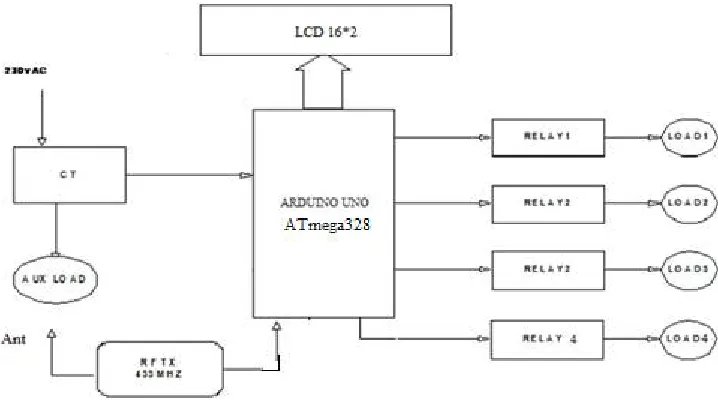
Fig : functional block diagram of system
load exceeds the threshold value of current then transmitter sends the request to the receiver, these request includes the ON/OFF commands. This receives the commands transmitted by the transmitter and are given to the microcontroller. The microcontroller plays a major role in receiving the commands from the RF receiver module and to switch on or off the particular device according to the command. Here in this project priority is given to the auxiliary load rather than normal loads. At first all the normal loads are ON, then select the mode which has inbuilt priorities of loads that should be on/off. After microcontroller verifies the threshold current condition if it exceeds then it will OFF the selected loads i.e. attached to the specified mode.
III.SOFTWARE
Arduino can sense the environment by receiving input from a variety of sensors and can affect its surroundings by controlling lights, motors, and other actuators. The microcontroller on the board is programmed using the Arduino programming language (based on Wiring) and the Arduino development environment (based on Processing). Arduino projects can be stand-alone or they can communicate with software on running on a computer (e.g. Flash, Processing, MaxMSP).
IV.HARDWARE
Microcontroller is the central part of the hardware. It serves two purposes, first it controls the serial communication and secondly it controls the relays. Other parts include RF transceivers, relay driver and relays.
COMPONENT DETAILS
A. ATmega328:
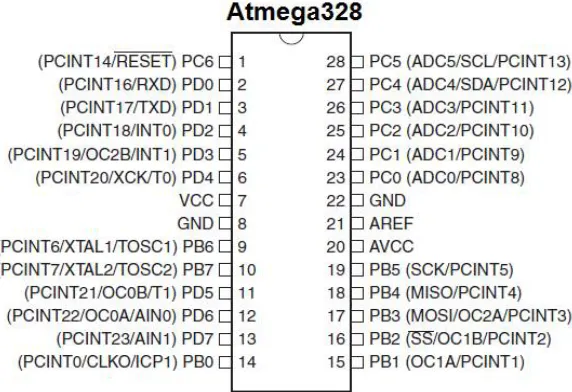
The ATmega328 is a single-chip microcontroller created by Atmel in the mega AVR family. The Atmel 8-bit AVR RISC-based microcontroller combines 32 kB ISP flash memory with read-while-write capabilities, 1 kB EEPROM, 2 kB SRAM, 23 general purpose I/O lines, 32 general purpose working registers, three flexible timer/counters with compare modes, internal and external interrupts, serial programmable USART, a byte-oriented 2-wire serial interface, SPI serial port, 6-channel 10-bit A/D converter (8-channels in TQFP and QFN/MLF packages), programmable watchdog timer with internal oscillator, and five software selectable power saving modes. The device operates between 1.8-5.5 volts. The device achieves throughput approaching 1 MIPS per MHz. As of 2013 the ATmega328 is commonly used in many projects and autonomous systems where a simple, low-powered, low-cost micro-controller is neede. Perhaps the most common implementation of this chip is on the popular Arduino development platform, namely the Arduino Uno and Arduino Nano models.
B. ULN2803
The eight NPN Darlington connected transistors in this family of arrays are ideally suited for interfacing between low logic level digital circuitry (such as TTL, CMOS or PMOS/NMOS) and the higher cur- rent/voltage requirements of lamps, relays, printer hammers or other similar loads for a broad range of computer, industrial, and consumer applications. All devices feature open–collector outputs and freewheeling clamp diodes for transient Suppression. The ULN2803 is designed to be compatible with standard TTL families while the ULN2804 is optimized for 6 to 15 volt high level CMOS or PMOS.
Fig: Functional Circuit Diagram of ULN2803
C. RF Transmitter and Receiver
The ST-TX01-ASK is an ASK Hybrid transmitter module. ST-TX01-ASK is designed by the Saw Resonator, with an effective low cost, small size, and simple-to-use for designing. An RF transmitter module is a small PCB subassembly capable of transmitting a radio wave and modulating that wave to carry data. Transmitter modules are usually implemented alongside a microcontroller which will provide data to the module which can be transmitted. RF transmitters are usually subject to regulatory requirements which dictate the maximum allowable transmitter power output, harmonics, and band age requirements.
The ST-RX02-ASK is an ASK Hybrid receiver module. A effective low cost solution focusing at 315/433.92 MHz. The circuit shape of ST-RX02-ASK is L/C.
Receiver Frequency: 315 / 433.92 MHZ .
Typical sensitivity: -105dBm
Supply Current: 3.5mA ,
IF Frequency: 1MHz.
An RF receiver module receives the modulated RF signal, and demodulates it. There are two types of RF receiver module: super heterodyne receiver and super-regenerative. Super regenerative modules are usually low cost and low power designs using a series of amplifiers to extract modulated data from a carrier wave. Super regenerative modules are generally impressed as there frequency of operation varies considerably with temperature and power supply voltage. Super heterodyne receivers have a performance advantage over super regenerative theory offer increase accuracy and stability over large voltage and temperature range. This stability comes from fixed crystal design which in turn leads to a comparatively more expensive product
V. CONCLUSION
The project implements the design of a system by which we can control the load through Pc remotely. Earlier such control over the load was operated manually. This system uses wireless transmission through transmitter and receiver connected at the power station and your pc or laptop respectively. Using this system, we can establish the link between RF remote and control board with the help of RF communication. The microcontroller plays a major role in receiving the command from RF receiver module and according to the priority; the load will be switched automatically. And also load management according to our convenience is possible.
VI.FUTURE WORK
Global competition, limited resources and environmental protection will have a decisive influence on developments in automation technology. Safety concepts are changing: New requirements in machine and plant construction give rise to new sensor solutions. In the future, increased technological demand is expected from the Far East, in particular from China. There is a growing trend towards a higher degree of automation and extended functionality like automatic power management. In addition to conventional sensors, vision systems and vision sensors will also increase in popularity. In this project one can control all their power grids through mobile and also set the priorities, this design can be more advance by using the IOT (internet of things) concept. Modern sensors will play an increasingly important role with regard to reliability and protection of investments. This project can be made more advance according to the application and all the flaws will be possibly become negligible using advance techniques available.
ACKNOWLEDGMENT
It gives us an immense pleasure to present the technical paper on topic Priority Energy Load Management Using Microcontroller undertaken during Master of Engineering final year. I would like to express our deep and sincere gratitude to IJIRCCE Journal for the support to develop this document our project guide for providing us excellent guidance, encouragement and inspiration throughout the project work. We would like to extend our special thanks to Head of Department & Project In charge for their immense support in all kind of work
REFERENCES
1. International journal of scientific & technology research volume 5, issue 01, january 2016 issn 2277-8616
2. R. Hooshmand, M Moazzami, ―Optimum design of adaptive under frequency load shedding using artificial neural networks in isolated power system‖. ELSEVIER, Electrical power and Energy systems 42(2012) 220-228.
3. Divyansh Mathur, ―Maximum Power Point Tracking with Artificial Neural Network‖ . International Journal of Emerging Science and Engineering (IJESE) ISSN: 2319– 6378, Volume-2, Issue-3, January 2014
4. C.T Hsu,M.S.Kang and C.S Chen ―Design of adaptive load shedding by artificial neural networks.‖ IEE proc.- Gener. Transm. Distrib., Vol 152,No.3, May 2005.
5. Testsuya Kakkonda, Eiichi Tsukada. ―Electrical load forecasting by Neural Networks Considering Various Load Types‖. IEEE Intelligent system ISAP 2003
6. Mohsen Hayati and Yazdan Shirvany . ―ANN approach for short term load forecasting for Illam region‖. IJECSE vol.1 number 2, 2007 ISSN1307-5179.
7. M. Suman , M Venugopal, ―ANN based short term hydrothermal scheduling.‖ RECENT , vol 14,No 3(39) November 2013
8. Saxena Sachin Kumar, Singh Neha . ―Load scheduling Algorithm prediction for multiple Tasks using Time series Neural Network‖. IJARCSSE , Vol 3, Issue 5, May 2013, ISSN 2277 128X,
9. M.A.Wazed , N. Nafis, M. T. Islam and A. S. M. Sayem Department of Engineering Design and Manufacture University of Malaya (UM), Faculty of Engineering 50603 Kuala Lumpur, Malaysia
10. Neelika Tripathi and Manju Vishwakarma- AUTOMATIC POWER GRID CONTROLLER, International Journal of Advanced Technology & Engineering Research (IJATER)