Reversible Data Hiding Using Run Length
Coding
Arathy Dhanapal, Doniya jose
M.Tech Scholar (VLSI & Embedded System), Dept of ECE, IIET, M. G. University, Kottayam, Kerala, India Assistant Professor (VLSI & Embedded System), Dept of ECE, IIET, M. G. University, Kottayam, Kerala, India
ABSTRACT: Here present a modified reversible data hiding (RDH) that have a compressed data structure and ensuring the security of data. In reversible data hiding most successful method is Prediction Error Expansion (PEE) Prediction error expansion is based on modification of prediction error histogram (PEH). Run length coding is used for better data compression and secret key encryption is used for ensuring the security of secret message the performance is based on PEH modification manner. In previous reversible data hiding method having no compression technique and also there have no security ensuring methods for secret message. In this reversible data hiding technique we have to adopt both of these techniques.
KEYWORDS: Reversible data hiding, Prediction error expansion, Prediction error histogram, Run length coding.
I .INTRODUCTION
Reversible data hiding (RDH) means a secret message is embed into an image by slightly modifying its pixel value and that hiding message will be retrieve from this marked image .The word reversible means lossless that means the secret message is completely retrieve from the covering image [1],[2]. This method is used for image authentication [3] in this RDH method having no any other degradation there for this method is used for military application, medical purposes. In early Reversible Data Hiding technique having only on lossless data compression that method having no security ensuring technique because these method having some security problems and also that method using the least significant bit (LSB) compression method [4] .Using this method the distortion is increases dramatically.
Using histogram modification and expansion technique to develop new Reversible data hiding methods (RDH) advantage of this method is high visual quality. In data embedding we have to use the peak point of image histogram. In this method each pixel value will be modified by 1.Using histogram difference of image that maintains the quality of marked image. In Lee et al.’s method utilized a regular shaped histogram [5] that histogram was centered at origin and rapid two sided decay which is more suitable for RDH. At first Tian [6] proposed an expansion technique. Tian method is performed on pixel pairs ,one data bit is embed on selected pixel pair difference of the covering image. This having high embedding capacity with an improved PSNR introducing this method an important progress in Reversible Data Hiding (RDH) .The expansion technique is mainly based on Integer to Integer transformation [7]-[11] , Location map reduction [12]-[14] and Prediction error expansion (PEE).
Day by day the importance of image processing is increasing and also the importance of Reversible data hiding so normal RDH method is changed to most effective technique. In this method we adopt Run length coding and secret key ensuring. Run length coding used to binary image compression and a linear feedback shift register is used for secret key ensuring that ensure the security of our secret message that means that secret data cannot access outsiders. PEE technique firstly proposed by Thodi and Rodriguez . In PEE method we have to predict the error and the secret data bit is embedding to this error value in PEE method we can show that better performance that means perfect secret data embedding and also ensuring the security of that secret message.
II.RELATED WORK
optimal expansion AO PEE. In a PEE based method first step is generation of PEH, it based on specific scanning order. The cover image pixels are collected in to one dimensional sequence (p1,p2,………….,pn). Totally N numbers of pixels
are collected, then predict values for each corresponding pixels. The predicted value is denoted by pi^ then we subtract
the predicted value from original value this is known as prediction error. Ei = pi - pi^
Then derived corresponding PEH from this error value is denoted by H. H(E)= #{1<_i <_ N : Ei =E }
# denote cardinal number of a set in this step we create a PEH then the next is modification of these PEH.
A. C-PEE
In convensional PEE embedding procedure containing the bellow steps. Ei+m if Ei =0
Ei-m if Ei =-1
Ei ‘ = Ei+1 if Ei >0
Ei-1 if Ei <0
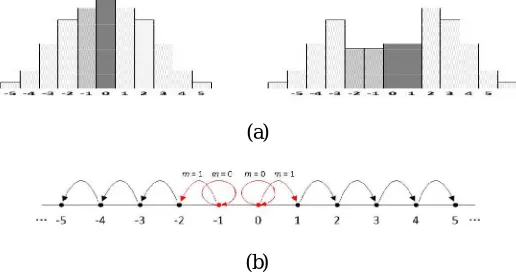
Here m € {0,1} ,The bits -1 ,0 are expanded to data bits the other bins are creating vacancy that are ensure reversibility. The cover pixel is modified to Pi’ = Pi^ + Ei ‘ and generate marked pixel. The abow method will compleated then the all
secret data bits are embedd in the covering image.
(a)
(b)
Fig. 1. Histogram modification mechanism for C-PEE. (a) PEH before (left) and after (right) C-PEE embedding. (b) Mapping of bins for C-PEE.
Figure 1 shows the hisogram modification mechanisum mapping of bins for CEE shown in fig 1(b) figure shows red point and black ponit red points are denoted the expanded bins and the black points are shifted bins.The original prediction error was recoverd from the bellow equations
Ei’ if Ei’ € {1,0}
Ei= Ei’ -1 if Ei’ >0
Ei’ +1 if Ei’ <1 B. A-PEE
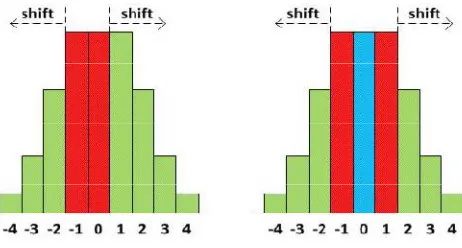
Fig. 2. C-PEE (left) v.s. O-PEE (right).
C. O-PEE
In OPEE method the specific PEH are shown in right figure of fig2. We can select the bins -1 and 1 for expansion in this situation the bins larger than 1 or smaller than -1 need to be shifted while the bit 0 will remain unchanged. Compaired with CPEE the expected value of embedding distortion is reduced from N-H to N-2H
Through this example, we see that it is possible to improve C-PEE by suitably selecting expansion bins. one can select two expansion bins a < b to minimize the embedding distortion, and the optimal expansion bins can be determined by repeated embedding for a collection of (a, b).
Ei if a < Ei < b
Ei + m if Ei = b
Ei’ = Ei -m if Ei = a
Ei + 1 if Ei > b
Ei - 1 if Ei < a
The O-PEE extraction is just the inverse of data embedding. The data extraction and image restoration procedure of PEE is omitted.
D. AO-PEE
AOPEE is the combination of adaptive embedding and optimal expansion bins selection. This combined embedding having better performance is occurring. The cover pixel value is xi , Then consider the complexity
measurement ni < T , Ei is the prediction error , xi is modified same as APEE. In AO-PEE three parameters are
determined complexity, Threshold, and expansion bins (a,b).
min(u, v) if w ≥ max(u, v)
xi’ = max(u, v) if w ≤ min(u, v)
u + v – w otherwise.
III. PROPOSED RDH METHOD
Fig. 3. Shadow and blank pixels partition. The scanning order for shadow (blank) pixels is from left to right and top to bottom.
The blank pixel is embedding after the completion of shadow pixel embedding. But in the extraction phase first extract the message from blank pixel after that the extraction process of shadow pixel. Except the border pixel, The shadow pixels are scanned from left to right and top to bottom and get the cover sequence are x1,x2 ………xn ,For
avoiding the over flow and underflow we assume that the value of pixel 0 will be changed to 1 and 255 changed to 254 and a location map is created for showing this changes this location map is a binary sequence. For compression of this location map we choose RUN LENGTH CODING . In this proposed method having also an secret key ensuring technique that will be ensure the security of secret message. Run Length coding is producing sequence of integer run values it is stored in integer arrays each run value represent the length of run.
Fig 4.scret key encryption method
Secret key ensuring is a method used to ensure the security of secret message. A stream cipheris a symmetric cipher which operates with a time-varying transformation on individual plaintext digits. By contrast, block ciphers operate with a fixed transformation on large blocks of plaintext digits. More precisely, in a stream cipher a sequence of plaintext digits, m0,m1. . ., is encrypted into a sequence of cipher ext digits c0,c1 . . . as follows: a pseudorandom
sequence s0,s1. . ., called the running-keyor the key stream, is produced by a finite state automaton whose initial state
is determined by a secret key. Figure shows the secret key encryption method using linear feedback shift register (LFSR)
IV.PERFORMANCE EVALUATION
Area (No. of slices)
Delay(ns) Normal RDH 42 16.49 RDH using run length
coding
44 14.075
Comparison result of Normal reversible data hiding and modified reversible data hiding. Normal RDH method is proposed based on PEE of multiple histograms. For each pixel, its prediction value and complexity measurement are first computed according to its context, then multiple histograms are generated by counting the prediction-errors for different complexity levels. Finally, data embedding is implemented according to the proposed embedding strategy based on multiple histograms modification. Moreover, to optimize the embedding performance, the expansion bins are adaptively selected in each generated histogram such that the distortion is minimized. In the case of modified reversible data hiding the run length coding is used to compress the length of large data and the secret key will ensuring the security of secret message .In secret key ensuring have using linear feedback shift registers.
V. CONCLUSION
An efficient RDH method is based on prediction error histogram. In PEE method we calculate the pixel value of each pixel, prediction value and complexity measurement then the histograms are generated by counting the prediction error. The data embedding is based on proposed embedding strategy. The previous RDH method have no compression techniques and also they have no security protection for the secret messages but in the case of modified RDH method have run length coding is used for create compression location map and secret key ensuring is used for ensure the security of secret message.
REFERENCES
1. Y. Q. Shi, “Reversible data hiding,” in Proc. IWDW, vol. 3304, pp. 1–12 ,2004,.
2. R. Caldelli, F. Filippini, and R. Becarelli, “Reversible watermarking techniques: An overview and a classification,” EURASIP J. Inf. Security, vol. 2010, Jun. 2010, Art. ID 134546.
3. J. M. Barton, “Method and apparatus for embedding authentication information within digital data,” U.S. Patent 5 646 997, Jul. 8, 1997.
4. M. U. Celik, G. Sharma, A. M. Tekalp, and E. Saber, “Lossless generalized-LSB data embedding,” IEEE Trans. Image Process., vol. 14, no. 2, pp. 253–266, Feb. 2005.
5. S.-K. Lee, Y.-H. Suh, and Y.-S. Ho, “Reversible image authentication based on watermarking,” in Proc. IEEE ICME, Jul. 2006, pp. 1321–1324. 6. J. Tian, “Reversible data embedding using a difference expansion,” IEEE Trans. Circuits Syst. Video Technol., vol. 13, no. 8, pp. 890–896, Aug. 2003.
7. A. M. Alattar, “Reversible watermark using the difference expansion of a generalized integer transform,” IEEE Trans. Image Process., vol. 13,no. 8, pp. 1147–1156, Aug. 2004.
8. D. Coltuc and J.-M. Chassery, “Very fast watermarking by reversible contrast mapping,” IEEE Signal Process. Lett., vol. 14, no. 4, pp. 255–258, Apr. 2007. 9. X. Wang, X. Li, B. Yang, and Z. Guo, “Efficient generalized integer transform for reversible watermarking,” IEEE Signal Process. Lett., vol. 17, no. 6, pp. 567–
570, Jun. 2010.
10. F. Peng, X. Li, and B. Yang, “Adaptive reversible data hiding scheme based on integer transform,” Signal Process., vol. 92, no. 1, pp. 54–62,Jan. 2012. 11. D. Coltuc, “Low distortion transform for reversible watermarking,” IEEE Trans. Image Process., vol. 21, no. 1, pp. 412–417, Jan. 2012.
12. L. Kamstra and H. J. A. M. Heijmans, “Reversible data embedding into images using wavelet techniques and sorting,” IEEE Trans. Image Process., vol. 14, no. 12, pp. 2082–2090, Dec. 2005.
13. S. Weng, Y. Zhao, J.-S. Pan, and R. Ni, “Reversible watermarking based on invariability and adjustment on pixel pairs,” IEEE Signal Process. Lett., vol. 15, pp. 721–724, 2008.
14. H. J. Kim, V. Sachnev, Y. Q. Shi, J. Nam, and H.-G. Choo, “A novel difference expansion transform for reversible data embedding,” IEEE Trans. Inf. Forensics Security, vol. 3, no. 3, pp. 456–465, Sep. 2008.
15. D. M. Thodi and J. J. Rodriguez, “Expansion embedding techniques for reversible watermarking,” IEEE Trans. Image Process., vol. 16, no. 3, pp. 721–730, Mar. 2007.
BIOGRAPHY