Top N Recommendation with TrustSVD++ for
User Trust and Item Rating with Implicit
Techniques
Rambhau B. Lagdive, Prof. Amol R. Dhakne
Department of Computer Engineering, Flora Institute of Technology, Pune, Savitribai Phule Pune University,
Maharashtra, India.
Department of Computer Engineering, Flora Institute of Technology, Pune, Savitribai Phule Pune University,
Maharashtra, India.
ABSTRACT: We propose TrustSVD, a trust-based lattice factorization method for suggestions. TrustSVD coordinates different data sources into the suggestion show keeping in mind the end goal to diminish the information sparsity and frosty begin issues and their corruption of proposal execution. In Proposal System used recommendation in item to item recommendation and User trust recommendation and an investigation of social trust information from four certifiable information sets proposes that the unequivocal as well as the verifiable impact of both evaluations and trust ought to be mulled over in a suggestion show. TrustSVD consequently expands on top of a best in class suggestion calculation, SVD++ (which utilizes the express and certain impact of appraised things), by further fusing both the unequivocal and understood impact of trusted and trusting clients on the expectation of things for a dynamic client. And dynamic recommendation are happen With the help of Top n recommendation algorithms The proposed system is the first to augment SVD++ with social trust data. Trial comes about on the four information sets exhibit that TrustSVD accomplishes preferred precision over other ten partner’s suggestion methods.
KEYWORDS: Recommender systems, social trust, matrix factorization, implicit trust, collaborative filtering.
I. INTRODUCTION
II. REVIEW OF LITERATURE
Number Paper Name Author Name and Year
Proposed System Referred Point
1. Toward the next generation of recommender systems: A survey of the state-of-the-art and possible extensions
G.
Adomavicius and A. Tuzhilin. 2005
This paper presents an overview of the field of recommender systems and describes the current generation
ofRecommendation.
Improve recommendation capabilities and make recommender systems applicable to an even broader
range of applications.
2. A simple but effective method to incorporate trusted neighbors in recommender systems
G. Guo, J. Zhang, and D. Thalmann. 2012
In this paper, we propose a simple but effective method, namely “Merge”, to incorporate social trust information in providing recommendations.
To find similar other users
For generating recommendations.
3. SoRec: Social recommendation using probabilistic matrix factorization
H. Ma, H. Yang, M. Lyu, and I. King. 2008
In this paper, based on the intuition that a user’s social network will affect this user’s behaviors on the Web, we present a novel social recommendation factorization.
The complexity analysis indicates it is scalable to very large datasets.
4. Recommender systems with social regularization
H. Ma, D. Zhou, C. Liu, M. Lyu, and I. King.
2011
In this paper, we proposea matrix factorization framework with social regularization.
We elaborate how social network information can benefit
recommenderSystems.
5. A matrix factorization technique with trust propagation for recommendation in social networks.
M. Jamali and M. Ester. 2010
In this paper, we explore a model-based approach for recommendation in social networks, employing matrix factorization techniques.
Collaborative filtering
is the most popular approach to building recommender systems
and has been successfully employed in many applications.
6. Social collaborative filtering by trust
B. Yang, Y. Lei, D. Liu, and J. Liu.
2013
we have proposed a novel social CF method named Trust MF, which is Motivated by the heuristic that individuals will affect each other during the process of reviewing.
Trust MF gets remarkable improvements against the state-of-the-art social CF methods according to the validations and comparisons on a real-world dataset.
7. Leveraging decomposed trust in probabilistic matrix factorization for
H. Fang, Y. Bao, and J. Zhang.
In this paper, further employing the support vector
III. EXISTING SYSTEM
Traditionally for any recommendation based system, we used the Collaborative filleting approach for recommending product to the end user by gathering the interest of user by collecting there preferences or tats information from many user(Collaborating) for example a collaborative filtering recommendation system for television tastes could make prediction about which television show a user should like given a portals list of user’s tasters(Like or dislike ). Even through this model recommends the products effectively it suffers from cold start problem. A cold start problems is a potentials problems in computer based information system which involves the degree of automated data modeling. Specifically, it concerns the issues that system can not draw any inferences for user or item about which it been not yet gathered sufficient information.In the Collaborative filtering approach the recommender system would identify user who share the same preferences for example rating patterns with the active user and provider items which the like-mainlined user favored (and the active user has not yet seen ) Due to the cold start problem this approach would fail to consider item which no-one in the Community has rated previously
DISADVANTAGES -
1. Existing trust based model may not works well if there exists only trust a like relationship. 2. Theses Observation could other kinds of recommendation problems.
3. Exiting trust based model consider only the explicit influences of rating. probabilistic matrix
factorization modelfor rating prediction in recommender systems. 8. Matrix factorization
techniques for recommender systems
Y. Koren, R. Bell, and C. Volinsky. 2009
Electronic retailers and contentproviders offer a huge selection of products,with unprecedented opportunitiesto meet a variety of special needs and tastes.
Because good personalized recommendations can add another dimension to the user
experience, e-commerce leaders like Amazon.com and Netflix have made recommender systems a salient part of their websites.
9. Factor in the neighbors: Scalable and accurate collaborative filtering.
Y. Koren 2010
We introduce a new neighborhood model with improved prediction accuracy.
Accuracy improvements are achieved by extending the model to exploit both explicit and implicit feedback by the users.
10. Factorization meets the neighborhood: A multifaceted collaborative filtering model.
Y. Koren. 2008
We introduce some innovations to both approaches. The factor andneighborhood models can now be smoothly merged, thereby buildinga more accurate combined model.
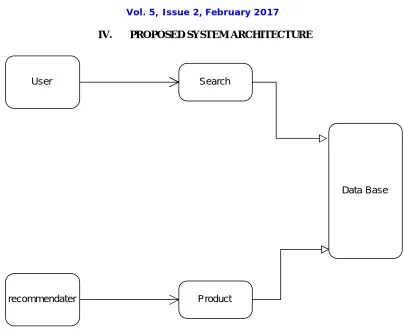
IV. PROPOSED SYSTEM ARCHITECTURE
Fig No 01 Proposed System Architecture
Use the empirical trust analysis and observer the trust and item rating are comp element to each other Implicitly and Explicitly influences of rating and trust into our user trust based modelPotential we observer the beneficial solving the other kind of Recommendation problem like top N Recommendation.We use the Top k approaches to show the result after mining with help of TKU algorithms. TrustSVD consequently expands on top of a best in class suggestion calculation, SVD++ (which utilizes the express and certain impact of appraised things), by further fusing both the unequivocal and understood impact of trusted and trusting clients on the expectation of things for a dynamic client. And dynamic recommendation is happen With the help of Top n recommendation algorithms The proposed system is the first to augment SVD++ with social trust data. Trial comes about on the four information sets exhibit that TrustSVD accomplishes preferred precision over other ten partner’s suggestion methods.
V. CONCLUSION
This article proposed a novel trust-based framework factorization display which joined both rating and trust data. Our investigation of trust in four genuine information sets demonstrated that trust and appraisals were corresponding to each other, and both vital for more precise proposals. Our novel approach, TrustSVD, considers both the express and understood impact of appraisals and of trust data while foreseeing evaluations of obscure things. Both the trust impact of trustees and trusters of dynamic clients are included in our model. What's more, a weighted-regularization system is adjusted and utilized to encourage regularize the era of client and thing particular inactive element vectors. Computational many-sided quality of TrustSVD showed its ability of scaling up to large-scale information sets.
User Search
Data Base
various testing sees and crosswise over clients with various trust degrees. We presumed that our approach can better reduce the information sparsely and cool begin issues of recommender frameworks.
.
REFERENCES
[1] G. Adomavicius and A. Tuzhilin, “Toward the next generation of recommender systems: A survey of the state-of-the-art and possible extensions,” IEEE Trans. Know. Data Eng., vol. 17, no. 6, pp. 734–749, Jun. 2005.
[2] G. Guo, J. Zhang, and D. Thalmann, “A simple but effective method to incorporate trusted neighbors in recommender systems,” in Proc. 20th Int. Conf. User Model., Adaptation Personalization, 2012, pp. 114–125.
[3] H. Ma, H. Yang, M. Lyu, and I. King, “SoRec: Social recommendation using probabilistic matrix factorization,” in Proc. 31st Int. ACM SIGIR Conf. Res. Develop. Inform. Retrieval, 2008, pp. 931–940.
[4] H. Ma, D. Zhou, C. Liu, M. Lyu, and I. King, “Recommender systems with social regularization,” in Proc. 4th ACM Int. Conf. Web Search Data Mining, 2011, pp. 287–296.
[5] M. Jamali and M. Ester, “A matrix factorization technique with trust propagation for recommendation in social networks,” in Proc. 4th ACM Conf. Recommender Syst., 2010, pp. 135–142.
[6] B. Yang, Y. Lei, D. Liu, and J. Liu, “Social collaborative filtering by trust,” in Proc. 23rd Int. Joint Conf. Artif. Intell., 2013, pp. 2747–2753. [7] H. Fang, Y. Bao, and J. Zhang, “Leveraging decomposed trust in probabilistic matrix factorization for effective recommendation,” in Proc. 28th AAAI Conf. Artif.Intell., 2014, pp. 30–36.
[8] Y. Koren, R. Bell, and C. Volinsky, “Matrix factorization techniques for recommender systems,” Computer, vol. 42, no. 8, pp. 30– 37, Aug. 2009. [9] Y. Koren, “Factor in the neighbors: Scalable and accurate collaborative filtering,” ACM Trans. Know. Discovery Data, vol. 4, no. 1, pp. 1:1–1:24, 2010.