A Review on Self-Destructing Scheme in
Cloud Computing for Data Security
Akshay Mandlecha
1,Vaibhav Mule
2Omprasad Devkate
3Ruhul Choudhari
4,Shrikant Dhamdhere
5BE Student, Dept. of Computer, PGMCOE Wagholi, Pune, Savitribai Phule Pune University, Maharashtra, India1 BE Student, Dept. of Computer, PGMCOE Wagholi, Pune, Savitribai Phule Pune University, Maharashtra, India2 BE Student, Dept. of Computer, PGMCOE Wagholi, Pune,,Savitribai Phule Pune University, Maharashtra, India3 BE Student, Dept. of Computer, PGMCOE Wagholi, Pune, Savitribai Phule Pune University, Maharashtra, India4 Professor, Dept. of Computer, PGMCOE Wagholi, Pune, Savitribai Phule Pune University, Maharashtra, India5
ABSTRACT: Cloud computing have been playing very vital role in the rapidly growing organizations. It becomes mostly susceptible to usecloud services to share data between organizations, electronic businesses and a friend circle in the cloud computing environment. Because of the fastest development in electronic business by using the various cloud services, it is very difficult to provide full lifecycle privacy security and access control becomes a very tedious task, specifically when sharing the sensitive data on cloud servers for achieving the anytime, anywhere service for authentic person or organization. Also for sharing purpose we need efficient method and secure technique over cloud services. In order to grab this problem the key-policy attributebased encryption with time-specified attributes KPTSABE, which is focus on data security over specific time period and proposed new proxy re-encryption technique for providing full lifecycle privacy security solution We predict that fast and secure re-encryption will become increasingly popular as a method for managing encrypted file systems in which new re-encryption schemes that realize a stronger notion of security.
KEYWORDS:Sensitive Data, Cloud Computing, privacy,preserving, finegrained access control
I. INTRODUCTION
Today's business applications hardly work in isolation manner; they need many numbers of applications to interaction to complete business requirements. The customer and clients is believed in the instant access to all business applications which offered by an enterprise, without worrying about which systems provides the functionality at anytime and anywhere (24x7). The cloud computing is playing very important role in business now a day. The electronic business is becoming more and more dynamic which experiencing the major changes, since the market is in hurry to develop of new systems, databases, technologies for providing or adding efficient and dynamic nature to electronic business. As per IDC (International Development Corporation) survey todays around 70 to 80 percent of electronic data generated in last two to three years, most significant think is maximum data is very sensitive with respect to organization and person.
Cloud Computing is also called as the on-demand computing because of its features anytime, anywhere, as per your requirement with pay per use features. It is considered as modern way of evaluation on-demand information technology which combines a set of new and existing technologies from exploration areas such as Virtualization and service-oriented architectures (SOA). With the hurried development of flexible cloud computing technology and services, it is routine for users to control over the cloud storage services to share data with others in a friend circle such as Google Drive and Dropbox.
When we are using the word “Moving to Cloud”, means we have shifted existing services or data to cloud computing but whenever moving information to cloud information can be very sensitive (Organization business profile, financial information, client records, personal information) and need to be restricted only authentic organization and friends. But restriction to sensitive information in shared data in cloud is very big challenge. Sometimes need to migrated data from one cloud to other cloud for outsourcing and share it for cloud searching, so that it very big challenge to provide the sensitive data security in cloud. It mostly becomes very tedious task for security in big data environment and information in cross cloud.
One of the solutions for providing authenticity to sensitive data is self-expiration time and fined-grain access control. The sensitive and shared information should be destruct itself after expiration time provided by user and also providing re-encryption technique for providing full lifecycle privacy to the sensitive information.
One of the techniques for protecting data from unauthorized access is to store the sensitive information in the encrypted form. But the disadvantage for encrypting data is that the user cannot share his/her sensitive encrypted data at a fine-grained level. When the data holder wants to share data with someone, the information owner should have known the exactly one wants to share his/her sensitive information.
II. LITERATURE SURVEY AND RELATED WORK
There are many techniques available for protecting information in cloud and each technique has its own advantages and disadvantages. Cloud computing has been providing various and versatile services for sharing information over the internet for electronic business as well for personal use from anywhere and anytime. The main task is providing protection to shared data.
A.TRADITIONAL ENCRYPTION
This is one way to protecting shared information on cloud by encrypted data. There are so many disadvantages to this traditional encryption are easily decrypted and we cannot shared the encrypted data in fine-grained level. Also very difficult task during sharing the information, data owner should know the information of his/her. In traditional way of encryption is the technique for one to one encryption is done only
B.ATTRIBUTE BASED ENCRYPTION (ABE)
Attribute Based encryption has so many advantages over the traditional way encryption. ABE has supported flexible one to many encryption instead of one to one encryption like traditional technique. It also provides fine-grained access control for sharing encrypted data to cloud. This scheme of encryption provides powerful and efficient data security as compare to traditional way of encryption.
It is based on the fuzzy identity-based encryption. There are two flavors of ABE such as KP-ABE and cipher text-policy ABE (CP-ABE). In CP-ABE, the cipher text is related with the access structure while the private key contains a set of attributes. In KP-ABE, when a user made a secret request, the trusted authority determined which combination of attributes must appear in the cipher text for the user to decrypt.
C.SECURE SELF DESTRUCTION SCHEME (SSDS)
III. ARCHITECTURE
Fig 1.SYSTEM MODEL OF THE KP-TSABE SCHEME
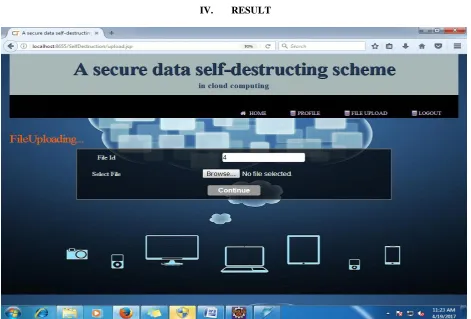
IV. RESULT
Screen 2 Data user
Screen 4show files
Screen 6 File Access
V.CONCLUSION
Data privacy is essential in the Cloud environment. A new approach is introduced for protecting the data privacy from attackers which may obtain, from legal or other means, a user’s stored data and private decryption keys. A novel aspect is the leveraging of the essential properties of active storage frame work based on T10OSD standard. Personal data stored in the cloud may contain account numbers, secret codes and other necessary details that could be used and misused.
SeDas uses the selfdestruct operation without any action on the user’s part. Measurement and experimental security analysis sheds insight into the practicability of this approach. Plan to release the current SeDas system will help to provide researchers with further valuable experience to inform future objectbased storage system designs for Cloud services.
REFERENCES
1. B. Wang, B. Li, and H. Li, “Orut a: Privacy-preserving public auditing for shared data in t he cloud,” Cloud Computing, IEEE Transact ions on, vol. 2,no. 1, pp. 43–56, 2014.
2. J. Xiong, Z. Yao, J. Ma, X. Liu, Q. Li, and J. Ma, “Priam: Privacy preserving identity and access management scheme in cloud,” KSII Transact ions on
Internet and Information Systems (TIIS), vol. 8, no. 1, pp. 282–304, 2014.
3. P. Jamshidi, A. Ahmad, and C. Pahl, “ Cloud migrationresearch:Asystematic review,” Cloud Computing, IEEE Transact ions on,vol. 1, no. 2, pp. 142–157, 2013.
4. R. Lu, H. Zhu, X. Liu, J. K. Liu, and J. Shao, “Toward efficient and privacy -preserving computing in big data era,” Network, IEEE, vol. 28, no. 4, pp.46–50, 2014.
5. A. F. Chan and I. F. Blake, “ Scalable, server-passive, user anonymous timed release cryptography,” in Proceedings of the International Conference onDistributed Computing Systems. IEEE, 2005, pp. 504–513.
6. JinboXiong, Ximeng Liu, Zhiqiang Yao, Jianfeng Ma, Qi Li, KuiGeng, and Patrick S. Chen (2014), A Secure Data Self-Destructing Scheme in Cloud Computing, IEEE Transaction on Cloud computing, 2(4) pp. 448-458.
7.B. Wang, B. Li, and H. Li, (2014), Oruta: Privacy-preserving public auditing for shared data in the cloud, IEEE Transactions on Cloud Computing , 2(1), pp 43-56.
8.J. Xiong, Z. Yao, J. Ma, X. Liu, Q. Li, and J. Ma (2014 Priam: Privacy preserving identity and access management scheme in cloud, KSII Trans. Internet Inf. Syst., 08(01), pp 282-304.
9.J. Xiong, F. Li, J. Ma, X. Liu, Z. Yao, and P. S. Chen, (2014), A full lifecycle privacy protection scheme for sensitive data in cloud computing,
Peer-to-peer network Appl.
10P. Jamshidi, A. Ahmad, and C. Pahl (2013), Cloud migration research: A systematic review, IEEE Trans. Cloud Compute. 01(02), pp 142-157. 11.R. Lu, H. Zhu, X. Liu, J. K. Liu, and J. Shao, “Toward efficient and privacy-preserving computing in big data era,” Network,IEEE, vol. 28, no. 4, pp. 46–50, 2014.
12. X. Liu, J. Ma, J. Xiong, and G. Liu, “Ciphertext-policy hierarchical attribute-based encryption for fine-grained access control of encryption data,”