Extractive Summarization under Strict Length Constraints
Yashar Mehdad1† Kapil Thadani1† Dragomir Radev2 Amanda Stent1 Youssef Billawala1 Karolina Buchner3 1Yahoo Research 2University of Michigan 3Apple
{ymehdad, thadani}@yahoo-inc.com, [email protected],{stent, billawala}@yahoo-inc.com, [email protected]
Abstract
In this paper we report a comparison of various techniques for single-document extractive summarization under strict length budgets, which is a common commercial use case (e.g. summarization of news articles by news aggregators). We show that, evaluated using ROUGE, numerous algorithms from the literature fail to beat a simple lead-based baseline for this task. However, a supervised approach with lightweight and efficient features improves over the lead-based baseline. Additional human evaluation demonstrates that the super-vised approach also performs competitively with a commercial system that uses more sophisticated features.
Keywords:text summarization, extractive summarization
1.
Introduction
Extractive text-to-text summarization has a rich history (e.g. (Carbonell and Goldstein, 1998; Erkan and Radev, 2004)). In this task, sentences or text snippets are extracted from an input document or set of documents to produce a summary. However, in previous extractive summariza-tion shared tasks such as the DUC shared tasks (http: //duc.nist.gov/) length restrictions on output sum-maries were quite generous (100 to 400 words, or 400+ characters) as opposed to the very strict length budgets re-quired by current commercial use cases (160 to 300 char-acters for search result and news article summarization, es-pecially on mobile devices).
In this work, we focus on a supervised method to generate extractive summaries under strict length constraints without sacrificing meaning or grammaticality. We present evalua-tion results for the single-document news summarizaevalua-tion use case, comparing performance on well written articles as well as on a sampling of news articles of random quality.
2.
Related Work
Research on single-document, extractive summarization has been conducted since the 1950s (Luhn, 1958). Tra-ditionally, extractive single document summarization has focused on scoring, ranking, and extracting the most “in-formative” sentences from a document using various su-pervised (e.g. (Conroy et al., 2004; Daum´e and Marcu, 2006; Lin, 1999; Svore et al., 2007)) and unsupervised (e.g. (Erkan and Radev, 2004; Mei et al., 2010; Mihalcea and Radev, 2011)) methods. Innovations fall into two broad categories: (a) finding ways to assess whether a sentence should be included in a summary; and (b) efficient algo-rithms for exploring the space of possible summaries. A recent study compared a number of extractive summa-rization algorithms (Hong et al., 2014). The best perform-ing algorithm performed global optimization over the input sentence set. However, these algorithms were compared using the DUC 2004 task, (a) which is a multi-document summarization task; and (b) for which the reference sum-maries were abstractive.
†
[image:1.595.310.530.279.396.2]Equal contribution.
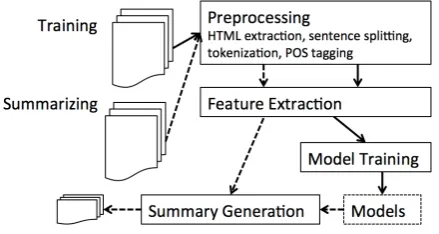
Figure 1: Our summarization system
More related to our framework, snippet extraction is a pop-ular approach for search engines and news aggregators to show some content related to the query and the original document (Li et al., 2008). A simple way to identify snip-pets is to extract a passage from specific areas of the origi-nal page where the important information is found, relying on structural markup to identify such information (Callan, 1994). Although this approach is simple and scalable, doc-ument style and structural differences when changing do-mains or publishers can significantly affect snippet quality.
3.
System
Our system takes as input an HTML document. We auto-matically extract the article text from the HTML, and then automatically preprocess the text to obtain sentences, to-kens and part of speech tags. Then, we compute various features over the preprocessed document. Each sentence is scored using a combination of feature values and feature weights, which are learned using a structured perceptron (Collins, 2002). Finally, sentences are extracted in a greedy fashion based on their scores while respecting the length constraint. These steps are illustrated in Figure 2.
3.1.
Features
Category Examples
Position sentence position, paragraph position, in-paragraph position
Length word length, character length, sum-mary length
Content similarity to query / headline / title/ document / summary
Lexical cues containing url / special pattern / quote / question / capitalization / number / money
[image:2.595.306.542.72.238.2]Syntactic cues containing pronouns/ nouns/ certain part of speech
Table 1: Feature categories implemented in our summariza-tion framework
Positionfeatures indicate the inverse position of each sen-tence and paragraph in the document, and of each sensen-tence in its containing paragraph. Lengthfeatures indicate the length of each sentence, and of the summary so far, in words and characters. Content features indicate similar-ity of each sentence to the input query, headline or title as well as to the document and to the summary so far, and are computed as cosine similarity over term frequency vec-tors. Lexical cue features are binary features indicating whether a sentence contains various lexical items such as URLs, quotations, or numbers. Finally,Syntactic cue fea-tures are binary and normalized count feafea-tures indicating whether a sentence contains a syntactic phenomenon such as a pronoun, and if so, how many. Although we experi-mented with all these features, the best performing model for sentence scoring contained only the very efficient and easy to compute position, length and content features; the lexical and syntactic cue features were used in a preproces-sor that prunes sentences that should not be in a summary (e.g. a sentence that contains a URL).
3.2.
Supervised Learning
An input documentDis represented as a set{x1, . . . , xn}
ofnsentences. An extractive summaryS is composed of sentences from this document, i.e.,S ⊆ D. For any doc-ument, we seek to recover the highest-scoring summarySb which can fits within a pre-determined budgetb.
b
S= arg max S⊆D
score(S, D) (1)
s.t. cost(S)< b
The tractability of this inference formulation depends on the factorization of the function scoreover the summary. In this work, we forego exact solutions to (1) in order to accommodate richer scoring functions that can model phe-nomena such as diversity (Carbonell and Goldstein, 1998) and coherence (Barzilay and Lapata, 2005; Christensen et al., 2013). Summaries are scored using a linear model
score(S, D) =w>Φ(S, D) (2)
whereΦis a feature map for summaries andwis a vector of learned parameters.
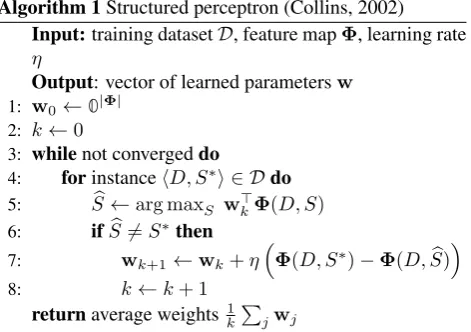
In order to train the parametersw, we assume the existence of a training dataset D comprised of instances hD, S∗i
Algorithm 1Structured perceptron (Collins, 2002) Input:training datasetD, feature mapΦ, learning rate
η
Output: vector of learned parametersw
1: w0←0|Φ| 2: k←0
3: whilenot convergeddo
4: forinstancehD, S∗i ∈ Ddo
5: Sb←arg maxS wk>Φ(D, S) 6: ifSb6=S∗then
7: wk+1←wk+η
Φ(D, S∗)−Φ(D,Sb)
8: k←k+ 1
returnaverage weights 1kP
jwj
whereS∗represents a reference summary for documentD. The parameters are estimated using the structured percep-tron (Collins, 2002) which minimizes a 0/1 loss overDand incorporates parameter averaging for generalization. The basic learning procedure is described in Algorithm 1. When inference is inexact and carried out via search—as in the case of our framework—convergence and performance can be improved usingviolation-fixingweight updates (Huang and Feyong, 2012). In addition to greedy search, we also experimented with beams of various sizes to reduce search errors but did not observe performance improvements1.
4.
Experiments - Systems Compared
4.1.
Baselines and Other Methods
We compare the extractive summaries generated by our framework to three simple baselines (Lead-basedand two variations ofGreedy) as well as to an array of standard sum-marization methods from the literature.
Lead-based The baseline, lead-based, algorithm takes the first sentences in the document that fit within the budget.
Greedy The greedy algorithm is exactly the one de-scribed in (McDonald, 2007): sentences are ordered by a sentence scoring function, and then added one by one to the summary until the budget is full. The sentence scor-ing function may be entirely precomputable (incorporatscor-ing assessments of relevance of sentence to the document, in-dependence of the sentence, etc.) or may also incorporate aspects that are computed on the fly (e.g. redundancy of sentence with respect to the summary).
In addition to the standard greedy search algorithm, we im-plemented a version in which the first sentence in the doc-ument must be included in the summary (S1 + Greedy).
MEAD (Radev et al., 2004) provides a sentence clas-sifier. Sentence features include similarity to centroid, length, and position. The default reranker orders the sen-tences and iteratively decides whether to add each sentence to the summary, based on its similarity to previously in-cluded sentences. At each step, if the quota of words or sentences has not been filled, and the sentence is not too
1This phenomenon has also been reported in prior work
similar to any sentence already in the summary, the sen-tence in question is added to the summary. After the al-located length has been reached, the reranker increases the scores of the selected sentences and discounts the disquali-fied (by similarity) or unselected sentences.
In addition to standard MEAD, we implemented a variation in which the first sentence in the document is required to be in the summary (S1 + MEAD).
Divrank (Mei et al., 2010) is based on a reinforced ran-dom walk over a lexical similarity graph. This model auto-matically balances the prestige and the diversity of the top ranked vertices in a principled way.
Lexrank (Erkan and Radev, 2004) is based on eigenvec-tor similarity over a lexical similarity graph. The nodes of the graph correspond to input sentences and the edges to weighted cosine similarity. The most central sentences are selected for the summary.
MaxCov (Takamura and Okumura, 2009) applies ap-proximation algorithms for the budgeted maximum cover-age problem (Khuller et al., 1999) to document summariza-tion. It assumes the existence of a vocabulary in which each word is associated with some positive profit (word score in the summary). Given a collection of subsets of this vocab-ulary (sentences), each associated with some cost (number of characters), the budgeted maximum coverage problem identifies a summary whose total cost remains within the budget and whose union maximizes the summary score.
Personalized PageRank (PPR) (Agirre and Soroa, 2009) is a variation of the pagerank algorithm where the ranking process is performed depending on the relation-ships among all sentences in the document.
Knapsack We use the algorithm described in (McDon-ald, 2007), except that the scoring function may be varied, as described above in the synopsis of the greedy algorithm.
Maximal Marginal Relevance (MMR) (Carbonell and Goldstein, 1998) is a variant of greedy summarization which encourages the sentences in the summary to be di-verse and non-redundant. As new sentences are considered for the summary, the greedy objective balances the rele-vance of any new sentence with its similarity to each sen-tence already in the summary.
4.2.
Data
We collected 172 highly popular articles from the Yahoo home page: (a) Yahoo-produced content; (b) content from Yahoo partners; and (c) news articles of any type, cover-ing a wide range of journalistic quality (“random”). We obtained gold-standard extractive 300-character reference summaries for each document from one to four (usually two) professional annotators. This makes our data and ref-erence summaries much more similar to the commercial use case than other publicly available data sets such as DUC. For training the model for our supervised framework, we used a subset of the New York Times Annotated Cor-pus containing 1800 articles with extractive summaries of length less than 300 characters. The model contains “lightweight” features that require minimal preprocessing,
Summarizer R-1 R-2 R-4
Greedy 0.51 0.34 0.29
S1 + Greedy 0.58 0.45 0.40
Lead-based 0.66 0.59 0.55
PPR(α=0.5, simceil=0.15) 0.27 0.1 0.06
MaxCov 0.43 0.25 0.20
Divrank 0.46 0.33 0.28
Lexrank 0.50 0.38 0.34
MEAD 0.51 0.39 0.35
S1 + MEAD 0.51 0.40 0.36
Knapsack 0.57 0.43 0.38
MMR(λ=0.8) 0.61 0.49 0.44
[image:3.595.323.520.66.226.2]Ours 0.71 0.61 0.56
Table 2: Results of automated evaluation under ROUGE
including positional features (sentence position in the doc-ument and the paragraph), relevance features (relevance of the sentence to the document, computed using cosine sim-ilarity over term frequency vectors) and a binary feature— computed on the fly—to identify when a candidate sentence is adjacent to a sentence already present in the summary. The scoring function we used for the greedy and knapsack algorithms uses the same features.
4.3.
Automatic Evaluation
For evaluation, we produced 300-character extractive sum-maries from the input documents by passing them through the systems described earlier.
We evaluate the performance of all systems against man-ually creative extractive reference summaries. We use ROUGE (Lin, 2004), a well-established automatic evalua-tion metric based on lexical overlap which has been widely used in the scientific community and has been shown to correlate well with human evaluations. We follow the stan-dards suggested by Owczarzak et al. (2012). As is standard, we report ROUGE R-1, R-2 and R-4.
Table 2 shows evaluation results. The lead-based baseline outperforms all the methods from the literature that we in-cluded. However, our framework outperforms this baseline. Analyzing the reference summaries, we observed that they are primarily lead-based unless one of the first sentences in the input document is a result of errors in article extraction from HTML (e.g. a byline is extracted as part of the arti-cle, or a photo caption is included as part of the article) or a repetition of the article title.
5.
Experiments - Side by Side Editorial
Evaluation
We also conducted a manual, side-by-side evaluation com-paring the summaries produced by our system to those pro-duced by a commercial summarizer.
5.1.
Dataset
We collected a sample set of popular articles from the Yahoo home page covering the period 04/20–04/24 2015. These articles fall into three categories:
ar-Title Randy Travis Surprises, Moves Spectators with First Awards Show Appearance
Our system Traviss moment on camera was brief and slightly shaky, but showcased the fact that he is on the way to full recovery. Travis underwent an acrimonious divorce with his first wife, Lib Hatcher, in 2010, which appeared to set off a chain of troublesome events to follow.
Commercial system When country star Lee Brice took the stage at the 50th annual Academy of Country Music Awards to announce the Song of the Year prize, spectators were delighted by his unexpected stanza of Randy Travis’s 1987 hit “Forever And Ever, Amen.” They were even more excited, however, when... Title Source: Bruce Jenner Began Transgender Journey in 1980s, Then Stopped After Meeting Kris Jenner Our system A source with direct knowledge told ET that Jenner talked about transitioning 30 years ago, and that by the mid-1980s Jenner had started hormone therapy, electrolysis and had plastic surgery to make his features look more feminine. Bruce Jenner’s Emotional New Promo: ’How Does My Story End?’ Commercial system ET has exclusive new information about when Bruce Jenner began his gender transition. A source with direct knowledge told ET that Jenner talked about transitioning 30 years ago, and that by the mid-1980s Jenner had started hormone therapy, electrolysis and had plastic surgery to make his features... Title Which passports are the best (and worst) to have?
Our system Arton, an advisory firm that helps people take part in citizenship and residency programs for investors, has created the Passport Index, which ranks travel documents based on how many countries their holders can visit without having to obtain a visa in advance.
[image:4.595.59.534.63.312.2]Commercial system How “powerful” is your passport? This is the question that the folks at Arton Capital have set out to answer. The more nations you can access merely by showing up and getting a landing visa at the airport (or even entering visa-free), the more powerful your passport is.
Table 6: Sample summaries from our system and a commercial system
Summary # % Equally bad Equally good Ours much better 14 12
Ours better 65 54
No preference 31 26 5 (4%) 26 (22%) Other better 8 7
Other much better 2 2
Table 3: Results onPopulararticles
Summary # % Equally bad Equally good Ours much better 18 15
Ours better 41 24
No preference 36 30 11 (8%) 24 (17%) Other better 26 22
Other much better 18 15
Table 4: Results onRandom Partnerarticles
ticles from Yahoo and its publishing partners from the same time period.
Random Other: a subsample of 139 random articles from any article publisher from the same time period.
300 character summaries were automatically produced for all of these articles using both our framework and a com-mercial system that uses more sophisticated features based on entity mentions in the input document.
For each document, we presented professional annotators with the two summaries produced by these two methods. Order of presentation of the summaries was randomized. We asked the annotators to choose if they “highly prefer” or “prefer” one summary over another, or they had no pref-erence. We also asked them to justify their answer.
5.2.
Results
Based on the manual evaluation results (Tables 3, 4 and 5), our framework outperforms the commercial system for the PopularandRandom Partnerdatasets. However, the same trend was not reflected for theRandom Otherdataset.
An-Summary # % Equally bad Equally good Ours much better 2 1
Ours better 22 16
No preference 62 45 43 (31%) 16 (12%) Other better 50 36
Other much better 3 2
Table 5: Results onRandom Otherarticles
notators complained of unusual character and formatting issues in our outputRandom Other documents; the com-mercial system has better handling of unicode symbols and other character formatting in its output.
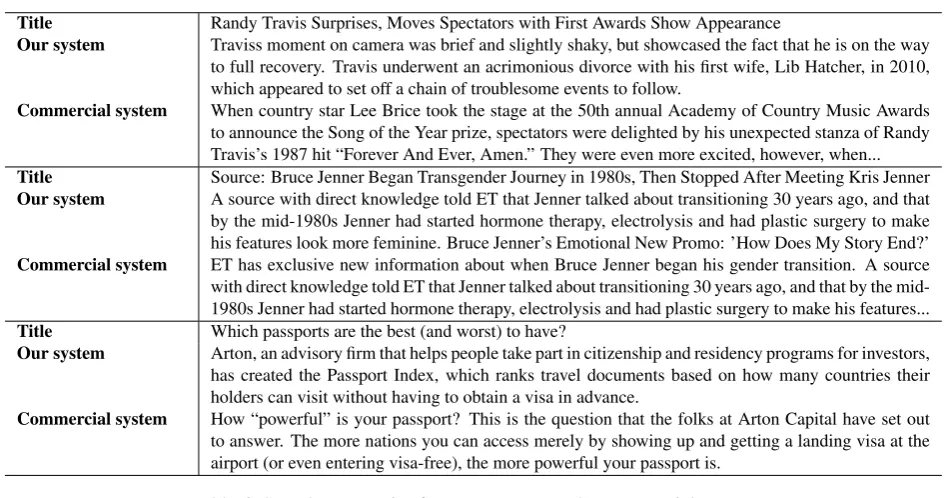
Table 6 shows example outputs. In general, we observed that our summaries are less redundant with article titles (ex-amples 1 and 3); however, our summaries tend to contain extraneous short sentences to fill up the budget (example 2). By contrast, the commercial system quite often simply produces a lead-based summary (examples 1–3). It also fre-quently exceeds the character budget, leading to truncated sentences in the output (examples 1 and 2). The perfor-mance of both summarizers was upper-bounded by errors due to incorrect article extraction from HTML, including incorrect inclusion of photo captions, ads for other articles (example 2), etc.
6.
Conclusions
7.
Bibliographical References
Agirre, E. and Soroa, A. (2009). Personalizing PageRank for word sense disambiguation. In Proceedings of the EACL.
Barzilay, R. and Lapata, M. (2005). Modeling local coher-ence: An entity-based approach. In Proceedings of the ACL.
Callan, J. (1994). Passage-level evidence in document re-trieval. InProceedings of SIGIR.
Carbonell, J. and Goldstein, J. (1998). The use of MMR, diversity-based reranking for reordering documents and producing summaries. InProceedings of SIGIR. Christensen, J., Mausam, Soderland, S., and Etzioni, O.
(2013). Towards coherent multi-document summariza-tion. InProceedings of NAACL-HLT.
Collins, M. (2002). Discriminative training methods for hidden Markov models: Theory and experiments with perceptron algorithms. InProceedings of EMNLP. Conroy, J. M., Goldstein, J., Schlesinger, J. D., and
O’Leary, D. P. (2004). Left-brain/right-brain multi-document summarization. InProceedings of the DUC. Daum´e, III, H. and Marcu, D. (2006). Bayesian
query-focused summarization. InProceedings of the ACL. Erkan, G. and Radev, D. R. (2004). LexRank:
Graph-based centrality as salience in text summarization. Jour-nal of Artificial Intelligence Research, 22:457–479. Hong, K., Conroy, J. M., Favre, B., Kulesza, A., Lin, H.,
and Nenkova, A. (2014). A repository of state of the art and competitive baseline summaries for generic news summarization. InProceedings of LREC.
Huang, L. and Feyong, S. (2012). Structured perceptron with inexact search. InProceedings of HLT-NAACL. Khuller, S., Moss, A., and Naor, J. S. (1999). The
bud-geted maximum coverage problem. Information Pro-cessing Letters, 70(1):39–45.
Li, Q., Candan, K. S., and Yan, Q. (2008). Extracting relevant snippets for web navigation. InProceedings of AAAI.
Lin, C.-Y. (1999). Training a selection function for extrac-tion. InProceedings of CIKM.
Lin, C.-Y. (2004). Rouge: a package for automatic evalua-tion of summaries. InText summarization branches out: Proceedings of the ACL-04 workshop.
Luhn, H. P. (1958). The automatic creation of litera-ture abstracts. IBM Journal of Research Development, 2(2):159–165.
McDonald, R. (2007). A study of global inference algo-rithms in multi-document summarization. In Proceed-ings of ECIR.
Mei, Q., Guo, J., and Radev, D. R. (2010). DivRank: the interplay of prestige and diversity in information net-works. InProceedings of KDD.
Mihalcea, R. and Radev, D. (2011). Graph-based natu-ral language processing and information retrieval. Cam-bridge University Press, CamCam-bridge; New York.
Owczarzak, K., Conroy, J. M., Dang, H. T., and Nenkova, A. (2012). An assessment of the accuracy of automatic evaluation in summarization. InProceedings of
Work-shop on Evaluation Metrics and System Comparison for Automatic Summarization.
Radev, D. R., Jing, H., Sty´s, M., and Tam, D. (2004). Centroid-based summarization of multiple documents. Information Processing and Management, 40:919–938, December.
Svore, K., Vanderwende, L., and Burges, C. (2007). En-hancing single-document summarization by combining RankNet and third-party sources. In Proceedings of EMNLP-CONLL.