VoxML: A Visualization Modeling Language
James Pustejovsky and Nikhil Krishnaswamy
Brandeis UniversityWaltham, Massachusetts USA
{jamesp,nkrishna}@cs.brandeis.edu
Abstract
We present the specification for a modeling language, VoxML, which encodes semantic knowledge of real-world objects represented as three-dimensional models, and of events and attributes related to and enacted over these objects.VoxML is intended to overcome the limitations of existing 3D visual markup languages by allowing for the encoding of a broad range of semantic knowledge that can be exploited by a variety of systems and platforms, leading to multimodal simulations of real-world scenarios using conceptual objects that represent their semantic values.
Keywords:Semantics, Cognitive Methods, Simulation, Lexical Semantics, Visualization
1.
Introduction
In this paper, we describe a modeling language for con-structing 3D visualizations of concepts denoted by natu-ral language expressions. This language, VoxML (Visual Object Concept Modeling Language), is being used as the platform for creating multimodal semantic simulations in the context of human-computer communication.1
Prior work in visualization from natural language has largely focused on object placement and orientation in static scenes (Coyne and Sproat, 2001; Siskind, 2001; Chang et al., 2015), and we have endeavored to incorporate dynamic semantics and motion language into our model. In previous work (Pustejovsky and Krishnaswamy, 2014; Pustejovsky, 2013), we introduced a method for modeling natural language expressions within a 3D simulation en-vironment built on top of the game development platform Unity (Goldstone, 2009). The goal of that work was to eval-uate, through explicit visualizations of linguistic input, the semantic presuppositions inherent in the different lexical choices of an utterance. This work led to two additional lines of research: an explicit encoding for how an object is itself situated relative to its environment; and an opera-tional characterization of how an object changes its location or how an agent acts on an object over time. The former has developed into a semantic notion of situational context, called ahabitat(Pustejovsky, 2013; McDonald and Puste-jovsky, 2014), while the latter is addressed by dynamic in-terpretations of event structure (Pustejovsky and Moszkow-icz, 2011; Pustejovsky, 2013).
The requirements on a visual simulation include, but are not limited to, the following components:
1. A minimal embedding space (MES) for the simula-tion must be determined. This is the 3D region within which the state is configured or the event unfolds;
2. Object-based attributes for participants in a situation or event need to be specified; e.g., orientation, relative size, default position or pose, etc.;
1This work is being carried out in the context of CwC, a
DARPA effort to identify and construct computational semantic elements, for the purpose of carrying out joint plans between a human and computer through NL discourse.
3. An epistemic condition on the object and event ren-dering, imposing an implicit point of view (POV);
4. Agent-dependent embodiment; this determines the relative scaling of an agent and its event participants and their surroundings, as it engages in the environ-ment.
In order to construct a robust simulation from linguistic in-put, an event and its participants must be embedded within an appropriate minimal embedding space. This must suffi-ciently enclose the event localization, while optionally in-cluding space enough for a frame of reference for the event (the viewer’s perspective). We return to this issue later in the paper when constructing our simulation from the se-mantic interpretation associated with motion events. Existing representation languages for 3D modeling, such as VRML (Parisi and Pesce, 1994), (Carson et al., 1999) or X3D (Brutzman and Daly, 2010), adequately represent the vertices, edges, faces, and UV texture mapping that make up the model itself, but contain no information about how such an object interacts with other objects in a real or sim-ulated environment. Such information is represented on an ad hocbasis for the needs of the particular platform or en-vironment in which the model will be deployed.
In this paper, we describe a specification language for mod-eling “visual object concepts”, VoxML. The object defined within VoxML will be called avoxeme, and the library of voxemes, avoxicon.
2.
Habitats and Affordances
Before we introduce the VoxML specification, we review our assumptions regarding the semantics underlying the model. Following Generative Lexicon (GL) (Pustejovsky, 1995), lexical entries in the object language are given a feature structure consisting of a word’s basic type, its parameter listing, its event typing, and its qualia structure. The semantics of an object will consist of the following:
a. Atomic Structure (FORMAL): objects expressed as basic nominal types
b. Subatomic Structure (CONST): mereotopological structure of objects
c. Event Structure (TELIC andAGENTIVE): origin and functions associated with an object
d. Macro Object Structure: how objects fit together in space and through coordinated activities.
Objects can be partially contextualized through their qualia structure: a food item has aTELICvalue ofeat, an instrument for writing, aTELICofwrite, a cup, aTELICof
hold, and so forth. For example, the lexical semantics for the nounchaircarries aTELICvalue ofsit in:
λx∃y
chair
AS =
ARG1=x:e
QS =
F=phys(x)
T=λz, e[sit in(e, z, x)]
While an artifact is designed for a specific purpose (its TELICrole), this can only be achieved under specific cir-cumstances. (Pustejovsky, 2013) introduces the notion of an object’s habitat, which encodes these circumstances. Assume that, for an artifact,x, given the appropriate con-textC, performing the actionπwill result in the intended or desired resulting state,R, i.e.,C → [π]R. That is, if a contextC (a set of contextual factors) is satisfied, then ev-ery time the activity ofπis performed, the resulting state
Rwill occur. The precondition contextC is necessary to specify, since this enables the local modality to be satisfied. Using this notion, we define a habitat as a representation of an object situated within a partial minimal model; it is a directed enhancement of the qualia structure. Multi-dimensional affordances determine how habitats are de-ployed and how they modify or augment the context, and compositional operations include procedural (simula-tion) and operational (selection, specification, refinement) knowledge.
The habitat for an object is built by first placing it within an embedding spaceand then contextualizing it. For example, in order to use a table, the top has to be oriented upward, the surface must be accessible, and so on. A chair must also be oriented up, the seat must be free and accessible, it must be able to support the user, etc. An illustration of what the resulting knowledge structure for the habitat of a
chair is shown below.
λx
chairhab
F=[phys(x), on(x, y1), in(x, y2), orient(x, up)]
C =[seat(x1), back(x2), legs(x3), clear(x1)]
T=λzλe[C →[sit(e, z, x)]Rsit(x)]
A=[made(e0, w, x)]
As described in more detail below, event simulations are constructed from the composition of object habitats, along with particular constraints imposed by the dynamic event structure inherent in the verb itself, when interpreted as a program.
The final step in contextualizing the semantics of an ob-ject is to operationalize theTELICvalue in its habitat. This effectively is to identify theaffordance structurefor the ob-ject (Gibson, 1977; Gibson, 1979). The affordance struc-ture available to an agent, when presented with an object, is the set of actions that can be performed with it. We re-fer to these as GIBSONIAN affordances, and they include “grasp”, “move”, “hold”, “turn”, etc. This is to distinguish them from more goal-directed, intentionally situated activ-ities, what we callTELICaffordances.
3.
The VoxML Specification
3.1.
VoxML Elements
Entities modeled in VoxML can be objects, programs, or logical types. Objects are logical constants; programs are n-ary predicates that can take objects or other evaluated pred-icates as arguments; logical types can be divided into at-tributes, relations, and functions, all predicates which take objects as arguments. Attributes and relations evaluate to states, and functions evaluate to geometric regions. These entities can then compose into visualizations of natural lan-guage concepts and expressions.
3.2.
Objects
The VoxML OBJECT is used for modeling nouns. The current set of OBJECTattributes is shown below:
LEX OBJECT’s lexical information TYPE OBJECT’s geometrical typing HABITAT OBJECT’s habitat for actions AFFORDSTR OBJECT’s affordance structure EMBODIMENT OBJECT’s agent-relative embodiment
The LEXattribute contains the subcomponents PRED, the predicate lexeme denoting the object, and TYPE, the ob-ject’s type according to Generative Lexicon.
the “corpus” of 3D artwork and 3D modeling software2 (Giambruno, 2002). Using common 3D modeling prim-itives as convenience definitions provides some built-in redundancy to VoxML, as is found in NL description of structural forms. For example, arectangular prism
is the same as aparallelepipedthat has at least two defined planes of reflectional symmetry, meaning that an object whose HEAD isrectangular prism could be defined two ways, an association which a reasoner can unify axiomatically. Possible values for HEAD are given below:
HEAD prismatoid, pyramid, wedge, parallelepiped, cupola,
frustum, cylindroid, ellipsoid, hemiellipsoid, bipyramid, rectangular prism, toroid, sheet
It should be emphasized that these values are not intended to reflect the exact structure of a particular geometry, but rather a cognitive approximation of its shape, as is used in some image-recognition work (Goebel and Vincze, 2007). Object subparts are enumerated in COMPONENTS. CON -CAVITYcan beconcave,flat, orconvexand refers to any concavity that deforms the HEAD shape. ROTAT -SYM, or rotational symmetry, defines any of the world’s three orthogonal axes around which the object’s geometry may be rotated for an interval of less than 360 degrees and retain identical form as the unrotated geometry. A sphere may be rotated at any interval around any of the three axes and retain the same form. A rectangular prism may be ro-tated 180 degrees around any of the three axes and retain the same shape. An object such as a ceiling fan would only have rotational symmetry around the Y axis. Reflec-tional symmetry, or REFLECTSYM, is defined similarly. If an object may be bisected by a plane defined by two of the world’s three orthogonal axes and then reflected across that plane to obtain the same geometric form as the original ob-ject, it is considered to have reflectional symmetry across that plane. A sphere or rectangular prism has reflectional symmetry across the XY, XZ, and YZ planes. A wine bot-tle only has reflectional symmetry across the XY and YZ planes.
The possible values of ROTATSYMand REFLECTSYMare intended to be world-relative,notobject-relative. That is, because we are only discussing objects when situated in a minimal embedding space (even an otherwise empty one) wherein all coordinates are given Cartesian values, the axis of rotational symmetry or plane of reflectional symmetry are those denoted in the world, not of the object. Thus, a tetrahedron—which in isolation has seven axes of rotational symmetry, no two of which are orthogonal—when placed in the MES such that it cognitively satisfies all “real-world” constraints, must be situated with one base downward (a tetrahedron placed any other way will fall over). Thus re-ducing the salient in-world axes of rotational symmetry to one: the world’s Y-axis. When the orientation of the
ob-2
Mathematically curved surfaces such as spheres and cylinders are in fact represented, computed, and rendered as polyhedra by most modern 3D software.
ject is ambiguous relative to the world, the world should be assumed to provide the grounding value.
The HABITAT element defines habitats INTRINSIC to the object, regardless of what action it participates in, such as intrinsic orientations or surfaces, as well as EXTRIN -SIChabitats which must be satisfied for particular actions to take place. We can define intrinsic faces of an object in terms of its geometry and axes. The model of a computer monitor, when axis-aligned according to 3D modeling con-vention, aligns the screen with the world’s Z-axis facing the direction of increasing Z values. When discussing the object “computer monitor,” the lexeme “front” singles out the screen of the monitor as opposed to any other part. We can therefore correlate the lexeme with the geometrical rep-resentation by establishing an intrinsic habitat of the com-puter monitor of front(+Z). We adopt the terminology of “alignment” of an object dimension, d ∈ {x, y, z}, with the dimension,d0, of its embedding space,E
d0, as follows: align(d,Ed0).
AFFORD STR describes the set of specific actions, along with the requisite conditions, that the object may take part in. There are low-level affordances, called GIBSO -NIAN, which involve manipulation or maneuver-based ac-tions (grasping, holding, lifting, touching); there are also TELICaffordances (Pustejovsky, 1995), which link directly to what goal-directed activity can be accomplished, by means of theGIBSONIANaffordances.
EMBODIMENTqualitatively describes the SCALEof the ob-ject compared to an in-world agent (typically assumed to be a human) as well as whether the object is typically MOV -ABLEby that agent.
3.3.
Programs
PROGRAMis used for modeling verbs. The current set of PROGRAMattributes is shown below:
LEX PROGRAM’s lexical information TYPE PROGRAM’s event typing
EMBEDDING SPACE PROGRAM’s embedding space as a function of the participants and their changes over time
Just like OBJECTs, a PROGRAM’s LEX attribute contains the subcomponents PRED, the predicate lexeme denoting the program, and TYPE, the program’s type as given in a lexical semantic resource, e.g., its GL type.
TYPEcontains theHEAD, its base form;ARGS, reference to the participants; andBODY, any subevents that are executed in the course of the program’s operation. Top-level values for a PROGRAM’s HEADare given below:
HEAD state, process, transition assignment, test
The type of a program as shown above is given in terms of how the visualization of the action is realized. Basic program distinctions, such astestversusassignment
3.4.
Logical Types
Like OBJECTs and PROGRAMS, all functional type classes contain a LEXattribute and a PREDparameter that denote the lexeme related to the VoxML representation. The dis-tinction between ATTRIBUTEs, RELATIONs, and FUNC -TIONs lies mainly in differences in their TYPE structure, discussed in each subsection below.
3.4.1. Attributes
Adjectival modification and predication involve reference to an ATTRIBUTEin our model, along with a specific value for that attribute. Often, but not always, this attribute is as-sociated with a family of other attributes, structured accord-ing to some set of constraints, which we call a SCALE. The least constrained association is a conventional sortal classi-fication, and its associated attribute family is the set of pair-wise disjoint and non-overlapping sortal descriptions (non-super types). Following (Stevens, 1946; Luce et al., 1990), we will call this classification anominalscale, and it is the least restrictive scale domain over which we can predi-cate an individual. binaryclassifications are a two-state subset of this domain. When we impose more constraints on the values of an attribute, we arrive at more structured domains. For example, by introducing a partial ordering over values, we can have transitive closure, assuming all orderings are defined. This is called an ordinalscale. When fixed units of distance are imposed between the el-ements on the ordering, we arrive at anintervalscale. Finally, when a zero value is introduced, we have a scalar structure called aratioscale.
In reality, of course, there are many more attribute cate-gories than the four listed above, but the goal in VoxML is to use these types as the basis for an underlying cognitive classification for creating measurements from different attribute types. In other words, these scale types are models of cognitive strategies for structuring values for conceptual attributes associated with natural language expressions involving scalar values. VoxML encodes how attributes and the associated programs that change their values can be grouped into these scalar domains of measurement. As VoxML is intended to model visualizations of physical objects and programs, we should note here that we are only examining first-order attributes, and not those that require any subjective interpretation relative to their arguments (that is, VoxML is intended to model “the image is red” but not “the image is depressing”). Examples of different SCALEtypes follow:
ordinal DIMENSION big, little, large, small, long, short
binary HARDNESS hard, soft
nominal COLOR red, green, blue
rational MASS 1kg, 2kg, etc.
interval TEMPERATURE 0◦C, 100◦C, etc.
VoxML also denotes an attribute’s ARITY, or the relative of the attribute to the object it describes compared to other in-stances of the same object class. transitiveattributes are considered to describe object qualities that require com-parison to other object instances (e.g. the small cup vs.
the big cup), whereasintransitiveattributes do not require that comparison (a red cup is not red compared to other cups; it is objectively red—or its redness can be assessed quantitatively). Finally, every attribute must be realized as applying to an object, so attributes require an ARG, a variable representing said object and the typing thereof. This is denoted identically to the individual ARGS of VoxML PROGRAMs.
3.4.2. Relations
A RELATION’s type structure specifies a binary CLASSof the relation:configurationorforce dynamic, de-scribing the nature of the relation. These classes them-selves have subvalues—for configurational relations these are values from the region connection calculus (Randell et al., 1992). Also specified are the arguments participating in the relations. These, as above, are represented as typed variables.
3.4.3. Functions
FUNCTIONs’ typing structures take as ARG the OBJECT voxeme being computed over. REFERENTtakes any sub-parameters of the ARG that are semantically salient to the function, such as the voxeme’s HEAD. If unspecified, the entire voxeme should be assumed as the referent. MAP -PING is set to a denotation of the type of transformation the function performs over the object, such as dimension-ality reduction (notated asdimension(n):n-1for a function that takes in an object ofndimensions and returns a region of n-1). Finally, ORIENTATION provides three values: SPACE, which notes if the function is performed inworld
space or objectspace; AXIS, which notes the primary axis and direction the function exploits; and ARITY, which returnstransitiveorintransitivebased on the boolean value of a specified input variable (x[y]:intransitive de-notes a function that returnsintransitiveif the value ofyin xis true). Defintions of transitive and intransitive follow those for ATTRIBUTEs.
4.
Examples of Voxemes
In this section, we illustrate the representational capabili-ties of the specification by briefly presenting example vox-eme entries from the current VoxML voxicon. VoxML OB -JECTrepresentations are intended to correspond with spe-cific voxeme geometries, which are given below the markup example. In cases where a representation instance is given independently of a geometry, it should be assumed to de-note a prototypical or “default” representation of the vox-eme’s associated lexeme. We explore the richness of the language in more detail in the long version of the paper.
4.1.
Objects
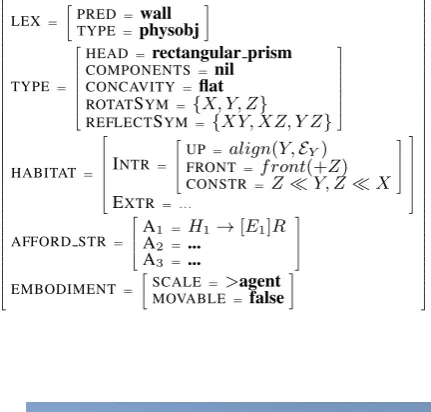
TYPE=physobj
HEAD=rectangular prism COMPONENTS=nil CONCAVITY=flat ROTATSYM={X, Y, Z}
HABITAT=
AFFORD STR=
EMBODIMENT=
SCALE=>agent MOVABLE=false
Figure 1: Wall voxeme instance
While walls and tables are both geometries that have habitats which are upwardly aligned, tables have a head geometry of sheet, which is a special case of
rectangular prismwhere the Y dimension is signifi-cantly less than X or Z. This head is identified in the habitat as the top of the object, facing up.
PRED =table TYPE=physobj
COMPONENTS=surface [1], leg+ CONCAVITY=flat
ROTATSYM={Y}
HABITAT=
AFFORD STR=
EMBODIMENT=
SCALE
=agent MOVABLE=true
Now consider the voxeme forplate. This illustrates how the habitat feeds into activating the affordance structure associ-ated with the object. Namely, if the appropriate conditions are satisfied ([1]), then the telic affordance associated with a plate is activated; every putting ofxonyresults iny hold-ingx.
Figure 2: Table voxeme instance
PRED =plate TYPE =physobj
HEAD=sheet
COMPONENTS=surface, base CONCAVITY=concave ROTATSYM ={Y}
HABITAT=
AFFORD STR=
EMBODIMENT=
SCALE
=<agent MOVABLE=true
Figure 3: Plate voxeme instance
PRED =apple TYPE =physobj
HEAD=ellipsoid [1]
COMPONENTS=fruit [1], stem, leaf CONCAVITY=convex
ROTATSYM ={Y}
HABITAT=
AFFORD STR=
EMBODIMENT=
SCALE
=<agent MOVABLE=true
4.2.
Programs
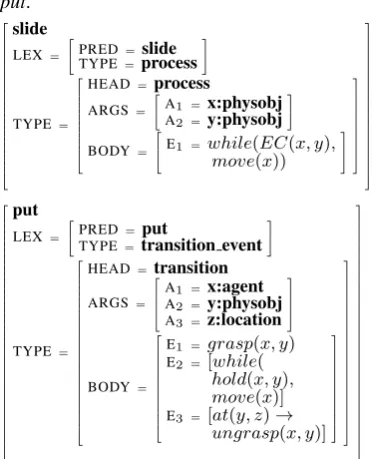
Figure 4: Apple voxeme instance
TYPE=process
HEAD=process ARGS=
TYPE=transition event
HEAD=transition
ARGS=
4.3.
Attributes
Unlike physical objects, which can be associated with spe-cific geometries, attributes are abstract predications over distinct domains, and can only be simulated by application to an element of this domain. Below is an example of the nominal attributive interpretation of the adjective brown, and the ordinal attributive interpretation ofsmall.
PRED =brown
SCALE=nominal ARITY=intransitive ARG=x:physobj
PRED =small
SCALE=ordinal ARITY=transitive ARG=x:physobj
4.4.
Relations
Spatial relations are propositional expressions, contributing configurational information about two or more objects in a state.
PRED =is touching
CLASS=config VALUE=EC
4.5.
Functions
Finally, we illustrate the semantics of spatial functions with top. This applies to an object of dimensionalityn, returning an object of dimensionalityn−1; the top of a cube is a plane; that of a rectangular sheet is a line; and the top of a line is a point.
ARG=x:physobj REFERENT=x→HEAD MAPPING =dimension(n):n-1
ORIENTATION =
SPACE=world AXIS=+Y
5.
Using VoxML for Simulation Modeling of
Language
VoxML treats objects and events in terms of a dynamic event semantics, Dynamic Interval Temporal Logic (DITL) (Pustejovsky and Moszkowicz, 2011). The advantage of adopting a dynamic interpretation of events is that we can map linguistic expressions directly into simulations through an operational semantics (Miller and Charles, 1991; Miller and Johnson-Laird, 1976). Models of processes using up-dating typically make reference to the notion of a state tran-sition (van Benthem, 1991; Harel, 1984). This is done by distinguishing between formulae, φ, and programs, π. A formula is interpreted as a classical propositional expres-sion, with assignment of a truth value in a specific model. For the present discussion, we represent the dynamics of actions in terms of Labeled Transition Systems (LTSs) (van Benthem, 1991).3 An LTS consists of a triple,hS, Act,→i,
where: S is the set of states; Act is a set of actions; and
→is a total transition relation:→⊆S×Act×S. An ac-tion,α ∈ Act, provides the labeling on an arrow, making it explicit what brings about a state-to-state transition. As a shorthand for(e1, α, e2)∈→, we will also usee1
α −→e2.
Simulation generation begins by parsing a natural English sentence, currently using the ClearNLP parser (Choi and McCallum, 2013).4 The dependency parse is then
trans-formed into a predicate-argument set representation using the root of the parse as the main predicate and its de-pendencies as arguments. Each predicate can have more than one argument and arguments may themselves be pred-icates (thus higher-order predpred-icates are permissible). This
3
This is consistent with the approach developed in (Fernando, 2009; Fernando, 2013). This approach to a dynamic interpreta-tion of change in language semantics is also inspired by Steedman (2002).
4
predicate-argument set formula is then evaluated from the innermost first order predicates outward until a single first-order representation is reached.
Figure 5: Dependency parse
1.pred:=put(x,y)
2.x:=apple
3.y:=on(z)
4.z:=plate put(apple,on(plate))
Figure 6: Transformation to logical form
put(apple,<1, 2.3, -0.8>)
Figure 7: “on(plate)” evaluates to coordinates
The evaluation of predicates entails the composition of the voxemes involved. Since we allow for program voxemes (verbs), logical type voxemes (relations, attributes, func-tions) and object voxemes (nominals), evaluation involves executing a snippet of code that operationalizes a program voxeme using the geometric and VoxML-encoded seman-tic information from the voxeme(s) indicated by the input predicate’s argument(s).
In the example given above, the predicateon(plate)is eval-uated to a specific location that satisfies the constraint de-noted by “on the plate”, using information about theplate object, specifically its dimensions and concavity. The pro-gram put can then be realized as a DITL program that moves the objectappletoward that location until the apple’s location and the location evaluated foron(plate)are equal, and executed as a simple state transition ¬φ
e1
α −→ φ
e2
.
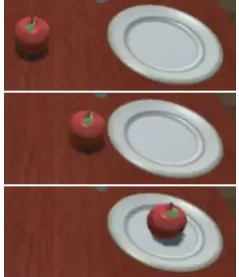
Given a 3D scene that contains voxemes for all nominals referred to in the text, the program can be operationalized in code and the state transition can be executed over the geometries visualized in 3D space. We use an updated ver-sion of the the simulator built for (Pustejovsky and Krish-naswamy, 2014) and the C# language to generate visualiza-tions like that shown in Figure 9 below.
6.
Conclusion
In this paper we have outlined a specification to represent semantic knowledge of real-world objects represented as three-dimensional models. We use a combination of pa-rameters that can be determined from the object’s geomet-rical properties as well as lexical information from natural language, with methods of correlating the two where ap-plicable. This information allows for the visualization and simulation software to fill in information missing from the natural language input and allows the software to render a
put(obj,y)
loc(obj) := x, target(obj) := y; b := x;
(x := w; x6=w; d(b,x)<d(b,w), d(b,y)>d(y,w)+
Figure 8: DITL expressions forput(obj,y).
Figure 9: Program is executed in automatically generated rendering
functional visualization of programs being run over objects in a robust and extensible way. Currently we have a voxi-con voxi-containing 500 object (noun) voxemes and 10 program (verb) voxemes.
As our library of available voxemes continues to grow the specification elements may as well, allowing us to opera-tionalize a larger library of various and more complicated programs, and to compose complex behaviors out of sim-pler ones. The voxeme library and visualization software will be deployed at http://www.voxicon.net. There users may find the current library of voxemes and conduct vi-sualizations of available behaviors driven by VoxML after parsing and interpretation.
7.
Acknowledgements
8.
Bibliographical References
Brutzman, D. and Daly, L. (2010). X3D: extensible 3D graphics for Web authors. Morgan Kaufmann.
Bunt, H. (2010). A methodology for designing semantic annotation languages exploiting syntactic-semantic iso-morphisms. InProceedings of ICGL 2010, Second Inter-national Conference on Global Interoperability for Lan-guage Resources.
Carson, G. S., Puk, R. F., and Carey, R. (1999). Develop-ing the vrml 97 international standard. Computer Graph-ics and Applications, IEEE, 19(2):52–58.
Chang, A., Monroe, W., Savva, M., Potts, C., and Manning, C. D. (2015). Text to 3d scene generation with rich lexi-cal grounding. arXiv preprint arXiv:1505.06289. Choi, J. D. and McCallum, A. (2013). Transition-based
dependency parsing with selectional branching. InACL (1), pages 1052–1062.
Coyne, B. and Sproat, R. (2001). Wordseye: an automatic text-to-scene conversion system. InProceedings of the 28th annual conference on Computer graphics and in-teractive techniques, pages 487–496. ACM.
Dobnik, S. and Cooper, R. (2013). Spatial descriptions in type theory with records. InProceedings of IWCS 2013 Workshop on Computational Models of Spatial Lan-guage Interpretation and Generation (CoSLI-3). Cite-seer.
Dobnik, S., Cooper, R., and Larsson, S. (2013). Mod-elling language, action, and perception in type theory with records. InConstraint Solving and Language Pro-cessing, pages 70–91. Springer.
Fernando, T. (2009). Situations in ltl as strings. Informa-tion and ComputaInforma-tion, 207(10):980–999.
Fernando, T. (2013). Segmenting temporal intervals for tense and aspect. InThe 13th Meeting on the Mathemat-ics of Language, page 30.
Giambruno, M. (2002). 3D graphics and animation. New Riders Publishing.
Gibson, J. J. (1977). The theory of affordances. Perceiv-ing, actPerceiv-ing, and knowing: Toward an ecological psychol-ogy, pages 67–82.
Gibson, J. J. (1979). The ecological approach to visual perception: classic edition. Psychology Press.
Goebel, P. M. and Vincze, M. (2007). A cognitive model-ing approach for the semantic aggregation of object pro-totypes from geometric primitives: toward understand-ing implicit object topology. InAdvanced Concepts for Intelligent Vision Systems, pages 84–96. Springer. Goldstone, W. (2009). Unity Game Development
Essen-tials. Packt Publishing Ltd.
Gr¨unbaum, B. (2003). Are your polyhedra the same as my polyhedra? In Discrete and Computational Geometry, pages 461–488. Springer.
Harel, D. (1984). Dynamic logic. In M. Gabbay et al., ed-itors,Handbook of Philosophical Logic, Volume II: Ex-tensions of Classical Logic, page 497?604. Reidel. Ide, N. and Romary, L. (2004). International standard for a
linguistic annotation framework. Natural Language En-gineering, 10(3-4):211–225.
Luce, D., Krantz, D., Suppes, P., and Tversky, A. (1990).
Foundations of measurement, vol. iii: Representation, axiomatization, and invariance.
McDonald, D. and Pustejovsky, J. (2014). On the represen-tation of inferences and their lexicalization. InAdvances in Cognitive Systems, volume 3.
Miller, G. and Charles, W. (1991). Contextual correlates of semantic similarity. Language and Cognitive Processes, 6(1):1–28.
Miller, G. A. and Johnson-Laird, P. N. (1976). Language and perception. Belknap Press.
Parisi, A. and Pesce, M. (1994). Virtual reality markup language (vrml).URL: http://www. wired. com/vrml. Pustejovsky, J. and Krishnaswamy, N. (2014). Generating
simulations of motion events from verbal descriptions. Lexical and Computational Semantics (* SEM 2014), page 99.
Pustejovsky, J. and Moszkowicz, J. (2011). The qualita-tive spatial dynamics of motion. The Journal of Spatial Cognition and Computation.
Pustejovsky, J., Knippen, R., Littman, J., and Saur´ı, R. (2005). Temporal and event information in natu-ral language text. Language Resources and Evaluation, 39:123–164, May.
Pustejovsky, J., Lee, K., Bunt, H., and Romary, L. (2010). Iso-timeml: A standard for annotating temporal informa-tion in language. InProceedings of LREC, pages 394– 397.
Pustejovsky, J. (1995). The Generative Lexicon. Bradford Book. Mit Press.
Pustejovsky, J. (2013). Dynamic event structure and habitat theory. In Proceedings of the 6th International Conference on Generative Approaches to the Lexicon (GL2013), pages 1–10. ACL.
Randell, D., Cui, Z., and Cohn, A. (1992). A spatial logic based on regions and connections. In Morgan Kauf-mann, editor, Proceedings of the 3rd Internation Con-ference on Knowledge Representation and REasoning, pages 165–176, San Mateo.
Siskind, J. M. (2001). Grounding the lexical semantics of verbs in visual perception using force dynamics and event logic. J. Artif. Intell. Res.(JAIR), 15:31–90. Steedman, M. (2002). Plans, affordances, and
combina-tory grammar. Linguistics and Philosophy, 25(5-6):723– 753.
Stevens, S. S. (1946). On the theory of scales of measure-ment.