Gesture Recognition System Using TTS
Engine
Aishwarya Ranawade 1, Priyanka Salunkhe 2, Saurabhkumar Sigh 3, Prof. M.N.Khan 4
Student, Dept. of E&TC, IS&M SOT Nande Pune, Savitribai Phule Pune University, Pune, India1,2,3
Professor, Dept. of E&TC, IS&M SOT Nande Pune, Savitribai Phule Pune University, Pune, India4
ABSTRACT: Gesture recognition system is developed for deaf and dump people those who can't able to listen and see as like a normal human being. It based on the American Sign Language. The idea behind this system is to understand sign language so that deaf and dump people can communicate with the outside world without any interpreter. In this proposed system the gestures are capture using web camera and then send to raspberry pi module. Capturing the external image and identify the gestures is challenging task, especially when the image is blur. And processing is done in raspberry pi is a fast processing system and the gestures are recognized. And this gesture is converted to text. This text is sent to the smart phone via Bluetooth module. And in smart phone there is one application it will convert text to speech. So that gesture is converted to audio.
KEYWORDS: OpenCV, Payton, gesture detection and recognition, Smartphone, information retrieval in text, TTS engine.
I. INTRODUCTION
Sign language is the only medium of communication for physically impaired people like deaf and dump. This people are depending on sign language translator to express their ideas to other people. This causes isolation of these people in society, they cannot able to convey the messages properly to normal people and sometimes there are changes of misunderstandings in understanding their languages. so the idea came in our mind to design and development such system which will convert sign language to the normal people understandable language using smart phone so they those people who are deaf and dump they can able to express their thoughts. So that they also become as like Stephen Hawking who lost his voice in 1985 and still because of the system like these he can able to express his thought. Normal people think that deaf and dump live in an empty world which blocks many doors in their life and these thoughts affect badly on the deaf and dump and make them in an isolation state from the society. So we have proposed a method that makes the use of hand gestures for recognition of Indian Sign Language.
A system is designed and developed for deaf and dump people. The primary function of this system is to recognize hand gesture. Here, gesture image is taken from Web camera and image will be processed in Raspberry pi and after identifying the gestures, according to the result, it will displayed on LCD and send it to smart phone via Bluetooth module. Smart phone speaker that will provide audio output for gesture identified. The secondary functions of this system is to operate the smart phone’s speaker according to recognize hand gesture.
The work in this paper is divided in three stages:- 1. Input stage
2. Main Processing stage 3. Output stage
The project bridges the gap between normal people and physically impaired peoples. It uses hand gestures as an input. This system can able to recognise any gestures that the deaf and dump people wants to tell.
Computer vision:
Computer vision is used to make use of real time camera gesture images as a physical objects and using that it will recognised a meaningful description of gesture.
Following are main objectives of computer vision:
1. Segmentation: Segmentation is breaking images and video into meaningful segments. 2. Reorganization: Recognizing objects in a scene
II. RELATEDWORK
Sometimes deaf and dump people wants to convey some important messages but interpreter is not available at that time then may causes problem. Detecting and recognizing these gestures can be very important.
Figure. 1 Flow diagram of gesture recognition algorithm
Our system aim is to recognise gesture. This is done by the algorithm. Fig. 1 shows the flow diagram of gesture recognition algorithm. The algorithm steps are summarized as follows.
1. First step is capturing images of hand gestures using camera because our main region of intrest is hand region. 2. Pre-processing is the main role in gesture recognition because it used to remove the background and also used
to reduce the noise.
I. We know that the capture image is in the firm of RGB but the processing in colour format is complicated so we convert RGB image into gray scale image and the image is in the form of pixel.
II. And then to get an accurate image pixels it is necessary to remove noise. For removing noise bluring of an image is to done on the optained gray scale image. Here the median filter is used to get noise free binary representation of an image. In median filtering each pixel in an image is replaced by its median of neighbouring filter.
III. Then thresholding is done to remove background from image. It is used to identify particular object from image. But in thresholding we have to be very careful while selecting a threshold so as to determine a pixel as object or background. In thresholding if the intensity of particular pixel in an image is higher than defined threshold, then pixel is set to some maximum value otherwise that particular pixel is set to zero. A threshold changing intensity of pixels into a binary image with maximum value 255 and minimum value 0. Here 255 means pure white and 0 corresponds to black. The background subtracted image will immediately converted to new background.
Let us consider a simple threshold of 100 is experimented to work well If image(i,j) >10 ;
Then image(i,j)=255; Else image(i,j)==0; Capturing image using web camera Pre-processing and segmentation Contour extraction & convex hull Feature extraction & sign detection
Smart phone Bluetooth module
3. Then contour extraction has to done. It means detecting edges. It is done by canny edge detection and using OpenCV function i.e findContours and drawContours. Contours are obtained from edges and we need to connect hat edges to make closed curves. After this the image is treated as a set of points.
Finding Convexity Defects Convexity defects are valley points. In particular, convexity defects are sequences of contour points between two consecutive contour vertices on the contour Hull. Fig. 4.5a , 4.5b , 4.5c , 4.5d , 4.5e shows the convexity defects in a palm , open thumb , V shaped fingers , a fist , and in three fingers .These convexity defects are very useful in providing information about the location and state of the fingers . In the figures below, the pure white markers are the convexity defects or the valley points and the dark markers are the start and end points respectively.
4. We will find out number of convex points in contours and then we will find furthest away from each convex vertex i.e. convexity defects and then we will filter out convexity defect which is not relevant.
As shown in Figure.3 all the convexity defects do not provide useful information. Most of the defects are formed due to distorted contours. Each defect has a start and an end point. They marked as special defects, as this convexity defect is required at later stages. It is used to find out the angle between the lines from each defect to its neighbouring convex vertices.
Here the angle between first-second fingers is 20 to 40 and second-third finger is between 40 to 60 and so on. If three fingers are present then the addition of the angle is take place i.e. Angle between First-second finger and then it will add with angle between second-third fingers.
5. Then Last stage is identification of the hand gesture this is done by comparing the calculated angle with the range of angle specified in the program and if it is lies in the particular range then the approximated gestures recognised and identified.
Figure. 2 Convexity Defect And angle between neighbouring convex polygon vertices
Let us consider a simple Example of recognition of Sign ‘A,B’ is as follow If angle between two neighbouring convex polygon vertices is ‘0’ ; Then Sign is ‘A’;
If angle between two neighbouring convex polygon vertices is < = 40 > 20 ; Then Sign is ‘B’.
After applying all above steps, we get a meaning sign identification from gesture image that contains only sign information.
III.SYSTEM DESCRIPTION
1. Capturing image using web camera: Camera is used to capture images of hand because our main region of interest is the hand region.
2. Raspberry Pi B2 module: Image processing will be taken place in raspberry pi and the gesture will be successfully recognised. And it is connected to Bluetooth module.
3. LCD Display: LCD display used here is of 16*2 LCD display, is the best choice regarding power consumption, startup time delay and price. It is used to display recognize gestures character
4. Bluetooth module: Bluetooth module with serial port, which can configure as either master or slave is used. Range for the selected module is of 10 to 15 meters. Module is interfaced to the Raspberry pi to transfer the characters to the Smart Phone.
5. Smart phone: Smartphone used here is any Android mobile phone in that we have to design one android application i.e. TTS engine meaning text to speech converter. With the help this Application smart phone converts the text message into the speech. Authorized person can insert any message or text then this application will take that message as a input and provide speech as a output.
IV.EXPERIMENTAL RESULTS
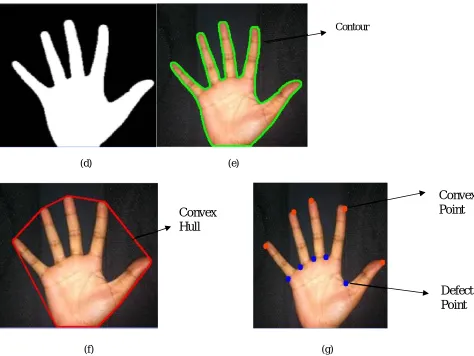
This section presents of results of the segmentation and pre-processing steps of above gesture recognition algorithm in the Figure. 4.a to 4.d Here the algorithm is applied to the colour images taken from camera; the original colour image is shown in the figure 4.a that includes the hand gesture. Then as we know that the processing on RGB image is quite difficult as compare to the gray scale image, so in Figure.4.b it shows the result after RGB to gray conversion i.e. Gray scale image. In Figure.4.c, the result of image blurring is shown. The image blurring operation on image is done to reduce the noise from gray scale image is explain in above algorithm. After this thresholding operation is taken placed, this operation is used to remove background and extract particular information, is shown in Figure.4.d The main task of contour extraction i.e. edge detection is done by using OpenCV function and the result of contour extraction is shown in Figure.4.e
In the next part of algorithm to recognise the particular gesture we used convex hull to find out the finger tips. Convex hull is nothing but the set of convex point which enclosed the full hand region. It is shown in the Figure.4.f, that the red line joining the hand is convex hull.
As we know that to calculate angle between two polygon vertices, we calculate each convexity defect point. And according to the each defect point we will filter out the non relevant convex defect point. This convex point is used to find out the angle between two neighbouring convex defect point or vertices. Result of Convex point and the defect point is shown in Figure.4.g
And the last stage is the gesture identification stage, In this stage the calculated angle is compare by using program and if it is lies in particular range then the gesture is recognised and identified.
(c)
Figure. 4 (a) Original image (b) Gray scale (c) Blur image (d) Threshold image (e) Contour (f) Convex Hull (g) Convexity defect
V. CONCLUSION
We have implemented gesture recognition system for deaf and dump people. Our algorithm successfully detects the sign or data from the gesture image. We have applied our algorithm on many images and found that it successfully detect the sign from gesture.
REFERENCES
[1] Soowoong Kim, Jae-Young Sim, And Seungjoon Yang "Vision-Based Cleaning Area Control For Cleaning Robots", IEEE Vol. 58, No. 2, May 2012
[2] Nasser H. Dardas And Nicolas D. Georganas "Real-Time Hand Gesture Detection And Recognition Using Bag-Of-Features And Support Vector Machine Techniques", IEEE Vol. 60, No. 11, November 2011
[3] Anupam Agrawal, Rohit Raj and Shubha Porwal "Vision-based Multimodal Human-Computer Interaction using Hand and Head Gestures" IEEE Conference on Information and Communication Technologies ICT 2013
[4] Ankita Saxena,Deepak Kumar Jain,Ananya Singhal, “Hand Gesture Recognition using an Android Device”, Fourth International Conference on Communication Systems and Network Technologies,2014
[5] Guobo Xie and Wen Lu, “Image Edge Detection Based On Opencv”, International Journal of Electronics and Electrical Engineering Vol. 1, No. 2, June 2013
[6] Ruchi Manish Gurav, Premanand K. Kadbe, “Real time Finger Tracking and Contour Detection for Gesture Recognition using OpenCV”, International Conference on Industrial Instrumentation and Control (ICIC) College of Engineering Pune, India. May 28-30, 2015
Convex
Point
Defect
Point
Convex
Hull
(d) (e)
Contour
[7] Rajat Shrivastava, “A Hidden Markov Model based Dynamic Hand Gesture Recognition System using OpenCV”, 3rd IEEE InternationalAdvanceComputing Conference (IACC), 2013
[8] Ruchi Manish Gurav, Premanand K. Kadbe, “Implementation of efficient algorithm for human hand gesture identification”, IEEE, 2011 [9] A. Sharmila Konwar, B. Sagarika Borah, C. Dr.T.Tuithung, “An American Sign Language Detection System using HSV Color Model and
Edge Detection”, International Conference on Communication and Signal Processing, April 3-5, 2014
[10] Gary Bradski and Adrian Kaehler, “Learning OpenCV: Computer Vision with the OpenCV Library”, O’Reilly Publications. [11] The OpenCV Tutorials, Release 2.4.6.0.