
R E S E A R C H
Open Access
Fast parametric reciprocal-orthogonal jacket
transforms
Moon Ho Lee
1*, Xiao-Dong Zhang
2and Xueqin Jiang
3Abstract
In this paper, we propose a new construction method for a novel class of parametric reciprocal-orthogonal jacket transform (PROJT) having94Nparameters for a sequence lengthN=2r+1that is a power of two, based on the reciprocal-orthogonal parametric (ROP) transform and block diagonal matrices. It is shown that the inverse transform of the proposed PROJT is conveniently obtained by the reciprocal of each elements of the forward matrix and transpose operation. What is more, an efficient algorithm for the computation of the PROJT has been developed with the aid of the matrix decomposition and Kronecker product. Further, the experiments show that the independent parameters in the proposed PROJT are successfully used as additional secret keys for image encryption, watermarking, and error-correcting codes.
1 Introduction
There are a variety of discrete signal orthogonal trans-forms [1-3], such as discrete Fourier transform (DFT), discrete Hartley transform (DHT), Walsh-Hadamard transform (WHT), Haar transform, slant transform, and discrete cosine transform (DCT), which have various application in digital signal processing, image compress-ing video processcompress-ing, and pattern recognition. A lot of services of these transforms are mainly due to their prac-tical usefulness and the existence of fast and efficient algorithms for their computation. However, since each of the well-known transforms [4-9], for example DFT, DHT, WHT, DCT, etc., is fixed without any parameters, each single transform only deals with its special area of applications. In order to best match the given input sig-nal class or the application, many parametric transforms [10-15] with matrices associating a set of parameters are presented to fit the desirable signal by choosing appropri-ate parameters. An advantage of parametric transforms is the possibility to implement large families of transforms with a unified software/hardware, which is efficient for every representative of the family and may be tuned to the desired transforms [16].
*Correspondence: [email protected]
1Division of Electronics and Information Engineering, Chonbuk National University, Jeonju 561-756, Korea
Full list of author information is available at the end of the article
On the other hand, the DCT and the Karhunen-Loeve transform (KLT) have better compaction performance than the slant transform [10,11]. Both the DCT and KLT have more computational complexity than the slant transform. Therefore, the need arises for slant transform improvement schemes that yield performance comparable to that of the KLT and DCT without incurring their com-putational complexity [10-20]. Therefore, various general-izations of the WHTs and DFTs have been attempted. Lee [6] proposed a center weight Hadamard transform with matrix of order 4. However, the proposed jacket transform has only three parameters at most. Recently, Bouguezel et al. [13] proposed a new class of reciprocal-orthogonal parametric (ROP) transforms, which have 32N indepen-dent parameters for an input data vector of lengthN. Fur-ther, they showed that the inverse of the ROP transforms and matrices is easily obtained and has fast algorithm. Lee et al. [18] proposed a novel class of element-wise inverse jacket transforms (EIJTs) having 2N− 1 parameters for an input data vector of length N = 3 · 2r. Moreover, Bouguezel et al. [14] proposed new parametric discrete Fourier transforms, Hartley transforms, and algorithms for fast computation. Ding et al. [15] proposed arbitrary-length Walsh-Jacket transforms. Agaian et al. [11] devel-oped a class of generalized parametric Slant-Hadamard transforms with fast algorithm, whose performance is bet-ter than the classical one-transform-based model. Chen et al. [21] proposed a fast cocyclic jacket transform
over the complex number field. Moreover, many other transforms based on complex field and finite fields were proposed [19,20,22].
In recent years, enormous parametric transforms cor-responding to the existing determined transforms have been developed. It has been shown that parametric trans-forms can have more flexibility and a wider range of applications compared to its original transform. For exam-ple, the independent parameters of the fractional dis-crete transform are used as an additional secret key for watermarking [5], encryption [4,17], error-correcting codes, etc. From this point of view, parametric trans-forms with matrices described in a unified form and based on a set of parameters become more and more important.
The main purpose of this paper is to propose a fast para-metric reciprocal-orthogonal jacket transform (PROJT) having94Nparameters for an input data vectorN=2r+1,
which is reciprocal-orthogonal and has a fast and efficient algorithm with special structure. In addition, this pro-posed transform has more parameters than some known proposed transforms. A lot of simulations show that the independent parameters in the PROJT are able to be used as additional secret keys for image encryption. The rest of this paper is organized as follows. In Section 2, jacket matrices and some preliminaries are recalled. In Section 3, the PROJT is proposed and developed. In Section 4, an efficient algorithm with special structure is developed for the proposed PROJT having many param-eters. Examples and computer simulations are given in Section 5. We draw some conclusions and remarks in Section 6.
2 Preliminaries and notations
In this section, we introduce some definitions and nota-tions. For anN ×N matrix [J]N, theN×N associated matrix [J]RTN is obtained from matrix [J]N by taking the reciprocal of each entry and exchanging its row and col-umn indices. In other words, the (k,i) entry of [J]RTN is equal to the reciprocal of the element in the(i,k)position in [J]N. We now recall the definition of a jacket matrix which is reciprocal-orthogonal in [7].
Definition 2.1. An N×N complex matrix[J]N=(ji,k)is called a jacket matrix, if[J]Nis invertible and the element in the entries(i,k)of its inverse matrix is equal to the prod-uct of N1 and the inverse of the element in the entries(k,i)
For example, the well-known Hadamard matrices are jacket matrices. A 2×2 jacket matrix is as follows:
[J]2=
a b
c −bca , (3)
wherea,b,care nonzero complex numbers, since
[J]2[J]RT2 =
Clearly, this 2×2 jacket matrix has three parameters. The proposed jacket matrix of order 4 [6]
[J]4=
generalization of the 4 × 4 center-weighted Hadamard matrix
with only one nonzero complex parameter and [CWH]4[CWH]RT4 = 4[I]4. Bouguezel et al. [13]
pro-posed the following ROP transform of order 8 that is (7) and [P]8[P]RT8 =8[I]8.
3 Proposed PROJT with many parameters
Before proposing a desired PROJT, we also need to intro-duce some notations and definitions. For a given integer N=2r+1, any integer 0≤n≤N−1 can be written as
n=nr2r+nr2r−1+ · · · +n12+n0 (8)
whereniis 0 or 1 for 0≤i≤r+1. For two integersnand k=kr2r+kr−12r−1+ · · · +k12+k0, we define
Further, we denote the two sets as follows:
Se≡
n|0≤n≤N−1, r
i=0
ni is even
and
So≡
n|0≤n≤N−1, r
i=0
ni is odd
.
Moreover, let
p(n)=
0, if n∈Se, 1, if n∈So,
and
n=
0, if n is even, 1, if n is odd.
Let
V(i)=
V0,2i V0,2i+1
V1,2i, V1,2i+1 ,
fori = 0, 1, 2· · ·,N/2−1 = 2r −1, whereV1,2i+1 = −V1,2iV0,2i+1
V0,2i . Therefore, we have
V0,2iV1,2i+1+V0,2i+1V1,2i=0, (9)
wherei = 0, 1,· · ·,N/2−1. Moreover, it is easy to see thatV(0),V(1),· · ·,V(2r−1)are 2×2 jacket matrices, each of which has three independent parameters. Let
α=a0,0,a0,1,· · ·,a0,N/4−1,a0,N/4,· · ·,a0,N/2−1
and
β =a1,0,a1,1,· · ·,a1,N/4−1,a1,N/4,· · ·,a1,N/2−1
where a1,i = a0,Na/0,2−ii−1a1,N/2−i−1 for i = N/4,N/4 +
1,· · ·,N/2−1.
Based on the above two vectors Bouguezel et al. [13] constructed a class of ROP transforms having 34N inde-pendent parameters for a sequence lengthN/2. The ROP transform of a complex input dataX(k)of orderN/2=2r can be stated as follows [13]:
Y(n)= N/2−1
k=0
(−1)<k,n>ap(n),kX(k), (10)
wheren=0, 1,· · ·,N/2−1. Further, they proved that the inverse of the ROP transform by (10) is fastly decoded by
X(k)= 1 N
N/2−1
n=0
(−1)<k,n> ap(n),k
Y(n), (11)
wherek=0, 1,· · ·,N/2−1.
For twoN×N matrices [A]N= (aij)and [B]N= (bij), the Hadamard product [C]N= (cij)of the two matrices
[A] and [B] is defined ascij = aijbijand denoted [C]N= [A]N◦[B]N. For the proposed ROP transform, Bouguezel et al. also gave the method on how to construct the transform matrix associated with the ROP transform. Let [A]N/2be the matrix, whosek−th row equals to thek−th
row of [A]N/2, to beαifp(k) = 0 and to beβ ifp(k) =
1. Moreover, let [H]N/2=[H]2⊗[H]2⊗ · · · ⊗[H]2be the
Hadamard matrix of orderN/2. Then the proposed ROP matrix [P]N/2is just [A]N/2◦[H]N/2. Therefore, it is easy
to see that [P]N/2is orthogonal and
[P]N/2[P]RTN/2=[P]RTN/2[P]N/2=N/2[I]N/2,
where [I]N/2is theN/2×N/2 identity matrix. In other
words, we have the following equation:
N/2−1
s=0
(−1)<k,s>ap(k),s
(−1)<l,s>ap(l),s =
N/2 ifk=l
0 ifk=l , (12)
wherek,l= 0, 1,· · ·,N/2−1. With the above notations and symbols, we are ready to propose a novel class PROJT as follows.
Definition 3.1. A PROJT of a complex sequence X(n)of order N =2r+1is defined as
Y(n)= N−1
i=0
(−1)<n2 , i 2 >a
p(n2 ),2i Vn,iX(i), (13)
n=0, 1,· · ·,N−1,andn2 stands for the largest integer no more thann2.
The PROJT matrix of orderN = 2r+1 have 94N inde-pendent parameters, since there are 34N nonzero inde-pendent parameters a00,· · ·,a0,N/2−1,a1,0,· · ·,aN/4−1
and 32Nindependent parametersV00,· · ·,V0,N,V1,0,· · ·,
V1,N/2−1. It is known that the more independent
param-eters a transform has, the more it has applications. Note that the PROJT has94Nparameters while the ROP has32N parameters, which implies that the PROJT has more appli-cations in watermarking, encryption, and error-correcting codes than the ROP. Further, it can be shown that the inverse transform of the proposed transform is easily obtained and has an efficient algorithm.
Theorem 3.2. The inverse transform of the PROJT defined by (13) is given as follows:
X(i)= 1 N
N−1
n=0
(−1)<2i , n 2 > ap(n
2 ), i 2 Vn,i
Y(n), (14)
Proof. We establish the above theorem by proving that the following equation holds
N−1
Case 2. Next, we consider thatt = n. There are four subcases.
where the last equality follows from (12).
Subcase 2.2:n=2kandt=2l+1. Then
where the last equality follows from (9).
Subcase 2.3n= 2k+1 andt = 2l; andSubcase 2. 4 n=2k+1 andt=2l+1 are similar to Subcase 2.2 and Subcase 2.1. Hence we omitted the detail. Therefore,
where the second last equality follows from (15) andi = 0, 1,· · ·,N−1. Hence we finish our proof.
From the above theorem, the inverse transform of the proposed PROJTs is easily obtained by the reciprocal of the forward matrix. Next, we give the matrix form of the PROJTs. Moreover, this matrix has a simple structure and interesting properties. Assume that the input sequence is theN×1 vectorX=(x(0),· · ·,x(N−1))Tand the output sequence is theN×1 vectorY = (y(0),· · ·,y(N−1))T, whereTdenotes the transpose of a vector or matrix. Then the proposed PROJT and its inverse transform can be presented in terms of the matrix form as follows:
Y =[J]NX
By Theorem 3.2, the inverse matrix [J]−N1of the inverse transform can be obtained from the forward matrix with the two reciprocal-orthogonal and transpose operation. The(k,m)entry of [J]−N1equals to the reciprocal of the
(m,k) entry of the forward matrix [J]N up to a scaling factorN1. Hence the inverse matrix [J]−N1can be obtained by the following operation from the forward matrix [J]N. First, the matrix [J]RN is obtained by taking the recipro-cal of each entry of [J]N. Second, the matrix([J]RN)T is obtained by transposing [J]R
N. Last, [J]−N1is obtained by
In order to understand the proposed PROJT, we give some examples to illustrate how to construct it.
Example 1.ForN = 4 = 21+1andr = 1. Since the
Then, the forward matrix associated with the PROJT is (17).
So the 4×4 forward ROP matrix associated with the ROP transform is
[J]8=
4 Fast and efficient algorithm for the proposed PROJT
In this section, we analyze some properties of the pro-posed PROJT, which are used to present an efficient algorithm for a fast computation of the proposed PROJT by (13) and (14).
In order to give an algorithm, we may rewrite (13) in another form so that we can analyze the PROJT by split-ting the summation in (13) into a sum of two summations and for even and odd indices. For every output vector components we have fast and efficient algorithm for the proposed ROP trans-form. Since the set{0, 1,. . .,N/2−1}can be split into two
The N ×N proposed matrix with the PROJT can be
Then the ROP matrix by the ROP transform [13] can be decomposed to
Hence, the proposed PROJT is as follows:
[W]N=
Therefore, the decomposition of the proposed trans-form is the following:
[W]N =
By the mean of this decomposition of the proposed matrix, we are able to get a fast and efficient algorithm.
Example 3.LetN=2r+1=4. Then
Hence we have the following equation (22):
Example 5.LetN=16=2r+1. Let
Hence we have the equation (23).
[W]16= matrix whose diagonal entries are 1,a1,0
a0,0, 1,
an N × N diagonal matrix whose diagonal entries are V0,0,V0,1,V0,2,. . .,V1,N−2,V0,N−1.
Let [Q](N4) be the N×N matrix whose entries (0, 0),
(1, 2),(3, 6),. . ., (i, 2i),. . .,(N/2 − 1,N − 2),(N/2, 1),
(N/2+1, 3),. . .,(N/2+i, 2i+1),. . .,(N−1,N−1)are 1 and the other entries are 0. Then
[P]N/2⊗[I]2=([Q](N4))T
[I]2⊗[P]N/2
[Q](N4).
Hence the fast decomposed factor of the proposed PROJT can be presented as (24).
[W]N =
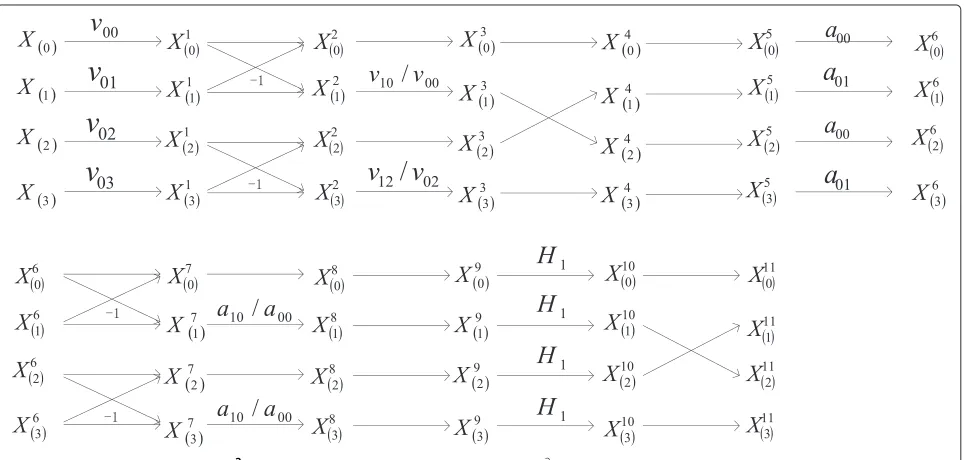
Moreover, the fast flows of orders 4 and 8 are presented in Figures 1 and 2.
Now we compute the complexity of this decomposed factor of the proposed PROJT. Since the permutation matrices do not need any additions and multiplications, we do not consider permutations in computing the
Table 1 Computation complexity of additions and multiplications in conventional DFT [1], reciprocal-orthogonal parametric [10], EIJT [18]N=3×2r, and
proposed PROJT withN=2r+1matrix size, wherer≥2
Conventional ROP [13] EIJT [18] Proposed DFT [1] N=2r+1 N=3×2r N=2r+1
Parameters 1 (fixed) 3N/2 2N−1 9
4N
Additions (N−1)N Nlog2N 3Nlog2N N+Nlog2N
Multiplications N2 3N/2 Nlog
2N 3N
complex of the proposed PROJT. Firstly, for the diagonal matrix [D](N1), there are needs forNmultiplications. Since [H]2needs 2 additions, [I]N/2⊗[H]2needsN/2×2=N
additions. Note that there are N/2 main diagonal ele-ments which may be equal to 1. Then there are needs for N/2 multiplications for the the diagonal matrix [D](N2). Hence there are needs forN+N/2 multiplications and N additions for the matrix [D](N2)([I]N/2⊗[H]2)[D](N1). Since [D](N3)/2 is the N/2× N/2 diagonal matrix, there
are needs forN/2 multiplications. However [D](N4/)2is the N/2 ×N/2 diagonal matrix in which there are at least N/4 1’s on the main diagonal, so onlyN/4 multiplications are needed. Clearly,([I]N/4⊗[H]2needs 2×N/4=N/2
additions. [I]2⊗[H]N/4 needs 2 × (N/4)log2(N/4)
additions. Therefore,[Q](N3/)2 [I]2⊗[H]N/4
[Q](N2)/2[D](N4/)2×
[I]N/4⊗[H]2
[D](N3)/2[Q](N1/)2 needsN/2+N/4=3N/4 multiplications and N/4 × 2 + 2N/4 log2
(N/4)=N/2 log2N−N/2 additions. Hence
[Q](N4)
T
[I]2⊗
[Q](N3/)2[I]2⊗[H]N/4
[Q]N(2/)2[D](N4/)2×[I]N/4⊗
[H]2)[D](N3/)2[Q]( 1)
N/2
[Q](N4) needs 3N/2 multipli-cations and Nlog2N − N additions. In sum, the decomposed factor of the proposed PROJT needs 3N/2+ 3N/2 = 3N multiplication and 2N +Nlog2N −N = NlogN+N addition operations. Table 1 shows that the complexity of the proposed PROJT is better than conven-tional DFT, but a litter less than the ROP. However, the PROJT has a larger number of parameters than the ROP.
Figure 3The PROJT encryption and decryption.(a)Original image.(b)Encrypted image.(c)Decrypted image with the correct parameters.
5 Simulations and discussion
In all of the following computer experiments, we use the proposed PROJT and inverse PROJT for encryptions and decryptions. Let V0,2i, V0,2i+1, V1,2i, a0,i for i = 0, 1,. . .,N/2 −1 and a1,j forj = 0, 1,N/4− 1 denote the 2+14N independent parameters employed in the encryption process. Let V0,2 i, V0,2 i+1, V1,2 i, a0,i fori = 0, 1,. . .,N/2−1 anda1,jforj=0, 1,N/4−1 denote the
2+ 14N parameters employed in the decryption pro-cess. Figure 3a shows the 512×512 original image to be encrypted, whose elements are integers in the range 0-255. Figure 3b shows the magnitude image of its encryption output using the proposed PROJT. Then, we use the cor-rect parameter vectors for decryption, and the decrypted output is shown in Figure 3c, which is the same as the orig-inal image. To give a decryption example of the previous encrypted image with one single wrong parameter of the
2+ 14Nindependent parameters, we use
V0,2 i = V0,2i+δmod 255, V0,2 i+1 = V0,2i+1,
V1,2 i = V1,2i,
a0,i = a0,i, (25)
wherei=0, 1,. . .,N/2−1 and
a1,j=a1,j, (26)
wherej = 0, 1,N/4−1. Errorδ can be any integer uni-formly distributed in the range 1-255. Figure 3d shows the decrypted image with the minimized errorδ = 1, which shows that the original image is successfully protected.
Therefore, to successfully decrypt the 512×512 (N = 512) image, whose elements are integers in the range 0-255, we need to know every parameter ofV0,2i, V0,2i+1,
V1,2i, a0,i for i = 0, 1,. . .,N/2 − 1 and a1,j for j = 0, 1,N/4−1. Intuitively, this is also true for N > 512. Assume that the errors inV0,2 i,V0,2 i+1,V1,2 i,a0,ifori = 0, 1,. . .,N/2−1 anda1,j forj = 0, 1,N/4−1 are uni-formly distributed. Then, the probability of a successful decryption without knowing all the 2+14N = 1152 parameters correctly is 1/2561152.
6 Conclusions
In this paper, we have proposed a new class of PROJT of orderN=2r+1independent 3Nparameters. The PROJT is based on the the proposed ROP transform [13], block diagonal matrices, and permutations. On one hand, the critical usefulness of the PROJT generalized the proposed ROP transform, which is a special case of the the PROJT. On the other hand, the PROJT has more parameters than the ROP transform. What is more important, some nice
properties are presented, in particular, the inverse trans-form is fastly obtained by the reciprocal and transpose operations. With the aid of matrix decomposition and Kronecker product approach, a fast and efficient algo-rithm for computing the proposed PROJT is obtained. In fact, we show that the PROJT has 3N multiplica-tions and N +Nlog2N addition operations. Therefore, the proposed PROJT can be employed in watermaking and encryption where the independent parameters can be used as an additional secret key.
Competing interests
The authors declare that they have no competing interests.
Acknowledgements
The authors would like to thank the reviewers for their insightful suggestions and comments for improving the manuscript.
This work was supported by the MEST 2012-002521, National Research Foundation, Korea. It was also supported partly by the National Nature Science Foundation of China (11271256, 61201249) and the DHU Distinguished Young Professor Program (14D210402).
Author details
1Division of Electronics and Information Engineering, Chonbuk National
University, Jeonju 561-756, Korea.2Department of Mathematics, MOE-LSC,
Shanghai Jiao Tong University, Shanghai 200240, China.3School of Information
Science and Technology, Donghua University, Shanghai 201620, China.
Received: 14 March 2014 Accepted: 10 September 2014 Published: 29 September 2014
References
1. N Ahmed, KR Rao,Orthogonal Transforms for Digital Signal Processing. (Springer, New York, 1975)
2. RK Yarlagadda, JE Hershey,Hadamard Matrix Analysis and Synthesis With Applications to Communications Signal/Image Processing.
(Kluwer Academic Publishers, Norwell, MA, 1997) 3. KJ Horadam,Hadamard Matrices and Their Applications.
(Princeton University Press, Princeton, NJ, 2006)
4. S-C Pei, W-L Hsue, The multiple-parameter discrete fractional Fourier transform. IEEE Signal Process. Lett.13(6), 329–332 (2006)
5. C-C Tseng, Eigenvalues and eigenvectors of generalized DFT, generalized DHT, DCT-IV and DST-IV matrices. IEEE Signal Process.50(4), 866–877 (2002)
6. MH Lee, The center weighted Hadamard transform. IEEE Trans. Circuits Syst.36(9), 1247–1249 (1989)
7. MH Lee, A new reverse jacket transform and its fast algorithm. IEEE Trans. Circ. Syst. II.47(1), 39–47 (2000)
8. JJ Ding, SC Pei, PH Wu, Jacket Haar, Transform, inCircuits and Systems (ISCAS) 2011 IEEE International Symposium, (15-18 May 2011), pp. 1520–1523
9. MH Lee, X-D Zhang, Fast block center weighted Hadamard transform. IEEE Trans. Circuits Syst. I: Reg. Papers.54(12), 2741–2745 (2007) 10. S Agaian, K Tourshan, JP Noonan, Parametric Slant-Hadamard transforms
with applications. IEEE Signal Process. Lett.9(11), 375–377 (2002) 11. S Agaian, K Tourshan, JP Noonan, Generalized parametric Slant-Hadamard
transforms with applications. Signal Process. Lett.84(8), 1299–1306 (2004) 12. S Bouguezel, A reciprocal-orthogonal parametric transform and its fast
algorithm. IEEE Signal Process. Lett.19(11), 769–772 (2012) 13. S Bouguezel, MO Ahmad, MNS Swamy, A new class of
reciprocal-orthogonal parametric transforms. IEEE Trans. Circuits Syst. I, Reg. Papers.56(4), 795–804 (2009)
14. S Bouguezel, MO Ahmad, MNS Swamy, New parametric discrete Fourier and Hartley transforms, and algorithms for fast computation. IEEE Trans. Circuits Syst. I, Reg. Papers.58(3), 562–575 (2011)
15. JJ Ding, S-C Pei, P-H Wu, Arbitrary-length Walsh-Jacket transforms, in
16. S Minasyan, J Astola, D Guevorkian, An image compression scheme based on parametric, Haar-like transform, inCircuits and Systems 2005. ISCAS 2005. IEEE International Symposium, (23-26 May 2005), pp. 2088–2091 17. JM Vilardy, JE Calderon, CO Torres, L Mattos, Digital images phase
encryption using fractional Fourier transform, inElectronics, Robotics and Automotive Mechanics Conference, vol. 1, (26-29 Sept 2006), pp. 15–18 18. MH Lee, X-D Zhang, W Song, X-G Xia, Fast reciprocal jacket transform with
many parameters. IEEE Trans. Circuits Syst. I, Reg. Papers.59(7), 1472–1481 (2012)
19. MH Lee, A new reverse, Jacket transform based on Hadamard matrix, in
IEEE International Symposium on Information Theory(Sorrento, Italy, 25-30 June 2000), p. 471
20. MH Lee, YL Borissov, On Jacket transforms over finite fields, inIEEE International Symposium on Information Theory(Seoul, Korea, 28 June 2009-3 July 2009), pp. 2803–2807
21. Z Chen, MH Lee, G Zeng, Fast cocylic jacket transform. IEEE Trans. Signal Process.56(5), 2143–2148 (2008)
22. MH Lee,Jacket Matrices: Construction and its Applications for Fast Cooperative Wireless Signal Processing. (Lambert Academic Publishing, Lambert, Germany, 2012)
doi:10.1186/1687-6180-2014-149
Cite this article as:Leeet al.:Fast parametric reciprocal-orthogonal jacket transforms.EURASIP Journal on Advances in Signal Processing20142014:149.
Submit your manuscript to a
journal and benefi t from:
7Convenient online submission
7 Rigorous peer review
7Immediate publication on acceptance
7 Open access: articles freely available online
7High visibility within the fi eld
7 Retaining the copyright to your article

![Table 1 Computation complexity of additions andmultiplications in conventional DFT [1], reciprocal-orthogonal parametric [10], EIJT [18] N = 3 × 2r, andproposed PROJT with N = 2r+1 matrix size, where r ≥ 2](https://thumb-us.123doks.com/thumbv2/123dok_us/894928.1107783/10.595.55.539.369.701/computation-complexity-andmultiplications-conventional-reciprocal-orthogonal-parametric-andproposed.webp)
![The effect of web based depression interventions on self reported help seeking: randomised controlled trial [ISRCTN77824516]](data:image/gif;base64,R0lGODlhAQABAIAAAP///wAAACH5BAEAAAAALAAAAAABAAEAAAICRAEAOw==)