Functional Encryption for Randomized Functionalities
in the Private-Key Setting from Minimal Assumptions
Ilan Komargodski∗ Gil Segev† Eylon Yogev∗
Abstract
We present a construction of a private-key functional encryption scheme for any family of randomized functionalities based on any such scheme for deterministic functionalities that is sufficiently expressive. Instantiating our construction with existing schemes for deterministic functionalities, we obtain schemes for any family of randomized functionalities based on a variety of assumptions (including the LWE assumption, simple assumptions on multilinear maps, and even the existence of any one-way function) offering various trade-offs between security and efficiency.
Previously, Goyal, Jain, Koppula and Sahai [Cryptology ePrint Archive, 2013] constructed a public-key functional encryption scheme for any family of randomized functionalities based on indistinguishability obfuscation.
One of the key insights underlying our work is that, in the private-key setting, a sufficiently expressive functional encryption scheme may be appropriately utilized for implementing proof techniques that were so far implemented based on obfuscation assumptions (such as the punctured programming technique of Sahai and Waters [STOC 2014]). We view this as a contribution of independent interest that may be found useful in other settings as well.
∗
Department of Computer Science and Applied Mathematics, Weizmann Institute of Science, Rehovot 76100, Israel. Email: {ilan.komargodski,eylon.yogev}@weizmann.ac.il. Research supported in part by a grant from the Israel Science Foundation, the I-CORE Program of the Planning and Budgeting Committee, BSF and IMOS.
†
School of Computer Science and Engineering, Hebrew University of Jerusalem, Jerusalem 91904, Israel. Email:
1 Introduction
The cryptographic community’s vision of functional encryption [SW08, BSW11, O’N10] is rapidly evolving. Whereas traditional encryption schemes offer an all-or-nothing guarantee when accessing encrypted data, functional encryption schemes offer tremendous flexibility. Specifically, such schemes support restricted decryption keys that allow users to learn specific functions of the encrypted data and nothing else.
Motivated by the early examples of functional encryption schemes for specific functionalities (such as identity-based encryption [Sha84, BF03, Coc01]), extensive research has recently been devoted to the construction of functional encryption schemes for rich and expressive families of
functions (see, for example, [SW08, BSW11, O’N10, GVW12, AGV+13, BO13, BCP14, DIJ+13,
GGH+13, GKP+13, Wat14, GGH+14, BS14] and the references therein).
Until very recently, research on functional encryption has focused on the case of deterministic
functions. More specifically, in a functional encryption scheme for a family F of deterministic
functions, a trusted authority holds a master secret key msk that enables to generate a functional key skf for any function f ∈ F. Now, anyone holding the functional key skf and an encryption of
some value x, can compute f(x) but cannot learn any additional information about x. In many
scenarios, however, dealing only with deterministic functions may be insufficient, and a more general framework allowing randomizedfunctions is required.
Functional encryption for randomized functionalities. Motivated by various real-world
sce-narios, Goyal et al. [GJK+13] have recently put forward a generalization of functional encryption
to randomized functionalities. In this setting, given a functional keyskf for a randomized function f and given an encryption of a valuex, one should be able to obtain a sample from the distribution f(x). As Goyal et al. pointed out, the case of randomized functions presents new challenges for functional encryption. These challenge arise already when formalizing the security of functional
encryption for randomized functions1, and then become even more noticeable when designing such
schemes.
Goyal et al. [GJK+13] presented a realistic framework for modeling the security of functional encryption schemes for randomized functionalities. Even more importantly, within their framework they constructed a public-key functional encryption scheme supporting the set of all randomized functionalities (that are computable by bounded-size circuits). Their construction builds upon the elegant approach of punctured programming due to Sahai and Waters [SW14], and they prove the security of their construction based on indistinguishability obfuscation [BGI+12, GGH+13].
Identifying the minimal assumptions for functional encryption. The work of Goyal et al.
[GJK+13] naturally gives rise to the intriguing question of whether functional encryption for random-ized functionalities can be based on assumptions that are seemingly weaker than indistinguishability obfuscation. On one hand, it may be the case that functional encryption for randomized functional-ities is indeed a significantly more challenging primitive than functional encryption for deterministic functionalities. In this case, it would be conceivable to use the full power of indistinguishability obfuscation for constructing such schemes. On the other hand, however, it may be possible that a functional encryption scheme for randomized functions can be constructed in a direct black-box manner from any such scheme for deterministic functions.
1
For example, an adversary holding a functional key skf and an encryption of a value x, should not be able to
This question is especially interesting since various functional encryption schemes for (general) deterministic functionalities are already known to exist based on assumptions that seem significantly weaker than indistinguishability obfuscation (such as Learning with Errors assumption or even the existence of any one-way function) offering various trade-offs between security and efficiency (see Section 2.2 for more details on the existing schemes).
1.1 Our Contributions
In this work we consider functional encryption in the private-key setting, where the master secret key is used both for generating functional keys and for encryption. In this setting we provide an answer to the above question: we present a construction of a private-key functional encryption scheme for
any family F of randomized functions based on any private-key functional encryption scheme for
deterministicfunctions that is sufficiently expressive2. Inspired by the work of Goyal et al. [GJK+13] in the public-key setting, we prove the security of our construction within a similarly well-motivated framework for capturing the security of private-key functional encryption for randomized functions.
Instantiations. Our resulting scheme inherits the flavor of security guaranteed by the underlying
scheme (e.g., full vs. selective security, and one-key vs. many-keys security), and can be instantiated by a variety of existing functional encryption schemes. Specifically, our scheme can be based either on the Learning with Errors assumption, on obfuscation assumptions, on multilinear-maps assumptions, or even on the existence of any one-way function (offering various trade-offs between security and efficiency – we refer the reader to Section 2.2 for more details on the possible instantiations).
Applicable scenarios. Following-up on the motivating applications given by Goyal et al. [GJK+13]
in the contexts of auditing an encrypted database via randomized sampling, and of performing
differentially-private analysis on an encrypted database via randomized perturbations, we observe that these two examples are clearly valid in the private-key setting as well. Specifically, in both applications, the party that provides functional keys is more than likely the same one who encrypts the data.
Obfuscation-based techniques via function privacy. One of the key insights underlying our
work is that in the private-key setting, where encryption is performed honestly by the owner of the master secret key, the power of indistinguishability obfuscation may not be needed. Specifi-cally, we observe that in some cases one can instead rely on the weaker notion of function privacy [SSW09, BRS13a, AAB+13, BS14]. Intuitively, a functional encryption scheme is function private if a functional key skf for a function f reveals no “unnecessary” information onf. For functional
en-cryption in the private-key setting, this essentially means that enen-cryptions of messagesm1, . . . , mT
together with functional keys corresponding to functionsf1, . . . , fT reveal essentially no information
other than the values{fi(mj)}i,j∈[T]. Brakerski and Segev [BS14] recently showed that a
function-private scheme can be obtained fromanyprivate-key functional encryption scheme.
Building upon the notion of function privacy, we show that anyprivate-keyfunctional encryption scheme may be appropriately utilized for implementing some of the proof techniques that were so far implemented based on indistinguishability obfuscation. These include, in particular, a variant of the punctured programming approach of Sahai and Waters [SW14]. We view this as a contribution of independent interest that may be found useful in other settings as well.
2
1.2 Additional Related Work
A related generalization of functional encryption is that of functional encryption formultiple-input
functions due to Goldwasser et al. [GGG+14]. A multiple-input functional encryption scheme for
a function family F allows generating a functional key skf for any function f ∈ F, and this
en-ables to compute f(x, y) given an encryption of x and an encryption of y, while not learning any additional information. Although capturing the security guarantees that can be provided by such schemes is quite challenging, multiple-input functional encryption might be useful for dealing with single-input randomized functionalities: One can view a randomized functionf(x;r) as a two-input function, where its first input is the actual inputx, and its second input is the randomnessr(that is possibly derived by a PRF key). However, the construction of Goldwasser et al. is based on indistin-guishability obfuscation, and our goal is to rely on weaker assumptions. In addition, it is not clear that the notion of security of Goldwasser et al. suffices for capturing our notion of “best-possible” message privacy which allows for an a-priori non-negligible advantage in distinguishing the output distributions of two randomized functions (see Sections 1.3 and 3 for our notion of privacy).
Our construction relies on the notion of function privacy for functional encryption schemes, first introduced by Boneh et al. [BRS13a, BRS13b] in the public-key setting, and then studied by Agrawal et al. [AAB+13] and by Brakerski and Segev [BS14] in the private-key setting (generalizing the work on predicate privacy in the private-key setting by Shen et al. [SSW09]). As discussed in Section 1.1, for functional encryption in the private-key setting, function privacy essentially means that encryptions of messages m1, . . . , mT together with functional keys corresponding to
functionsf1, . . . , fT reveal essentially no information other than the values{fi(mj)}i,j∈[T]. In terms
of underlying assumptions, we rely on the fact that Brakerski and Segev [BS14] showed that a function-private scheme can be obtained from any private-key functional encryption scheme.
1.3 Overview of Our Approach
A private-key functional encryption scheme for a family F of randomized functions consists of four probabilistic polynomial-time algorithms (Setup,KG,Enc,Dec). The syntax is identical to that of functional encryption for deterministic functions (see Section 2.2), but the correctness and security requirements are more subtle. In this section we begin with a brief overview of our notions of correctness and security. Then, we provide a high-level overview of our new construction, and the main ideas and challenges underlying its proof of security.
Correctness and independence of decrypted values. Our notion of correctness follows that
of Goyal et al. [GJK+13] by adapting it to the private-key setting. Specifically, we ask that for any sequence of messages x1, . . . , xT and for any sequence of functions f1, . . . , fT ∈ F, it holds that the
distribution obtained by encrypting x1, . . . , xT and then decrypting the resulting ciphertexts with
functional keys corresponding to f1, . . . , fT is computationally indistinguishable from the
distribu-tion {fj(xi;ri,j)}i,j∈[T] where the ri,j’s are sampled independently and uniformly at random. As
noted by Goyal et al. [GJK+13], unlike in the case of deterministic functions where is suffices to define correctness for a single ciphertext and a single key, here it is essential to define correctness for multiple (possibly correlated) ciphertexts and keys. We refer the reader to Section 3.1 for our formal definition.
“Best-possible” message privacy. As in functional encryption for deterministic functions, we
When dealing with randomized functions, however, it is significantly less clear how to prevent
adversaries from choosing functions f that will enable to easily distinguish between encryptions
of x∗0 and x∗1. Our notions of message privacy ask that the functional encryption scheme under consideration will not add a non-negligible advantage to the (possibly non-negligible) advantage that adversaries may already have in distinguishing between the distributionsf(x∗0) and f(x∗1). That is, given that adversaries are able to obtain a sample from the distributionf(x∗0) or from the distribution f(x∗1) using the functional key skf, and may already have some advantage in distinguishing these
distributions, we ask for “best-possible” message privacy in the sense that essentiallyno additional advantage can be gained.
Concretely, if the distributions f(x∗0) and f(x∗1) can be efficiently distinguished with advantage
at most ∆ = ∆(λ) to begin with (where ∆ does not necessarily have to be negligible), then we
require that no adversary that is given a functional key for f will be able to distinguish between encryptions ofx∗0 andx∗1 with advantage larger than ∆ +neg(λ), for some negligible functionneg(·). More generally, an adversary that is given functional keys for T =T(λ) such functions (and access to an encryption oracle), should not be able to distinguish between encryptions of x∗0 and x∗1 with advantage larger thanT·∆ +neg(λ). We note that our approach for realistically capturing message privacy somewhat differs from that of Goyal et al. [GJK+13], and we refer the reader to Appendix A for a brief comparison between the two approaches3.
We put forward two flavors of “best-possible” message privacy, a non-adaptive flavor and an adaptive flavor, depending on the flavor of indistinguishability guarantee that is satisfied by the function family under consideration. We refer the reader to Section 3.2 for our formal definitions, and for some typical examples of function families that satisfy each flavor.
Our construction. Let (Setup,KG,Enc,Dec) be any private-key functional encryption scheme that
provides message privacy and function privacy4. Our new scheme is quite intuitive and is described
as follows:
• The setup and decryption algorithms are identical to those of the underlying scheme.
• The encryption algorithm on input a messagex, samples a stringsuniformly at random, and outputs an encryption ct ← Enc(msk,(x,⊥, s,⊥)) of x and s together with two additional “empty slots” that will be used in the security proof.
• The key-generation algorithm on input a description of a randomized function f, samples a
PRF key K, and outputs a functional key for the deterministic function Leftf,K defined as
follows: On input (xL, xR, s, z) outputf(xL;r) wherer =PRFK(s).
The correctness and independence of our scheme follow in a straightforward manner from the cor-rectness of the underlying scheme and the assumption thatPRFis pseudorandom. In fact, it suffices that PRF is weakly pseudorandom (i.e., computationally indistinguishable from a truly random function when evaluated on independent and uniformly sampled inputs).
As for the message privacy of the scheme, recall that we consider adversaries that can access an encryption oracle and a key-generation oracle, and should not be able to distinguish between an encryption Enc(msk,(x∗0,⊥, s∗,⊥)) of x∗0 and an encryption Enc(msk,(x∗1,⊥, s∗,⊥)) of x∗1 with
advantage larger than T ·∆ +neg(λ) (where T is the number of functional keys given to the
3As far as we are able to currently tell, it seems that both our scheme and the scheme of Goyal et al. [GJK+13] provide message privacy according to both of these approaches. We emphasize that we view the main contribution of our paper as basing the security of our scheme on any underlying functional encryption scheme (and avoiding obfuscation-related assumptions), and not as offering alternative notions of message privacy.
4
adversary, and ∆ is the a-priori distinguishing advantage for the functions under consideration as described above).
The first step in our proof of security is to replace the challenge ciphertext with a modi-fied challenge ciphertext Enc(msk,(x0∗, x∗1, s∗,⊥)) that contains information on both challenge
mes-sages (this is made possible due to the message privacy of the underlying scheme). Next,
de-noting the adversary’s key-generation queries by f1, . . . , fT, our goal is to replace the functional
keysLeftf1,K1, . . . ,LeftfT,KT with the functional keys Rightf1,K1, . . . ,RightfT,KT, where the function Rightf,K is defined as follows: On input (xL, xR, s, z) output f(xR;r) where r =PRFK(s). At this
point we note that, from the adversary’s point of view, when providing onlyLeft keys the modified challenge ciphertext is indistinguishable from an encryption of x∗0, and when providing only Right
keys the modified challenge ciphertext is indistinguishable from an encryption of x∗1.
The most challenging part of the proof is in bounding the adversary’s advantage in distinguishing the sequences ofLeft andRight keys, based on the function privacy and the message privacy of the underlying scheme. The basic idea is to switch the functional keys from Left to Right one by one, following different proof strategies for pre-challenge keys and for post-challenge keys5.
When dealing with a pre-challenge keyskf, the functionf is already known when producing the
challenge ciphertext. Therefore, we can use the message privacy of the underlying scheme and replace the (already-modified) challenge ciphertext withEnc(msk,(x∗0, x∗1, s∗, z∗)), wherez∗ =f(x∗0;r∗) and
r∗ = PRFK(s∗). Then, we use the function privacy of the underlying scheme, and replace the
functional keyLeftf,Kwith a functional key for the functionOutputZthat simply outputszwhenever s=s∗. From this point on, we use the pseudorandomness ofPRF and replacer∗ =PRFK(s∗) with
a truly uniformr∗, and then replace z∗ ←f(x0∗) with z∗ ← f(x∗1). Similar steps then enable us to replace the functional keyOutputZ with a functional key for the functionRightf,K.
When dealing with a post-challenge key skf, we would like to follow the same approach of
embedding the value f(x∗0;r∗) orf(x∗1;r∗). However, for post-challenge keys, the function f is not known when producing the challenge ciphertext. Instead, in this case, the challenge messages x∗0 andx∗1 are known when producing the functional keyskf. Combining this with the function privacy
of the underlying scheme enables us to embed the above values in the functional key skf, and once
again replace the Left keys with the Right keys. We refer the reader to Section 4 for the formal
description of our scheme and its proof of security.
1.4 Paper Organization
The remainder of this paper is organized as follows. In Section 2 we provide an overview of the basic notation and standard tools underlying our construction. In Section 3 we introduce our notions of security for private-key functional encryption schemes for randomized functionalities. In Section 4 we present our new scheme and prove its security. Formal proofs of the claims that are stated in Section 4 appear in Appendices B and C.
2 Preliminaries
In this section we present the notation and basic definitions that are used in this work. For a
distribution X we denote by x ← X the process of sampling a value x from the distribution X.
Similarly, for a set X we denote by x ← X the process of sampling a value x from the uniform
distribution overX. For a randomized function f and an inputx∈ X, we denote by y←f(x) the process of sampling a value y from the distribution f(x). For an integer n ∈ N we denote by [n]
5
the set {1, . . . , n}. A function neg:N→ R is negligible if for every constant c > 0 there exists an
integerNc such thatneg(λ)< λ−c for allλ > Nc.
Thestatistical distancebetween two random variablesX andY over a finite domain Ω is defined asSD(X, Y) = 12P
ω∈Ω|Pr[X=ω]−Pr[Y =ω]|. Two sequences of random variablesX={Xλ}λ∈N andY ={Yλ}λ∈Narecomputationally indistinguishableif for any probabilistic polynomial-time algo-rithmAthere exists a negligible functionneg(·) such thatPr[A(1λ, Xλ) = 1]−Pr[A(1λ, Yλ) = 1]
≤
neg(λ) for all sufficiently large λ∈N.
2.1 Pseudorandom Functions
Let{Kλ,Xλ,Yλ}λ∈Nbe a sequence of sets and let PRF= (PRF.Gen,PRF.Eval) be a function family with the following syntax:
• PRF.Genis a probabilistic polynomial-time algorithm that takes as input the unary represen-tation of the security parameterλ, and outputs a keyK∈ Kλ.
• PRF.Evalis a deterministic polynomial-time algorithm that takes as input a key K ∈ Kλ and a value x∈ Xλ, and outputs a value y∈ Yλ.
The sets Kλ, Xλ, and Yλ are referred to as the key space, domain, and range of the function
family, respectively. For easy of notation we may denote by PRF.EvalK(·) orPRFK(·) the function
PRF.Eval(K,·) for K ∈ Kλ. The following is the standard definition of a pseudorandom function
family.
Definition 2.1 (Pseudorandomness). A function family PRF= (PRF.Gen,PRF.Eval) is
pseudoran-dom if for every probabilistic polynomial-time algorithm A there exits a negligible function neg(·) such that
AdvPRF,A(λ)def=
Pr
K←PRF.Gen(1λ) h
APRF.EvalK(·)(1λ) = 1 i
− Pr
f←Fλ h
Af(·)(1λ) = 1i
≤neg(λ),
for all sufficiently large λ∈N, whereFλ is the set of functions that mapXλ intoYλ.
In addition to the standard notion of a pseudorandom function family, we rely on the seem-ingly stronger (yet existentially equivalent) notion of a puncturable pseudorandom function family [KPT+13, BW13, SW14, BGI14]. In terms of syntax, this notion asks for an additional probabilistic
polynomial-time algorithm, PRF.Punc, that takes as input a key K ∈ Kλ and a set S ⊆ Xλ and
outputs a “punctured” keyKS. The properties required by such a puncturing algorithm are capture
by the following definition.
Definition 2.2 (Puncturable PRF). A pseudorandom function familyPRF= (PRF.Gen,PRF.Eval,
PRF.Punc) is puncturableif the following properties are satisfied:
1. Functionality: For all sufficiently largeλ∈N, for every setS ⊆ Xλ, and for everyx∈ Xλ\S
it holds that
Pr
K←PRF.Gen(1λ);
KS←PRF.Punc(K,S)
[PRF.EvalK(x) =PRF.EvalKS(x)] = 1.
2. Pseudorandomness at Punctured Points: Let A = (A1,A2) be any probabilistic
poly-omial-time algorithm such that A1(1λ) outputs a set S ⊆ Xλ, a value x ∈ S, and state
information state. Then, for any suchAthere exists a negligible function neg(·) such that
AdvpuPRF,A(λ) def
for all sufficiently large λ ∈ N, where (S, x,state) ← A1(1λ), K ← PRF.Gen(1λ), KS =
PRF.Punc(K, S), andy ← Yλ.
As observed by [KPT+13, BW13, SW14, BGI14] the GGM construction [GGM86] of PRFs from
one-way functions can be easily altered to yield a puncturable PRF.
2.2 Private-Key Functional Encryption
A private-key functional encryption scheme over a message spaceX ={Xλ}λ∈Nand a function space
F ={Fλ}λ∈N is a quadruple (Setup,KG,Enc,Dec) of probabilistic polynomial-time algorithms. The setup algorithm Setup takes as input the unary representation 1λ of the security parameter λ∈N
and outputs a master-secret key msk. The key-generation algorithm KG takes as input a
master-secret keymsk and a functionf ∈ Fλ, and outputs a functional key skf. The encryption algorithm
Enc takes as input a master-secret key msk and a message x ∈ Xλ, and outputs a ciphertext ct.
In terms of correctness we require that for all sufficiently large λ ∈ N, for every function f ∈ Fλ
and message x ∈ Xλ it holds that Dec(KG(msk, f),Enc(msk, x)) = f(x) with all but a negligible
probability over the internal randomness of the algorithms Setup,KG, andEnc.
In terms of security, we rely on the private-key variants existing indistinguishability-based notions for message privacy (see, for example, [BSW11, O’N10, BO13]) and function privacy (see [AAB+13, BS14]). When formalizing these notions it would be convenient to use the following standard notion of aleft-or-right oracle.
Definition 2.3 (Left-or-right oracle). Let O(·,·) be a probabilistic two-input functionality. For
each b∈ {0,1}we denote byOb the probabilistic three-input functionalityOb(k, z0, z1)def= O(k, zb).
2.2.1 Message Privacy
A functional encryption scheme is message private if the encryptions of any two messagesx0 and x1
are computationally indistinguishable given access to an encryption oracle (as required in private-key encryption) and to functional private-keys for any function f such that f(x∗0) = f(x∗1). We consider two variants of message privacy: (full) message privacy in which adversaries are fully adaptive, and selective-function message privacy in which adversaries must issue their key-generation queries in advance.
Definition 2.4(Message privacy). A functional encryption schemeFE= (Setup,KG,Enc,Dec) over
a message space X = {Xλ}λ∈N and a function space F = {Fλ}λ∈N is message private if for any probabilistic polynomial-time adversary Athere exists a negligible function neg(·) such that
AdvMPFE,A,F(λ) def
=
Pr
h
AKG(msk,·),Enc0(msk,·,·)(1λ) = 1
i −Pr
h
AKG(msk,·),Enc1(msk,·,·)(1λ) = 1
i
≤neg(λ)
for all sufficiently largeλ∈N, where for every (x0, x1)∈ Xλ× Xλ and f ∈ Fλ with whichAqueries
the oracles Encb and KG, respectively, it holds that f(x0) = f(x1). Moreover, the probability is
taken over the choice ofmsk←Setup(1λ) and the internal randomness ofA.
Definition 2.5 (Selective-function message privacy). A functional encryption schemeFE= (Setup,
KG,Enc,Dec) over a message space X ={Xλ}λ∈Nand a function spaceF ={Fλ}λ∈NisT -selective-function message private, where T =T(λ), if for any probabilistic polynomial-time adversaryA= (A1,A2) there exists a negligible functionneg(·) such that
AdvsfMPFE,A,F,T(λ)def=
Pr
h
Expt(0)FE,A,F,T(λ) = 1i−PrhExpt(1)FE,A,F,T(λ) = 1i
for all sufficiently largeλ∈N, where for eachb∈ {0,1}andλ∈Nthe random variableExpt(FEb),A,F,T(λ) is defined as follows:
1. msk←Setup(1λ).
2. (f1, . . . , fT,state)← A1(1λ), where fi∈ Fλ for all i∈[T].
3. skfi ←KG(msk, fi) for all i∈[T].
4. b0 ← AEncb(msk,·,·)
2 (skf1, . . . ,skfT,state), where for each of A2’s queries (x0, x1) ∈ Xλ× Xλ to Encb(msk,·,·) it holds thatfi(x0) =fi(x1) for all i∈[T].
5. Outputb0.
Such a scheme is selective-function message private if it isT-selective-function message private for all polynomials T =T(λ).
Known constructions. Private-key functional encryption schemes that satisfy the notions
pre-sented in Definitions 2.4 and 2.5 (and support circuits of any a-priori bounded polynomial size) are known to exist based on various assumptions. The known schemes are in fact public-key schemes, which are in particular private-key ones.
Specifically, a public-key scheme that satisfies the notion of 1-selective-function message privacy was constructed by Gorbunov, Vaikuntanathan and Wee [GVW12] under the sole assumption that public-key encryption exists. In the private-key setting, their transformation can in fact rely on any private-key encryption scheme (and thus on any one-way function). By assuming, in addition, the existence of a pseudorandom generator computable by small-depth circuits (which is known to be implied by most concrete intractability assumptions), they construct a scheme that satisfies the notion of T-selective-function message privacy for any predetermined polynomial T = T(λ).
However, the length of the ciphertexts in their scheme grows linearly with T and with an upper
bound on the circuit size of the functions that the scheme allows (which also has to be known
ahead of time). Goldwasser et al. [GKP+13] showed that based on the Learning with Errors (LWE)
assumption, T-selective-function message privacy can be achieved where the ciphertext size grows
withT and with a bound on the depth of allowed functions.
In addition, schemes that satisfy the notion of (full) message privacy (Definition 2.4) were con-structed by Boyle et al. [BCP14] and by Ananth et al. [ABG+13] based on differing-input obfuscation,
by Waters [Wat14] based on indistinguishability obfuscation, and by Garg et al. [GGH+14] based
on multilinear maps. We conclude that there is a variety of constructions offering various flavors of security under various assumptions that can be used as a building block in our construction.
2.2.2 Function Privacy
A private-key functional-encryption scheme is function private [SSW09, AAB+13, BS14] if a func-tional key skf for a function f reveals no “unnecessary” information onf. More generally, we ask
that encryptions of messages m1, . . . , mT together with functional keys corresponding to functions f1, . . . , fT reveal essentially no information other than the values {fi(mj)}i,j∈[T]. We consider two
variants of function privacy: (full) function privacy in which adversaries are fully adaptive, and selective-function function privacy in which adversaries must issue their key-generation queries in advance.
Definition 2.6 (Function privacy). A functional encryption scheme FE = (Setup,KG,Enc,Dec)
probabilistic polynomial-time adversary Athere exists a negligible function neg(·) such that
AdvFPFE,A,F(λ) def=
Pr
h
AKG0(msk,·,·),Enc0(msk,·,·)(1λ) = 1i−PrhAKG1(msk,·,·),Enc1(msk,·,·)(1λ) = 1i
≤ neg(λ)
for all sufficiently large λ ∈ N, where for every (f0, f1) ∈ Fλ × Fλ and (x0, x1) ∈ Xλ × Xλ with
which Aqueries the oraclesKGand Encb, respectively, it holds thatf0(x0) =f1(x1). Moreover, the
probability is taken over the choice ofmsk←Setup(1λ) and the internal randomness ofA.
Definition 2.7 (Selective-function function privacy). A functional encryption schemeFE= (Setup,
KG,Enc,Dec) over a message space X = {Xλ}λ∈N and a function space F = {Fλ}λ∈N is said T-selective-function function private, where T = T(λ), if for any probabilistic polynomial-time adversaryA= (A1,A2) there exists a negligible functionneg(·) such that
AdvsfFPFE,A,F,T(λ)
def =
Pr
h
Expt(0)FE,A,F,T(λ) = 1
i −Pr
h
Expt(1)FE,A,F,T(λ) = 1
i
≤neg(λ),
for all sufficiently largeλ∈N, where for eachb∈ {0,1}andλ∈Nthe random variableExpt(FEb),A,F,T(λ) is defined as follows:
1. msk←Setup(1λ).
2. ((f0,1, . . . , f0,T),(f1,1, . . . , f1,T),state)← A1(1λ), wherefσ,i∈ Fλ for allσ∈ {0,1}andi∈[T].
3. sk∗i ←KG(msk, fb,i) for all i∈[T].
4. b0 ← AEncb(msk,·,·)
2 (sk
∗
1, . . . ,sk∗T,state), where for each query (x0, x1)∈ Xλ× Xλ toEncb(msk,·,·)
it holds that f0,i(x0) =f1,i(x1) for all i∈[T].
5. Outputb0.
Such a scheme isselective-function function private if it is T-selective-function function private for all polynomials T =T(λ).
Known constructions. Brakerski and Segev [BS14] showed how to transform any
(selective-function or fully secure) message-private (selective-function encryption scheme into a (selective-(selective-function or fully secure, respectively) functional encryption scheme which is also function private. Thus, any instantiation of a message-private (or selective-function message private) function encryption scheme as discussed in Section 2.2.1 can be used as a building block in our construction.
3 Private-Key Functional Encryption for Randomized Functionalities
In this section we present a framework for capturing the security of private-key functional encryption for randomized functionalities. Our framework is inspired by that of Goyal et al. [GJK+13] in the public-key setting, but takes a slightly different approach as we discuss below.
Throughout this section, we let F ={Fλ}λ∈N be a family of randomized functionalities, where for every λ ∈ N the set Fλ consists of functions of the form f : Xλ × Rλ → Yλ. That is, such a functionf maps Xλ into Yλ using randomness from Rλ.
3.1 Correctness and Independence
In terms of correctness we rely on the definition of Goyal et al. [GJK+13] (when adapted to the private-key setting). As discussed in Section 1.3, we ask that for any sequence of messagesx1, . . . , xT
and for any sequence of functionsf1, . . . , fT ∈ F, it holds that the distribution obtained by
encrypt-ing x1, . . . , xT and then decrypting the resulting ciphertexts with functional keys corresponding to f1, . . . , fT is computationally indistinguishable from the distribution {fj(xi;ri,j)}i,j∈[T] where the
ri,j’s are sampled independently and uniformly at random.
Definition 3.1 (Correctness). A functional encryption scheme Π = (Setup,KG,Enc,Dec) for a
familyF of randomized functions is correctif for all sufficiently large λ∈N, for every polynomial
T =T(λ), and for every x1, . . . , xT ∈ Xλ and f1, . . . , fT ∈ Fλ, the following two distributions are
computationally indistinguishable:
• Real(λ)def= Dec(skfj,cti) i,j∈[T], where:
– msk←Setup(1λ),
– cti ←Enc(msk, xi) for all i∈[T],
– skfj ←KG(msk, fj) for allj∈[T].
• Ideal(λ)def= {fj(xi)}i,j∈[T].
As noted by Goyal et al. [GJK+13], unlike in the case of deterministic functions where is suffices to define correctness for a single ciphertext and a single key, here it is essential to define correctness for multiple (possibly correlated) ciphertexts and keys. We refer the reader to [GJK+13] for more
details.
3.2 “Best-Possible” Message Privacy
We consider indistinguishability-based notions for capturing message privacy in private-key func-tional encryption for randomized funcfunc-tionalities. As in the (standard) case of deterministic functions (see Section 2.2), we consider adversaries whose goal is to distinguish between encryptions of two challenge messagesx∗0 and x∗1, when given access to an encryption oracle (as required in private-key encryption) and to functional keys of various functions. Recall that in the case of deterministic func-tions, the adversary is allowed to ask for functional keys for any functionf such thatf(x∗0) =f(x∗1). As discussed in Section 1.3, our notions of message privacy ask that the functional encryption scheme under consideration will not add any non-negligible advantage to the (possibly non-negligible)
advantage that adversaries holding a functional key for a function f may already have in
distin-guishing between the distributions f(x∗0) andf(x∗1) to begin with. That is, given that adversaries are able to obtain a sample from the distribution f(x∗0) or from the distribution f(x∗1) using the functional key skf, and may already have some advantage in distinguishing these distributions, we
ask for “best-possible” message privacy in the sense that essentially no additional advantage can be gained.
In what follows we put forward two flavors of “best-possible” message privacy, depending on the flavor of indistinguishability guarantee that is satisfied by the function family under consideration.
Message privacy for non-adaptively-admissible functionalities. Our first notion is that of
non-adaptively-admissiblefunction families. These are families F such that for a randomly sampled f ← F, no efficient adversary on input f can output x0 and x1 and distinguish the distributions
One possible example for such a function family is a function that on inputx samples a public-key pkfor a public-key encryption scheme, and outputs pktogether with a randomized encryption ofx. For such function families we consider a corresponding notion of message privacy in which the adversary obtains functional keys only for functions that are sampled uniformly and independently from F. This is formally captured by the following two definitions.
Definition 3.2 (Non-adaptively-admissible function family). A family F ={Fλ}λ∈N of
efficiently-computable randomized functions is ∆(λ)-non-adaptively admissible if for any probabilistic poly-nomial-time algorithmA= (A1,A2) it holds that
AdvnaADMF,A (λ) def
=
Pr
h
ExptnaADMF,A (λ) = 1
i −1
2
≤∆(λ)
for all sufficiently largeλ∈N, where the random variableExptnaADMF,A (λ) is defined via the following experiment:
1. b← {0,1},f ← Fλ. 2. (x0, x1,state)← A1(1λ, f).
3. y=f(xb;r) for r← {0,1}∗.
4. b0 ← A2(y,state).
5. Ifb0 =b then output 1, and otherwise output 0.
Definition 3.3 (Message privacy; non-adaptive case). LetF ={Fλ}λ∈N be a ∆(λ)-non-adaptively
admissible function family. A private-key functional encryption scheme Π = (Setup,KG,Enc,Dec) is message private with respect to F if for any probabilistic polynomial-time adversary A = (A1,A2) and for any polynomialT =T(λ) there exists a negligible functionneg(λ) such that
AdvnaMPRFΠ,F,A,T(λ)def=
PrhExptnaMPRFΠ,F,A,T(λ) = 1i− 1
2
≤T(λ)·∆(λ) +neg(λ),
for all sufficiently largeλ∈N, where the random variableExptnaMPRFΠ,F,A,T(λ) is defined via the following
experiment:
1. b← {0,1},msk←Setup(1λ),f1, . . . , fT ← Fλ.
2. skfi ←KG(msk, fi) for all i∈[T].
3. (x∗0, x∗1,state)← A1Enc(msk,·)(1λ, f1, . . . , fT,skf1, . . . ,skfT).
4. c∗ =Enc(msk, x∗b).
5. b0 ← A2Enc(msk,·)(c∗,state).
6. Ifb0 =b then output 1, and otherwise output 0.
Message privacy for adaptively-admissible functionalities. Our second notion is that of
adaptively-admissible function families. These are families F such that no efficient adversary can output f ∈ F together with two inputs x0 and x1, and distinguish the distributions f(x0) and
f(x1) with probability larger than ∆. One possible example for such a function family is that of
differentially private mechanisms, as discussed by Goyal et al. [GJK+13]. Specifically, these are
randomized functions that on any two inputs that differ on only a few of their entries, produce output distributions whosestatisticaldistance is polynomially small (i.e., ∆ is polynomial in 1/λ)6.
6
It is easy to observe that there are function families that are non-adaptively admissible but are not adaptively admissible. One possible example is functions of the form fpk that are indexed by a
public encryption key pk, and on input x output a randomized encryption ofx under pk. Giving
adversaries the possibility of adaptively choosing such functions, they can choose a function fpkfor which they know the corresponding decryption keysk. In this case, although for a randomly chosen
pk the distributions fpk(x0) and fpk(x1) are computationally indistinguishable, they may be easily
distinguishable given the randomness used by the adversary (from which it may be easy to compute the corresponding decryption keysk).
For adaptively-admissible function families we consider a corresponding notion of message pri-vacy in which the adversary obtains functional keys for functions that are adaptively chosen from
F. This is formally captured by the following two definitions.
Definition 3.4 (Adaptively-admissible function family). A family F = {Fλ}λ∈N of
efficiently-computable randomized functions is ∆(λ)-adaptively admissibleif for any probabilistic polynomial-time algorithm A= (A1,A2) it holds that
AdvaADMF,A (λ)def=
PrhExptaADMF,A (λ) = 1i−1
2
≤∆(λ)
for all sufficiently large λ∈N, where the random variable ExptaADMF,A (λ) is defined via the following experiment:
1. b← {0,1}.
2. (f, x0, x1,state)← A1(1λ), wheref ∈ Fλ.
3. y=f(xb;r) for r← {0,1}∗.
4. b0 ← A2(y,state).
5. Ifb0 =b then output 1, and otherwise output 0.
Definition 3.5 (Message privacy; adaptively-admissible case). Let F = {Fλ}λ∈N be a ∆(λ
)-adaptively admissible function family. A private-key functional encryption scheme Π = (Setup,
KG,Enc,Dec) ismessage private with respect toF if for any probabilistic polynomial-time adversary
A= (A1,A2) that issues at mostT =T(λ) key-generation queries there exists a negligible function
neg(λ) such that
AdvaMPRFΠ,F,A(λ)def=
PrhExptaMPRFΠ,F,A(λ) = 1i−1
2
≤T(λ)·∆(λ) +neg(λ),
for all sufficiently largeλ∈N, where the random variableExptaMPRFΠ,F,A(λ) is defined via the following experiment:
1. b← {0,1},msk←Setup(1λ).
2. (x∗0, x∗1,state)← A1Enc(msk,·),KG(msk,·)(1λ).
3. c∗ =Enc(msk, x∗b).
4. b0 ← A2Enc(msk,·),KG(msk,·)(c∗,state).
5. Ifb0 =b then output 1, and otherwise output 0.
4 Our Functional Encryption Scheme
everyλ∈Nthe setFλ consists of functions of the form f :Xλ× Rλ → Yλ (i.e.,f maps Xλ intoYλ
using randomness from Rλ). Our construction relies on the following building blocks:
1. A private-key functional encryption schemeFE= (FE.Setup,FE.KG,FE.Enc,FE.Dec).
2. A pseudorandom function familyPRF= (PRF.Gen,PRF.Eval). We assume that for everyλ∈N
and for every keyK that is produced byPRF.Gen(1λ), it holds thatPRF.Eval(K,·) :{0,1}λ →
Rλ.
As discussed in Section 1.1, we assume that the scheme FE is sufficiently expressive in the
sense that it supports the function family F (when viewed as a family of single-input deterministic functions), the evaluation procedure of the pseudorandom function familyPRF, and a few additional basic operations (such as conditional statements). Our scheme Π = (Setup,KG,Enc,Dec) is defined as follows.
• The setup algorithm. On input the security parameter 1λthe setup algorithmSetupsamples
FE.msk←FE.Setup(1λ), and outputsmsk=FE.msk.
• The key-generation algorithm. On input the master secret key msk and a function
f ∈ Fλ, the key-generation algorithm KG samples K ← PRF.Gen(1λ) and outputs skf ←
FE.KG(msk,Leftf,K), where Leftf,K is a deterministic function that is defined in Figure 1.
• The encryption algorithm. On input the master secret keymskand a message x∈ Xλ, the
encryption algorithmEnc sampless← {0,1}λ and outputs ct←FE.Enc(msk,(x,⊥, s,⊥)).
• The decryption algorithm. On input a functional keyskf and a ciphertextct, the
decryp-tion algorithmDec outputsFE.Dec(skf,ct).
Leftf,K(xL, xR, s, z):
1. Letr =PRF.Eval(K, s). 2. Outputf(xL;r).
Rightf,K(xL, xR, s, z):
1. Let r=PRF.Eval(K, s). 2. Output f(xR;r).
Figure 1: The functions Leftf,K andRightf,K. The functionLeftf,K is used by the actual scheme, whereas
the functionRightf,K is used in the proofs of its security.
The correctness and independence of the above scheme with respect to any family of randomized functionalities follows in a straightforward manner from the correctness of the underlying functional
encryption scheme FEand the assumption that PRF is a pseudorandom function family (in fact, it
suffices thatPRFis aweak pseudorandom function family). Specifically, consider a sequence of mes-sagesx1, . . . , xT and a sequence of functionsf1, . . . , fT. As the encryptionFE.Enc(msk,(xi,⊥, si,⊥))
of each message xi uses a uniformly sampled si ∈ {0,1}λ, and the functional key for a
func-tion fj contains a freshly sampled key Kj for the pseudorandom function family, the distribution
{fj(xi;PRF.Eval(Kj, si)} is computationally indistinguishable from the distribution {fj(xi;ri,j)},
where theri,j’s are sampled independently and uniformly at random.
The following two theorems capture the security of the scheme. These theorems (which are proved in Sections 4.1 and 4.2) state that under suitable assumptions on the underlying building blocks, the scheme is message private for non-adaptively-admissible randomized functionalities and for adaptively-admissible randomized functionalities.
Theorem 4.1. Assuming that PRF is a pseudorandom function family and that FE is
Theorem 4.2. Assuming thatPRF is a puncturablepseudorandom function family and that FE is function private, then Π is message private for adaptively-admissible randomized functionalities.
As discussed in Sections 2.1 and 2.2, Theorems 4.1 and 4.2 can be instantiated based on a variety of known pseudorandom function families and functional encryption schemes. In particular, Theorem 4.1 can be based on the minimal assumption that a selective-function message-private functional encryption scheme exists, and Theorem 4.2 can be based on the minimal assumption that a message-private functional encryption scheme exists.
4.1 Proof of Theorem 4.1
We prove that the scheme Π is message private for non-adaptively-admissible functionalities (see
Definition 3.2) based on the assumptions thatPRF is a pseudorandom function family and thatFE
is selective-function function private (see Definition 2.7).
Let A be a probabilistic polynomial-time adversary that receives functional keys for at most
T =T(λ) functions (note that T may be any polynomial and is not fixed in advance), and letF be a ∆-non-adaptively admissible family of randomized functionalities. We denote by f1, . . . , fT the
functions for whichA receives functional keys.
We present a sequence of experiments and upper boundA’s advantage in distinguishing each two consecutive experiments. Each two consecutive experiments differ either in the description of their encryption oracle or in the description of their key-generation oracle. The first experiment is the experimentExptnaMPRFΠ,F,A,T(λ) (see Definition 3.3), and the last experiment is completely independent
of the bitb. This enables us to prove that there exists a negligible function neg(·) such that
AdvnaMPRFΠ,F,A,T(λ)
def =
Pr
h
ExptnaMPRFΠ,F,A,T(λ) = 1
i −1
2
≤T(λ)·∆(λ) +neg(λ)
for all sufficiently large λ∈ N. Throughout the proof we use, in addition to Leftf,K and Rightf,K
that are defined in Figure 1, the algorithm OutputZ that is described in Figure 2. In what follows
OutputZ(xL, xR, s, z)
1. Outputz.
Figure 2: The functionOutputZ.
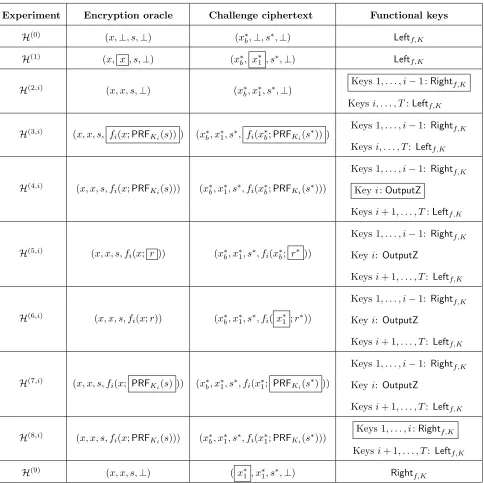
we describe the experiments, and we refer the reader to Table 1 for a high-level overview of the differences between them.
Experiment H(0)(λ). This is the experimentExptnaMPRF
Π,F,A,T(λ) (see Definition 3.3).
Experiment H(1)(λ). This experiment is obtained from the experiment H(0)(λ) by modifying
the encryption oracle and the distribution of the challenge ciphertext as follows. The encryption oracle on input x sampless← {0,1}λ and outputs ct← FE.Enc(msk,(x, x , s,⊥)) instead of ct ←
FE.Enc(msk,(x, ⊥, s,⊥)). Similarly, the challenge ciphertext is computed by samplings∗ ← {0,1}λ
and outputting ct∗←FE.Enc(msk,(x∗b, x∗1 , s∗,⊥)) instead ofct∗←FE.Enc(msk,(x∗b, ⊥, s∗,⊥)). Note that for each functionf ∈ {f1, . . . , fT}with an associated PRF keyK, for the deterministic
functionLeftf,K it holds thatLeftf,K(x, x, s,⊥) =Leftf,K(x,⊥, s,⊥) (and similarly for the challenge
ciphertext). Therefore, the selective-function message privacy of the underlying scheme FE (with
Experiment Encryption oracle Challenge ciphertext Functional keys
H(0) (x,⊥, s,⊥) (x∗
b,⊥, s
∗,⊥) Left
f,K
H(1) (x, x , s,⊥) (x∗
b, x
∗
1 , s∗,⊥) Leftf,K
H(2,i) (x, x, s,⊥) (x∗
b, x∗1, s∗,⊥)
Keys 1, . . . , i−1 :Rightf,K
Keysi, . . . , T:Leftf,K
H(3,i) (x, x, s, f
i(x;PRFKi(s)) ) (x
∗
b, x∗1, s∗, fi(x∗b;PRFKi(s
∗)) ) Keys 1, . . . , i−1: Rightf,K
Keysi, . . . , T: Leftf,K
H(4,i) (x, x, s, f
i(x;PRFKi(s))) (x
∗
b, x∗1, s∗, fi(x∗b;PRFKi(s
∗)))
Keys 1, . . . , i−1: Rightf,K
Key i:OutputZ
Keysi+ 1, . . . , T:Leftf,K
H(5,i) (x, x, s, f
i(x; r )) (x∗b, x
∗
1, s∗, fi(x∗b; r
∗ ))
Keys 1, . . . , i−1: Rightf,K
Keyi: OutputZ
Keysi+ 1, . . . , T: Leftf,K
H(6,i) (x, x, s, f
i(x;r)) (x∗b, x1∗, s∗, fi(x∗1 ;r∗))
Keys 1, . . . , i−1: Rightf,K
Keyi: OutputZ
Keysi+ 1, . . . , T: Leftf,K
H(7,i) (x, x, s, f
i(x; PRFKi(s) )) (x
∗
b, x
∗
1, s∗, fi(x∗1; PRFKi(s
∗) ))
Keys 1, . . . , i−1: Rightf,K
Keyi: OutputZ
Keysi+ 1, . . . , T: Leftf,K
H(8,i) (x, x, s, f
i(x;PRFKi(s))) (x
∗
b, x∗1, s∗, fi(x∗1;PRFKi(s
∗))) Keys 1, . . . , i:Rightf,K
Keysi+ 1, . . . , T: Leftf,K
H(9) (x, x, s,⊥) (x∗
1 , x∗1, s∗,⊥) Rightf,K
functions Leftf,K and Rightf,K for everyf ∈ F and PRF key K (as defined in Figure 1) as well as
the functionOutputZ (as defined in Figure 2). In Appendix B we prove the following claim:
Claim 4.3. There exists a probabilistic polynomial-time adversary B(0)→(1) such that
Pr
h
H(0)(λ) = 1i−PrhH(1)(λ) = 1i ≤Adv
sfMP
FE,F0,B(0)→(1),T(λ).
Experiment H(2,i)(λ) where i∈[T + 1]. This experiment is obtained from the experiment
H(1)(λ) by modifying the distribution of the functional keys as follows. The functional keys for
f1, ..., fi−1 are generated asskf ←FE.KG(msk, Rightf,K ) instead of as skf ←FE.KG(msk, Leftf,K )
(whereRightf,K is defined in Figure 1), and the functional keys forfi, ..., fT are generated as before
(i.e., asskf ←FE.KG(msk,Leftf,K)). We observe that H(1)(λ) =H(2,1)(λ).
ExperimentH(3,i)(λ) wherei∈[T]. This experiment is obtained from the experimentH(2,i)(λ)
by modifying the encryption oracle and the distribution of the challenge ciphertext as follows. The encryption oracle on input x samples s ← {0,1}λ and outputs ct ← FE.Enc(msk,(x, x, s, z )),
wherez=fi(x;PRF.Eval(Ki, s)), instead ofct←FE.Enc(msk,(x, x, s, ⊥)). Similarly, the challenge
ciphertext is computed by samplings∗ ← {0,1}λand outputtingct←FE.Enc(msk,(x∗ b, x
∗
1, s∗, z
∗ )), wherez∗=fi(x∗b;PRF.Eval(Ki, s∗)), instead of ct←FE.Enc(msk,(x∗b, x∗1, s∗, ⊥)).
Note that for functionf ∈ {f1, . . . , fT}with an associated PRF keyK, for the deterministic
func-tionsLeftf,K andRightf,K it holds thatLeftf,K(x, x, s, z) =Leftf,K(x, x, s,⊥) andRightf,K(x, x, s, z)
=Rightf,K(x, x, s,⊥) (and similarly for the challenge ciphertext). Therefore, the selective-function
message privacy of the underlying scheme FE (with respect todeterministic functions) guarantees
that the adversaryAhas only a negligible advantage in distinguishing experimentsH(2,i) andH(3,i).
In Appendix B we prove the following claim:
Claim 4.4. For everyi∈[T]there exists a probabilistic polynomial-time adversary B(2,i)→(3,i) such
that
Pr
h
H(2,i)(λ) = 1i−PrhH(3,i)(λ) = 1i ≤Adv
sfMP
FE,F0,B(2,i)→(3,i),T(λ).
ExperimentH(4,i)(λ) wherei∈[T]. This experiment is obtained from the experimentH(3,i)(λ)
by modifying the distribution of the functional key for theith functionfi. Specifically, the functional
key for fi is computed as skfi ← FE.KG(msk, OutputZ ) instead of skfi ← FE.KG(msk, Leftfi,Ki ),
where the function OutputZis defined in Figure 1.
Note that the encrypted values are all of the form (x, x, s, fi(x;PRF.Eval(Ki, s))) or of the
form (x∗b, x∗1, s∗, fi(x∗b;PRF.Eval(Ki, s∗))), and therefore OutputZ(x, x, s, fi(x;PRF.Eval(Ki, s))) =
Leftfi,Ki(x, x, s, fi(x;PRF.Eval(Ki, s))) and similarly OutputZ(x
∗
b, x∗1, s∗, fi(xb∗;PRF.Eval(Ki, s∗))) =
Leftfi,Ki(x
∗ b, x
∗
1, s∗, fi(x∗b;PRF.Eval(Ki, s∗))). Therefore, the selective-function function privacy of
the underlying scheme FE (with respect to deterministic functions) guarantees that the adversary
A has only a negligible advantage in distinguishing experiments H(3,i) and H(4,i). In Appendix B
we prove the following claim:
Claim 4.5. For everyi∈[T]there exists a probabilistic polynomial-time adversary B(3,i)→(4,i) such
that
Pr
h
H(3,i)(λ) = 1
i −Pr
h
H(4,i)(λ) = 1
i ≤Adv
sfFP
ExperimentH(5,i)(λ) wherei∈[T]. This experiment is obtained from the experimentH(4,i)(λ)
by modifying the encryption oracle and the distribution of the challenge ciphertext as follows. The encryption oracle on input x outputsct ← FE.Enc(msk,(x, x, s, z)), where z =fi(x; r ) for a fresh
and uniformly sampled value r instead of z = fi(x; PRF.Eval(Ki, s) ). Similarly, the challenge
ciphertext is computed asct∗←FE.Enc(msk,(x∗b, x∗1, s∗, z∗)), wherez∗=fi(x∗b; r∗ ) for a fresh and
uniformly sampled value r∗ instead ofz∗ =fi(x∗b; PRF.Eval(Ki, s∗) ).
The pseudorandomness of PRF.Eval(Ki,·) guarantees that the adversaryAhas only a negligible
advantage in distinguishing experiments H(4,i) and H(5,i). In Appendix B we prove the following
claim:
Claim 4.6. For everyi∈[T]there exists a probabilistic polynomial-time adversary B(4,i)→(5,i) such
that
Pr
h
H(4,i)(λ) = 1i−PrhH(5,i)(λ) = 1i
≤AdvPRF,B(4,i)→(5,i)(λ).
ExperimentH(6,i)(λ) wherei∈[T]. This experiment is obtained from the experimentH(5,i)(λ)
by computing the challenge ciphertext asct∗ ←FE.Enc(msk,(x∗b, x∗1, s∗, z∗)), where z∗ =fi( x∗1 ;r∗)
instead ofz=fi( x∗b ;r∗).
The computational admissibility of the function family F guarantees that the advantage of the adversary A in distinguishing experiments H(5,i) and H(6,i) is at most ∆(λ). In Appendix B we
prove the following claim:
Claim 4.7. For everyi∈[T]there exists a probabilistic polynomial-time adversary B(5,i)→(6,i) such
that
Pr
h
H(5,i)(λ) = 1i−PrhH(6,i)(λ) = 1i ≤Adv
naADM
F,B(5,i)→(6,i)(λ)≤∆(λ).
ExperimentH(7,i)(λ) wherei∈[T]. This experiment is obtained from the experimentH(6,i)(λ)
by modifying the encryption oracle and the distribution of the challenge ciphertext as follows. The encryption oracle on inputxoutputsct←FE.Enc(msk,(x, x, s, z)) wherez=fi(x; PRF.Eval(Ki, s) )
instead ofz=fi(x; r ) for a fresh and uniformly sampled valuer. Similarly, the challenge ciphertext
is computed as ct∗ ← FE.Enc(msk,(x∗b, x∗1, s∗, z∗)), where z = fi(x∗1; PRF.Eval(Ki, s∗) ) instead of
z=fi(x∗1; r∗ ) for a fresh and uniformly sampled value r∗.
The pseudorandomness of PRF.Eval(Ki,·) guarantees that the adversary A has only a
negligi-ble advantage in distinguishing experiments H(6,i) and H(7,i). The proof of the following claim is
essentially identical to the proof of Claim 4.6 (see Appendix B):
Claim 4.8. For everyi∈[T]there exists a probabilistic polynomial-time adversary B(6,i)→(7,i) such
that
Pr
h
H(6,i)(λ) = 1
i −Pr
h
H(7,i)(λ) = 1
i
≤AdvPRF,B(6,i)→(7,i)(λ).
ExperimentH(8,i)(λ) wherei∈[T]. This experiment is obtained from the experimentH(7,i)(λ)
by modifying the distribution of the functional key for theith functionfi. Specifically, the functional
As in the proof of Claim 4.5, the selective-function function privacy of the underlying scheme
FE (with respect to deterministic functions) guarantees that the adversary A has only a
negligi-ble advantage in distinguishing experiments H(7,i) and H(8,i). The proof of the following claim is
essentially identical to the proof of Claim 4.5 (see Appendix B):
Claim 4.9. For everyi∈[T]there exists a probabilistic polynomial-time adversary B(7,i)→(8,i) such
that
Pr
h
H(7,i)(λ) = 1
i −Pr
h
H(8,i)(λ) = 1
i ≤Adv
sfFP
FE,F0,B(7,i)→(8,i),T(λ).
Next, we observe that the experiment H(2,i+1)(λ) is obtained from the experiment H(8,i)(λ) by
modifying the encryption oracle and the distribution of the challenge ciphertext as follows. The encryption oracle on input x outputs ct ← FE.Enc(msk,(x, x, s, ⊥)) instead of ct ← FE.Enc(msk, (x, x, s, z )) wherez=fi(x;PRF.Eval(Ki, s)). Similarly, the challenge ciphertext is computed using z∗ =⊥instead ofz∗=fi(x∗1;PRF.Eval(Ki, s∗)).
Note that for each function f ∈ {f1, . . . , fT} with an associated PRF key K, for the
deter-ministic functions Leftf,K and Rightf,K it holds that Leftf,K(x, x, s,⊥) = Leftf,K(x, x, s, z) and
Rightf,K(x, x, s,⊥) =Rightf,K(x, x, s, z) (and similarly for the challenge ciphertext). Therefore, the selective-function message privacy of the underlying schemeFE(with respect todeterministic func-tions) guarantees that the adversaryAhas only a negligible advantage in distinguishing experiments
H(8,i) and H(2,i+1). The proof of the following claim is essentially identical to the proof of Claim
4.4 (see Appendix B):
Claim 4.10. For every i∈ [T] there exists a probabilistic polynomial-time adversary B(8,i)→(2,i+1)
such that
Pr
h
H(8,i)(λ) = 1
i −Pr
h
H(2,i+1)(λ) = 1
i ≤Adv
sfMP
FE,F0,B(8,i)→(2,i+1),T(λ).
Experiment H(9)(λ). This experiment is obtained from the experiment H(2,T+1)(λ) by
comput-ing the challenge ciphertext as ct∗ ← FE.Enc(msk,(x∗1 , x∗1, s∗,⊥)) instead of ct ← FE.Enc(msk,
(x∗b , x∗1, s∗,⊥)). Note that this experiment is completely independent of the bit b, and therefore
PrH(9)(λ) = 1
= 1/2.
In addition, note that for every function f ∈ {f1, . . . , fT} with an associated PRF key K, for
the deterministic function Rightf,K it holds that Rightf,K(x∗b, x∗1, s∗,⊥) = Rightf,K(x∗1, x∗1, s∗,⊥).
Therefore, the selective-function message privacy of the underlying scheme FE (with respect to
deterministic functions) guarantees that the adversaryA has only a negligible advantage in distin-guishing experimentsH(8,i) and H(2,i+1). The proof of the following claim is essentially identical to
the proof of Claim 4.3 (see Appendix B):
Claim 4.11. There exists a probabilistic polynomial-time adversary B(2,T+1)→(9) such that
Pr
h
H(2,T+1)(λ) = 1
i −Pr
h
H(9)(λ) = 1
i ≤Adv
sfFP
FE,F0,B(2,T+1)→(9),T(λ).
H(2,1)(λ) and Pr
H(9)(λ) = 1
= 1/2, we observe that
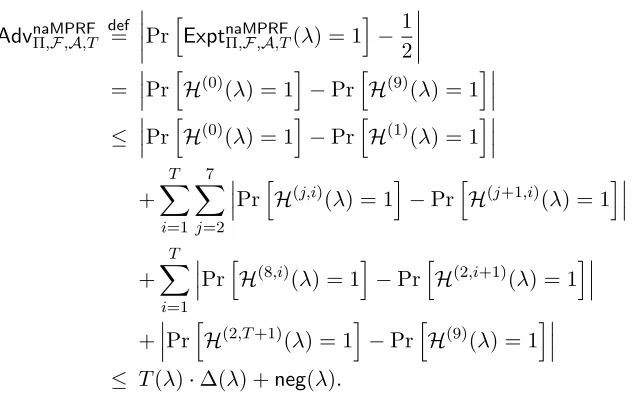
AdvnaMPRFΠ,F,A,T def=
PrhExptnaMPRFΠ,F,A,T(λ) = 1i− 1
2 = Pr h
H(0)(λ) = 1i−PrhH(9)(λ) = 1i
≤ Pr
h
H(0)(λ) = 1
i −Pr
h
H(1)(λ) = 1
i + T X i=1 7 X j=2 Pr h
H(j,i)(λ) = 1
i −Pr
h
H(j+1,i)(λ) = 1
i + T X i=1 Pr h
H(8,i)(λ) = 1
i −Pr
h
H(2,i+1)(λ) = 1
i + Pr h
H(2,T+1)(λ) = 1
i −Pr
h
H(9)(λ) = 1
i
≤ T(λ)·∆(λ) +neg(λ).
4.2 Proof of Theorem 4.2
We prove that the scheme Π is message private for adaptively-admissible functionalities (see
Defi-nition 3.5) based on the assumptions thatPRF is a puncturable pseudorandom function family and
thatFE is function private (see Definition 2.6).
LetAbe a probabilistic polynomial-time adversary that issues at mostT1 =T1(λ) pre-challenge
key-generation queries, at most T2 = T2(λ) post-challenge key-generation queries (where T =
T1 +T2), and at most T = T(λ) encryption queries (note that T1, T2 and T may be any
poly-nomials and are not fixed in advance), and letF be a ∆-adaptively admissible family of randomized functionalities. We denote byf1, . . . , fT the key-generation queries that are issued by A.
We present a sequence of experiments and upper bound A’s advantage in distinguishing each
two consecutive experiments. Each two consecutive experiments differ either in the distribution of their challenge ciphertexts or in the distribution of the functional keys that are produced by the key-generation oracle. The first experiment is the experiment ExptaMPRFΠ,F,A,T(λ) (see Definition 3.5), and the last experiment is completely independent of the bitb. This enables us to prove that there exists a negligible function neg(·) such that
AdvaMPRFΠ,F,A,T(λ)
def = Pr h
ExptaMPRFΠ,F,A,T(λ) = 1
i −1 2
≤T(λ)·∆(λ) +neg(λ)
for all sufficiently largeλ∈N. Throughout the proof we use, in addition to the functionsLeftf,K and
Rightf,K that were defined in Figure 1, the functions PuncOutputYf,K0,y,s∗ and PuncOutputZf,K0,s∗
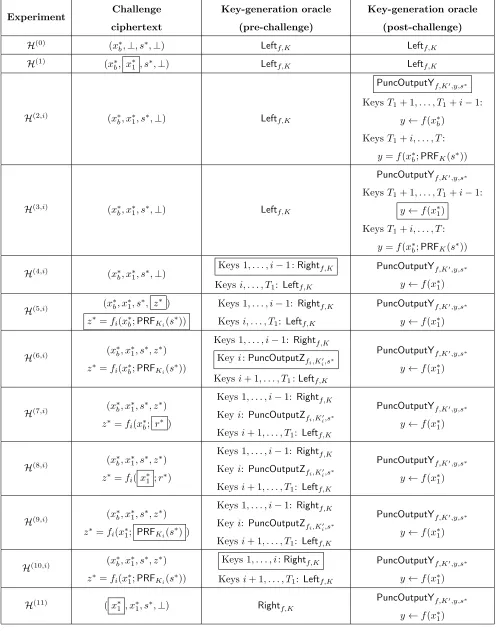
that are defined in Figure 3. In what follows we describe the experiments, and we refer the reader to Table 2 for a high-level overview of the differences between them. We note that in all experiments the encryption oracle is as defined by the encryption procedure of the scheme.
Experiment H(0)(λ). This is the experimentExptaMPRF
Π,F,A(λ) (see Definition 3.5).
Experiment H(1)(λ). This experiment is obtained from the experiment H(0)(λ) by modifying
the encryption oracle so that on the challenge input (x∗0, x∗1) it samples s∗ ← {0,1}λ and outputs
Experiment Challenge ciphertext Key-generation oracle (pre-challenge) Key-generation oracle (post-challenge)
H(0) (x∗
b,⊥, s∗,⊥) Leftf,K Leftf,K
H(1) (x∗
b, x
∗
1 , s∗,⊥) Leftf,K Leftf,K
H(2,i) (x∗
b, x
∗
1, s∗,⊥) Leftf,K
PuncOutputYf,K0,y,s∗
KeysT1+ 1, . . . , T1+i−1:
y←f(x∗b)
KeysT1+i, . . . , T:
y=f(x∗b;PRFK(s∗))
H(3,i) (x∗
b, x∗1, s∗,⊥) Leftf,K
PuncOutputYf,K0,y,s∗
KeysT1+ 1, . . . , T1+i−1:
y←f(x∗1)
KeysT1+i, . . . , T:
y=f(x∗b;PRFK(s∗))
H(4,i) (x∗
b, x∗1, s∗,⊥)
Keys 1, . . . , i−1 :Rightf,K
Keysi, . . . , T1: Leftf,K
PuncOutputYf,K0,y,s∗
y←f(x∗1)
H(5,i) (x
∗
b, x∗1, s∗, z∗ )
z∗=fi(x∗b;PRFKi(s
∗))
Keys 1, . . . , i−1: Rightf,K
Keysi, . . . , T1: Leftf,K
PuncOutputYf,K0,y,s∗
y←f(x∗1)
H(6,i) (x
∗
b, x∗1, s∗, z∗)
z∗=fi(x∗b;PRFKi(s
∗))
Keys 1, . . . , i−1: Rightf,K
Keyi:PuncOutputZf
i,Ki0,s∗
Keysi+ 1, . . . , T1:Leftf,K
PuncOutputYf,K0,y,s∗
y←f(x∗1)
H(7,i) (x
∗
b, x
∗
1, s∗, z∗)
z∗=fi(x∗b; r
∗ )
Keys 1, . . . , i−1: Rightf,K
Keyi: PuncOutputZfi,K0
i,s∗
Keysi+ 1, . . . , T1: Leftf,K
PuncOutputYf,K0,y,s∗
y←f(x∗1)
H(8,i) (x
∗
b, x
∗
1, s∗, z∗)
z∗=fi(x∗1 ;r∗)
Keys 1, . . . , i−1: Rightf,K
Keyi: PuncOutputZfi,K0
i,s∗
Keysi+ 1, . . . , T1: Leftf,K
PuncOutputYf,K0,y,s∗
y←f(x∗1)
H(9,i) (x
∗
b, x∗1, s∗, z∗)
z∗=fi(x∗1; PRFKi(s
∗) )
Keys 1, . . . , i−1: Rightf,K
Keyi: PuncOutputZf
i,K0i,s∗
Keysi+ 1, . . . , T1: Leftf,K
PuncOutputYf,K0,y,s∗
y←f(x∗1)
H(10,i) (x
∗
b, x
∗
1, s∗, z∗)
z∗=fi(x∗1;PRFKi(s
∗))
Keys 1, . . . , i:Rightf,K
Keysi+ 1, . . . , T1: Leftf,K
PuncOutputYf,K0,y,s∗
y←f(x∗1)
H(11) (x∗
1 , x∗1, s∗,⊥) Rightf,K
PuncOutputYf,K0,y,s∗
y←f(x∗1)