Escuela Técnica Superior de Ingeniería
Departamento de Informática
Coscheduling Techniques for
Non-Dedicated Cluster Computing
Memoria presentada por Francesc Sol-sona Tehàs para optar al grado de Doctor en Informática
Coscheduling Techniques for
Non-Dedicated Cluster Computing
Memoria presentada por Francesc Solsona Tehàs para op-tar al grado de Doctor en Informática por la Universidad Autónoma de Barcelona. Trabajo realizado en el Depar-tamento de Informática de la Escuela Técnica Superior de Ingeniería de la Universidad Autónoma de Barcelona, den-tro del programa de doctorado “Arquitectura de Computa-dores y Procesamiento Paralelo”, bajo la dirección del Dr. Porfidio Hernández Budé.
Barcelona, Mayo de 2002
Vo. Bo. Director de Tesis
dicación a la supervisión del trabajo.
A Francesc Giné, por su ayuda y colaboración en varias fases del trabajo. A Concepció Roig, que habiendo coinci-dido en la realización de la Tesis ha sido en todo momento un importante punto de apoyo. Y en general a toda el área de Arquitectura del Departamento de Informática de la Uni-versidad de Lleida.
A Emilio Luque y a todo el grupo de investigación de la Unidad de Arquitectura y Sistemas Operativos del Depar-tamento de Informática de la UAB, que gracias a su colab-oración y apoyo ha sido posible la realización de esta Tesis.
Y como no, a toda mi familia. A mis padres, hermanos, a mi mujer, Montse y a los pequeños, Sara y Roger, que han sabido entender en todo momento la dedicación que me ha supuesto la realización del proyecto.
Abstract
When general-purpose workstations are interconnected by a Local Area Network (LAN) they form the so-called Network Of Workstations (NOW) or Cluster sys-tem. This kind of workstation is designed for developing and executing appli-cations without excessive computing requirements. These appliappli-cations, named “local” or “user” in this project, are usually very interactive or I/O bound. Their execution rarely exceeds the computing power provided by the hardware resources of the workstation.
Large CPU-bound applications require more complex computer systems. Su-percomputers and MPPs (Massively Parallel Processors) have been the most widely used platforms to execute this kind of application. Basically, they are formed by a large number of Processing Elements (PE) with shared (all the PEs share a global memory) or distributed memory (a local memory is assigned to each PE). Depend-ing on the memory access pattern, the applications can be classified as parallel or distributed. This also differentiates two different research fields, namely parallel and distributed processing. In the parallel case, communication/synchronization between processes (located at different PEs) making up parallel applications is performed through the Shared Memory. In contrast, in distributed processing, as local memory in one PE cannot be accessed by another one, the remote processes forming the distributed applications, communicate/synchronize between them by means of message passing.
The key questions are why not to use the Clusters in distributed processing, and what the advantages/drawbacks in doing so are. Many researchers work in this research field of Cluster Computing trying to answer these questions. Apparently, the workstations are not designed to execute distributed applications efficiently, but recent advances in their hardware components and the increasing speed of
LANs provide the NOWs with performance capabilities ever closer to the that of the MPPs. Another factor to be mentioned is the constant evolution of different Distributed Computing Environments (DCE), such as PVM (Parallel Virtual Ma-chine) and MPI (Message Passing Interface), which are also applicable in Cluster computing and simplify the design and implementation of distributed applications for such systems. As a result, the use of NOWs or Clusters in distributed proces-sing is increaproces-sing and with time is becoming more and more popular.
There are important drawbacks to be considered if both distributed and local applications are executed in parallel in a Cluster system. The performance of distributed applications depends on the behavior of all their forming processes, spread over the Cluster nodes, so the performance of distributed applications can decrease significantly if the nodes (even only one node) of the Cluster are (is) heavily loaded by local jobs. On the other hand, nodes with large distributed workload can disturb the local jobs excessively. The local tasks are normally I/O bounded, so the term “disturb” would mean here: “increase the response time”. If the local tasks were CPU-bound, “disturb” would mean in this case: “increase the return time”.
As a consequence of the above commented dissertation, a new research goal in Cluster computing appeared recently: how to coordinate local and distributed applications when they are executed in parallel in a Cluster system. We also focus our research on this area. More precisely, our efforts are centered on constructing a Virtual Machine over a Cluster system that provides the double functionality of executing traditional workstation jobs as well as distributed applications effi-ciently.
The problem is focused on Clusters in which the forming nodes have
mul-tiprocessing capabilities. If not, no manner of executing distributed and local
applications in parallel would be possible.
Moreover, the execution of local applications (which usually require low aver-age response times) in the Cluster implies that the operating system of each node must also be time-sharing. This property attempts to split the CPU time between all the executing tasks, so the average response time of local tasks can be reduced. Furthermore, distributed applications with a high (even low) communication de-gree will be affected if this property is not provided: an excessive delay in the
iii execution of distributed tasks will not favor the rapid interchanging of messages, and consequently their performance would be low.
To solve the problem, two major considerations must be addressed:
• How share and schedule the workstation resources (especially the CPU) between the local and distributed applications.
• How to manage and control the overall system for the efficient execution of both application kinds.
Coscheduling is the base principle used for the sharing and scheduling of the CPU.
As will be seen later in greater depth, coscheduling is based on reducing the com-munication waiting time of distributed applications by scheduling their forming tasks, or a subset of them at the same time. Consequently, non-communicating distributed applications (CPU bound ones) will not be favored by the application of coscheduling. Only the performance of distributed applications with remote communication can be increased with coscheduling.
Coscheduling techniques follow two major trends: explicit and implicit
con-trol. This classification is based on the way the distributed tasks are managed and
controlled. Basically, in explicit-control, such work is carried out by specialized processes and (or) processors. In contrast, in implicit-control, coscheduling is per-formed by making local scheduling decisions depending on the events occurring in each workstation.
Two coscheduling mechanisms which follow the two different control trends are presented in this project. They also provide additional features including us-ability, good performance in the execution of distributed applications, simulta-neous execution of distributed applications, low overhead and also low impact on local workload performance. The design of the coscheduling techniques was mainly influenced by the optimization of these features.
An implicit-control coscheduling model is also presented. Some of the fea-tures it provides include collecting on-time performance statistics and the useful-ness as a basic scheme for developing new coscheduling policies. The presented
implicit-control mechanism is based on this model.
The good scheduling behavior of the coscheduling models presented is shown firstly by simulation, and their performance compared with other coscheduling
techniques in the literature. A great effort is also made to implement the principal studied coscheduling techniques in a real Cluster system. Thus, it is possible to collect performance measurements of the different coscheduling techniques and compare them in the same environment. The study of the results obtained will provide an important orientation for future research in coscheduling because, to our knowledge, no similar work (in the literature) has been done before.
Measurements were made by using various distributed benchmarks with diffe-rent message patterns: regular and irregular communication patterns, token rings, all-to-all and so on. Also, communication primitives such as barriers and basic sending and receiving using one and two directional links were separately mea-sured. By using this broad range of distributed applications, an accurate analysis of the usefulness and applicability of the presented coscheduling techniques in Cluster computing is performed.
Another point to mention is that general-purpose workstations do not differ-entiate between distributed and local jobs. All of these are simply jobs. Con-sequently, some sort of mechanism for differencing these two kinds of jobs is considered when new solutions are proposed.
Furthermore, the implementation of the coscheduling techniques may be per-formed in the user or the system space. So, it is necessary to analyze the main features the Cluster communication subsystem provides in the design of the cos-cheduling techniques. Moreover, the scos-cheduling mechanisms (located in the ope-rating system) of the forming nodes must also be studied. PVM and Linux are respectively the DCE and the operating system which were used in this project as base platform. The communication subsystem composed by PVM and Linux and also the Linux scheduler were accordingly studied in depth.
Contents
1 Introduction 1 1.1 Cluster Systems . . . 3 1.1.1 Cluster Components . . . 7 1.1.1.1 Operating System . . . 8 1.1.1.2 Cluster Networks . . . 101.1.1.3 Distributed Computing Environments (DCEs) . 11 1.1.1.4 Local Applications . . . 12
1.2 The Coscheduling Concept . . . 13
1.2.1 Scheduling Schemes . . . 13 1.2.2 Coscheduling . . . 14 1.2.3 Coscheduling Classification . . . 16 1.3 Related Work . . . 17 1.3.1 Explicit-control Coscheduling . . . 19 1.3.2 Implicit-control Coscheduling . . . 20
1.4 Motivation and Objectives . . . 23
1.4.1 Motivation . . . 23 1.4.2 Objectives . . . 25 1.5 Overview . . . 27 2 Coscheduling Techniques 29 2.1 Explicit Coscheduling . . . 31 2.1.1 STATIC Mode . . . 33 2.1.2 BALANCED Mode . . . 34 2.1.3 DISTRIBUTED Mode . . . 37 v
2.1.4 Explicit Synchronization . . . 37
2.2 Predictive Coscheduling . . . 39
2.2.1 Notation . . . 40
2.2.2 Performance metrics . . . 43
2.2.3 Local Coscheduler (LC) . . . 45
2.2.4 Predictive Coscheduling Algorithm . . . 47
2.3 Dynamic Coscheduling . . . 50
3 Coscheduling Prototypes 53 3.1 Preliminary Concepts . . . 54
3.1.1 Analysis of the Communication System . . . 54
3.1.1.1 PVM Layer . . . 54
3.1.1.2 Linux Layers . . . 55
3.1.2 The Linux Scheduler . . . 58
3.2 DTS . . . 60
3.2.1 DTS Scheduler . . . 61
3.2.2 DTS Overhead . . . 63
3.3 High-Priority Distributed Tasks (HPDT) . . . 64
3.4 Implicit . . . 65
3.4.1 Implicit Coscheduling Overhead . . . 67
3.5 Predictive . . . 68
3.5.1 Predictive Scheduler . . . 69
3.5.2 Obtaining the current sending/receiving frequency . . . . 71
3.5.3 Additional Comments . . . 72
3.6 The Dynamic Version . . . 74
4 Experimental Results (Simulation) 77 4.1 Coscheduling Models Evaluation . . . 80
4.2 Predictive and Dynamic . . . 88
4.3 Summary . . . 91
4.4 Concluding Remarks . . . 92
5 Experimental Results (Implementation) 95 5.1 Benchmarks . . . 96
CONTENTS vii
5.1.1 Kernel Benchmarks . . . 97
5.1.2 Multiprocessor Low_Level Benchmarks . . . 105
5.1.2.1 Communication Benchmarks . . . 105
5.1.2.2 Synchronization Benchmark . . . 106
5.2 Local Workload Characterization . . . 106
5.3 Explicit Coscheduling . . . 107
5.3.1 IP Interval and Local Overhead . . . 108
5.3.2 DTS Modes . . . 110
5.4 Explicit versus Implicit . . . 112
5.4.1 Implemented Environments . . . 112
5.4.2 Distributed Performance . . . 113
5.4.3 Local Performance . . . 114
5.5 Predictive and Dynamic . . . 115
5.5.1 NAS Results . . . 115
5.5.1.1 Executing Together . . . 118
5.5.2 Low Level Results . . . 120
5.5.3 Local Tasks Overhead . . . 123
5.5.4 Varying the Message Size . . . 125
5.5.5 Additional Measurements . . . 127
5.6 Summary . . . 128
6 Conclusions and Future Work 135 6.1 Conclusions . . . 135
6.1.1 Explicit-control Coscheduling . . . 135
6.1.2 Implicit-control Coscheduling . . . 137
6.1.3 Additional Conclusions . . . 139
6.2 Future Work . . . 141
A DTS and Linux Command 143
B Additional Results 147
1.1 Taxonomy of Parallel Architectures. . . 3
1.2 Cluster architecture . . . 7
1.3 Applications A1, A2and A3 . . . 23
1.4 Coscheduling benefits. . . 24
2.1 Explicit environment behavior . . . 32
3.1 PVM protocols. . . 55
3.2 PVM message structure (pmsg) . . . . 56
3.3 Linux communication levels. . . 56
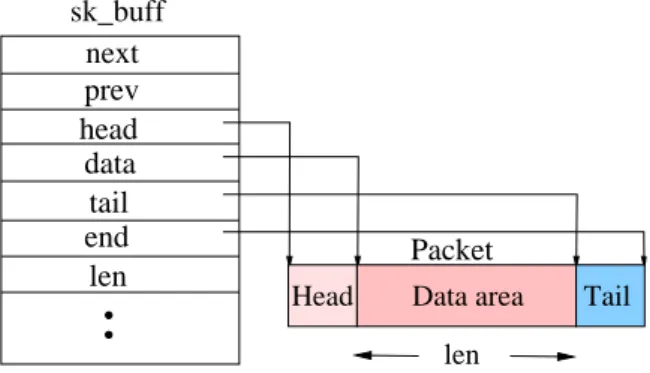
3.4 sk_buff and packet structures. The packet Data area contains the information to be transmitted. . . 57
3.5 Linux Scheduler. . . 58
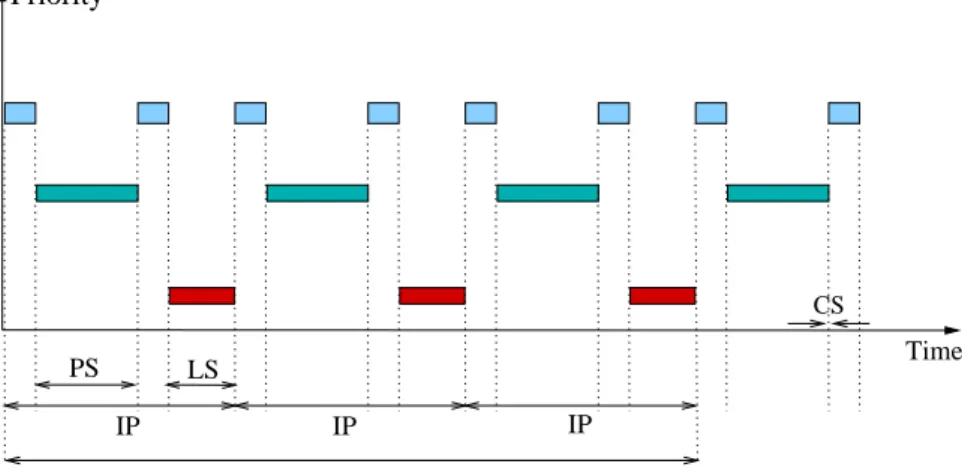
3.6 DTS environment. . . 61
3.7 Most frequently used Linux structures (and their fields). . . 72
3.8 (a) write_queue and (b) CBL transmission queues. . . 74
4.1 SCluster input arguments. . . 78
4.2 NSTATIONS=4, MRQL=2. (left) SCODE (right) TIMES. . . 83
4.3 NSTATIONS=4, MRQL=5. (left) SCODE (right) TIMES. . . 87
4.4 SCODE: NSTATIONS=4, MRQL=5, maxm=1. . . 88
4.5 MCO. NSTATIONS=4. (left) MRQL=2 (right) MRQL=5. . . 90
5.1 EP class A. . . 100
5.2 IS class A. . . 100
5.3 MG class A. . . 101 ix
x LIST OF FIGURES
5.4 FT class T. . . 102
5.5 CG class T. . . 103
5.6 BT class T. . . 103
5.7 SP class T. . . 104
5.8 (a) STATIC mode results. (b) local workload overhead. . . 108
5.9 Comparison between the three DTS modes. . . 110
5.10 Execution of the NAS parallel benchmarks. (a) IS (b) MG. . . 113
5.11 Local Overhead (LO) of local tasks. . . 114
5.12 IS class A, 4 nodes. . . 116
5.13 IS class A, 8 nodes. . . 116
5.14 MG class T and A, 4 and 8 nodes. . . 118
5.15 IS and MG, 4 nodes. (a) IS (b) MG. . . 119
5.16 CG and SP. (b) CG (b) SP. . . 120
5.17 CG, IS and SP. (a) CG (b) IS (b) SP. . . 121
5.18 Low Level benchmark COMMS2. . . 122
5.19 Low Level benchmark SYNCH1. . . 123
5.20 Local Overhead (LO) of calcula2. . . 124
5.21 Local Overhead (LO) of calcula2. . . 125
5.22 benchmarks: (a) sinring and (b) sintree . . . 126
5.23 Varying the message size. . . 126
5.24 master-slave benchmark. . . 127
5.25 master-slave execution times (in seconds). . . 128
5.26 Explicit vs. Predictive (IS). (a) Distributed Gain (b) LO. . . 130
5.27 Explicit vs. Predictive (MG). (a) Distributed Gain (b) LO. . . 131
B.1 NSTATIONS=8, MRQL=2. (left) SCODE (right) TIMES. . . 148
B.2 NSTATIONS=8, MRQL=5. (left) SCODE (right) TIMES. . . 149
B.3 NSTATIONS=16, MRQL=2. (left) SCODE (right) TIMES. . . . . 150
B.4 NSTATIONS=16, MRQL=5. (left) SCODE (right) TIMES. . . . . 151
B.5 MCO. NSTATIONS=8. (left) MRQL=2 (right) MRQL=5. . . 152
B.6 MCO, NSTATIONS=16. (left) MRQL=2 (right) MRQL=5. . . 153
B.7 CG, FT, BT and SP. Class T, 4 Nodes. . . 154
B.9 CG, BT and SP. Class A, 8 Nodes. . . 155
B.10 IS and CG. (left) IS (right) CG. . . 156
B.11 IS and BT. (left) IS (right) BT. . . 156
List of Tables
1.1 PVM versus MPI . . . 11
1.2 Time-slicing and space-slicing classification. . . 14
1.3 Coscheduling Techniques. . . 18
2.1 Relation between RLA, PS and LS . . . . 36
2.2 CMC task field and global variable initializations. . . 47
4.1 Simulation Summary. . . 91
5.1 NAS Parallel Benchmarks. Memory: max. resident set size of each node when the benchmark is executed in 4 nodes. OM: Out of Memory. . . 98
5.2 IS Execution/Communication times. . . 100
5.3 MG Execution/Communication times. . . 101
5.4 FT Execution/Communication times. . . 101
5.5 CG Execution/Communication times. . . 102
5.6 BT Execution/Communication times. n: nodes, C: Class. . . 102
5.7 SP Execution/Communication times. . . 104
1 Explicit Scheduler . . . 31 2 Explicit Synchronization Algorithm. . . 38 3 Local Coscheduler (LC) of node N[k]. . . 45 4 Predictive Coscheduling Algorithm (PCA). S_C≡T[i].de<MCO.
C_C≡h.f req>T[i].f req. . . . 48 5 DTS Scheduler. . . . 62 6 Priority Scheduler. Assigns real-time priority to PVM tasks. . . . 65 7 ImCoscheduling. Implements the Implicit coscheduling. . . 66 8 Function goodness(task). . . . 69 9 Predictive version of the Linux Scheduler. Only the modifications
(addition of Steps 5.1 to 5.3) with respect to the original Linux Scheduler (Fig. 3.5) are shown. . . 70 10 Function n_packets(task,queue). . . 71
Chapter 1
Introduction
The studies in [4] indicate that the workstations in a NOW (Network of Work-stations) are normally underloaded. So, a great number of researchers have been exploring ways to make better use of the wasted NOWs capacity for parallel com-puting. As a result, Networks of Workstations have become important and cost-effective parallel platforms for scientific computation.
Basically, there are three methods of using these CPU idle cycles. The first area is the analysis, design and development of remote execution facilities,
Con-dor [5], Process Server [6], Sprite [3] and so on.
The second area is task migration [5, 7]. In a NOW, in accordance with the research by Arpaci [16], the unpredictable behavior of local users may lower the effectiveness of this method. An alternative is load balancing, which may be ex-cessively time costly in Cluster computing [34]. In addition, load balancing may cause subsequent problems, such as redirection of messages (due to the migration of tasks), and extra overhead and communication traffic in managing and control-ling the overall system.
The third and last area is job scheduling [8, 49, 18]. This deals with the design of schedulers, which must ensure the requested interactive behavior of a work-station. At the same time, this technique attempts to give as many CPU cycles (including the wasted ones) as possible to parallel tasks.
Job scheduling is the area chosen to tackle the problem, and more specifically parallel-task coscheduling rather than job scheduling.
In practice, a NOW system is heterogeneous and non-dedicated. These two unique factors make scheduling policies on multiprocessor/multicomputer sys-tems unsuitable for NOWs, but the coscheduling principle is still an important basis for parallel process scheduling in these environments.
The heterogeneity of a NOW can be modeled by using the Power Weight, de-veloped by Zhang in [50]. Each node making up the Cluster has a value (the power weight) between [0..1] assigned. This value represents the execution speed with respect to the fastest node in the system. Nevertheless, the non-dedicated feature means that two issues must be addressed, these being how to coordinate the si-multaneous execution of the processes forming a parallel application, and how to manage the interaction between parallel and local user jobs. Combining parallel and sequential workloads on a non-dedicated Cluster system, with reasonable per-formance for both kinds of computation is an open research goal. Efforts in this project have been focused on the proposal of new solutions in this research field.
To define the problem to be solved, a more accurate study of the Cluster sys-tems must be performed. Section 1.1 presents the location of NOWs inside a ge-neral classification of parallel architectures together with their principal features.
The coscheduling principle is defined in section 1.2. The different kinds of coscheduling are also presented in this section.
An in depth study of the state of the art is performed in section 1.3. Special attention is given to the coscheduling techniques which consider simultaneous executions of various distributed applications jointly with local or user workload. Next, by means of a simple example, the reason for using coscheduling in Cluster computing is demonstrated (in section 1.4). After presenting the most relevant work in coscheduling and one specific motivation example, the main ob-jectives of this project can be more easily understood. The presentation of the main aim as well as the detailed objectives of this thesis occupy the last part of this section.
Finally, the remaining contents of this project are presented in the Overview section (section 1.5).
1.1. CLUSTER SYSTEMS 3
1.1
Cluster Systems
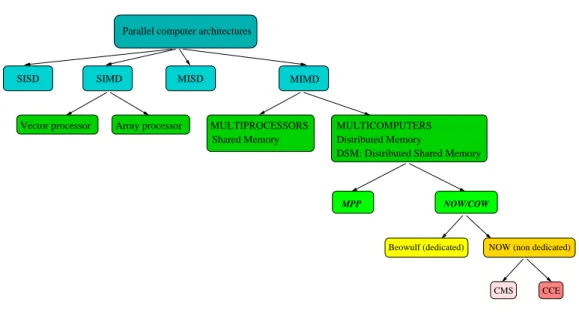
A taxonomy of parallel systems, done by Tanenbaum in [36], is shown in Fig. 1.1. Here, the location where the Clusters are can be observed.
Array processor
Distributed Memory
DSM: Distributed Shared Memory
MPP MISD
Vector processor
SISD SIMD MIMD
Parallel computer architectures
NOW/COW MULTICOMPUTERS MULTIPROCESSORS Shared Memory CCE CMS
Beowulf (dedicated) NOW (non dedicated)
Figure 1.1: Taxonomy of Parallel Architectures.
The first level of the Tanenbaum taxonomy (see Fig. 1.1) is based on Flynn’s classification of parallel computers.
Flynn used the concepts “instruction” and “data” stream as base terms for classifying the different kinds of architecture. Each Instruction stream has an associated Program Counter. A data stream consists of a set of operands. For example, SISD is the acronym of Single Instruction stream Single Data stream and corresponds to the classic Von Newman’s Machine. We are interested in the MIMD (Multiple Instruction stream Multiple Data stream) category. In this case, multiple processes will execute in parallel by using various data sets. This is the branch where the NOWs are located, so the rest of Flynn’s classification will not be considered henceforth.
The MIMD classification includes Multiprocessors (shared-memory machines) and Multicomputers (message-passing machines). Multiprocessor classification is based on the way the shared memory is implemented in them. Accordingly, no more comments nor explanations about Multiprocessors are necessary.
The Multicomputers are divided into MPPs (Massively Parallel Processors) and NOWs/COWs (Network/Cluster Of Workstations). The MPPs are expensive Supercomputers consisting of many CPUs “tightly coupled” by a high-speed in-terconnection network. The Cray T3E and IBM SP/2 are two well-known exam-ples. NOWs, which are also named COWs, consist of regular PCs or workstations “thinly coupled” by commercial off-the-self interconnection technology.
Since the early 1980s, a particular trend in parallel computing is to move away from specialized platforms (such as MPPs) to general purpose systems, and espe-cially to Cluster systems [74].
The most interesting comment to be made before introducing the NOWs is that they are based on distributed memory (see Fig. 1.1). However, some devel-oped environments for distributed-memory systems implement the so-called DSM (Distributed Shared Memory). DSM allows the execution of shared-memory ap-plications in distributed memory systems. These environments are discarded be-cause we are interested in pure message-passing communication systems.
Distributed computing is a more accurate terminology for parallel compu-ting in Cluster systems. Message passing is the paradigm used in communicat-ing/synchronizing distributed tasks and no semaphores or shared memory utili-ties like those in parallel computing are used. This can be a drawback because to date, the most important work and research was been performed for shared-memory parallel applications. Furthermore, applications designated for serial sys-tems are more easily migrated to parallel syssys-tems than distributed ones, because both serial and parallel systems use the shared-memory paradigm for communica-tion/synchronization. Distributed applications use message passing instead. Re-searchers have made a great effort investigating automatic tools (i.e. interpreters and compilers) for migrating applications from shared to distributed memory sys-tems, but a lot of work still remains to be done in this area.
1.1. CLUSTER SYSTEMS 5 Definition of Cluster: a "Cluster" is a local computing system comprising a set of independent computers and a network which interconnects them. The constituent computer nodes are general purpose workstations and the inter-connection network usually employs an isolated local area network (LAN). A "Beowulf-class system" ([61]) is a dedicated Cluster which is generally com-posed of personal computers (PC), integrated by local area networks (LAN), and normally hosting an open source Unix-like operating system in each node. Non-dedicated Clusters are also referenced as NOWs (Network Of Workstations) or simply Clusters.
In our case, the system used (for implementing and testing the coscheduling techniques presented in this thesis) is a NOW or Cluster. The system is non-dedicated because we are interested in executing in parallel user (local or interac-tive) as well as distributed applications.
The NOWs can be also divided between Cluster Management Software (CMS) and Cluster Computing Environments (CCE). The difference between CMS and CCE is that in the first, the addition of new functionality to the NOW is per-formed without modifying the operating system of the component nodes (addi-tions/modifications are made in the user space). Instead, the CCE term usually serves to designate NOWs where the operating system incorporates parallel (dis-tributed) facilities and services (additions/modifications are made in the system space). As will be seen, our work deals with both kinds of NOW.
The increasing use of Cluster systems in distributed computing is due to many factors. The most important ones are mentioned below:
• Continuous advances in high speed networks, microprocessor and compo-nent performance. Furthermore, the ratio between performance and price overtakes the contemporary Supercomputers.
• Commercial hardware and software technologies can also serve in high per-formance computing using Cluster systems. As a consequence, their acqui-sition does not require the heavy investment of the Supercomputers.
Exactly what attributes a Cluster system should possess is still an open question. The most desirable features a Cluster should provide are listed below:
• Stability: the most important characteristics are robustness against crashes of nodes (or processes) and usability under heavy load.
• Performance: bandwidth and latency of the interconnecting network, as well as memory management, process scheduling, I/O and communication protocols of each component node, should be as efficient as possible.
• Scalability: the scalability of a Cluster is mainly influenced by the pro-vision of the contained nodes (i.e. maximum number of processes, user addressable space and so on). Also, the performance characteristics of the interconnection network have an important influence on scalability.
• Support: unlike large Supercomputers, the support cost of any Cluster is normally much lower because Cluster components are developed for the commercial and consumer computer markets.
• Heterogeneity: a Cluster system does not necessarily consist of homoge-neous hardware and software. It can be made up of different kinds of nodes (PCs, workstations, even Supercomputers), operating systems (Unix, Win-dows, NT Windows and so on), etc ...
Another kind of distributed computing is Metacomputing. Metacomputing sys-tems must be able to handle heterogeneous computer syssys-tems, wide area distribu-tion, heterogeneous data, multiple user identities, and multiple security systems. Basically, differences between Cluster computing and Metacomputing are in the kind of network used in interconnecting the forming nodes. Usually, Cluster com-puting deals with NOWs, whose interconnection network is a LAN. Meanwhile, the term Metacomputing is associated to LANs which are also interconnected by means of WANs (Wide Area Networks). Thus, Metacomputing is a more generic term than Cluster Computing. For example, in addition to the problems of Cluster Computing, Metacomputing also includes user verification, and security control and maintenance. The work presented in this thesis is centered exclusively in Cluster Computing.
1.1. CLUSTER SYSTEMS 7
1.1.1
Cluster Components
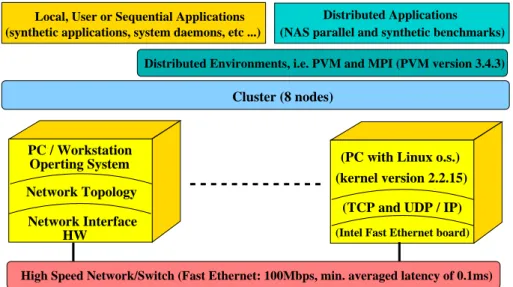
The main components of a Cluster system are studied next separately. This study is necessary for understanding the terminology used throughout this document. Figure 1.2 shows the scheme of the general resources making up a Cluster sys-tem. Particular features of the Cluster used in the implementation of the different coscheduling techniques presented in this document appear in parenthesis. A par-ticular characteristic (not shown in the figure) is that the nodes making up the Cluster are uniprocessor.
Cluster (8 nodes)
(PC with Linux o.s.)
(TCP and UDP / IP) HW PC / Workstation Operting System Network Topology Network Interface (kernel version 2.2.15)
(Intel Fast Ethernet board)
Distributed Applications Local, User or Sequential Applications
(NAS parallel and synthetic benchmarks) (synthetic applications, system daemons, etc ...)
High Speed Network/Switch (Fast Ethernet: 100Mbps, min. averaged latency of 0.1ms) Distributed Environments, i.e. PVM and MPI (PVM version 3.4.3)
Figure 1.2: Cluster architecture
One of the most important Cluster components is the Operating System run-ning in each Cluster node. Special attention is paid to the Linux o.s., this being the one chosen for this project.
Three Cluster Network Topologies are also commented on. The first one is the Internet Protocol, which is the kind of network used in this project. The other two are Active Messages and Fast Messages. As we will see later, Active and Fast Messages were used in implementing the two most important coscheduling techniques we based this project on.
The most commonly used Distributed Computing Environments (DCE) in Cluster computing are PVM (mainly used in this project) and MPI. Their
prin-cipal features and differences are also presented in this section.
Finally, the final part of this section contains the definition and some additional comments about the local applications.
1.1.1.1 Operating System
We are interested in investigating non-dedicated Clusters. This is, the study of the efficient use of Cluster systems for executing both distributed and user (interactive or local workload) applications simultaneously. So, based on that and taking into account the Cluster definition, the list of requirements the underlying o.s. must provide are as follows:
• Multiprocessing or multiuser capabilities: multiple execution of different processes (or users) must be allowed. If not, only serial execution would be possible. In a multiuser system, each process belongs to a user. Fur-thermore, each user has an specific environment (i.e. file system directory, rights, environment variables and so on), which serves for controlling sys-tem security and managing resource accounting. The environment is asso-ciated and reset for the permitted user in the login phase (when entering the system).
• Time-sharing: this feature guarantees rapid response time for interactive, I/O-bound, or even message passing intensive applications. If time-sharing were not provided by the underlying o.s., most of both distributed and local applications would perform poorly when various of them were executed in parallel. Normally, time-sharing is accomplished by using some sort of Round-Robin scheduler policy, which is based on repeatedly assigning a maximum execution time slice (quantum) to each process.
• Extensibility: the o.s. should allow the integration of coscheduling me-chanisms and Cluster-specific extensions. For example, as we will see, some modifications to the original scheduler (in the kernel space) will be performed on the implementation of a new coscheduling technique. Also, some specific system information (for example, number and size of buffered communicating messages) which is not reported by the original system will
1.1. CLUSTER SYSTEMS 9 be accessed in doing so. Thus, new extensions to the o.s. must be easily incorporated.
• Usability: an absolute necessity is remote system administration. For exam-ple, some initial configuration should be performed by scripts which access nodes remotely. If remote access was not available, it must be performed manually, thus leading to hard, tedious work.
In this thesis, and principally in the implementation sections, comments and as-sumptions are mostly based on Linux [62, 63, 65, 66, 64]. Also, this was the o.s. chosen for implementing the coscheduling techniques in each Cluster node because Linux fulfils the above commented requirements and also for five addi-tional reasons:
1. It is free.
2. It is an open source operating system: anyone is free to modify or customize the kernel for their own specific needs. This means that it can incorporate I/O optimizations, such as specialized drivers for new high-speed networks. 3. Research and development focus: Linus Torvalds started a personal project aimed at extending the MINIX o.s. [67]. He converted it into a UNIX re-ply. Nowadays, Linux is still an incomplete project. From its public launch in 1991, it has undergone a continuous and rapid evolution because many scientists base their research on this o.s.. As a consequence, extensive doc-umentation is available nowadays as well as s/w and h/w resources adapted to it.
4. Acceptance: there is a growing acceptance in the last years over a great range of computer systems (specially in PCs or Workstations). Also, com-puter firms trust more and more in Linux as a base platform for developing their applications or components. Since its initial development for the Intel processors, it has been ported to other processor families as for example SPARC, Alpha and MIPS.
5. For historic reasons: Donald Becker selected Linux for the original Beowulf Cluster and thus, Beowulf-derived systems have also used Linux.
1.1.1.2 Cluster Networks
There are a broad range of interconnection technologies available for Cluster com-puting. So, only the ones referred to or used in the document are commented on. Internet Protocol: The Internet Protocol (IP) [71] is the de facto standard for
networking worldwide. IP offers messaging service between two comput-ers that have an IP address. The Transmission Control Protocol (TCP) [70] and the User Datagram Protocol (UDP) [69] are both transport layer pro-tocols built over the Internet Protocol. TCP (or TCP/IP) offers a reliable, connection-oriented service between two hosts on a network. UDP is an un-reliable, connectionless transport layer service. The de facto standard BSD sockets is the most common Application Programmer’s Interface (API) for TCP and UDP. Traditionally, TCP and UDP protocols are typically imple-mented using operating system services and one or more buffers in main memory.
The most important drawback in the use of TCP(UDP)/IP is that as net-work hardware became faster and faster, the overhead of the communication protocols remains significantly larger than the actual hardware transmission time for messages. That is, the operating system latencies in sending mes-sages, have not evolved as rapidly as the network ones.
Active Messages: messages in Active Messages [24] are synchronous: each mes-sage contains the address of a user-level handler at its head. The handler is executed on message arrival. The role of the handler is to get the message out of the network and to yield it to the corresponding process. Like a tradi-tional pipeline, the sender blocks until the message can be injected into the network and the handler executes immediately on arrival. Then, the handler will transfer the message from the network to the receive buffer, in the user memory.
The main advantage of Active Messages is that no buffering in system memory is performed.
Fast Messages: Fast Messages [72] was developed at the University of Illinois. It is a very similar protocol to Active Messages. Fast Messages extends
1.1. CLUSTER SYSTEMS 11 Active Messages by guaranteeing that all messages arrive reliably and in-order, even if the underlying network hardware does not. It does this in part by using flow control to ensure that a fast sender cannot overrun a slow receiver, thus causing messages to be lost.
Authors assure that Fast messages provides MPP-like communication per-formance on workstation Clusters.
1.1.1.3 Distributed Computing Environments (DCEs)
A DCE (Distributed Computing Environment) is a high-level message passing system, used for developing, executing, testing and controlling distributed appli-cations.
Currently, the two most popular DCEs are the de facto standard PVM [30] (Pa-rallel Virtual Machine), from the Oak Ridge National Laboratory and the standard MPI [32, 33] (Message Passing Interface), defined by the MPI Forum.
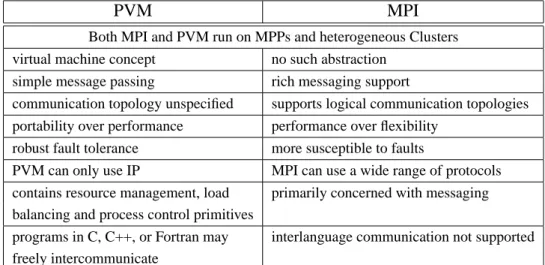
Geist et al. provide an excellent comparison between these two environments in [31], summarized in Table 1.1.
PVM MPI
Both MPI and PVM run on MPPs and heterogeneous Clusters virtual machine concept no such abstraction
simple message passing rich messaging support
communication topology unspecified supports logical communication topologies portability over performance performance over flexibility
robust fault tolerance more susceptible to faults
PVM can only use IP MPI can use a wide range of protocols contains resource management, load primarily concerned with messaging balancing and process control primitives
programs in C, C++, or Fortran may interlanguage communication not supported freely intercommunicate
Table 1.1: PVM versus MPI
We are not interested in any particular environment because we do not want to modify or improve any of those aspects listed in Table 1.1. Also, the study and applicability of coscheduling do not depend on the choice of one of them.
However, PVM has more resource management facilities (such as the console) and task management capabilities. These facts simplify enormously the use and control of the overall system and as we will see, they also have an important role in the implementation of new coscheduling mechanisms. Consequently, PVM was finally the chosen distributed computing environment.
1.1.1.4 Local Applications
Different kinds of applications can be executed in a Cluster. We only distinguish between distributed and local ones. Distributed applications are formed by one or various distributed tasks. This is also true for local applications. The main difference between them is that all the local tasks making up a local application reside in one unique node. On the contrary, distributed tasks making up distributed applications can reside in different nodes. So, remote (only local) communication or synchronization between distributed (local) tasks may occur.
Throughout this document the local applications are denoted as local, user or interactive workload. Also, the term “workload” will be used to denote the local tasks residing in a particular Cluster node.
The term “workload index” will be used to quantify the number of local tasks residing in each Cluster node. A wide variety of workload indices have been used in the literature [53, 54, 55]. From among, the Ready to run Queue (RQ) length was chosen. This was decided because the work done by Ferrari [54] shows, by a wide range of experimentation, that the length of the RQ is a good index for measuring the load of a workstation.
Ferrari compared various workload indices. First, he differentiated the ones based on resource utilization and the ones based on resource queue length. Various resources were considered: the CPU, Main Memory (MM) and I/O (the different disk queues were treated as a single I/O queue). It was shown that resource uti-lization cannot reflect the load level exactly. As an example, a resource with an average queue lengths of 3 and 6, probably has a utilization close to 100%, while they are obviously very differently loaded. Also differences in workload indices based only on CPU queue length and those considering also I/O and MM queue lengths gave very close values. He also proved that the CPU is the most
predom-1.2. THE COSCHEDULING CONCEPT 13 inant resource. The conclusion is that the average RQ length is a good workload index.
In [55], using a synthetic, executable workload, the experiments were con-ducted to determine the effect of different load indices. It was also shown that by using a simple workload descriptor, such as the number of tasks in the ready queue, one can achieve an equal or better performance compared with more com-plex load descriptors.
In this project we are interested in observing the interaction between the dis-tributed and local workloads. A wide range of disdis-tributed applications (i.e. syn-thetic and well known benchmarks) will form the distributed workload. Instead, the local or user workload characterization in each node of the Cluster is carried out by means of running synthetic applications, which perform basically floating point operations indefinitely (or a variable number of times). Taking into account the work done by Ferrari, it is a good characterization of the workload because the key question is based on varying the mean RQ length (and this way, the work-load). Furthermore, it is more helpful in obtaining and comparing performance of the different proposed environments because the workload is not a variable factor to be taken into account (it can be fixed at a predetermined value).
1.2
The Coscheduling Concept
1.2.1
Scheduling Schemes
Parallel/Distributed scheduling is usually decomposed into two independent steps. The first step, space slicing, determines the mapping of a parallel/distributed ap-plication into a set of processors. The second step, time slicing (or time sharing), dispatches those allocated processes over time.
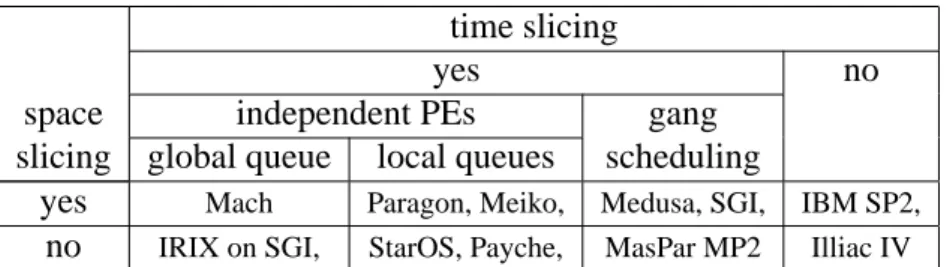
A comprehensive classification of the scheduling techniques for multipro-grammed parallel systems was done by Feitelson in [13]. It was based on the way the computing resources are shared: space slicing, time slicing, or both. Ta-ble 1.2 shows a more reduced Feitelson’s scheme with one or two examples of real systems for each particular case. On the time slicing axis, the main distinction was made between mechanisms that operate independently in each PE (Processor
Ele-ment) and Gang scheduling (defined later), that handles a group of PEs as a single unit. Mechanisms for independent PEs are further divided into those that use lo-cal queues (requiring processes to be mapped to PEs before their scheduling), and those which use a shared global queue.
time slicing
yes no
space independent PEs gang
slicing global queue local queues scheduling
yes Mach Paragon, Meiko, Medusa, SGI, IBM SP2, no IRIX on SGI, StarOS, Payche, MasPar MP2 Illiac IV
Table 1.2: Time-slicing and space-slicing classification.
As can be seen in Table 1.2, the first and second scheduling steps are indepen-dent. We focus on the second step of time slicing processes over time. Thus, no more space slicing techniques will be considered.
One of the most popular time slicing mechanisms is Gang scheduling ([2]).
Gang scheduling is based on the preemptive and simultaneously scheduling of a
certain set of processes (or threads) on distinct PEs, with a one-to-one mapping of threads to PEs. Thus, it requires coordinated context switching across the PEs, which is harder to implement than independent context switching. Basically, the benefits are reached when the overhead of frequent context switching is saved and the need for buffering during communication is reduced.
Gang scheduling is gaining in popularity, and an increasing number of
com-mercial systems provide gang scheduling. Some examples of real implementa-tions in different computer systems are: Medusa, SGI, Butterfly, Tera, Cray T3E, Meiko CS-2, Intel Paragon, CM-5, Cedar, IBM SP2 and so on.
1.2.2
Coscheduling
In gang scheduling (coscheduling’s ancestor) all the threads in a job are scheduled and de-scheduled at the same time, so threads composing jobs should be known in advance. This information, in distributed systems like Clusters or NOWs, is very difficult to obtain (or maintain). The alternative is to identify them during
1.2. THE COSCHEDULING CONCEPT 15 execution [12]. Furthermore, if the processes synchronize with each other at fine granularity, it would be beneficial to schedule just some of them simultaneously, leading to coscheduling rather than gang scheduling.
Coscheduling was originally defined by Ousterhout in [2] to describe systems
where the operating system attempts to schedule a set of processes simultaneously on distinct PEs, as in gang scheduling, but if it cannot, then it resorts to scheduling only a subset of the processes simultaneously.
Another interesting and perhaps a bit more self-contained definition, by Feit-elson in [12], is as follows: Coscheduling ensures that no process will wait for a non-scheduled process for synchronization/communication and will minimize the waiting time at the synchronization points.
In a Cluster or NOW system, coscheduling is applied to reduce message wai-ting time (by synchronizing tasks composing fine grained distributed applications -those with a high communicating degree-).
The distinction between gang scheduling and coscheduling is subtle but signi-ficant. Coscheduling is a variant of gang scheduling that does not guarantees that all the processes (or threads) making up a distributed (or parallel) application will always run simultaneously.
A gang feature (derived from the above mentioned distinction) which also dif-ferentiate those mechanisms is that gang scheduling allows guarantees about the performance to be given. This is so because applications execute in an environ-ment that is essentially the same as a dedicated machine, except for some addi-tional overheads. Coscheduling, on the other hand, has unknown performance implications. If the application processes are largely independent, they can make progress even if the whole gang is not scheduled. Coscheduling can be performed between groups of processes which form the gang. In this case, coscheduling can be highly beneficial.
Researchers in this area have shown that coscheduling can offer good per-formance, although the literature demonstrates that coscheduling is critical for parallel programs in order to achieve acceptable performance. The key question is how coscheduling techniques must combine parallel and sequential workloads with reasonable performance for both computation kinds.
1.2.3
Coscheduling Classification
The coscheduling techniques follow two control-based trends:
• Explicit-control coscheduling: in explicit-control coscheduling, cooper-ating components (i.e. specialized nodes or processes) explicitly contact other local or remote components for control or state information. They are responsible for making decisions and controlling the overall system.
Another level of classification was indicated by Poovendran in [20]. Explicit-control coscheduling may be accomplished statically with the provision of a global scheduler responsible of making decisions in advance, or dynami-cally, where decisions are made at each context switch. In the last case, controlling and information interchange must be performed between the processes or nodes responsible for implementing explicit-control cosche-duling in a distributed manner.
• Implicit-control coscheduling: in implicit-control coscheduling, compo-nents infer remote state by observing naturally-occurring local events and their corresponding implicit information, i.e., incoming (outgoing) mes-sages to (from) a Cluster node, local workload, etc...
It deals with implicit information: each node in the Cluster acts according to the interpretation of some sort of event, and determining from this the convenience for coscheduling processes with other cooperating distributed tasks.
Implicit-control simplifies the construction of distributed system services. Com-ponents neither query nor control remote comCom-ponents in their actions. Thus, an implicit-control system does not contain additional communication beyond that which is inherent in constructing the service.
Unlike implicit-control coscheduling, explicit-control techniques provide a means for controlling the overall system, and information concerning the global behavior must be maintained, thus more accurate decisions can be taken. The drawback is in the overheads introduced in the addition of (information and con-trol) message exchanging between the processes that implement the mechanism.
1.3. RELATED WORK 17 The choice between explicit or implicit-control coscheduling mechanisms de-pends on the requirements of the final distributed system.
1.3
Related Work
Researchers and efforts in coscheduling have grown continuously since their ori-gin. Nowadays, it still remains as an open question. As a consequence of such research work, many tendencies have arisen or are being developed. So, an accu-rate study of the state of the art must be performed.
Feitelson and Rudolph in [11], compared the performance of gang scheduling using busy-waiting synchronization to that of independent (uncoordinated) time sharing using blocking synchronization. They found that for applications with fine-grain synchronization, performance could degrade severely under uncoordi-nated time sharing when compared with gang scheduling. In an example where processes synchronized about every 160µs on a multiprocessor with 4-MIPS pro-cessing nodes, applications took roughly twice as long to execute under uncoor-dinated scheduling as they did under gang scheduling.
Another interesting study was performed by Crovella et al. in [8]. They showed that independent time sharing without regard for synchronization pro-duced significantly greater slowdowns than coscheduling. Chandra et al. have reported similar results in [10]: in some cases independent time sharing is as much as 40% slower than coscheduling.
In general, the results cited above agree with the claims advanced by Ouster-hout in [2]: under independent time sharing, multiprogrammed parallel job loads will suffer large numbers of context switches, with attendant overhead due to cache and TLB reloads. The extra context switches result from attempts to syn-chronize with de-scheduled processes.
As was mentioned in section 1.2, the coscheduling techniques follow two ma-jor trends: explicit and implicit control. Moreover, the coscheduling techniques studied (from the literature) and the ones presented in this document are located in one of these two categories. So, the study of the previous work, developed in this section, attempts to separate the main coscheduling contributions to date according to this classification.
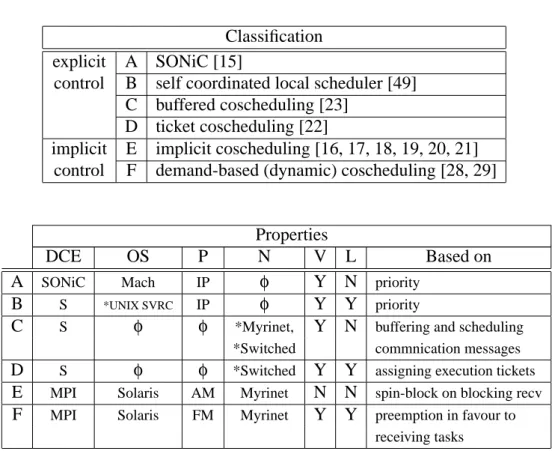
Table 1.3 resumes the most relevant work done in coscheduling to date, and presented later in this section.
The table is split into two parts. In the upper part, a classification of the most important explicit and implicit-control techniques is given. In the bottom part, the main features of each model are listed. It summarizes schematically the main differences between the models. The abbreviations used are the following: Y -Yes; N - No;φ- no observations have been made. DCE - used Distributed Com-puting Environment (S: Simulated); OS - Operating System; P - Protocol (IP: TCP(UDP)/IP, AM: Active Messages, FM: Fast Messages); N Network type (* -the coscheduling model was based on this kind of network); V - simultaneous ex-ecutions of Various distributed applications considered; L - Local tasks starvation considered.
Classification explicit A SONiC [15]
control B self coordinated local scheduler [49] C buffered coscheduling [23]
D ticket coscheduling [22]
implicit E implicit coscheduling [16, 17, 18, 19, 20, 21] control F demand-based (dynamic) coscheduling [28, 29]
Properties
DCE OS P N V L Based on
A SONiC Mach IP φ Y N priority
B S *UNIX SVRC IP φ Y Y priority
C S φ φ *Myrinet, Y N buffering and scheduling
*Switched commnication messages D S φ φ *Switched Y Y assigning execution tickets E MPI Solaris AM Myrinet N N spin-block on blocking recv F MPI Solaris FM Myrinet Y Y preemption in favour to
receiving tasks
1.3. RELATED WORK 19
1.3.1
Explicit-control Coscheduling
In [15, 49] two variants of explicit-control coscheduling were implemented. In [15] a Mach-based scheduling server was developed. It allows for parti-tioning a workstation among parallel and interactive tasks. This server is an inte-gral part of SONiC, the “Shared Objects Net-interconnected Computer”. SONiC implements an object-based distributed shared memory and remote execution ser-vices and allows for execution of parallel programs in workstation environments. The scheduling server relies on Mach’s fixed-priority scheduling policy and it is based on giving as many CPU cycles as possible to parallel tasks. By manipulating task priorities it overrides the operating system scheduler. The main contribution was that in contrast with other “remote execution systems”, SONIC does not have to be restricted to the use of only purely idle workstations.
X. Du [49], based on the coscheduling principle, implemented the so-called "self-coordinated local scheduler", which guarantees the performance of both lo-cal and parallel jobs in a NOW by a time-sharing and priority-based operating system. The scheme can be applied to schedule multiple parallel jobs. Each local scheduler adjusts the execution rate of a parallel process. The coordination of pa-rallel processes is performed independently in each workstation. The priority of the processes was varied according to the power usage agreement between local and parallel jobs. The effectiveness of this method was demonstrated by means of simulation.
Another variation of explicit-control coscheduling is Buffered Coscheduling [23]. Instead of synchronizing distributed applications, the messages are buffered and delivered later, thus reducing the need to coschedule communicating tasks. The communication generated by each processor is buffered and performed at the end of regular intervals (or time-slices) in order to amortize the communication and scheduling overhead. By delaying communication, a global scheduling of the communication pattern can be performed. Next, a strobing mechanism performs a total exchange of control information at the end of each time-slice in order to move from isolated scheduling algorithms to more global system scheduling algorithms. An important advantage of Buffered Coscheduling is that, instead of overlap-ping computation with communication and I/O within a single parallel program,
all the communication and I/O which arise from a set of parallel programs can be overlapped with the computations of the overall programs. However, additional overhead should be introduced because an explicit manipulation of messages must be done.
Although no real implementation has been performed yet, the obtained simu-lation results make this a technique to be considered. Also a more accurate study of how the messaging delay affects performance of the communicating tasks must be done.
1.3.2
Implicit-control Coscheduling
In [28], Sobalvarro introduced the concept of demand-based coscheduling, a new approach to scheduling parallel computations on time-shared multiprogrammed multiprocessors. Under demand-based coscheduling, processes are scheduled si-multaneously only if they communicate; communication is treated as a demand for coordinated scheduling. Also, it indicated that the programmer would not even need to identify the processes that constitute a parallel job.
That method does not follow the coscheduling line explained above (in explicit-control). In demand-based coscheduling, potential coscheduling is detected by the implicit information (so it follows an implicit-control trend) between communi-cating processes; avoiding not only the need to implement a system controller, but also extra communication traffic, and fault tolerance problems. Sobalvarro divided
demand-based coscheduling between Dynamic and Predictive coscheduling. Dynamic coscheduling uses the arrival of a message as a means of signaling
the scheduler that the process to which the message is addressed should be imme-diately scheduled. In the first Dynamic algorithm he presented (named the Always
Schedule dynamic coscheduling algorithm), the reception of a message always
caused a context switch in favor of the receiving task (thus preempting the task being executed in the CPU). In the most interesting algorithm, the second (named
equalizing dynamic coscheduling algorithm), a mechanism was also provided to
avoid local task starvation, where equal shares of the CPU for both distributed and local tasks were considered.
ap-1.3. RELATED WORK 21 plication was evaluated. Due to the limitations of Fast Messages [72] (the user messaging level where the equalizing algorithm was implemented), no more than one concurrent execution of parallel applications was possible.
The Predictive method is based on coscheduling at the same time those pro-cesses that have recently communicated with each other (the so-called correspon-dent processes). It deals with detecting these kind of processes implicitly and efficiently coscheduling them. No previous work in this area has been performed to date, thus Predictive coscheduling is a new and open research field.
A variation of Dynamic coscheduling, named Implicit coscheduling in [16, 17, 18], is based on the spin-blocking technique. In this, a process waiting for messages spins (i.e. performs an empty loop) for a determined time and if the response is received before the time expires, it continues execution. If not, the requesting process is blocked and another one is scheduled. In [17], the measure-ments in a Cluster of 16 workstations showed how multiple competing parallel jobs can be coscheduled implicitly with good performance. These results hold for programs that communicate either continuously or in bulk synchronous style, as well as applications with a mix of communication characteristics.
Dynamic coscheduling, in contrast to Implicit coscheduling, deals with all message arrivals (not just those directed to blocked processes), thus increasing the range of potential cases for coscheduling. This produces an important Implicit drawback because it supposes that multiple executions of distributed applications cannot be efficiently coscheduled.
In [19], Implicit coscheduling was implemented in the Berkeley Cluster, which contains 105 workstations with 16-port Myrinet switches. The communication subsystem in each node was formed by the MPI ([32, 33]) environment MPICH ([27]), and the Abstract Device Interface was implemented by Active Messages [24] operations. Results obtained in the execution of various NAS kernel bench-marks ([56]) shown as implicit coscheduling reduced the communication waiting time in the message passing applications. Their performance was improved by a factor of as much as 10, reducing the applications slowdown to 1.5 in the worst case. However, the implications that the gain in message passing applications produced in the local workload were not studied.
the extensive simulation results for Implicit coscheduling reported in the literature was presented. It provided arbitrary distributions for message arrival to distributed processes, in contrast to previous results, where only uniform ones where taken into account.
Anglano [21] evaluated different Implicit coscheduling algorithms. Basically, these algorithms were obtained as a result of combining different coscheduling strategies based on the spin-block technique explained above. Strategies were divided between: spin indefinitely, classical block, spin-block (as in [16, 17, 18]) and spin-yield (after spinning, the priority of the receiving process is decreased). Simulation results showed the importance of coscheduling a receiving process as soon as possible. But if I/O-bound (or interactive) jobs are present, more complex strategies are required in order to achieve satisfactory performance for parallel jobs. The results concerning the performance of local job performance showed that the worst strategies were those based on pure spin.
Furthermore, Gupta et al. showed similar results in [9]. They had already con-cluded that the use of non-blocking (spinning) synchronization primitives would result in even worse performance under moderate multiprogrammed loads be-cause, while the extra context switches are avoided, the spinning added an im-portant overhead. Also, the above mentioned work by Feitelson and Rudolph in [11] corroborates these conclusions.
Anglano reconsidered the situation in [22], motivated by the fact that spinning does not allow performance of parallel applications to be achieved when various of them were executed simultaneously with local workload. In that work, he pro-posed a ticket distribution between users and processes. It is based on distributing execution tickets to the users depending on the global shared resource require-ments. The strategy moved thus from implicit to explicit-control coscheduling. Experiments were performed by simulation. Note that in Cluster computing, re-source requirements change rapidly, continuously and drastically, so the manage-ment of the global user requiremanage-ments, can be very inefficient.
1.4. MOTIVATION AND OBJECTIVES 23
1.4
Motivation and Objectives
1.4.1
Motivation
The necessity and the main goal for coscheduling distributed tasks in Cluster sys-tems is explained next by means of an example.
Let three intensive message-passing distributed applications be A1, A2and A3,
and a Cluster C made up of three identical machines, M1, M2 and M3. Each
distributed application is composed of two tasks (i.e. A1 ={A1,1,A1,2}, A2 = {A2,1,A2,2}, A3={A3,1,A3,2}) (see Fig. 1.3), which are also mapped into three
different machines. The Mapping Assignment (MA) for each distributed applica-tion is: MA(A1) = n A11,1,A12,2o, MA(A2) = n A22,1,A23,2o, MA(A3) = n A23,1,A33,2o, where Aki,jmeans task j composing distributed application i is assigned to machine
k.
Communication Computation
tasks Ai,1 and Ai,2 form distributed application Ai
Comments: A A3,1 A A3,2 A1,1 A1,2 2,1 2,2
both computation and communication for each task is 1 time unit
Figure 1.3: Applications A1, A2and A3
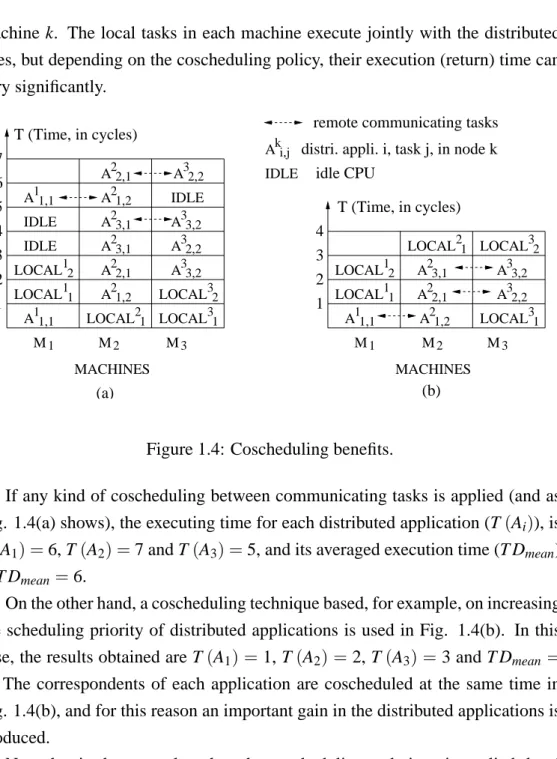
It is assumed that when a distributed task cannot communicate, it only per-forms its computations and will need another Time Slice for communication. However, if the distributed task can communicate with its correspondent, it can perform computation and communication at the same time, because the resources to do this are different. For simplicity reasons we suppose that each task of every application needs one unit of time for computation and another time unit for com-munication.
It is also supposed that there are local tasks in each machine: {LOCAL11,
LOCAL12} in machine M1, {LOCAL12} in machine M2 and {LOCAL31, LOCAL32}
machine k. The local tasks in each machine execute jointly with the distributed ones, but depending on the coscheduling policy, their execution (return) time can vary significantly. M3 M1 M3 M2 M1 LOCAL11 LOCAL12 LOCAL11 LOCAL12 LOCAL21 LOCAL21 LOCAL31 LOCAL32 LOCAL32 LOCAL31 M2 1,1 A1 1,1 A1 A23,1
remote communicating tasks
IDLE idle CPU
4 3 2 1 7 6 5 4 3 2 1 IDLE IDLE IDLE T (Time, in cycles) T (Time, in cycles) MACHINES MACHINES (a) (b) A A A A A A A A A A 1,1 A A A 1,2 2 2 2 2 2 3 3 3 3 1 2 2 2 3 3 2,1 A3,1 1,2 2,1 3,2 2,2 3,2 3,1 2,1 3,2 2,2 2,2 1,2 A
Aki,j distri. appli. i, task j, in node k
Figure 1.4: Coscheduling benefits.
If any kind of coscheduling between communicating tasks is applied (and as Fig. 1.4(a) shows), the executing time for each distributed application (T(Ai)), is
T(A1) =6, T(A2) =7 and T(A3) =5, and its averaged execution time (T Dmean)
is T Dmean =6.
On the other hand, a coscheduling technique based, for example, on increasing the scheduling priority of distributed applications is used in Fig. 1.4(b). In this case, the results obtained are T(A1) =1, T(A2) =2, T(A3) =3 and T Dmean =
2. The correspondents of each application are coscheduled at the same time in Fig. 1.4(b), and for this reason an important gain in the distributed applications is produced.
Note that in the example, when the coscheduling technique is applied, local tasks, denoted as LOCAL21 (in machine M2) and LOCAL32 (in machine M3), are
delayed by three and two cycles respectively. To simplify the problem, time is in cycle units. In real time-sharing systems, each cycle corresponds to some variable amount of time (often named Time Slice). In turn, a Quantum is the maximum
Follow-1.4. MOTIVATION AND OBJECTIVES 25 ing the example, if one cycle is equivalent to a Quantum, it would mean that each process spends all the maximum allowed time executing inside the CPU each time it is dispatched. In Linux, the value of the Quantum is 210 ms, and if it is used as a reference in this example, LOCAL21 would be delayed 630 ms. In this case, the response time (one of the most important system performance indices for lo-cal applications) of LOCAL21 is not increased excessively, but real coscheduling techniques may even cause starvation of the local (even distributed) tasks.
This simple example shows us the motivation for implementing coscheduling techniques, but the observed gain is not always reached. There are many other fac-tors to be considered, for example, how to obtain the communicating frequency, avoid local tasks starvation and so on.
1.4.2
Objectives
In Cluster or NOW systems, combining parallel and sequential workloads with reasonable performance for both computation kinds is an open research goal. Or in other words, how to build a NOW that runs parallel programs with performance equivalent to a MPP (Massively Parallel Processor) with the ability to execute sequential programs like a dedicated uniprocessor, is still an open question to be solved.
Furthermore, as mentioned at the beginning of this chapter, workstations in a NOW are normally underloaded. Thus, executing distributed applications in these systems will lead to making good use of the CPU idle cycles. Consequently, the use of NOWs in distributed processing is also justified.
Certainly, taking into account these previous comments, the Cluster system features and the definition of coscheduling, the goals of this thesis will be more easily understood.
Before going into detail on the objectives of this project, the main and sec-ondary goals are described in general terms.
Main objective: to execute distributed and local (or user) applications efficiently
in a Cluster of NOW system by applying coscheduling techniques. Efforts
or NOW system when distributed jobs are executed jointly with local work-loads, balancing parallel performance against the local interactive response. To carry out this objective, new coscheduling techniques are presented in this thesis.
Furthermore, various coscheduling mechanisms proposed in the literature were tested by simulation and some of them were also evaluated in a real Linux Clus-ter. Comparison of their performance in the same simulator system and in a real Cluster was the second objective of this thesis.
These two generic objectives are summarized in the design and implemen-tation of two new coscheduling techniques (one with explicit and another with implicit control), which are detailed below.
Explicit-Control: the realization of a real implementation of explicit coschedu-ling in a NOW is the first objective. We will attempt to ensure that user of the parallel machine regularly has all the computing power of the NOW available during a short period of time. The expectation in doing so is to in-crease the performance of message-passing distributed applications without excessively damaging the local one.
Our contribution in this field is based on the work carried out in [37, 38, 39], where an explicit-control coscheduling algorithm was implemented in a PVM-Linux Cluster.
Implicit-Control: the realization of a Predictive coscheduling algorithm in a non-dedicated Cluster is the second specific aim of this thesis. It consists of cos-cheduling the sets of correspondent -recent communicated- processes at the same time. To do so, the correspondents must be known in advance, but in distributed (i.e. Cluster) systems, this information is very difficult to obtain. Our proposal is based on the assumption that high receive-send message frequencies imply that potential coscheduling with remote processes is met. We propose to identify the correspondent processes in each node by tak-ing into account the receive-send message frequency. Normally, the most recent communicating processes need to communicate again soon, so their
1.5. OVERVIEW 27 scheduling priority must be increased without damaging the local task per-formance excessively. Not only is message receiving considered -as in [16, 17, 18, 19, 28, 29]-, since tasks performing only message receiving do not justify the need for coscheduling. This is also true for only sen-ding processes. This way, an approximation to Predictive coscheduling is performed.
Also, as in explicit-control, the contributions presented in implicit-control are based on some previously presented work in [39, 41, 42, 43].
1.5
Overview
The remainder of this document is organized as follows.
In chapter 2, two new coscheduling models are presented. They are defined and analyzed separately. First, in section 2.1, an explicit-control mechanism is presented, named also Explicit.
A new Predictive coscheduling mechanism which follows an implicit-control policy is presented in section 2.2. It includes an implicit-control coscheduling model (named CMC: Coscheduling Model for non-dedicated Clusters). Sections 2.2.1 and 2.2.2 respectively describe the notation used and a new set of CMC related performance metrics. Their applicability in a generic scheduler is introdu-ced next in section 2.2.3. Also, a Predictive coscheduling algorithm based on this model is developed in section 2.2.4.
Finally, Dynamic coscheduling, a variant of