A DISSERTATION SUBMITTED TO THE GRADUATE DIVISION OF THE UNIVERSITY OF HAWAI‘I AT M¯ANOA IN PARTIAL FULFILLMENT
OF THE REQUIREMENTS FOR THE DEGREE OF DOCTOR OF PHILOSOPHY
IN
COMMUNICATION AND INFORMATION SCIENCES AUGUST 2019
By Philipp Jordan Dissertation Committee: Scott Robertson, Chairperson
Rich Gazan Wayne Buente Brent Auernheimer
Hyoung-June Park
Keywords: science fiction, human-computer interaction, computer science, science studies, content analysis
an incredible person, mother and teacher who left too early, but will never be forgotten.
I also dedicate this dissertation to Wilhelm Jordan, a worldly-wise and calm father who always supported my dreams
and allowed me to live my life the way I chose, which is truly the greatest gift of all.
I also dedicate this work to all the dreamers out there, the players with no agenda,
the thinkers and not the makers, the artists and not the economists and
I would like to express my gratitude to my chairperson, Scott Robertson, Professor of Computer Science at the University of Hawai‘i at M¯anoa, who has been a wonderful source of both, academic guidance and emotional support to me. Thank you Scott, you believed in me and this topic and you let me pursue it, independently, under your supervision. At the same time, you brought me back on track when I got lost and you certainly made me believe in myself in times, I did not.
I would like to acknowledge my incredible committee member Brent Auernheimer, Professor of Computer Science at California State University Fresno. Brent, who I have (so far) never met in person, directed my attention to a 2015 workshop on science fiction and human-computer interaction and, as a result, created the inception point of my dissertation topic. Brent, I genuinely have come to appreciate your wisdom, eye for opportunity, helpful advice and of course, the continuous exchange and mutual suggestions regarding the best streaming shows out there.
I would like to recognize my committee members Rich Gazan, Professor of Library and Information Sciences and former Communication and Information Sciences (CIS) Program chair, Wayne Buente, Professor of Communication and Hyoung-June Park, Professor of Architecture and Design.
I also would like to mention the CIS Program chairs I have met over the years, who always did provide an open ear and understanding in times, when academics were not the priority in my life, when funding fell through, when I needed support or when I was struggling in the CIS Program. I would like to acknowledge Daniel Suthers, Professor in Information and Computer Sciences and former CIS chair for admitting me last-minute into the CIS Program in Fall 2011. I would like thank Elizabeth Davidson, Professor of Information Technology Management and former CIS chair for her continuing support in the last couple of semesters, when I was finishing this work.
I also want to express my gratitude to a couple of extramural researchers, who did join the science fiction bandwagon and helped me conducting numerous pilot studies, among those, Omar Mubin, Senior Lecturer at Western Sydney University and Mohammad Obaid, Lecturer in Art and Design, at the University of New South Wales. I think without our collaboration, this journey and dissertation would have not been possible. Thank you for working with me on this topic, I certainly enjoyed the papers we wrote as much as the many discussion we had.
Lastly, but certainly not least, I want to thank my dear friend, first true academic mentor and former supervisor Paula Alexandra Silva, currently a Research Fellow at the University of Aveiro. I know Paula since almost ten years and did finish my first Master of Science Degree under her supervision. Ever since, we have been supporting each other, in- and outside of academics. Without you Paula, I would not have ever come to Hawai‘i and you were seminal in supporting me academically and personally over the many, many years, which we used to develop our amazing and true friendship. You are always in my thoughts and I am very grateful to have you in my life.
The depictions of advanced devices, innovative interactions and future technologies in science fiction are a regular topic in popular news and tech magazines. While actual studies concerning the usage of science fiction in computer science research are scarce and if any, rely mostly on anecdotal evidence and scattered oral accounts, such investigations are critical to better understand the potential utility and latent shortcomings of science fiction for computing research, innovation and education. Through a content analysis of science communication, this dissertation endeavors to shed light on the relationship between both domains.
Based on a dataset of n=1647 computer science publications, retrieved in the IEEE Xplore Digital Library via a faceted, full-text search for ‘science fiction’, this dissertation presents a study of science communication. A random sample of n=500 records of the principal dataset is subjected to a detailed, qualitative content analysis over 10 variables, including an inter-rater agreement evaluation of n=125 publications between two raters for two interpretative variables – the type of research paper and the contextual usage of the science fiction referral.
The results of the study show that science fiction, in the grand scheme of things, is a niche topic in computer science research. Within that margin, however, the results demonstrate that science fiction referrals appear primarily in opinion-type research contributions, most often for reasons of drawing inspiration and innovation into the research paper.
In addition, the analysis of science fiction referrals, across paper types and contexts over time, indicates a transition and diversification from initially, informal contributions toward later on, a broader diversity of research publication types. Also, the study shows that science fiction films are more often referenced than science writings. Most recently, in publications from 2014-2017, an emphasis on a broad and diverse set of concrete, visual, science fiction – potentially indicating a shift away of scientists from written, interpretative science fiction – can be observed.
The analysis of the most frequent, specific science fiction referrals reflects a narrow, mostly western-originated selection of the most popular, influential and iconic science fiction authors, writings, films, and characters of the 20th century, among those, Isaac Asimov and Arthur C. Clarke,
William Gibson’s novel Neuromancer, the Star Trek and Star Wars franchises and Stanley Kubrick’s 2001: A Space Odyssey, including its main antagonist, HAL 9000.
The results and implications of this study can guide computer scientists and educators to consciously utilize science fiction in their research and scholarship and therefore, contribute to forthcoming, innovative HCI and computer science research, application, and education. In addition, the results provide insight into the appropriation of popular culture within a technical-oriented, professional, academic science communication repository. Building upon extensive prior work, this dissertation moreover provides a methodological framework, which allows the meaningful discovery of interdisciplinary relations between computer science research and culture & art.
The role of science fiction (SF), and especially science fiction movies and shows (SFMS), to inspire and generate real-world technological developments is slowly understood and occasionally utilized by human-computer interaction (HCI) researchers, user experience professionals, and science educators. Nowadays, through the proliferation of cinematic special effect technologies and means of digital distribution, SFMS are available to audiences around the globe in the blink of an eye.
Specifically, depictions of future HCI and soon-to-be technologies can be found in great numbers in SF writings and films. These examples, and the occasional oral account, do provide partial evidence that SF might be a factor in driving real-world inventions and innovation. As such, the possibilities of this repository of SF / SFMS for science and technology research and development (R&D) are increasingly recognized, discussed and applied by experts in science and closely related
science, technology, engineering and mathematics (STEM) fields.
This study engages with SF / SFMS and explores its uses in academic communication over time. In a concise manner, the structure of this dissertation can be summarized in the following fashion:
- Chapter 1 gives an introduction to SF, SFMS and the relationship of SF, SFMS and science and technology in the context of HCI and computer science research.
- Chapter 2 provides the significance and contribution statement and introduces the research rationale of the study, including the research aims, research objectives, and research questions. - Chapter 3 provides the background as a theme-oriented literature review on the topic of HCI
and SF (Section 3.1) as well as a methodological background (Section 3.2) with a focus on text retrieval and content analysis.
- Chapter 4 presents the methodology in a comprehensive description, including an overview of the research process and details on the search and retrieval approach, sampling, coding scheme and subsequent descriptive and qualitative content analysis.
- Chapter 5 provides the key results, based on a review of a cache of n=500 computer science research publications, among those, insights on the uses of SF / SFMS in different research contributions as well as evolutionary trends over a period of more than 7 decades.
- Chapter 6 presents an inclusive discussion and outlines the limitations of the study.
- Chapter 7 provides the conclusions of this dissertation and in addition, envisions future work in the context of SF / SFMS and computer science / HCI research.
- Appendix A provides the full results of the study in form of exhaustive frequency tables. - Appendix B provides the peer-reviewed work, earned press and extramural research funding in
Acknowledgments . . . iv
Abstract . . . v
Preamble . . . vii
List of Abbreviations . . . xii
List of Tables . . . xiv
List of Figures . . . xvi
1 Introduction . . . 1
1.1 SF Movies and Shows . . . 1
1.2 SF and Science Crossings . . . 12
1.3 Summary . . . 14
2 Research Rationale . . . 15
2.1 Current Limitations . . . 15
2.2 Significance and Contribution . . . 16
2.3 Research Aims . . . 18 2.4 Research Objectives . . . 18 2.5 Research Questions . . . 19 2.6 Summary . . . 21 3 Background . . . 22 3.1 Related Work . . . 22
3.1.1 SF, Computing Visions and Design Theory . . . 22
3.1.3 SF and Real-World Scientists . . . 27
3.1.4 SF in Computer Science Education . . . 30
3.1.5 SF and Computer Science Frameworks and Models . . . 34
3.1.6 A Chronology of SF and Computer Science Research . . . 39
3.1.7 Summary of the Related Work . . . 41
3.2 Methodological Background . . . 42
3.2.1 Research Tools and Software . . . 42
3.2.2 Metadata versus Full-text Search and Retrieval . . . 43
3.2.3 Repository Search Limitations . . . 44
3.2.4 Prospective Coding Categories . . . 45
3.2.5 Type of Research Paper . . . 46
3.2.6 Usage and Relationship of SF in the Paper Context . . . 48
3.2.7 SF–Computer Science / HCI Coding Schemes, Classifications and Taxonomies 51 3.2.8 Inter-rater Reliability . . . 52
3.2.9 Magnitudes and Interpretation of Cohen’sκ and Krippendorff’s α . . . 53
3.2.10 Summary of the Methodological Background . . . 54
4 Methodology . . . 55
4.1 Method Overview . . . 55
4.2 Method Sampling . . . 57
4.3 Inter-rater Reliability: C4 (125). . . 58
4.4 Final Coding Categories: C4 (500) . . . 59
4.4.1 Location of the SF Referral . . . 59
4.4.3 Type of Research Paper . . . 60 4.4.4 Contextual SF Referral . . . 60 4.4.5 Contextual SF Particulars . . . 62 4.5 Summary . . . 62 5 Results . . . 64 5.1 Candidate Repositories . . . 64 5.2 Candidate Sets . . . 65 5.2.1 Initial Queries . . . 66
5.2.2 Final Candidate Sets . . . 68
5.2.3 C1: Candidate Set 1 – ACM Digital Library – Metadata . . . 70
5.2.4 C2: Candidate Set 2 – IEEEXplore – Metadata . . . 71
5.2.5 C3: Candidate Set 3 – ACM Digital Library – Full-text . . . 71
5.2.6 C4: Candidate Set 4 – IEEEXplore – Full-text . . . 72
5.2.7 Dataset Facets . . . 72
5.2.8 C4 as Final Dataset . . . 72
5.3 Metadata Analysis: C4 (1647) and C4 (2487) . . . 74
5.3.1 Publication Types: C4 (2784) and C4 (1647) . . . 74
5.3.2 Publication Years: C4 (2784) and C4 (1647) . . . 74
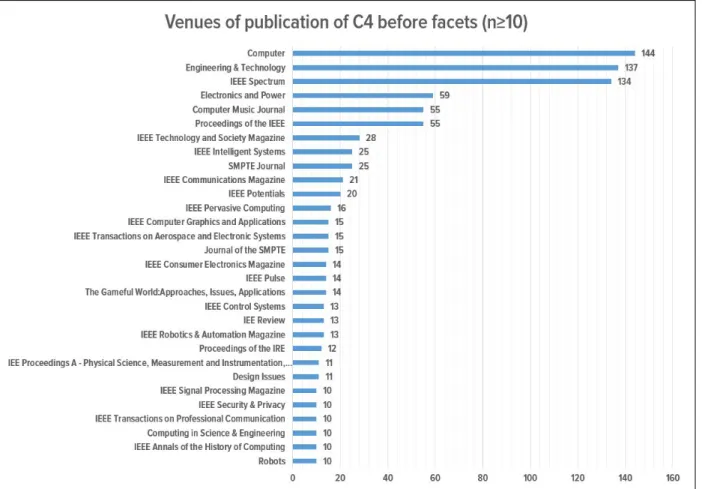
5.3.3 Publication Venues: C4 (2784) and C4 (1647) . . . 77
5.3.4 Publication Keywords and Index Terms: C4 (2784) and C4 (1647) . . . 79
5.4 Descriptive Analysis: C4 (125) . . . 82
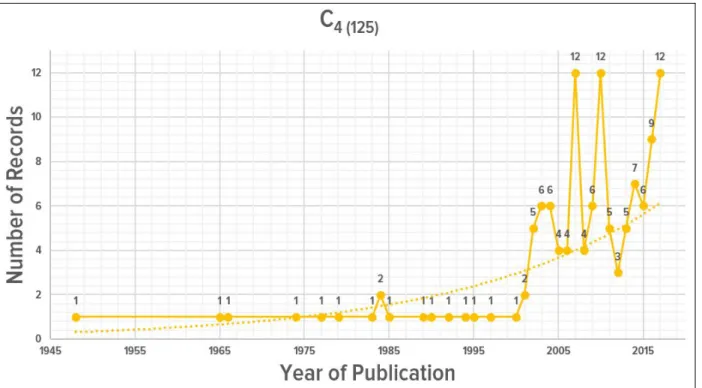
5.4.1 Publication Years: C4 (125). . . 82
5.4.3 Inter-rater Reliability: C4 (125) . . . 83
5.5 Descriptive Analysis: C4 (500) . . . 87
5.5.1 Publication Years: C4 (500). . . 87
5.5.2 SF Referral Frequency and Location: C4 (500) . . . 87
5.5.3 Type of Research Paper: C4 (500) . . . 90
5.5.4 Contextual Usage of the SF Referral: C4 (500) . . . 90
5.5.5 Type of Research Paper / Contextual Usage of the SF Referral: C4 (500) . . . 91
5.5.6 SF Authors: C4 (500) . . . 92
5.5.7 SF Writings: C4 (500) . . . 93
5.5.8 SF Movies and Shows: C4 (500) . . . 95
5.5.9 SF Characters: C4 (500) . . . 96
5.5.10 SF Concepts: C4 (500) . . . 98
5.6 Chronological Trends: C4 (500) . . . 100
5.6.1 Chronological Trends – Paper Types: C4 (500) . . . 100
5.6.2 Chronological Trends – SF Referrals: C4 (500) . . . 102
5.6.3 Chronological Trends – SF Particulars: C4 (500) . . . 104
5.7 Selected Coding Examples: C4 (500) . . . 106
5.7.1 C4 (500): Artifact-type Papers . . . 106 5.7.2 C4 (500): Empirical-type Papers . . . 108 5.7.3 C4 (500): Methodological-type Papers . . . 110 5.7.4 C4 (500): Opinion-type Papers . . . 113 5.7.5 C4 (500): Other-type Papers . . . 117 5.7.6 C4 (500): Survey-type Papers . . . 120
5.7.7 C4 (500): Theoretical-type Papers . . . 122 5.7.8 Summary . . . 124 6 Discussion . . . .125 6.1 Selected Results . . . 125 6.2 Limitations . . . 132 7 Conclusions . . . .135 Bibliography . . . .139 A Full Results . . . .166 A.1 SF Authors in C4 (500) . . . 166 A.2 SF Writings in C4 (500) . . . 168
A.3 SF Movies and Shows in C4 (500) . . . 174
A.4 SF Characters in C4 (500). . . 177
A.5 SF Concepts in C4 (500) . . . 179
A.6 Paper Types by Year in C4 (500) . . . 188
A.7 SF Referrals by Year in C4 (500) . . . 190
A.8 SF Particulars by Year in C4 (500) . . . 192
Table 1: List of Abbreviations Abbreviation Paraphrase
ACM Association for Computing Machinery ACS American Chemical Society
AI Artificial Intelligence AR Augmented Reality BCI Brain-computer Interface
C1 Candidate Set 1
C2 Candidate Set 2
C3 Candidate Set 3
C4 Candidate Set 4
C4 (2874) Candidate Set 4 before facets (2874 records)
C4 (1647) Candidate Set 4 after facets (1647 records)
C4 (500) Random sample of 500 records of C4 (1647)
C4 (125) Random subset of 125 records of C4 (500)
CGI Computer-generated Imaginary CHI Computer-human Interaction CRT Cathode-ray Tube
EBSCO Elton B. Stephens CO. FX Special Effects
HAI Human-Agent Interaction
HAL Heuristically programmed ALgorithmic computer HCI Human-computer Interaction
HRI Human-robot Interaction
IBM International Business Machines Corporation ICT Information and Communication Technologies IDF Inverse Document Frequency
IEEE Institute of Electrical and Electronics Engineers
INSPEC Information Services for the Physics and Engineering Communities IMDB Internet Movie Database
MIT Massachusetts Institute of Technology IRB Institutional Review Board
Table 1 – continued from previous page Abbreviation Paraphrase
IRR Inter-rater Reliability
ISI Institute for Scientific Information IxD Interaction Design (IxD)
MMORPG Massively Multiplayer Online Role-playing Game NASA National Aeronautics and Space Administration
NAS National Academy of Sciences NLM National Library of Medicine OCR Optical Character Recognition
P21 Framework for 21st Century Learning
QDA Qualitative Data Analysis R1 Rater 1
R2 Rater 2
R&D Research and Development RFID Radio-frequency Identification
SIGCSE Special Interest Group on Computer Science Education SF Science Fiction
SFMS Science Fiction Movies and Shows SFP Science Fiction Prototyping
SPSS Statistical Package for the Social Sciences
STEM Science, Technology, Engineering, and Mathematics STS Science, Technology and Society Studies
TF Term-frequency
UCLA University of California Los Angeles UX User Experience Design
1 List of Abbreviations . . . xii
3.1 Taxonomies of HCI and SF . . . 51
3.2 κ and α ranges and interpretation . . . 53
4.1 Overview of variables, attributes, scales and data types . . . 63
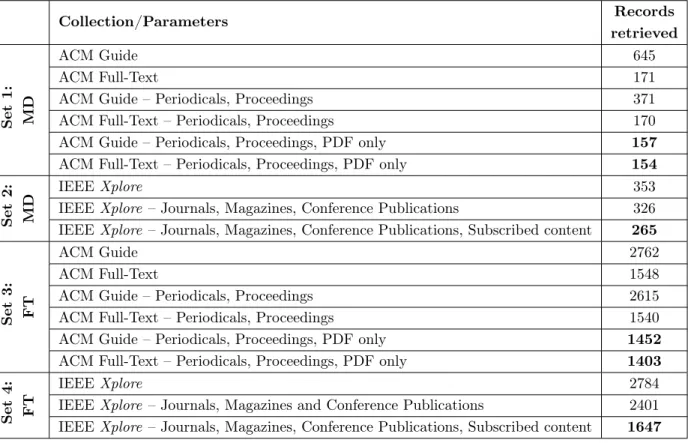
5.1 Overview of candidate sets . . . 70
5.2 Publication Types: C4 (2784) and C4 (1647) . . . 74
5.3 Top 20 keywords and indexing terms: C4 (2784) and C4 (1647) . . . 81
5.4 SF Referral frequency and location: C4 (125) . . . 83
5.5 SF Referral frequency and location in C4 (500) . . . 89
5.6 Most frequent SF Authors: C4 (500) . . . 93
5.7 Most frequent SF Writings: C4 (500) . . . 94
5.8 Most frequent SF Movies and Shows: C4 (500) . . . 96
5.9 Most frequent SF Characters: C4 (500) . . . 97
5.10 Most frequent SF Concepts: C4 (500) . . . 99
A.1 Full list of SF Authors: C4 (500) . . . 166
A.2 Full list of SF Writings: C4 (500) . . . 168
A.3 Full list of SF Movies and Shows: C4 (500) . . . 174
A.4 Full list of SF Characters: C4 (500) . . . 177
A.6 Data table for Figure 5.14 . . . 188
A.7 Data table for Figure 5.15 . . . 190
A.8 Data table for Figure 5.16 . . . 192
1.1 Selected SF Movies portraying HCI and CS technologies . . . 7
1.2 Black Mirror social rating system — ©Endemol Shine UK/Channel 4 . . . 8
1.3 Selected SF Shows portraying HCI and CS technologies . . . 9
1.4 X-Menshape-changing display and Xenovision Mark III ‘needle table’ . . . 11
2.1 Simplified visualization of the research questions . . . 20
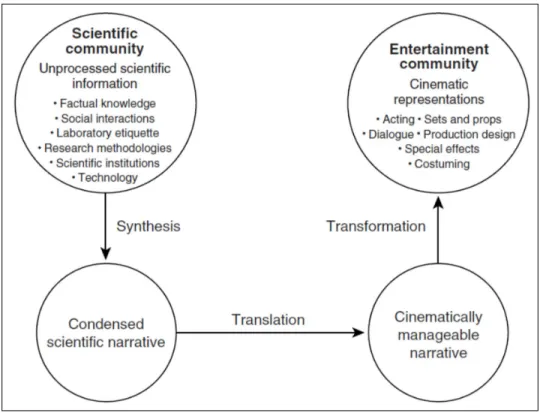
3.1 Kirby’s unidirectional framework . . . 34
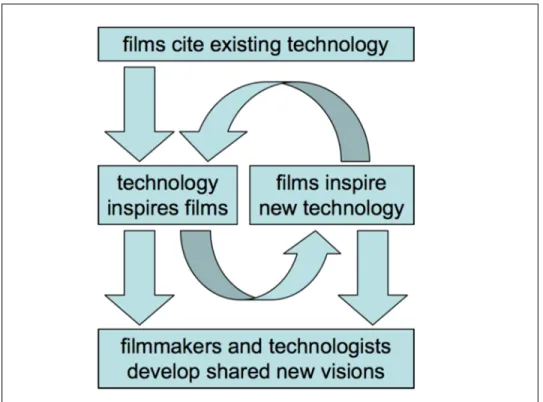
3.2 Schmitz’ multi-directional framework . . . 35
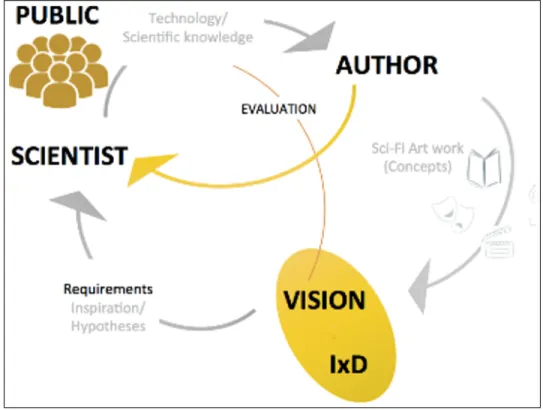
3.3 UXPA science fiction feedback loop . . . 36
3.4 UXPA science fiction feedback loop over time . . . 37
3.5 Mubin’s virtuous design cycle . . . 38
3.6 Chronological HCI / CS research . . . 39
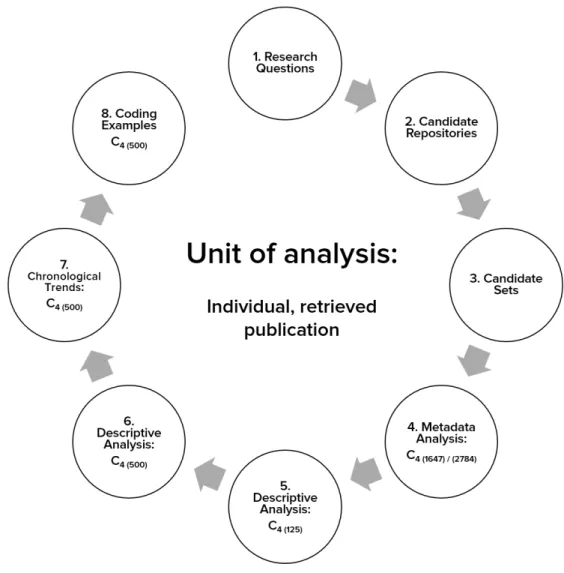
4.1 Research process . . . 56
4.2 Principal sampling of the dataset . . . 58
5.1 Searches and retrievals for SF in the ACM and IEEEXplore Digital Libraries . . . . 68
5.2 2*2 search and retrieval approach . . . 69
5.7 Distribution of publication years: C4 (125) . . . 82
5.8 IRR coefficients for the type of research paper: C4 (125) . . . 85
5.9 IRR coefficients for the contextual SF referral: C4 (125) . . . 86
5.11 Type of Research Paper: C4 (500) . . . 90
5.12 Contextual SF Referral: C4 (500). . . 90
5.13 Type of Research Paper / Context of SF Referral: C4 (500) . . . 91
5.14 Publication Years / Type of Research Paper: C4 (500) . . . 101
5.15 Publication Years / Contextual SF Referral: C4 (500) . . . 103
5.16 Publication Year / SF Particulars: C4 (500) . . . 105
5.17 Artifact-type papers and contextual SF referral: C4 (500) . . . 106
5.18 Empirical-type papers and contextual SF referral: C4 (500) . . . 108
5.19 Methodological-type papers and contextual SF referral: C4 (500) . . . 110
5.20 Opinion-type papers and contextual SF referral: C4 (500) . . . 113
5.21 Other-type papers and contextual SF referral: C4 (500) . . . 117
5.22 Survey-type papers and contextual SF referral: C4 (500). . . 120
This chapter provides a foundation for the dissertation. Section 1.1 begins with a brief overview of the history and themes of technology depiction in SF / SFMS. Section 1.2 present a more contemporary view, including the latest developments and tangible outcomes of exemplary crossings of SF / SFMS and state of the art computer science research.
1.1
SF Movies and Shows
A rich literature [86, 114, 140, 141, 142, 272, 289, 306] exists on the history of SF, SFMS and the SF film genre and its evolution. This history begins in the 19th century and runs to the present day.
For instance, Johnston’s [142] review of the history of SFMS identifies four distinct periods in parallel to paradigm shifts of the movie themes and stories within each era. These paradigm shifts are inevitably tied to external factors, including, but not limited to, the technological limitations of movie production itself (silent movie era, color television, computer-generated imagery (CGI), digital distribution), the overall geopolitical environment (e.g. the cold war/atomic era conflict between the United States of America and the Soviet Union) or, according to Johnston [142], the technological climate, including and expectations and fears of the general public.
In the period from 1895 to 1950, the genre originated and invented itself. Movies themes were diverse and focused on scientists (mostly portrayed as evil at the time, though recently transformed into more mixed or positive representations [87]), automatons, spaceships, technological uncertainty, the artificial creation of life and general scientific progress; all laying out the initial conventions what would later be known as SF film.
The next big development occurred in the period from 1950 to 1970. In these decades, American SF film depicted the geopolitical conflicts and societal fears at the time, for example, urban legends of UFO sightings (commonly referred to as flying saucers), the beginning of the aerospace race between the USA and the Soviet Union and other cold war tropes.
In the decades from 1970 to 1990, and with respect to the successful moon landing of Apollo 11, American SF cinema depicted new and elaborated imaginations of space travel and political conflicts, such as seen in theStar Warsfranchise or theStar Trekuniverse. Furthermore, special
effect technology became a commonality of the production of SFMS, such as the motion control technology in2001: A Space Odyssey [166] or the extensive CGI Computer-generated Imagery
(CGI) sequences in the originalTronmovie.
Johnston’s [142] investigation into the genre history of SFMS concludes with the decades from 1990-2010 and observes a diversification of the genre moving away from:
“[...] previous definitions of science fiction as grand displays of ‘industrial light and magic’ (citing Sobchack [306, p. 282] concerned with (and containing) special effects, technology-based narratives, and science-led plots, were no longer an accurate assessment of genre boundaries (if, indeed, they ever were).” [142, p. 105]
In contrast to a chronological analysis, Perkowitz [248] analyzes the SF film genre from a thematic perspective. Based on a dystopian point of view, the author delineates Hollywood movie themes and presents numerous examples of SF movies which depict various threats to mankind.
Among others, Perkowitz [248] introduces movie subjects which range from alien encounters and invasions (e.g. The Thing From Another World[240], Independence Day [96]), to
the consequences of a planetoid, asteroid or comet collision (e.g. When Worlds Collide [209], Armageddon [33],Deep Impact [180]).
Man-made threats to humanity, such as the consequences of overpopulation of the planet (e.g.
Soylent Green [109]) or rapid climate change (e.g. Twister[79],The Day After Tomorrow
[97]) are also common themes in SFMS. More examples of topical focal points in his review of American SF film are nuclear fear and destruction (e.g. On The Beach[162], The Sum Of All Fears[273]) as well as genetic modification, cloning and viral outbreaks (e.g. Jurassic Park[307], Gattaca [233],Outbreak [250]).
The most important topical domain in Perkowitz’ [248]) overview, in the context of this disserta-tion, is the group of SFMS which depict advanced technologies, such as sentient Artificial Intelligence (AI) and super-computers, robots, virtual or augmented realities, as seen in I, Robot [259], The Matrix[340], Blade Runner[291] orColossus: The Forbin Project[284]. In the latter part
of his review, Perkowitz [248] discusses SFMS which either, portray science and scientists reasonably accurate or, misrepresent basic scientific principles false, ultimately emphasizing the positive and negative impacts SFMS can have on the cinematic audience and as such, the general public.
While an accurate and precise definition of the SF movie genre seems already difficult enough given the outlined genre history and diversity of themes and topics it entails, defining the concept SF itself seems an even more challenging undertaking, as Gunn and Candelaria [124, p. 5] state that:
“[...] the most important, and most divisive issue in science fiction is definition.”
A variety of sources, such as SF dictionaries [260], SF authors [21], SF fan sites and collections [63, 337], critics, film researchers and futurists [83] in the history and philosophy of science offer a multitude of definitions and classifications to choose from in an attempt to define an illimitable field. According to some sources, SF dates back as early as 2AD with the Greek travel taleA True Story[281], a work consensually accepted as the first known writing with basic fictional elements,
for example outer space travel and interstellar conflicts. Among many other definitions, the Oxford English dictionary [243] describes SF at present as:
or environmental changes, frequently portraying space or time travel and life on other planets.”
Gunn and Candelaria [124, p. 6] describe SF as:
“[...] the branch of literature that deals with the effects of change on people in the real world as it can be projected into the past, the future, or to distant places. It often concerns itself with scientific or technological change, and it usually involves matters whose importance is greater than the individual or the community; often civilization or the race itself is in danger.”
Robert’s [272] cites three seminal, increasingly complex definitions of SF:
“In 1979, Darko Suvin defined the genre as a literary genre whose necessary and sufficient conditions are the presence and interaction of estrangement and cognition, and whose main formal device is an imaginative framework alternative to the author’s empirical environment.” [272, p. 7]
In 1997, Gwyneth Jones puts special emphasis on the ‘science aspect’ as:
“[...] ‘science’ in science fiction has always had a tacit meaning other than that commonly accepted. It had nothing in particular to say about the subject matter, which may be just about anything so long as the formal conventions of future dress are observed. It means only, finally, that whatever phenomenon or speculation is treated in the fiction, there is a claim that it is going to be studied to some extent scientifically—that is objectively, rigorously; in a controlled environment [. . . ].” [272, pp. 9-10]
In 1995, Broderick’s definition draws from concepts found in literary criticism and defines SF as: “[...] a species of storytelling native to a culture undergoing the epistemic changes impli-cated in the rise and supersession of technical-industrial modes of production, distribution, consumption and disposal. It is marked by (i) metaphoric strategies and metonymic tactics, (ii) the foregrounding of icons and interpretative schemata from a collectively constituted generic ‘mega-text’ and the concomitant de-emphasis of ‘fine writing’ and characterization, and (iii) certain priorities more often found in scientific and postmodern texts than in literary models: specifically, attention to the object in preference to the subject.” [272, p. 12]
In addition, Sobchack’s [306] highly citedScreening Space provides a plethora of definitions of
the genre as well. Even so, an epistemological inquiry into the various aspects, dimensions, and conceptualizations of the term ‘science fiction’ is not within the scope of this introduction, SF is without a doubt, closely knotted to advanced and emerging themes in technology and in particular,
computers. Furthermore, utopian or dystopian visions of future societies with a lack of technical plausibility and scientific verisimilitude seem to be a regular part of modern SF narratives as well. In this regard, the SF genre has as well been differentiated between ‘hard’ and ‘soft’ SF by Samuelson [282], stating that:
“[...] the label ‘hard SF’ has been applied to tales in which scientific theories and technological applications get a significant share of attention.”
For the purposes of this dissertation, SF and SFMS are viewed in accordance with the definitions provided by Johnston [142, p. 1] which emphasize the technological key aspects of SF, expressed for example:
1. by SF writer John Wyndham, who:
“[...] felt it presupposed a technology, or an effect of a technology [. . . ]” 2. Kingsley Amis, who defined SF as:
“[...] a hypothesis on the basis of some innovations in science and technology [. . . ]” 3. or John W. Campbell Jr. describing it as:
“[...] an effort to predict the future on the basis of known facts.” In the end, Johnston [142, p. 22] summarizes SF as:
“[...] a genre that marries a scientific or technological premise with imaginative specula-tion.”
In the light of the previous introduction to SFMS and general SF, it seems consensually accepted that SFMS commonly depict yet to come societies and their usage of advanced, emerging, future and fictional technologies. In contrast to scientific documentaries or educational teaching media, SFMS disregard – to a larger or lesser extent – accurate scientific logic and explanations for the purposes of a simple and consumable movie narrative or an episodic format, typically for a mass audience with a focus on entertainment. A strong emphasis on the potential of future technologies, interfaces, and Human-computer Interaction (HCI) are found to be a very popular and common theme in SFMS.
In comparison to SF literature, a different medium where the reader of a story uses his or her individual cognition and imagination to picture the narrative, actors, devices, interactions, and technologies, SFMS have a different set of constraints. SFMS must visualize fictional elements to some extent in order to depict a believable, soon-to-be future vision for the audience within an enclosed feature-film movie or episodic television (TV) format.
On one hand, SFMS might limit or even mislead the individual imagination of the viewer due to the constraints of the medium format itself as well as the depicted technological and metaphysical
assumptions within the movie narrative or diegesis. On the other hand, the made-up, explicit visualization of these elements SFMS can serve as powerful showcases of future devices, interactions and information and communication technologies (ICTs) to not only the general public, but researchers as well. This ‘trade-off’ of affordances and constraints amid both medium formats (SF writing versus SFMS) is accordingly observed by Johnson [140, p. 98]:
“The filmmaker is less fortunate: he must show the invention, and he must show it working”.
The proliferation of technological advances in the professional entertainment industry, such as chroma key compositing and CGI as well as the digital distribution of media through online streaming services only augments the quantity, quality, and global distribution of SFMS to even unparalleled audiences at the present time [142, p. 40]:
“Technology is a central conceit within science-fiction analysis: whether reflecting a societal uncertainty over new developments (cloning in Gattaca [233]; surveillance techniques in The Truman Show [345]), considering how consumer technologies might portray capitalist ideology (the Gap advertisements in Minority Report [308]; fashion in High Treason [46], or using spaceship-based exploration to investigate repressed areas of human consciousness (Event Horizon[16], Sunshine[49]). On the level of production, technology has been key to how films are able to depict these science fictions and, in terms of dissemination and exhibition, new devices have fueled an interest in how viewers use technology and how media technologies have fueled theories around intertextuality.”
Original depictions of future HCI and soon-to-be technologies can be found in great numbers in the evergrowing repository of more than 100 years of SFMS. As Johnston [142, p. 21] states:
“[...] advances in science and technology appear to mimic earlier science fictions (heart transplants, genetic manipulation, mobile phones, space travel).”
Johnson [140] provides additional examples of SFMS which anticipated emerging real-world tech-nologies. For instance, the early 1909 SF short movie The Battle Of The Clouds[43] depicted
according to Johnson [140, p. 4] the:
“[...] Zeppelin bombing raids and aerial dogfights of World War I.”
More examples are 1932sF.P.1 Doesn’t Respond[130], which visualized platform superstructures
in the oceans similar to present day oil drilling rigs orDestination Moon[251], which portrayed
modern day space exploration.
It is important to note that SFMS do not necessarily always precede emerging technologies and can be of reactionary nature as well. According to Johnston [141, 142], the mid-century, post-World
War II Japanese ‘Godzilla’ movies and later-on, Western ‘Mars-based’ SF films in the 2000s were merely reactions towards the consequences of atomic bombings in the former, and responses to the National Aeronautics and Space Administration (NASA) Mars Pathfinder mission in 1997 in the latter instance.
One of the earliest, most visceral examples of a fictional technology (at the time of the movie production) is depicted in the German dystopian SF drama Metropolis[174], which originally
imagined and introduced video phone calls as early as in 1927, see Figure 1.1a, page 7.
Roughly forty years later in 1968, Stanley Kubrick’s seminal, epic SF dystopia 2001: A Space Odyssey[166] was released and depicted an advanced and sentient AI to support the crew of the
fictional spaceship ‘Discovery One’ on a Jupiter exploration mission. The Heuristically programmed ALgorithmic computer (HAL) is portrayed as an ubiquitous and embedded computer system within the imagined spaceship. HAL’s main function is to provide support to the crew on a longitudinal space exploration mission, which is the movie’s main plot. The depiction of the supercomputer is an extraordinary example of a fictional AI which has the ability to think, reason, communicate and emphasize with the crew through a perfect natural language interface (NLI). In a dystopian plot twist, HAL is facing a potential shutdown and goes into self-preservation mode in order to defend himself against the crew by lethal force. This forces the astronauts aboard to deactivate HALs ‘cognitive circuits’, which results in the shutdown of the rogue AI, see Figure 1.1b, page 7.
Among others,2001: A Space Odysseyportrayed advanced HCI technologies, including speech
recognition and synthesis or the first computer-human chess game. Furthermore, it is important to note that at the time of the movie release (1968), comparable real computer technology was quasi-non-existent or merely at a very early prototypical stage. For example. the Harpy speech understanding system [360] had a very limited vocabulary of 1011 words in comparison to a seemingly infinite vocabulary of HAL in 2001: A Space Odyssey.
In the early 2000s, one of the most famous examples of a SF movie, which has had a reported impact on HCI research, isMinority Report[308]. The movie depicted in 2002 yet to come
multi-touch interfaces, advanced gestural interactions, personalized advertising and advanced biometrics (Figure 1.1c, page 7). Director Steven Spielberg’s science and technology advisor John Underkoffler, a Massachusetts Institute of Technology (MIT) researcher who later became an entrepreneur through his work on Minority Report[210], is credited with the creation of a variety of innovative hand
gestures for the motion picture.
Black Mirror, a British SF anthology, is one of the latest examples of a SF show, which
powerfully introduces upcoming HCI technologies and consequential etho-social effects, such as controversial end-of-life technologies or the issue of social media stigmatization and online blackmail. For example, the first episode of season threeNosedive[355] is set in an alternate reality where an
individual’s reputation solely depends on an omnipresent rating system utilizing pervasive, mobile devices. If one’s social credit falls below a certain threshold, due to ‘inappropriate behaviour’, access
(a) Videophone system inMetropolis— ©Universum Film UFA
(b) Depictions of HAL 9000 in2001: A Space Odyssey— ©Warner Bros. Entertainment Inc.
(c)Minority Reportgestural interface — ©20th Century Fox Figure 1.1: Selected SF Movies portraying HCI and CS technologies
to basic and advanced public services as well as social circles becomes restricted. A recent realization of such a system is de facto China’s Social Credit System, which has been recently scrutinized for transparency and fairness and found to be asymmetry by design [99]
While the purpose of the episode is clearly the examination of an alternative dystopian reality, an elitist and emotionless society without compassion for the weak, the ICTs, interfaces, and interactions which empower the status quo are powerfully visualized to such a rich and plausible extent that the resemblance to modern social media interfaces and/or rating-, voting- or dating applications cannot be denied (Figure 1.2 on page 8).
Figure 1.2: Black Mirror social rating system — ©Endemol Shine UK/Channel 4
For more visualizations of HCI in SFMS, a repository of examples are referenced in Shedroff and Noessel’s works [299, 298, 239] and the accompanying website [238], which both provide reasonable overviews given the sheer amount of SFMS available up to this day and time.
The actual transition of future technologies, devices, and interactions initially depicted in SFMS into real-world expectations, concepts, and prototypes and ultimately consumer products can similarly be sketched out. For instance, the invention of the first commercial cell phone is attributed to Motorola inventor Martin Cooper [61], which in turn has been inspired by the Star Trek
communicator (Figure 1.3a, page 9):
(a)Star TrekCommunicator and Motorola StarTAC — ©CBS/Paramount/Motorola
(b)Star TrekMedical Tricorder and XPrize Prototypes — ©CBS/Paramount/XPrize Figure 1.3: Selected SF Shows portraying HCI and CS technologies
an inspiration for his vision. Kirk’s ability to be mobile and stay in touch with his crew was what drove Cooper beyond the limiting range of even a car phone. (Which was still a fairly novel thing as late as the 1980s.”
According to Shedroff and Noessel [299, p. 6], the depiction of the Star Trekcommunicator did:
“[...] set expectations about mobile telephony in the late 1960s, when the audience’s paradigm was still a combination of walkie-talkie and the Princess phone tethered to a wall by its cord. Though its use is a little more walkie-talkie than telephone, it set the tone for futuristic mobile communications for viewers of primetime television. Exactly 30 years later, Motorola released the first phone that consumers could flip open in the same way the Enterprise’s officers did. The connection was made even more apparent by the product’s name: the StarTAC. The phone was a commercial success, arguably aided by the fact that audiences had been seeing it promoted in the form of Star Trek episodes and had been pretrained in its use for three decades. In effect, the market had been presold by sci-fi.”
Another example of a technology applied in the real-world, but initially depicted in a SF movie is the ‘rocket launch’ sequence. The so-called countdown to ignition is according to Perkowitz [248, p. 215]:
“[...] the most famous carryover from a science fiction film to the real world [. . . ]; the invention of the backward countdown, ‘ten...nine...eight...’ before a spacecraft blasts off, as used by NASA. This dramatic overture to a launch first appeared in Fritz Lang’ 1929 silent movie Frau im Mond [175].”
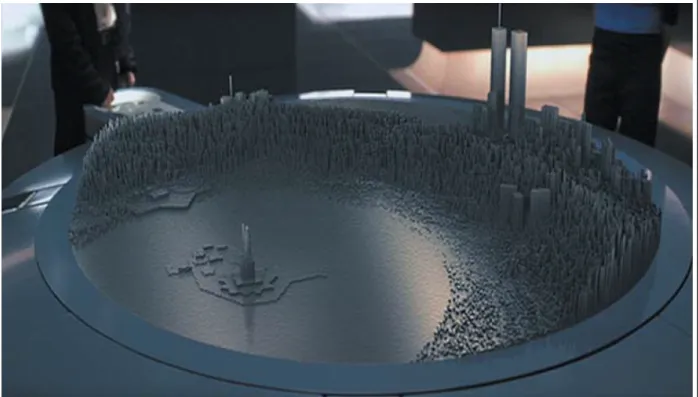
Yet one more example of the transition of a SF technology into reality is the shape-changing display (Figure 1.4a, page 11) depicted in the SF movie X-Men[301]. Watching X-Menhas reportedly
been attributed to inspire Douglas Caldwell [299, p. 11] to develop the ‘XenoVision Mark III’ (Figure 1.4b, page 11), a [356]:
“[...] self-reconfigurable solid terrain model with military applications.”
Most recently, Qualcomm’s five-year, $10 million XPRIZE [357] Tricorder competition is one more case in point of the successful transition of a fictional technology into a real-world prototype. In 2017, two research teams won the competition for the development of a portable, wireless prototype which can diagnose up to thirteen health conditions and five real-time vital signs, worthy of comparison with the fictional medical Tricorder depicted in the Star Trekfranchise. The XPRIZE competition
web page pays tribute to Star Trek and, at the time of this writing, did display both, the
original Medical Tricorder fromStar Trek: The Original Series andStar Trek: The Next Generation in company of the two developed prototypes (Figure 1.3b, page 9).
(a) Shape-changing display inX-Men— ©20th Century Fox/Marvel
(b) XenoVision Mark III: A Dynamic Solid Terrain Model
Figure 1.4: X-Menshape-changing display and Xenovision Mark III ‘needle table’
As a final example, Technovelgy [63], a privately-run website manages a rich repository of ideas, technologies, and inventions from SF books and SFMS with cross-references to news reports and examples of equivalent technologies found in the real world. As an illustration, the entry onMinority Report[308] on Technovelgy lists currently eight ‘fictional technologies’ from the movie, such as
‘Data Tiles’, ‘E-paper’, and ‘Biometric Personalized Ads’. The entry on ‘E-paper’ on Technovelgy reveals further intricate details to illustrate the transition of fictional technologies into real-world science: First, it presents the respective scenes from the movie as screencaps end to end with an explicit description of the depiction of the fictional technology. Second, science fiction literature
cross-references to ‘E-paper are provided as well [63]:
“A paper-thin, flexible LCD-style display that is large enough to display a full newspaper page.”
“E-paper [. . . ] was presaged in Neal Stephenson’s mediatron from his 1995 novel The Diamond Age.”
In the end, Technovelgy links SFMS, science fiction literature and real-world technological devel-opments in an accessible web repository for the general public. Presently, the website provides a dataset consisting of more than 2500 ‘science fiction-related’ inventions, technologies, and ideas.
1.2
SF and Science Crossings
As introduced in the previous section, SF and real-world technological development, or more broadly, art and science, do intersect in a variety of ways and a bi-directional relationship between both domains seems indeed not too far-fetched.
For example, the related work (Section 3.1) provides accounts on Science, Technology, Engineering and Mathematics (STEM) scientists, who increasingly collaborate with SF entertainment producers in order to provide more scientifically accurate and believable cinematic depictions of soon-to-be technologies and societal futures; with academic movie consultation emerging as an expert interest for scholars outside of the realm of their traditional academic work.
Likewise, selected universities and computer science programs now offer innovative computer science curricula and courses which utilize SF portrayals of fictional technologies and futures in the classroom, for instance to speculate on future design possibilities through the utilization of SF prototyping. Equally, the interplay of HCI research and SFMS seems to have gained traction as well and studies on the evolution and intersection of both topical domains can equally, describe the possibilities and the boundaries for computer science research, inspiration, and innovation.
As Perkowitz [248, page 213] quotes Carl Sagan:
“The continuing dance between science and science fiction – in which the science stimulates the fiction, and the fiction stimulates a new generation of scientists, is a process benefiting both genres.”
SFMS do portray utopian visions of high-tech societies (Star Trek: The Next Generation
[274]) or dystopian ideas of authoritarian regimes utilizing technology to dominate and oppress others (Nine-Teen-Eighty-Four[262]). On occasion, SFMS depict a fairly foreseeable future criticizing
the integration, usage, and consequences of ICTs in our everyday lives, such as the tech-paranoias depicted inBlack Mirror[53]. As Sobchack [306, page 103] wrote back in 1987:
“The SF film gives us images – even if manufactured – of the immense and the infinitesimal. Extrapolating from known and accepted science, these film images derive their power to induce wonder in the viewer not from the imaginativeness of their content, but from the imaginativeness of their stance and their scope.”
Distinct aspects of the mutual relationship and crossings of SF and HCI have been deliberated and partially studied. Aaron Marcus [204] has not only presented an overview detailing an HCI travelogue of Hollywood and SFMS, he has also coordinated two Computer-human Interaction (CHI) conference plenaries [205, 206] on the topic. Similarly, Schmitz, Endres and Butz [287] surveyed various instances of a convergence of SF movies and HCI, outlining a collaboration scheme between researchers and filmmakers through a continuous, inspirational dialogue wherein films (or filmmakers) are inspired by technology (or by scientists).
Kirby [156, 155, 157, 158] speaks to the impact of SF on public perception and Research and Development (R&D) of technology and vice-versa in his comprehensive qualitative studies on the collaboration schemes of scientists and moviemakers through qualitative interviews. Furthermore, Kirby’s [158, p. 41] concept of ‘diegetic prototypes’ is extensively discussed as an opportunity for academics – taking on the role of technical consultants – on sets of SFMS. These consultants, or domain-specific experts and researchers, who advise on a particular SFMS, are able to speculate and extend ideas within the fictional reality of a movie in order:
“[...] to account for the ways in which cinematic depictions of future technologies demon-strate to large public audiences a technology’s need, viability and benevolence. Entertain-ment producers create diegetic prototypes by influencing dialogue, plot rationalizations, character interactions and narrative structure. These technologies only exist in the fictional world – what film scholars call the diegesis.”
HCI researchers have recently followed up on the concept of design fiction (see also Section 3.1.1, page 22). For example, Tanenbaum [319, 320] refers to Kirby’s [158] concept of diegetic prototypes and extends it into an emerging research and design method in HCI for innovative interface design research, which is currently used as:
1. a method to envision new futures and technologies;
2. a tool for communicating innovations to other researchers and the public and;
3. an inspirational and motivational vehicle to explore design affordances and constraints within fictional scenarios.
The mutual relationship between SF and HCI is as well recognized in expert associations in computer science and related fields. For instance, the User Experience Professionals Association (UXPA) [332] covered SF in their February 2013 issue of the User Experience Magazine. The volume proposes
SF-based user development, personas, stories and use cases as valid research methods in the field of HCI. The utility of SF dystopias to foresee – and therefore to hopefully avoid – negative socio-technical futures through virtual ethnographies of SFMS depictions of technology and interaction is as well discussed.
In a similar fashion, the Biochemical Society, which publishes the Biochemist, an open access journal on the topic of molecular bioscience, dedicated its December 2012 special issue [323] to SF and the intersection with real-world science. As an illustration, the special issue discusses the depiction of human cloning and bioethics in the case of the 1997 SF movieGattaca[233], as well as
SFMS-based innovation opportunities in educational settings, which can foster student engagement, encouragement, and reflection [48].
Nature Careers [304] published in 2014 an article highlighting selected researchers who regularly consult on SFMS, among those for instance, James Kakalios, science advisor on The Amazing Spider-Man [344]. Kakalios reportedly used examples from his involvement in the movie in
his undergraduate physics class at the University of Minnesota. Correspondingly, Donna Nelson [304, page 114], Professor of Chemistry at the University of Oklahoma, advised on the TV drama
Breaking Bad[115] with:
“[...] the goal to ‘build a bridge between science and entertainment’ and expose more viewers to realistic portrayals of science.”
Nelson hosts as well a symposium on science in film as part of the annual meeting of the American Chemical Society (ACS) in order “to explore the role and relevance of science in film” [311, page 1]). Collaboration efforts of researchers and scientists with movie-makers are very often established through the Los Angeles based Science and Entertainment Exchange, which describes itself as:
“[...] a program of the National Academy of Sciences (NAS) that connects entertainment industry professionals with top scientists and engineers to create a synergy between accurate science and engaging storylines in both film and TV programming.” [228]
1.3
Summary
This brief introduction serves to familiarize the reader with a variety of links between the fields of HCI / STEM and SF / SFMS. The outlined potential of SF for computing research and education, HCI ideation and design or real-world outcomes of SF technologies stimulates the research motivation and significance of this dissertation, which will be discussed in detail in the following Chapter 2.
This chapter lays out the fundamental motivation and research rationale of this dissertation. To begin with, Section 2.1 introduces the lack of studies untangling the complex SF / SFMS and CS / HCI relationship in the context of science communication. As such, Section 2.2 presents five major contributions this study provides. Next, Section 2.3 provides the three principal research aims of this dissertation while Section 2.4 formulates three specific research objectives to attain said research aims. As a result from the formulation of research objectives, Section 2.5 generates accordingly three, detailed research questions this dissertation investigates.
2.1
Current Limitations
Notwithstanding the earlier introduced commonalities of SF / SFMS and HCI / computer science research, Marcus [200] states that the history, relationship and synergy effects of both fields are poorly documented and insufficiently described. In particular, no studies which explore the usage of SF and SFMS in scientific publications, with a focus on computer science, are available up to this date.
Even though scattered indicators of aspects of the introduced relationship can be found in contemporary public news [32, 212, 271] and tech magazines [15], they are usually not evidentiary per se, but more often of anecdotal nature. Likewise, SF in computer science research is discussed to some degree, but the existing studies on the subject matter are:
– limited on specific aspects and applications of SF / SFMS for HCI / computer science research, such as specific interaction types [107, 330];
– have a selection bias (e.g. toward a specific subset of selected SF films) and lack accountable and longitudinal data to describe the relationship of SF / SFMS and HCI over time and across fields of computer science research [177, 287];
– or use a limited sample size (e.g. investigations for 20 SF films) and do not focus on SF and computing research [183, 182].
In particular, no meta-study does investigate the presence and patterns of usage of SF and SFMS in the context of scientific publications; over time and within distinct subfields of computer science research. As a result, SF appears like a related, but yet undiscovered topical domain in computer science research, education, inspiration, reflection, communication and collaboration.
Be that as it may, such investigations are, however, important as they can point to missed opportunities and future potentials of SF for computing research. An overview and chronological
description of SF in computing research can provide many insights which are important for future computing research application, research and education. For instance, data on the occurrence, frequency, usage and contextual referrals of SF and its terminology derivatives in computer science publications can identify computing research themes, which are more or less prone to use SF; and therefore, might benefit more or less from assimilating SF and SFMS in the future.
In addition, the cultural origin, purpose, and nature of the SFMS and narratives in computer science publications have not been described as well, for instance, the patterns of usage of Western and Non-Western SF. Also, the prevalence or abundance of SF referrals within and between distinct subfields of computer science research publications, for instance, the patterns of usage in HCI, Human-robot Interaction (HRI) or design research are not investigated at present.
One might ask why SF is used in a computer science publication; what kind of SF is referenced in the respective publication and how does it inform the research itself? Is there a cultural bias of the referred SF in computing literature? Did SF referrals evolve from rhetorical devices into serious research topics for HCI and computing literature over time? Are there clusters of computer science areas (e.g. HCI, HRI, AI) which regularly draw from and refer to SF?
These are questions this study aims to answer and it is this niche, the contribution of this dissertation is situated in. Prior pilot studies ([148, 151, 222]) in the leading computer science conference (CHI conference), respectively the ACM Digital Library, do support the assumption that SF is progressively used throughout HCI research.
Moreover, prior work recognizes a cultural bias of the SFMS in computing literature due to a strong tendency towards the usage of Western, and averseness of Non-Western SF. Despite these indications linking both fields, further research is necessary to describe this symbiotic and multi-faceted relationship, on the micro- or the macro-level.
2.2
Significance and Contribution
First, the study of the relationship of SF / SFMS and HCI/computer science research is insufficient. In order to address this academic void, this dissertation aims to discover linkages of SFMS in scientific publications. Levin and De Filippo’s [183] study of the referrals of twenty self-selected SF movies in the Web of Science database does provide a methodology and some insight into the usage of selected SF media across scientific fields. However, Levin and De Filippo [183] do not deliver a comprehensive analysis of SFMS in computer science publications from an chronological, cross-cultural and contextual perspective.
Second, the author is developing the topic with collaborators to delineate distinct aspects of the links of SF and HCI research though incremental efforts. Extensive prior work (Section B) gives an account of six published pilot contributions. Based on this prior work and the literature review (Section 3.1), this dissertation aims to provide a further, wide-ranging investigation of HCI and SF in peer-reviewed computer science publications in a larger corpus using quantitative and qualitative
content analysis techniques to describe the usage, purposes, cultural origin and chronological patterns of SF in computer science communication. By doing so, the results of this work are expected to discover emerging patterns between art and science in the field of computing.
Third, the exemplary studies of the crossings HCI and SF which are introduced in Section 6.1 are primarily overviews and lack depth and a full analysis of the relationship of SF and HCI. Specifically, the works of Marcus [200, 199, 198, 201, 202, 203, 204], Schmitz et al. [287], Levin [182] and Levin and De Filippo [183] are fairly general and do not present a full picture of the links between HCI and SF. Most importantly these overviews do not measure this relationship in detail, nor provide directions how to measure the connection of SF and HCI research within each publication and across different collections. This work, therefore, aims to provide a measurable and specific outcome of the linkages between the two disciplines of HCI and SF. By doing so, this dissertation will provide a complete representation of the mutual relationship of the two disciplines through the analysis of publications from two representative computer science databases, the ACM Digital Library and the IEEE Xplore Digital Library repositories.
Fourth, an important parameter to judge the influence of any discipline within a field of research is the analysis of the articles emerging from that area. Scientometrics [161] and bibliometrics [341] are defined as the area of research focusing on measuring various factors on science and technology and the technique is being widely utilized in understanding the publication trends in HCI [30]. Through the analysis of the contextual presence and usage of SF related keywords, terms and publication characteristics (titles, abstracts) in computer science research publications, this dissertation is expected to show an increase of the usage and importance of the role SF plays in computer science research. As there is gradual recognition that the field of HCI and interactive technology can benefit from SF and vice-versa, this dissertation will explore this developing bi-directional relationship in the case of two computer science collections and an expected publication corpus of 2000 conference papers and periodicals in multiple studies.
Fifth, through a contextual analysis of the purpose, nature and chronological usage of SF in HCI and computing research (e.g. country of origin and type of SF, the context of the SF referral), emerging research themes where SF and SFMS are utilized in computer science publications are expected to be identified. For instance, an analysis of the prevalence of explicit SF over time and editions of specific periodicals or conferences could show varying degrees of influence, popularity and usage patterns. This then may tie back to a particular SF movie being released in a certain year and will assist in determining what leads to a successful collaboration between the two disciplines of HCI and SF over time and assist in extrapolating distinct subfields in computing research, which SF and computer research intersect.
2.3
Research Aims
The assumption in this study is that SF is an existing, yet undiscovered topical domain in computer science research and its associated subfields. Specifically, SFMS, but also general SF authors, technologies, concepts, characters, and stories will be traced in order to investigate the prevalence, usage, and appropriation of SF in scientific publications. Thus, the primary aims of this dissertation are to establish a ground truth of the relationship between HCI and SF, outlined in the following:
1. The dissertation aims to quantify for the first time the described relationship between popular SF media depiction of technology in computer science publications.
2. The dissertation aims to create and describe measures of this relationship utilizing guided content analysis (term-frequency measures, co-word analysis, cluster extraction) of publications which reference SF as well as descriptive analysis (total publications referring SF over time, types of SF referred over time).
3. The dissertation aims to inform a more comprehensive framework to re-conceptualize the bi-directional relationship of HCI and SFMS and related fields which utilize SF and SFMS.
2.4
Research Objectives
The principal research objective of this dissertation is to discover, to describe and to analyze the relationship between SF and computer science research through a content analysis of scientific publications which refer SF in their metadata; over time and within distinct subfields of computer science research. The following paragraphs present increasingly specific research objectives and research questions to guide this study.
RO1: Identify an Interplay between SF / SFMS and HCI Research
The primary research objective of this dissertation is to discover a relationship between SF / SFMS and computer science research, with a special focus on human-computer interaction topics. For the purposes of this dissertation, RO1 is addressed through the related and prior work. The related work (Section 3.1) provides a thematic literature review and indicates a mutual, yet not quantified, relationship of both fields. In addition, prior work [148, 151, 222] confirmed the presence and usage of SF / SFMS concepts in the ACM Digital Library and the CHI proceedings.
To further investigate these suggestions and corroborate RO1, an in-depth study of the occurrence of SF /SFMS in a larger scientific corpus of peer-reviewed publications and studies is conducted, in particular in the context of the IEEEXplore Digital Library.
RO2: Determine Patterns of SF / SFMS References in Computer Science / HCI Research Publications
The second research objective of this dissertation is to explore possible indicators SF has had, currently has and potentially will have on computer science and HCI research. To do so, text mining and a qualitative content analysis of the cited SF concept(s) in relationship to the research theme of the retrieved publications will be used to understand the context of the referral.
Through such a qualitative analysis, a determination of the purpose and level of influence of the referral in distinct subtopics of computing research and HCI (such as mobile computing, robotics, wearables, virtual reality and others) can be assessed. Moreover, patterns across periodicals and collections, such as the mechanics of SF referrals in certain subtopics in computing literature could indicate which fields of research or authors are more or less prone to draw from and integrate, SF in their research.
RO3: Describe and Analyze the Characteristics, Purpose and Cultural Origin of the SF / SFMS References in Computer Science / HCI Research Publications over Time
A third research objective in this dissertation is the identification and determination of the cultural origin of the referenced SF in the retrieved publication in order to provide an chronological overview of the type and purposes of SFMS in research publications over time through a descriptive analysis. A contextual analysis of science fiction in computer science research publications can describe the cultural origins of the material (authorship of the SF / SFMS, country of production) as well as the purposes of the referral in the context of the individual publication.
Through RO3 the prevalence and absence of specific SF from specific countries and areas will be determined. Patterns, for instance, the type of SF, the purpose of the reference of the SFMS, the year and subfield of computing research over time should enable deductions if SF precedes, matches or follows real-world technological development and research.
2.5
Research Questions
In a very simplified form, the three research questions, as well as the overarching, encompassing relationship of SF and CS research is illustrated in Figure 2.1 om page 20. In a more explicit and definite form as well as in association with the general research aims and objectives, the following specific research questions are formulated:
RQ1: What are the Metadata Characteristics of Computer Science Publications which reference Science Fiction?
Figure 2.1: Simplified visualization of the research questions – Publication topic [e.g. AI, Design Research];
– Publication year [Year];
– Publication venue [CHI/AI & Society/Ethics and Information Technology]; – Publication keywords [Natural language interface, Technology ethics, Robots].
RQ2: What Science Fiction Particulars co-occur in the Context of Computer Science Publications which reference Science Fiction?
Science fiction particulars can be understood as references to additional science fiction authors, shows, movies, novels, books, narratives, characters and technologies (e.g Isaac Asimov, The Matrix,Mr. Data,Holodeck). RQ2 can be addressed after coding the retrieved publications,
– The contextual referral of the science fiction reference and particulars within a certain periodical; – Relationships of the type and purpose of the SF referral and SF particulars with regards to
the publication year.
RQ3: What is the Purpose of References to Science Fiction, and Science Fiction Par-ticulars which co-occur in the Context of Science Fiction References, in Computer Science Publications?
RQ3 will develop categorizes of purposes, for instance: – Science fiction referral as a rhetorical device;
– Science fiction as a data source itself for the research paper; – Science fiction as an inspiration for the research paper; – More categories can be derived from [183, 151, 222].
2.6
Summary
This chapter presented the research rationale of this dissertation, which is motivated by both, a lack of comprehensive studies of SF / SFMS in computer science research communication and the implicit, likely beneficial relationship between SF / SFMS and computer science and HCI research.
Based on the introduction (see Chapter 1), traces of this relationship are discovered, which the research questions presented in this section aim to answer through quantifiable data, including frequencies and contextual types of usages of SF in computer science research publications.
Next, Chapter 3 presents an in-deep background and literature review of SF / SFMS in computer science research in addition to a methodological background (see Section 3.2), relevant for the presented dissertation study.
This chapter provides the background of this dissertation, divided into two sections. Section 3.1 provides an extensive, thematic literature review on the topic of HCI and SF. In addition, Section 3.2 provides the essential, methodological background for this dissertation. Furthermore, Appendix B gives a brief account of the prior work and cumulative publications on the research topic in the context of this dissertation.
3.1
Related Work
In this section, a theme-oriented literature review will present related work which links SF / SFMS and computer science / HCI research on a multitude of aspects. Research on SFMS as potential depictions of real-world, future technologies, studies on the relationship between SF-makers and researchers in addition to work on reciprocal influences of the field of SF and computer sciences will be reviewed. The goal of this section is to establish a comprehensive review of related work on the interplay of SF and computer science research.
3.1.1 SF, Computing Visions and Design Theory
The intersection of SF and real-world scientific progress, with a special focus on computer science research, has been noted by Ferro and Swedin’s inquiry [105, 104] into the linkages of SF and computing as well as Kay and Dourish’s [85] special issue on SF and ubiquitous computing. Both contributions provide accounts of “a long relationship between scientific research and speculative fiction” [85, p. 765] through a compilation of essays of SF authors and design researchers as well as philosophical explorations into both SF and real-world science. However, the actual measurement of the role and usage of SF in science seems a more complicated endeavor as Ferro and Swedin [104, p. 4] state that:
“[...] measuring the degree to which science fiction has played a role in creating technology and defining culture is not trivial, nor do the analysts of science fiction necessarily believe science fiction to the principal creative factor.”
Both, Ferro and Swedin [104] and Kaye and Dourish [85] refer to well-known SF authors, such as Bruce Sterling or futurists, such as Brian David Johnson [138], a proponent of SF prototyping who give accounts of the symbiotic relationship of both fields.
Stork’s [313, 314] inquiry into AIs culminating in his edited book HAL’s Legacy: 2001’s Computer as Dream and Reality[64] focuses on diverse aspects of the Heuristically programmed
ALgorithmic computer – HAL – from the SF movie 2001: A Space Odyssey [166]. Forty years
later,2001: A Space Odyssey and the aspects of the AI which have been both, correctly or falsely,
envisioned by Kubrick are revisited. Yet another compendium of essays and interviews with a focus on a specific, seminal SF movie, scientists from the field of computing and AI research explore the predictions, verisimilitude, and proximity of a real-world ‘HAL-equivalent supercomputer’.
The work [64] compares the envisioned natural language user interface capabilities, HALs ability to recognize human emotion (affective computing) in contrast to real-world developments and achievements in AI and computing research. Accounts from computer scientist Murray S. Campbell, who describes his involvement in the creation of IBMs Deep Blue supercomputer (which for the first time in 2006 defeated the reigning chess Grandmaster Garry Kasparov) draws analogies to HALs chess playing skills in2001: A Space Odyssey. Likewise, AI pioneer Marvin Minsky [271],
describes through an interview his involvement in 2001: A Space Odyssey at the time of the
movie production, which is renowned for its scientific accuracy as a result of director Kubrick’s and writer Clark’s recruitment of [64, p. 2]:
“[...] scientists in universities and industry and at NASA in their effort to portray correctly the technology of future space travel.”
Westfahl, Yuen and Chan [346] present a collection of critical essays on the topic of SF and techno-logical futures through a review of selected SF literature as a means to predict the future. Typical utopian fallacies, such as assumptions of universal wealth and general technological deterministic stances in SF stories are found to be common characteristics of the genre.
Dunne and Raby’s [88] work on speculative design embodies a design catalog of non-functional products, artifacts, devices and installations in a similar fashion to Bleecker [38, 39, 40] as a means to visualize how things could be when technological limitations at the present are disregarded.
Additional accounts of the relationship of SF and HCI are provided by Doctorow, Warner, Perkowitz and Johnson [83] on SF prototyping, Shedroff and Noessel’s [298] overview of HCI in SF movies and Marcus [200] eBook on HCI in SF movies.
In addition, a 2004 CHI Panel [35] explored and reviewed the value of video visions of the future for HCI1. The main agreement of the panelists was an acknowledgment of the importance of video
visions for creativity and inspiration in computer science and HCI research.
Among others, the panel discussed the pros and cons of videos, or so-called ‘potential vessels’, as research stimulus. These can range from low-quality research videos to stylish utopian [216], as well as dystopian [211], future visualizations of society and technology. Beside of the actual quality of the visual depiction and overall presentation of the future video vision, the panel further identified as well the importance of the story and narrative the vision and the technologies are embedded in. In the past, the importance of stories and narratives for a believable future vision has been discussed by a variety of researchers, for instance by Tanenbaum [319] and Frank [112].
1
![Figure 1.2: Black Mirror social rating system — ©Endemol Shine UK/Channel 4 For more visualizations of HCI in SFMS, a repository of examples are referenced in Shedroff and Noessel’s works [299, 298, 239] and the accompanying website [238], which both provi](https://thumb-us.123doks.com/thumbv2/123dok_us/1879400.2774339/25.918.111.813.332.773/endemol-channel-visualizations-repository-examples-referenced-shedroff-accompanying.webp)