A Compliance Based Framework for
Information Security in E-Government in
Oman
A thesis submitted in fulfilment of the requirements for the degree of
Doctor of Philosophy
Ahmed Al-Kalbani
BSc (Hons) Software Engineering, Staffordshire University
MSc (Information Engineering), Sultan Qaboos University
School of Business Information Technology and Logistics
College of Business
RMIT University, Melbourne, Australia
February 2017
Declaration
I, Ahmed Al-Kalbani, hereby declare that,
a. I am the sole author of this thesis, except where due acknowledgement has been made; and
b. The work has not been submitted previously, in whole or in part, to qualify for any other academic awards; and
c. The content of this thesis is the result of work which has been carried out since the official commencement of the approved research program at RMIT University.
Ahmed Al-Kalbani 27th February 2017
Primarily, Glory and thanks be to the Almighty God for giving me the strength to complete this study. My special thanks go to my first supervisor, Professor Hepu Deng, for his invaluable support from the very beginning of this PhD study all through its completion, for his insightful suggestions and extraordinary efforts to get this thesis in its current form and content. I like to take this opportunity to wish him and all his family great health and happiness. I also thank my second supervisor, Professor Booi Kam, for his encouragement and invaluable insight into my research. His much-needed feedback is always inspiring and constructive. I owe many thanks to those individuals who have participated in the empirical study of this research.
I like to express my heartfelt thanks to my friends and colleagues in Oman and in Australia who have offered helpful suggestions and comments during my PhD journey. I also extend my appreciation and thanks to my employer, Oman Government for their financial support with the provision of a full scholarship.
Finally, my special gratitude goes to every single member of my family, and above all my mother and aunt for their continued supplication. I’m indebted to my great man whose positive influence in my life I can never forget: my father, who passed away in 1999, you will always be remembered. I’m also very thankful to my beloved wife, her unwavering love, support and encouragement allow me to complete this long journey. Last but not least, my most precious and delightful children – Mazoon, Khalid, and Metwasim for their unconditional love and prayers for me. Your distractions have protected me from exhaustion and made this journey truly meaningful. May you find science and knowledge in your innermost thoughts and curiosity!
Declaration ... i
Acknowledgments... ii
List of Publications ... viii
List of Abbreviations... ix
List of Tables ... xii
List of Figures ... xiii
Abstract ... xv
Chapter 1 Introduction ... 1
1.1 Research Overview ... 1
1.2 Motivation of the Research ... 4
1.3 Research Aims and Research Questions ... 5
1.4 Methodology of the Research ... 6
1.5 Structure of the Thesis ... 8
Chapter 2 Literature Review ... 11
2.1 Introduction ... 11
2.2 An Overview of E-Government ... 13
2.3 Development of E-Government in Oman ... 18
2.4 Information Security for E-Government ... 21
2.5 Information Security Compliance ... 25
Chapter 3 A Conceptual Framework ... 33
3.1 Introduction ... 33
3.2 Theoretical Foundation ... 34
3.3 Framing Information Security Compliance in Theories ... 41
3.4 A Conceptual Framework ... 47
3.4.1 Organizational Security Culture ... 49
3.4.2 Information Security Processes ... 53
3.4.3 Security Technologies ... 55
3.4.4 Environment Pressures ... 57
3.5 Conclusion ... 61
Chapter 4 Research Methodology ... 62
4.1 Introduction ... 62
4.2 Research Paradigms ... 64
4.3 A Mix-Methods Methodology ... 67
4.4 Rationale for Adopting the Mixed-Methods Methodology... 70
4.5 Methodology Implementation ... 73
4.5.1 The Qualitative Approach ... 74
4.5.2 The Quantitative Approach ... 76
4.6 Conclusion ... 84
Chapter 5 Analysis of the Qualitative Data ... 86
5.1 Introduction ... 86
5.2 An Overview of the Thematic Analysis ... 88
5.3 An Overview of the Profile of the Interviewees ... 92
5.4.2 Global Theme Two: Information Security Processes ... 104
5.4.3 Global Theme Three: Security Technologies ... 108
5.4.4 Global Theme Four: Environment Pressures ... 114
5.5 Conclusion ... 118
Chapter 6 Analysis of the Quantitative Data ... 121
6.1 Introduction ... 121
6.2 An Overview of the Data Analysis Techniques ... 122
6.3 Data Preparation ... 128
6.3.1 Missing Value ... 128
6.3.2 Outliers, Skews, and Kurtosis... 129
6.3.3 Normality ... 130
6.3.4 Construct Reliability ... 132
6.4 A Profile of the Respondents ... 133
6.5 Full Measurement Model Analysis ... 136
6.5.1 The Assessment of the Full Measurement Model ... 141
6.5.2 One-Factor Congeneric Models Analysis ... 142
6.5.3 Higher-Order Measurement Models Analysis ... 154
6.5.4 The Final Measurement Model... 157
6.6 Full Structural Model Analysis ... 162
6.7 Findings of the SEM Analysis ... 165
Chapter 7 A Revised Framework ... 170
7.1 Introduction ... 170
7.2 Triangulating the Research Findings ... 171
7.3 A Revised Framework ... 179
7.4 Recommendations ... 183
7.5 Conclusion ... 189
Chapter 8 Conclusion ... 190
8.1 Introduction ... 190
8.2 An Overview of the Research Findings ... 191
8.3 Contributions and Implications of the Research ... 197
8.4 Limitations and Future Research ... 198
References ... 201
Appendix A Semi-Structured Interview Questions ... 220
Appendix B The Source of the Questionnaire Items ... 224
Appendix C Questionnaire... 230
Appendix D A Guideline for the Use of the Goodness of Fit Indices ... 241
Al-Kalbani, A., Deng, H., and Kam, B. (2014). A conceptual framework for information security in public organizations for e-government development. Proceedings of the 25th Australasian Conference of Information Systems, December 8 – 10, New Zealand.
Al-Kalbani, A., Deng, H., and Kam, B. (2015). Organizational security culture and information security compliance for e-government development: The moderating effect of social pressure. Proceedings of the 19th Pacific Asia Conference on Information Systems, July 5 – 9, Singapore.
Al-Kalbani, A., Deng, H., and Kam, B. (2015). Investigating the role of socio-organizational factors in information security compliance in organizations. Proceedings of the 26th Australasian Conference of Information Systems, November 30 – December 4, Australia.
Al-Kalbani, A., Deng, H., Kam, B., and Zhang, J. (2016). Investigating the impact of institutional pressures on information security compliance in organizations. Proceedings of the 27th Australasian Conference of Information Systems, December 5 – 7, Australia.
List of Abbreviations
ACC: Accountability
AMOS: Analysis of Moment Structures Aud: Audit and monitoring
ADF: Asymptotically Distribution Free AWR: Awareness and Training
AVE: Average Variance Extracted, BSI: British Standards Institution CFA: Confirmatory Factor Analysis
CR: Critical Ratio
COBIT: Control Objectives for Information and Technology D2: Squared Mahalanobis Distance
Df: Degree of Freedom
EFA: Exploratory Factor Analysis Env: Environment Pressure E-government: Electronic Government G2C: Government to Citizens, G2B: Government to Businesses, G2G: Government to Government
GOF: Goodness-of-Fit
GLS: Generalized Least Square,
ICT: Information and Communication Technologies
IT: Information Technology
InfoSecCompliance: Information Security Compliance for E-government MangCom: Management Commitment,
MI: Modification Indices
ML: Maximum Likelihood
NCSI: National Centre for Statistics and Information in Oman NIST: National Institute of Standard and Technology
OrgSecCult: Organizational Security Culture ProcInteg: Process Integration
P: Probability
RegPres: Regulation Pressure SLS: Scale Free Least Square SecPro: Information Security Process
TECH: Security Technology
SPSS: Statistical Package for Social Sciences
SE: Standard Error
SFL: Standardized Factor Loading
SR: Standardized Residuals
SEM: Structural Equation Modeling SRW: Standardized Regression Weight SocPres: Social Pressure
TOE: Technology-Organization-Environment Theory TechCap: Technology Capability
TechCom: Technology Compatibility ULS: Un-Weighted Least Square
URW: Un-Standardized Regression Weight WLS: Weighted Least Square,
α: Cronbach’s Alpha
H Coefficient
Table 2.1 A summary of the e-government studies in Oman ……...………. 21
Table 2.2 An overview of information security compliance studies ………. 31
Table 3.1 A summary of the TOE based studies ………... 38
Table 3.2 A summary of the institutional theory based studies.….…...…… 40
Table 3.3 An overview of the hypotheses ……….. 60
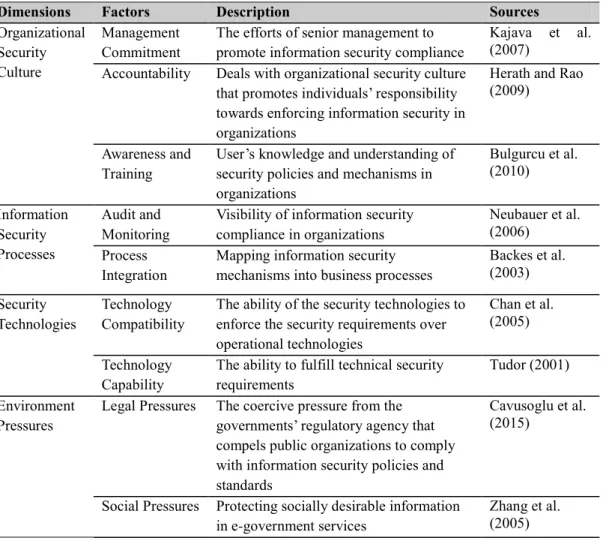
Table 4.1 An overview of the construct description ……….. 79
Table 5.1 The profile of the interviewees ……….. 93
Table 6.1 An overview of the normal distribution examination ……… 132
Table 6.2 A summary of the Cronbach’s Alpha values ……… 133
Table 6.3 A summary of the indicator variables in the full model ……...….. 140
Table 6.4 SR indicator values of the MangCom model ………... 145
Table 6.5 Initial and re-specified congeneric measurement models ……... 148
Table 6.6 The convergent validity of the one-factor congeneric model ….... 151
Table 6.7 The discriminant validity of the one-factor congeneric model ….. 153
Table 6.8 GOF indices of the OrgSecCult model ……….…. 155
Table 6.9 GOF indices of the SecProc model ……… 156
Table 6.10 GOF indices of the Env model ……….……….. 157
Table 6.11 GOF indices of the full measurement model …………..………... 159
Table 6.12 The discriminant validity of the full model ………..…. 160
Table 6.13 The composite reliability of the full model ……… 160
Table 6.14 The hypotheses test results ………...……….. 164
Table 6.15 GOF indices of the initial model and the final model.…... 165
Table 7.1 A comparative analysis of qualitative and quantitative findings ... 173
List of Figures
Figure 1.1 An overview of the research process ……….. 8
Figure 3.1 The theoretical background of the framework ……….... 34
Figure 3.2 An overview of the TOE theory ……….…. 36
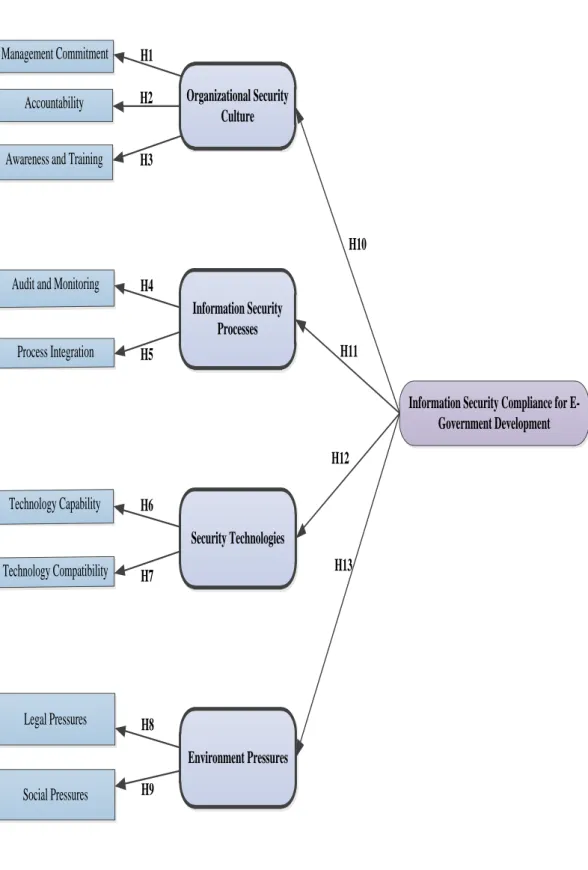
Figure 3.3 An information security compliance framework ………….…... 48
Figure 4.1 The mixed-methods methodology……….…………...… 69
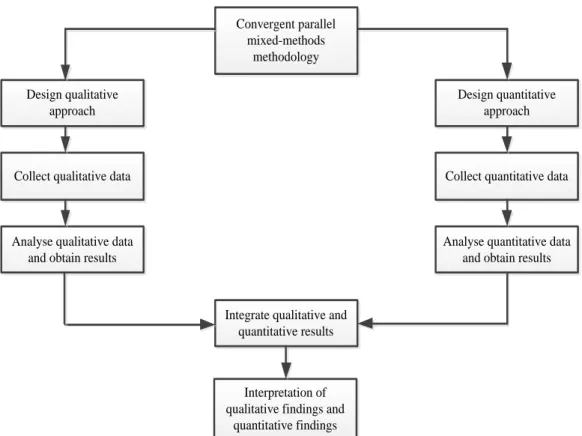
Figure 4.2 The convergent parallel mixed-methods methodology ……..….. 74
Figure 5.1 A thematic network map ……….. 90
Figure 5.2 A thematic network map for an organizational security culture ... 103
Figure 5.3 A thematic network map for information security processes …… 108
Figure 5.4 A thematic network map for security technologies ………... 114
Figure 5.5 A thematic network map for environment pressures ……….…… 118
Figure 5.6 A thematic network map for information security compliance in e-government development ……….…….. 119
Figure 6.1 The steps for the SEM analysis ……….…… 127
Figure 6.2 The age profile of the respondents ………... 134
Figure 6.3 The educational profile of the respondents ……….. 134
Figure 6.4 The employment profile of the respondents ………. 135
Figure 6.5 The organizational profile of the respondents ……….….. 136
Figure 6.6 Afull measurement model ………..………….. 138
Figure 6.7 An one-factor congeneric model of MangCom ………….……… 143
Figure 6.8 A re-specified one-factor congeneric measurement model of MangCom…………..………..……. 146
Figure 6.11 A measurement model of Env ………..…...…….. 157
Figure 6.12 Afinal full measurement model ……… 158
Figure 6.13 A final full measurement model for information security
compliance ……….... 161
Figure 6.14 The estimated structural model ………...………..……… 163
Abstract
The development of electronic government (e-government) in Oman has created new means for public organizations to deliver services, engage citizens, and improve workflows between public organizations. Such a development has opened the possibility that critical information in e-government systems can be exposed. This directly affects the confidence and trust of e-government stakeholders. Such confidence and trust are important to the continued development of e-government in Oman. As a result, the security of information has become a critical issue that needs to be adequately addressed in e-government development.
This research aims to develop a compliance-based framework for information security in public organizations in e-government development in Oman. Specifically it aims to (a) identify the critical factors for effective information security compliance in public organizations in Oman, (b) develop a framework for information security compliance, and (c) provide the Omani government with some recommendations for effective information security compliance in public organizations for e-government development. To fulfill these research aims, a mixed-methods methodology is used. A conceptual framework is developed by hypothesizing the critical factors for effective information security compliance in organizations. With the use of survey data collected from public organizations in Oman, the conceptual framework is tested and validated using structural equation modeling. To further validate the identified critical factors, thematic analysis is carried out on the semi-structured interview data collected simultaneously. The quantitative findings and the qualitative findings are triangulated for better understanding information security compliance in public organizations for
e-accountability, organizational loyalty, audit and monitoring, process integration, technology capability, technology compatibility, technology reliability, legal pressures, and social pressures are critical for effective information security compliance in public organizations for e-government development in Oman. Based on the critical factors identified, a new framework for information security compliance is developed. Such a framework consists of four main dimensions including (a) organizational security culture, (b) information security processes, (c) security technologies, and (d) environment pressures.
This research contributes to the e-government and information security compliance research from both the theoretical and practical perspectives. From the theoretical perspective, this research demonstrates the applicability of socio-organizational factors for influencing information security compliance in public organizations for e-government development. From the practical perspective, this research provides an in-depth investigation of the critical factors for information security compliance, which provides the Omani government with useful guidelines on how to ensure information security in public organizations for e-government development. Such guidelines are also useful for other developing countries in their e-government development endeavors.
Chapter 1
Introduction
1.1
Research Overview
Electronic government (e-government) is about the use of information and communication technologies (ICT) for transforming public services to make them more accessible, effective and accountable (Deng 2008; Karunasena & Deng 2012; Wangpipatwong et al. 2009). It has invented new ways for governments to interact with their stakeholders including citizens and businesses. As a result, many governments worldwide have implemented various e-government initiatives for improving their community services, engaging the private sector and enhancing workflows between government entities (Al-Mamari et al. 2013; Karunasena & Deng 2011).
The government of Oman in 2003 officially launched its e-government initiative for improving its public services (Al-Busaidy & Weerakkody 2009; Al-Mamari et al. 2013). Since the adoption of this e-government initiative, many e-government projects have been delivered including the National Statistics Online project, the e-Tendering project, the Educational Portal, and the National Registration System (Information Technology Authority 2016). The implementation of these projects has greatly improved the delivery of public services (Al-Mamari et al. 2013). As a result, the overall performance of e-government in Oman has been improved significantly (Information Technology Authority 2016). Such an improvement is confirmed by the United Nations e-government Index which ranked Oman at the 66th position out of 193 countries in 2016 (United Nations 2016).
The development of e-government in Oman has provided the government with new means to deliver better public services, engage citizens, and improve workflows (Al-Busaidy & Weerakkody 2009; Al-Mamari et al. 2013; AlKalbani et al. 2014). Such a development, however, has also opened the possibility that the critical information in the e-government systems can be exposed that may hinder the overall development of e-government (Heeks 2003; Siponen & Oinas 2007; Tassabehji et al. 2007). As a result, the security of information in e-government developments has become critical (Al-Kalbani et al. 2014; Karokola et al. 2012; Ransbotham & Mitra 2009).
Information security is about the confidentiality, integrity and availability of information in specific circumstances (Karokola et al. 2012; Torres et al. 2006). It is critical for the development of e-government because the security of information in e-government systems directly affects the confidence and trust of e-government stakeholders in their adoption of e-government (Al-Kalbani et al. 2015; Zhao & Zhao 2010). Such confidence and trust would help improve the quality of e-government services and facilitate the development of e-government (Karokola et al. 2012).
There are various studies in the literature for addressing the issue of information security for e-government development (Karokola et al. 2012; Smith & Jamieson 2006; Wangwe et al. 2012). These studies are carried out from both the technical and the non-technical perspectives. The information security research from the technical perspective focuses on the development of tools and applications for protecting the storage, processing and transmission of valuable information
Chapter 1 Introduction
(Kaliontzoglou et al. 2005; Lambrinoudakis et al. 2003; Wimmer & von Bredow 2001). The information security research from the non-technical perspective concentrates on the investigation of how people behave and what processes and procedures can be used for information security (Wang 2009; Zhou & Hu 2008).
To adequately protect information in e-government development, there is an increasing focus on enforcing information security compliance approach (Boss & Kirsch 2007; Herath & Rao 2009; Siponen et al. 2007). In this context, information security compliance is referred to as the effective implementation of information security policies and standards for protecting the information in organizations (Al-Kalbani et al. 2015; Von Solms 2005). Information security compliance ensures that information security mechanisms can work together effectively (Neubauer et al. 2006; Von Solms 2001). It can improve existing information security mechanisms in organizations (Siponen et al. 2010). Furthermore, the use of a compliance-based approach satisfies the security requirements of various stakeholders in public organizations for e-government development, therefore improving the confidence and trust of e-government stakeholders.
There are various studies on information security compliance in organizations (Lee et al. 2016; Siponen et al. 2010; Vroom & Von Solms 2004). Sasse et al. (2001), for example, analyze employees’ interactions with information security mechanisms for information security compliance in organizations. Hazari et al. (2008) explore the employees’ behavior on information security compliance in organizations. Bulgurcu et al. (2010) investigate the role of information security
awareness on employees’ attitudes towards complying with information security requirements. These studies have shown their respective merits in investigating information security compliance from different perspectives.
Much of existing research on information security compliance has focused primarily on the factors related to employees’ attitudes and behaviors in information security compliance in organizations. They have not really addressed the issue of information security compliance from an organizational perspective. There is lack of a comprehensive framework for information security compliance with respect to socio-organizational dynamics associated with information security practices in organizations in order to adequately protect the information (Dhillon & Backhouse 2001; Vance et al. 2012). This calls for developing a compliance-based framework that incorporates socio-organizational factors for effective information security compliance in organizations.
1.2
Motivation of the Research
The motivation to undertake this research is due to three main reasons. Firstly, with the increasing delivery of e-government services in Oman, information security has been increasingly becoming critical for the development of e-government services (Al-Busaidy & Weerakkody 2009; Al-Mamari et al. 2013; AlShihi 2006). It is imperative to understand how information security can be effectively managed in e-government services that can help the Omani government to expand and enhance its government services through e-government development.
Chapter 1 Introduction
Secondly, there is a call for the development of an appropriate framework for adequately ensuring information security in public organizations for e-government development in Oman. Existing literature shows the merits of individual frameworks for effective information security for e-government (Breu et al. 2005; Kaliontzoglou et al. 2005; Karokola et al. 2012; Karyda et al. 2006; Lambrinoudakis et al. 2003; Smith & Jamieson 2006; Wang 2009; Wimmer & Von Bredow 2002; Zhou & Hu 2008; Zissis & Lekkas 2011). These studies, however, have focused only on technical solutions for securing information in e-government projects. They have not really investigated the critical factors for information security comprehensively. There is lack of empirically based information security research in e-government. As a result, the development of an appropriate framework for adequately ensuring information security in public organization for e-government development is desirable.
Thirdly, there is an increasing focus on enforcing information security compliance for adequately protecting organizational information (Boss & Kirsch 2007; Kam et al. 2013a; Siponen & Oinas 2007). A review of the related literature on information security compliance shows that most, if not all, of the studies focus on the factors related to employees’ attitudes and behaviors for influencing information security compliance in public organizations. Few attempts have been made to develop a comprehensive framework to address the issue of information security compliance from the socio-organizational perspective.
information security in public organizations for e-government development in Oman. Specifically it aims t o (a) identify the critical factors for effective information security compliance in public organizations, (b) develop a conceptual framework for information security compliance, and (c) provide the Omani government with some appropriate recommendations for effective information security compliance in public organizations for e-government development.
To fulfill these aims of the research, a primary research question has been formulated as follows:
How can information security compliance be effectively ensured in public organizations for e-government development in Oman?
To assist answering the main research question, several secondary questions are proposed as follows:
What are the current practices for information security in public organizations for e-government development in Oman?
What are the critical factors for effective information security compliance in public organizations for e-government development in Oman?
What is an appropriate framework for information security compliance for e-government in Oman?
1.4
Methodology of the Research
The research questions formulated in this research are both confirmatory and exploratory in nature (Tashakkori & Teddlie 2010). It is therefore necessary to use
Chapter 1 Introduction
both quantitative and qualitative data to adequately answer the research questions. As a result, this study uses a mixed-methods approach in the research (Creswell et al. 2011). The adoption of the mixed-methods approach gives a better understanding of the research problem when it is related to real-world practices such as information security (Johnson et al. 2007). It capitalizes on the strengths of both the quantitative and the qualitative approaches to provide a comprehensive analysis of the research problem (Creswell et al. 2003).
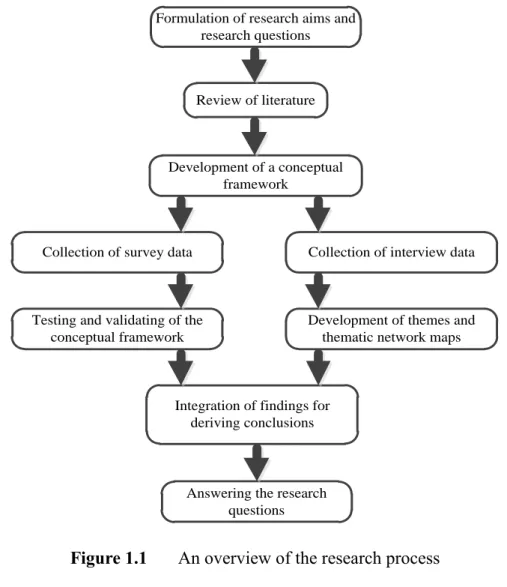
Figure 1.1 presents an overview of the research process that this research follows in the study. This research is initiated with the formulation of the research aims and the research questions. A comprehensive review of the related literature is conducted on e-government, information security, and information security compliance in organizations. This leads to the development of a conceptual framework for information security compliance in organizations. With the use of survey data collected from public organizations in Oman, the conceptual framework is validated and tested using SEM for answering the confirmatory research question. At the same time exploratory research questions are answered by performing thematic analysis (Fereday & Muir-Cochrane 2006) using the qualitative data collected through interviews with information security managers in public organizations in Oman. Finally, the quantitative and qualitative findings are integrated for deriving the conclusion for answering the research question.
Formulation of research aims and research questions
Development of a conceptual framework
Review of literature
Collection of survey data Collection of interview data
Integration of findings for deriving conclusions
Answering the research questions
Development of themes and thematic network maps Testing and validating of the
conceptual framework
Figure 1.1 An overview of the research process
1.5
Structure of the Thesis
This thesis consists of eight chapters. The remaining chapters are organized in the following manner.
Chapter Two provides a comprehensive review of the literature in e-government, information security for e-government development, and information security compliance in organizations. The existing approaches and frameworks for information security and information security compliance are explicitly discussed in this chapter. The need for a new conceptual framework towards effective information security compliance in public organizations in Oman is illustrated.
Chapter 1 Introduction
Chapter Three develops a conceptual framework for effective information security compliance in public organizations in Oman. The conceptual framework developed in this chapter serves as the foundation for developing the survey instrument for identifying the critical factors in information security compliance in e-government development. It also helps to develop the interview questions and facilitates the analysis of the interview data using deductive thematic analysis.
Chapter Four describes the research methodology. An overview of the research paradigms and methodologies is presented with the intention of understanding the rational for selecting a suitable research methodology in the research. The actual implementation of the selected research methodology is then discussed by detailing how the development of the research instrument, the data collection process, and the implementation of the data analysis process are implemented in this research to adequately answer the research questions.
Chapter Five focuses on the analysis of the qualitative data collected through interviews in public organizations in Oman. The procedures undertaken to analyze the qualitative data are illustrated. An overview of the thematic analysis technique is then presented. The research findings from the thematic analysis are then reported.
Chapter Six presents the results of the quantitative data analysis in the study. The procedures undertaken to analyze the quantitative data is first discussed. An overview of the data analysis procedures in SEM is then illustrated in this research. This leads to the presentation of the quantitative research findings with
respect to the adoption of confirmatory factor analysis (CFA) in SEM.
Chapter Seven provides a revised conceptual framework for effective information security compliance in public organizations for e-government development in Oman. With the integration of the findings from both the quantitative study and the qualitative study, the critical factors for effective information security compliance in e-government development are identified. With the use of the identified critical factors, a revised framework for information security compliance in public organizations for e-government development in Oman is developed.
Chapter Eight concludes the thesis. The research questions are revisited to confirm what has been accomplished in this research. A summary of the research findings and the contribution of the research to the information security compliance research are discussed. The limitations of the research and some suggestions for further research in this domain are presented.
Chapter 2
Literature Review
2.1
Introduction
The rapid development of e-government across the world has exposed the critical information in public organizations to the possibility of cybercrime (Al-Kalbani et al. 2015; Zhou & Hu 2008). This can be demonstrated by more than 38% increase in information security breaches in public organization in 2016 compared with that in 2014 (PWC 2016). Such an increase requires public organizations to design, implement and operate a secure electronic environment for the exchange of public e-documents and access to the repositories of public information for authorized public servants and hosting of shared applications in e-government development (Zhou & Hu 2008).
With the increasing delivery of e-government services in Oman, information security has been considered as one of the critical factors that assist the development of e-government (Al-Busaidy & Weerakkody 2009; Al Abri 2009). In an effort to protect the information in e-government systems, Omani government has initiated various information security projects such as the public key infrastructure for providing a secure platform on the delivery of e-government services (Information Technology Authority 2015). Furthermore, some public organizations in Oman have introduced security trainings and awareness programs to provide their employees with the necessary skills and knowledge of information security risks and threats.
The existing research in information security for e-government can be classified into two perspectives including technical and non-technical. The technical perspective focuses on developing security systems that can be adopted to secure transactions, protect access to information, and fence off hackers (Breu et al. 2005; Karokola et al. 2012; Zissis & Lekkas 2011). The non-technical perspective concentrates on determining the key factors for establishing reliable information security practices (Smith & Jamieson 2006; Wimmer & Von Bredow 2002; Zhao & Zhao 2010). These studies have shown their merits for information security in e-government development. They, however, have not investigated information security for e-government comprehensively (Al-Kalbani et al. 2014; Dunkerley & Tejay 2010; Wimmer & Von Bredow 2002).
Effective information security in e-government development requires an adequate consideration of both the technological perspective and the non-technical perspective (Dunkerley & Tejay 2010). This leads to the adoption of information security compliance for information security in organizations (Von Solms 2005). In this context, information security compliance is referred to as the implementation of information security policies and standards for protecting organizational information (Alfawaz et al. 2010; Dunkerley & Tejay 2010; Smith & Jamieson 2006; Von Solms 2005). Information security compliance can improve existing information security mechanisms in public organizations (Siponen et al. 2010). The use of a compliance approach satisfies the security requirements of various stakeholders in public organizations for e-government development, therefore improving the confidence and trust of e-government users. As a result, information security compliance is widely acknowledged as an
Chapter 2 Literature Review
effective means for information security in public organizations for e-government development (Alfawaz et al. 2010; Dunkerley & Tejay 2010; Smith & Jamieson 2006).
This chapter provides a comprehensive review of the related literature in e-government, the development of e-government in Oman, information security for e-government development, and information security compliance in organizations. Such a review justifies the need for this study and paves the way for the development of a conceptual framework for information security compliance in e-government development.
The chapter is organized as follows. An overview of the literature on e-government is first presented. This is followed by an illustration of the development of e-government development in Oman. The related literature on information security for e-government development is then comparatively analyzed followed by a review of the literature on information security compliance with a specific focus on the critical factors for information security compliance in public organizations. Finally, a summary of the literature reviewed in this chapter is presented.
2.2
An Overview of E-Government
E-government is a global phenomenon with many interpretations (Deng 2008). Muir and Oppenheim (2002), for example, define e-government as an online delivery of information and services through the use of ICT. Karunasena and
between government, citizens, and businesses. Bekkers and Homburg (2007) refer to e-governments as the use of ICT in public organizations to redefine existing and future relations with “stakeholders” in the internal and external environments. In this study, e-government is referred to as the use of ICT for transforming public services to make them more accessible, effective and accountable (Deng 2008; Wangpipatwong et al. 2009).
There are numerous benefits from the development of e-government in individual countries across the world. The development of e-government, for example, facilitates the interaction between government, citizens and businesses (Basu 2004; Holden et al. 2003). It can improve the delivery of public services (Clark 2003; Deng 2008; Sprecher 2000). Furthermore, the adoption of e-government simplifies the operational processes in public organizations, therefore improving the efficiency and effectiveness of these organizations (Basu 2004; Holden et al. 2003). Due to these potential benefits, e-government is widely adopted worldwide in individual countries.
There are three kinds of e-government initiatives that can be identified in the literature including government to citizens (G2C), government to businesses (G2B), and government to government (G2G) (Evans & Yen 2006; Ndou 2004; Palvia & Sharma 2007). G2C involves in facilitating the communication between government and citizens by allowing citizens to have access to public information and services in an efficient manner (Evans & Yen 2006; Karunasena & Deng 2012; Wang 2008). It often involves in providing a one-stop portal in which citizens can carry out a variety of activities and tasks across multiple
Chapter 2 Literature Review
organizations (Löfstedt 2005; Ndou 2004). There are two major forces driving the development of G2C e-government. The first one is the demand of citizens in using electronic transactions in their lives with the rapid development of ICT (Abu-Doush et al. 2013). The second one is in the interest of public organizations for delivering better services through e-government development (Al-Mamari et al. 2013; Karunasena & Deng 2010a).
G2B focuses on creating opportunities for businesses to conduct online transactions with government (Al-Mamari et al. 2013; Carter & Bélanger 2005). Such opportunities include speeding contractors’ payment for projects and bidding for public projects. There are two major forces driving the development of G2B. The first one is the business demand for cost savings through the adoption of ICT in processing various activities with governments (Karunasena & Deng 2012). The second one is the interest of both government and businesses in improving the efficiency and consistency of the public procurement processes (Krishnan et al. 2012).
G2G represents the backbone of e-government (Al-Mamari et al. 2013). It refers to the collaboration between public organizations by sharing information, resources and capabilities to provide stakeholders with complete public services (Al Nagi & Hamdan 2009; Azam et al. 2013; Evans & Yen 2006). This collaboration enhances the operations of internal systems and procedures. Such an enhancement leads to the creation of a connected government through the development of e-government. As a result, better coordination and communication between public organizations can be achieved.
There are a number of forces that motivate the development of G2G. One of these is through the development and implementation of specific legislation in specific circumstances (Al-Mamari et al. 2013; Dombrowski et al. 2014). The Computer Security Act in Australia (Smith & Jamieson 2006), for example, requires public organizations to develop information security plans and tasks that comply with international information security policies and standards. The second force is the interest of government in improving the efficiency of public organizations by increasing the speed of transactions, reducing the work force to complete a task, and improving the consistency of the delivery of public services (Abu-Doush et al. 2013; Al-Busaidy & Weerakkody 2009). Another force that motivates the development of G2G is through the need of government in utilizing efficient allocation of resources and cost cutting of government operations (Heeks 2003).
E-government initiatives strive to fully realize the capabilities of available ICT in an effort to improve and automate delivering public services for 24 hours a day, seven days a week to citizens, businesses, and public organizations. Such initiatives, however, take time and effort to achieve their objectives (Al-Mamari et al. 2013; Karunasena & Deng 2012; Karunasena et al. 2011). An analysis of the development of e-government shows that there are four stages of e-government development including the publishing stage, the interaction stage, the transaction stage and the transformation stage (Grönlund & Horan 2004; Moon 2002).
The publishing stage of e-government development focuses on the provision of public information online with the adoption of ICT (Howard 2001). This is the first stage of e-government development with the development of Internet and
Chapter 2 Literature Review
other technologies. A typical example is the establishment of a public website that presents information such as hours of operations, contact details, and list of services available of individual public organizations. Such websites usually have no interactive capabilities. They are used as a passive presentation of general information (Basu 2004).
The interaction stage of e-government development allows the exchange of limited information between citizens, businesses and public organizations (Basu 2004; Chandler & Emanuels 2002). It focuses on facilitating interactions that revolve around the information provision between government, businesses and citizens. Such interactions include the provision of guidelines for obtaining services, downloadable forms, or e-mail contacts and the response to simple questions from the e-government stakeholders (Chandler & Emanuels 2002).
The transaction stage of e-government development provides citizens and businesses with opportunities to carry out various transactions online (Chandler & Emanuels 2002). It enables citizens and businesses to complete entire tasks electronically at any time of day or night such as license renewals, utility bill payments, and submission of bids for procurement contracts (Evans & Yen 2006). Although the level of interactivity is of a higher magnitude than that in the interaction stage, the activities still involve a flow of information that is primarily a one-way process with predictable outcomes such as approval, a receipt, and acknowledge.
delivery of public services through the provision of a single point of contacts for all e-government services (Baum & Di Maio 2000; Karokola et al. 2012). It facilitates the seamless flow of information and close collaboration in decision-making between e-government stockholders (Karokola et al. 2012). Transactions with one public organization, for example, can be traced by another government organization (Azam et al. 2013; Dombrowski et al. 2014). The provision of a single point of contacts can be accessed through a one-stop portal or a front office counter installed at any government organization (Krishnan et al. 2012).
E-government can be approached from different perspectives including e-services, e-administrations, e-participation, and e-security (Löfstedt 2005; Bolívar et al. 2010). E-services government concentrates on the delivery of quality public services (Carter & Bélanger 2005; Tung & Rieck 2005). E-administration e-government strives to improve the effectiveness and efficiency of public organizations (Al-Mamari et al. 2013; Heeks 2003). E-participation e-government encourages the participation of citizens and businesses in the management of public organizations (Karunasena & Deng 2011; Layne & Lee 2001; Ndou 2004). E-security e-government is related to the development of technologies, applications, policies and standards for ensuring the security of information in e-government (Dunkerley & Tejay 2010; Karokola et al. 2012).
2.3
Development of E-Government in Oman
Oman is located in the southeast of the Arabian Peninsula. It is bounded in the northeast by the gulf of Oman and southeast by the Arabian Sea. Oman covers an area of about 119,500 square miles. According to the National Centre for Statistics
Chapter 2 Literature Review
and Information in Oman (NCSI 2016), Oman has a total population of 4.522 million people with a growth rate of 9.2%. The World Bank has estimated that the Omani population will reach 6 million by 2023.
Following the global trend of the development in e-government, the government of Oman in 2003 officially launched the initiative of e-government called “Towards the Digital Oman” for carrying out a contextual study for producing a national strategy in developing e-government. The objective of this strategy is to utilize ICT and human capacities to participate in economic activities that promote efficiency, cost saving, and knowledge transfer (Information Technology Authority 2015).
In order to effectively implement the national strategy of the Digital Oman, the government has identified specific initiatives to be adopted based on the country’s seventh five-year development plan (2006-2010). These initiatives include (a) the National Information Technology Training and Awareness program to address the issue of digital divide by empowering communities, (b) the National Data Centre to provide subsidized data housing solutions for government entities, (c) the Oman Government Network to provide affordable access to information and e-services with a secured network that connect public organizations, (d) the National e-Payment Gateway to provide a secure platform for online payment, and (e) the Oman Computer Emergency Response Team to deal with mitigating security risks and defending against malicious attacks (Ministry of National Economy 2008). The adoption of these initiatives has therefore significantly improved the overall performance of e-government development in Oman.
There is an increasing delivery of e-government services in public organizations in Oman. These services have become the most important and efficient means of the public service delivery by which the government of Oman interacts with businesses and citizens. Such a development, however, has also opened the possibility that critical information can be exposed that may hinder the overall development of e-government (Abanumy et al. 2005; Al-Busaidy & Weerakkody 2009; Deakins et al. 2008; Heeks 2003; Tassabehji et al. 2007). As a result, the security of information has become critical for e-government development.
There are several studies related to e-government development in Oman. These studies focus on (a) the challenges of implementing e-government initiatives (Abanumy et al. 2005; Al-Busaidy & Weerakkody 2009; Deakins et al. 2008), (b) the success factors for the adoption of e-government (Al-Mamari et al. 2013), and (c) the e-government adoption model from citizens‘ and government employees‘ perspective (Al-Adawi et al. 2005; Al Abri 2009). Most of these studies have considered information security as one of the factors that assist the development of government in Oman. Table 2.1 summarizes the studies of e-government in Oman.
Chapter 2 Literature Review
Table 2.1 A summary of the e-government studies in Oman
Studies Context
Al-Adawi et al (2005) Factors that affect citizens’ usage of e-government as a primary government interaction channel.
Abanumy et al (2005) Human factors in the process of implementing successful e-government websites.
AlShihi (2006) Impediments associated with the development of e-government with a focus on non-technical and country-specific factors.
Al-Busaidy et al (2009) Factors that affect e-government development and implementation. Al Abri (2009) Risks associated with online transactions for influencing the use of
e-government services.
Al-Mamari et al (2013) Factors that influence the adoption and implementation of e-Government initiatives from the organizational perspective.
2.4
Information Security for E-Government
E-government has created new ways of interactions between public organizations and citizens in the delivery of public services. These interactions have necessitated the need for maximum information protection. In general there are five broad requirements of information security in e-government: confidentiality, integrity, availability, authenticity, and accountability (Karokola et al. 2012; Zissis & Lekkas 2011). Confidentiality means protecting information from unauthorized disclosure by assuring that information is shared only among authorized stakeholders. Integrity concerns the accuracy of the information, including maintaining its origin, completeness, and correctness. Availability implies allowing information to be accessed by the right people at the right time. Authenticity refers to the legitimacy of data involved in transactions, communications, and documentation. Accountability suggests that all actions compromising e-government security can be traced back to the responsible party (Karokola et al. 2012; Zissis & Lekkas 2011).
challenging. This is because there are various factors that directly affect the information security in e-government. There are, for example, always potential breaches that may jeopardize the security of information in e-government systems in public organizations (Benabdallah et al. 2002; Dunkerley & Tejay 2010; Zhou & Hu 2008). The existence of information sharing between public organizations raises various security concerns (Baskerville & Siponen 2002; Conklin 2007; Karokola et al. 2012). Furthermore, there is an increasing probability of having malicious attacks on e-government services (Burkett 2012; Conklin & White 2006; West 2004). As a result, the adoption of effective approaches for effective information security in government becomes critical for the success of e-government development (Dunkerley & Tejay 2010; Ebrahim & Irani 2005; Karokola et al. 2012).
Considerable efforts have been made to design and develop various frameworks for information security in e-government (Dunkerley & Tejay 2010; Karokola et al. 2012; Smith & Jamieson 2006). Karokola et al. (2012), for instance, propose a framework for securing e-government services based on the e-government maturity model that includes the degree of technology complexity, the degree of systems sophistication, and the level of interactions. In this framework, different industrial security standards such as the National Institute of Standard and Technology (NIST 2008) are considered for information security in e-government development.
Dunkerley and Tejay (2010) propose a conceptual framework for information security in e-government development. Such a framework focuses on the system
Chapter 2 Literature Review
security, user security, and security effectiveness for protecting information in public organizations in an e-government context. It considers various critical factors including information integrity, information systems assurance, business enablement, user intent, user expertise, and security benefits for better understanding information security in e-government development. This framework shows different information security aspects for e-government that need to be considered. The applicability of this framework, however, has not been tested.
Breu et al. (2005) develop a conceptual framework for information security from the perspective of inter-organizational workflows in the context of securing web services in e-government. A model-driven architecture approach is adopted that automatically generates systems architectures and components for information security. The developed model provides specifications for the design of collaborating systems to support the security requirements for e-government services. This model is extremely useful for addressing the information security requirements across different public organizations for e-government services.
Smith and Jamieson (2006) present an analysis of the critical factors for information security in e-government development in Australia. The study reveals that awareness, active management support, training, and appropriate funding are essential for information security in e-government development. In a similar manner, Wangwe et al. (2012) present a study to analyze the information security success factors for e-government development in Tanzania. This leads to the identification of the information security success factors including support and
commitment, availability of human resource capacity, institutional and legal framework, and financial resources as critical for information security in e-government development.
Lambrinoudakis et al. (2003) propose the adoption of the public key infrastructure for information security in e-government platforms. The study reveals that the utilization of the security services offered by a Public Key Infrastructure can fulfill the consolidated government security requirements in the delivery of e-government services. This study further demonstrates that the development of a uniform e-government information security policy can be achieved by compiling a list of security requirements of individual services.
Existing literature discussed above has shown considerable efforts for designing and developing various frameworks for information security in e-government development. These individual frameworks, however, have focused either on the technological aspect or the non-technological aspect of information security. It is widely argued that effective information security require an adequate consideration of both the technological perspective and the socio-organizational perspective for safeguarding information and preventing the misuse of e-government information systems in public organizations (Dhillon & Backhouse 2001; Karokola et al. 2012; Wimmer & Von Bredow 2002). This is because the reliance only on the adoption of technology-based approaches, for example, can be rendered ineffective by a poorly designed operating procedure, or careless attitudes towards information security in organizations (Dunkerley & Tejay 2010).
Chapter 2 Literature Review
Effective information security in e-government development requires the adoption of an approach that is able to (a) build-up trusted technical infrastructure that can secure transactions and protect access to information, (b) establish reliable internal processes to efficiently execute information security controls, and (c) develop effective security cultures that promote positive individual attitudes and behaviors towards information security in organization. This is why there is an increasing focus on information security compliance to adequately protect organizational information in recent years (Boss & Kirsch 2007; Kolkowska et al. 2016; Siponen et al. 2010; Sommestad et al. 2014a).
2.5
Information Security Compliance
Information security compliance refers to the effective implementation of information security policies and standards for protecting information in organizations (Al-Kalbani et al. 2015; Von Solms 2005; Von Solms 2005). The rapid development of ICT and the increasing adoption of information systems in organizations lead to a wide adoption of information security compliance for adequately protecting organizational information (Boss & Kirsch 2007; Siponen et al. 2007). A British Standard Institution survey (BSI 2016) shows that more than 63% of the organizations regard information security compliance as a pre-requisite for business growth while about 56% of the respondents believe that the use of an information security compliance approach in their organizations has enhanced their business operational processes.
There are various international standards for information security that organizations need to comply within their industries. The International
Organization for Standardization (ISO) standard 17799, for example, is developed to create an international standard that organizations could subscribe to (Saint-Germain 2005). This standard provides the ability for an organization to apply an information security framework that includes governance requirements and information security regulations for information security. It covers the management of information security with the adoption of 133 controls that are divided in 11 different domains for defining the information security requirements in organizations (Calder & Watkins 2005).
The Control Objectives for Information and Technology (COBIT) is another international standard for information security in organizations. It provides a governance model for managing information security in organizations (Höne & Eloff 2002). Such a standard is reflected in 34 high-level processes that are grouped into four domains including planning and organization, acquisition and implementation, delivery and support, and monitoring and evaluation. These domains revolve around the concept of IT governance in terms of control requirements, technical issues and business risks. The adoption of COBIT enables a clear policy development and a good practice for information security controls throughout organizations. It emphasizes a regulatory compliance, helps organizations to increase the value of ICT, and enables an alignment between ICT governance and information security controls in organizations (Höne & Eloff 2002).
The adoption of an information security compliance approach is fast becoming an institutional yardstick for information security in organizations. It signals that
Chapter 2 Literature Review
adequate steps have been taken to protect organizational information (Boss & Kirsch 2007; Siponen et al. 2010). It also ensures that information security mechanisms can work together effectively to protect the critical information in organizations (Appari et al. 2009; Ifinedo 2013). As a result, information security compliance is widely considered as an effective approach for effective information security in organizations (Herath & Rao 2009).
Maintaining information security compliance in organizations is complex and challenging. Often organizations introduce different methods to maintain the information security compliance process (Bulgurcu et al. 2010; Siponen et al. 2014). Some organizations, for example, introduce security training and awareness programs to provide their employees with the necessary skills and knowledge for evaluating and responding to security threats (Bulgurcu et al. 2010). Other organizations use technical and administrative controls based on the information security policies and standards to guide employees to protect organizational information resources (Kolkowska & Dhillon 2012).
Several studies have examined information security compliance in organizations from different perspectives in recent years. Kolkowska et al. (2016), for example, use a value-based compliance method for capturing the rationalities behind employees’ compliance and non-compliance behavior with respect to their actual actions towards different information security practices in organization. The study shows the rationality of conflicts that impact the information security compliance behaviors of employees in organizations. The study also offers an improved basis for strategic decision making towards efficient security solutions that are aligned
with the organizational business goals, workflows, and employees’ behaviors.
Myyry et al. (2009) examine the influence of moral reasoning and values on compliance with information security policies by integrating two well-known psychological theories: the theory of cognitive moral (Kohlberg 1976) and the theory of motivational types of values (Schwartz 1992). The findings show that employees with punishment are more likely to follow the information security compliance policy. The study further shows that employees who are exhibited to follow their own intellectual and emotional interests, such as choosing own goals, seeking excitement, novelty, and challenge in life, or seeking pleasure and the satisfaction of sensual needs are less likely to follow the information security policy in organizations.
Herath and Rao (2009) develop and empirically validate an integrated model drawing from several different domains backgrounds for better understanding the motivations, values and norms that affect employees’ intentions to comply with an organization’s information security policies. The findings show that the perceived cost and benefits of complying with security policies and standards directly increases employees’ intention towards information security compliance in organizations. This study further indicates that organizational commitment and social influence have a significant impact on employees’ compliance intentions.
Lee et al. (2004) use an interactive method to investigate employees’ information security actions and behaviors with a focus on the abuse or misuse of information security practices under different scenarios. This study shows the rationality of
Chapter 2 Literature Review
employees’ attitudes towards different technical information security controls in organizations. It offers an improved basis for designing and implementing efficient security controls that align with employees’ behaviors in organizations.
Siponen et al. (2010) adopt two dominant theories including the universal constructive instructional theory and the elaboration likelihood theory to explain what learning principles affect employees’ compliance intention to information security policies. The findings suggest that information security training should utilize contents and methods that activate and motivate employees towards information security compliance. The findings indicate that a continuous communication process is required to increase employees’ intention to comply with information security policies and standards in organizations.
Ifinedo (2013) proposes a conceptual framework for complying with information security policies in organizations from the perspective of (a) socialization, (b) social influence, and (c) cognition. This study focuses on changing individual’s thoughts, actions, feelings, and attitudes towards information security compliance. The findings assert that social bonds that are formed at work largely increase employees’ intention towards information security compliance. This study further shows that employees’ locus of control and capabilities and competence that are related to information security issues increase information security policy compliance. The findings of this study confirm the earlier study by Chan et al. (2005a) that examines the effects of social contextual factors including management practices, supervisory practices, and coworker's socialization for increasing employees' intentions towards information security policies
compliance.
Safa et al. (2016) show the rationality of employees’ involvements such as knowledge sharing, collaboration, intervention and experience using both social bond and involvement theories towards information security compliance in organizations. The findings suggest that management in organizations should encourage their employees to share knowledge and collaborate in the domain of information security. The findings further show that employees with information security experience have a deep understanding of information security issues for protecting the information in organizations.
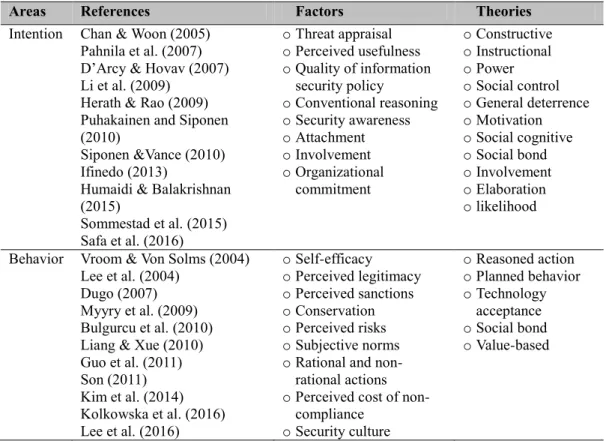
Overall, most existing studies in information security compliance have focused primarily on the factors that are related to employees’ attitudes in terms of understanding their behaviors and increasing their intentions to comply with information security policies and standards in organizations (Sommestad et al. 2014b). Table 2.2 summarizes the discussion about these studies above. There is, however, more on information security compliance with respect to understanding the complex socio-organizational dynamics in information security in public organizations (Al-Kalbani et al. 2015; Da Veiga & Eloff 2010; Martin et al. 2011; Posthumus & Von Solms 2004). Such dynamics include information security governance (Posthumus & Von Solms 2004; Smith & Jamieson 2006) and legislative requirements (Benabdallah et al. 2002) that may influence information security compliance in organizations. To adequately address the issue above, it is essential to develop a comprehensive framework that includes socio-organizational factors and empirically test and validate the framework in order to
Chapter 2 Literature Review
have effective information security compliance in public organizations for e-government development in Oman.
Table 2.2 An overview of information security compliance studies
Areas References Factors Theories
Intention Chan & Woon (2005) Pahnila et al. (2007) D’Arcy & Hovav (2007) Li et al. (2009)
Herath & Rao (2009) Puhakainen and Siponen (2010)
Siponen &Vance (2010) Ifinedo (2013)
Humaidi & Balakrishnan (2015) Sommestad et al. (2015) Safa et al. (2016) oThreat appraisal oPerceived usefulness oQuality of information security policy oConventional reasoning oSecurity awareness oAttachment oInvolvement oOrganizational commitment oConstructive oInstructional oPower oSocial control oGeneral deterrence oMotivation oSocial cognitive oSocial bond oInvolvement oElaboration olikelihood
Behavior Vroom & Von Solms (2004) Lee et al. (2004)
Dugo (2007) Myyry et al. (2009) Bulgurcu et al. (2010) Liang & Xue (2010) Guo et al. (2011) Son (2011) Kim et al. (2014) Kolkowska et al. (2016) Lee et al. (2016) oSelf-efficacy oPerceived legitimacy oPerceived sanctions oConservation oPerceived risks oSubjective norms
oRational and non-rational actions
oPerceived cost of non-compliance oSecurity culture oReasoned action oPlanned behavior oTechnology acceptance oSocial bond oValue-based
2.6
Conclusion
This chapter has reviewed the related literature on e-government, e-government development in Oman, information security for e-government, and information security compliance in organizations. The review reveals that the existing information security frameworks for e-government have an inadequate consideration of both the technical and non-technical aspects for protecting the information in e-government systems. The review further shows that there is a limited focus on information security compliance with respect to understanding the complex socio-organizational dynamics in information security compliance at
framework is emerged for effective information security compliance in public organizations in e-government development in Oman.