Methods Guide
for Comparative Effectiveness Reviews
Grading the Strength of a Body of Evidence When
Assessing Health Care Interventions for the Effective
Health Care Program of the Agency for Healthcare
Research and Quality: An Update
This report is based on research conducted by the RTI International-University of North Carolina Evidence-based Practice Center under contract to the Agency for Healthcare Research and Quality (AHRQ), Rockville, MD (Contract No. 290-2007-10056-I). The findings and
conclusions in this document are those of the authors, who are responsible for its contents; the findings and conclusions do not necessarily represent the views of AHRQ. Therefore, no statement in this report should be construed as an official position of AHRQ or of the U.S. Department of Health and Human Services.
The information in this report is intended to help health care decisionmakers—patients and clinicians, health system leaders, and policymakers, among others—make well-informed decisions and thereby improve the quality of health care services. This report is not intended to be a substitute for the application of clinical judgment. Anyone who makes decisions concerning the provision of clinical care should consider this report in the same way as any medical
reference and in conjunction with all other pertinent information (i.e., in the context of available resources and circumstances presented by individual patients).
This report may be used, in whole or in part, as the basis for development of clinical practice guidelines and other quality enhancement tools, or as a basis for reimbursement and coverage policies. AHRQ or U.S. Department of Health and Human Services endorsement of such derivative products may not be stated or implied.
This document is in the public domain and may be used and reprinted without special permission. Citation of the source is appreciated.
Persons using assistive technology may not be able to fully access information in this report. For assistance contact [email protected].
None of the investigators have any affiliations or financial involvement that conflicts with the material presented in this report.
Suggested citation: Berkman ND, Lohr KN, Ansari M, McDonagh M, Balk E, Whitlock E,
Reston J, Bass E, Butler M, Gartlehner G, Hartling L, Kane R, McPheeters M, Morgan L, Morton SC, Viswanathan M, Sista P, Chang S. Grading the Strength of a Body of Evidence When Assessing Health Care Interventions for the Effective Health Care Program of the Agency for Healthcare Research and Quality: An Update. Methods Guide for Comparative Effectiveness Reviews (Prepared by the RTI-UNC Evidence-based Practice Center under Contract No. 290-2007-10056-I). AHRQ Publication No. 13(14)-EHC130-EF. Rockville, MD: Agency for Healthcare Research and Quality. November 2013.
Authors:
Nancy D. Berkman, Ph.D., MLIRa Kathleen N. Lohr, Ph.D., M.Phil., M.A. a Mohammed Ansari, M.D., M.Med.Sc., M.Phil.b Marian McDonagh, Pharm.D.c
Ethan Balk, M.D.d Evelyn Whitlock, M.D., M.P.H.e James Reston, Ph.D.f Eric Bass, M.D., M.P.H.g Mary Butler, Ph.D.h Gerald Gartlehner, M.D., M.P.H.i Lisa Hartling, Ph.D.j Robert Kane, M.D., M.P.H.h Melissa McPheeters, Ph.D.k Laura Morgan, M.A.a Sally C. Morton, Ph.D.l Meera Viswanathan, Ph.D.a Priyanka Sista, B.A.a
Stephanie Chang, M.D., M.P.H.m a
RTI International, Research Triangle Park, NC b
University of Ottowa, Ottawa, Ontario, Canada c
Oregon Health and Science University, Portland, OR
d
Tufts University School of Medicine, Boston, MA e
Kaiser Permanente Center for Health Research, Portland, OR f
ECRI Institute, Plymouth Meeting, PA g
Johns Hopkins School of Medicine, Baltimore, MD h
University of Minnesota, Minneapolis, MN i
Danube University, Krems, Austria
j
University of Alberta, Edmonton, Alberta, Canada
k
Vanderbilt University, Nashville, TN
l
Preface
The Agency for Healthcare Research and Quality (AHRQ), through its Evidence-based Practice Centers (EPCs), sponsors the development of evidence reports and technology assessments to assist public- and private-sector organizations in their efforts to improve the quality of health care in the United States. The reports and assessments provide organizations with
comprehensive, science-based information on common, costly medical conditions and new health care technologies and strategies. The EPCs systematically review the relevant scientific literature on topics assigned to them by AHRQ and conduct additional analyses when
appropriate prior to developing their reports and assessments.
Strong methodological approaches to systematic review improve the transparency, consistency, and scientific rigor of these reports. Through a collaborative effort of the Effective Health Care (EHC) Program, AHRQ, the EHC Program Scientific Resource Center, and the AHRQ
Evidence-based Practice Centers have developed a Methods Guide for Comparative Effectiveness Reviews. This Guide presents issues key to the development of Systematic
Reviews and describes recommended approaches for addressing difficult, frequently encountered methodological issues.
The Methods Guide for Comparative Effectiveness Reviews is a living document, and will be updated as further empiric evidence develops and our understanding of better methods improves. We welcome comments on this Methods Guide paper. They may be sent by mail to the Task Order Officer named below at: Agency for Healthcare Research and Quality, 540 Gaither Road, Rockville, MD 20850, or by email to [email protected].
Richard G. Kronick, Ph.D. Jean Slutsky, P.A., M.S.P.H.
Director Director, Center for Outcomes and Evidence
Agency for Healthcare Research and Quality Agency for Healthcare Research and Quality Stephanie Chang, M.D., M.P.H.
Director and Task Order Officer Evidence-based Practice Program Center for Outcomes and Evidence
Acknowledgments
The authors thank Gillian Sanders, Ph.D., of the Duke Evidence-based Practice Center for organizing an EPC retreat in 2012 that was a crucial step in the development of this guidance. We also express our appreciation to members of the GRADE working group, and in particular Holger Schünemann, M.D., MSc, Ph.D., for offering their guidance both in person and through thoughtful comments on the draft document. Lastly, we acknowledge with gratitude the expert document preparation provided by Loraine Monroe at RTI International.
This research was funded through the Agency for Healthcare Research and Quality Effective Health Care program. The opinions expressed here are those of the authors and do not
necessarily represent the views of the Agency for Healthcare Research and Quality, the Department of Health and Human Services, or the Department of Veterans Affairs.
Peer Reviewers
Naomi Aronson, Ph.D.
Blue Cross and Blue Shield Association Chicago, IL
Suzanne Belinson, Ph.D., M.P.H. Blue Cross and Blue Shield Association Chicago, IL
Kevin Bozic, M.D., M.B.A.
University of California at San Francisco San Francisco, CA
Timothy Carey, M.D., M.P.H.
Cecil G. Sheps Center for Health Services Research, University of North Carolina Chapel Hill, NC
David Moher, Ph.D.
Ottawa Hospital Research Institute Ottawa, Quebec, Canada
Diana Petitti, M.D., M.P.H. Arizona State University Phoenix, AZ
Gregory Samsa, Ph.D. Duke University Durham, NC
David Samson, M.S.
Blue Cross and Blue Shield Association Chicago, IL
Harold C. Sox, M.D.
Dartmouth Institute for Health Policy and Clinical Practice and Geisel School of Medicine
Dartmouth, NH
Jonathan Treadwell, Ph.D. ECRI
Plymouth Meeting, PA
C. Michael White, Pharm.D. University of Connecticut Storrs, CT
Introduction
Systematic reviews are essential tools for summarizing information to help users make well-informed decisions about health care options.1 The Evidence-based Practice Center (EPC) program, supported by the Agency for Healthcare Research and Quality (AHRQ), produces substantial numbers of such reviews, including those that explicitly compare two or more clinical interventions (sometimes termed comparative effectiveness reviews). These reports synthesize a body of literature; the ultimate goal is to help clinicians, policymakers, and patients make well-considered decisions about health care. The goal of strength of evidence assessments is to provide clearly explained, well-reasoned judgments about reviewers’ confidence in their systematic review conclusions so that decisionmakers can use them effectively.2
Beginning in 2007, AHRQ supported a cross-EPC set of work groups to develop guidance on major elements of designing, conducting, and reporting systematic reviews.3 Together the
materials form the EPC Methods Guide for Effectiveness and Comparative Effectiveness Reviews;4 one chapter focused on grading the strength of evidence.5 This chapter updates the original EPC strength of evidence approach,5 presenting findings and recommendations of a work group with experience in applying previous guidance; it should be considered current guidance for EPCs. The guidance applies primarily to systematic reviews of drugs, devices, and other preventive and therapeutic interventions; it may apply to exposures (characteristics or risk factors that are determinants of health outcomes) and broader health services research questions. It does not address reviews of medical tests.
EPC reports support the work of many decisionmakers, but EPCs do not themselves develop recommendations or practice guidelines. In particular, we limit our grading strength of evidence approach to individual outcomes. Unlike grading systems that were designed to be used more directly by specific decisionmakers,6-8 we do not develop global summary judgments of the relative benefits and harms of treatment comparisons.
We briefly explore the rationale for grading strength of evidence, define domains of concern, and describe our recommended grading system for systematic reviews. The aims of this guidance are twofold: (1) to foster appropriate consistency and transparency in the methods that different EPCs use to grade strength of evidence and (2) to facilitate users’ interpretations of those grades for guideline development or other decisionmaking tasks. Because this field is rapidly evolving, future revisions are anticipated; they will reflect our increasing understanding and experience with the methodology.
Aims and Key Considerations for Grading Strength of Evidence
The primary purposes of a systematic review are to synthesize evidence for use by clinicians and patients and to facilitate the work of organizations that develop practice guidelines or make coverage decisions. Systematic reviewers examine all available evidence, summarize the findings, and communicate to end-users the reviewers’ confidence in those findings. In some cases, reviewers may be able to conduct a meta-analysis to provide a quantitative estimate of effect (or no difference in effect) and related statistical inferences via a confidence interval (CI) or hypothesis test. In other cases, however, they may be able to speak only to the direction of effect through a qualitative (narrative) synthesis. The strength of evidence grade summarizes the reviewers’ confidence in the findings based on either approach to evidence synthesis.
Grading the strength of evidence requires assessment of specific domains, including study limitations, directness, consistency, precision, and reporting bias. To assess the consistency and precision of a body of evidence, reviewers need to decide whether they are rating these domains with respect to estimating either an effect size or only the general direction of effect. The
precision domain assesses possible random error; all other required domains assess possible sources of systematic bias that may distort true effects. Additional domains that may be considered for some bodies of evidence and increase confidence in the findings include
increasing dose-response associations, plausible confounding that decreases the observed effect, and large magnitudes of effect.
Attaining the goals of consistency, transparency, and usability rests in part on uniformity and predictability in how EPC reviewers interpret these domains. Although no single approach for reporting results and grading the related strength of evidence is likely to suit all users,
documentation and a consistent approach in reporting of the most important summary
information about a body of literature —the general concept of transparency—will make reviews more useful to the broad range of potential audiences that AHRQ’s work aims to reach.
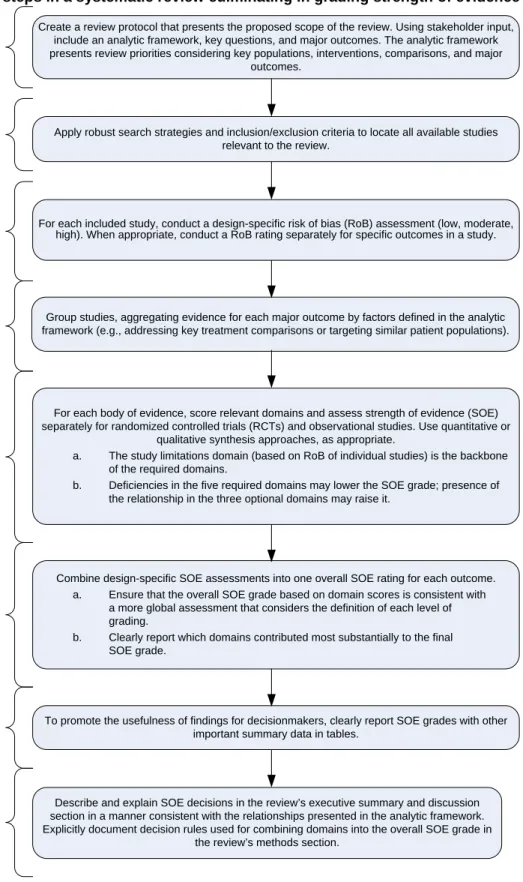
Figure 1 illustrates the major steps of strength of evidence assessments, using hypothetical information. Some decisions must be made a priori and are documented during the stage in which review protocol are developed. Then, according to these decisions rules and procedures documented in protocols, EPCs assess individual domain scores and establish overall strength of evidence grades.
Figure 1. Major steps in a systematic review culminating in grading strength of evidence
Note: Adapted from © G.H. Guyatt, et al. Figure 1. Schematic view of GRADE’s process for developing recommendations. J
Create a review protocol that presents the proposed scope of the review. Using stakeholder input, include an analytic framework, key questions, and major outcomes. The analytic framework presents review priorities considering key populations, interventions, comparisons, and major
outcomes.
Apply robust search strategies and inclusion/exclusion criteria to locate all available studies relevant to the review.
For each included study, conduct a design-specific risk of bias (RoB) assessment (low, moderate, high). When appropriate, conduct a RoB rating separately for specific outcomes in a study.
Group studies, aggregating evidence for each major outcome by factors defined in the analytic framework (e.g., addressing key treatment comparisons or targeting similar patient populations).
For each body of evidence, score relevant domains and assess strength of evidence (SOE) separately for randomized controlled trials (RCTs) and observational studies. Use quantitative or
qualitative synthesis approaches, as appropriate.
a. The study limitations domain (based on RoB of individual studies) is the backbone of the required domains.
b. Deficiencies in the five required domains may lower the SOE grade; presence of the relationship in the three optional domains may raise it.
Describe and explain SOE decisions in the review’s executive summary and discussion section in a manner consistent with the relationships presented in the analytic framework. Explicitly document decision rules used for combining domains into the overall SOE grade in
the review’s methods section.
To promote the usefulness of findings for decisionmakers, clearly report SOE grades with other important summary data in tables.
8. Transparent Reporting 7. Summary Tables 6. Overall Strength of Evidence 5. Outcome-Level Strength of Evidence by Study Design 4. Group Available Evidence 3. Individual
Study-Level Risk of Bias Assessments 2. Search and Selection of Relevant
Studies 1. Review Protocol
Combine design-specific SOE assessments into one overall SOE rating for each outcome. a. Ensure that the overall SOE grade based on domain scores is consistent with
a more global assessment that considers the definition of each level of grading.
b. Clearly report which domains contributed most substantially to the final SOE grade.
EPC and GRADE Approaches to Evaluating Evidence
The EPCs’ strength of evidence approach is based in large measure on the approach developed by the GRADE working group for assessing evidence.9-25 Although numerous grading systems have been available over the years,26-28 the GRADE system has been widely used. EPCs recommend, consistent with GRADE, relying on ratings of specific domains and aggregating domain information into a single overall grade.29This update incorporates advice from members of the GRADE working group, information from their explanatory series of articles, and EPCs’ experience in applying the original EPC guidance and recommendations. 13-25
Differences in the specific guidance to EPCs and GRADE users involve some terminology, purposes of grading evidence, and characteristics of domains. As to the lexicon, EPCs refer to the assessment of strength of evidence, whereas GRADE refers to quality of evidence.
Historically, EPCs referred to the evaluation of individual studies as quality assessment; EPCs have generally shifted in practice and terminology to assessing risk of bias.30 In either case, EPC terminology was intended to distinguish rating specific studies from assessing a body of
evidence. GRADE refers to risk of bias at the individual study level and in relation to a body of evidence. Finally, EPCs refer to three of the domains as directness, consistency, and precision; GRADE uses the terms indirectness, inconsistency, and imprecision.
The GRADE approach for systematic reviewers who are assessing the quality of evidence is often intended to complement activities of guideline developers who are also using a GRADE approach to look across outcomes to assess the strength of their recommendations; it assumes a close partnership between the two efforts.13 In contrast, EPCs grade the strength of evidence only for individual outcomes and not across outcomes; EPCs do not themselves make or grade clinical recommendations. On any given systematic review, EPCs may work with a quite diverse body of end-users (policymakers, administrators, health professionals, advocacy groups, and patients)— even audiences of which they may not be aware at the start of a given review. They expect that end-users can and will make their own global summary judgments of relative benefits and harms across treatment comparisons.
EPCs consider applicability of the evidence explicitly but separately from strength of evidence in their reviews, so as to provide clear, direct descriptions to disparate sets of potential users.31 The GRADE approach considers applicability as a part of the indirectness domain; reviewers using the GRADE approach typically have an identified target audience and can assess evidence against a specific target situation.11
Consistent with the Cochrane Risk of Bias tool for individual trial reports, the GRADE guidance recommends assessing outcome reporting bias within the domain of study limitations; it assesses publication bias as a separate domain.20,32 EPC guidance newly directs EPCs to assess selective outcome reporting and publication bias within the single domain of reporting bias. No matter what the precise origin of the components of reporting bias, the risk of such bias lowers confidence that the evidence in the review reflects the true effect of a given intervention on an outcome of interest.
Overall, EPC and GRADE guidance both emphasize applying a structured, transparent method. The GRADE working group has developed detailed guidance in many areas, created
Similarly, an EPC’s final grades should reflect a reasoned weighting of domain ratings. Within that framework, this updated guidance addresses some particular challenges that commonly arise in EPC reviews. EPCs often need to assess evidence from both trials and observational studies in evaluating a single outcome. They frequently encounter substantial heterogeneity in populations, interventions, or outcomes that may preclude conducting meta-analyses. The approach to synthesis in such circumstances is necessarily qualitative (i.e., narrative, based on reasoned judgment, rather than based on statistical inference).
A Priori Determinations Required in the EPC Approach for
Grading Strength of Evidence
Selecting Outcomes
Systematic reviews can be broad in scope, encompassing multiple patient populations, interventions, and outcomes. Because assessing strength of evidence can be labor intensive, especially when the combinations of comparisons and outcomes are numerous, EPCs are not expected to grade every possible comparison for every outcome. Rather, reviewers should specify their priorities in the review protocol for those combinations (patients-interventions-outcomes) that are likely to be of considerable importance to most users of the report. This decision contrasts with the Institute of Medicine recommendation in favor of assessing each outcome for strength of evidence,33 but it is consistent with the GRADE approach.
We recommend that EPC authors identify a priori (in protocols) the major outcomes that they intend to grade and specify these core elements in analytic frameworks accompanied by an explanation for their choices in text. Also, we recommend that major outcomes include both benefits and harms. Determining which outcomes and comparisons are most important to decisionmakers in clinical practice and health policy depends heavily on the key questions and their specified outcomes or comparisons, the clinical and policy context, and the purpose of the report.
EPCs make these choices considering the input of key informants, including patients, during the topic refinement phase of the project34 and subsequently through input from members of a technical expert panel (TEP). The final choices of outcomes rests on several considerations: the important needs that key informants, TEP members, and other end-users have expressed; the ultimate scope of the review (as reflected, for instance, in key questions); and the reliability, validity, responsiveness and other attributes of the outcome measures under consideration.
Ideally, outcomes that EPC authors elect to grade will be patient-centered. The Patient-Centered Outcomes Research Institute (PCORI) has defined patient-centered outcomes as those that “people notice and care about.”35 They can also be considered to reflect “an event that is perceptible to the patient and is of sufficient value that changing its frequency would be of value to the patient.”36, p.15 Patient-centered health outcomes may include reductions in mortality or disease severity and improvements in patient-reported outcomes such as health-related quality of life; they may also involve known or potential harms, such as occurrences of serious and
troubling adverse events and inconveniences.
An analytic framework can help to distinguish between these patient-centered, clinically important outcomes and intermediate outcomes. In some cases, EPCs may decide to grade intermediate outcomes that have clear, strong associations with health outcomes or that are, in
and of themselves, important to patients or other target users of the report (e.g., blood pressure control, cholesterol levels, adherence to treatment, or knowledge about an illness).
Specifying Study Eligibility
EPCs establish which studies will be eligible to answer the review questions.37 Eligibility criteria will reflect the scope of the review but may take account of study design considerations. Sometimes EPCs may determine a priori (in protocols) that, even if a study might have met other inclusion criteria, some aspect of the study’s design or execution was so flawed that it could not contribute meaningfully to the body of evidence. For instance, such studies may have very high attrition or high differential attrition, or they may use invalid or unreliable measures for a major outcome. When EPCs make such judgments, they may exclude such studies from the strength of evidence assessment and the review overall. Taking this stance is more likely for evaluating benefits than examining harms. Regardless of the types of decisions that EPCs might make about study eligibility, they should establish a priori criteria to identify studies with particular design elements that would constitute an unacceptably high risk of bias; they must also clearly state their rationale for these decisions.30
Specifying Procedures and Decision Rules
EPCs should decide a priori how they will ensure the accuracy and consistency of evidence assessments. For example, they should plan for specific steps to promote reliability and
transparency in the whole process (i.e., in scoring individual domains and in using each domain to derive an overall strength of evidence grade). They should devise ways to identify and deal with disagreements among reviewers within a given review team. Recent empirical work documents that inter-rater reliability for domain scoring can be problematic when studies have markedly different strengths and weaknesses, use different or incompatible outcome measures, or do not report all their findings clearly.38
We suggest that at least two reviewers with training in these methods independently score domains and determine final grades; in reaching final grades, at least two of the reviewers should be senior authors. Approaches to resolving disagreements in domain scores or final grades include invoking a third, senior author and consensus discussions that include senior authors or the EPC’s leadership.
Finally, integrating individual domains into an overall strength of evidence grade is a
considerable challenge. EPCs should describe their process for determining their overall strength of evidence assessment; steps include adopting a starting point and applying each domain score in upgrading or downgrading from that starting point. They should note how they will combine randomized controlled trial (RCT) and observational study bodies of evidence.
Major Steps in Grading Strength of Evidence
Scoring Domains: General Considerations
EPCs must assess a set of agreed-upon, “required” domains when grading the strength of evidence for each major outcome and comparison (Table 1). Four of these required domains are those in the EPC Program’s original guidance: study limitations (previously named risk of bias), directness, consistency, and precision. The fifth required domain is reporting bias; it was
previously an “additional” domain, limited to publication bias; now it also includes outcome reporting and analysis reporting bias. A set of three additional, but not required, domains are most relevant to bodies of evidence consisting of observational studies: dose-response
association, plausible confounding, and strength of association (i.e., magnitude of effect). All are discussed in more detail below.
To score the first four required domains, EPCs evaluate the body of evidence that reports each outcome of interest. EPCs assess the fifth domain, reporting bias, when strength of evidence is high, moderate, or low based on the first four domains. In other words, evidence deemed insufficient is not scored on this domain. To score this fifth domain, EPCs need to identify whether additional evidence has not been reported either because entire studies have not been published or because included studies have not reported planned outcomes. Another Methods Guide chapter provides further direction on assessing reporting bias.39
For each outcome and intervention (or intervention comparison) of interest, EPCs should develop domain scores and strength of evidence grades separately for RCT evidence and observational study evidence when both contribute to evidence synthesis. We discuss
considerations about when and how best to combine these separate bodies of evidence into one overall strength of evidence grade below.
The set of five required domains comprises the main constructs that EPCs should use for all major outcomes and comparisons of interest. As briefly defined in Table 1, these domains represent related but separate concepts, and each is scored independently. The concepts are explained in more detail in text.
Table 1. Required domains: definitions and scores
Domain Definition and Elements Score and Application
Study Limitations
Study limitations is the degree to which the included studies for a given outcome have a high likelihood of adequate protection against bias (i.e., good internal validity), assessed through two main elements: • Study design: Whether RCTs or other designs
such as nonexperimental or observational studies. • Study conduct. Aggregation of ratings of risk of
bias of the individual studies under consideration.
Score as one of three levels, separately by type of study design:
• Low level of study limitations • Medium level of study limitations • High level of study limitations
Directness Directness relates to (a) whether evidence links interventions directly to a health outcome of specific importance for the review, and (b) for comparative studies, whether the comparisons are based on head-to-head studies. The EPC should specify the
comparison and outcome for which the SOE grade applies.
Evidence may be indirect in several situations such as: • The outcome being graded is considered
intermediate (such as laboratory tests) in a review that is focused on clinical health outcomes (such as morbidity, mortality).
• Data do not come from head-to-head comparisons but rather from two or more bodies of evidence to compare interventions A and B—e.g., studies of A vs. placebo and B vs. placebo, or studies of A vs. C and B vs. C but not direct comparisons of A vs. B.
• Data are available only for proxy respondents (e.g., obtained from family members or nurses) instead of directly from patients for situations in which patients are capable of self-reporting and self-report is more reliable.
Indirectness always implies that more than one body of evidence is required to link interventions to the most important health outcome.
Score as one of two levels:
• Direct
• Indirect
If the domain score is indirect, EPCs should specify what type of
Table 1. Required domains and their definitions (continued)
Domain Definition and Elements Score and Application
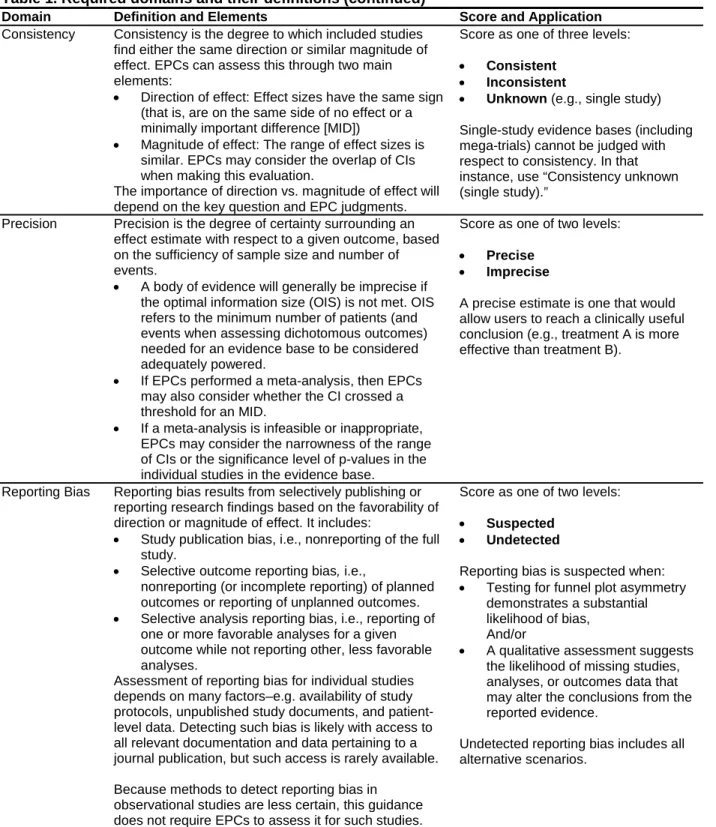
Consistency Consistency is the degree to which included studies find either the same direction or similar magnitude of effect. EPCs can assess this through two main elements:
• Direction of effect: Effect sizes have the same sign (that is, are on the same side of no effect or a minimally important difference [MID])
• Magnitude of effect: The range of effect sizes is similar. EPCs may consider the overlap of CIs when making this evaluation.
The importance of direction vs. magnitude of effect will depend on the key question and EPC judgments.
Score as one of three levels:
• Consistent • Inconsistent
• Unknown (e.g., single study) Single-study evidence bases (including mega-trials) cannot be judged with respect to consistency. In that instance, use “Consistency unknown (single study).”
Precision Precision is the degree of certainty surrounding an effect estimate with respect to a given outcome, based on the sufficiency of sample size and number of events.
• A body of evidence will generally be imprecise if the optimal information size (OIS) is not met. OIS refers to the minimum number of patients (and events when assessing dichotomous outcomes) needed for an evidence base to be considered adequately powered.
• If EPCs performed a meta-analysis, then EPCs may also consider whether the CI crossed a threshold for an MID.
• If a meta-analysis is infeasible or inappropriate, EPCs may consider the narrowness of the range of CIs or the significance level of p-values in the individual studies in the evidence base.
Score as one of two levels:
• Precise
• Imprecise
A precise estimate is one that would allow users to reach a clinically useful conclusion (e.g., treatment A is more effective than treatment B).
Reporting Bias Reporting bias results from selectively publishing or reporting research findings based on the favorability of direction or magnitude of effect. It includes:
• Study publication bias, i.e., nonreporting of the full study.
• Selective outcome reporting bias, i.e.,
nonreporting (or incomplete reporting) of planned outcomes or reporting of unplanned outcomes. • Selective analysis reporting bias, i.e., reporting of
one or more favorable analyses for a given outcome while not reporting other, less favorable analyses.
Assessment of reporting bias for individual studies depends on many factors–e.g. availability of study protocols, unpublished study documents, and patient-level data. Detecting such bias is likely with access to all relevant documentation and data pertaining to a journal publication, but such access is rarely available.
Because methods to detect reporting bias in observational studies are less certain, this guidance does not require EPCs to assess it for such studies.
Score as one of two levels:
• Suspected
• Undetected
Reporting bias is suspected when: • Testing for funnel plot asymmetry
demonstrates a substantial likelihood of bias,
And/or
• A qualitative assessment suggests the likelihood of missing studies, analyses, or outcomes data that may alter the conclusions from the reported evidence.
Undetected reporting bias includes all alternative scenarios.
CI = confidence internal; EPC = Evidence-based Practice Center; MID = minimally important difference; OIS = optimal information size
Study Limitations Domain
Definition
Scoring the study limitations domain is the essential starting place for grading strength of the body of evidence. It refers to the judgment that the findings from included studies of a treatment (or treatment comparison) for a given outcome are adequately protected against bias (i.e., have good internal validity), based on the design and conduct of those studies. That is, EPCs assess the ability of the evidence to yield an accurate estimate of the true effect without bias
(nonrandom error).
Scoring
EPCs derive the score for the study limitations domain from their assessment of the risk of bias for each individual study (rated high, moderate, or low) based on guidance in another
Methods Guide chapter.30 EPCs consider differences in concerns about risk of bias that are based on study design by separately scoring bodies of evidence for two main designs (i.e., RCTs and observational studies). Then, for a particular outcome or comparison within each study design group, EPCs assign one of three levels of aggregate risk of study limitations based on study conduct; the scores are low, medium, or high.
Combining evidence from studies with a high risk of bias and those with less risk can be problematic. In particular, if studies included in a body of evidence differ substantially in risk of bias, based on study design, study conduct, or both, EPCs may consider the consistency in findings between the bodies of evidence. If results are inconsistent, EPCs should assess whether differing levels of risk of bias explain this inconsistency they should then determine whether combining these bodies of evidence may obscure the findings from evidence rated either low or moderate risk of bias. For example, a body of observational studies in an evidence base may have a high risk of bias; thus, combining them with a body of RCTs of low or moderate risk of bias could inappropriately lower the strength of evidence assessment and obscure the findings for a major outcome.
To determine which groups of studies to include in the domain score and the final strength of evidence assessment, EPCs can conduct sensitivity analyses involving the high risk-of-bias studies. They can explore whether meta-analytic findings with this subset of studies are systematically different from the findings limited to less biased studies, i.e., whether
heterogeneity in study design or conduct can explain inconsistencies. If EPCs conclude that the findings do differ in material ways (with proper documentation of methods, explanation and justification), then they can give greater weight to the lower risk-of-bias studies or limit their final synthesis to these studies.37 EPCs should describe clearly how they derived the score for this domain when some individual studies have high risk of bias but others have low or moderate risk of bias. They should also be sure to discuss in results the reasons that they assigned high risk-of-bias ratings to these studies and how they decided whether these studies did (or did not) contribute to the domain score, overall findings, and strength of evidence. Such high-risk-of-bias studies are still counted as part of the overall evidence base and cited in references.
Directness Domain
Definition
Directness of evidence expresses how closely available evidence measures an outcome of interest. Assessing directness has two parts: directness of outcomes and directness of
comparisons. Applicability of evidence (external validity) is considered explicitly but separately from strength of evidence.31
Scoring
Directness (of outcomes or of comparisons) is scored as either direct or indirect. Generally, direct evidence for outcomes reflects a single link between an intervention and a patient-centered or clinically important ultimate health outcome, and direct evidence for comparisons requires head-to-head comparisons of interventions. EPCs score outcomes as indirect chiefly when an outcome is intermediate to or a proxy of an ultimate health outcome or when bodies of evidence lack head-to-head comparisons. EPCs should discuss considerations in determining directness in their synthesis of evidence, particularly links between intermediate and final health outcomes.
Directness of Outcomes
The focus of the review determines the evidence that EPCs should consider to be direct. As described earlier, insofar as possible EPCs should identify a priori which outcomes they will grade. In most cases those should be patient-centered or clinically important outcomes. For instance, for a review about treatment for heart disease, myocardial infarction (MI) or quality of life following an MI would be patient-centered outcomes (i.e., direct), whereas low density lipoprotein (LDL cholesterol) level would be considered an intermediate outcome, and in this illustrative review, thus, is indirect.
EPCs may consider some intermediate outcomes important enough to grade the strength of evidence. For example, in the heart disease example, if one key question concerns changes in risk factors for heart disease, EPCs can score the LDL outcomes on directness and consider this evidence direct. If, however, all key questions are limited to ultimate health outcomes of
treatment for heart disease, EPCs would view LDL only as an intermediate outcome and consider the LDL evidence only as indirect. If EPCs have no direct evidence whatsoever to answer a key question regarding an ultimate outcome, then they may want to consider use of surrogate markers or intermediate outcomes and score them for this domain; such evidence would be considered indirect.
Evidence may also be considered indirect because investigators used proxy respondents to stand in for certain kinds of patients or subjects in measuring the outcome of interest. For instance, investigators may use surrogates (e.g., family members or nurses) to obtain patients’ perceptions of their states of health, such as quality of life or measures of symptom
improvement. However, when patient self-report is truly not possible, such as from infants or the cognitively impaired, EPCs may consider such data from proxy respondents to be direct.
Directness of Comparisons
Comparisons are considered direct when the evidence derives from studies that compare interventions specifically with each other; that is, the studies are head-to-head comparisons. For the directness domain, this is the most desirable situation.
In many circumstances, such head-to-head evidence is not available. When studies compare an intervention group with a placebo control or a “usual care” (or similar) group but not
specifically with a comparator intervention of interest, then the evidence is indirect.
EPCs can use separate bodies of evidence (e.g., A versus placebo, B versus placebo, and C versus placebo) to estimate indirectly the comparative effectiveness of the interventions. As an example, in a review of off-label use of atypical antipsychotic drugs, only placebo-controlled trials evaluated changes in depression scores in patients with major depressive disorder who had been treated with olanzapine, quetiapine, or risperidone as adjunct therapy to antidepressants.40 This evidence is considered indirect for making comparisons of one antipsychotic with another. Mixed treatment comparisons should be considered indirect (i.e., when the model combines direct and indirect evidence). Detailed guidance on indirect comparisons for EPCs has been reported previously.41,42
Consistency Domain
Definition
Consistency refers to the degree of similarity in the direction of effects or the degree of similarity in the effect sizes (magnitudes of effect) across individual studies within an evidence base. EPCs may choose which of these two notions of consistency (direction or magnitude) they are scoring; they should be explicit about this choice.
Scoring
CategoriesThe consistency of a body of evidence is scored using one of three categories: consistent, inconsistent, and consistency unknown. These categories apply for both direction of effect or magnitude of effect.
Some bodies of evidence may show consistency in the direction of effect but inconsistency in the magnitude of effect sizes. In such cases, EPCs would judge the evidence as consistent or inconsistent based on the choice they have made about grading direction or magnitude of effect in answering a key question.
Judging Direction of Effect (or Equivalence)
EPCs are most often judging consistency in evidence of superiority of one treatment over another. This is appropriate when comparing two interventions or an intervention with placebo or usual care. They look for consistency in direction of effect estimates in relation to the line that distinguishes superiority from inferiority (odds ratio [OR] or risk ratio [RR] =1.0 or absolute difference = 0). CIs may provide additional information on the consistency of the direction of effect in the body of evidence. For example, if all studies except one show estimates of effect in the same direction, but the CI for that one study overlaps the CIs for the estimates of effect in the other studies, then this body of evidence may still be considered consistent.
In contrast to superiority, EPCs may look for evidence to support noninferiority or equivalence when comparing two different interventions with each other. In distinguishing
would consider the evidence to show a benefit or harm of one treatment over another treatment or placebo. For example, EPCs can judge studies as consistent and find no meaningful difference between treatments when all estimates are between thresholds of an explicitly defined MID (e.g., between −0.75 and +1.25 for dichotomous outcomes).
Optimally, MID thresholds are based on empirical evidence or published guidelines. When such evidence is not available, then EPCs can use the consensus of the review team with input from clinical experts. Ideally, MIDs are determined a priori, but they may be established post hoc if necessary. In either case, EPCs should explicitly define meaningful clinical thresholds (and the rationale for them) in the methods section of the review.
Determining MIDs is not always possible. For example, studies in a review may use a variety of scales to measure the same outcome, and those scale scores may not have been calibrated or cross-walked against each other. Moreover, some or all of such scales may not have been
subjected to reliability or validity testing. Thus, EPCs may not be able to determine a meaningful threshold across scales with different measurement properties. EPCs can find additional
discussion concerning MIDs in the EPC guidance chapter on assessing equivalence and noninferiority.43
Judging Magnitude of Effect (and Heterogeneity)
EPCs judge consistency in the magnitude of effect by determining the degree to which point estimates are similar across studies. EPCs can consider studies to be consistent when the CIs of individual studies overlap a summary effect estimate calculated from a meta-analysis. When meta-analysis results are unavailable, EPCs will need to rely on the reviewers’ judgment.
Substantial unexplained differences (heterogeneity) across studies may suggest the need for caution in estimating a summary magnitude-of-treatment effect. When EPCs can explain heterogeneity (e.g., a prioridetermined differences attributable to populations, intervention characteristics, comparators, study design, or conduct); they may not need to score the evidence as inconsistent. This may be the case when they can either stratify the evidence by meaningful subgroups, and separately score the magnitude of effect of outcomes for these subgroups; it may also be possible when they can select the most believable effect estimate from among the studies being considered and then adequately explain the difference between it and the results from the remaining studies.44
When EPCs cannot explain heterogeneity ahead of time but meta-analysis is appropriate, they can evaluate consistency in magnitude of effect both qualitatively and through statistical tests for heterogeneity (e.g., Cochran’s Q test) or the magnitude of heterogeneity (e.g., I2 statistic3). EPCs should not use results from statistical tests as the sole determinant of the presence of inconsistency because of potential problems in their interpretation and lack of statistical power.45,46 No single measure is ideal, so EPCs need to explore heterogeneity by considering several statistical approaches, differences in effect estimates, and degree of overlap in CIs in individual studies. EPCs can find more detail about evaluating heterogeneity in
GRADE guidance on inconsistency.22
Judging a Single-Study Evidence Base
Scoring consistency ideally requires an evidence base with independent investigations of the same treatment/outcome comparison in more than one study. EPCs cannot be certain that a single study, no matter how large or well designed, presents the definitive picture of any particular clinical benefit or harm for a given treatment.47-49 Accordingly, we recommend that
Precision Domain
Definition
Precision is the degree of certainty surrounding an estimate of effect with respect to an outcome. It is based on the potential for random error evaluated through the sufficiency of sample size and, in the case of dichotomous outcomes, the number of events. A precise body of evidence should enable decisionmakers to draw conclusions about whether one treatment is inferior, equivalent, or superior to another.50,51
Scoring
CategoriesThe assessment of the precision of a body of evidence has two categories: precise and imprecise.
Judging Precision
When EPCs have conducted a quantitative synthesis and calculated a pooled estimate
through meta-analysis, they can evaluate precision based on the CI from the meta-analysis. If the CI is wide, EPCs must judge whether it is caused by heterogeneity (which may be attributed to inconsistency) or imprecision. If a wide CI can be attributed to unexplained inconsistency in results, EPCs should not score evidence as imprecise as well. For greater details, see the later section on assigning an overall strength of evidence grade.
When a quantitative synthesis is not possible, EPCs must judge precision based on the constituent parts that would have contributed to the CI for the pooled estimate—i.e., the sample size and the assessment of variance within individual studies. EPCs can evaluate sufficiency of sample size relative to the optimal information size (OIS). OIS concerns the minimum number of patients (for continuous outcomes) and events (for dichotomous outcomes) that would be needed to regard a body of evidence as having adequate power. For a given effect size (such as an OR, a RR, or a weighted mean difference), the optimal number of patients derives from standard sample size calculations for a single, sufficiently powered trial. More detail on OIS is available in the GRADE guidance on imprecision.21 If the OIS criteria are not met, EPCs may score the evidence as imprecise.
After assessing the adequacy of the sample size or events, EPCs must consider whether the potential for random error in individual studies would decrease their confidence in the study findings. In ideal circumstances, EPCs will have measures of variance for the outcomes of interest in the individual studies (e.g., standard deviation, CI), but in some cases they may have only p values. If more precise measures of variance in studies are not reported but the OIS is met, then EPCs may consider the evidence to be precise when studies report significance level of differences between treatments as p values of less than 0.05.
Reporting Bias
of reporting bias that either authors or journals can introduce: publication bias and outcome and analysis reporting bias.
Table 2. Definitions and descriptions of reporting bias
Types of Reporting
Bias Definition Examples and Implications
Publication The whole study has been concealed from public access (nonregistration and/or nonpublication) or it will be made accessible only after an initial delay; this is the “file drawer phenomenon” and the “reporting lag time bias,” respectively. A variant is purposeful publication of some or all of the study data in obscure platforms or journals.
Data included in the review are more likely to reflect favorable findings than unfavorable findings. For example, significant differences favoring an intervention for efficacy outcomes or nonsignificant differences for harms outcomes are likelier to be reported in study articles than other results.
Selective Outcome Reporting
The study is reported, but one or more of the planned outcomes are not reported and investigators do not provide a reasonable justification.
Data included in the review are more likely to reflect favorable findings than unfavorable findings. For example, significant differences favoring an intervention for efficacy outcomes or nonsignificant differences for harms outcomes are likelier to be reported in study articles than other results.
Outcome data are reported but the specific outcome itself or the way it was measured was not as planned.
This phenomenon reflects data mining and increased risk for type I error when significant differences may be a chance occurrence rather than a true effect.
Selective Analysis Reporting
Outcome data are reported but they are based on the most favorable of several analyses undertaken; other analyses are suppressed.
This phenomenon includes presenting selective post hoc subgroup analyses, dichotomizing continuous data using a cut-point that gives the most favorable results, reporting more favorable adjusted versus unadjusted analyses, cherry-picking statistical assumptions, and reporting selective time-point analyses from among multiple follow-up points that had been planned.
Precision of outcome data estimates is incompletely or not reported.
This problem includes presenting a point estimate without measures of dispersion or giving inexact, nonsignificant p-values (e.g., p>0.05)
The same outcome data are ambiguously reported in multiple study reports.
Authors do not make the copublication status transparent, which may lead to double counting of outcomes data.
Methods to assess reporting bias exist only for RCTs. Further details on approaches to detecting reporting bias may be found in another paper in progress.39 Observational studies may also be susceptible to reporting bias,54-57 particularly because studies are generally not registered and lack a priori protocols. No comparable methods exist for assessing reporting bias for these study designs.
Scoring
CategoriesThe risk of reporting bias is scored as suspected or undetected.
Judging Reporting Bias
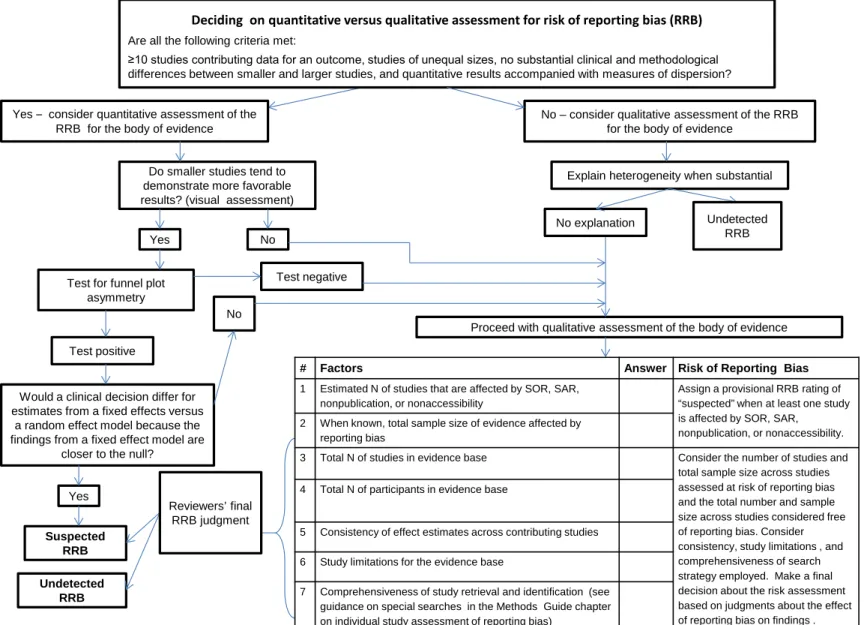
when those findings, if reported, would be either not statistically significant or unfavorable in direction.58-64 EPCs can test for the impact of unreported data through, for instance, tests for funnel plot asymmetry, a trim and fill method, and selection modeling. When EPCs cannot do quantitative assessments, or in addition to quantitative assessments, they can conduct a
qualitative assessment of reporting bias for the body of evidence. A proposed, but untested, decision aid to evaluate the risk of reporting bias provides guidance on taking a cautious
approach for testing funnel plot asymmetry and conducting a qualitative assessment of the risk of reporting bias (see Appendix A).
Additional Domains
The second set of domains, which supplement the five required domains, has three components: dose-response association; uncontrolled confounding that would diminish an observed effect (which is referred to here as “plausible confounding”); and strength of
association (i.e., large magnitude of effect). EPCs should consider the additional domains when appropriate; they need not report on those domains when they regard them as irrelevant to the body of evidence. Although these additional domains apply to RCTs, when they are present they can increase the strength of evidence and are, therefore, especially relevant for observational studies.
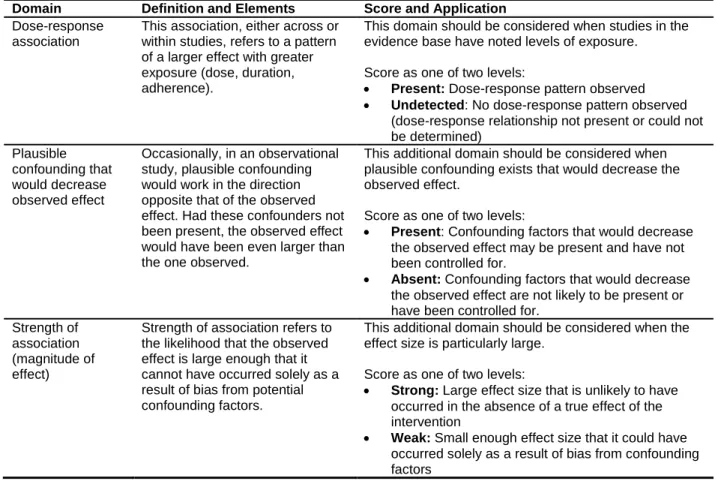
Table 3 defines these additional domains and ways to score and apply them. EPCs should explain which additional domains they have used in arriving at any overall strength of evidence grade and how they have altered a judgment that had otherwise been based on only the required domains.
Table 3. Additional domains and their definitions
Domain Definition and Elements Score and Application
Dose-response association
This association, either across or within studies, refers to a pattern of a larger effect with greater exposure (dose, duration, adherence).
This domain should be considered when studies in the evidence base have noted levels of exposure.
Score as one of two levels:
• Present: Dose-response pattern observed • Undetected: No dose-response pattern observed
(dose-response relationship not present or could not be determined) Plausible confounding that would decrease observed effect Occasionally, in an observational study, plausible confounding would work in the direction opposite that of the observed effect. Had these confounders not been present, the observed effect would have been even larger than the one observed.
This additional domain should be considered when plausible confounding exists that would decrease the observed effect.
Score as one of two levels:
• Present: Confounding factors that would decrease the observed effect may be present and have not been controlled for.
• Absent: Confounding factors that would decrease the observed effect are not likely to be present or have been controlled for.
Strength of association (magnitude of effect)
Strength of association refers to the likelihood that the observed effect is large enough that it cannot have occurred solely as a result of bias from potential confounding factors.
This additional domain should be considered when the effect size is particularly large.
Score as one of two levels:
• Strong: Large effect size that is unlikely to have occurred in the absence of a true effect of the intervention
• Weak: Small enough effect size that it could have occurred solely as a result of bias from confounding factors
Applicability
EPCs define applicability as “the extent to which the effects observed in published studies are likely to reflect the expected results when a specific intervention is applied to the population of interest under “real-world’ conditions.” 31, p.2Because of the broad target audiences of EPC reports, EPCs have chosen to make judgments about applicability explicit and separate from assessments of strength of evidence. The goal is to enable varied decisionmakers to take into account how well the evidence maps to the patient populations, diseases or conditions,
interventions, comparators, outcomes, and settings that are most relevant to their decisions. EPCs should record information describing applicability for the outcomes and comparisons for which they specify an overall strength of evidence grade. Separate guidance on applicability is
available.31
Establishing an Overall Strength of Evidence Grade
Four Strength of Evidence Levels
The four levels of grades are intended to communicate to decisionmakers EPCs’ confidence in a body of evidence for a single outcome of a single treatment comparison. Although assigning a grade requires judgment, having a common understanding of the interpretation will be useful for helping EPCs as they conduct their own global assessment and for improving consistency
Table 4 summarizes the four levels of grades that EPCs use for the overall assessment of the body of evidence. Grades are denoted high, moderate, low, and insufficient. They are not
designated by Roman numerals or other symbols. EPCs should apply discrete grades and should not use designations such as “low to moderate” strength of evidence.
Table 4. Strength of evidence grades and definitions
Grade Definition
High We are very confident that the estimate of effect lies close to the true effect for this outcome.
The body of evidence has few or no deficiencies. We believe that the findings are stable, i.e., another study would not change the conclusions.
Moderate We are moderately confident that the estimate of effect lies close to the true effect for this outcome. The body of evidence has some deficiencies. We believe that the findings are likely to be stable, but some doubt remains.
Low We have limited confidence that the estimate of effect lies close to the true effect for this outcome. The body of evidence has major or numerous deficiencies (or both). We believe that additional evidence is needed before concluding either that the findings are stable or that the estimate of effect is close to the true effect.
Insufficient We have no evidence, we are unable to estimate an effect, or we have no confidence in the estimate of effect for this outcome. No evidence is available or the body of evidence has unacceptable deficiencies, precluding reaching a conclusion.
Each level has two components. The first, principal definition concerns the level of confidence that EPCs place in the estimate of effect (direction or magnitude of effect) for the benefit or harm; this equates to their judgment as to how much the evidence reflects a true effect. The second, subsidiary definition involves an assessment of the level of deficiencies in the body of evidence and belief in the stability of the findings, based on domain scores and a more
holistic, summary appreciation of the possibly complex interaction among the individual domains.
Assigning a grade of high, moderate, or low implies that an evidence base is available from which to estimate an effect for either the benefit or the harm. The designations of high, moderate, and low should convey how confident EPCs would be about decisions based on evidence of differing grades, which can be based on either quantitative or qualitative assessment.
For comparative effectiveness questions, the comparison is typically a choice of either direction (A>B, A=B, A<B) or magnitude (difference between A and B). In some instances assigning different grades regarding the direction and the magnitude of an effect may be appropriate. An example of this situation is when studies consistently find that an intervention improves an outcome (e.g., apnea-hypopnea index is reduced by a statistically significant amount or beyond a minimally important difference), but the degree of heterogeneity about the estimate is high (e.g., range -10 to -46 events/minute; I2 = 86%).
The importance of the distinctions among high, moderate, and low levels (and the distinction with insufficient strength of evidence) can vary by the type of outcome, comparison, and
decisionmaker. EPCs understand that some stakeholders may want to take action only when evidence is of high or moderate strength, whereas others may want to understand clearly the implications of low versus insufficient evidence. Even when strength of evidence is low or insufficient, consumers, clinicians, and policymakers may find themselves in the position of having to make choices and decisions, and they may consider factors other than the evidence
Evidence Grade of Insufficient
In some cases, EPCs cannot draw any evidence-based conclusions for a particular outcome, specific comparison, or other question of interest. In these situations, EPCs should assign a grade of insufficient but be specific in text or tables as to why the evidence does not permit a
conclusion. EPCs need to take particular care not to conflate “low” strength of evidence with “insufficient.” If a body of evidence is truly insufficient, that should mean that EPCs cannot draw any conclusion regarding the effect from the body of evidence.
The first reason that EPCs may conclude that evidence is insufficient is that no evidence is available from the included studies. This case includes the absence of any relevant studies whatsoever. In some systematic reviews, for example, certain drug comparisons may never have been studied (or published) in head-to-head trials and placebo-controlled trials of the multiple drugs of interest may not provide adequate indirect evidence for any comparisons.
Another common reason for a grade of insufficient is that evidence on the outcome is too weak, sparse, or inconsistent to permit EPCs to draw any defensible conclusion concerning the effect. This situation can reflect one or more of several complicated conditions, such as
unacceptably high study limitations or a major unexplained inconsistency (e.g., two studies with the same risk of bias that found opposite results, with no clear reason for the discrepancy).
A grade of insufficient may be appropriate when the CI around the estimated effect in a meta-analysis or across the preponderance of evidence in a qualitative assessment is so wide that it includes two incompatible conclusions: that one treatment is clinically significantly better than the other, and that it is worse. This should not be misunderstood to mean that all statistically nonsignificant effects should lead to a grade of insufficient. Instead, EPCs should use the grade of insufficient when the imprecision results in no confidence regarding whether the effect of one intervention is superior, inferior, or equivalent to another.
Evidence based on a single study often warrants a grade of insufficient. Because the evidence includes only one study, consistency is unknown. When combined with a study size too small to meet OIS criteria, the resulting lowering of the precision domain score further reduces the confidence in the finding of that study, often leading the EPC to be unable to estimate an effect, and thus a grade of insufficient.
Incorporating Domains into an Overall Grade
Overview
For each outcome to be graded, EPCs should first score domains and strength of evidence separately for RCTs and observational studies. EPCs should describe whether evidence from observational studies complements or conflicts with evidence from RCTs, give plausible reasons for any differences, and note pertinent limitations in both bodies of evidence. They then combine those design-specific strength of evidence grades into one overall strength of evidence grade, or they may choose to rely on one study design if it clearly provides stronger evidence.
The final judgment for combining domains into an overall strength of evidence must weigh the relative importance of each of the domains in relation to the most worrisome uncertainty in the body of evidence. EPCs must clearly describe how the major concerns in each domain did or did not contribute to the overall strength of evidence. Thus, EPCs may use different approaches to incorporate multiple domains into an overall strength of evidence grade as long as their rationale for grading strength of evidence is clear and adheres to the important general principles
grading of strength of evidence and note which domains were important in reaching a final grade.
Starting Point for Grades for RCTs and Observational Studies
Based on study design, RCT bodies of evidence initially start with a provisional grade of high strength of evidence. EPCs might change such an assessment after evaluating study limitations based on how the RCTs actually were conducted and the other domains.
In contrast, evidence based on observational studies isgenerally assumed to pose a greater risk of having study limitations because of the typically higher risk of bias attributable to a lack of randomization (and inability of investigators to control for critical confounding factors). This usually corresponds to an initial provisional grade of low strength of evidence.
EPCs may move up the initial grade for strength of evidence based on observational studies to moderate when the body of evidence is scored as low or medium study limitations, based on controls for risk of bias through study conduct or analysis. Similarly, EPCs may initially grade the strength of evidence as moderate for certain outcomes such as harms or certain key questions, when observational study evidence is at less of a risk for study limitations because of a lower risk of bias related to potential confounding.
Also, EPCs may well decide that, after assessing the additional domains, the overall strength of evidence of a body of observational studies can be upgraded to moderate (although rarely high).
Focusing the Strength of Evidence Assessment on Subsets of Studies
Based on reasonable standards of evidence for the subject area, EPCs may adopt a “best evidence” approach. That is, they may focus their assessment of strength of evidence on the subset of studies that provide the least limited, most direct, and most reliable evidence for an outcome or comparison, after analysis of all the evidence. EPCs may want to specify a
dichotomy to define the best evidence subset; examples include active-controlled versus placebo-controlled, randomized versus nonrandomized, prospective versus retrospective, or lower risk of bias versus high risk of bias. For example, when EPCs locate a reasonable number of studies of head-to-head comparisons of important alternatives (i.e., Drug A versus Drug B), they are likely to elect not to use placebo-controlled comparisons (Drug A versus placebo, Drug B versus placebo) in their summary estimate of effect. This means that they also would not use the placebo-controlled comparisons in developing their summary findings and their strength of evidence grading.
EPCs may choose to determine an appropriate subset of studies for presenting review findings and strength of evidence assessment by conducting an analysis with and without the problematic studies (such as with a sensitivity analysis)37,65 and consider which results are most valid and informative. No matter the criteria they use, EPCs must clearly identify studies that met their inclusion criteria and included in the review but did not use in the strength of evidence assessment.
Special Considerations Incorporating Consistency and Precision
Domains into Overall Grades
some studies in the evidence base do not report (or reviewers cannot independently calculate) measures of dispersion around between-group differences in effect. This gap in data precludes not only statistical testing of heterogeneity but also qualitative assessment of consistency based on an examination of CIs. Even when the effect sizes appear to be generally consistent across directions or estimates of effect, EPCs cannot determine whether all CIs from the individual studies are above a threshold of no difference. In this case consistency may be uncertain, and EPCs’ reviewers must use their judgment to decide whether lowering the grade is appropriate.
Another example of a challenging consistency scenario is an evidence base consisting of studies that all measured roughly the same construct (e.g., functional limitation) but used instruments that differed enough to make reviewers doubt the wisdom of converting to a
standardized measurement for conducting any meta-analysis. Because differences in effect sizes may reflect differences in measurement instruments, EPCs cannot always determine whether the evidence base is truly inconsistent and whether lowering the grade is appropriate. Although precision may also be unknown in this example, an EPC would lower the grade no more than once (i.e., downgrade for unknown consistency or imprecision, but not both).
In many instances, in a body of evidence with estimates of effect that appear imprecise, EPCs may find it difficult to distinguish whether the evidence is inconsistent as well. The main reasons are that (a) the same measures are often used to assess both precision and consistency and (b) the underlying statistical model used in a meta-analysis may have incorporated measurement of both random error and heterogeneity. In meta-analyses with wide CIs, EPCs can examine whether most of the uncertainty can likely be attributed to inadequate sample size and random error (the OIS may be an indicator) or whether it arises mostly because of the heterogeneity in results. We recommend that when a meta-analysis has wide CIs that permit different interpretations, EPCs attribute the uncertainty to either imprecision or inconsistency and lower the grade only once unless they can justify otherwise.
Transparency: Documenting and Reporting Strength of Evidence
Overview
In arriving at an overall strength of evidence grade, a crucial requirement is transparency. EPCs should make a global assessment of the overall strength of evidence with explicit
consideration for how the scores for each domain contribute to that overall grade. Being explicit and transparent about what steps and criteria are used to arrive at a final strength of evidence grade is the essential element.
EPCs should carefully document procedures used to grade strength of evidence (in the review’s Methods section) and provide enough detail to assure that users can grasp the methods and underlying reasoning that were employed. Important considerations include how EPCs incorporated different study designs and studies with high risk of bias into the strength of evidence grading, how they weighted each of the required domains in assigning the grade for each outcome, and which additional domain was assessed (if any). For the sake of consistency across reviews and EPCs, EPCs should define the domains using the terminology presented in this paper.
EPCs should present information about all comparisons of interest for the outcomes that are most important to patients and other decisionmakers. Obtaining complete and perfect