Operational Programme for
Objective 3 Cross-border Co-operation
Austria-Hungary 2007-2013
The assistance of the expert team as follows should be acknowledged:
mecca - Technisches Büro für Raum- und Landschaftsplanung Hannes Schaffer, Petra Hirschler, Hartmut Dumke
A-1130 Wien, Hochwiese 27 Tel.: +43/1/526-51-88 Fax: +43/1/526-51-88-11 [email protected] www.mecca-consulting.at HAS CRS
West-Hungarian Research Institute Mihaly Lados H-9022 Győr, Liszt F. út 10. Tel.: +36 96 516 570 Fax: +36 96 516 579 [email protected] www.rkk.hu/nyuti
Commissioned by VÁTI Kht, Budapest Wien – Győr, 21/11/2007
CONTENTS
1.
INTRODUCTION ... 4
1.1. Rules and regulations on European territorial co-operation ...4
1.2. The programming process ...4
2.
THE AUSTRIAN-HUNGARIAN BORDER REGION... 7
2.1. Eligible area and regional structure ...7
2.2. Networks and co-operation structures ...9
2.3. Demography...10
2.4. Economy ...12
2.5. Tourism ...14
2.6. Labour Market ...15
2.7. Education, research and development ...18
2.8. Infrastructure ...19
2.9. Environment and natural resources ...21
2.10. Summary...23
3.
STRATEGY AND GENERAL PROGRAMME OBJECTIVES ... 27
3.1. Overall strategic goal ...27
3.2. Guiding Principles for implementation ...28
3.3. Correspondence with the principles of national programmes and other EU-Programmes ...30
3.3.1. National programmes ... 30
3.3.2. Other EU-Programmes... 35
3.4. Cooperation with Interact ...40
3.5. Ex-Ante Evaluation & Strategic Environmental Assessment ...40
4.
PRIORITIES – OBJECTIVES AND TARGETS ... 44
4.1. Innovation, integration and competitiveness (Priority 1) ...44
4.1.1. Objectives... 44
4.1.2. Main areas of intervention/Fields of activity ... 46
4.2. Sustainable development and accessibility (Priority 2)...49
4.2.1. Objectives... 49
4.2.2. Main areas of intervention/Fields of activity ... 49
4.3. Technical assistance (Priority 3) ...52
5.
PROGRAMME INDICATORS... 53
6.
FINANCING PLAN ... 57
7.
ORGANISATIONAL STRUCTURES AND PROCEDURES FOR THE
IMPLEMENTATION OF THE OPERATIONAL PROGRAMME... 59
7.1. Organisational structures for the programme implementation...59
7.1.1. Administrative structures... 59
7.1.2. Control System... 63
7.2. Procedural regulations governing the programme implementation (procedural organisation)....65
7.2.1. Lead beneficiary (Lead partner principle)... 65
7.2.2. Project life cycle ... 65
7.3. Evaluation ...70
7.4. Publicity and communication...70
8.
INDICES AND SOURCES ... 71
8.1. Indices...71
1. INTRODUCTION
The European Union’s (EU) Cohesion Policy intends to strengthen the Community’s economic and social cohesion in order to promote the harmonious, balanced and sustainable development of the Community, while reducing the economic and social, territorial disparities arisen especially in countries and regions lagging behind and speeding-up their economic and social restructuring, in line with Article 158-161 of the Treaty.
For the 2007-2013 programming period new objectives were defined in the field of cohesion policy, which are as follows:
the Convergence objective;
the Regional competitiveness and employment objective;
the European territorial co-operation objective.One of the main changes introduced within the framework of reforms on regional policy was that more emphasis will be put on cross-border co-operation. It has been transformed to one of the three objectives of the cohesion policy under the name „European territorial co-operation”.
Regarding the scope of assistance, the European territorial co-operation objective of the 2007-2013 programming period focuses its assistance provided by ERDF on three main co-operation fields1:
The development of cross-border economic, social and environmental activities through jointstrategies for sustainable territorial development;
Strengthening of transnational co-operation through actions related to Community priorities and promoting integrated territorial development;
Reinforcement of effectiveness of regional policy by promoting inter-regional co-operation,through exchange of experience at appropriate territorial level.
1.1. Rules and regulations on European territorial co-operation
The rules for the programmes to be implemented under the European territorial co-operation Objective are stated in regulations which have direct effect and direct applicability in the Member States. Regarding the fact that the special rules on territorial co-operation are laid down in a higher legislative provision, i.e. in a regulation adopted by the Council, these programmes will have a more precise form in respect of the management giving assistance with implementation and the co-operation areas as well. These changes to be introduced are in line with the view of the Commission, according to programmes should become more transparent and simple regarding programme management and implementation, with a more concentrated definition of co-operation areas, so that funds available can be used in a more efficient way.
The Austria-Hungary operational programme for the 2007-2013 programming period has been elaborated in accordance with the following regulations:
COUNCIL REGULATION (EC) No 1083/2006 of 11 July 2006 laying down general provisions on the European Regional Development Fund, the European Social Fund and the Cohesion Fund and repealing Regulation (EC) No 1260/1999 (henceforth: General Regulation);
REGULATION (EC) No 1080/2006 OF THE EUROPEAN PARLIAMENT AND OF THE COUNCIL of 5 July 2006 on the European Regional Development Fund and repealing Regulation (EC) No 1783/1999 (henceforth: ERDF Regulation);
COMMISSION REGULATION (EC) No 1828/2006 of 8 December 2006 setting out rules for the implementation of Council Regulation (EC) No 1083/2006 laying down general provisions on the European Regional Development Fund, the European Social Fund and the Cohesion Fund and of Regulation (EC) No 1080/2006 of the European Parliament and of the Council on the European Regional Development Fund (henceforth: Implementing Regulation).1.2. The programming process
Austria and Hungary have already a long history in cross-border co-operation. The countries participated already in the Interreg IIA-Phare CBC Programmes 1995-1999, which helped to improve and intensify cross-border co-operation in the joint border region and in the Interreg IIIA-Phare CBC
Programmes 2000-2006. There are strong and day-to-day professional links between the Austrian and Hungarian partners and the continuous consultation became a daily routine, which makes the co-operation fruitful for both sides.
The programming process in both countries and all involved regions has been implemented with respect to the partnership principle as set out in Article 11 (2) of the General Regulation and including the provisions on ex-ante evaluation in Article 48 (2) of the General Regulation (including governmental bodies, social and economic partners and NGOs).
In autumn 2005 a bilateral “Working Group for Programming Territorial Co-operation Austria-Hungary” was set up. Members of this programming group on both sides of the border came from the relevant bodies at national and regional level. The programming work was based on several workshop meetings, supported by a number of additional discussions and coordination meetings on the level of experts and programme coordinators. The comments of the Ex-Ante evaluation and the Strategic Environmental Assessment have been included into the programming process and the programme document (see 3.5. Ex-Ante Evaluation & Strategic Environmental Assessment).
Table 1: Programming process
Date/Place Milestone 16.11.2005,
Szombathely 1
st Meeting of the Programming Group (PG)
“Territorial Cross-Border Co-operation Austria – Hungary 2007–2013”:
introduction of the members of PG, specification of the territorial and institutional framework of the programme, clarification on need of external support
15.12.2005,
Wien 2
nd Meeting of the Programming Group: agreement on external support (draft
ToR), clarification of programme area 09.03.2006,
Reichenau/Rax 3
rd Meeting of the Programming Group: presentation of key issues and projects,
presentation of SEA and Ex-Ante evaluation experts, starting discussion on structures, roles and procedures, agreement on work plan for OP drafting 23.03.2006,
Eisenstadt 4
th Meeting of the Programming Group: Project life cycle, Lead Partner Principle
06.04.2006,
Sopron Thematic Multilateral Workshop & SWOT Discussion: discussion about priorities based on regional analysis and SWOT, identification of key themes and project ideas
25.04.2006, Wien
5th Meeting of the Programming Group: review of results of thematic workshop,
discussion of the revised draft of regional analysis and SWOT 30.-31.05.2006,
Budapest 6
th Meeting of the Programming Group: continuation of the discussion on LPP,
finalising the regional analysis and SWOT (incl. comments by SEA and Ex-Ante evaluation experts), discussion about the first draft of strategy, priorities and implementation structure
29.06.2006, Bruck/Leitha
Workshop on expert level to integrate the documents of the Ex-Ante evaluation and the SEA into the programming document
26.06.2006,
Keszthely 7
th Meeting of the Programming Group: starting discussion of indicators and
project selection criteria 11.07.2006,
Neusiedl/See 8
th Meeting of the Programming Group: discussion about the recent OP draft,
presentation of impact monitoring by external experts, continuation of discussion on indicators and project selection criteria
21.09.2006, Wien
9th Meeting of the Programming Group: discussion about the 3rd draft OP as well
as comments of SEA and Ex-Ante evaluation experts 2.10.2006,
Wien Task Force meeting on PC light (programme complement light) and quantification of indicators 10.10.2006,
Eisenstadt Task Force meeting on project selection criteria 31.10.2006,
Eisenstadt 10
th Meeting of the Programming Group: discussion about the 4th draft OP,
comments of the Ex-Ante Evaluation 14.12.2006,
Wien
11th Meeting of the Programming Group: Comments of public SEA consultation,
finalising the OP including comments of EC 8.2.2007,
Eisenstadt 12
th Meeting of the Programming Group: Final comments, discussion of final draft
OP 4.4.2007,
Eisenstadt 1
st meeting of the Programming Group PC-Light: discussion about goals and
content of the PC-Light, principles of project selection and implementation 12.6.2007,
Eisenstadt 2
nd meeting of the Programming Group PC-Light: Detailed discussion about
16.-17.7.2007, Hagensdorf 3
rd meeting of the Programming Group PC-Light: discussion of project
implementation, co-ordination on programme level, draft application form 24.07.2007 Submission of the OP through SFC 2007
16.08.2007 Admissibility 20.08.2007 Interruption letter
21.08.2007 Submission of additional documents (SEA according Interruption letter) 9.-10.10.2007
Sopron
4th meeting of the Programming Group PC-Light: discussion of the draft
comments from EC, finalisation of the application form, discussion of annexes of the application package, rules of procedure for the Joint Monitoring Committee, preparations for the first meeting of the JMC.
6.-7.11.2007,
Vienna 5
th meeting of the Programming Group PC-light: detailed discussion on the final
document structure, eligibility rules and other open questions 25.10.2007
(SFC 12.11.2007)
Official comments to the OP from the EC
22.11.2007 Submission of the last version of the OP through SFC 2007
Within the involved regions the consultation processes were organised according to the national and regional procedures in both Austria and Hungary. In Burgenland a working group for the preparation of the period 2007-2013 has been established, covering the programming of the "phasing out programme of Burgenland" and the territorial co-operation programmes. There have been regularly meetings with different experts to build up an integrated strategy for the region. The members of the working group have also been informed about the current programming process of the Territorial Co-operation programmes.
In Niederösterreich a working group for the preparation of the period 2007-2013 has been established. There have been regularly meetings with different experts to build up an integrated strategy for the region. The members of the working group have also been informed about the current programming process of the Territorial Co-operation programmes.
In Wien a working group for the preparation of the period 2007-2013 has been established. There have been regularly meetings with different experts to build up an integrated strategy for the region. The members of the working group have also been informed about the current programming process of the Territorial Co-operation programmes. A multilateral meeting was organised on 19th October
2006 to present the Operational Programme (OP) to different stakeholders (e.g. social partners). In Steiermark the department 16 of the Land Government entrusted the Euregio Steiermark to involve regional partners in discussion and defining the key topics for the future cross border Co-operation programmes. The collected ideas were the basis for the bilateral regional discussion. The stakeholders have also been consulted while the draft OP has been prepared.
In Hungary, the National Development Agency and VÁTI has organised meetings with regional, county-level and local stakeholders as well as line ministries to prepare the strategy for the programme and efforts have been dedicated to collect potential project ideas with the involvement of the West Pannon Regional Development Agency. The Hungarian Government has established a Planning Committee for all Territorial Co-operation programmes that has been regularly consulted on the OP Austria-Hungary.
2.
THE AUSTRIAN-HUNGARIAN BORDER REGION
The Austrian-Hungarian border region is playing a bridging role between Western and Eastern areas of Europe and is also located along the connection route between the Baltic and the Adriatic space. The border region is at the cross-road between these two corridors: the traditional West-East Trans-European route and the reviving historic “North-South Amber” route. This excellent geographic position has resulted in a faster economic growth of this region than the European average over the last 10 years.
2.1. Eligible area and regional structure
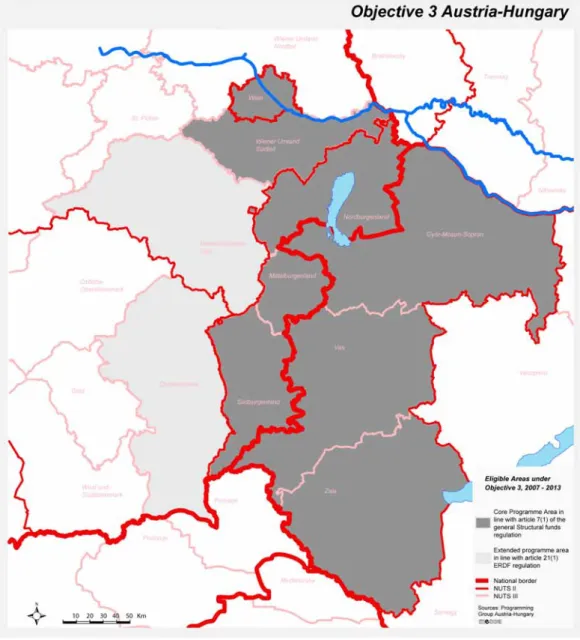
The Austrian-Hungarian border region covers the Austrian Länder of Burgenland and Wien and the NUTS III region Wiener Umland-Südteil as well as the NUTS II region Nyugat-Dunántúl with the counties of Győr-Moson-Sopron, Vas and Zala from the Hungarian side. The core programme area remained the same as approved in the period 2000 – 2006. The adjoining NUTS III-regions Niederösterreich-Süd and Oststeiermark fall under the 20% clause in the sense of Article 21 of the ERDF Regulation (Map 1: Regional Structure, eligible areas) due to their geographic proximity to the border and their strong relations with the bilateral border region.
Referring to Article 21 of the ERDF Regulation “at project level, expenditure incurred by partners located outside the programme area may be eligible, if the project could hardly achieve its objectives without that partner’s participation”this possibility may be used from partners e.g. from CENTROPE2
(-area) or from Graz/Graz-Umgebung.
The past experience has shown that multilateral projects are of rising importance for regional development and territorial cohesion in the multi-programme area comprising Austrian, Czech, Slovakian and Hungarian border regions. Therefore the Austrian-Hungarian programme partners consider it as important for the programme design and implementation to widen the scope of the cross border programmes and to take care of the needs and opportunities of multilateral projects.
The Austrian-Hungarian border region covers 13,5% of the total area and 20,4% of total population of the two countries. On the Austrian side 33% of the countries total population is living. Regarding the Hungarian side the share is 10%. Approximately 3,7 million people lived in this region in 2005.
2 CENTROPE contains the following regions: Wien, Niederösterreich, Burgenland, Győr-Moson-Sopron, Vas,
Map 1: Regional Structure, eligible areas
Table 2: Area and Population of the Austrian-Hungarian Border Region
NUTS III region Area
(km2) Population 2005 (inh/kmDensity2)
Wien 415 1.626.440 3.919,1
Wiener Umland Südteil 1.475 303.046 205,5
Niederösterreich-Süd 3.366 249.900 74,2
Nordburgenland 1.793 143.196 79,9
Mittelburgenland 702 37.505 53,4
Südburgenland 1.472 97.514 66,3
Oststeiermark 3.369 268.627 79,7
Total Austrian Border Region 12.592 2.726.228 216,5
Győr-Moson-Sopron 4.208 439.922 104,5
Vas 3.337 265.229 79,5
Zala 3.784 295.197 78,0
Total Hungarian Border Region 11.329 1.000.348 88,3
Total At-HU Border Region 23.921 3.726.576 155,8
The region is characterized by a mix of ethnic groups on both sides of the border, differences can be observed only in terms of proportions of the given nationalities. Communication and travelling lines follow geographic and morphological facilities in the southern parts of the region again: they usually follow river valleys (Rába/Raab). Compared to the West-East direction, North-South directions were less important during periods of history and this is the case even nowadays – causing problems in strengthening regional economic cohesion.
The economic core of the area is Wien, the only Metropolitan European Growth Area (MEGA) in the programming area of the total 75 MEGAs in Europe3. Győr is defined as transnational/national Functional Urban Area (FUA), and the rest of centres over 50.000 inhabitants are regional/local FUA´s.
The joint programme region has a dual character regarding the urban network. The north part of the region is an industrial growth pole of central Europe while the southern part of the region is rather the periphery of this growth region with medium sized centres in the Hungarian and small centres in the Austrian side, having more rural characteristics. The level of urbanisation is decreasing from north to south, the average size and economic capacity of towns and villages becomes smaller along the same pattern.
2.2. Networks and co-operation structures
Over the last two decades co-operations across the Austrian-Hungarian border emerged on every level and developed the following most relevant structures:
Transborder co-operation structures like Alps-Adriatic Community, ARGE Donauländer, CENTROPE, Spa World;
Cross-border co-operation structures like EuRegio West/Nyugat Pannonia, joint national/nature parks management, joint world heritage management, Grenzkommunalforum, city networks (e.g. Sopron-Eisenstadt-Wiener Neustadt, Szombathely-Köszeg-Oberpullendorf-Oberwart);
Regional co-operation structures like regional development agencies, regional labour offices, economic chambers, economic clusters, universities, civil organisations.At the start of the new programming period the Austrian-Hungarian cross-border co-operation has wide scope of experiences. The institutional level experienced almost 20 years of co-operation. Since the mid 1980s the border became more permeable.
In the field of spatial development a government co-operation called Austrian-Hungarian Spatial Development and Planning Committee was established in 1985. The Committee set up subcommittees where the counties (Győr-Moson-Sopron and Vas) and Burgenland were involved. In 1992 the Cross-border Regional Subcommittee was established. The evolution of these institutional co-operations led to the foundation of West/Nyugat Pannon EuRegio in 1998 including Burgenland, Győr-Moson-Sopron and Vas. In 1999 Zala joined the EuRegio. In 2002 the Council of the EuRegio adopted the document on “Entwicklungleitbild EuRegio West/Nyugat Pannonia”. This strategy is a key document for the middle part of the border region regarding the forthcoming programming period of 2007-2013.
In the north part of the Austrian-Hungarian border region the natural process of economic development led to a political agreement of key actors to utilise the favourable investment site potential and strengthen co-operation among regions and cities within a Central European region, by formulating a platform called CENTROPE on political level (including large parts of the eligible area of this programme, except for Zala and Oststeiermark but covering also West Slovakia and South Moravia). The strategy of CENTROPE may give a new impetus to the present territorial co-operation programme.
On a professional level the Biosphere growth region concept has been developedwithin the project “Joint Regional Development Strategy for Vienna-Bratislava-Győr Region (JORDES+)”. The major principle of this concept is the use of natural resources (land, landscape, warm and thermal water, renewable energy resources) for economic activities like tourism, energy production and transport in a sustainable way.
3 Nordregio, et. al.: ESPON 1.1.1 - Potentials for polycentric development in Europe. ESPON Monitoring
The southern part of the programming area – Südburgenland, Vas, Zala and Oststeiermark – has more relations to the centres of Graz and Maribor. Networking of cities in a wider southern space is also expected to have a positive influence on this programme area.
Beside these strategic regional co-operations also a lot of small actions and projects were implemented. The people-to-people actions (e.g. Small project funds, SPF-projects) on different levels were often the starting point of close relations. The contacts linked directly to the border are the backbone of close communication and a good co-operation climate.
Over the last 10 years the Interreg-Phare CBC programme initiated and supported the institutional co-operation across the border. A strong obstacle of joint projects was the different program environment for Interreg and Phare implementation. In the last period (Interreg-Interreg 2004-2006) – the requirements for real partnership have received more weight. Almost 500 organisations have participated in cross-border co-operation activities over the last 10 years.
2.3. Demography
While sustained high in-migration rates in the past decades cause a dynamic growth in the population of the northern parts of the area, in the southern regions the population declined or stagnated mainly due to the heavy migration from rural communities.
The entire border region is characterised by the tendency of an ageing population. The share of under-15-year-olds is around 15% in all regions, while the share of the over-60-year-olds is above 20%. Due to the higher life expectancy of women the share of over-60-year-old females is considerably higher than the total.
These figures in both age groups show slightly less favourable trends than the European average. The trend is the most critical in Mittel- and Südburgenland where the difference between the two relevant age groups is over 10%. This is resulted by the process of negative net migration and the negative natural growth of the population. The reason behind that are the peripheral location, the disperse settlement structure and the agricultural characteristics of that region which offers little job opportunities and unattractive living conditions for young people.
Table 3: Population trends 1991-2005 and age structure 2005
Population trend (Change in %) Age structure (%) 1991-2001 2002-2005 Share of
under-15-year-olds, 2005 Share of over-60-year-olds, 2005 Regional Unit
NUTS III region
Total Total Women Total Women Total Women
Wien 0,7 4,1 3,4 14,7 13,6 22,2 25,5
Wiener Umland Südteil 7,7 3,2 3,2 16,0 15,2 23,1 25,3
Niederösterreich-Süd 3,9 1,3 1,0 16,1 15,3 23,6 26,4
Nordburgenland 6,3 1,4 1,4 14,9 14,3 23,8 26,8
Mittelburgenland -1,0 -0,6 -1,2 14,0 13,6 26,2 29,7
Südburgenland -1,3 -0,5 -0,7 14,0 13,4 24,9 28,2
Oststeiermark 2,0 0,0 -0,1 16,6 15,9 21,5 24,7
Total AT Border Region 1,8 2,9 2,5 15,1 14,2 22,6 25,7
Győr-Moson-Sopron 1,6 1,1 0,4 15,0 14,2 20,5 25,2
Vas -2,5 -1,3 -0,7 14,9 14,1 21,3 25,0
Zala -1,9 -1,3 -0,9 14,2 13,1 22,0 26,2
Total HU Border Region -0,6 -0,3 -0,3 14,8 13,8 21,2 25,5 Total AT-HU Border
Region
1,2 2,05 1,74 15,0 13,9 22,2 25,2
Map 2: Population density
Development tendencies
There are positive demographic trends in the north part of the region: growing population and migration into the area. This trend increases the size of labour market, generates demand for higher level of services (like higher education, health and wellness spa) and for quality products (like organic food products). At the same time, the south is characterised by negative demographic trends: decreasing population and out-migration. These trends are partially based on the distance from the main development axis remaining a lagging behind region with rural character and a slower economic growth. A danger is the acceleration of these trends because of ageing population.
Future activities should focus on balancing the demographic disparity between the north and the south of the region. This means improvements especially for the Mittel- and Südburgenland and the countries of Vas and Zala, where people partly suffer from the disadvantages of harder accessibility (see Map 5: Transport infrastructure (roads, airports) and Map 6: Transport infrastructure (railways)). It will be important to improve services for special target groups (e.g. elderly people – health and domestic services, young generation – educational and job options).
If the quality of life (including the services mentioned above) can be enhanced in the small cities and the rural parts of the region, it can soften the loss of population and job opportunities. As a backbone for the quality of life the social infrastructure and public services need to be secured and improved. Therefore the polycentric structure of the region should be strengthened.
2.4. Economy
The previously demonstrated demographic trends and spatial structure are also reflected in the economic performance of the border region. The north of the region is among the strongest economic regions of Europe (Table 4: Gross domestic product (GDP) at current market prices and PPS per capita (1997, 2003), Map 3: GDP (purchasing power parities, in % of EU average)). In comparison the regions of Südburgenland as well as the Hungarian counties achieve less than 75% of the European average. The fastest growth has been in Győr-Moson-Sopron where the GDP has doubled over the period of 1997-2003.
Table 4: Gross domestic product (GDP) at current market prices and PPS per capita (1997, 2003)
Millions of Euro (from 1.1.1999) / Millions of ECU (up to 31.12.1998)
Purchasing power parities per capita in percentage of the
EU25 average (%) NUTS III region
1997 2003 1997 2003
Wien 51.158,9 62.874,9 178,7 170,9
Wiener Umland Südteil 7.285,7 9.228,5 135,4 134,3
Niederösterreich-Süd 4.349,8 5.014,3 94,5 87,5
Nordburgenland 2.353,6 3.130,6 92,5 95,6
Mittelburgenland 503,2 702,4 70,2 81,0
Südburgenland 1.279,2 1.584,8 67,7 70,4
Oststeiermark 3.761,8 4.841,0 78,9 78,0
Total Austrian Border Region 70.692,2 86.674,1 -
-Győr-Moson-Sopron 1.861,9 3.845,7 54,9 71,5
Vas 1.233,5 2.055,4 57,3 62,9
Zala 1.088,8 2.016,5 45,8 55,4
Total Hungarian Border Region 4.184,2 5.981,6 -
-Total At-HU Border Region 74.876,4 92.655,7 -
-European Union (15 countries) 7.415.684,3 9.503.520,8 110,3 109,1 European Union (25 countries) 7.710.192,1 9.953.329,3 100,0 100,0 - no data available
Source: eurostat
The general trend of the changing structure of the economy has been similar to all developed economies over the last decades: a strong decrease of the share of the primary sector, generally a decreasing employment trend in the secondary sector, and a fast growth in the tertiary sector. However, the Austrian-Hungarian border region is not homogenous in this respect (see also Table 8: Total employment and trends by economic activity 1998, 2003). In the regions with highest per capita GDP – Wien and Wiener Umland Südteil – agriculture has a very minor role in employment (below 2%) but services have a dominant position (above 70%). By contrast Oststeiermark remained the only area within the Austria-Hungarian border region where the share of agriculture is still above 10%. Agriculture and forestry as well as downstream industries such as wood- and food-processing play in the Hungarian border region a similarly important role as in Nord-, Mittelburgenland and Oststeiermark. Especially arable lands in Győr-Moson-Sopron belong to the best quality lands in Central Europe. Zala has the highest rate of forest areas in Hungary.
Wien has low and declining shares in manufacturing and high shares in high-ranking services of the public and private sectors. It is a centre for banking and insurance industry as well as for international organisations and group company headquarters, influencing patterns and development trends of the northern part of the border region and it has highly dynamic surrounding regions (Wiener Umland Südteil, Nordburgenland, Győr-Moson-Sopron).
Economic structures are more diversified in Nordburgenland, in Mittelburgenland and Südburgenland, economic activity concentrates in few industries and locations (textile and garments industries). The construction industry also accounts for a very high share of jobs. The benefits of the economic conditions in Nordburgenland are based largely on location factors that result from the region’s vicinity to the central space of Wien. The largest enterprises in the region belong to the food and beverages industry, metal-working and wood processing industries. Characteristic for all three parts is the
relatively high share of agriculture and the predominance of smaller enterprises. Approximately 60% of enterprises in Burgenland employ less than 20 workers.
A typical feature of the NUTS III regions of Niederösterreich is the high share of employment in the service sector (Wiener Umland Südteil) and the high share of industries and services (Niederösterreich-Süd). Oststeiermark has a very high share of employment in agriculture and marketing of agricultural products. Beside that innovative forms of energy production and environmental friendly technologies play a growing role.
The Hungarian side of the border experienced a relatively fast structural change. The weight of agriculture has decreased by 10% over the last 15 years. The change was led by the foreign direct investments (FDI). The major factors to attract FDI were the accessibility and the skilled relatively cheap labour. Especially the export oriented industries – machinery and related sectors – showed the most dynamic development. New investments have created the largest vehicle and car components industry in Hungary.
Map 3: GDP (purchasing power parities, in % of EU average)
Development tendencies
According to experts estimation there are several strengths and positive economic development trends in the border region: a growing number of small and medium sized enterprises (SME) in the entire region, a dynamic service sector, skilled labour, a great supply of business sites, the establishment of knowledge based intermediary and transfer institutions (innovation and technology centres,
competence centres, regional development agencies), emerging economic clusters, networking activities across the border has started and high quality arable land. Some negative trends counterbalance the economic processes of the border region: low co-operations of SMEs4 regarding large companies and Research and Development (R&D) sector as well as high dependence on the Viennese labour market. Additionally after 10 years some low value added assembling companies started to move to new locations (Eastern Europe, China, Far-East). Therefore the new challenge is to keep the level of FDI and stabilise the SME sector. A potential barrier for the restructuring of the economy is the relatively weak R&D capacity of West Pannon Region – the region has the second highest per capita GDP and the second worst R&D capacity in Hungary.
In the future the economic gaps and differences between the north-south are not easy to be changed. Also the east-west division will not disappear but diminish. The sustainable use of natural resources offers great potential for economic activities. Issues like renewable energy or organic raw materials will become a crucial factor for the economic performance of the region. Beside that medical engineering is of growing importance in the region (e.g. project Medaustron5). They offer chances for SMEs and R&D in co-operation with a cross-border labour market to sustain the high quality of life in the region.
2.5. Tourism
Tourism plays an important role in the region. The border region is rich in natural (e.g. hills, lakes, rivers, landscape and great variety of ecosystems, thermal water and spas) and common cultural heritage (e.g. castles, music, festivals). Those attractions and their combination generate tourism. Several joint cross-border actions have been taken place based on those strengths over the last decade. Tourism is based on national and nature parks and an enormous density of spas. The larger centres offer congress facilities and a great variety of cultural sights. Castles, gardens, festivals, cycling and sporting complete the tourist attractions.
In the region tourist infrastructure as well as tourist offers are rather heterogeneously developed. Although Wien accounts for only 10% of hotels and similar establishment its share in beds however is more than one third of the Austrian border region. The city is one of Europe’s most important congress locations (Table 5: Number of hotels and beds). The numbers of overnight stays in Wien has increased from 40% to 43% between 2000 and 2005 (see Table 6: Number of overnight stays). From the total 20,1 million overnight stays of the border region 8,7 million was reported from Wien.
Table 5: Number of hotels and beds
Number of hotels and similar
establishments Number of beds in hotels and similar establishments
NUTS III region 1995 2000 2005 1995 2000 2005
Wien 341 348 - 40.132 39.995
-Wiener Umland Südteil 138 143 150 7.423 7.901 8.096
Niederösterreich-Süd 340 284 274 9.836 8.795 8.370
Nordburgenland 276 232 219 9.565 7.922 7.683
Mittelburgenland 15 20 28 437 867 1.562
Südburgenland 98 107 116 3.699 4.017 5.574
Oststeiermark 453 413 381 14.075 14.379 14.397
Total Austrian Border Region 1.661 1.547 - 85.167 83.876
-Győr-Moson-Sopron 42* 60* 164 4.867* 7.901* 8.594
Vas 16* 20* 86 3.725* 5.738* 6.449
Zala 53* 64* 131 7.788* 10.841* 13.114
Total Hungarian Border Region 111 144 381 16.380 24.480 28.157
Total At-HU Border Region 1.772 1.691 - 101.547 108.356
-*in Hungary: only hotels, - no data available Source: eurostat (2006), KSH (1996, 2005)
There are several common points of interest in tourism: significant impulses are expected from the common thermal spa network and the national and nature parks in the area (Neusiedler See-Fertő for the regions of Nordburgenland and Győr-Moson-Sopron County, Geschriebenstein-Írottkő Nature Park
4 This view is supported by the estimation of the most relevant stakeholders in the programming area. 5 http://www.medaustron.at
in middle, and Raab-Őrseg-Goričko Nature Park in the south). The rich variety of ecosystems offers a huge potential for day-trippers in the vicinity of the metropolitan areas. The following topics are important for the future of tourism in the region: spa&wellness, active and nature tourism (hills, rivers, lakes, nature- & national parks), culture and wine. Conference tourism is concentrated mainly in Wien. In a much smaller scale Sopron has good potential in this field of tourism as well. The southern part (Südburgenland, Zala County) is concentrating on expanding environmentally and socially compatible forms of tourism.
Table 6: Number of overnight stays
Regional Unit, NUTS III region 2000 (total) 2005 (total)* Trend (%)
Wien 7.629.819 8.675.441 13,7 Wiener Umland-Südteil 1.275.370 1.391.470 9,1 Niederösterreich-Süd 1.341.709 1.146.215 -14,6 Nordburgenland 1.521.697 1.384.363 -9,0 Mittelburgenland 116.721 246.297 111,0 Südburgenland 782.251 882.483 12,8 Oststeiermark 2.785.087 2.755.200 -1,1
Total Austrian Border Region 15.452.654 16.481.469 6,7
Győr-Moson-Sopron 987.627 913.207 -7,5
Vas 805.458 867.707 7,7
Zala 1.820.661 1.809.950 -0,6
Total Hungarian Border Region 3.613.746 3.590.864 -0,6 Total AT-HU Border Region 19.066.400 20.072.333 5,3 * in Hungary 2004
Source: Statistic Austria (2005), KSH (2001, 2005)
Development tendencies
Projects like HEALTHREGIO6 or the SPA world7 showed already the potentials of cross-border tourism development with issues like wellness- or health services. In general tourism will stay a growing sector also in the future. Themes are culture, sports, wine and other forms of nature based activities (e.g. cycling, bird watching and hiking). Excursions to innovative forms of using renewable energy (e.g. Güssing, Bruck/Leitha, Weiz) gain growing importance. Many of the NUTS III regions doubled (Hungarian regions) or even tripled (Mittelburgenland) their number of available beds in the past 10 years. In the future the enhancement of quality and logistic infrastructure (booking possibilities and multinational public relations) as well as the extension of the duration of stays under sustainable aspects (eco-mobility as demonstrated in the Neusiedler See region) are the goals to achieve.
2.6. Labour Market Employment
There is a difference between the Austrian and the Hungarian side of the border region regarding employment rates. The employment rates in the Austrian part of the border region are above the European average by 3-10% while the West-Transdanubia region is below the European average by -2% (Table 7: Employment rates (%) and deviation form EU25 (%), 2004). Especially the employment rate of women in West-Transdanubia is 3% below the EU 25 deviation. Extraordinary high is the female employment rate in Steiermark with 6% and Niederösterreich with 12% above average. We assume that one of the reasons behind the different female employment rates within the region is the low rate of part time job facilities in West-Transdanubia.
The dominant position of Wien in the regional labour market pattern is underlined by high commuter rates in the surrounding regions (Table 8: Total employment and trends by economic activity 1998, 2003). Nearly one third (31,7%) of Burgenland’s labour force are employed outside of Burgenland. This trend is not significant in the Hungarian counties (about 2%) due to their urban centres that offer work places for the resident labour force and function as commuter targets for the surrounding municipalities.
6http://www.healthregio.net
Table 7: Employment rates (%) and deviation from EU25 (%), 2004 EU 25 Nyugat-Dunántúl (West- Trans-danubia)
Burgenland österreich Nieder- Wien Steiermark
Total 51,4 50,3 52,8 56,3 52,8 54,3 Men 59,6 58,9 61,3 64,1 60,5 63,2 Women 43,7 42,6 44,9 49,1 46,1 46,2 Deviation from EU 25 total -2 3 10 3 6 Deviation from EU 25 men -1 3 8 2 6 Deviation from EU 25 women -3 3 12 5 6
Source: eurostat, http://epp.eurostat.ec.europa.eu/
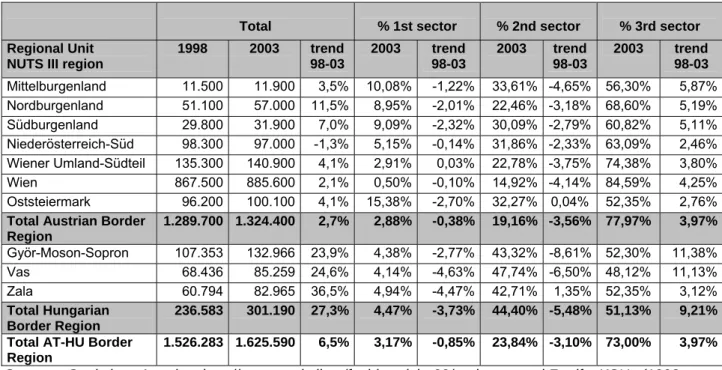
Table 8: Total employment and trends by economic activity 1998, 2003
Total % 1st sector % 2nd sector % 3rd sector
Regional Unit NUTS III region
1998 2003 trend 98-03 2003 trend 98-03 2003 trend 98-03 2003 trend 98-03 Mittelburgenland 11.500 11.900 3,5% 10,08% -1,22% 33,61% -4,65% 56,30% 5,87% Nordburgenland 51.100 57.000 11,5% 8,95% -2,01% 22,46% -3,18% 68,60% 5,19% Südburgenland 29.800 31.900 7,0% 9,09% -2,32% 30,09% -2,79% 60,82% 5,11% Niederösterreich-Süd 98.300 97.000 -1,3% 5,15% -0,14% 31,86% -2,33% 63,09% 2,46% Wiener Umland-Südteil 135.300 140.900 4,1% 2,91% 0,03% 22,78% -3,75% 74,38% 3,80% Wien 867.500 885.600 2,1% 0,50% -0,10% 14,92% -4,14% 84,59% 4,25% Oststeiermark 96.200 100.100 4,1% 15,38% -2,70% 32,27% 0,04% 52,35% 2,76%
Total Austrian Border Region 1.289.700 1.324.400 2,7% 2,88% -0,38% 19,16% -3,56% 77,97% 3,97% Györ-Moson-Sopron 107.353 132.966 23,9% 4,38% -2,77% 43,32% -8,61% 52,30% 11,38% Vas 68.436 85.259 24,6% 4,14% -4,63% 47,74% -6,50% 48,12% 11,13% Zala 60.794 82.965 36,5% 4,94% -4,47% 42,71% 1,35% 52,35% 3,12% Total Hungarian Border Region 236.583 301.190 27,3% 4,47% -3,73% 44,40% -5,48% 51,13% 9,21%
Total AT-HU Border Region
1.526.283 1.625.590 6,5% 3,17% -0,85% 23,84% -3,10% 73,00% 3,97%
Source: Statistics Austria, http://www.statistik.at/fachbereich_02/regkonten_tab7.pdf, KSH (1998, 2003)
In general most of the NUTS III regions follow the usual European employment trend: decrease of the employed persons in the first and second sector and increase in the third sector. The largest contribution to the GDP by the first sector shows the Oststeiermark (approx. 15%) and the Mittelburgenland (approx. 10%). Here agriculture and forestry are still vital economic factors. Of course the opposite is Wien: the rate of people employed in the third sector is approx. 85%.
Unemployment
Unemployment rates show no significant differences between the Austrian and Hungarian part of the region. In all major unemployment indicators – long term, young people and female – the region shows a better picture than the European average (Table 9: Unemployment rate of different target groups, 2004). Female unemployment is slightly above the average in all regions except Wien. Youth unemployment is especially in Wien above the average, but everywhere far below the European average.
Table 9: Unemployment rate of different target groups, 2004
Total Long
term Female Young Regions Unemployment rate (%) Total Burgenland 4,2 21,2 4,8 7,1 Total Niederösterreich 3,5 27,3 3,7 5,7 Total Steiermark 3,8 27,6 3,7 5,8 Wien 7,2 37,1 6,0 11,1
Total Hungarian Border Region 4,1 38,6 4,2 8,8
EU 15 7,8 40,2 8,8 15,2
EU 25 9,0 44,3 10,0 18,1
Source: EC (2004), CIP (2004), KSH (2005).
Assessment of the cross-border labour market
The European integration provides a new framework for cross-border labour market relations. While many Hungarians work in Austria official statistics do not indicate a significant number of Austrian employees on the Hungarian side of the border region.
Labour offices have started to cooperate 10 years ago. They set up a joint Labour Market Strategy and established a joint Labour Market Academy. In the last years they extended the co-operation to municipalities and enterprises via joint Labour Market Pacts, which is a potential tool to maintain and
increase the employment level of the border region. The limits imposed under the Austrian Foreign Workers Employment Act have prevented higher rates of cross-border employment in the past five years. In April 2006 Austria extended those limitations by additional three years. With this extension, the free movement of labour force can be realised by 2010.
Development tendencies
Issues of cross border labour market tendencies are discussed very emotionally in general. In the past years workforce moved quite one-sided from Hungary to Austria. Thus all regions face similar trends (decrease in the first and second sector, increase in the third) and the personal mobility will rise in a post-Schengen era, it is very probable that workforce will move in more than one direction.
These trends are already under discussion – e.g. in joint Labour Market Pacts within the EuRegio West-Nyugat Pannonia. Concerning the employment and unemployment rates of women and young people the situation is better than in the EU average. Nevertheless the development needs to be watched to improve the equal opportunities on the labour market. The perspective in the future should emphasize also the positive chances of a liberalized and mobile labour market, especially from the Austrian perspective. The establishment of a cross border labour market strengthens the economic power of the region on a regional as well as on the international level.
2.7. Education, research and development
Research and education are key factors for the creation of an innovative business environment. The prime location for high-quality education and research facilities within the entire Austrian-Hungarian border region is Wien. The strong concentration of public and co-operative research facilities – more than half are located in Wien – is counter-pointed by a 17,5% share of private industrial research, which is – in terms of both geographical distribution and technical specialisation – in line with the geographical distribution of industry across Austria.
Five universities and three academies of arts are located in Wien. Further universities or university faculties are located in Sopron, Győr, Mosonmagyaróvár and Keszthely. Universities of applied sciences are located in Wiener Neustadt, Eisenstadt and Szombathely. Additional higher education units work in the larger cities Nagykanizsa, Zalaegerszeg, Mödling, Pinkafeld, Stadt Schlaining and Weiz. Based on the Bologna process there will be no obstacles to the harmonisation of qualifications and diplomas in the border region.
The high economic performance of the Hungarian border area is vulnerable in national terms because of low capacities in research and development (R&D). Concerning the rate of employees in the R&D sector (researchers per 10.000 people: 12) the border region is far below the Hungarian average (researchers per 10.000 people: 23). Even this low capacity is unequally distributed. 64,9% of the 142 institutions involved in research and development are located in Győr-Moson-Sopron, 22,5% in Vas and 12.6% in Zala County. Also on the Austrian side the expenses for research and development are not extremely high on the NUTS II level.
Over the last decade the region has started to plug the gaps in regional innovation systems. Centres for innovation and applied research have been established in Eisenstadt, Güssing, Jennersdorf, Wiener Neustadt, Győr, Sopron and Szombathely. According to the Lisbon strategy co-operation between the universities, R&D and industries is evolving.
In the knowledge transfer between R&D, innovation and technology centres and the industries, economic clusters may play a relay function. In the West Pannon Region eight clusters have been established since 2000. Similar institution systems have been established also on the Austrian side of the border region over the last 10 years. These developments give a potential for closer co-operation (networking) across the border at all levels of the innovation system.
Development tendencies
Education, research and development will play a stronger role in cross border co-operation. In general a good and diverse supply is given in the whole region, with a certain dominance of Wien and some gaps in the southern part. The established co-operation’s will be continued and extended on the one hand among the education institutions and on the other hand to the R&D and industry.
The focus on specific strengths in the region (e.g. the successful post graduate MSc course “Renewable Energy in Central and Eastern Europe”) offers skills for qualified workforce in the region.
Other “hot spots” for R&D co-operations can be implemented in courses or offers of the smaller educational sites mentioned above. Among these thematic fields are nature management, renewable primary products, medical engineering, logistics, eco-mobility and sustainable tourism.
2.8. Infrastructure
Regarding international and intraregional transport networks conditions vary widely in the region. The northern part (Wien-Győr) is easily accessible by all means of transport. The southern part has to face disadvantages in terms of accessibility. The improvement of connections is a key factor to foster economic coherence. Furthermore an important aspect is the concentration on eco-mobility.
Road Transport
The northern area (Wien, Wiener Umland Südteil, Nordburgenland and city of Győr) has a high-grade road network (A2, A3, A4, A6, S1, S4, S31, see also Map 5: Transport infrastructure (roads, airports)). On the Hungarian side the significantly increasing traffic flow through the emerging new north-south (Baltic-Adriatic) corridor, together with the growing road capacity problems emphasises the importance to develop the north-south axis within the West Pannon Region (M9). The two northern branches of this axis, the first one on the Bratislava-Csorna-Szombathely line and the other one through Wien-Sopron-Bük-Szombathely are meeting at Szombathely; the first one rather linking the Baltic and Adriatic area, while the second one heading via Zalaegerszeg and Nagykanizsa toward Zagreb as a new nodal and distribution point towards the Balkans.
Railway Transport
The accessibility by rail has been increased significantly within the northern parts of the border region since 2000, when the Euregio-trains between Wien and Győr have been launched. To improve this rail line, electrification and modernization of the railway line between Sopron and Szombathely has started, bringing closer the mid-part of Western Transdanubia to the agglomeration of Wien. Around the Neusiedler See/Fertő and in other protected or sensitive areas, the concept of sustainable transport development gives special significance to the electrification of the railway system.
Map 6: Transport infrastructure (railways)
Other means of transport
The Danube’s potential in the intermodal transport flows has been improved considerably. In the cross-border region the port of Wien has already established its role as an international harbour, while at the Győr-Gönyű port the doubling of the port’s capacity and the railway connection to the Wien-Budapest line should contribute to the increased potential.
Due to the growing importance of international transport links, the airports within the region are also gaining more relevance. Especially the Vienna International Airport (VIE) has become increasingly important for the cross-border region as a whole due to continuous efforts to develop its position as an international hub. Beside the airport in Bratislava important gateways for the southern part of the region are the regional airports: Sármellék, Fertőszentmiklós, Szombathely and Graz.
The establishment of a bicycle network and building cross-border connection points increases the tourist attraction of the region. An inter-regional cycling network has been planned and partly built up over the last decade. The network on the Hungarian side still needs to be developed and important
links between the two sides of the border are also missing. Further efforts have to be dedicated to organise common services and marketing of this network. Public busses are an important means of transport, too.
Telecommunications and public utilities
The telecommunication infrastructure is especially in rural areas still lagging behind compared with international as well as national standards. However a number of initiatives have been established to improve the situation. Over the last 10-15 years considerable improvements and modernisation of the infrastructures for supply and disposal have been achieved – these efforts were especially marked in the Hungarian side of the border region. Nevertheless an overall assessment pointed at insufficient levels of infrastructure in small and medium-sized municipalities. The sewage system of the region is inhomogeneous and is generally below EU standards. Although significant steps have been taken to solve the problem of the disposal, purification and placement of sewage, several local and regional sewage treatment plants and regional and local collecting mains have been established there are still deficits in these areas. In some cases there is a potential for cross-border use of the sewage system and treatment and solid waste collection and disposal.
Development tendencies
Especially the north of the region is well equipped with road and railway connections. Also the southern part will benefit from the European Transport corridors (Baltic-Adriatic corridor as well as the corridors IV, V and VII). On the regional scale many road links and border crossings are missing. To improve the accessibility, measures on two levels are foreseen:
Improved accessibility among larger cities including a better link to Wien and the development of a North-South corridor on the Hungarian side of the border;
Reconstructing small scale East-West links across the border.In the cross-border internal transport network of the region missing or insufficient elements can be found especially in the agglomerations of Sopron-Eisenstadt (Road No. 85), Szombathely-Oberwart (No. 89) and Kőszeg-Oberpullendorf (No. 87). The motorways M8 and M7 will have a key role in the accessibility of the southern part of the area. The participation of Hungary in the Schengen Treaty which is foreseen for 2008 will boost the opening of small border crossings. In ecological sensitive areas such as the UNESCO World Heritage Site Neusiedler See innovative forms of public transport and eco-mobility are being implemented.
Regarding transport of goods, the importance of multimodal systems, such as the RO-LA (Rollende Landstraße/transporting lorries by rail) terminal at Sopron is growing. Between Győr and Gyönyű a new railway line construction (10 km) will start soon, contributing to the better utilisation of the RO-RO (Roll on roll off) harbour at Gönyű.
For the future the role of information technology (IT) infrastructure and public services will be enlarged, especially for the smaller centres and communities. Accessibility is not only “hardware” – a vital and fast information flux needs strong internet backbones. On the local level many facilities of water, sewage and waste management will need more investments. The cross border perspective for a common facility management or other activities like logistic measures like bilingual signposting of bike paths will increase its importance.
2.9. Environment and natural resources
The region is formed by a broad variety of different landscapes:
the Wiener Becken and its edges, i.e. in the West the hilly and mountainous zones of the Wienerwald and in the East the semi-alpine zones of the Alps – including the eastern foothills of the Central Alps, i.e. the Leitha mountains (484m), and the Rosalien and Ödenburger mountains (606m) in the Nordburgenland as well as the Landseer and Günser mountains in the Mittelburgenland;
the Kisalföld with the Kőszeg, Sopron and Sag Mountains and the hilly lands of the Zala and Vas regions;
the lowlands of the Nordburgenland (the flat of Parndorf, Seewinkel) and the basin of Oberpullendorf which opens to the Hungarian Small Plain (Kisalföld);
the hilly lands in Oststeiermark and the Südburgenland as part of the basin of Graz;
Alpokalja - the ‘fingers’ of the Alps reaching Hungary.Cultural heritage
The great variety of ecosystems and the rich natural heritage is responsible for a number of nature parks and national parks (NP) such as the NP and world heritage site Neusiedler See/Fertő, sensitive areas, Natura 2000 and protected areas. Together with the richness of cultural heritage and the geologic conditions for spas they offer favourable conditions for environmental forms of sustainable tourism.
Most of the nature and landscape conservation areas are located at a distance from the main settlement and development areas. A key measure in the field of nature conservation was the establishment of the national parks Neusiedler See-Seewinkel and Fertő-Hanság, which encompasses the South-Eastern shore of Neusiedler See/Fertő, more than half of the lake itself and the adjacent reeds and meadows. Central Europe’s only steppe-lake national park covers an area of about 20.000 hectares, 8.000 are situated in Burgenland. In an effort to protect and develop cross-border nature parks, two nature reserves – Geschriebenstein-Írottkő and Raab-Őrseg-Goričko – were established. In 1993 the national park Neusiedler See-Seewinkel gained international reputation as an IUCN Category II preserve. Finally in 2001 the national parks in Austria and Fertő-Hanság were together accepted as a UNESCO World Heritage Site. A joint management plan has been developed to foster the sustainable development of the sensitive area. It includes the general vision, short and medium term objectives and an action plan for landscape protection, protection of cultural assets, sustainable agriculture, especially wine culture, townscape and village protection, a new building culture, sustainable transport, education and public awareness. It was established within a regional participation process and approved by the regional and national authorities as well as the UNESCO in 2003/2004.
Eco-mobility
Among several cross-border concepts and joint development actions focusing on the environmental reserves, the initiative on “Sustainable transport development in sensitive areas” shall help to shape the economic development of the area preserving the quality of living conditions for future generations. This idea is in line with the biosphere growth region concept elaborated in the Joint Development Strategy for the Vienna-Bratislava-Győr Region (JORDES+) and describes the potential synergies among skilled labour forces, R&D and natural resources. Steiermark identifies itself as the ‘Green Heart of Austria’ as well as the vision of the West Pannon Region is to be a ‘Green Region’ including Vas and Zala. These facts make it easy to extend the biosphere growth region concept across the entire border region.
Renewable energy
There is a growing awareness within the border region regarding environment. Utilisation of renewable and alternative energy sources (e.g. biomass, wind, solar) has started and extended in the Austrian side of the border. This process has a strong influence on the Hungarian side of the border via the cross-border activities of the European Centre for Renewable Energy in Güssing, the Energy Park Bruck/Leitha and the Energy Region Oststeiermark. Including also the experiences of public companies and municipalities the topic has become an intensive co-operation field among cross-border relations.
Water
Water is an important resource for the region. Common problems are changes in the water level of Neusiedler See as well as in some parts of the river Raab. Another topic of interest is food protection and the improvement of water quality. Drinking and waste water treatment is an important issue especially on the Hungarian side of the region.
Development tendencies
The great variety of eco-system in the region bears opportunities for future development. The issue environment will be among the most important factors for the region. For example the ‘Grüne Mitte’ concept was developed on the strategic level in the north part of the region. Simplified, this concept advises to produce added value and to make sustainable use of the outstanding natural resources and “green” core competences (biosphere management, organic food production, bridging, renewable energies, eco mobility) of the region. This can end in large-scale projects like common product brands or in sophisticated small scaled projects for local energy supply. By know-how transfer and institutional co-operations those positive trends and strategies can be extended to the entire border region.
Based on directives and traditional joint efforts within the Austrian-Hungarian “Cross-border Water Committee” co-operation in the field of flood prevention will be an important topic for the future.
Environment will also be a strong factor for further cross border co-operation. Austria has more experience and a more diverse landscape, Hungary has enormous agricultural potentials, both have experience in common nature management. Also there are already common risk prevention models and water concepts that will be enlarged for the whole region.
2.10. Summary
Strengths and weaknesses
The Austrian-Hungarian border region as a whole has a good growth potential in terms of GDP per capita. Since the accession of Austria to the European Union and the start of the Austrian-Hungarian Interreg-Phare CBC programmes, this region (except Wien) has experienced a faster growth than the European average. However, there is a high level regional difference: more indicators show a north-south development gap within the region; other factors represent East-West differences across the region.
The spatial system of the region is balanced and imbalanced at the same time. Balanced because larger cities are spatially equally distributed from north to south. Imbalanced because there is only one large metropolitan centre Wien, which is situated the north edge of the border region and has only limited effects on the southern part of the region which is more influenced by Graz. From north to south the size of urban centres is decreasing by number of population.
There are positive demographic trends in the northern part of the region resulting in a growing population and migration into the area. This trend increases the size of labour market, generates demand for higher level of services (like higher education, health and wellness spa) and for quality products (like organic food products). At the same time the south is characterised by negative demographic trends: decreasing population and out-migration. These trends are partially based on the distance from the main development axis forming a region lagging behind with rural character and a slower economic growth. A danger is the acceleration of these trends because of ageing population. There are several strengths and positive economic development trends in the border region such as a growing SME sector by number of enterprises in the entire region, a dynamic service sector, skilled labour force, a great supply of business sites, establishments of knowledge based intermediary and transfer institutions (innovation and technology centres, competence centres, regional development agencies), emerging economic clusters, networking activities across the border and a high quality arable land.
Some negative trends hinder economic development in the border region such as a low degree of co-operations of SMEs8 and a high dependence from the labour market in Wien. Additional weaknesses
are existing on the Hungarian side of the border such as structural problems of the labour market and insufficient sewage and waste disposal systems.
The border region is rich in natural resources and has a great variety of ecosystems. A specific particularity is the enormous number of thermal water and spas and a great number of common cultural heritage sites. The prosperity of the economy, the emerging tourism (e.g. spa and wellness) and the suburbanisation process around larger cities increase the traffic of goods and people. These trends cause harmful effect on the environment. To reduce negative effects needs more efficient use of multi-modal systems, further joint discussions and pilot actions on eco-mobility.
Map 8: Regional overview
Opportunities and threats
The location at the former intersection between east and west gives the opportunity for increasing economic co-operations (e.g. supplier relations, clusters, R&D co-operations) and the extension of markets for regional products (like organic products, wellness and spa resorts, wine and wine tourism). The traditional economic links and the initial direct investments to Eastern Europe are a good basis for further investments and know-how transfer. This process can be promoted by the further development of the European transport corridors, the TEN (Trans European Network) and TINA (Transport Infrastructure Needs Assessment) system. The Bologna process promotes the transparency in the educational system and initiates the harmonisation of qualifications to improve the relation between the needs of the labour market and education and training. The emerging role of agricultural value chains contributes to the sustainability of the Austrian-Hungarian border region.
High regional disparities within the border region foster these opportunities in the northern part of the region. In the southern part competencies on the sustainable use of renewable energies are an asset. There are, however, a number of barriers for a deeper integration of the region such as the following:
the still high differences between the Austrian and Hungarian wage levels (this limits the potentialfor labour exchange mostly direction from Hungary to Austria);
the delay Hungary’s accession to the Euro zone influences the cross-border project implementation financially because of the high fluctuation of the HUF/EUR exchange rate;
the delay in the extension of the TEN/TINA network (e.g. the development of north-south corridor: ‘Amber route’) hinders the economic and social integration of the region. On the other hand the increasing traffic causes harmful effects on the environment of the region.3.
STRATEGY AND GENERAL PROGRAMME
OBJECTIVES
The cross-border co-operation programme presents a coherent and effective response to the obstacles and weaknesses of the region and defines suitable strategies for a common future development of the Hungarian-Austrian border region on the basis of the experiences of the last programme period and the conclusions of the regional analysis. The strategy includes an overall strategic goal of the programme and identifies specific objectives to be reached by the measures under the chosen priority axes of the programme. The main bases for the development of the strategies were the following resources:
Socio-economic analysis and the SWOT-analysis of the Hungarian-Austrian border region;
National programmes and strategies on both sides of the border;
Experiences from the previous and still running cross-border co-operation programmes: INTERREG IIA, PHARE CBC and INTERREG IIIA (1995-2006);
Legal provisions for implementing the Structural Funds’ co-financed programmes, especially the cross-border co-operation programmes under the Objective “European territorial co-operation”;
Conclusions of the discussions of the bilateral programming group, responsible authorities,experts and key persons at the regional level.
3.1. Overall strategic goal
The overall strategic goal of the programme is to foster the economical, social, environmental and cultural development of the border region and to reduce regional disparities by means of cross-border co-operation. By supporting the implementation of joint activities and the sustainable use of endogenous resources the CBC-programme will contribute to the establishment of a prosperous region with cultural and ecological diversity and a high quality of life for its inhabitants. The suitable development strategies will be based on the following regional
features:
a high dynamic of economic growth and impulses in the northern area;
a great variety of cultural, social and natural resources;
a high potential of human resources and training opportunities;
a stringent awareness and a number of initiatives on sustainable usage of resources;
a high level of regional disparities between north-south and east-west;
a limited accessibility in some parts of the region.Furthermore the CBC Programme aims to achieve the following specific objectives:
To invest in sustainable growth by evolving into an economically strong competitive regionwith a high standard of living, using the vicinity to the metropolitan growth centres as stimulus for the economic development of the whole region, concentrating on renewable forms of energy, developing new value chains, stimulating research and development co-operation among universities and companies etc.
To maintain and evolve the attractiveness and quality of life by promoting comprehensiveand integrated actions towards the sustainable and equitable development of the programming area, supporting biosphere management for the preservation of the ecological and cultural diversity, supporting common risk prevention and emergency management, supporting tourism etc.
To bride regional imbalances by bridging the development gaps between east and west aswell as north and south divide should be tackled as well but according to the size of the CBC programme there may only be little effects, fostering social cohesion and good neighbourly relations, improving the accessibility in the remote parts of the programme area, serving the needs of the local resident people, supporting the establishment of polycentric urban and regional networks etc.