Procedia - Social and Behavioral Sciences 103 ( 2013 ) 586 – 594
1877-0428 © 2013 The Authors. Published by Elsevier Ltd. Open access under CC BY-NC-ND license.
Selection and peer-review under responsibility of The Association of Science, Education and Technology-TASET, Sakarya Universitesi, Turkey.
doi: 10.1016/j.sbspro.2013.10.376
ScienceDirect
13
thInternational Educational Technology Conference
Learning Style in A Personalized Collaborative Learning
Framework
Nuzulla Mamat*, Norazah Yusof
Software Engineering Department, Faculty of Computing, Universiti Teknologi Malaysia Johor Bahru (UTM JB), 81310 Johor Bahru, Malaysia
Abstract
This paper aims to discuss learning style implementation into an e-learning environment. The relationship between learning style and adaptive system is identified and connected. Elements gained from traditional learning style researches are adapted into e-learning system to support Personalized Collaborative Learning (PCL) online learning environment. PCL embed Human Computer Interaction (HCI) elements in its environment. Learner model in terms of learning style, learners’ needs and references are smaller, hence it should be broadened to integrate more personalized features into an adaptive system. Therefore, knowledge/materials sharing, question well formation and freedom option support the design of depth personalization into adaptive system like iYu to balance between Personalized Learning Environment (PLE) and collaborative learning. Apart from that, theories overlapping, generalization and time constraits are among the factors that may cause failure to e-learning system effectiveness. In addition, learners’ learning style is found to be dynamic during a learning process or self-reflection occurence in PCL framework. Results showed that learners were able to reflect and discover themselves with the presentation of iYu user interface.
© 2013 The Authors. Published by Elsevier Ltd.
Selection and peer-review under responsibility of The Association of Science, Education and Technology-TASET, Sakarya Universitesi, Turkey.
Keywords: learning style; online learning environment; Personalized Collaborative Learning (PCL), user interface
1.
Introduction
Existing systems such as Social Networking Sites (SNSs) are not able to clarify specifically learning style
according to their provided learning environment. Each learner possesses different unique learning style.
Therefore, an appropriate learning environment platform need to be constructed in order to suit learners’ varied
* Corresponding author. Tel.: +0-6019-600-3168.
E-mail address: [email protected], [email protected]
© 2013 The Authors. Published by Elsevier Ltd. Open access under CC BY-NC-ND license.
Selection and peer-review under responsibility of The Association of Science, Education and Technology-TASET, Sakarya Universitesi, Turkey.
learning style. Most traditional learning style researches can be converted into online learning style research to
design an online learning environment. There is also a need to embed HCI features in a learning environment
framework to enhance learners’ performance in terms of detecting early learning style and its change when they
login to or logout from a particular system. Online persona relationship with learning style is not really
emphasized in several SNSs. If combined, learning style can also be studied to enrich online persona rubrics
development. Studies on online learning environment are needed to analyze relationship between online persona
and early/last detection of learners’ learning style. Online persona and learning style are related to learner identity
and learner mood. In addition, online persona, learning style, learner identity and learner mood are related to
learners’ whole selves (learner model) either in their class or outside class.
Several issues identified for learning style include:
i.
the “one size fits all” teaching method which is contrast to learning style overlaps varied theories either in
traditional researches or integration of it into any adaptive systems
ii.
generalization of many learners’ learning style and learning preference to personalization or deep
personalization into adaptive system
iii.
time barrier during class/lab hours cannot give ample time/opportunities for learners to reflect on their
learning for task-based activities
iv.
learners’ and teachers’ time response duration may not be the same, hence affect both sides performance
The key features for iYu system invention are also identified as follows:
i.
knowledge sharing wealth: by personalization (learners’ themselves) and collaboration (with peers)
ii.
knowledge question depth: by climbing thinking ladders steps
iii.
knowledge search freedom: by discovering learners’ selves, learning and future career search
manipulation
In addition, PCL framework for an online learning environment can be built based on the integration of PLE
and Computer Supported Collaborative Learning (CSCL). PLE refers to adaptive system approach to recognize
wider/unique scope of learner model (not limited to learning style and group formation only) to provide
customizable learning to learners. Meanwhile, CSCL falls under collaborative learning where learners are
required to complete tasks within groups. CSCL refers to a much intense area of collaborative learning using
computer. Several CSCL tools identified from various researches are used to enhance interaction between
learners and their peers, lecturers or online facilitators. Clustering method is applied in order to recognize group
representative in PCL framework (Li and Zhao, 2008).
2.
Learning Style
Learning style is always associated with intelligent and adaptive system. Adaptive system links either learners’
needs or preferences into adaptive system. And adaptation refers to personalization. Learning style metrics are
often found in educational researches and are integrated into adaptive system to enhance learner intent and
participation as well as learning performance. Scopes of learning style in e-learning researches can be wider and
not limited to attachment of it into systems only. The overlapping of learning style type and many learning style
theories makes it difficult for system designers to test system to a particular matched learning style discovered by
them. Thus, a framework is needed to solve the issue by providing several important components of an adaptive
system in a personalized learning environment. Below is a table built by the author to summarize different
researches found on learning style (refer Table 1):
Table 1. Learning style integration in adaptive system
Title Authors Issues Contents Results Future Works
Experiences of learning styles in an Alaoutinen et al. (2012) Pedagogical framework goal is to achieve learning objectives by an e-learning
E-learning must follow the latest trend due to learners’ interest on a particular
Code Camp offers collaborative learning in an
Code Camp can also be used for other courses to
intensive collaborative course
and gives design emphasis on the whole learning model, course design and activity management of it which can be normative or descriptive depending on its teaching methodology.
popular features and the rise of new learning style like up-to-date. Pedagogy approach can be used either alone or by mixed methods
(traditional/engagement) such as personalized learning, collaborative learning and problem-based learning. Learners’ cultural background and learning style are also inserted as crucial elements in the designed Code Camp as an educational concept which pays attention to time usage and cooperative learning.
intensive course which is considered as today’s trend and has flexibility provided to learners. Learners’ preference based on learning style is compared to Code Camp components like intensive co-operation, free application, help, short lecture, demonstration, information retrieval, practical task and instant feedback. Code Camp is observed as a place for learners to reflect, express ideas, learn quickly, do open-ended task, listen for lectures, think reflectively and critically and get continuous facilitation.
teach practical skills. Apart from that, Code Camp should be enhanced from curriculum integration, skill/level integration, optionality, better teaching method verification to generalization of it to other fields. Learning style model for e-learning systems Hamada
(2012) Freedom and social emotional aspects and learners’ learning preference collective view need to be given proper attention in designing an e-learning system.
Learning style model helps learners in finding their own learning preference. An adaptive and intelligent system assist learners to perform better with four system easiness in terms of user-friendly interface, e-learning integration, collective view of learners’ preference in learning (based on gender) and access/use.
Enhanced Learning Style Index (ELSI) where new components are built based on learners’ learning preferences. Hamada’s (based on culture) old system applied automata and computation theory that caters the needs of all learners, but learners face problems in terms of manipulation. Evaluation should be done to test system integration and model reliability. A study of a learning style index to support an intelligent and adaptive learning systems Hamada et
al. (2013) Learners and their learning materials are given proper attention to generate adaptive system. It is because, adaptive system could refer to various learning model existence.
ELSI is an improved system of Hamada’s (2012) work that uses automata and computation theory. ELSI applies fuzzy-like evaluation system to evaluate its realistic dimension of social and emotional dimension. The social and emotional dimension is emphasized based on five skills related to feelings, moods, social awareness, collaborative Rapid growth of learning push integration of adaptive system to a new level. Educational system in some countries shifts from collectivity to individuality. Most learners have well-balanced learning preference. ELSI embraces several Due to ELSI integration to intelligent and adaptive e-learning system, further follow-ups are needed to improve the automata integration.
skill and decision making
skill. components such as animation, hypertext introduction, Finite State Machine (FSM) simulator, Turing Machine (TM) simulator, self-assessment, chat and visual automata example. Learning style as a factor which affects the quality of e-learning Markovi and Jovanovi (2012) Challenges in designing good e-learning frameworks are discussed such as learning style type and tool hour to relate content with varied learners and content domain level.
Quality, time and interaction, content display tool are important for better online learning. Liaw and Huang (2007) frameworks consist of two e-learning environment sub-elements (characteristics – information sharing and satisfaction – positive perception with increased learner participation level) as well as learners’ characterization and activities (knowledge sharing and experience). There are three
adaptation/personalization of e-learning such as adapted system (system customization design phase), adaptable system (user requirement and intervenion) and adaptive system (continuous process of meeting users’ needs).
Learning style plays significant role in e-learning and instructor must be prepared with different teaching methodology (frameworks). Testing system is built based on learners’ preference. A recommendation representation is also provided.
3.
Methodology
The designed iYu system interface used participatory design method in determining its usability and
manipulation. Respondents whom were involved in this study are second year learners from Faculty of
Computing, Universiti Teknologi Malaysia, Johor Bahru (UTM JB). They had taken basic English course and are
also attending advanced English class when the experiment were conducted. The respondents’ data were
analyzed quantitatively and qualitatively while their performance was observed for nearly two weeks. Items for
both quantitative and qualitative data asked learners about their experience with iYu system use to evaluate it
effectiveness in measuring reflective and critical thinking. Apart from that, constant online facilitation and
semi-authentic materials were also provided to ensure learners could finish their tasks conveniently. SNSs like
Facebook and its Messenger, Short Message Service (SMS) and e-mail were also used as additional tool in
increasing learner participation level as well as interaction quality either in real-time or delayed discussion.
4.
Implementation of Proposed Learning Style into iYu System
A PCL environment can be defined as integration of PLE and collaborative learning where it provides caring
approach to learners while working in group. The scope of Dunn and Dunn’s (1999) “five stimuli which includes
smaller components called elements” is narrowed by taking physiological stimuli with perceptual elements only
such as Visual (V), Auditory (A) and Kinaesthetic (K) excluding Tactual (T) element. iYu interface design as
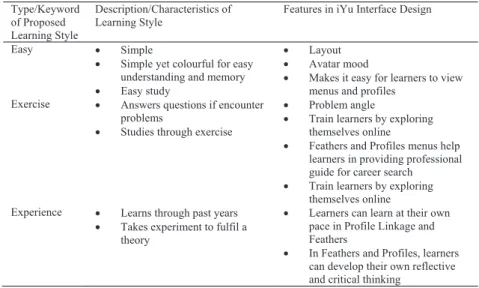
displayed in the following figure (refer Fig. 1) applied the proposed learning style with the integration of V, A
and K characteristics (refer Table 3). The proposed learning style had been compared and matched with the
selected psychological stimuli components and there is overlapping of learning style such as one characteristic
representing two learning style types. They were obtained from previous data collection before designing the
actual iYu interface design to fulfil users’ current needs. The interface design is also influenced by PLE and
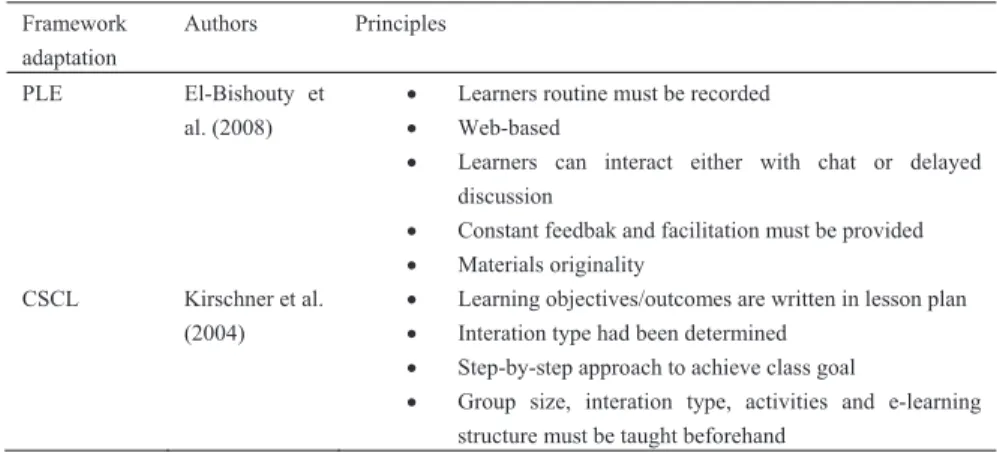
CSCL principles. Several principles of PLE are injected/embedded into CSCL principles to come out with a new
PCL framework in nurturing a good reflective thinking and critical thinking. The PLE and CSCL principles are
also matched with learning style adaptation in learners’ activities and teaching materials in terms of presentation
(El-Bishouty et al., 2008; Kirschner et al., 2004; Dunn and Dunn, 1999). Among the principles applied in
designing the PCL framework (refer Table 2) include:
Table 2. PCL framework principles Framework
adaptation
Authors Principles
PLE El-Bishouty et
al. (2008)
Learners routine must be recorded Web-based
Learners can interact either with chat or delayed discussion
Constant feedbak and facilitation must be provided Materials originality
CSCL Kirschner et al. (2004)
Learning objectives/outcomes are written in lesson plan Interation type had been determined
Step-by-step approach to achieve class goal
Group size, interation type, activities and e-learning structure must be taught beforehand
Computer interation verification as learning improvement learner participation level increment must be proved
Learning Style
Dunn and Dunn (1999)
Characteristics of learning style type must be applied and integrated into task and framework (for instance, VAK)
The Feathers menu represents thinking layers that could help generating reflective thinking and critical
thinking at the same time. Although the participatory design method data was obtained from small sample of
learners’ population, the students managed to discuss and collaborate with their peers along the learning process
quite well. From the author observation, the respondents:
could climb thinking level ladder
could finish system exploration within one hour approximately
could complete all tasks within one to two hour/hours with two to six logins
who are reflective learners performed well with good response and feedback
are last-minute learners were positive and has the intention to use the system repeatedly
enjoyed using the system to discover themselves and plan their future
Fig. 1. iYu index page interface design
Table 3. iYu interface design proposed learning style Type/Keyword
of Proposed Learning Style
Description/Characteristics of
Learning Style Features in iYu Interface Design
Easy Simple
Simple yet colourful for easy understanding and memory Easy study
Layout Avatar mood
Makes it easy for learners to view menus and profiles
Exercise Answers questions if encounter problems
Studies through exercise
Problem angle
Train learners by exploring themselves online
Feathers and Profiles menus help learners in providing professional guide for career search Train learners by exploring themselves online Experience Learns through past years
Takes experiment to fulfil a theory
Learners can learn at their own pace in Profile Linkage and Feathers
In Feathers and Profiles, learners can develop their own reflective and critical thinking
Last Minute Performs only when under pressure
Studies a day before a test Studies last minute with study group for revision
Always studying at the last minute
Learners can finish system familiarization depending on their own time set
Could help learners train their mind within limited time Reference
Search Finds references from books Probes questions when do not understand a topic
Seeks for answer from lecturers
Original, Share Half and Share Part assists learners in realizing their own original idea In Interview and Feathers, Peer Review and Peer Remark helps learners to gain some feedback from their lectures and/or peers Smart Studies basic stuffs/materials
Smart, but in a hard way
Feathers Why? 1 feature help learners in generating basic idea on a subject
Feathers three Why? features help learners think in a smart yet complex way
Summary Makes short notes for every special topic
Jot down notes in very simple keywords on a very small paper
Feathers, Profiles and My Identity layouts applied summary type by providing small textboxes in each interface
Up-to-date Cool style Trendy
Certain Social Networking Sites (SNSs) like elements
Relaxed Rests after studying activities like listening or watching audio/video
Relaxed, but organized
Uploaded audio and/or video help learners to relax
Lounge feature help learners identifying their learning type using a nice interface
5.
Conclusion
The paired version of PLE and CSCL could form PCL framework based on learner model metrics expansion.
As a results, learning style cannot be hidden, but the association of it with several other components must also be
emphasized in designing an adaptive system. New principles of PCL to evaluate justified framework that focuses
on labelling concept and deep personalization can be proposed in the future. Future works should include or
enhance iYu adaptive user interface manipulation to a new level such as labelling, deep personalization, flow and
technique. Apart from that, iYu system must also be tested to other courses learners to differentiate data analysis
results based on demographic background in order to maintain and improve iYu system performance as well as
its effectiveness to them.
Acknowledgements
The author would like to express gratitude to the involved sample of the course population in the participatory
design method.
References
Alaoutinen, S., Heikkinen, K. & Porras, J. (2012). Experiences of learning styles in an intensive collaborative course. Int J Technol Des Educ, 22, 25–49.
Dunn, R., & Dunn, K. (1999). The complete guide to the learning styles inservice system. Needham Heights, MA: Allyn and Bacon. Hamada, M. (2012). Learning style model for e-learning systems. Active Media Technology, Lecture Notes in Computer Science Volume 7669, 186 - 195.
El-Bishouty, M. M., Ogata, H. & Yano, Y. (2008). A Model of Personalized Collaborative Computer Supported Ubiquitous Learning Environment. Proceedings of the 8th International Conference on Advanced Learning Technologies (ICALT08), 97 - 101.
Hamada, M., Nishikawa, K. & Brine, J. (2013). A study of a Learning style index to support an intelligent and adaptive learning systems.
Intelligent and Adaptive Educational-Learning Systems Smart Innovation, Systems and Technologies, 17, 109 - 132 .
Kirschner, P. A., Martens, R. L. & Strijbos, J. W. (2004). CSCL in Higher Education. In Strijbos, J. W., Kirschner, P., & Martens, R. (Ed.).
What We Know About CSCL: And Implementing It in Higher Education. Dordrecht: Kluwer.
Li, Z. & Zhao, X. (2008). The Design of Web-Based Personal Collaborative Learning System (WBPCLS) for Computer Science Courses. Advances in Web Based Learning - ICWL 2008 LNCS, 5145, 434—445.
Liaw, S. S. & Huang, H. M. (2007). Developing a collaborative e-learning system based on users’ perceptions. Lect Notes Comput Sci, 4402,
751–759.