Building Radio frequency IDentification for the Global
Environment
Serial Level Manufacturing Control
Authors: Alexandra Brintrup (CAM), Maurizio Tomasella (CAM), Mark
Harrison (CAM), Paul Bowman (BT), Jason Ng (BT), Cosmin Condea
(SAP)
June 2009
About the BRIDGE Project:
BRIDGE (Building Radio frequency IDentification for the Global Environment) is a 13 million Euro RFID project running over 3 years and partly funded (€7,5 million) by the European Union. The objective of the BRIDGE project is to research, develop and implement tools to enable the deployment of EPCglobal applications in Europe. Thirty interdisciplinary partners from 12 countries (Europe and Asia) are working together on : Hardware development, Serial Look-up Service, Serial-Level Supply Chain Control, Security; Anti-counterfeiting, Drug Pedigree, Supply Chain Management, Manufacturing Process, Reusable Asset
Management, Products in Service, Item Level Tagging for non-food items as well as Dissemination tools, Education material and Policy recommendations.
For more information on the BRIDGE project:
This document results from work being done in the framework of the BRIDGE project. It does not represent an official deliverable formally approved by the European Commission.
This document:
In this document, we first aim to give an overview of how RFID, the EPC Network and additional developments such as those in BRIDGE WP3 may help in manufacturing related operations in various ways, through the use of unique identification, item level track and trace and enhanced track and trace, elimination of the need for line-of-sight for data readability and, finally, historical tracing. We also aim to bring together a set of high level, generic requirements for networked RFID, and enhanced track and trace solution providers, regarding the beneficial use of track and trace software within the manufacturing industry.
Disclaimer:
Copyright 2009 by (University of Cambridge, BT, SAP) All rights reserved. The information in this document is proprietary to these BRIDGE consortium members
This document contains preliminary information and is not subject to any license agreement or any other agreement as between with respect to the above referenced consortium members. This document contains only intended strategies, developments, and/or functionalities and is not intended to be binding on any of the above referenced consortium members (either jointly or severally) with respect to any particular course of business, product strategy, and/or development of the above referenced consortium members. To the maximum extent allowed under applicable law, the above referenced consortium members assume no responsibility for errors or omissions in this document. The above referenced consortium members do not warrant the accuracy or
completeness of the information, text, graphics, links, or other items contained within this material. This document is provided without a warranty of any kind, either express or implied, including but not limited to the implied warranties of merchantability, satisfactory quality, fitness for a particular purpose, or non-infringement. No licence to any underlying IPR is granted or to be implied from any use or reliance on the information contained within or accessed through this document. The above referenced consortium members shall have no liability for damages of any kind including without limitation direct, special, indirect, or consequential damages that may result from the use of these materials. This limitation shall not apply in cases of intentional or gross negligence. Because some jurisdictions do not allow the exclusion or limitation of liability for consequential or incidental damages, the above limitation may not apply to you. The statutory liability for personal injury and defective products is not affected. The above referenced consortium members have no control over the information that you may access through the use of hot links contained in these materials and does not endorse your use of third-party Web pages nor provide any warranty whatsoever relating to third-party Web pages.
TABLE OF CONTENTS
1. INTRODUCTION ... 6 1.1 AIMS ... 6 1.2 RATIONALE... 6 1.3 METHODOLOGY ... 6 1.4 DOCUMENT STRUCTURE ... 62. SERIAL LEVEL RFID DATA IN MANUFACTURING: USES AND OPPORTUNITIES ... 7
2.1 BUSINESS DRIVERS AND CHALLENGES FACING MANUFACTURERS ... 7
2.1.1 Legislative drivers ... 8
2.1.1.1 Waste Electrical and Electronic Equipment ... 8
2.1.1.2 RoHS ... 9
2.1.1.3 Food safety legislation ... 9
2.1.1.4 EU Legislation ... 9
2.1.1.5 Bioterrorism Act ...10
2.1.1.6 Organic products ...11
2.1.2 Product Traceability ...11
2.1.3 The environment and related issues ...11
2.2 OVERVIEW OF UNIQUE ID,RFID,TRACK AND TRACE AND USAGE FEEDBACK IN MANUFACTURING ... 12
2.2.1 Manufacturing Process ...13 2.2.1.1 Design Product ...13 2.2.1.2 Plan Process ...13 2.2.1.3 Procure Parts ...13 2.2.1.4 Schedule Production ...13 2.2.1.5 Production ...14 2.2.1.6 Inspection ...15 2.2.1.7 Storage ...15 2.2.1.8 Dispatch ...16 2.2.1.9 Design System ...16 2.2.1.10 Reconfiguration ...17 2.2.1.11 Maintenance ...17
2.3 OTHER MANUFACTURING-RELATED ACTIVITIES ... 20
2.3.1 Sorting and decision support for remanufacturing ...20
2.3.2 Reverse Logistics ...23
3. RFID IN MANUFACTURING PROCESS IMPROVEMENT ... 24
4. REQUIREMENTS ANALYSIS FOR ENHANCED TRACK AND TRACE ... 28
5. CONCLUSIONS ... 38
LIST OF FIGURES
Figure 1 The manufacturing jigsaw ...13 Figure 2 Flow of full and empty IBCs between processes ...18 Figure 3 Sorting and decision support for manufacturing ...21
LIST OF TABLES
Table 1 Use of RFID in manufacturing improvements methods ...27 Table 2 Use of RFID in manufacturing improvement tools within an improvement
GLOSSARY
6S 6 Sigma
BRIDGE Building Radio frequency Identification solutions for the Gloabal Environment
DS Discovery Services
DYNAMITE Dynamic Decisions in Maintenance (FP6 IP project) EAM Enterprise Asset Management
EC European Community
EDD Earliest Due Date
EEE Electrical and Electronic Equipment EPC Electronic Product Code
EPCIS EPC Information Service ERP Enterprise Resource Planning
EU European Union
FEFO First-Expire-First-Out FIFO First-In-First-Out
FMCG Fast-Moving Consumer Goods FP6 6th European Framework Programme GIAI Global Individual Asset Identifier GM Genetically Modified
GRAI Global Reusable Asset Identifier IBC Intermediate Bulk Container ID Identification
IS Information System IT Information Technology JIT Just In Time
MRP Material Requirements Planning PCF Product Carbon Footprint POS Point Of Sale
ppm parts per million
PROMISE PROduct lifecycle Management and Information tracking using Smart Embedded systems (FP6 IP project)
RF Radio Frequency
RFID Radio Frequency Identification
RoHS Restriction on the use of certain Hazardous Substances in electrical and electronic equipment
SPC Statistical Process Control SPT Shortest Processing Time T&T Track and Trace
TCO Total Cost of Ownership TOC Theory of Constraints
TPM Total Productive Maintenance TPS Toyota Production System TQM Total Quality Management
UK United Kingdom
WEEE Waste Electrical and Electronic Equipment WIP Work In Process or Work In Progress WMS Warehouse Management System
1. Introduction
1.1 Aims
In this document, we first aim to give an overview of how RFID, the EPC Network and additional developments such as those in BRIDGE WP3 may help in manufacturing related operations in various ways, through the use of unique identification, item level track and trace and enhanced track and trace, elimination of the need for line-of-sight for data readability and, finally, historical tracing.
We also aim to bring together a set of high level, generic requirements for networked RFID, and enhanced track and trace solution providers, regarding the beneficial use of track and trace software within the manufacturing industry.
1.2 Rationale
Although RFID has found various uses in the manufacturing sector, there is no clear and complete guidance as to how its various dimensions can help practitioners. Currently, practitioners interested in RFID can only refer to case studies or sometimes to optimistic claims of various RFID consultancy companies, and consequently may not have an accurate picture of what RFID can do for them. With this document, we aim to partly address this gap by providing such a guide.
In addition we assert that valuable technologies such as Discovery Services (DS) can prove to be very valuable for manufacturing operations, despite their current focus on the supply chain. In this document we explore what questions DS can answer in the domain of manufacturing and how.
1.3 Methodology
First an initial brainstorming session took place, with the participation of all BRIDGE Task 3.3 partners, to list aspects of manufacturing on which we would like to focus. The session provided us with the specific list of keywords and topics we used to conduct a literature review, with the aim of investigating how the concepts of RFID, basic Track & Trace and enhanced Track & Trace techniques have been applied in manufacturing industry and
related research projects. The search strategy was developed by identifying the relevant data sources, timeframe and keywords. Initially, a broad selection of databases was identified, covering journals, conference proceedings, books, and technical reports. These databases included IEEE, Scopus, Compendex, Inspec, RFID Journal along with the more traditional library cataloguing systems. The timeframe for this study was chosen initially to include only literature published between 1995 and 2009. However, as research progressed, this was naturally extended as a consequence of cross-checking citations. Keywords included (in various combinations): Manufacturing, RFID, track and trace, unique ID, Discovery Services, EPC, Production control, production planning, JIT, MRP, 6 Sigma, lean manufacturing, TOC, TPM, Agile manufacturing.
A second brainstorming session was then conducted among the same partners, to gather requirements for enhanced Track & Trace in manufacturing, based on their direct
involvement in the development of enhanced T&T, on their expertise in manufacturing, and on their involvement in BRIDGE WP 8.
1.4 Document Structure
Section 2 presents the results of the literature review by outlining and suggesting the uses of RFID in various aspects of manufacturing operations. Section 3 looks specifically into use of RFID in manufacturing improvement methodologies such as lean and agile manufacturing.
Section 4 presents the results of the requirements analysis for enhanced Track & Trace in manufacturing. Section 5 concludes the report and suggests future research directions.
2. Serial level RFID data in manufacturing: uses and opportunities
2.1 Business drivers and challenges facing manufacturers
Within a manufacturing environment, there are many diverse opportunities for the introduction of RFID. In the case of supply chains, the focus is generally to improve traceability from data derived from known points in the supply network so as to enable queries to be answered such as those proposed in BRIDGE deliverable D3.1: Serial level inventory tracking model:
• What is the full history of detections of item 123? • Where and when was item 123 last detected?
• Which companies have had item 123 under their custody? • When will item 123 be likely to arrive at location xyz?
• What is the most probable next location of item 123 (based on historic observation data)?
• Which products have been exposed to temperature higher than X? • Has product 123 suffered any shock during its lifetime?
• Raise warning if any products deviate from their permitted/legitimate route.
The manufacturing environment is often the source of goods entering a supply chain and can be regarded as an integral part of the network starting with the raw materials and
components through to the end user or consumer. During the manufacturing process, there are potentially many critical processes that would be under the control of operators and RFID can provide the opportunity for reducing operator error, increasing automation and offering more accurate real-time inventory control. So, from a manufacturer’s perspective, there are many opportunities to monitor and improve the efficiency of the production processes. Additionally, it is possible to maintain a complete record of source components and raw materials, equipment used during the manufacturing processes, including test equipment used and any specific customisation.
To enable detailed product and production information to be associated with each item, extended ability to answer an additional set of queries focussed on manufacturing, such as:
• Who manufactured item 123?
• Which tools and equipment were used in the production process for item 123? • Which batch did item 123 belong to?
• Where did the raw material(s) come from?
• Which assets (tools, jigs, etc) were used in the production of item 123? The following sections will highlight some of the drivers and challenges of serial level identification, which can be integrated with e.g. the MRP (Material Requirements Planning), ERP (Enterprise resource planning) and JIT (Just in Time) systems. Although RFID is not the only mechanism for serial level identification, it does have the advantage of non line-of-sight reading of tags. With the diverse range of tags currently available, there are tags that can be selected for use on metallic surfaces and in close proximity to conductive liquids, etc. in the manufacturing environment. Furthermore, RFID tags can be encapsulated to withstand the wear and tear that would be expected in the production process and throughout the lifetime
of the item. The described drivers will outline the importance and the value of information management associated with such products throughout their lifetime, as well as any related key environmental and safety related issues.
2.1.1 Legislative drivers
2.1.1.1
Waste Electrical and Electronic Equipment
The Waste Electrical and Electronic Equipment (WEEE) Directive is European Union
legislation that aims to reduce the amount of electronic waste that ends up unsorted in landfill sites or incinerators; thus minimising the negative impact of discarded electrical and
electronic equipment (EEE) on the environment. The Directive has already become law in most EU member states.
The WEEE Directive applies to producers, which can mean a person or company, who: 1. Manufactures and sells electrical and electronic equipment under an own brand, 2. Resells equipment produced by other suppliers under an own brand
3. Imports electrical and electronic equipment on a professional basis into a member state, even if it is not under an own brand.
The WEEE Directive applies to a wide spectrum of electrical products and appliances
(including those destined for both consumers and business users) which falls in the following categories:
1. Household appliances
2. IT and telecommunications equipment 3. Consumer equipment
4. Lighting equipment (including light bulbs and fluorescent tubes in households) 5. Electrical and electronic tools (with the exception of large-scale stationary industrial
tools)
6. Toys, leisure and sports equipment
7. Medical devices (with the exception of all implanted and infected products) 8. Monitoring and control instruments
9. Automatic dispensers.
Producers have the responsibility to provide:
Sales information: Numbers of products and the weight of each product, to give a total weight in each period (this varies between EU countries) for all of the equipment for which it has responsibility, i.e. which has been placed on the market. This data is then used to determine a producer’s
responsibility for recovery and recycling targets.
Take back: A producer must offer the customer to take back the WEEE when new equipment is being replaced, on a like for like, one for one basis.
WEEE treatment: Unless special arrangements have been made with the customer, the producer will have a responsibility to take back and recycle WEEE products that have been produced.
The ability to provide information to those involved in the collection, treatment, recycling and disposal of WEEE would enable the identification of various components and any hazardous substances.
2.1.1.2
RoHS
The RoHS (Restriction on the use of certain Hazardous Substances in electrical and
electronic equipment) Directive is a partner Directive to the WEEE Directive aiming to control the use of certain hazardous substances in the production of new EEE. The Directive places restrictions on the use of mercury, lead, hexavalent chromium, cadmium and a range of flame retardants, notably polybrominated biphenyls and polybrominated diphenyl ethers. Although there are certain exemptions for the use of the hazardous substances in specific applications, the Directive covers the categories listed under the WEEE Directive with the exception of:
• Medical devices (with the exception of all implanted and infected products) • Monitoring and control instruments
The accurate identification and handling of hazardous substances can significantly add to the costs as well as the challenge of recycling. Again, implementing serial-level ID at the
manufacturing stages can help to ensure that appropriate levels of reliable information can be made available as and when required throughout the entire lifecycle of the products.
2.1.1.3
Food safety legislation
The following sub sections relate to the traceability of food as an end product that is destined for human consumption as well as traceability of certain ingredients that are used in the early stages of production. In all areas of manufacturing there is always an element of risk, no matter how small, which can be of danger to the end consumer. There is hence a clear objective for manufacturers to cope with such risk. In fact, whenever an error has occurred or contamination has been identified, the manufacturers have a duty to take appropriate action as swiftly as possible. This is because the consequences, following such issues, can have a disastrous impact or knock-on effect on its brand and shareholder values, as well as a loss of public confidence. The use of RFID technology can therefore help to minimise such
consequences by enabling full traceability along the whole of the supply chain from raw materials and throughout the manufacturing process.
2.1.1.4
EU Legislation
EC Directive 1992/59/EC covers requirements concerning the safety of products that are placed on the market and that are intended for consumers or likely to be used by consumers. The Directive includes a requirement for systems to be put in place that would enable
products to be withdrawn, if a problem has arisen that might affect consumer safety. EC Directive 89/396/EC, covers a batch or lot identification system to facilitate the identification and tracing of products in the food chain.
EC Directives 96/24, 96/25 and 98/67 cover the labelling and movement of materials destined for animal feed. The requirement is that a label must be attached to, or travel with, the batch of feed material. The label must contain the details of the person responsible and other statutory information relating to the composition. In addition, where the feed is part of a divided batch then the original batch must be referenced on the label.
EC Directives 1999/2/EC and 1999/3/EC require that records are kept, for each batch of food that has been irradiated and that they also identify the facility where it was irradiated.
A revised General Product Safety Directive (2001/95/EC), which contains traceability requirements for products (including food), has imposed new obligations on food producers and distributors, to ensure that products can be traced back to their point of production. EU General Food Law Regulation (178/2002), Article 18 states:
1. The traceability of food, feed, food-producing animals, and any other substance intended to be, or expected to be, incorporated into a food or feed shall be established at all stages of production, processing and distribution.
2. Food and feed business operators shall be able to identify any person from whom they have been supplied with a food, a feed, a food-producing animal, or any substance intended to be, or expected to be, incorporated into a food or feed. To this end, such operators shall have in place systems and procedures which allow for this information to be made available to the competent authorities on demand.
3. Food and feed business operators shall have in place systems and procedures to identify the other businesses to which their products have been supplied. This information shall be made available to the competent authorities on demand.
4. Food or feed which is placed on the market or is likely to be placed on the market in the Community shall be adequately labelled or identified to facilitate its traceability, through relevant documentation or information in accordance with the relevant requirements of more specific provisions.
The general traceability requirements cover all operators, producers and retailers down to the final consumer. However the legislation does not prescribe how records are kept or that there is internal traceability. However, the legislation stipulates that food companies must be able to identify who they sold the products to and where they obtained the products, i.e. 'one up, one down' traceability.
2.1.1.5
Bioterrorism Act
The US Public Health Security and Bioterrorism Preparedness and Response Act of 2002 (Bioterrorism Act) mandates tracking raw materials as they arrive at the manufacturing plants, ensuring that samples of each shipment are tested. In addition, it is necessary to track ingredients going into finished goods and shipments leaving the plant. Blommer Chocolate, a cocoa-processing company, implemented an RFID tracking system to improve inventory control and visibility. The project was initiated after the acceptance of the
Bioterrorism Act, which requires food suppliers to track the custody and quality of raw materials as well as finished products in real-time. Furthermore, the company aimed at making its warehouse operations more accurate and efficient. As a result of that, the company can now speed up its loading process and adopt the first-expire-first-out (FEFO) model for ingredients, which means that the oldest ingredients are used first (O'Connor, 2006a).
2.1.1.6
Organic products
EU Regulation 2092/91 (1991) and subsequent reviews that have extended the original scope, covers many aspects of organic food and drink production. The Regulation describes the details of how organic food should be produced, processed and packaged so that they can then be labelled as being ‘organic’.
The extension to the Regulation also covers:
• The production of meat, eggs, poultry and dairy goods.
• The presence of GM (Genetically Modified) materials in organic food
2.1.2 Product Traceability
Product traceability systems are of particular value to the manufacturers as well as benefiting the consumers. Their reasons can span from allergy alerts to safety recalls. They are
systems that might not need to be invoked very often; but should a need occur, it can happen at very short notice which can be both disruptive and costly. Its subsequent action typically involves a withdrawal of a range of products from the shelves or a recall from the customers who would be notified to return the product. In some instances, it is likely that reverse logistics would need to be arranged and manufacturing programmes re-scheduled.
Apart from the need to comply with any relevant legislation, traceability systems can help to target items that might require a recall to carry out a modification; this in turn can lead to a faster diagnosis of a problem and rectification of the production process. In addition to that, having efficient systems in place can also help to provide product differentiation.
2.1.3 The environment and related issues
Product stewardship is concerned with making sure that products that are purchased, produced, used and sold are safe and have the lowest possible impact on the environment. This means minimising their impact when they are designed, made, used and disposed of. Coupled with this concept, any form of production or manufacturing has a carbon footprint that is associated with it. An estimate of the carbon footprint, related to the main greenhouse gas emissions, and which is produced during the lifecycle of a product is known as the Product Carbon Footprint (PCF).
Though it is still questionable, at least for some sectors, if the reduction of a company’s PCF should be used as the only driving environmental performance parameter, this reduction is currently in the agenda of many entrepreneurs and managers as well as a matter of discussion for the scientific community in different sectors.
Some of the many ways in which a manufacturer might seek to reduce PCF through the use of enabling technology can as RFID can be:
• Reducing waste that is due to production errors (e.g. human error) • Introduce lean manufacturing or lean production practices
• Optimise inter-site and intra-site transportation • Aim for zero fault production
• Reduce, or eliminate, waste from each stage of the manufacturing process
• Ensuring production lines are run at the most cost effective rate possible (and do not have to be stopped due to lack of components or raw materials)
2.2 Overview of Unique ID, RFID, Track and Trace and usage feedback in
manufacturing
Manufacturing comprises all those activities within the plant that, based on a product design, carry out a certain Manufacturing Process and transform raw materials and simple
components into a finished product ready for sale. This is done by using a given set of manufacturing devices and machines, organized in a manufacturing system.
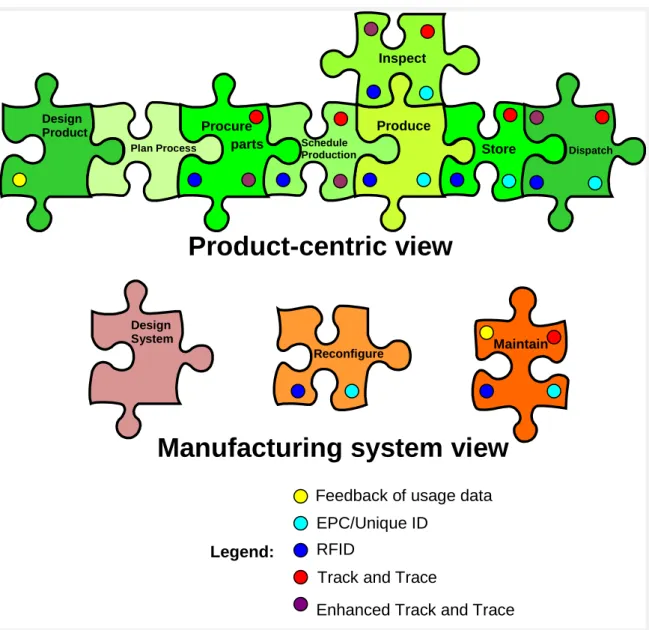
Figure 1 shows an overview of the activities involved in manufacturing, which may be sequenced differently from the way they are depicted in the same figure, depending on the specific case. A particular manufacturing process for a product may involve one or more combinations of these activities. This range of activities remains the scope of this report. Details of each activity as well as potential uses of RFID are summarised below.
Design Product Produce Reconfigure Procure Design System Maintain Inspect parts
Product-centric view
Feedback of usage data EPC/Unique ID
RFID
Track and Trace Legend:
Schedule Production
Plan Process Store Dispatch
Manufacturing system view
Figure 1 The manufacturing jigsaw
2.2.1 Manufacturing Process
2.2.1.1
Design Product
This activity involves the design level definition of geometric product parameters using an engineering drawing, or a computer aided engineering design tool. RFID technology here can help link usage data and design features, making designers more informed about which features need to be updated or enhanced for future product generations, closing the design loop. Two of the Application WPs in the EU FP6 PROMISE project, with demonstrators developed and successfully tested in Bombardier and Caterpillar, have been showcases of this concept, by linking field usage data with the design stage to improve future designs of products (PROMISE 2004). For instance, in the Caterpillar case, performance and health of earth-moving machinery has been monitored in the field using smart embedded systems, involving active RFID. This dynamically generated data led to the re-design of products which would not have been possible previously due to loss of visibility after the POS (Point Of Sale). Item level health data is collected and categorised with respect to similar product models; then a data mining activity identifies common failure modes, ultimately leading to the re-design of an entire product line. RFID coupled with sensor information and item level information contribute to making this concept possible.
2.2.1.2
Plan Process
This activity involves design of the process to produce the product, including a definition of machines, machining steps, durations, materials, machine parameters such as pressure or heat, and the necessary jigs, tools and fixtures. Here we have found no direct link with RFID systems, although a tracking mechanism might help a company that has many distributed resources to make an accurate inventory of its manufacturing resources such as tools and jigs. This would make the process planning easier and faster as an accurate picture of its resources in use and in stock are available to the process planner. Unique identification of tools and jigs is also useful because the specific tools and jigs used in the production of a specific design or product can be associated with the design documents and product class. In some situations, multiple jig components are combined to form different composite jigs for the production of different kinds of products.
2.2.1.3
Procure Parts
This activity involves the gathering of necessary raw materials from suppliers, other plants, or from within the factory. Existing stock levels and consumption rates can be monitored
through the use of RFID and analysis of the data over time. RFID and enhanced serial level track and trace data is also useful for predicting when a particular item will arrive, and where it is at a point in time, since this information may help in planning of procurement activities such as calculation of economic order quantities.
2.2.1.4
Schedule Production
Scheduling involves the arrangement, sometimes the optimal arrangement, of the sequence of different processes to produce various product batches in a factory. Optimality can be defined by maximisation of capacity, parallel processing, minimisation of lead time, or even minimisation of buffer space. Accurate tracing of items is important to determine optimal
schedules. Predictive tracking capabilities can be very useful to re-optimise in the case where changes occur in the schedule.
RFID technology is also used to provide timely replenishment of materials used in
production. RFID has the potential to bring just-in-time replenishment tools such as kanbans to new levels of efficiency and responsiveness. These performance improvements let manufacturers lower their material stocks and thus reduce their operating expenses without the need for reengineering the replenishment process (Intermec, 2006)
Daimler AG, a global car maker, piloted an RFID project to increase visibility of parts in their production sites. In a proof-of-concept exercise the company added passive tags to existing kanban parts-management cards. The goal of the project was to improve the flow of parts from the on-site storage spaces to workstations at the production line. Using RFID, the company will be able to track whether parts are in storage or being used on a production line. Although the increased visibility eliminates the need for labour-intense and time-consuming annual stock counts (see section), the key driver is the enablement of electronic kanban by providing an accurate inventory the automaker will be able to automate part orders, requests and inquiries form the suppliers (Collins, 2006)
(Hozak and Hill 2008) showed how ideal frequencies of production rescheduling may be determined through the use of timely information provided by RFID technology.
(Brewer and Sloan 1999, Li et al 2006) further showed how RFID based information led to dynamic improvements in production planning.
There are various applications of eKanbans with RFID based systems, which result in improved inventory accuracy and timely scheduling of replenishment production at the upstream suppliers. Please refer to Section 3 for a more detailed overview of these. 2.2.1.5
Production
This activity involves the actual machining operations resulting in the manufactured product. RFID can help with accurate implementation of dispatching and processing rules such as Just In Time (JIT), Shortest Processing Time (SPT), Earliest Due Date (EDD) or First In First Out (FIFO). Furthermore, automated routing can be implemented in assembly type
operations with the help of RF technology, or processing logic can be automatically downloaded to the machine at which a particular product arrives.
Applying RFID technology enables real-time performance of essential functions within process control and quality systems, such as identifying incoming products, providing operators with critical information, monitoring and controlling operations during processes, moving products to subsequent processes, and stopping further processing if products failed predefined quality limits (HK Systems, 2006).
When requiring build-to-order production and sequencing, manufacturing processes rely on item-level tagging to ensure that the correct base components and raw materials are used. Moreover, RFID provides an easy way to verify objects and can be integrated with material handling and production-control systems. By doing so, items are routed to the appropriate assembly, testing or packaging locations (Intermec, 2006). There are however many
technical hurdles to overcome for achieving this. Please refer to (Keskilammi et al 2003) for a detailed discussion on the technical challenges of how RFID technology can be used to achieve automated production control.
Most of the industrial developments under this stage of manufacturing have therefore been in process tracking.
Lawsgroup, a Chinese contract manufacturer that produces garments for U.S. retailers uses RFID technology to automate the tracking of work-in-process items such as raw materials, semi-finished components and finished garments. An alert is raised if incoming orders and current production levels point to a bottleneck. The system resulted in improvements
including easier performance measurement and better production decision making as well as shorter lead times and higher production-planning accuracy (O'Connor, 2006b).
(Huang G.Q. et al., 2007) proposed wireless manufacturing shopfloors based on RFID for better operational productivity and quality, achieved through fundamentally better flows of WIP materials and information with real-time traceability and visibility. Like many other authors advocating motivation for RFID, they suggested that non-value adding data
collection activities are eliminated and enterprise data become valuable enterprise assets to support various decision-making activities.
(Günther et al. 2008) reported on six case studies on the use of RFID within manufacturing process tracking from automotive, steel, electronics and packaging industries. Among these an airbag producer used RFID to track production processes to show the traceability of the quality of its airbags. A manufacturer of cast parts used RFID for accurately finding out locations of models in stock.
(Thiesse and Fleisch 2008), presented the design and implementation of a real-time identification and localisation system to achieve better lot scheduling in a wafer fabrication facility. The system helped reduce stock and improve efficiency with regard to process performance indicators such as cycle time and machine utilization.
At Ford Motor Company, production stages are tracked and updated using RFID technology (Johnson 2002). As vehicles pass through, the production record is updated indicating what needs to be done at each station. This eliminated the previously deployed manual recording and associated errors.
2.2.1.6
Inspection
This stage may occur at certain stages of the production of a product, or after the production, and involves batch level, sample, or final testing of the product set. Radio-frequency and unique identification capabilities enable automated checking of sample test results as the product batch moves through the system, hence reducing human error associated with manual quality checks. Serial level data enhances statistical process control activities. In BRIDGE WP 8, Nestle UK examined the use of RFID for the quality control of work in progress products. Batch samples of sweets are sent for testing, the results of which are updated in the IS. The production operator has to check the quality status of the batch before further processing occurs. Sometimes this is forgotten by the operator, which results in waste of time and processing as products with the wrong quality status needs to be scrapped immediately. Nestle UK aims to install an automatic quality tracking and alarm system based on RFID to be piloted at its Halifax factory.
2.2.1.7
Storage
This activity involves the storage of finished goods, work-in-progress or raw materials. RFID technology may automate the counting of storage items, increasing granularity and accuracy of data.
Inventory management had been a key push for RFID in manufacturing, since its accuracy has direct impacts on manufacturing cost. Inventory costs form a large margin of a
company’s cost and minimising inventory is a key concern for many companies.
Procurement of new raw materials is based on current inventory levels, so misplaced orders can be reduced using RFID to track items already in stock. Furthermore, traceability may help prevent loss of items and aid in the implementation of storage rules for perishable objects, alerting operators when and from where a stored product should be taken. In
BRIDGE WP 8, Nestle UK examined RFID to accurately check stock levels of raw materials, finished goods and work in progress and aimed to deploy RFID for its inventory management of flavouring oils, to implement the FIFO protocol for its usage. Operators may automatically be alerted as to which items should be taken for use. The same technique can be used for WIP or finished products.
A few more examples include (Mills-Harris et al 2005) and (Zhou et al 2007). The former advocated the use of RFID for the inventory management of perishable materials and provided an adaptive inventory management model, based on a forecasting algorithm that utilizes RFID-based state and event data for tracking and dispatching of time sensitive materials in a manufacturing facility. The latter (Zhou et al 2007) proposed an RFID based remote monitoring system over the Internet to provide a transparent and visible information flow for supply chain and resource management within the enterprise. A combination of RFID, Bluetooth, and Internet technologies, allowed the provision of transparent information flow to the management team who could use this data to make effective production and marketing decisions.
2.2.1.8
Dispatch
This activity involves the outbound shipment of a product after manufacturing. Serial level data may prevent items from becoming lost or misplaced. Traceability may help receiving companies schedule activities in advance. Tracking shipments have been another area of intense RFID use in manufacturing.
At Blommer Chocolate, it is necessary to track ingredients going into finished goods and shipments leaving the factory. Furthermore, the company aimed to make its warehouse operations more accurate and efficient.
In 2004 Gardeur AG, a German clothing manufacturer, decided to deploy an RFID system to track garments from production to its warehouse using reusable tags. At that time, the company did not know how many products arrived at their warehouses and distribution centres, nor was Gardeur able to confirm that all goods from a production site actually arrived at their planned destinations. Moreover, when a delivery arrived, employees had to spend a lot of time counting and sorting the different product variants. Thus, the goal of the implementation was to reduce manual work, to reduce shrinkage, and to increase efficiency of the underlying processes. In this application, individual items are tagged when they are shipped and read when they arrive at the warehouse. Upon arrival of the goods, their tags are removed and reused in a subsequent delivery (Wessel, 2006).
2.2.1.9
Design System
This activity involves the design of the plant layout such that a set of given products can be manufactured efficiently. Although we have not found any uses of RFID in this activity in particular, use of RFID might help in tracking mobile manufacturing assets and predicting their arrival at a particular location, so that the manufacturing operation can be prepared in advance for a particular product, e.g. minimising changeover/setup time for retooling and reconfiguration.
2.2.1.10
Reconfiguration
This activity involves the reconfiguration of machines, or the production system upon the introduction of a new product variety. Automated reconfiguration may be achieved with RF technology, as products may ask a specific configuration to be loaded upon arrival. Holonic manufacturing has been one area where this concept has been tested. Represented by agent software, individual materials arrive at machines and demand a particular production operation. To undertake the operation the machine has to reconfigure itself for different products by loading configuration information from the network. Items carrying an RFID tag may automatically cause the machine to load and reconfigure as experimented in (Huang et al. 2007).
2.2.1.11
Maintenance
Assets in a manufacturing environment can be subdivided into two distinct types – those that are directly used to carry out the manufacturing process, such as machines and devices belonging to a manufacturing system, and those that are used to move WIP objects,
intermediate components and raw materials all around the facility so that they can be used to feed the manufacturing process. This section will focus on the latter category, for which the benefit of the RFID technology has been made evident in both literature and practical trials and implementations.
Some examples of both categories are:
• Reusable containers, for example: cylinders and IBC (Intermediate Bulk Containers) • Moulds
• Jigs & engineered assets • Specialist test equipment • Individual production lines • Custom tools
• Measurement devices (that require independent calibration that is traceable to national standards)
Here, an example from a FMCG (Fast Moving Consumer Goods) confectionery manufacturer will be described, highlighting the flow of both full and empty reusable assets in the
operation. The reusable assets used in this case study are known as Intermediate Bulk Containers (IBC). Because of their size, they are normally moved by fork-lift trucks around the manufacturing areas.
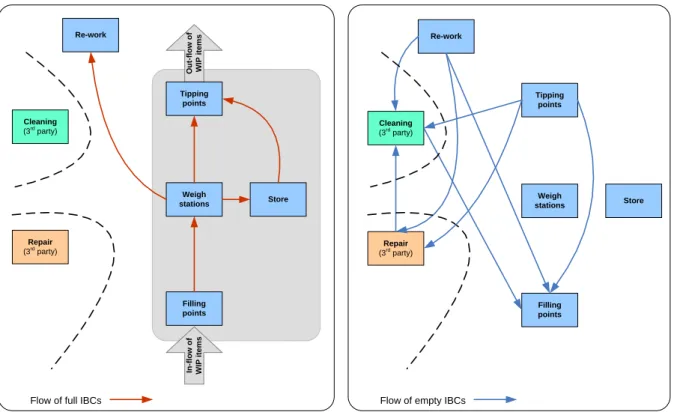
The directed flows of the IBCs are shown in Figure 2. In the figure, the lines between two processes represent the logically permitted paths for the IBCs. The left hand side of the figure is concerned with IBCs that are filled with work-in-progress components. These IBCs are weighed and sent either to a cool storage location, for medium term storage, or directed to a tipping point to be passed to the next process stage.
Note that when production is running, all of the WIP components will be transported within the grey region. Their flow follows a more linear movement which is in contrast with the cyclic movement of the IBCs. The exception to this is the transfer of IBCs to the “rework” area; this
is an area on the factory floor that is used when a problem arises and can be rectified manually.
Flow of full IBCs
Out -flow of WIP items In -flow of WIP items Re-work Store Tipping points Weigh stations Filling points Cleaning (3rd party) Repair (3rd party) Re-work Store Tipping points Weigh stations Filling points Cleaning (3rd party) Repair (3rd party)
Flow of empty IBCs
Figure 2 Flow of full and empty IBCs between processes
The right hand side of Figure 2 shows the typical flows or permitted paths for the empty IBCs. These IBCs are generally collected from the tipping points and made available to the filling points when required. To comply with hygiene requirements, the IBCs have to be sent for cleaning after at least every ten fill/empty cycles or whenever necessary. The cleaning facility, although located nearby, is an outsourced service managed by a separate company. Similarly, if an IBC is in need of a repair, it will be sent to a repair facility that is external to the manufacturing plant.
The main requirements for the management of the IBCs can be summarised as follows: • There should always be enough empty IBCs that can be made available to the filling
points such that production is not impeded. • The location of all empty IBCs should be known.
• The location of any loaded IBC should be known because its unique GIAI (Global Individual Asset Identifier) will have been associated with the batch code and weight of the items it contains. The manufacturer operates a FEFO (First-Expire-First-Out) policy to manage stock - hence location information is necessary.
• If the contents of an IBC are to be blocked (isolated) for whatever reason then its location needs to be known.
• Cleaning is required at least after every ten fill/empty cycles or when necessary. As this function is outsourced, the records about the cleaning of the IBCs need to be kept up to date.
• Similarly, repairs are performed by an external company; up to date records are needed to manage the inventory and for accounting purposes.
• The current state of all IBCs should be known, which could essentially include in one of the following:
o Full
o Empty
o Being cleaned (not to be used until cleaned)
o Being repaired (not to be used until repaired)
o Blocked (or not to be used until a clear decision has been made with what to do with the current contents, e.g. scrap, re-work or use, etc)
Translating the above requirements into proper queries would require the manufacturer, the external repairer and the cleaning service to have RFID capabilities that are networked such that appropriate read event data can be made readily available. This would require equipping the IBCs with RFID tags and locating readers at strategic locations within the factory, such as the filling points, the weigh stations, store, and external access points (e.g. dock doors), and represents a first evidence of the link between RFID and the management of manufacturing returnable assets.
In cases such as this example, there are key sets of information that can be derived, for instance:
• Statistical information e.g. utilisation – this can help monitor use and take into account peaks, such as seasonal demand, leading to increased stock being produced and increased filling of IBCs. Also in times of plant outages, IBCs cannot be emptied and this thus creates a shortage of empty IBCs. With no empty IBCs, this would probably require the line producing the WIP components to be halted.
• Logical information – within this manufacturing operation, there are essential processes that must be completed before the next one can be started. For example, the filled IBC must be weighed and the precise product batch be associated with the IBCs’ GIAI. Any ambiguity at a later stage might result in the product being scrapped. Currently, most of the processes require manual intervention and errors can (and do) occur. An RFID based system can hence be employed to either provide explicit information to an operator or trigger an alarm/interlock to prevent an erroneous step from taking place.
• Administrative information – automated management of invoicing between the three parties: manufacturer, repairer and cleaning service. This can include accurate monitoring of turnaround time and quality control issues.
Another example case of reusable asset tracking is in one of the leading manufacturers of residential glass (Chapell and Dragotta, 2004). It uses metal racks to transport sheets of glass within the facility and for shipping to window manufacturers. The problem is that they can only account for a percentage of the racks. This creates additional problems, as individual sites may not have enough racks on hand to support customer orders, impacting the sales cycle and ultimately the revenue. It also contributes to excess inventory as more racks are purchased to meet the demand because of the misplaced racks. Adopting RFID technology is an effective solution to trace the racks. Active RFID tags are placed on each rack and readers placed at each dock door. The corresponding data management software is integrated into the manufacturer's host systems so that this information can be shared across the enterprise, allowing total visibility to all racks and providing a means for them to make better decisions as they manage incoming orders.
Finally, another interesting contribution in the literature is the one by (Lampe et al. 2006), providing an extensive discussion on the basic concepts of management of returnable assets enhanced by means of RFID outlined in the examples above.
2.3 Other manufacturing-related activities
The above given examples refer to the use of RFID in various activities in manufacturing. There are however a few related activities and concepts that do not fit in the traditional manufacturing cycle but are nevertheless part of the manufacturing industry. These include remanufacturing, where end of life products are re-inserted in the production chain, and reverse logistics, where end of life products need to be shipped back to their original factory. In the remainder of this section we discuss these.
2.3.1 Sorting and decision support for remanufacturing
When manufactured items are shipped to customers, there will inevitably be a percentage of them that is returned for one reason or another. Consequently there is a need to manage these returns from customers and have in place a process to handle these returned items in a cost effective manner.
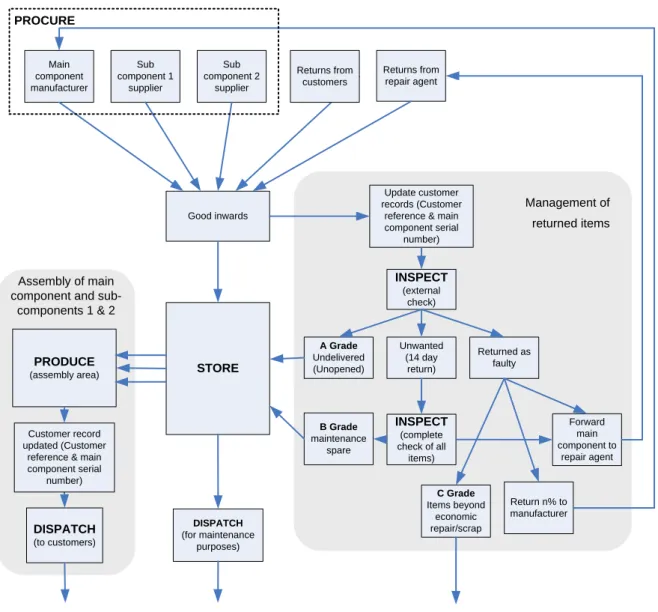
Based on a real life use case, this section describes a study of an assembly and dispatch operation in conjunction with a returns handling process as illustrated in Figure 3. The basic blocks include Procure, Produce, Dispatch and Inspect as previously outlined in Figure 1. The whole operation is designed to ship complete products to the end user, to match serial ID to customer records and to deal with any returned items. The process effectively starts with the planning department of the company in question, which makes a demand forecast of its products based on marketing activity and current market trends. A procurement bulk order is then placed for a supply of the main components from a selected major manufacturer as shown in the Procure block of Figure 1. The main components will arrive at the goods inwards area palletised and are then placed in a central store. The additional items that are required, sub components 1 and 2, are also ordered but will arrive from separate sources. These too are checked on arrival at pallet level and placed into the same store.
Assembly of main component and
sub-components 1 & 2 Management of returned items Main component manufacturer Sub component 1 supplier Sub component 2 supplier Good inwards STORE PRODUCE (assembly area) DISPATCH (to customers) Returns from repair agent Returned as faulty INSPECT (external check) A Grade Undelivered (Unopened) Unwanted (14 day return) INSPECT (complete check of all items) B Grade maintenance spare Forward main component to repair agent Update customer records (Customer reference & main component serial number) Return n% to manufacturer DISPATCH (for maintenance purposes) Returns from customers C Grade Items beyond economic repair/scrap Customer record updated (Customer reference & main component serial
number)
PROCURE
Figure 3 Sorting and decision support for manufacturing
In the production area, the main components and associated sub-components are de-palletised, assembled and packaged. At this point, the serial ID (currently labelled as a barcode) of the product is read and associated with an individual customer’s record and order number. When this has been completed, a custom label is printed with the shipping details; and the sealed items are dispatched to the customer by a 3rd party courier.
The outbound assembly and dispatch processes are relatively straightforward but as they are manual processes, there is some degree of error inherent in the operation. For example, one of the sub-components could be missing. If the individual items were RFID tagged at source then accurate metrics would be available at the various key steps prior to despatch. Also, a final check of the sealed package could be made to ensure that all of the parts were correct before the item is dispatched.
As with most products, there is some percentage of flow back from customers for a variety of reasons. In this particular example:
• Items can be returned via courier within a 14 day period. The majority of these returns are not faulty but are due to the customers changing their mind and deciding that they didn’t want the product any more.
• The items are returned because of suspected fault
When items are returned, they will be diverted to a separate area for inspection. The process will start with an update of the customer record which has the customer reference or account details associated with the serial number of the main component. At this point, a basic visual inspection is made to categorise the products into grades, as follows:
A grade:
The returned item is all intact and complete but, cosmetically, the packaging might show slight signs of damage and is not suitable for restocking as new. Although this can be repackaged internally, it is generally done externally by a third party.
B grade:
Either the box or the wrapping of the returned item has been opened and the seal broken. This unit will be set aside to be sent to a third party to be refurbished. Although the original serial numbers are maintained the item will be given a new serial code to indicate that it has been refurbished. These items are generally used, at a later date, as maintenance items held by the field service engineers.
Of the remainder, if the returned item has been flagged as faulty, then depending on the arrangement with the manufacturer, a certain quantity or percentage will be returned directly to the manufacturer for quality control purposes. Alternatively, based on a manual inspection, a certain quantity will fall into the third Grade and will be scrapped.
C grade:
These are returned items that, on inspection, are deemed not worth salvaging and are despatched in bulk to a third party specialised in managing Electrical and Electronic Equipment (EEE).
Now, by equipping the units with RFID and employing an EPC network, appropriate data could be shared between the key parties, such as (1) the main component manufacturer, (2) the service provider (dealing directly with the end customer) which carries out the
procurement, final assembly and management of returned items, and (3) the repair agent. The benefits would enable, for example:
• The main component manufacturer would have real-time information relating to the serial numbers of the faulty units. This could include units that have been physically returned or those that are currently handled by the repair agent.
• The service provider could take advantage of the increased level of automation to filter out items that have been flagged as faulty, manage the customers’ record and check outgoing items prior to despatch.
The planning department and other functions such as accounting would have access to analytic information relating to, for example, the percentage returned, the quantities separated into the various grades, stock control (components, complete items and maintenance spares), and repair turnaround times.
2.3.2 Reverse Logistics
According to a recent study (Accenture 2008), consumer electronics manufacturers,
communication carriers and electronics retailers in the U.S. spend an annual $13.8 billion on testing, repairing, repackaging, restocking and reselling returned merchandise. In Europe, the figure is estimated at $11.5 billion. This trend poses challenges in terms of managing the reverse product flows to the manufacturing enterprises, as well as to the logistics and retail enterprises, on a global scale.
Despite this, much of the value connected to the management of the product return process, is actually lost along the same process, with the major problem being the inefficient process design which introduces considerable delays at the collection and inspection stages (Condea et al. 2009). The current design of the product return process is actually inadequate for the continually rising return rates and for significant value nowadays embedded in the stream of recoverable assets.
Automatic data collection technologies, such as the joint use of RFID and sensors, are expected to bring many enhancements to this process (Wyld 2007). Precise and rich information collected by sensors and embedded on the product by means of an RFID tag may help overcome some of the uncertainties that prevail in the returns and recovery
processes. For example, one inherent feature of RFID combined with sensor technologies is that of enabling each product to gather its status during the usage period. The status
information could consist of key parameters related to mechanical, thermal, electrical, magnetic, radiant and chemical conditions. For reverse logistics, such information is highly relevant as it can be used directly at the return point to automate decisions upon the most viable recovery option. Nevertheless, even a good set of such parameters would possibly not deliver the accuracy of workbench inspection. On the other hand, provided an initial
investment in technical infrastructure, sorting based on sensory information becomes cheaper and quicker compared to the typical manual process currently in place.
(Condea et al. 2009) provides a novel way for quantifying the value of sensor-equipped RFID tags in the reverse logistics of the high-tech industry for a specific application scenario, considering the impact of accuracy of timely sensor-delivered information regarding product quality on the recovered value from returned goods.
The paper deals in particular with the returns management process for consumer products at a world-wide manufacturer of imaging and information technologies solutions, presents an analytical model to compare an RFID-based returns management process to the traditional process, and finally a numerical sensitivity analysis. The conclusion derived from the numerical results is that the combination of RFID and sensors bears the potential to
significantly improve the costs. Early product differentiation enabled by sensorial information positively impacts profit, even if the accuracy of inspection is not perfect. Furthermore, RFID-enabled return process shows in general less sensitivity to changes in parameters such as the cost of inspection, the cost of transportation and the cost of disposal, which makes it particularly attractive for time-sensitive product, with a volatile price on the secondary market. This is particularly true because of the global nature of the firms operating in this sector, considering that these costs can vary greatly depending on the specific location, geographic region, logistics provider, etc.
3. RFID in manufacturing process improvement
In the previous pages, we have seen how RFID can help the different processes and
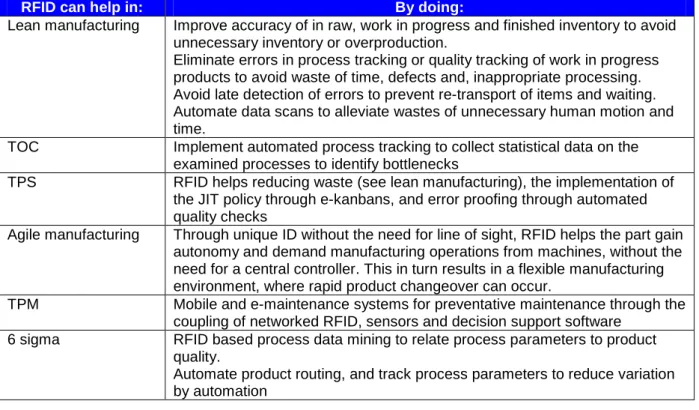
activities involved in manufacturing. We assert that RFID may help in strategic management in addition to daily operational activity. Strategic management for manufacturing firms involves the use of various tools and methodologies to achieve better performance, in terms of waste management, smoothing out operations and providing better value and quality to the customer. The most notable of these methodologies/manufacturing philosophies include lean manufacturing, theory of constraints, the Toyota Production System , Agile and Flexible manufacturing, Six sigma, and Total Productive Maintenance, although numerous others exist. In this section we give a brief review of each methodology and discuss how automated identification technology may help in its realisation.
Lean Manufacturing integrates different tools to focus on elimination of waste and produce products to meet customer expectations (Womack et al 1990). The lean concept refines mass production by eliminating waste at the operational level. (Moore and Gibbons 1997) defined areas of focus as flexibility, waste elimination, optimization, process control, people utilization. Various tools have been suggested to identify and eliminate waste, two of which are: value stream mapping (Rother and Shook 1999, Womack and Jones 1996), and Seven tools for seven wastes (Hines and Taylor 2000).
(Patti and Narsing 2008) acknowledge that lean manufacturing is compatible with RFID through industrial examples at lean firms, including assembly part location tracking and electronic Kanbans. (Myers 2009) asserts that data collected by RFID may provide insight into the average amount of time spent on work in each step, the average amount of time spent on transportation between each step, and the total time a single item takes to complete the entire process. This data collection itself may point the analyst to points of improvement, assisting the implementation of lean manufacturing. The BRIDGE WP 8 team hypothesised that RFID can help reduce the 7 wastes, through elimination of data errors that yield
unnecessary motion, overproduction, unnecessary inventory, inappropriate processing, waiting, defects, and transport. Inaccuracy in inventory counts lead to orders of unnecessary inventory or overproduction. Errors in process tracking or quality tracking of work in progress products result in re-processing or scrap, which are related to waste of time, defects, and inappropriate processing. Late detection of errors leads to re-transport of items and to further waiting. Manual data scans or records are wastes of motion and time. All these aspects have the potential to be remedied by the use of RFID, as the automation of data scans ensures operator induced errors are reduced. Item level data increases inventory and process tracking accuracy. Hence, lean manufacturing and RFID are highly synergetic as RFID can be a tool for achieving a leaner environment. Later (Brintrup et al 2009) suggested that there is a lack of analysis frameworks for manufacturing practitioners to examine how RFID can help them achieve leaner operations despite the abundance of whitepapers claiming the potential of RFID in manufacturing. As part of BRIDGE WP 8, they offered an analysis toolset for RFID opportunity in achieving reduced waste. A simulation study by the same WP tests the waste reduction through RFID hypothesis by using case studies from Nestle UK and COVAP.
In Theory of Constraints (TOC), throughput of an operation is the main focus. The main constraint to throughput is a bottleneck. A bottleneck prevents the operation from making more money, by restricting its ability to increase production. TOC has actually a broader scope than just manufacturing; as such, it is considered by its early adopters as a feasible approach to virtually any problem in systems engineering (in a broad sense).
The improvement methodology here uses five steps to “break” bottlenecks to increase production:
• Identify
• Exploit: Decide how to manage or limit that constraint.
• Subordinate •
: Make every decision and action in the whole office support reducing and eliminating that constraint.
Elevate
• Then, once you "break" a constraint, start over at the beginning. : Continue to work toward breaking constraints.
TOC and Lean manufacturing both aim to improve the process, by increasing its efficiency. They both aim at improving manufacturing flow. Both advocate producing only what you can sell, so that overproduction is avoided. They do not however agree completely, as TOC attacks bottlenecks, which in turn would cause waste in the form of waiting, inventory, which are in turn defined as wastes to be eliminated by lean manufacturing. Since RFID may be used to effectively gather data on when and where products have been seen, what process they have been through, how long the process lasted, how long did they wait before being processed etc., statistics may be gathered dynamically. This can help identify bottlenecks in the process. The identification part of the TOC methodology can be greatly aided by an automated data gathering system such as RFID.
A closely related topic is the Toyota Production System (TPS). TPS aims to reduce costs by eliminating the seven wastes defined by (Ohno 1980). Two key principles of TPS are JIT production and automation. JIT is achieved by the Kanban tool, where goods are pulled through production by use of kanbans – a signal in the form of an empty cart, a marker or paper, triggering the movement or production of material in the factory. Kanbans result in a pull system that determines the supply, or production, according to the actual demand of the customers. In contexts where supply time is lengthy and demand is difficult to forecast, the best one can do is to respond quickly to observed demand. So JIT production has been very applicable to complex products such as automotive or aerospace parts. Key strategies of TPS are to shorten set up times and lead times, to standardise line operations, and train multi-function workers. RFID has been used as a form of e-kanban (Liker). Kanbans originally did not involve computers; today, as companies become more dependent on electronically exchanged information, both internally and externally, kanban integration into business infrastructures makes sense (Vernyi and Vinas 2005). Electronic kanban systems automate the pull-based replenishment without letting go of simplicity (Drickhamer 2005). The first problem e-kanbans solve is they eliminate lost cards and therefore errors in inventory or production counts. Since e-kanbans can be part of a company's ERP, or they may be supply chain applications that automate the transfer of the kanban demand signal in the form of an electronic message, via RFID, to an upstream supplier. Suppliers have more visibility and manufacturers can monitor the status of any given replenishment order. By integration into the enterprise network, e-kanbans formalise the communication process and eliminate many of the manual errors that arise from faxing kanban orders or e-mailing spreadsheets to suppliers, which is how many companies currently send kanban signals to their suppliers (Drickhamer 2005). Poka-yoke is another tool utilised by the TPS to error proof parts of the production by putting limits on how an operation can be performed in order to force the correct completion of the operation. RFID based automated quality checks for batch items, sequence checks for assembly line operations can help prevent errors by raising alerts to the operator.
Agile and Flexible manufacturing is the integration of highly skilled people, advanced technology to achieve cooperation and innovation in developing highly customized products (Kidd 1994). Agile manufacturing looks to involve customers more closely in product
specification (Dove 1993). Improved productivity, faster response, improved product quality, learning, improved return on investments are key factors for deploying an agile
manufacturing strategy. In recent years, holonic manufacturing has been suggested as a means of achieving flexible manufacturing . This concept suggests giving autonomy to products themselves to drive production. Instead of having a central production controller that plans for material arrivals in advance, WIP products are routed to machines, and upon arrival, ask for machining operations to be carried out. The concept leads to rapid product changeover, eliminating lengthy re-programming of the machines. Subsequently a flexible