Recruitment Process Based on Computing with
Words using Interval Type-2 Fuzzy Set HM
Approach
Olufunke Oladipupo, Simisola Olawoye, Oluwole Olajide, Jelili Oyelade and Stephen Adubi
Abstract-- Recruitment process is a procedure of selecting an ideal candidate amongst different applicants who suit the qualifications required by the given institution in the best way. Due to the multi criteria nature of the recruitment process, it involves human evaluation which is often characterized with subjectivity and uncertainties in decision making. Given the uncertain, ambiguous, and vague nature of recruitment process there is need for an applicable methodology that could resolve various inherent uncertainties of human evaluation during the decision making process. Computing with word is a methodology in which the objects of computation are words and propositions drawn from a natural language and have more important bearing on how human make perception-based rational decisions in an environment of imprecision, uncertainty and partial truth. In this paper in order to capture word uncertainty an interval type 2 (IT2) fuzzy set using Hao and Mendel Approach (HMA) is proposed to model the qualification requirement for recruitment process in an academic environment. This approach will cater for both intra and inter uncertainty in decision makers’ judgments and demonstrates agreements by all subjects (decision makers) for the regular overlap of subject data intervals and the manner in which data intervals are collectively classified into their respective footprint of uncertainty.
Index Terms-- Interval Type 2, Recruitment process, computing with Words, Decision makers
I INTRODUCTION
ERSONNEL recruitment is a procedure for selecting an ideal candidate amongst different applicants who has the qualifications required by the given company [1]. The responsibilities of the Human Resource department of an organization includes identifying, evaluating, hiring, motivating, educating, and developing employees to reap organizational targets. Therefore, personnel recruitment is a core duty of an organization human resource department because it can go a long way to determine the success of an organization. Thus, effective personnel recruitment procedure is then needed to assist organizations pick the best person among alternatives for a given task.
Manuscript received July 24, 2017; revised August7, 2017. This work was supported and sponsored by Covenant University, Ota. Nigeria. All authors are with Department of Computer and Information Sciences, Covenant University. *Corresponding Author: O. Oladipupo.
+2348033319370 ([email protected]) S. Olawoye, ([email protected])
O. Olajide, ([email protected]) J. Oyelade,([email protected]) S. Adubi, [email protected]
Personnel recruitment is an extremely complex problem just like every other decision making problem because it is characterized by multiple, incommensurable and conflicting criteria. Many studies have been conducted to assist companies resolve the problem of employee selection and so a lot of strategies have been proposed. There have also been so many techniques that have been used during the process such as application paperwork, interview and so on whilst these techniques come to a conclusion on the use of subjective judgements of the experts which makes the accuracy of the end result questionable [2].
In decision making, a decision maker interviews the candidate for various job positions and then the best person is chosen based on capability analysis and measurement of the accomplishment of each applicant. However, the procedure is often characterized with subjectivity, which is due to the fact that natural language is often employed during decision making in order to articulate thinking and also for general expression. This is responsible for high level of uncertainties in qualitative measurements of criteria and further establishes inconsistency in the preference elicitation process from the decision makers, thus, words might not have a clear and well-defined meaning [3]
Given the uncertain, ambiguous, and vague nature of recruitment process there is need for an applicable methodology that could resolve various inherent uncertainties of human evaluation during the decision making process [4]; [5]. Therefore, in this paper we are interested in decision making under uncertainty. The main concept of fuzzy logic is to address situations in decision making that contain uncertainty. There are so many approaches of the fuzzy logic that have been used to solve this problem. Computing with words according to Zadeh “ is a methodology in which the objects of computation are words and propositions drawn from a natural language. This has more important bearing on how human make perception-based rational decisions in an environment of imprecision, uncertainty and partial truth” [6]. The words are modelled using fuzzy sets. The fuzzy set theory as projected by Zadeh, is known as an important tool that incorporates imprecise judgments by allowing the utilization of words when rating alternatives during the selection process. This done because the human form of expression is always in words as it is in many decision problems.
[6] proposed the Type 1 fuzzy set concept in order to captures intra-uncertainty in the decision making process.
This uncertainty is always associated with the knowledge Engineer who creates the fuzzy expression for every word (qualitative measures) within the interval [0, 1]. This restricted the construction of the type-1 fuzzy sets for each word to only the opinion of the knowledge engineer. Type-1 fuzzy set has been widely applied in literature with the incorporation of MCDM methods to estimate a desirable recommendation for the decision making situations [7], [8], [9],[10]. Despite the uncertainties that are being modelled by type-1 fuzzy set, it cannot still accurately reflect the linguistic uncertainties of different decision makers and this is very important in any decision-making process.
However, In order to curb this weakness of type-1 fuzzy set, in [11] the type-2 fuzzy set was proposed as an extension to type-1 fuzzy set which has the capacity to model both intra-uncertainties and inter-uncertainties in the decision making process. Due to the computational requirements of the type-2 fuzzy, the interval type-2 (IT2) fuzzy set was suggested and has recently started gaining its various applicability in literature. The interval type-2 fuzzy set can successfully model the intra and inter uncertainties involved in the decision making process and has less computational activities [12].
There are existing approaches in literature for obtaining interval type 2 fuzzy models from data collected about a word such as Interval Approach (IA), [12], Enhanced Interval Approach (EIA) [13] and [14]. According to [14] there are some limitations with other existing approaches (IA and EIA) which Hao and Mendel came to resolve. Therefore, in this study HMA is adopted for determining the IT2 fuzzy model.
The organization of the remaining part of the paper is as follows: the personnel selection with fuzzy approaches reviewed in the second section. In the third section the proposed methodology is stated and the experimental result and discussion was covered in section four. The paper is concluded in section five.
II RELATED WORKS
According to literature, so many methods have been proposed to solve the recruitment problem. [15] described the recruitment problem as multi criteria making problem. The aim of every multi criteria making method is to help make good recommendation by determining the overall preferences among various alternatives. Among the Multi Criteria Decision Making (MCDM) problems encountered in real life the recruitment problem has attracted the interest of so many researchers, thus researchers have contributed immensely using different MCDM methods with Fuzzy set theory.
[8] proposed a fuzzy hybrid multi criteria decision making technique composed of 3 different MCDM methods for sniper choice as a part of employees selection. Fuzzy Analytical Network Process (ANP), Fuzzy Technique for Order Preference by Similarity to Ideal Solution (TOPSIS), and Fuzzy ELECTRE techniques were hybridized for sniper choice that allows the usage of the aggregation of both qualitative and quantitative factors. Fuzzy ANP was used to calculate the overall weights of standards, Fuzzy TOPSIS was used to determine the most appropriate candidate, and the top 3 ranked applicants by Fuzzy TOPSIS were taken so
as to get the very last ranking procedure through Fuzzy ELECTRE.
[16] proposed a new linguistic extension of fuzzy measure and fuzzy integral for aggregation of information for evaluation. This is implemented for personnel selection under organization group decision making environment. The feasible dependencies among the criteria were considered stating the fact that other methods that were used in literature do not consider the interdependencies of these criteria. In [17], seven different applicants from an higher institution were evaluated and assessed base on seven different criteria using MADM methods. For successful evaluation and assessment the study adopted the, Weighted Product Model (WPM) method, Analytical Hierarchy Process (AHP) and TOPSIS for selecting the ideal candidate among various alternatives in an academic environment.
[18] developed a fuzzy MCDM model for linguistic reasoning under new fuzzy cluster higher cognitive process. The new linguistic reasoning for cluster higher cognitive process has the ability to combine subjective analysis of the decision makers and therefore produce a chance to perform more robust human resource choice procedures. The procedure was validated by employing a case study of Project manager selection in MAPNA firm, a massive multi-disciplinary power holding situated in Tehran, capital of Persia. In [19], the Shannon’s entropy concept was used to determine the objective weights and then the preference of each decision maker to obtain subjective weight. They used weighted Hamming distance to identify the distance value between the ideal alternative and the options. Moreover, ranking of alternatives was made based on the general evaluation of the criteria. The method was validated with an illustration of a lecturer selection in an academic institution.
the Hao and Mendel Approach is introduced to model recruitment process.
III METHODOLOGY
[image:3.595.49.247.149.493.2]This section is carried out systematically as shown by the methodological work flow in Fig. 1.
Fig. 1 Methodological flow of the study
A. Recruitment Requirement Collection
The recruitment requirements, the Linguistic terms (words) for eliciting criteria preference and evaluation grade for evaluating each alternative were gotten through one on one interaction with the human resource department of an academic institution. The Linguistic terms (words) for eliciting criteria preference are (Exactly equal, Slightly important, Fairly important, Strongly important, Extremely important). Evaluation grades for evaluating each alternative are (Very poor, poor, Average, Good, Very good, Very low, low, Average, High, Very high)
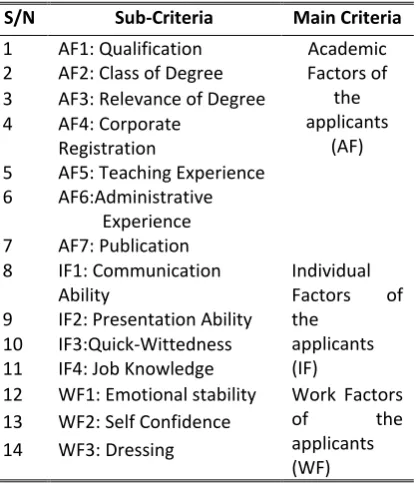
The recruitment requirements were categories under three broad attributes (criteria), which were sub-divided into seven, four and three sub criteria consecutively. The total qualification requirements refer to as criteria are fourteen (14) which stem out of 3 major attributes for rating performance as shown in Table 1. In order to ascertain the sufficiency of the linguistic terms defined by the decision makers, Jaccard similarity measure was used. The model is shown in equation 1.
[image:3.595.313.522.159.401.2]
(1)
Table I Criteria Definition
B. Collection of Data Interval
This process follows the establishment of the linguistic terms used in eliciting the requirement preference and evaluation of alternatives. Online questionnaire was used to gather the opinion of the decision makers. 37 decision makers were involved in the process. The linguistic values defined by the human resource department were used. Decision makers were required to describe an interval or range for each terms. After collection of all interval end points data for all words from all subjects, the Interval Type 2 process follows.
C. Interval Type-2 Process
The IT2 process involves three major processes, which are fuzzification process, type reduction and defuzzification process. The interval type-2 fuzzification process was carried out using the HMA. This is used to encode words into normal interval type-2 fuzzy sets, The HMA is divided into two parts (1) Data Part and (2) Fuzzy Set Part. The data part takes data intervals from the experts as the input [13]. This part acts on the interval endpoints starting with the n intervals collected from all subjects and processed in 4 steps, which are: Bad data processing, Outlier processing, Tolerance Limit Processing, Reasonable- interval processing. The fuzzy set part established the nature of the FOU as either a Left- or Right-shoulder or an Interior FOU, by making computations on the overlap of the intervals, removing the overlap from each of the original intervals and mapping the set(s) of smaller intervals into the two parameters that define the respective FOU. This part is achieved in four steps according to Hao and Mendel, (2016).
S/N Sub-Criteria Main Criteria
1 AF1: Qualification Academic
Factors of the applicants
(AF)
2 AF2: Class of Degree
3 AF3: Relevance of Degree
4 AF4: Corporate
Registration
5 AF5: Teaching Experience
6 AF6:Administrative
Experience
7 AF7: Publication
8 IF1: Communication
Ability
Individual
Factors of
the applicants (IF)
9 IF2: Presentation Ability
10 IF3:Quick-Wittedness
11 IF4: Job Knowledge
12 WF1: Emotional stability Work Factors
of the
applicants (WF)
13 WF2: Self Confidence
14 WF3: Dressing
Identification of recruitment criteria and Definition of linguistic terms for criteria
preference elicitation and evaluation grade
Collection of data interval for the linguistic terms defined
(Questionnaire method)
Interval type 2 data interval fuzzification (HM Approach) Expert
Type Reduction (EKM Approach)
Defuzzification (Average Sum)
D. Type Reduction and Defuzzification
The aggregated FOU is type reduced by computing the centroid (measure of uncertainty) of the IT2 FS using the Enhanced Kernik-Mendel (EKM) approach [13. The result is an interval valued set, which is defuzzified by taking the average of the interval’s two endpoints.
IV EXPERIMENTAL RESULT AND DISCUSSION
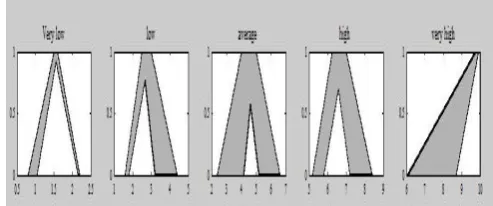
The first experiment was to ascertain the sufficiency of the linguistic terms defined by the decision makers. The Jaccard similarity measure results for the linguistic term defined by the human resources officers are shown in Table II, III and IV. The monotonically decreases in the results ascertains the sufficiency of the linguistic words defined. The decision makers are then invited to defined data intervals for each linguistic words. The screenshots for some data intervals described by the decision makers for linguistic terms, verylow, low, average, high and veryhigh are shown in FiG. 2. As depicted in Fig. 2 the first decision maker defined the interval of [1, 2] for the word very low and for low, an interval of [2, 3]. Meanwhile, the second decision maker defined the interval [1, 2] for very low and for low, an interval of [2, 4].Also the third decision maker defined the interval [0,3] for very low and for low, an interval of [4, 5]. This established the maxim of “words mean different things to different people”. This is responsible for the subjective influence on the recruitment process.
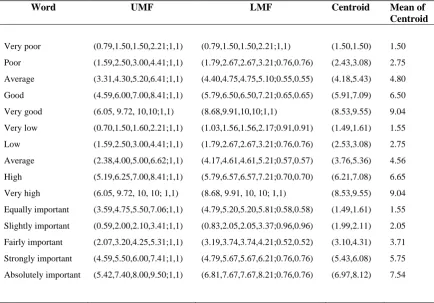
For the interval type-2 fuzzification process using the Hao and Mendel algorithm, the data Intervals obtained from the decision makers are the input into this algorithm. These data intervals are preprocessed and the result is as shown in Table V. The last column for each row shows the number of credible intervals remaining used finally in constructing the foot print of uncertainty for each word.Column number 1 to 4 under data part in Table V represents each step in the Hao and Mendel approach for constructing the FOU and this depicts the remaining number of decision makers’ credible data intervals that satisfies the criteria for each step. This result established the maxim that “each word now means similar things to different people (decision makers)” from the initial maxim of “words mean different things to different people”. The type-2 fuzzy set model derived for each word are also generated. Figure 2 shows the models for evaluation grade for evaluating each alternative. Each word is plotted with their type-2 fuzzy set depicting the respective uncertainties (Footprint of Uncertainty associated with the decision makers involved. The type-2 fuzzy set was reduced to the type-1 fuzzy set. The Upper Membership Function (UMF) and Lower Membership Function (LMF) parameters for each word obtained are represented in Table VI.
[image:4.595.302.552.73.188.2]The values obtained after the type reduction process using the EKM algorithm is also represented in the Table VI column 4. Lastly deffuzified values of this interval valued numbers gotten from the EKM algorithm for each word is represented at the last column of each row in Table VI. From this experiment, the type-2 fuzzy set is obtained for each word that are to be used for evaluating each alternative performances during the recruitment process thereby catered for both intra and inter uncertainties in the recruitment process.
Table II Similarity matrix for the other 5 related vocabulary
Word Very
low
low Average High Very high Very low
low
Average
High
Very High 1.00
0.05
0
0
0
0.05
1.00
0.15
0
0 0
0.15
1.00
0.08
0.01
0
0
0.08
1.00
0.12 0
0
0.01
0.12
1.00
Table III Similarity matrix for the other 5 related vocabulary
Word Very
low
low Average High Very high Very low
low Average High Very High
1.00 0.05 0 0 0
0.05 1.00 0.15 0 0
0 0.15 1.00 0.08 0.01
0 0 0.08 1.00 0.12
[image:4.595.311.544.385.483.2]0 0 0.01 0.12 1.00
Table IV Similarity matrix for the criterial preference vocabulary
Word EEG SI FI STI ABI Exactly equal
Slightly important Fairly important Strongly important Absolutely important
1.00 0.08 0 0
0
0.05 1.00 0.08 0
0 0 0.08 1.00 0.03
0 0 0 0.03 1.00
0.13 0 0 0 0.13
1.00
[image:4.595.311.558.549.652.2]Key-- Exactly equal (EEQ) ,Slightly important (SI), Fairly important (FI),Strongly important (STI),Absolutely important (ABI)
V CONCLUSION
[image:5.595.317.554.105.357.2]Recruitment process which involves human evaluation and often characterized with subjectivity and uncertainties in decision making was modeled with Interval Type-2 fuzzy using the Hao and Mendel Approach in this study. Data intervals was gathered for each linguistic term (word) defined to elicit requirement preference and evaluate alternatives’ performances, in order to capture decision makers divers opinion. This is to effectively resolved both intra and inter uncertainty in decision makers’ judgments. This approach demonstrates agreements by all subjects (decision makers) for the regular overlap of subject data intervals and the manner in which data intervals are collectively classified into their respective footprint of uncertainty. For the future work this approach could be introduce to Multi Criterial Decision Making (MCDM) and other ranking process whereby the selection stage of the recruitment process can be fully established.
Table V Each word’s remaining data intervals for each step in the HMA IT2 fuzzy set model
Word UMF LMF Centroid Mean of
Centroid
Very poor Poor Average Good Very good Very low Low Average High Very high Equally important Slightly important Fairly important Strongly important Absolutely important
(0.79,1.50,1.50,2.21;1,1) (1.59,2.50,3.00,4.41;1,1) (3.31,4.30,5.20,6.41;1,1) (4.59,6.00,7.00,8.41;1,1) (6.05, 9.72, 10,10;1,1) (0.70,1.50,1.60,2.21;1,1) (1.59,2.50,3.00,4.41;1,1) (2.38,4.00,5.00,6.62;1,1) (5.19,6.25,7.00,8.41;1,1) (6.05, 9.72, 10, 10; 1,1) (3.59,4.75,5.50,7.06;1,1) (0.59,2.00,2.10,3.41;1,1) (2.07,3.20,4.25,5.31;1,1) (4.59,5.50,6.00,7.41;1,1) (5.42,7.40,8.00,9.50;1,1)
(0.79,1.50,1.50,2.21;1,1) (1.79,2.67,2.67,3.21;0.76,0.76) (4.40,4.75,4.75,5.10;0.55,0.55) (5.79,6.50,6.50,7.21;0.65,0.65) (8.68,9.91,10,10;1,1)
(1.03,1.56,1.56,2.17;0.91,0.91) (1.79,2.67,2.67,3.21;0.76,0.76) (4.17,4.61,4.61,5.21;0.57,0.57) (5.79,6.57,6.57,7.21;0.70,0.70) (8.68, 9.91, 10, 10; 1,1) (4.79,5.20,5.20,5.81;0.58,0.58) (0.83,2.05,2.05,3.37;0.96,0.96) (3.19,3.74,3.74,4.21;0.52,0.52) (4.79,5.67,5.67,6.21;0.76,0.76) (6.81,7.67,7.67,8.21;0.76,0.76)
(1.50,1.50) (2.43,3.08) (4.18,5.43) (5.91,7.09) (8.53,9.55) (1.49,1.61) (2.53,3.08) (3.76,5.36) (6.21,7.08) (8.53,9.55) (1.49,1.61) (1.99,2.11) (3.10,4.31) (5.43,6.08) (6.97,8.12)
1.50 2.75 4.80 6.50 9.04 1.55 2.75 4.56 6.65 9.04 1.55 2.05 3.71 5.75 7.54 Preprocessing
(Data part)
Fuzzy set
part
1 2 3 4 Final State
Word
Exactly equal Slightly important Fairly important Strongly important Absolute Important Very poor
Poor Average Good Very good Very low Low Average High Very high
n’ m’ m” m
34 32 33 31 34 32 31 31 34 33 33 33 34 32 31 31 34 32 32 31 36 32 23 23 36 32 23 23 36 28 26 26 36 28 26 25 36 32 26 24 34 28 21 21 34 29 17 17 34 27 25 25 34 28 25 24 34 32 28 26
m*
7 5 7 4 5 16 20 18 7 24 14 15 12 16 26
[image:5.595.81.516.437.740.2]REFERENCES
[1] Dursun,M., and Karsak, E.E.(2010). A fuzzy MCDM approach for personnel selection. Expert Systems with Applications. Vol.37, Pg.4342–4330.
[2] Zhang, S. F., and Liu, S.Y. (2011).A GRA-based intuitionistic fuzzy multi-criteria group decision making method for personnel selection. Experts Systems with applications, Vol.38: 11401–11405. [3] Mardani, A., Jusoh, A., and Zavadskas, E. K. (2015).
Fuzzy multiple criteria decision-making techniques and applications–Two decades review from 1994 to 2014.
[4] Mulliner, E., Malys, N., and Maliene, V. (2016). Comparative analysis of MCDM methods for the assessment of sustainable housing affordability. Omega. Vol.59: 146-156.
[5] Daramola, O., Oladipupo, O., and Adebola, M.(2010). A Fuzzy Expert System Tool for On-line Personnel Recruitment. Int. J. Business Information Systems. Vol. 6(4): 444-462.
[6] Zadeh, L. A (1965). Fuzzy sets. Journal of Information and Control. Vol. 8: 338-353
[7] Rouyendegh, B.D., and Erkan, T.E. (2013), An application of the fuzzy ELECTRE method for academic staff selection, Human Factors and Ergonomics in Manufacturing and Service Industries, Vol.23(2): 107-115.
[8] Kabak,M., Burmaoglu,S., and Kazancoglu, Y. (2012) A fuzzy hybrid MCDM approach for professional selection, Expert Systems with Applications, Vol. 39: 3516–3525.
[9] Chaghooshia, A. J., Alireza, A., Seyyed, J., and Hosseini, D. (2016). A fuzzy hybrid approach for project manager selection. Journal of Decision Science Letters, Vol. 5: 447–460.
[10] Kusumawardani, R.P., and Agintiara, M.(2015). Application of Fuzzy AHP-TOPSIS Method for Decision Making in Human Resource Manager Selection Process. Procedia Computer Science. Vol. 27: 638 – 646.
[11] Zadeh, L.A (1975). The Concept of a Linguistic Variable and its Application to Approximate Reasoning-I . Journal of Information Science. Vol 8: 199-249 .
[12] Liu, F., and Mendel, J. M. (2008). Encoding words into interval type-2 fuzzy sets using an interval approach. Fuzzy Systems, IEEE Transactions on, 16(6), 1503-1521.
[13] Wu, D., Mendel, J.M., and Coupland, S. (2012). Enhanced interval approach for encoding words into interval type-2 fuzzy sets and its convergence analysis. Fuzzy Systems, IEEE Transactions on, Vol.20(3): 499-513.
[14] Hao, M., and Mendel, J. (2016). Encoding Words into Normal Interval Type-2 Fuzzy Sets: HM Approach. IEEE Transactions on Fuzzy Systems. Expert Systems with Applications, Vol. 42(8): 4126-4148.
[15] Golec A. and Kahya E. (2007). ‘A fuzzy model for competency-based employee evaluation and selection’,
Computer and Industrial Engineering. Vol. 52, No.1, Pp.143–161.
[16] Afshari,A.R., Rosnah M.Y., and Amir D.R.(2013). Linguistic Extension of Fuzzy Integral for Group Personnel Selection Problem. Arabian Journal of Science and Engineering, Vol.38: 2901–2910.
[17] Kumar,R., Jagadish, D., and Ray, A.(2014). Selection of Material for Optimal Design Using Multi-criteria Decision Making. Procedia Materials Science, Vol.6: 590-596.
[18] Dodangeh,J., Sorooshian,S., and Afshari, A.R.(2014), Linguistic Extension for group multi criteria project manager selection. Journal of Applied Mathematics. [19] Saad, M.D., Ahmad, M., Abu, M., and Jusoh, M.
(2014), Hamming Distance Method with Subjective and Objective Weights for Personnel Selection, The Scientific World Journal Volume 2014 (2014), Article ID 865495, 9 pages.
http://dx.doi.org/10.1155/2014/865495