COLLEGE OF ENGINEERING TECHNOLOGY Department of Electrical Engineering Can Tho University
Campus 2, 3/2 Str. Ninh Kieu Dist. Can Tho City http://cet.ctu.edu.vn/ktd/
AUN-QA
SELF-ASSESSMENT REPORT
ELECTRICAL ENGINEERING PROGRAM
DEPARTMENT OF ELECTRICAL ENGINEERNING
COLLEGE OF ENGINEERING TECHNOLOGY
LIST OF ABBREVIATIONS
ABET - Accreditation Board of Engineering and Technology AUN - ASEAN University Network
CoET - College of Engineering Technology CTU - Can Tho University
DoEE - Department of Electrical Engineering EEP - Electrical Engineering Program ELOs - Expected Learning Outcomes LRC - Learning Resource Center
MD - Mekong Delta
MOET - Ministry of Education and Training PS - Programme Specification
PSC - Program Structure and Contents PLC - Programmable Logic Controller QAT - Quality Assurance Team
QATC - Quality Assurance and Testing Center
TOEIC - Test of English for International Communication SA - Student Assessment
Table of Contents
---o0o---
I. INTRODUCTION... 3
II. AUN-QA CRITERIA AT PROGRAM LEVEL ... 7
1. Expected Learning Outcomes (elos)... 7
2. Program Specification (PS) ... 11
3. Program Structure and Content (PSC) ... 13
4. Teaching and Learning Strategy (TLS) (TLS) ... 21
5. Students Assessment (SA)... 24
6. Academic Staff Quality... 30
7. Quality of Support Staff ... 35
8. Student Quality ... 37
9. Student Advice and Support ... 40
10. Facilities and Infrastructure ... 42
11. Quality Assurance of Teaching and Learning Process ... 45
12. Staff Development Activities ... 48
13. Stakeholders Feedback... 49
14. Output... 52
15. Stakeholders Satisfaction ... 55
III. STRENGTHS AND WEAKNESSES ANALYSIS ... 62
1. Strengths... 62
2. Weaknesses... 65
3. Self-assessment at Program level ... 68
4. Plans ... 70
IV. APPENDICES ... 75
1. List of Tables and Figures ... 75
I. INTRODUCTION
1. CAN THO UNIVERSITY (CTU)
Established in 1966, Can Tho University (CTU) is an important public higher education institution and a cultural, scientific and technical center of the MD and Viet Nam with about 41,346 undergraduate students, 2,341 Master students, and 124 Ph.D candidates. CTU has got 1,969 staff including 1,190 teaching staff and 779 supporting staff. From a university with a few fields of study at the beginning, it has developed into a multidisciplinary university. Currently, it has 87 undergraduate training programs (including 02 college programs), 33 Master and 09 Doctoral training programs. Every year CTU receives students on internship programs from the U.S, Belgium, Japan and so on, or under agreements between their universities and CTU.
1.1 Mission of the university:
Mission of the university: by offering high quality educational programs, CTU focuses on training, conducting scientific research, and transferring technology to advance socio-economic development of the MD region.
1.2 Vision of the university:
CTU's strategic vision to 2020 is to not only become the best university in Vietnam, but to be recognized throughout Asia-Pacific as a leading institution in education, research, and development. CTU will expand human knowledge and benefit society through its research, teaching and strategic partnerships, all the while developing itself within the framework of global integration and mutual cooperation.
2. COLLEGE OF ENGINEERING TECHNOLOGY (COET)
In 1977, the Faculty of Agricultural Engineering and Water Management was established with 54 staff members. The College of Engineering Technology (CoET) was founded in 1995 by merging the Faculty of Water Management and Land Improvement with the Faculty of Agricultural Engineering. Currently, CoET has got 217 staff including teaching staff and supporting staffs.
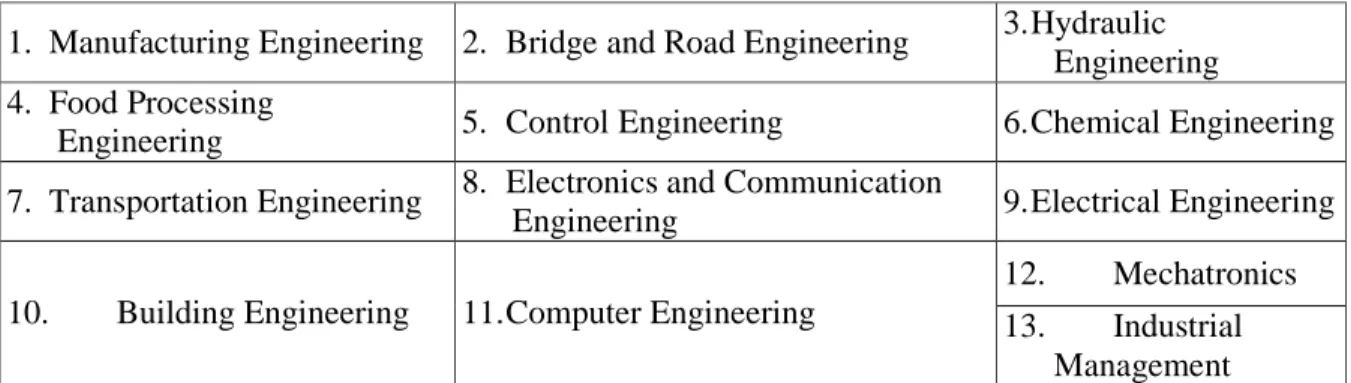
Table 1: Undergraduate programs in engineering
1. Manufacturing Engineering 2. Bridge and Road Engineering 3.Hydraulic Engineering 4. Food Processing
Engineering 5. Control Engineering 6.Chemical Engineering
7. Transportation Engineering 8. Electronics and Communication
Engineering 9.Electrical Engineering
12. Mechatronics 10. Building Engineering 11.Computer Engineering 13. Industrial
Management CoET has an enrollment of 5,000 undergraduate students. CoET has 07 departments and 03 centers, 38 laboratories and 01 workshop room. In the future, CoET will concentrate its efforts on improving the quality of undergraduate and graduate training; perfecting the management systems; investing in the facilities; improving the qualifications of training and research of staff, and comprehensively speeding up international cooperation.
Mission:
The Mission of CoET is threefold: Education, Research, and Technology Transfer. CoET provides high quality teachers, researchers and experts at the graduate and postgraduate levels to support socio-economical development in Mekong Delta area.
Vision:
The Vision of CoET is to be recognized as one of leading engineering colleges in Vietnam and to reach National and International standards in Training and educational qualification by 2020.
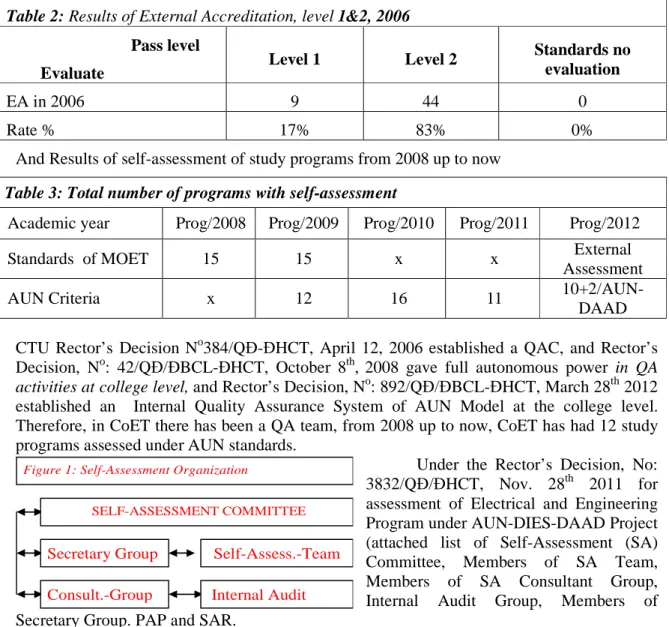
At Can Tho University, Quality Assurance activities began in 2003. To satisfy CTU and CoET’s Mission and Vision, it is necessary to establish an Internal Quality Assurance system at 02 levels. The table below shows the total results of External Accreditation (EA) at the university level according to the 10 standards of MOET in 2006.
Table 2: Results of External Accreditation, level 1&2, 2006 Pass level
Evaluate Level 1 Level 2
Standards no evaluation
EA in 2006 9 44 0
Rate % 17% 83% 0%
And Results of self-assessment of study programs from 2008 up to now
Table 3: Total number of programs with self-assessment
Academic year Prog/2008 Prog/2009 Prog/2010 Prog/2011 Prog/2012
Standards of MOET 15 15 x x Assessment External
AUN Criteria x 12 16 11
10+2/AUN-DAAD CTU Rector’s Decision No384/QĐ-ĐHCT, April 12, 2006 established a QAC, and Rector’s Decision, No: 42/QĐ/ĐBCL-ĐHCT, October 8th, 2008 gave full autonomous power in QA activities at college level, and Rector’s Decision, No: 892/QĐ/ĐBCL-ĐHCT, March 28th 2012 established an Internal Quality Assurance System of AUN Model at the college level. Therefore, in CoET there has been a QA team, from 2008 up to now, CoET has had 12 study programs assessed under AUN standards.
Under the Rector’s Decision, No: 3832/QĐ/ĐHCT, Nov. 28th 2011 for assessment of Electrical and Engineering Program under AUN-DIES-DAAD Project (attached list of Self-Assessment (SA) Committee, Members of SA Team, Members of SA Consultant Group, Internal Audit Group, Members of Secretary Group. PAP and SAR.
3. DEPARTMENT OF ELECTRICAL ENGINEERING
The Department of Electrical Engineering (DoEE) was founded in 2000. Currently, it has 21 staff including 20 teaching staff and 01 supporting staff and approximately 500 undergraduate students.
Figure 1: Self-Assessment Organization
SELF-ASSESSMENT COMMITTEE
Internal Audit Self-Assess.-Team Secretary Group
Mission:
The mission of the Department of Electrical Engineering is to support the mission of the College of Technology and Can Tho University through teaching, researching and transferring engineering activities, and to provide the best undergraduate electrical engineering education. The goal is to provide students with a strong theoretical foundation, advanced professional knowledge, practical skills, experience in interpersonal communication and teamwork, ethics, research and development, and graduate study.
Vision:
The vision of the Department of Electrical Engineering is to become the best Department of Electrical Engineering in MD region. The electrical engineering program will reach National and International standards in 2020.
4. PROGRAM EDUCATIONAL OBJECTIVES
Graduates of the Electrical Engineering program will: engage in professional practice in electric power, energy system, Industrial Power, Power-plant operation; promote innovation in the design, research and implementation of products and services in the electrical engineering area through strong communication, leadership and practical skills; engage in life-long learning.
5. PROGRAM OUTCOMES
CoET has designed course expected learning outcomes in course specifications and output standards. They are all described/based on ABET (The Accreditation Board for Engineering and Technology). So at the time of graduation, undergraduate students in Electrical Engineering will achieve 03 knowledge blocks: general, fundamental and professional knowledge (ELOs, 1.1, page 4).
At the time of graduation, undergraduate students in Electrical Engineering will have: a) Knowledge
§ Social and political knowledge and sciences: These subjects may make it possible for students to know the way and the policy of the Communist Party and Vietnamese State, fundamentals of Marxist and Leninist theory, and Ho Chi Minh Ideology. Moreover, students may achieve basic knowledge about Vietnamese Law, National Defense Education and social skills fitting specialized knowledge. Students have to have a sense of well-being to build and protect the Vietnamese Country.
§ Natural scientific knowledge: Students may apply knowledge about Maths and Physics for supporting specialized knowledge. In addition, the natural scientific knowledge exposes students to continue at postgraduate levels.
§ Fundamental knowledge: The basic knowledge helps learners to be capable of designing, doing experiments in the lab, proceeding and analyzing data in such professional areas as Electrical Material, Electromagnetism, basic measurements of electricity, optic and mechanics, electrical measurement, electric circuit and electric machines…
§ Specialized knowledge: Specialized knowledge is to provide students with professional knowledge about: operation of electrical devices, power plant, transmission line, power supply system, electrical load system, lighting system, lightning protection system, electrical industrial system, protection and automation and safety of electrical engineering, optimizing the economy of power system, using electrical energy effectively and economically, producing electrical power from renewable and clean energy sources. Graduates of EEP will have abilities in planning, operating, maintaining, repairing, and protecting the power-plant, substation, transmission system, distribution system, lighting system, power supply, Industrial Power, etc.
§ Information Technology knowledge: Students may apply Microsoft Office (MS Word, MS Excel, Window, Internet) and professional software as AUTOCAD, PowerWorld, Ecodial 3, Maxwell SV, Luxicon, PLC (Programmable Logic Controller), etc
§ Foreign languages: Graduates have an English level equivalent to TOEIC (400), being able to read and write English in Electrical Engineering.
b) Skills
§ Learners are trained for necessary skills, such as planning, operating, maintaining, repairing, and protecting for the power-plant, substation, transmission system, distribution system, lighting system, power supply, Industrial Power, etc
§ Graduates may propose and deploy solutions for managing electrical energy, saving energy, optimizing the economy of power plant, power system and power supply.
§ Operating, maintaining, repairing electrical devices, AC and DC machines, industrial and commercial transformers
c) Attitudes
§ Graduates will be good citizens, have a sense of responsibility to their career and be conscious of improving themselves, self-studying and researching methods and independent working or in pair or group.
§ Graduates will have a capacity to work scientifically, knowing how to analysis and solve practical problems in electrical fields, achieving thinking and argument skills.
d) Positions and working place after graduating
Education training facilities, Researching Institutes in electrical field, Department of Trade and Industry, Industrial areas, Industrial company and factory; Thermal Power Plant, Consulting firm, Design and Construction of power, Power company.
e) Graduates’ Ability at life-long learning
§ Graduates will have the ability to continue graduate levels in such electrical fields as power supply, power plant, electrical devices and power grid…
§ Graduates will have the ability to do specialized research in electrical fields such as Electrical Engineering, Power System.
II. AUN-QA CRITERIA AT PROGRAM LEVEL
1. EXPECTED LEARNING OUTCOMES (ELOs)
Expected learning outcomes are requirements that students must achieve by graduation. They are achieved by incremental attainment over the duration of courses in the program. Basing on the mission and vision (Exh.01.01) of Can Tho University and College of Engineering Technology, and the Program objectives ELOs are clearly designed with feedback from all stakeholders. ELOs cover the knowledge and intellectual, practical and transferable skills over 3 knowledge blocks of the program and help students to have right directions and awareness for self studying in the learning process. ELOs are popularized among the lecturers, students and different stakeholders via meetings at the department level, Can Tho University’s catalog of curriculum at university and college levels, media and website (Exh.01.02, Exh.01.04) of the College and University, and updated periodically in the last years.
1.1. The expected learning outcomes have been clearly formulated and translated into the program
v ELOs of Electrical Engineering are clearly formulated, basing on program outcomes of ABET (The Accreditation Board for Engineering and Technology) (Exh.01.03) COET inserts adding points: l and m:
a). “Apply knowledge of mathematics through probability; differential & integral calculus; differential equations; linear algebra; complex variables; and science and engineering in the context of electrical engineering problems.
b). Design and conduct scientific and engineering experiments, as well as to analyze and interpret data.
c). Design systems in electrical area that meet desired needs within realistic constraints such as economic, environmental, social, political, ethical, health and safety, manufacturability, and sustainability.
d). Function in multidisciplinary teams to solve effective electrical engineering problems. e). Identify, formulate, and solve current and emerging electrical engineering problems,
including the development of preliminary estimates and final plans, specifications, and designs; and the implementation and operation of systems components and processes that meet performance, cost, time, safety, and quality requirements.
f). Understand professional and ethical responsibility.
g). Communicate effectively technical material both orally and in writing.
h). Receive the broad education necessary to demonstrate an understanding of the impact of electrical engineering solutions in a global, economic, environmental, and societal context.
i). Demonstrate a recognition of the need for, and engage in life-long learning. j). Demonstrate knowledge of contemporary issues related to electrical engineering.
k). Use modern engineering techniques, skills, and computer-based tools for analysis and design”.
l). Have sense of well-being to build and protect Vietnamese Country
m). Know the way and the policy of the Communist Party and Vietnamese State, fundamentals of Marxist and Leninist theory, and Ho Chi Minh ideology.
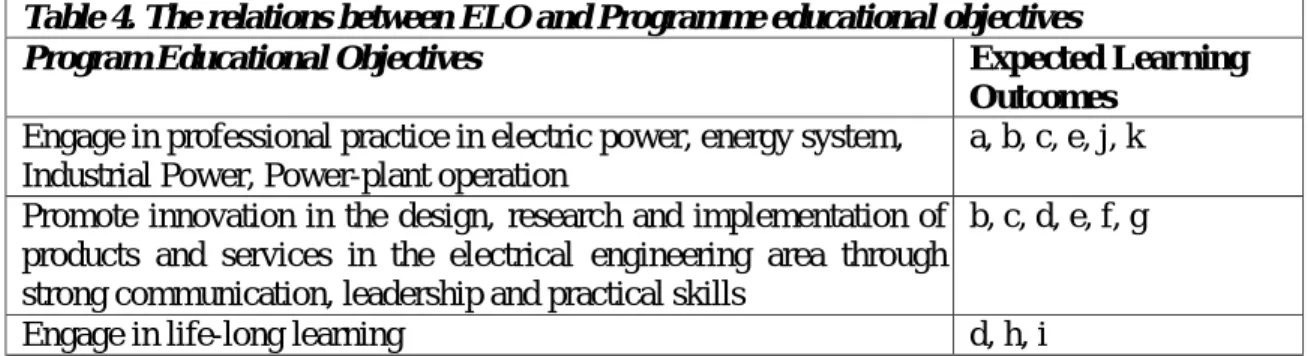
Table 4. The relations between ELO and Programme educational objectives
Program Educational Objectives Expected Learning
Outcomes Engage in professional practice in electric power, energy system,
Industrial Power, Power-plant operation
a, b, c, e, j, k Promote innovation in the design, research and implementation of
products and services in the electrical engineering area through strong communication, leadership and practical skills
b, c, d, e, f, g
Engage in life-long learning d, h, i
ELOs provide requirements that students know to achieve courses/general knowledge, fundamental knowledge and professional knowledge (Exh.01.03). Lectures and students clearly know them and to know to teach/learn and how to achieve those ELOs with individual directions before graduation.
v ELOs are clearly translated into the program via program specification, program & contents, teaching & learning strategies, staff quality, student advice and support, facilities and infrastructure, quality of teaching and learning and results of output. ELOs are covered on all courses via the course intended learning outcomes (course specifications) (Exh.01.04) in Can Tho University’s catalog of curriculum and output standards, structure and contents, syllabi and standards in teaching and learning process and student assessment under Statute No 43 of MoET, 15/08/2007 (Exh.01.06)
1.2. The programme promotes life-long learning
Teaching for lifelong learning, lecturers deliver to students relevant contents/methods in which students will remember, understand, use knowledge and create new ideas/production at different levels (under Benjamin Bloom’s Taxonomy) (Exh.01.16). Furthermore, graduates have to receive and integrate sustainable knowledge and skills that is necessary for lifelong learning in postgraduate levels. ELOs basically help students to gain the requirements of general knowledge, basic
Mission / Vision - Program Educational Objectives: Expected
Learning Outcomes a) b) c) d) e) f) g) h) i) j) k) l) m) Needs of Stakeholder
- Ability / practice skill - Ability of management - Ability of communication - Efficiency of work Programme outcomes a) Knowledge b) Skills c) Attitudes
d) Positions and working place after graduating e) Graduates’ Ability at life-long learning
Student
Education criterion
knowledge and specialized knowledge and different skills. ELOs enable the students to develop their keen sense of learning. Thus, ELOs have to be a tool for motivation and they need to be improved periodically. ELOs also provide students with self-study awareness (Exh.01.01). The teaching and learning strategy is one of the good tools to help lecturers teach, students to know how to learn to achieve ELOs directly (Exh.04.01). In 2010, CTU organized Workshop on 2-self studying periods/classes of students and a Workshop on learning consultancy for advisors and students in 2011 and so on.
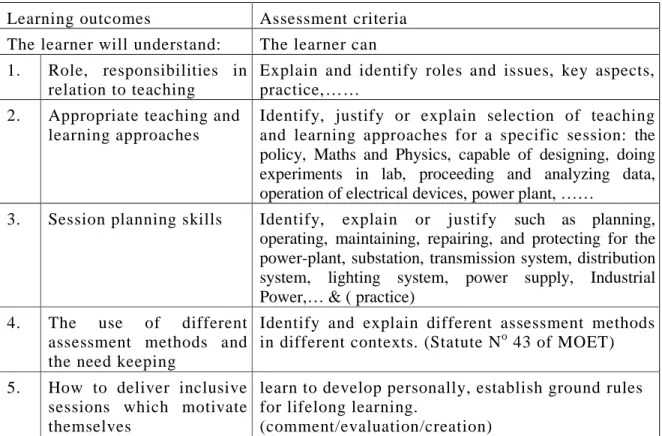
Table 5: How to teach in the lifelong learning
Learning outcomes Assessment criteria The learner will understand: The learner can 1. Role, responsibilities in
relation to teaching
Explain and identify roles and issues, key aspects, practice,……
2. Appropriate teaching and learning approaches
Identify, justify or explain selection of teaching and learning approaches for a specific session: the policy, Maths and Physics, capable of designing, doing experiments in lab, proceeding and analyzing data, operation of electrical devices, power plant, ……
3. Session planning skills Identify, explain or justify such as planning, operating, maintaining, repairing, and protecting for the power-plant, substation, transmission system, distribution system, lighting system, power supply, Industrial Power,… & ( practice)
4. The use of different assessment methods and the need keeping
Identify and explain different assessment methods in different contexts. (Statute No 43 of MOET) 5. How to deliver inclusive
sessions which motivate themselves
learn to develop personally, establish ground rules for lifelong learning.
(comment/evaluation/creation)
(under Programme outcomes (p.37&39), & Statute No 43 of MoET, 15/08/2007& National college Network,…)
Program objectives and program outcomes are to provide students a good background via general knowledge, basic knowledge and specialized knowledge, self-studying and researching methods and independent working or in pair or group. Thanks to that integration, students themselves develop and study more and more in an uninterrupted changing social environment (Exh.01.10). Mentioned ELOs, which are under the credit-based system with adequate structure and contents, teaching and learning strategies, step by step, help students plan and find out their own right direction for learning in the future (Exh.01.03). ELOs also draw professional progress and the pathways with long-sighted pictures with a view to positive learning process and lifelong-learning:
- In each theory course, a percentage of 30% of the total final grade is allocated to the students’ research and the development of their knowledge via project courses (Exh.01.11);
- Project courses in the program aim at helping students consolidate their specialized knowledge and solving specific programs (Exh.01.12);
- Practical courses aim at developing students’ ability in group work and focusing on upgrading their specialized skills (Exh.01.06, Exh.01.12, Exh.01.14, and Exh.01.15);
Graduates from the program have basic knowledge in technology and engineering, which can meet the requirements for flexibility in career transferability (Exh.01.10), They also have the ability for self-study to upgrade their level and continue to graduate levels as
described in the program standards for graduates (Exh.01.01).
Figure 3: Relationship between structure of knowledge in Electrical Engineering Program in Can Tho University and post-graduate program in Ho Chi Minh City University of Technology.
Thanks to the relationship between the structure and knowledge in the Electrical Engineering Program in CTU and the post-graduate program in HCMUT, after graduating the Electrical Engineering Program in Can Tho University, students are able to take the post-graduate program in Ho Chi Minh University of Technology.
1.3. The expected learning outcomes cover both generic and specialized skills and knowledge
The curriculum covers both generic and specialized skills and knowledge with 3 blocks of knowledge: general knowledge, fundamental knowledge and specialized knowledge.
(Exh.01.03) These three blocks of knowledge meet the comprehensive needs of society for our graduates. For students’ psychology, they only concentrate on specialized skills study, so ELOs are built like total common pictures for students to reach the final objectives
(Exh.01.01).
Within the Program Structure and Contents and Program Specification are the common picture and total knowledge and skills of program. Besides, Teaching and learning strategy and others help students to learn how to study and to achieve and to assess student (Exh.01.06, Exh.01.11, Exh.01.12, Exh.01.13, Exh.01.14, and Exh.01.15).
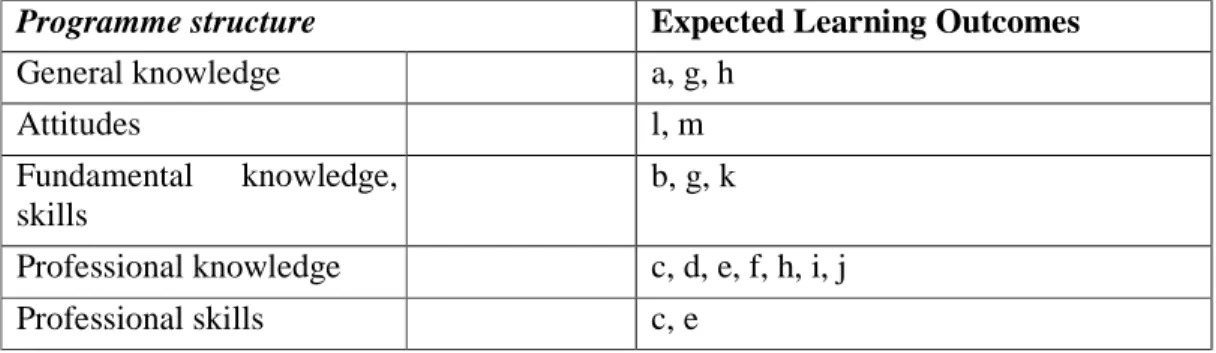
ELOs are required in which students have to receive and apply socio-common knowledge and professional skills (Exh.01.01). Graduates of EEP have ability in planning, operating, maintaining, repairing, and protecting the power-plant, substation, transmission system, distribution system, lighting system, power supply, Industrial Power, etc. Graduates of EEP with soft skills and social-political knowledge have abilities for holding some leader and manger positions for electrical energy project to satisfy labor market. Basing on the feedback from stakeholders (labor market, lecturers, students…), ELOs are planning to be improved periodically (Exh.01.07, Exh.01.08, and Exh.01.09).
Table 6: The relations between ELO and Programme structures
Programme structure Expected Learning Outcomes
General knowledge a, g, h Attitudes l, m Fundamental knowledge, skills b, g, k Professional knowledge c, d, e, f, h, i, j Professional skills c, e
1.4. The expected learning outcomes clearly reflect the requirements of the stakeholders
There is collaboration between CTU and CoET and society/stakeholders. At CTU and CoET, the feedback results from stakeholders (related to Criterion 13 and Criterion 15) are used to develop and improve ELOs (Exh.01.01). The quality and results of the
program are depended upon deploying contents and receiving achievements, so ELOs want to reflect the requirements of the stakeholders (Exh.01.07, Exh.01.08, and Exh.01.09). In addition, the program contents and specific courses were also added, adjusted frequently via feedback from learners in regular meetings between the department and newly-graduated students within one year from their graduation day and students at the department
(Exh.01.10). Moreover, the curriculum was also updated basing on the social needs, thanks to ideas contributed from electrical engineers (Exh.01.08). However, ELOs always need to be considered to reform and close gaps periodically (Exh.01.01).
a) Strengths
- The curriculum always strengthens the learners in their self-study and promotes their awareness in life-long learning via results of input and both in the learning process and output - Rate of graduate’s employability with satisfactory is high.
- ELOs description is referred/based on foreign standards-ABET with some adding points covering 3 knowledge blocks.
b) Weaknesses
§ Some students do not have an appropriate level of passion in the career, are not efficient in their self-study, self-research, and problem solving.
§ Activities for employability consultancy are still not adequate
§ Needs of society are always changed, but improvements of ELOs are still slow. c) Actions
§ The college will research for methodology innovation and teaching contents and more soft-skills for in order to motivate students’ passion in career, self-study and self-research. § Because of changed social needs, structures and contents of the program need to reform and
ELOs will improve adequately next time. 2. PROGRAM SPECIFICATION (PS)
A clear PS is using and providing stakeholder general information and main points about EEP such as ELOs and how these can be achieved, made informative, communicated, and available.
2.1 The university uses programme specification
The college has published and uses the program specification as introducing information of Electrical Engineering Program (Exh.02.01, Exh.02.03). The program specification which was edited and developed from the program curriculum of the Electrical Engineering program, published in 2007, clearly provides stakeholders with general and main points about EEP as well. It was communicated to relevant stakeholders via document system, website of the college (Exh.02.02).
Programme specification consists of main parts as follows: I) General Information; II) Program description: 1) Objectives, 2) ELOs, 3) Program structure; 4) Teaching and learning methods; 5) Assessment methods, 6) Employability, 7) Graduates’ Ability at life-long learning, 8) Support services for studies. COET identifies 1st area: I) General Information is about procedure of EEP; II) 2nd main area: II) Program description in which from section 1) to 6) for teaching and learning process and from section 7) to 8) for after graduation (Exh.02.04).
Program is periodically adjusted, so Program Specification will be also updated accordingly.
2.2 The programme specification shows the expected learning outcomes and how these can be achieved
a) The expected learning outcomes are clearly shown in Part II of the Program Specification Formand they are clearly formulated and translated into the program in
order to help stakeholders (lecturers, students, alumni, labor markets) to clearly know the program, how to learn it and how to achieve the results (Exh.02.01). The program specification shows the objectives of the program as well as ELOs about knowledge, skills and attitudes, through learning subjects, teaching, learning and assessment methods (See Exh.02.01, Section 2).
b) Learners will understand how to learn to achieve and can explain, use things that they learnt:
- Learners will acquire a block of general knowledge, basic knowledge and professional knowledge in three main specialized: Electrical System, Industrial Power and Power Supply
(Exh.02.03) and practice (Exh.01.13-16).
- Furthermore, learners will be trained for necessary skills, such as computing, foreign languages, critical thinking, communication skills (Exh.02.04), and research abilities
(Exh.02.05). Moreover, learners can improve their professional skills and are able to apply scientific techniques to solve practical problems (See Exh.02.06, Exh.01.15, and Exh.02.09).
- Besides, graduates will be good citizens, have a sense of responsibility to their career and be conscious of improving themselves.
+ Implementation of Program Specification
- Researching and training Committee and Rectorate Board are responsible for making decision of Program Specification.
- COET and Department of EEP, lecturers and students are responsible for implementation of PS.
- Department of Academic Affaires, QAC are responsible for monitoring of PS (Exh.02.08).
ELOs always change and are reformed, so PS needs to plan to be improved and has some good ways to show ELOs and to achieve them.
2.3 The programme specification is informative, communicated, and made available to the stakeholders
The stakeholders, especially students and lecturers, must clearly know about PS by different ways, such as in meetings, workshops, on the internet and others (Exh.02.02).
Clearly, if PS didn’t communicate and make available to the stakeholders, at that time it is very difficult for related people to implement/deploy the program because they don’t exactly understand the contents, structure, goals, methods and requisition how to do
(Exh.01.03, Exh.01.05). The program specification provides much useful information to stakeholders:
1) General information of the program consists of the name of awarding institute, entrance examination block, full knowledge of key volume, training time, mode of training, degree awarded…
2) Program description, including:
+ Goals and objectives of the program + Learning Outcomes
+ Program curriculum + Teaching methods + Methods of assessment
+ Job opportunity after graduation 3) Ability to study and improve upon graduation
Communication of PS must be timely, have a good plan, and better ways for updating periodically.
a) Strengths
§ The programme specification clearly explains the expected learning outcomes. § The programme specification is communicated to stakeholders.
b) Weaknesses
§ The program specification has not periodically been edited and updated yet. c) Actions
§ In 2012 & 2013, the university and college will make a plan to edit and update the program specification periodically.
§ In 2012-2015, meetings between university and college leaders will be implemented to assign prerequisite courses.
3. PROGRAM STRUCTURE AND CONTENT (PSC)
PSC base on Program framework and Statute of MOET No 43/2007. Programme describes a good balance of 03 blocks, the vision and mission, achievements of ELOs, integrated courses, showing breadth and depth, course levels or thesis, and is up to date.
3.1. The programme content shows a good balancebetween generic and specialised skills and knowledge
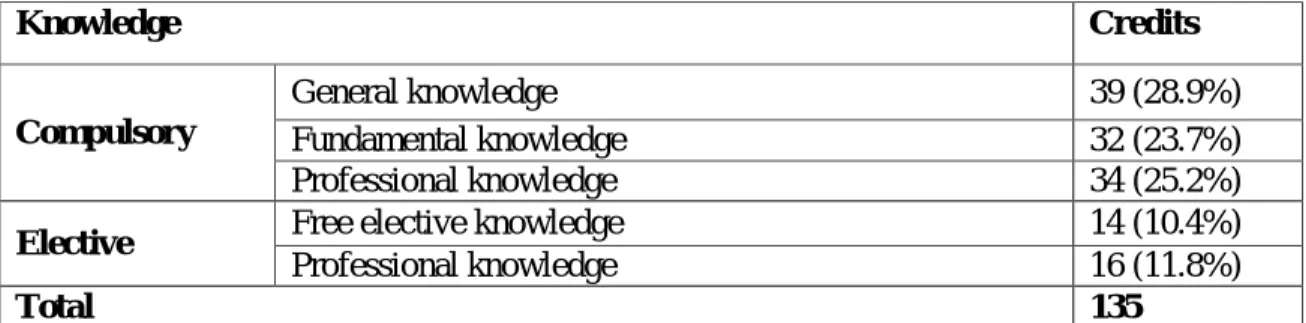
Table 7: Structure of Electrical Engineering Curriculum
Knowledge Credits
General knowledge 39 (28.9%)
Fundamental knowledge 32 (23.7%)
Compulsory
Professional knowledge 34 (25.2%)
Free elective knowledge 14 (10.4%)
Elective
Professional knowledge 16 (11.8%)
Total 135
Figure 4. Structure of knowledge in electrical engineering program (EEP)
General knowledge, 39 (28.9%) Fundamental knowledge, 32 (23.7%) Professional knowledge, 34 (25.2%) Free elective knowledge, 14 (10.4%) Professional knowledge, 16 (11.8%)
Table 8: Curriculum map of electrical engineering program
Introduced Reinforced Assessed (exit level) a). Apply knowledge of mathematics through
probability; differential & integral calculus; differential equations; linear algebra; complex variables; and science and engineering in the context of electrical engineering problems.
TN001, TN002, TN012, TN010 (lecture) CT138 (lecture) CN167, CN191, CN169, CT361 (lecture, practice) b). Design and conduct scientific and engineering
experiments, as well as to analyze and interpret data. CN169 CN171, CN267, CN178 (laboratory) CN285, CN286 (final project) c). Design systems in electrical area that meet
desired needs within realistic constraints such as economic, environmental, social, political, ethical, health and safety, manufacturability, and sustainability. CN264, CN265 CN279 (lecture, project) CN518, CN517 (project)
d). Function in multidisciplinary teams to solve effective electrical engineering problems.
CN139, TN014, TN016, CN151, CN192, CN176 (lecture, practice) CN518, CN517 (project), CN480, CT376 (lecture, practice) e). Identify, formulate, and solve current and
emerging electrical engineering problems, including the development of preliminary estimates and final plans, specifications, and designs; and the implementation and operation of systems components and processes that meet performance, cost, time, safety, and quality requirements.
CN177, CN284, CN280 (lecture) CN277, CN185 (lecture, project) CN285, CN286 (final project)
f). Understand professional and ethical responsibility.
CN177 (lecture)
CN503 (practice) g). Communicate effectively technical material
both orally and in writing.
CN801, CN802, CN803, or XH004, XH005, XH006 (lecture, practice) CN158, XH019 (lecture, practice)
h). Receive the broad education necessary to demonstrate an understanding of the impact of electrical engineering solutions in a global, economic, environmental, and societal context.
KT005, ML008, XH011 (lecture) CN276 (seminar),
i). Demonstrate a recognition of the need for, and engage in life-long learning.
CN120 (lecture, project) CN518, CN517 (project) j). Demonstrate knowledge of contemporary issues CN503 CN503
related to electrical engineering. (practice) (practice) k). Use modern engineering techniques, skills, and
computer-based tools for analysis and design
CN009 (lecture), CN010 (practice) CN271, CN133 (lecture, practice) CN283 (laboratory)
l). Have sense of well-being to build and protect Vietnamese Country
QP001 (lecture, practice) m). Know the way and the policy of the Communist
Party and Vietnamese State, fundamentals of Marxist and Leninist theory, and Ho Chi Minh ideology. ML009, ML010 (lecture) ML006, ML010, KL001 (lecture) Meaning of indicators
- Introduced: this subjects offers learning opportunities for this particular intended outcome at an introductory level. On completion, students should have the foundational knowledge/ skills / attributes to pursue this outcome further.
- Reinforced: this subject will build upon student’s existing knowledge/ skills / attributes in this particular intended outcome to provide learning opportunities through which students can reinforce and/ or further develop the knowledge/ skills / attributes described in the outcome statement.
- Assessed: the attainment of this outcome will be assessed in this subject
Contents in program structure have a good balance between general knowledge, basic knowledge and specialized knowledge. The Electrical Engineering Program was designed based on the curriculum of Ministry of Education and Training of Vietnam and based on the Credit-based system. In designed process of EEP there is reference to EEP of Technology University of Ho Chi Minh City (Exh.03.01, Exh.03.02). The Graduate needs to achieve complete blocks of knowledge and skills in which there are coherence number of credits or adequate courses. They will help students have enough firm foundation of depth and large knowledge (Exh.03.02). The curriculum is designed with three blocks of knowledge (135 credits in total):
i) Social and political knowledge and sciences (53 credits, with 14 optional ones), including foreign languages, general laws, national defense, philosophy, Marxist and Leninist theory, physical training, maths and physics.
ii) Basic knowledge (32 credits), including courses about electric circuits, digital circuits, fundamental electronics, electromagnetic field,…
iii) Specialized knowledge (50 credits, with 16 optional ones) including advanced knowledge about Power System, Industrial Power and Power Supply (Exh.01.03, Exh.01.04).
Besides, the department also has a curriculum map that facilitates students in building up the Full-Course Studying Plan and having a general view of the program (Exh.04.08).
From the labor market, their satisfaction and needs are changed, so a balance between general knowledge, basic knowledge and specialized knowledge should be updated accordingly (Exh.03.01).
3.2 The programme reflects the vision and mission of the university
ELOs are requirements that students clearly have to know, how to learn and how to achieve. Indeed, the ELOs achievement of graduates is the first step to achieve the aims and objectives of training activities. So it reflects the vision and mission of the university (Exh.03.03). The program plays an important role in
implementing the vision and mission of the university and training activities which are some of the main functions of CTU (Exh.03.03). The goals and objectives of the Electrical Engineering Program were set based on the vision and mission of the university to train and provide good engineers with a strong capacity in power and electric. The program not only provides learners with scientific theories, but also trains them professional skills in power and electric and project courses to satisfy needs of socio-economic development in Mekong Delta area (Exh.01.03, Exh.01.04). In socio-economic development, the mission and vision are updated, so the program contents also need to be improved adequately.
3.3. The contribution made by each course to achieving the ELOs is clear
The Program consists of courses/modules and the results of each course make the total successes of the program. It means that each Course ELO/course specification contributes to achieving the Program ELOs is clear (Exh.01.01). In CTU and CoET, Course Specification is designed like a module of Program Specification. Course ELOs are appropriately described and based on the Structure and Content of Program (Exh.01.03) and based on results of feedback from lecturers, students, graduates, alumni and labor market (Exh.01.07, Exh.01.08, and Exh.01.09).
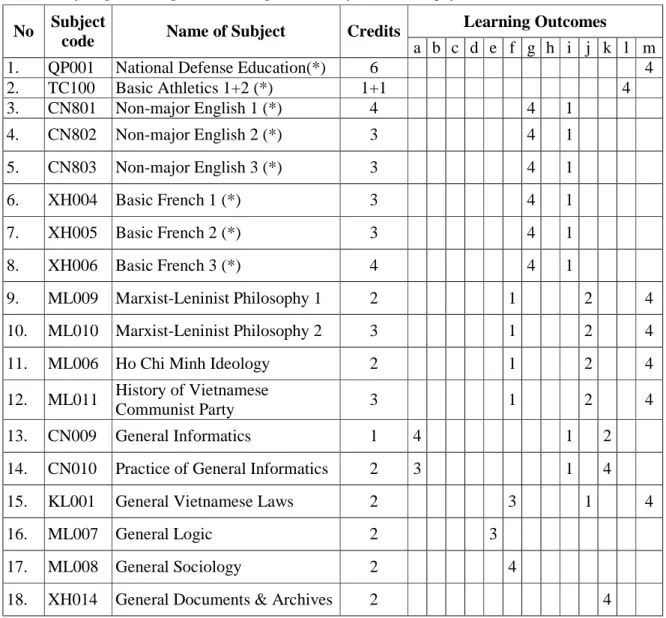
The stakeholders’ feedback via evaluation results of Course ELOs clearly contributes to the achievements of ELOs via following table:
Table 9: Relation between Course ELOs and Program ELOs via rates:
(4 = very big, 3 = big, 2 = average, 1 = very small, Empty cell = not relation)
Learning Outcomes No Subject
code Name of Subject Credits a b c d e f g h i j k l m 1. QP001 National Defense Education(*) 6 4 2. TC100 Basic Athletics 1+2 (*) 1+1 4 3. CN801 Non-major English 1 (*) 4 4 1 4. CN802 Non-major English 2 (*) 3 4 1 5. CN803 Non-major English 3 (*) 3 4 1 6. XH004 Basic French 1 (*) 3 4 1 7. XH005 Basic French 2 (*) 3 4 1 8. XH006 Basic French 3 (*) 4 4 1 9. ML009 Marxist-Leninist Philosophy 1 2 1 2 4 10. ML010 Marxist-Leninist Philosophy 2 3 1 2 4 11. ML006 Ho Chi Minh Ideology 2 1 2 4 12. ML011 History of Vietnamese
Communist Party 3 1 2 4
13. CN009 General Informatics 1 4 1 2 14. CN010 Practice of General Informatics 2 3 1 4 15. KL001 General Vietnamese Laws 2 3 1 4
16. ML007 General Logic 2 3
17. ML008 General Sociology 2 4
Learning Outcomes 19. XH011 Introduction to Vietnamese Culture 2 4 1 20. XH012 Vietnamese in Use 2 4 21. TN001 Calculus A1 3 4 22. TN002 Calculus A2 4 4
23. TN012 Linear Algebra & Geometry 4 4 24. TN010 Probability – Statistics A 3 4 25. TN014 General Physics –Mechanics &
Thermodynamics 2 4 3 26. TN016 Fundamental Photo-Electricity 2 4 27. CN151 Digital Circuits 2 4 3 28. CT138 Advanced Engineering Mathematics 2 4 29. CN415 Micro – Control 2 4 3 2 30. CN170 Electrical Material 2 4 31. CN171 Practice on Material of Electrical 1 4 3 32. CN192 Fundamental Electronics 2 4 33. CN176 Practice on fundamental Electronics 1 4 2 3 34. CN167 Electric Circuits 1 3 4 1 35. CN191 Electric Circuits 2 2 4 1 36. CN169 Practice on Electric Circuits 1 4 2 37. CT361 Electromagnetic Field 2 4 38. CN133
Descriptive Geometry and Technical Drawing in Electrical Engineering
3 3 4 39. CN130 Electrical Measurement 3 4 3 3
40. CN444 Power Electronics 2 4 2
41. CN178 Practice on Power Electronics
and Applications 1 4 2 3
42. CN139 Thermodynamics & Heat
Transfer 3 4 3 3
43. CN501 Electric machinery 1 3 4 4 2 1 44. CN502 Electric machinery 2 3 4 4 2 1 45. CN264 Power System Analysis 1 3 4 3 1 1 46. CN265 Power System Analysis 2 3 4 3 1 1
Learning Outcomes 47. CN267 Practice on Power System 1 4 2 1 48. CN177 Safety of Electrical Engineering 2 4 49. CN277 Power Generation Operation
and Control 2 4 3 1
50. CN517 Project in Electrical
Engineering 2 2 2 4 2
51. CN270 Practice on Electrical
Engineering Skills 3 2 4 3
52. CN518 Project in Power System 2 2 2 4 2 53. CN263 High Voltage Engineering 2 4 1 54. CN519 Electric Drives 2 3 4 1 1 3 55. CN268 Relay Protection And
Automation 3 4 3 1 3
56. CN274 Power Supply 2 4 3 2
57. CN503 Excursion on Electrical
Engineering 1 2 4
58. CN271 Applied informatics in electrical
engineering 2 3 4
59. CN272 Electric Devices 2 4
60. CN410 Control Engineering 2 4 3 3 61. CN279 Power System Design 2 2 4 2 2
62. CN275 Power Plant 2 4 2
63. CN273 Lighting Engineering 2 4 2 1 64. CN281 Design Electrical Devices 2 2 4 65. KT005 Principles of Enterprise
Management 2 3 2
66. CN283 CAD for Electrical Engineering 3 2 2 4
67. CN406 PLC 2 2 2 2 4
68. CN158 English in Electrical
Engineering 2 4 1
69. XH019 French for scientific &
technological Purposes 2 4 1 70. CN278 Refrigeration Electrical
Engineering 2 4 2 1
71. CT376 Industrial Electronics 3 3 4 2 2 72. CN480 Technologically Electricity 2 4 1 73. CN280 Power System Stability 2 4 2 1 2 74. CN185 Power System Planning 2 4 4 1 2
Learning Outcomes 75. CN284 Power System Reliability
Evaluation 2 4 2 3
76. CN120 Scientific Research Methods
and Report Writing 1 2 3
77. CN276 Seminar on Electrical
Engineering 2 4 2 2 1
78. CN285 Minor Graduation Thesis 4 4 2 2 1 79. CN286 Graduation Thesis 10 4 2 2 1
The Program periodically needs to use feedback results from stakeholders and to increase the quality of teaching and learning strategy and others to help student to achieve Course ELOs and Program ELOs (Exh.01.07, Exh.01.08, and Exh.01.09).
3.4 The programme is coherent and all subjects and courses have been integrated
Like 3.1. The programme content shows a good balance between generic and specialised skills and knowledge. Clearly, table 9 above also expresses that the programme is coherent and all subjects and courses have been integrated (Exh.01.03). Three skills and knowledge blocks are adequately designed in the structure and content of the program, so they demonstrate logical and integrated relations of the program and they supplement each other (Exh.01.03). The curriculum is based on the credit-based system, so learners can decide what specialized knowledge they want to learn. The courses are arranged in a logical series of knowledge and most specialized courses are tied with other prerequisite courses (Exh.01.05). MOET also provides an outline/diagram of courses (Exh.03.02) and they help students design a learning plan with a general view for the program in which there is information of the relation between 03 knowledge blocks. In Vietnam, the stakeholders’ comments and opinions ask to delete or to replace some courses, especially courses in part of basic knowledge, but it is very difficult to implement (Exh.01.07, Exh.01.08, and Exh.01.09). 3.5 The programme shows breadth and depth
The Three knowledge blocks of the Electrical Engineering program show breadth and depth. Breadth is covered on the social knowledge and skills, basic knowledge and specialized knowledge. In each block, there are different levels from basic levels to higher levels including both theory and practice (Exh.01.05). Because of the increasing needs of the labor market that require graduates have to use knowledge with breadth and depth to work for satisfactory in the labor market. Like different blocks, especially, the specialized knowledge is clearly divided into three specialized directions: Power System, Industrial Power and Power Supply and other different skills as: “in depth understanding of scientific principles, analysis and design skills to achieve success in the practice” (Exh.01.05, Exh.02.03). Furthermore, graduates have to receive and integrate sustainable knowledge and skills that is necessary for lifelong learning in postgraduate levels (Exh.03.04). Thanks to stakeholders’ feedback, in the future, the program quality will be enhanced both in breadth and depth.
3.6 The programme clearly shows the basic courses, intermediate courses, specialised courses and the final project, thesis or dissertation
The Program specification and program structure and contents clearly show useful information about the basic courses, intermediate courses, specialised courses and the final project, thesis or dissertation (Exh.01.05). It is easy for students to design and implement their learning plan to achieve learning results. The program also needs to
clearly identify all course levels and relevant subjects (Exh.01.03). To graduate, learners have to complete 135 credits in the curriculum, the structure and contents of program provide students with 03 knowledge blocks: general, basic and specialized knowledge. Especially, specialized knowledge divides into 03 parts with specialties: Power System, Industrial Power and Power Supply, then students can choose 02 directions with researching: students can decide to do the final dissertation or projects combined with some optional specialized courses that are equivalent to 10 credits (Exh.01.03). The curriculum has 30 optional credits, and students have to choose at least 20 credits. The curriculum is updated regularly to add more optional courses, depending on stakeholders needs, especially the labor market (Exh.01.07). This program has to be updated with new courses to satisfy with current social needs and be clearly added information about the basic courses, intermediate courses, specialised courses and the final project, thesis or dissertation.
3.7. The programme content is up-to-date
Goals of training activities are to reach stakeholder satisfaction, so the programme content has to be updated according to the changing needs of stakeholders
(Exh.01.03, Exh.01.07). Some of the contents of ELOs are to promote life-long learning, to cover different knowledge blocks and to reflect the requirements of the stakeholders. The Program structure and contents are periodically supplemented and improved. Program updates are based on the results of stakeholder feedback: lecturers, students, graduates (Exh.01.09) in meetings of Departments. Besides, electrical engineers of Departments provide stakeholder-labor market feedback to improve the program (Exh.01.08). The programme content is up-to-date is depended on different elements: MOET program framework, training process, regulation of credit-based system, teaching and learning strategies. Program improvement is to increase its quality via comments from companies (labor market) and this is apart of all QA process and is also referenced to different domestic and oversea Electrical Engineering Programs.
Since 2007 the program has been updated and changed into credit-based system (Exh.03.06) and in 2010 the program has been improved for a 2nd time. CTU and COET increased quality activities of regular surveys to evaluate course ELOs
(Exh.05.02).
a) Strengths
- The program provides sufficient specialized knowledge and basic skills for learners. The generic and basic knowledge is sufficient in order that students can study higher.
- The curriculum is structured to show range, depth, coherence and organization of the courses. The generic and basic knowledge is sufficient in order that students can study higher. b) Weaknesses
- The curriculum has not been examined and evaluated by labor market, alumni and specialists.
a) Actions
In 2012, the department and the college will have plans to:
- Implement surveys to get feedback about the program content and structure from external experts, employers and alumni.
- Adjust and edit the contents of practices/ practical classes in order that students can consolidate their knowledge and improve professional skills.
4. TEACHING AND LEARNING STRATEGY (TLS) (TLS)
CTU and COET use TLS. It enables students t o achieve and use knowledge. It helps students to have private directions for quality learning, it stimulates action learning and facility for learning basing on CTU’s, COET’s vision, Statute No 43/2007 of MOET, Academic Regulation of CTU, Training Plan, a student-centered approach to education, Handbook for lecturers and others.
4.1 The faculty or department has a clear teaching and learning strategy
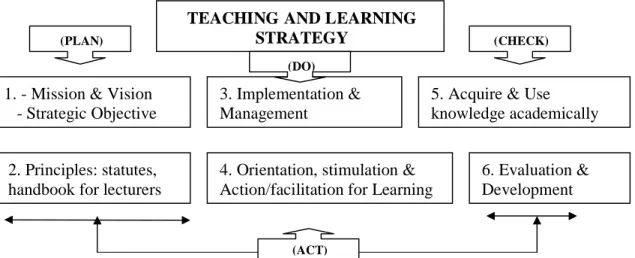
Basing on the mission, vision, statutes, regulations, educational plans and other things above CTU and CoET have designed appropriate teaching and learning strategies. Introduction: CTU’s Teaching and Learning Strategy for 2012-2017 supports the University’s mission, vision and educational objectives. Its aim is to ensure the high standards of teaching and learning approaches.
4.1.1. Introduction: CTU’s Teaching and Learning Strategy for 2012-2017 supports the University’s mission, vision and educational objectives. Its aim is to ensure the high standards of teaching and learning approaches.
4.1.2. Principles: a) CoET will adequately implement the mission, vision, educational objectives, educational plans and support services, b) will comply with Educational Law, Statutes, Regulations.
4.1.3. Implementation and management of educational process
4.1.4 Teaching objectives: lecturers deliver students a) orientation, b) stimulation, c) action learning, d) facilitation for learning.
4.1.5. Results of Teaching and Learning Strategy: Learners will acquire and use knowledge academically (Exh.06.06 & Exh.05.04).
4.1.6. Evaluation and development: CTU uses PDCA cycle to implement Teaching and Learning Strategy (Exh.06.06).
Besides, Specialized teaching staff have good professional knowledge, enthusiasm and most of them are skilled in computers and foreign languages. The Staff training plan in period 2008-2015 was publicized. Lecturers are well trained in both specialized knowledge and pedagogy and have abilities to manage the large numbers of students or group in some courses. (Exh.04.02).
TEACHING AND LEARNING STRATEGY
1. - Mission & Vision - Strategic Objective
3. Implementation & Management
2. Principles: statutes, handbook for lecturers
4. Orientation, stimulation & Action/facilitation for Learning learning
5. Acquire & Use knowledge academically 6. Evaluation & Development (DO) (PLAN) (CHECK) (ACT)
4.2. The teaching and learning strategy enables students t o acquire and to use knowledge academically
a) At the beginning of course the lecturer introduces learners to learning theory and practice from the teaching and learning strategy. Lecturers with up to date breadth and depth knowledge (Exh.04.07) uses adequate teaching methods according to student-centered approaches, the teaching methods through action, creating products can stimulate the learning spirit of students and help them master their knowledge better and different supports to help students to acquire knowledge academically. It will stimulate the learning spirit/keen sense of students and make a comfortable environment for learning.
(Exh.04.02 & Exh.04.03)
b) Organizing practice-training activities, students report and answer questions in groups, in the laboratory and outside, implementing active teaching methods depending on the requirements of each course and realistic conditions not only provide students with a positive learning spirit, but also many other necessary skills in use of knowledge academically. The above teaching methods aim to construct the activeness of the students’ learning process via a Full Course Studying Plan for Students (Exh.04.04, Exh.04.09 & Exh.04.10). In teaching plan, CTU and COET must consider regulations and conditions to implement the teaching and learning strategy, especially, to use and improve teaching methods better.
However, in class size, minimum number of students per lecture is 25; but in laboratory, the maximum number of students per group is 40 and the minimum is 20 students. CTU and COET will need to have an adequate plan to adjust the size of maximum number of students per lecture and laboratory. At the same time, lecturers themselves can divide class into 3 or 4 smaller groups/teams to take turns doing the same exercise (Exh.04.09, Exh.04.10 & Exh.04 Exh.04.13).
4.3. The teaching and learning strategy is student oriented and stimulated quality learning
a) Course ELOs and Program ELOs that student clearly needs to know, how to learn and to achieve. The teaching and learning strategy is still a tool in process of interaction between lecturers and students to achieve course ELOs. This process is student oriented quality learning. The teaching and learning strategy in which Course ELOs and Program ELOs, teaching and learning plan/methods and different support conditions are implemented. Flexibility of the credit-based training system encourages student independence and autonomy to choose courses or others for their quality learning plan and for right own direction/orientation (Exh.04.04). The assignment list of teachers, who are in charge of theory subjects, practical subjects or projects, was made publicly at the beginning of each semester (Exh.04.03); each subject has at least two university teachers in charge. The Department also made a detailed plan for the progress of doing dissertations and essays to help students take the initiative to implement their learning tasks (See Exh.01.03).
b) The teaching and learning strategy is described in the used principles: statutes, regulations, support services, consultant activities via seminars; meeting students in the beginning of every academic year to discuss the difficulties and learning experiences, innovative experiences; exchanging experience with prior students or the alumni and so on (Exh.04.11). Students can exchange experts easily with teachers directly or through the email system. The university and the college have enough computer rooms as well as wireless internet (Wi-Fi) to serve the learning, teaching and research needs of students and academic staff. CTU and COET have plans to exchange information and experience, consultancy and support in all aspects and self- studying process to enhance the soft skills of students. They stimulate qualitative learning of all students (Exh.04.06, Exh.07 & Exh.04.12).
4.4. The teaching and learning strategy stimulates action learning and facilitates learning to learn
adequate conditions for learning and ask to study how to learn through action, sothe teaching and learning strategy is support tool for these contents. Beside of CTU and COET regulations, good support conditions, teaching and learning plan and the adequate active, situation or student center teaching methods (the teaching method in which the teacher reads and the students write replaced by suggesting the main points for students to think and explore themselves) to stimulate action learning. In each semester and academic year, the Full Course Studying Plan of each student designed and sent to his/her academic advisors for approval (Exh.04.04). By doing so, students can be more active and flexible in scheduling and more conscious in their learning. Teaching methods including active teaching methods, teaching method through action and learning by doing to stimulate the learning spirit of students and the wide application of information technology and research activities of students and academic staff should be increased to help students to be conscious in changing learning ways from negative to active(Exh.08.04).
b) For adequate implement of credit-based system, learners have provided facilities for learning. Practical knowledge of students accumulated through site visits in organizations, companies outside the university (Exh.02.09, Exh.04.13). Students’ assessment is performed in each session with many various forms depending on each course. Kinds of assessment and course specification announced and informed widely and sufficiently by the teachers on the first class of the course. Students are clearly informed/introduced their needs to learn courses and curriculum: program structure and contents, teaching and learning plan/strategy, assessment methods, etc at the beginning of courses and in the process (Exh.04.03, Exh.01.03). Teaching strategies expressed through the program; students must learn the knowledge logically through prerequisite courses (Exh.01.03).
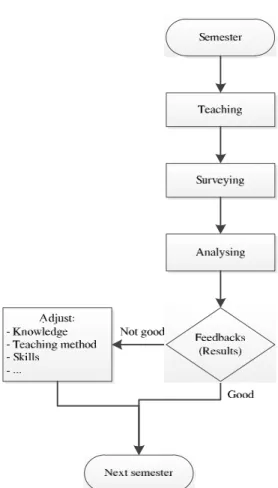
Figure 6: Feedback and information from students
After each semester, students give their feedback through the Course Evaluation Form related to teaching and learning strategies, knowledge, skills and qualifications obtained after completing the course, active teaching methods and their level of satisfaction about the course … QAT of CoET collects questionnaires and returns them to QATC; QATC processes data and provides results of statistics to use for course development and improvement. Results are sent back to CoET with statistics at faculty level. QAC also sends statistics at university level to the Rectorate Board of CTU. Each lecturer receives the results in a closed envelop with rates of each criteria for a course, and adjusts the teaching and learning activities of the course in next semesters basing on those helpful feedbacks of students.
The adjustments on the curriculum and the content of courses are based on feedback and information from students, such as adjusting the class size, improving the course registration process… The Department of Electrical Engineering collected feedbacks via different methods. CTU also considers the involvement of other stakeholders for course and curriculum development and improvement.
a) Strengths:
§ The strategy for teaching and learning is designed and implemented by a variety of methods § The wide application of information technology makes good conditions for both students
and lecturers in learning, teaching and researching. b) Weaknesses:
§ It is hard to apply new teaching methods in some course classes because of the large number of students in each class.
c) Actions:
§ In 2012 & 2013, the college will decrease the number of students in some course classes. 5. STUDENTS ASSESSMENT (SA)
CTU and COET comply with the Statute No 43/2007/MOET (Exh.08.04) and the Academic Regulation of CTU in students’ assessment (Exh.02.08). The student assessment includes entrance assessment, learning progress and exit test assessment (Exh.05.04).
5.1. Student assessment covers student entrance, student progress and exit tests 5.1.1. Student Entrance Assessment
CTU and COET recruit candidates via the annual National University Entrance Examination. Student entrance assessment complies with MOET’s recruitment Regulation (Exh.05.01). Recruiting good and adequate candidates into EEP is to express the recruitment with publicity and obviousness (Exh.05.04). From 3rd to 10th of July annually, candidates passed entrance assessment to Regular students including:
a) Candidates (passed the examination in Post Second School) apply into CTU with adequate documents like necessary procedures (Exh.05.02).
b) Candidates passed National University Entrance Examination with 03 subjects: Maths, Physics and Chemistry (Exh.05.03).
c) The total marks of candidates are:
- Equal or higher at basement marks level under MOET Regulation
- Equal or higher at standard marks level under CTU and COET Regulation (Exh.05.01).
For candidates, this is a very heavy/difficult examination because it wastes very big human and financial resources, so MOET should have some other directions for assessment of student entrance in the future.
5.1.2 Student Progress Assessment
CTU and COET have a good Progress Assessment System including activities to help students clearly know information about “Who they are?”, “Where they are?”, “How/What they have to do?” or “Where they go?”. It is necessary to implement Progress Assessment to control, to adjust and to improve student’s quality learning (Exh.05.04).ELOs, program structure and contents; teaching and learning strategy provide students with the best direction to get good results/success before graduation (Exh.05.04). 5.1.2.1. For courses, Students’ Progress Assessment consists of:
a) Lecturers inform and introduce needs, contents, time, ways and methods of assessment strategy, applicable criteria of evaluation at the beginning of every course
(Exh.04.04). Having a short assessment in first class helps lecturers to understand student’s background in class. For English, from the school year of 2011-2012 ahead, new students enrollment in CTU have to pass a TOEIC examination held by IIG (International Investment
Group) to be classified into different levels in order to be taught non-major languages at different levels. In the year of 2012-2013, CTU has just organized itself an examination for that purpose (Exh.05.05, Exh.05.06). Under CTU’s Academic Regulation, Statute No 43/2007/QĐ-BGDĐT (MOET), 15/08/2007,Article 19:
b) Course Assessment: Mid-term assessment includes oral, exercises, multiple choice tests, practice in pair or in group, writing, homework, practice in the laboratory report and total marks are under 50%. Depending on the purpose and requirements of each course, learning object, lecturers have appropriate forms of assessment and ensure compliance with the principles of objectivity and accuracy (Exh.04.04).
c) Final test with knowledge covers all courses and total marks are > 50%
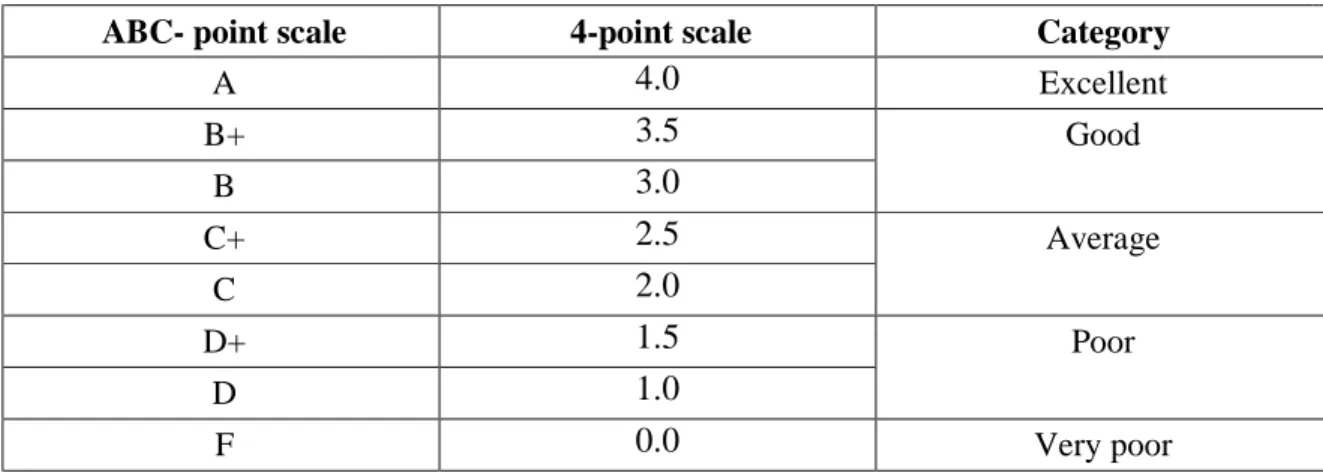
(Exh.04.04). According to university procedures, after publishing the results, teachers directly answer questions and complaints about the test results of students (Exh05.04). Lecturers input the learning results Student learning results, which are ranked on an alphabetic scale (A, B +, B, C +, C, D +, D, F) (Exh.05.08), are input to management system and submit to college and university (Exh05.07).
Table 10. Relationship of cardinal mark:
ABC- point scale 4-point scale Category
A 4.0 Excellent B+ 3.5 B 3.0 Good C+ 2.5 C 2.0 Average D+ 1.5 D 1.0 Poor F 0.0 Very poor
d) Average Mark of Semester, Average Mark of Year, Accumulated Average Mark (see Item 23 in the Academic Regulations)
- Accumulated courses: courses finished with D mark or above. Courses finished with “F” will be not accumulated.
- Accumulated credits are the number of credits of accumulated courses.
- Average Mark of Semester: is the average mark of courses in a semester (including courses obtaining “F” mark and conditional courses) whose weight is the total credits of those courses. AMS is the basis of studying results evaluation, scholarship approval, reward, academic warning after each semester. AMS is calculated as the following formula:
In which: Xi : is the mark of course i; ai : is the number of credits of course i;
n: is the number of courses registered in a semester
- Average Mark of Year: is the average mark of courses in a 02 main semesters of an academic year (including courses obtaining “F” mark and conditional courses)