THE CORRELATION BETWEEN STUDENTS’ READING HABIT AND THEIR WRITING ABILITY
THESIS
Submitted by NURUL KHALISA
Student of Faculty of Education and Teacher Training Department of English Language Education
Reg. No: 140203104
FACULTY OF EDUCATION AND TEACHER TRAINING AR-RANIRY STATE ISLAMIC UNIVERSITY
DARUSSALAM - BANDA ACEH 2018 M/1440 H
i
ACKNOWLEDGEMENT
In the name of Allah, the beneficent and the merciful, all praises are to Allah. He is the creator of everything in this university who has given me health and strength to finish this study. Peace and salutation to our prophet Muhammad saw who brought us from the darkness to the lightness where the world is full of Islamic knowledge.
In completing this thesis, I faced many obstacles. Therefore, I sincerely thank Dr. Syarwan, M.Lis and Dr. Jarjani, S.Ag, S.S, M. Sc, M.S, Ph.D as the supervisors who have helped me going through all tough situations in writing this thesis. I also thank them for their guidance, advice, motivation, and many more in completing this thesis.
I also express my gratitude to my beloved mother Nurfadhilah, and father Tarmizi for their countless supports, love and prayer for me. I would not be able to finish this study without them.
Additionally, my sincere thank goes to my three sisters Husnil Khatimah, Hadil Umami and Alfiani, my brother Helmi Yudi Habibi, and my three adorable nieces Cut Ravania Batrisya, Cut Syatara Thafana and Cut Zahwa Almeira who always support and pray for me in many ways.
In addition, my special thank goes to my best friends who has supported me endlessly to finish this study; TEN Loyal squads, Jobers, EDSA’s member, KPM
ii
Barieh team, Bimbel Khalifah team, Orion and Mujahidah mates. I would not be able to go through all these situations without them. Furthermore, I sincerely thank all my classmates for their support during my whole year in PBI who were always being there with me in completing this study.
I realize that this thesis is very far from perfection. Therefore, constructive criticisms and suggestions are expected for the sake of future improvement.
Banda Aceh, December 3, 2018
iii
LIST OF CONTENTS
ACKNOWLEDGEMENT ... .. i
LIST OF CONTENTS ... iii
LIST OF TABLES ... iv LIST OF APPENDICES ... v DECLARATION LETTER ... vi ABSTRACT ... vii CHAPTER I: INTRODUCTION A. Background of study ... 1 B. Research question ... 3 C. Aims of study ... 4 D. Significance of study ... 4
E. The key terms ... 5
CHAPTER II: LITERATURE REVIEW A. General concept of reading habit ... 7
B. General concept of writing ability ... 14
C. General concept of descriptive text ... 18
D. The correlation between reading habit and writing ability ... 20
E. Previous Studies ... 21
CHAPTER III: RESEARCH METHODOLOGY A. The study ... 23
B. Research designs ... 24
C. Population and sample ... 26
E. Data collection ... 27
C. Data analysis ... 29
CHAPTER IV: DATA ANALYSIS A. Research findings. ... 31
B. Discussion ...43
CHAPTER V: CONCLUSIONS AND SUGGESTIONS A. Conclusions ... 46
B. Suggestions ... 47
REFERENCES ... 48 APPENDICES
iv
LIST OF TABLES
Table 2.1 . The general purpose of descriptive text……… 18
Table 3.1 The total students of SMAN 4 Kota Banda Aceh……… 24
Table 3.2 Indicator score of reading habits……….. 28
Table 3.3 Classification of students’ reading habit……….. 28
Table 3.4 Rubric of scoring writing test………... 29
Table 3.5 Correlation coefficient table ……… 30
Table 4.1 The finding of reading habit questionnaire……….. 31
Table 4.2 Means of students reading habit questionnaire……… 34
Table 4.3 Students’ responses to English reading habit based on means………… 34
Table 4.4 Students’ writing test score……….. 36
v
LIST OF APPENDICES Appendix I : Rubric of scoring writing test
Appendix II : Means of students reading habit questionnaire Appendix III : Reading habit questionnaire and writing test Appendix IV : Students’ responses to questionnaire
Appendix V : Students writing test Appendix VI : SK bimbingan
Appendix VII : Surat pengumpulan data penelitian Appendix VIII : The pictures of research
vii ABSTRACT
The present study was carried out to explore the students’ English reading habit and to examine whether there is a correlation between students’ reading habit and their writing ability. The research was conducted to second year students at SMAN 4 Kota Banda Aceh. 40 students out of 271 were randomly taken as the sample of this study. The quantitative research was used to collect the data by using questionnaires and test in order to find out students’ English reading habit and their writing ability respectively. Twenty (20) items of questionnaire and writing test were given to the participant at SMAN 4 Kota Banda Aceh. The data were analysed by using Likert scale and the correlation coefficient by Pearson. The result of questionnaires show that students have a high reading habit. The majority of them enjoyed reading English very much using online sources; however only few agree to spent 15-30 minutes each day to read English although they spend their time periodically to read English every week. In addition, most of them also affirmed that reading English is purposed to improve their writing skill as they think that reading English is supported their intentions. This fact is highly correlated to the result of correlation coefficient which shows that the correlation between students’ reading habit and their writing ability is 0.899 (high correlation). Therefore, it can be concluded that the students have high reading habit even though only few agree to spent 15-30 minutes of their time to read English each day while they know that reading highly impacts their writing ability. Hence, it implies that students should provide more time to read voluntarily because it gives significant effect to their writing ability.
1 CHAPTER I INTRODUCTION A. Background of study
Maintaining English writing is equally crucial to the other skills, this is so because writing is one of the complex kinds of communication and it is produced in written forms. Moreover, writing skill is also one of the highest levels of communication skills because only people who truly have great attention to the knowledge progress that can understand the nature of writing. Besides, writing is not only the process of arranging the alphabets into words or sentences, but it also about expressing people’s idea in the written text (Mahyar, 2012).
There have been many attempts to improve students’ writing ability, such as by having a reading habit. The relationship between students’ reading habit and students’ writing ability are very close. According to Ferris and Hedgcock (as cited in
Ilham) reading is the basis of writing because the data gained through reading contains print-encoded messages and pieces of information about how the pragmatic, and rhetorical constitutes combine to make the message important (2012).
Many studies have been carried out on the effect of reading habit on students’
writing ability. Krashen (2014) states that writing style does not originate from actual writing experience, but rather from reading. Many researchers concurred that the individuals who read more, create the more elevated amount of proficiency. It is also believed that extensive reading leads to greater writing proficiency, by reading much,
the students will get numerous vocabularies. Clearly, the good acquisition of vocabularies will ease and help them in writing skills. Parry states, “to establish a firm foundation for the vocabulary building to be done in academic courses, we should encourage our students to read as much as they can before they leave the classes” (1991).
In addition, individuals who want to write, should have the capacity to read and comprehend one’s reading material. Reading helps them to have a better writing style, progressed grammatical competence and great spelling. Eckhoff (cited in Ilham) reported that reading activity influences children’s written work,
demonstrating that youngsters mirror the type of composing that they are exposed after they read (2012).
There are also several studies related to this research. The first one is the study conducted by Maula. The research discusses the correlation between students’
reading habit and their ability to write narrative text. The study was conducted for the grade 11 of SMAN 1 Kajen Pekalongan in the Academic Year of 2014/2015. Based on the result of her research, it shows that there is a significant positive correlation between student’ reading habit and their ability to write narrative text on grade 11 of
SMAN 1 Kajen Pekalongan Academic Year of 2014/2015. The study concluded that the students’ reading habits are strongly correlated with the students’ writing ability
Another research presented by Nanik Rahmawati discusses a correlative study between the students’ reading interest and their writing ability of the third semester of
international class program students of IAIN Salatiga in the academic year of 2015/2016. She found that there was a positive and significant correlation between reading interest and writing ability. It can be described at the level of significance at 1% (0.01), which is 0.708. It was proven by calculation which is higher than the r-table because r-calculation is 0.855 while r-r-table is 0.708. Consequently, the research shows that students’ reading interest and their writing ability are highly correlated
(2015).
Even though many studies have been carried out on the influence of reading habit on students’ writing ability, little is known about the impacts of students’
reading habit and their ability of writing of second year students of SMAN 4 Kota Banda Aceh. The study intends to fill in the gap by investigating the correlation between students’ reading habit and their writing ability.
B. Research questions
The following research questions were investigated for this research:
1. How is the English reading habit of second year students of SMAN 4 Kota Banda Aceh?
C. The aims of study
The purposes of this research are:
1. To investigate the English reading habit of second year students of SMAN 4 Kota Banda Aceh.
2. To find out whether there is any correlation between students reading habit and their ability of writing.
D. Significance of study
This study is significant because:
1. For Teachers
It can be beneficial for English teachers to know students’ reading habit in English, it leads the teacher to find out students’ need in learning. Moreover, this
research will draw a wider understanding to the teacher that students are needed to be motivated to read more, one of the ways is by providing enough time and several kinds of book to read.
In addition, the result also helps the teachers to develop a lesson plan in writing class based on their reading habit because the reading habit is significantly influenced students’ writing ability.
2. For students
It develops students’ awareness of their own reading habit and the importance of reading habit toward their writing. Having known the importance of it, the students are expected to have a better motivation to increase their habit in reading English texts/books.
E. The key terms
To avoid misunderstanding, there are some terms which need further detail to be explained. The terms are Reading Habit and Writing Ability.
a. Reading Habit
Habit is a repeated action. According to Sangkeo (1991) reading habit refers to behavior which expresses the likeness of reading and tastes of reading. It is a way of how the reader organizes her or his reading, how often, how much and what the readers read. In addition, according to Zwiers (2014) reading habit more clearly describes the automatic and unconscious processes that are involved in constructing meaning from text. Then, reading habit refers to the automatic process as the readers read the textual material and deriving meaning unconsciously. In accordance to the discussion above, the reading habit meant by the writer is the automatic process as the readers read the English text.
b. Writing Ability
Writing is a way to produce language and communicate with others on the written way. According to Boardman (2002) writing is a continuous process of thinking and organizing, rethinking and reorganizing. It can be concluded that writing is a way to produce language that comes from thought on the written way. However, unlike speaking, writing needs a continuous process of editing and reorganizing. The ability of writing means the skill of formulating, organizing, and finding the right word to present a written text. From the discussion, it can be concluded that the writing ability meant by the writer is the students’ ability in writing an English text. Furthermore, in this research, the writer measured student’ ability in writing
7 CHAPTER II LITERATURE REVIEW
This chapter reviewed the important theory on the correlation between students’ reading habit and writing ability which covers the general concept of
reading habit, the writing ability and descriptive text. Furthermore, it explains the correlation between reading habit and writing ability and the previous studies done on the correlation between those two variables.
A. General Concept of Reading Habit 1. Definition of Reading
Reading is the process of understanding written text. It is an activity which involves perception and thought. According to Linse (2006) reading is a set of skills that include making sense and getting significance meaning from printed work. Patel and Jain (2008) also state that reading is purposed to comprehend the significance of printed words into writing symbols. It is an active process which consist of word acknowledgement and comprehension skill. Pang, et.al (2003) add that the word acknowledgement is the way toward seeing how written symbols correspond to one’s spoken language while comprehension is way to understand
words, sentences and associated content. In addition, Manzo (1995) states that the act of reading ought to be made in two parts: the process and the product. The process indicates as a function or operations that someone’s encounter in obtaining meaning
whereas the product specifies as the concreate insight and information obtained as a result of reading.
Moreover Collins (1979) states that reading is an essential and important aptitude educated in school. It is highly valued by students and teachers since it is a complex activity of problem solving in which the reader attempts to understand a content not simply from the words and sentences on the page yet additionally from thoughts, memories and knowledge evoked by those words and sentences (Schoenbach, 2012). Collins (1979) also adds that reading is a mental process. Despite the fact that the eyes are associated with sending the data about printed word into the mind, mind plays out the genuine activity of reading. Therefore, it can be deduced that reading is a mental process which includes determining importance and sending data about printed word to the mind till being the genuine activity of reading.
2. Definition of Reading Habit
According to Wahyudi (2016) habit is a mental process of a means of thinking. Andrew (cited in Wahyudi) states that from psychology’s point of view, habit is a more concreate way of thinking, willing or feeling acquired through a continue action of a mental practices (2016). Thus, reading habit describes the way of thinking, willing or feeling acquired through automatic and unconscious processes that involved in constructing meaning from text (Zwiers, 2004). Reading habit refers to the behaviour, which expresses the likeness of reading and tastes of reading, it is meant that reading habit is also associated with someone’s behaviour that expressed
their willing in reading (Sangkeo, 1999). Reading habit is also defined as the manner in which an individual arranges his understanding (Davidovitch, 2016). Acquisition of reading habits is a continuous process of learning letters, words, sentences, passages, and complete texts (Parlette, 2010). Scientists note that for reading to become a habit, reading must be encouraged. In practice, reading accompanies a child throughout her life, with the understanding that reading is a means for personal growth, it shapes the imagination, and plays a critical role that allows the individual to control language and play a role in society (Knoester, 2010). The researchers have discovered that reading habits are correlated with gender, age, educational background, academic performance and professional growth (Muniandy, 2013). Reading is one of the most effective ways to become good readers and good spellers, have a sufficient vocabulary and advanced grammatical competence, and build up a decent writing style as well. Reading habit accompanies individuals as they progress in age and influence their academic circumstance (Owusu-Acheaw, 2014).
3. The Advantages of Reading Habit
Reading is one of the most fundamental skills that someone needs to learn to have a success life. Wulandari (2016) states that there are many advantages that students can get, these are:
a. Helps the mind performs effectively
Having a good reading habit helps the mind activate the neuron and make the mind do its job. The more someone read, the more it sharps their mind because reading habit can make their mind performs continuously. People with a good reading habit would be able to perform effectively in front of public.
b. Develop a good vocabulary
A frequent reader would have a range of words bank, the more someone read, the more they get many vocabularies that can build up their understanding in recognizing mistake, significance meaning and would be better to catch the message that the writer trying to convey in a reading passage.
c. Boost intellectual curiosity
As a saying says that “Reading is the window to the world”, so that, someone with regular reading will see the book as a source of knowledge, it is exposes them to read many types of the books and understand the complexity of different books. In addition, Frequent readers will boost their understanding about the various forms of literacy skills.
d. Habit of reading means psychological activity
As a mental activity, reading habit makes the reader’s mind feels the writers’
e. Helps readers to have positive mind
Reader with a good reading habit should give a regular feedback to the material they have read, it insists them to have an active, positive and critical mind set. They should summarize and make a judgement from the material.
4. Factors Influencing Reading Habit
The recent research shows that reading habit has gain much attention to the educators, parents and other stake holders. It is widely known that a good reading habit can help students in many aspects of academic life, it is one of the most effective ways to have better writing style, vocabulary improvement, advanced grammatical competence and good spelling. There are some other factors which influenced one’s reading habit; age, gender and educational background (Ross 2002).
As reviewed by Ross (2002) “heavy readers” are more likely to be female than male, younger than older and the one who has achieved a higher education than society at large. Moreover, Dalila (2018) states that there are factors influencing reading habit, the factors are:
a. Peer influence
A study of young people in Britain aged between 11 to 18 years found that peer influence was the top most reason for reading book. It is widely known that peer can be something very important on someone’s habit, many people intends to have
b. Personal interest
Personal interest is also believed to have an important role in obtaining the reading habit. A research found that the most important factor motivating students’ reading habit is students’ personal interest. In this case, the research shows that the students’ personal interest is highly correlated with gender, age, educational
background, academic performance and professional growth.
c. The library’s condition
Another factor influencing students’ reading habit is library’s condition, the National Library and Documentation Service (NLDB) in Sri Langka carried out a research and found that the reading habit of students is poor because the condition of library was insufficient as the book collections were old and most of students read light material, such as magazine, novels, comic and newspaper.
d. Library’s reading resource
A reading resource also influences students’ reading habit. A reading habit will increase if the resource in the library appropriate to students’ reading preference. A survey in Britain investigated that students had very diverse reading sources. A survey conducted in Denmark on student between nine-twelve years found that over a month, the students read a total of 159 fictions and non-fictions written by more than 700 authors. Among Singaporian students, adventure and mystery stories were the most popular. In Australia, student like reading action adventure, science fiction and
fantasy. In Britain, fantasy fiction was at the top followed by humour, horror and thriller book.
5. The Indicators of Reading Habit
According to Cesar, Gaona & Gonzalez (2010) there are six indicators of reading habit:
a. Reading frequency; the individual reports of books read in someone’s leisure time. It is an activity where somebody read for few minutes or hours.
b. Books read; the individual report of the sum of books having read by someone in the last three months.
c. Time spent on academic reading; the time spent by someone to read their academic book, it is identified with the subject of their study.
d. Time spent on non-academic reading; the time spent by someone to read the book that are not specifically associated with the subject of their study.
e. Motivation in the family environment; it is correlated to someone’s will to buy books, recommended books and reading interest in the family.
f. Motivation in the academic environment; it is correlated to the teachers’ command to read books.
B. General Concept of Writing Ability 1. Definition of writing
Writing skill is considered as more complicated than any other language skills because writing needs a well-structured way to present the thoughts in an organized and planned way (Braine & Yorozu, 1998). Moreover, while composing a writing, students not only focus on writing style but also on the content, organization, vocabulary, grammar, and language use at the same time. Mahyar (2012) states that writing is a process of acquiring idea and composing something into written form. It is meant that writing not only the process writing symbols but also pouring the thoughts into written form. Hyland (2003) mentions that writing is a way to develop individual perspective on a topic where someone is pouring their point of view toward a content or a topic in a written form. It is supposed to produce language and communicate with other on a written way and to express their opinions, thoughts, feeling then organize them in a written form. The purpose of writing is to give some information to other people by writing it down.
2. Definition of writing ability
Writing is considered as one of four skills in English language in addition to listening, speaking and reading. Writing is considered as one of complex kind of communication, besides it is produced in written forms, the writing skill is one of the most difficult skill and the highest level of communication skill. In this
case writing ability is defined as a specific skill which helps writers put their thoughts into word in a meaningful form to mentally interact with the message (Mahyar, 2012). Thus, it can be assumed that writing ability is the skill of putting together what they think or what they want to say using words, which is who read is able to know their thoughts, ideas, feeling and what they want to convey with grammatical rules, punctuation, composition and methods.
3. The characteristics of writing
Rahmawati (2015) as cited in Langan states that there are four characteristics of writing. They are unity, support, coherences, and sentence skills. The detail explanation of the characteristics are as follows:
a. Unity
The word “unity” is synonymous with “oneness”. The sentences in a passage
should focus on one aspect expressed in the topic sentence.
b. Support
The sentences that the writer write should be equipped with supporting details that support the previous sentences.
c. Coherences
Coherence is one of the most crucial roles in paragraph making. The related paragraph should support the connected idea related to the previous sentences.
d. Sentence skills
It is the skill where someone constructing a paragraph in their own way. It can be supported by students’ skill in determining the exact vocabulary for the passage.
4. The steps in writing
According to Maula (2015), in composing writing text, the writer generally follows a series of steps, the steps are:
a. Exploring Ideas
Writing first involves discovering ideas. Writers should consider the subject, the purpose, and the audience targeted. As in speaking, writers must have something to say, a reason for saying it, and someone to say it to.
b. Prewriting
The second step of the writing process involves writing the writers’ thoughts
on a paper or a computer. The writers may use some methods such as brainstorming, clustering, or free writing.
c. Organizing
After putting the ideas into words, writers can begin to organize them. They need to think again about their purpose and audience. The process of organizing involves selecting the best idea or part from the prewriting process, subtracting the
parts of the prewriting that are not related to writers’ choice, adding some other
information, and arrange them in a certain outline.
d. Writing a First Draft
In this step, writers start to develop their outline into paragraph. Writers may add new ideas by putting them in a note.
e. Revising the Draft
Revising is the most important steps of writing, especially for people who write in second or foreign language. Writers read the first draft, add ideas, remove ideas that do not fit, rearrange sections, say sentences differently and make a clean copy of the draft in this step.
f. Producing the Final Copy
This step includes editing and proofreading. Editing means that writers check carefully the grammar, word choice, verb forms, punctuation, and the spelling then correct them if there is an error made. Proofreading means carefully examining the final copy again and check the corrections the writers made.
The six writing steps need to be applied not only by book writer or experts but also by students as language learners in order to get better writing product.
C. General Concept of Descriptive Text 1. Definition of descriptive text
According Artono (cited in Prasetyo) “Description is the part of the paragraph that describe the character”. In other word, we can say that descriptive text is a text
which describes how something, someone, or a certain place is like (2016, p.15).
Descriptive writing is focused on one subject and uses specific detail to describe something that students are focused. It creates a vivid picture of an idea, place or person. For example, if the students are asked to write about their parents, their writing will not only tell the name of their parents and how they look like, but also describe their characteristic and what experience that they ever had (Prasetyo, 2016).
2. General purpose of descriptive text
Barbara (cited in Prasetyo, 2016, p.16), make a table that explains purpose for description text. The purpose as follow:
Table. 2.1 The general purpose of descriptive text
Purpose Description
To entertain An amusing description of a teenager’s bedroom
To express feeling A description of your favourite outdoor retreat so your reader understand why you enjoy it so much
of poverty you grew up in To inform (for a reader
unfamiliar with the subject)
A description of a newborn calf for a reader who has never seen one
To inform (to create a fresh appreciation for the familiar)
A description of an apple to help the reader rediscover the joys of this simple fruit
To persuade (to convince the reader that some music video degrades woman)
A description of a degrading music video
3. The generic structures of descriptive text
Like other genres of text, descriptive text also has its structure. The structures of descriptive text are:
1. Identification/ general statement
Is aimed at introducing and identifying specific participant such as a person, a thing, a place, an animal, and or an event.
2. Description
Is structured to describe that participant from its characteristics, appearances, personality, and habits or qualities (Noprianto, 2017).
D. The correlation between reading habit and writing ability
Reading habit is one of the most important aspects in people’s life. Reading is needed to master many things in life. Reading is “the window to the world”,
particularly when learning a foreign language. It means that reading a book gives people a broader perspective of the world than they otherwise have. Reading is a source to get information, which can be found in English book, magazine, newspaper, internet, technology and many other sources. None can get a lot of information without reading. By reading, the students can improve their vocabulary and understand some other aspects of language (Liunokas (2016). Reading itself has many advantages, such as Reading can improve writing ability, it is because writing and reading have a close correlation in learning. People start to learn through both of them. People can write easily and fluently because they read before they write. Moreover, we know that in the process of writing, we cannot ignore the contribution of reading activity. We know that reading is one of activities that can train us to be good and critical thinkers. Brookfield & Stephen (1987) states that critical thinking is generally conceptualized as an intellectual ability suitable for development by those involved in higher education. Reading is an integral part of the process. During reading, the reader transacts with the text to construct meaning, makes predictions and struggles to understand the text (Rosenblatt, 1988). The knowledge gained from the reading process is language knowledge. With a complex reading activity,
someone can gain the understanding of how ideas transferred into written form in an exact way using the correct grammar (Mahyar, 2012).
E. Previous study
The relevant information in this literature review is presented to support the present study, In the end of the section, the writer hopes that the reader has a better understanding on the basic concept of this study entitled “The correlation between students’ reading habit and their writing ability of the eleventh’s grade students of
SMAN 4 Kota Banda Aceh. In accordance to this review, the reader is presented some information about the importance of this research to be done.
The investigation of English reading habit of EFL students in Indonesia has long been investigated, in accordance to the research of Erna Iftanti (2012) entitled “A survey of the English reading habit of EFL students in Indonesia” concluded that
although the students have read English since elementary school, they do not indicate to have a good English reading habit. However, the research found that several students have a good English reading habits proposed by their eagerness to spend time reading various types of English text regularly and their motivation to read English without any enforcement.
Futhermore, the writing ability can also develop a poor reading habit. The study of Eziaku K Ukoha (2015) entitled “Impact of writing on improving the reading competence of Nigerian adolescents” showed that writing, aptitude, sex and age had
positive effects on reading. Since reading is a learnt behaviour, adolescents can improve their reading ability through practice in writing because reading is progressed in the same direction as aptitude and writing.
The following research by Ulfah Sartika Mahyar (2012) entitled “The influence of reading habit on students’ writing skill at the first grade of SMPN 1 Pedes Kerawang” concluded that the alternative hypothesis was accepted because the
tobs is higher that Ttable (2,57 > 2,02) which mean that the influence of reading habit on
students’ writing skill at the first grade of SMPN 1 Pedes Kerawang is more active.
In addition, the study of Nanik Rahmawati (2015) with the title of “A correlative study of students’ reading interest toward their writing ability of the third
semester of International class program students of IAIN Salatiga in the academic year of 2015/2016” concluded that the score of reading interest of the respondents
was good result because the average of their score for reading interest was 66 from the scale 1-100. 70% of students were highly interested in reading and the rest 30% were interested enough in reading. the score of writing ability of respondents showed a positive result. It was proven by the result of the writing test. The highest score was 87 and the lowest score was 53 from total score of 100. 20% of the students were categorized as excellent in writing ability and the rest of two were categorized as 40% good and 40% fair in writing ability. Thus, it can be concluded that the correlation between reading interest and writing ability was very significant.
23 CHAPTER III
RESEARCH METHODOLOGY
This chapter discusses the research methodology procedures which include a brief description of the study, research design, population and sample, techniques of data collection, research procedure and techniques of data analysis.
A. The study
SMAN 4 Kota Banda Aceh is located in JL. Panglima Nyak Makam, No.19, Kec. Kuta Alam, Gampong Kota Baru, Kota Banda Aceh. It was built in 1974. This school is led by Mr. Bakhtiar, S.Pd and has 65 teachers that consist of 59 civil servants and 6 temporary employees. 6 of them are English teachers, and they are graduated from different universities such as UIN Ar-raniry, Syiah Kuala University and many more. SMAN 4 Kota Banda Aceh also has 10 staffs; they are, staffs of administration officers and librarians.
In supporting English teaching learning activity, SMAN 4 Kota Banda Aceh used curriculum 2013 revision. The curriculum provided two different kinds of teaching learning classes. The classes named “wajib” and “bakat minat”. The “wajib” class provided 2 hours English learning while “bakat minat” provided 3 hours English
learning. In whole, students are provided 5 hours lesson for English learning.
Aside from the curriculum, SMAN 4 Kota Banda Aceh has 779 total students in academic year 2018/2019. It can be seen clearly in the following table:
Table. 3.1 The total students of SMAN 4 Kota Banda Aceh
No Class The Amount of students Total
Science Program Social Program
1 2 3 4 5 1 2 3 1. Class X 32 33 30 32 31 33 31 30 252 2. Class XI 34 34 34 35 35 33 34 32 271 3. Class XII 33 31 32 33 32 31 32 32 256 TOTAL 779 B. Research design
The research design is a quantitative and it used correlational method in which the variables correlated to each other. A quantitative design is more appropriate for this study compared to a qualitative design because the purpose of the study is to verify and measure the existence of relationships between variables, which qualitative studies do not indicate (Cozby & Bates, 2004). Quantitative is a process of getting knowledge by using a number of data as instruments to explain the subject (Margono, 2004).
A correlation research is a detection of the correlation between one variable and other variables based on the available correlation coefficient (Suryabrata, 2009). Fenton and Nail (2012) state that are three types of correlation, they are; linear
positive correlation, linear negative correlation, and no linear correlation. The type of correlation is decided by +1 to -1. If the correlation coefficient is closer to +1, the correlation is linear positive which means if one variable is high, another variable remains high, and if one variable is low, another variable remains low. In other word, if the correlation coefficient is closer to -1, the correlation is linear negative which means if one variable is high, another variable is low, and if one variable is low, another variable is high. If the correlation coefficient is 0, it means there is no linear correlation between variables. In this research, the first variable is reading habits (x), then the second variable is writing ability (y).
In accordance to the research, Product-Moment Method or also known as Pearson’s Product moment is generally used to measure the correlation between two variables. This method can measure the correlation from students’ score. This method
is representing as r. In this study, the researcher decides to use the Product-Moment Method in order to measure the correlation between reading habit and writing ability (rho) (Singh, 2006).
C. Population and sample 1. Population
The population of this study is the students of SMAN 4 Kota Banda Aceh. Population is the overall research subject (Arikunto, 2010). The population is focused on the second year students of SMAN 4 Kota Banda Aceh. The total number of the second year students of SMAN 4 Kota Banda Aceh is 271 students.
The researcher believed that the second year students of SMAN 4 Kota Banda Aceh are appropriate for the research because these students already learnt about descriptive text in the previous semester. Therefore, these students are eligible to be tested, especially the ability of writing descriptive text.
2. Sample
Sample is a representative part of the total population. According to Arikunto (2006) if the total number of populations is less than 100, it is better to take all numbers of population to be the sample and called total sampling, on the contrary, if the number of subjects more than 100, the sample could be taken for about 10-25% or more. Furthermore, in this study the researcher took sample about 15% from the population. Thus, only 40 students were chosen to be the sample of this research. In addition, the writer used random sampling technique in selecting the sample. According to Sugiyono (2013) it is called random sampling technique because it is
done randomly without categorizing anything in the population which means every member of population has equal opportunity to be the participant of the research.
D. Data collection
In conducting the research, the researcher needed various kinds of data and information to support the research. To obtain the data, the researcher uses two techniques:
1. Questionnaire
In this research, the questionnaire was handed out to measure the reading habits of second year students of SMAN 4 Kota Banda Aceh. The total questions of the questionnaire are 20 questions. Several items of the questionnaire in this instrument were adapted from some reliable sources. In addition, in selecting the items of questionnaire, the researcher had consulted the supervisors and the English teacher.
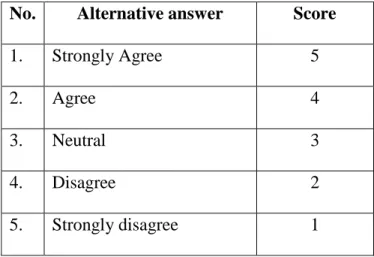
In this study, the questions were translated into Bahasa in order to ease the respondents in answering the questions. The questionnaire used in this study is closed questionnaire. The questionnaire in this research was designed based on Likert scale model. Arikunto (2010) stated that “likert scale is a statement which followed by table which show the scale, for example begin from strongly agrees to strongly disagree”. The indicator scoring on a Likert scale questionnaire items are as follows:
Table. 3.2 Indicator score of reading habits
In addition, to measure the students’ reading habit, the researcher categorized the classification of students’ reading habit and presented the means of reading habit
questionnaire to see the ranking of their responses. The classification can be seen as follows:
Table 3.3 Classification of students’ reading habit
Source: Rasyid, D (2012)
No. Alternative answer Score 1. Strongly Agree 5
2. Agree 4
3. Neutral 3
4. Disagree 2
5. Strongly disagree 1
No. Category Score
1. Very High 80-100
2. High 60-79
3. Middle 40-59
4. Low 20-39
2. Test
According to Dalila (2017) test is needed to describe students’ performance
and reveals their achievement in the target content they have learnt. In this research, the test was used as the second instrument, it was given to measure the students’
ability in writing. The students were given a task to write their own paragraph based on the topic given. In this research, the students were asked to write a descriptive text about An Admiring Figure.
The test item was analyzed and validated by the supervisors before it was implemented as the instrument to examine the students’ writing ability. To examine the students’ writing ability, the researcher used following indicators (See appendix
3.4).
F. Data analysis
The data were rearranged by separating reading habit score and writing ability. Reading habit is called variable X and writing ability is variable Y. The students reading habit was measured using Likert scale and the correlation between those two variables were analyzed statistically by using Pearson’s correlation formula, which is:
r
xy:
𝐍 (∑𝐗𝐘)−(∑𝐗)(∑𝐘)
in which:
rxy: Correlation coefficient variable X and Y
X: Reading habits score Y: Writing ability score N: Number of samples
The Pearsons’ correlation formula was used when the writer intended to
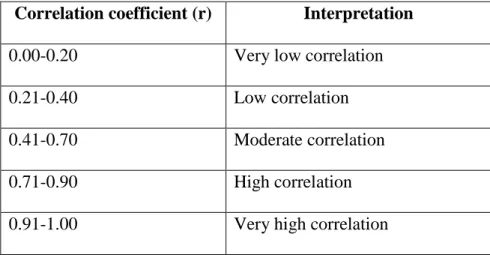
measure the correlation with raw data from test. The range of correlation in this formula is 1.00 until 0.00 in which 1.00 stands for a very strong correlation between both variables, and 0.00 stands for a very week or no correlation at all. To provide the better explanation, the correlation coefficient table can be seen as follow:
Table 3.5 Correlation coefficient table
Correlation coefficient (r) Interpretation 0.00-0.20 Very low correlation 0.21-0.40 Low correlation 0.41-0.70 Moderate correlation 0.71-0.90 High correlation 0.91-1.00 Very high correlation Source: Muawanah, S. (2014).
31 CHAPTER IV DATA ANALYSIS
This chapter analyzed the data as can be seen in section A. Discussion of the research is presented in section B.
A. Research findings
The following are the research findings and discussion of questionnaires’ score and writing ability’s score that have been analysed.
1. The finding of the questionnaires
The finding of the questionnaires showed that the scores of students were slightly different. The scores of 20 statements were calculated for each participants.. The finding of questionnaire are as follows:
Table 4.1 The finding of reading habit questionnaire
No Students Name Class Reading habit scores (X) 1. DAN XI-IA4 90 2. RRD XI-IA3 89 3. CSR XI-IS2 87 4. HN XI-IA4 86 5. DZ XI-IA1 85 6. VCK XI-IS1 85 7. AKI XI-IA1 84 8. DS XI-IA3 83 9. MT XI-IS2 83 10. AM XI-IA2 80 11. SZ XI-IS1 79
12. WMU XI-IA5 78 13. FKH XI-IA4 77 14. MAR XI-IA4 76 15. CPS XI-IS1 76 16. SF XI-IA3 74 17. PR XI-IA2 73 18. CRI XI-IA5 73 19. TZG XI-IS3 71 20. CFA XI-IA1 70 21. FM XI-IA5 70 22. NF XI-IA2 69 23. SNM XI-IS3 69 24. AKP XI-IA3 67 25. WLD XI-IA5 67 26. NR XI-IA5 66 27. JFIP XI-IS1 65 28. DS XI-IS3 64 29. NM XI-IS3 62 30. NH XI-IA1 57 31. ZB XI-IS2 57 32. JF XI-IA1 55 33. MUA XI-IA2 55 34. BAF XI-IA3 55 35. SN XI-IS3 54 36. WS XI-IS1 50 37. MF XI-IS2 49 38. MDR XI-IA4 46 39. ZR XI-IS2 46 40. EA XI-IA2 40
Table 4.1 shows that the students score is ranged from 40-90. Based on the previous discussion, it can be concluded that 9 students have very high reading habit, 20 students have high reading habit, 10 students have middle reading habit, 1 student has low reading habit and none has very low reading habit. The average result of students reading habit is 69 which classified as high. Therefore, it can be concluded that students has high reading habit,especially English reading habit. Furthermore, to know the means of each questions to students responses in questionnaire, see the (Appendix 4.2) for a better explanation.
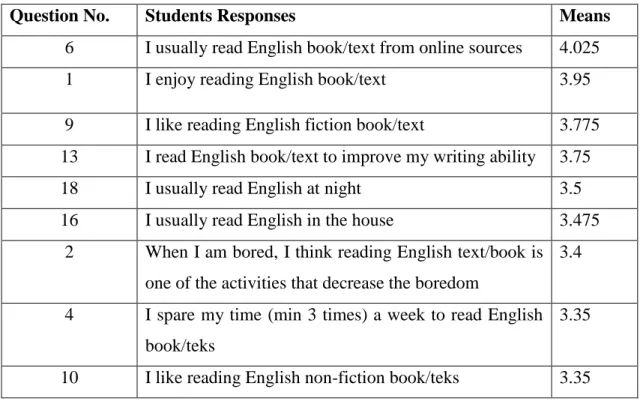
In addition, to see the ranks of their responses to the English reading habit, the means to the questionnaires result are presented in the table below:
Table 4. 3 Students’ responses to English reading habit based on means
Question No. Students Responses Means
6 I usually read English book/text from online sources 4.025 1 I enjoy reading English book/text 3.95
9 I like reading English fiction book/text 3.775 13 I read English book/text to improve my writing ability 3.75 18 I usually read English at night 3.5 16 I usually read English in the house 3.475
2 When I am bored, I think reading English text/book is one of the activities that decrease the boredom
3.4
4 I spare my time (min 3 times) a week to read English book/teks
3.35
11 I already read 2 English book/teks so far 3.35 14 I read English book/text to spend my free time 3.35 15 I usually read English book/text in the school 3.325
5 I spend (min 15-30) minutes to read English book/text each day
3.275
12 I read English text/book because it’s my hobby 3.15 3 I think, reading English text/book more fun than
playing
3.05
7 I usually buy English book/text 3 17 I usually read English book/text at day 2.975
8 I usually borrow English book/text 2.925 20 I have no motivation t read English book/text because
it difficult to understand
2.075
19 I feel pressured everytime reading English book/text 1.925
Table 4. 3 shows the average (means) of students’ responses to English reading habit. Most of the means fall in between 3 (neutral), which indicates that they are either agree or disagree to the question, meaning that they give a midpoints reaction to the question, it is confirming that they have neither positive response nor negative response to the question. 1 fall into 4 (agree) as referred to question number 6, which mean that most of students agree to using online resources as one of the ways to obtain English texts/books, also 1 question fall in between 2 (disagree) as referred to question number 20 which mean that the students do not think English text/book is difficult to understand. Next, there is also 1 question fall in between 1
(strongly disagree) as in number 19 indicates that they enjoy reading English text/book because they do not feel pressured when reading it.
2. The finding of test
The finding of writing test shows that the writing test score of 40 students were ranged from 42-93. The average score was 72. The researcher used mean formula to calculate the students’ average score. The table below presented a better calculation to the findings.
Table 4.4 Students’ writing test score
No Students Name Class Writing Ability Scores (Y) 1. CSR XI-IS2 93 2. DZ XI-IA1 91 3. MT XI-IS2 91 4. VCK XI-IS1 90 5. MAR XI-IA4 88 6. AKI XI-IA1 87 7. DAN XI-IA4 87 8. RRD XI-IA3 85 9. FKH XI-IA4 84 10. WMU XI-IA5 84 11. HN XI-IA4 83 12. SZ XI-IS1 82 13. PR XI-IA2 81 14. DS XI-IA3 80 15. AM XI-IA2 79 16. NR XI-IA5 76 17. CRI XI-IA5 76 18. CPS XI-IS1 76
19. CFA XI-IA1 74 20. NF XI-IA2 73 21. SF XI-IA3 71 22. AKP XI-IA3 71 23. TZG XI-IS3 71 24. FM XI-IA5 70 25. DS XI-IS3 70 26. ZB XI-IS2 69 27. MUA XI-IA2 68 28. WS XI-IS1 68 29. NH XI-IA1 67 30. WLD XI-IA5 67 31. NM XI-IS3 67 32. JFIP XI-IS1 64 33. BAF XI-IA3 59 34. SNM XI-IS3 58 35. JF XI-IA1 48 36. EA XI-IA2 47 37. SN XI-IS3 47 38. MDR XI-IA4 46 39. ZR XI-IS2 42 40. MF XI-IS2 42
3. The correlation between students’ reading habit and their writing ability To make it easy to interpret the finding between students’ reading habit and
their writing ability, there are some steps that should be made:
a. The computation of students’ reading habit and writing ability scores
The computation of students’ reading habit and writing test scores can be seen
Table 4.5 The students’ reading habit and writing ability scores NO NAME CLASS READING HABIT SCORES (X) WRITING ABILITY SCORES (Y) X2 Y2 XY 1. AKI XI-IA1 84 87 7056 7569 7308 2. DZ XI-IA1 85 91 7225 8281 7735 3. CFA XI-IA1 70 74 4900 5476 5180 4. NH XI-IA1 57 67 3249 4489 3819 5. JF XI-IA1 55 48 3025 2304 2640 6. AM XI-IA2 80 79 6400 6241 6320 7. EA XI-IA2 40 47 1600 2209 1880 8. MUA XI-IA2 55 68 3025 4624 3740 9. NF XI-IA2 69 73 4761 5329 5037 10. PR XI-IA2 73 81 5329 6561 5913 11. BAF XI-IA3 55 59 3025 3481 3245 12. DS XI-IA3 83 80 6889 6400 6640 13. SF XI-IA3 74 71 5476 5041 5254 14. AKP XI-IA3 67 71 4489 5041 4757 15. RRD XI-IA3 89 85 7921 7225 7565 16. MDR XI-IA4 46 46 2116 2116 2116 17. HN XI-IA4 86 83 7396 6889 7138 18. MAR XI-IA4 76 88 5776 7744 6688 19. FKH XI-IA4 77 84 5929 7056 6468 20. DAN XI-IA4 90 87 8100 7569 7830 21. WLD XI-IA5 67 67 4489 4489 4489 22. FM XI-IA5 70 70 4900 4900 4900 23. NR XI-IA5 66 76 4356 5776 5016 24. CRI XI-IA5 73 76 5329 5776 5548 25. WMU XI-IA5 78 84 6084 7056 6552 26. VCK XI-IS1 85 90 7225 8100 7650 27. SZ XI-IS1 79 82 6241 6724 6478 28. CPS XI-IS1 76 76 5776 5776 5776 29. WS XI-IS1 50 68 2500 4624 3400 30. JFIP XI-IS1 65 64 4225 4096 4160 31. CSR X I-IS2 87 93 7569 8649 8091 32. ZR XI-IS2 46 42 2116 1764 1932
33. ZB XI-IS2 57 69 3249 4761 3933 34. MF XI-IS2 49 42 2401 1764 2058 35. MT XI-IS2 83 91 6889 8281 7553 36. NM XI-IS3 62 67 3844 4489 4154 37. SN XI-IS3 54 47 2916 2209 2538 38. SNM XI-IS3 69 58 4761 3364 4002 39. DS XI-IS3 64 70 4096 4900 4480 40. TZG XI-IS3 71 71 5041 5041 5041 Total 2762 2872 197694 214184 205024
The definition of variables from table above: X: The score of students’ reading habit Y: The score of students’ writing ability
X2: The score of students’ reading habit squared Y2: The score of students’ writing ability squared
XY: The score of students’ reading habit and students’ writing ability
The students reading habit is as independent variable (X), shows that the highest score of the students’ reading habit is 90 and the lowest score is 40. The total of students’ reading habit score is 2762.
The students’ writing ability is as dependent variable (Y). The highest score of students’ writing ability is 93 and the lowest score of students’ writing ability is 42. The table above shows that the total score of students’ writing ability is 2872.
b. Computing the relationship between students’ reading habit and their writing ability
In this step, the researcher calculated the correlation coefficient (r) by applying formula:
rxy
: N (∑XY)−(∑X)(∑Y)√[𝑁 ∑ 𝑋2−(∑ 𝑋)2] [𝑁 ∑ 𝑌2 − (∑𝑌)2 ]
Which:
rxy: Correlation coefficient variable X and Y
X: Reading habits score Y: Writing ability score N: Number of samples
rxy
: N (∑XY)−(∑X)(∑Y) √[𝑁 ∑ 𝑋2−(∑ 𝑋)2] [𝑁 ∑ 𝑌2 − (∑𝑌)2 ]r
xy : (40)(205024)−(2762)(2872) √[(40)(197694)−7628644][(40)(214184)−8248384]r
xy : 8200960−7932464 √[7907760−7628644][8567360−8248384]r
xy : 268496 √[279116][318976]r
xy : 268496 √89031305216r
xy: 0.899From the calculation above, it shows that the correlation between students’ reading habit and their writing ability (r) is 0.899. In order to know to what extend both variables correlate each other, the standard of correlation coefficient proposed by Muawanah (2014) as mentioned in the previous chapter are referred.
The previous discussion shows that the interpretation of calculation result is 0.899 which indicate that there is a high correlation between students’ reading habit and their writing ability. It means that the students’ reading habit has a high correlation with their writing ability.
3. Computing the coefficient determinant
In order to know how much the percentage of students reading habit (variable X) influenced their writing ability (variable Y), it is better to calculate it through determination coefficient (R) formula. Determination coefficient shows to what does the variable X effect value of variable Y. The formula of determination coefficient is stated below: R= r2 x 100% In which: R: Determination coefficient r2: Correlation coefficient R= r2 x 100%
R= (0.899)2 x 100%
R= 0.808201 x 100%
R= 80.82%
The result of R value is 80.82%. It indicates that the effect of students’ reading habit (variable x) toward students’ writing ability (variable y) is 80.82%.
Meanwhile, another 19.18% may be affected by other factors.
B. Discussion
Having faced the results of the questionnaires and writing test, a discussion is presented in order to answer the research questions as stated in chapter 1.
1. The first research question is "How is the reading habit of the second year students of SMAN 4 Kota Banda Aceh?”. From the classification, it is presented that students have high English reading habit. The statement is drawn from the calculation of students average score for each participant. The average score is 69 which classified as high. Therefore, it can be concluded that the students have high English reading habit.
In detail, the result shows that the second year students of SMAN 4 Kota Banda Aceh enjoy reading English texts/books from online sources. The majority students also spent 3 times per week and 15-30 minutes each day to read English. Most of them also confirmed that reading English is purposed to enhance
their skill in writing. This is likely influenced by their believed that reading much developed their comprehension in writing. They also tend to read English in their home rather than in their school, they prefer to read at night to day and most of them also would prefer to read English from the online sources rather than buying or borrowing from the other people. Besides, majority of students enjoy reading fiction text/book in their spare time. Although it is indisputable that most of them also read non-fiction book in their daily activity especially when they were at school.
The result of the first aims of study is relevant to the research of Erna Iftanti (2012) which also investigated the English reading habit of EFL students in Indonesia. The study showed that a good reading habit supported by their motivation in reading English and their eagerness to spend time in reading various types of English text regularly.
2. The second research question is “Is there any correlation between students’ reading habit and their writing ability?”. In this research, the measurement of Correlation Coefficient Formula by Pearson showed that students’ reading habit has a very high correlation to students’ writing ability. It is concluded from the
calculation result of Correlation Coefficient Formula. The result is 0.899 which indicates a high correlation. In other word, it can be concluded that there is a high correlation between students’ reading habit and their writing ability.
Moreover, it is strengthened by the result of R value which is 80.82%. It can be assumed that the effect is 80.82% toward students’ writing ability. Meanwhile another 19.18% may be impacted by other factors. Those factors can be aptitude, gender, age or many others.
The result of this study is relevant to the findings of Zahra Kartal (2017) which showed that there is a significant relationship between students’ reading
habit and their writing ability. It was proven by the score of Tobs which is higher
than Ttable. Therefore, it can be concluded that the more students read the better
writing skill they have.
However, the findings of Agus Wahyudi (2016) contradicts the result of this study. It showed that that the t-obtained was 0.309. Accordingly, it can be concluded that there was no significant correlation between the two variables since the t-obtained was higher than 0.05. Furthermore, he stated that the condition might be influenced from some factors, they are; 1) the misperception of a good reading habit and 2) students preferred to read for pleasure while the tests were taken for academic purposed.
44 CHAPTER V
CONCLUSIONS AND SUGGESTIONS
This chapter deals with the conclusion and suggestions which present to the English teachers, the students and future researchers.
A. Conclusions
Several conslusion can be made from the research. They are; first, the students has a high English reading habit, it is indicated from the average score of the calculation result from each participant which fall in between 69 (high). The result is likely influenced by their enjoyment in reading English. The students tend to enjoy reading English very much, and they use online sources as one of the way to access the English book/texts. However, although most of them enjoyed reading English, only few agree to spend 15-30 minutes to read English each day. This is also likely impacted by their preference to playing than reading. Second, most of students agree that their intention to read English is to enhance their writing skill. The finding is highly correlated to the result of the correlation coefficient which calculated the correlation between students reading habit and their writing ability. The result of correlation coefficient is 0.899 which is specified as high correlation. Therefore, it can be concluded that there is high correlation between students’ reading habit and
B. Suggestions
Having made the conclusion above, some suggestions are presented in this study. First, the teachers should be able to create a fun learning activities. Based on what have been observed, the second year students of SMAN 4 Kota Banda Aceh has a good writing ability. However, they tent to be lazy following all the teaching learning activities because they find it boring. Therefore, it is suggested that the teacher should be able to create an enjoyable learning actvities with appropriate methods and increase their motivation to participate all teaching learning processes voluntarily. Beside that, teachers are also suggested to provide enough time to read different kinds of English text or book. It is purposed to decrease the students’
boredom in teaching learning process . After that, the students themselves also should be aware that writing is not an easy subject, that is why they need an exact method to develop their writing ability. One of them is by having a good reading habit. Therefore, it is suggested that the students should develop their interest in reading and gladly spend more time to read because it is necessary to enhance their writing ability. Yet, this study does not cover all aspects of the research. It is suggested that the future researcher not only investigate the same area of the research but also involve another area that might have a correlation to each other. Additionally, it is expected that further researcher with similar research should be done in a greater population in order to cover all aspects of information. Hence, it is expected to have a wider generalization and greater population.
46
REFERENCES
Arikunto, S. (2006). Prosedur penelitian, suatu pendekatan praktik. Jakarta: Rineka Cipta.
Annamalai, S., & Muniandy, B. (2013). Reading habit and attitude among Malaysian Polytechnic Students. International Online Journal of Education Sciences. 5(1), 32-41.
Boardman, C. A. (2002). Writing to communicate: Paragraph and essay. Newyork: Longman.
Braine, G., & Yorozu, M. (1998). Local area network (LAN) computers in ESL and ELF writing classes: Promises and realities. JALT Journal, 20(2).
Brookfield, D. S. (1987). Developing critical thinker. San Francisco: Jossey-Bass Publishers.
Brown, H. D. (2004). Language assessment: Principles and classroom practices. San Francisco State University: Longman.
Collins, C. (1979). There effect of writing experience in the expressive mod upon the self-esteem, attitudes and academic achievement of freshmen in a college reading course. Dissertation, Rutgers University, USA.
Cozby, P., & Bates. S. (2004). Methods in behavioral research (11th). California: The California State University.
Dalila, B. (2017). The correlation between recreational reading habit and reading achievement. Bachelor’s thesis. UIN Ar-Raniry, Banda Aceh.
Davidovitch, N., Yavich, R., & Druckman, E. (2016). Don’t throw out the paper and pens yet: On the reading habits of students. Journal of International Education Research-Fourth quarter, 12 (4).
Fenton, N., & Neil, M. (2012). Risk assessment and decision analysis with Bayesian networks. Boca Raton, Florida: CRC Press.
Gaona, J., & Gonzalez, E. (2010). Relationship between reading habits, university library and academic performance in a sample of psychology students. Revista De Le Educacion Superior. 157(1), 55-73.
Hyland, K. (2003). Second language writing. New York: Cambridge University Press.
Iftanti, E. (2012). A survey of the English reading habit of EFL students in Indonesia, TEFLIN Journal. 23(2).
Ilham, I. (2012). The correlation between students’ English reading habit and their essay writing. Bachelor’s skripsi, UIN Ar-Raniry, Banda Aceh.
Kartal, Z. (2017). The relationship between students’ reading habit and their narrative ability. Bachelor’s skripsi. UIN Syarif Hidayatullah, Tangerang. Knoester, M. (2010). Independent reading and the social turn: How adolescent
reading habit and motivation relate to cultivating social relationships. Networks, 12(1).
Krashen, S. D. (2014). The power of reading: Insight from the research. Portsmouth: Heineman.
Linse, C. T. (2006). Practical English language teaching: Young learner. Singapore: McGraw Hill.
Liunokas, Y. (2016). The contribution of reading activities toward the students writing performance. Ethical Lingua, 3(2).
Mahyar, U. S. (2012). The Influence of reading habit on students’ writing skill. Bachelor’s skripsi, STIKIP Siliwangi, Bandung.
Manzo, U. C., & Anthony, V. (1995). Teaching children to be literate: A reflective approach. New York: Holt Rinehart and Winston Publishers.
Margono. (2004). Metode penelitian Pendidikan. Jakarta: Rineka Cipta.
Maula, I. (2015). The correlation between students’ reading habit and their ability of writing narrative text. Bachelor’s skripsi, University of Semarang, Semarang. Muawanah, S. (2014). The relationship between students’ reading habit and their
reading comprehension. Bachelor’s skripsi, UIN Syarif Hidayatullah, Jakarta. Noprianto, E. (2017). Student’s descriptive text writing in SFL perspective. Journal of English Language Teaching and Applied Linguistics, 2(1)